Cooler Backpacks for Outdoor Adventures
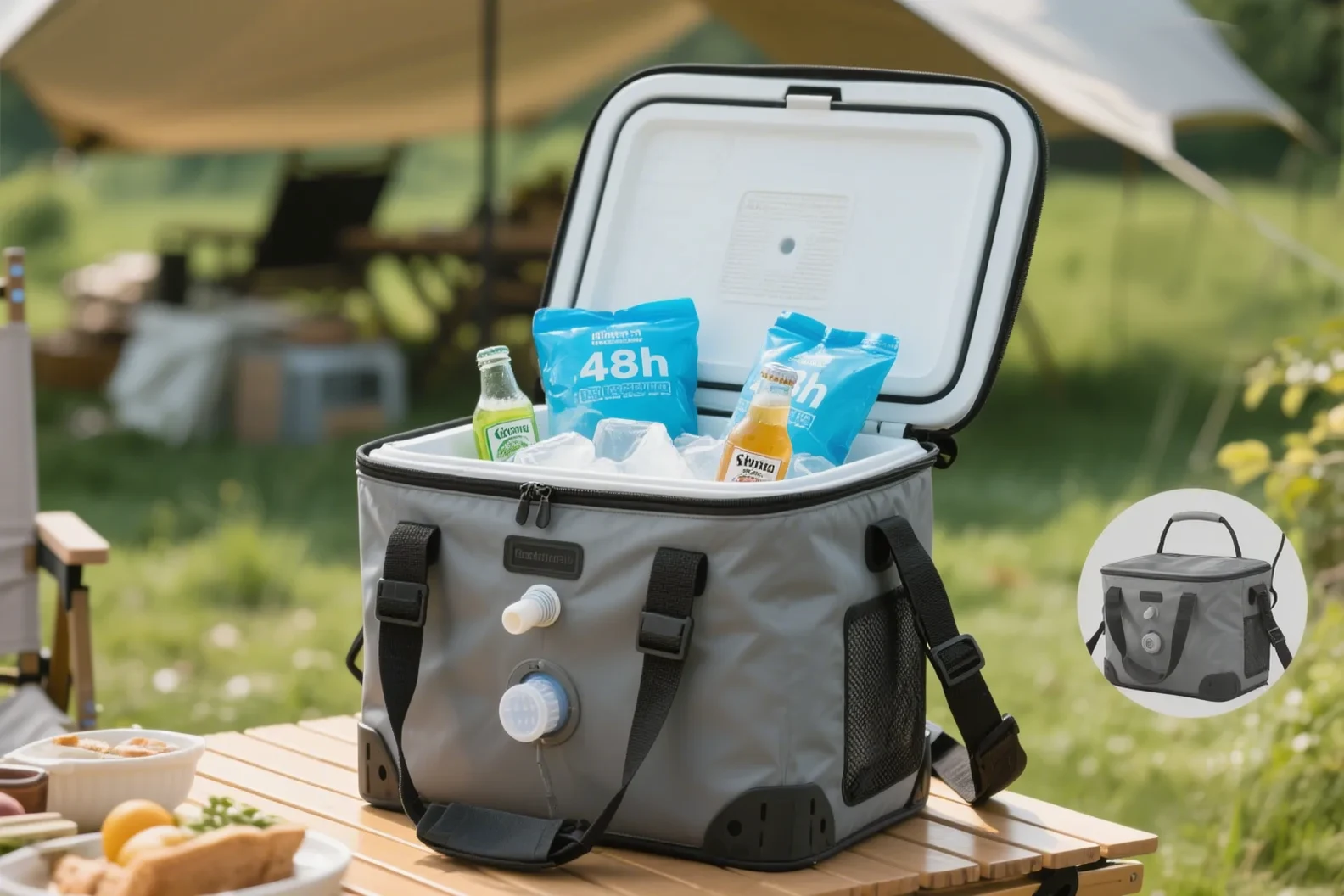
A cooler backpack keeps contents cold for 12–24 hours using 5–10 mm closed-cell foam insulation behind a welded TPU or PEVA liner — the same RF-welded seams that make it waterproof make it leakproof when tipped. Capacity runs 12–30 cans (15–25 L), with 500D exteriors for trail use and 840D for commercial rental fleets. This guide covers insulation thickness versus ice retention, welded versus stitched liners, harness comfort under 10–15 kg loads, and the OEM specification points for brands building cooler lines at MOQ 500.
Adventure-grade cooler backpacks for hiking, camping and fishing need 28–36 hour ice retention, welded food-grade liners, load-rated straps for 12–15 kg, and abrasion-resistant TPU shells. For outdoor brand buyers, the best OEM partner combines BSCI-audited production, SGS food-contact reports and a 500-piece MOQ.
Hiking: Ice-to-Weight Balance
On a day hike, a cooler backpack is a hydration-and-snacks carry, not a full picnic. Aim for 10–15 L capacity weighing under 8 kg loaded. Over-packing ice adds weight faster than it adds retention—a 12-can EPE cooler with a 2:1 ice ratio is the sweet spot for 8-hour hikes. Independent third-party verification follows published references: FDA food-contact materials guidance (FDA); EFSA food-contact materials (EFSA); SGS independent testing (SGS). For a deeper dive, explore our related guides on Thermal Insulation Materials for Waterproof Cooler Bags, Waterproof Fishing Cooler Bags: OEM Guide 2026, Waterproof Cooler Bag Manufacturer: OEM Guide.
Hikers also need external lash points for trekking poles, a bungee pocket for a jacket, and a hip-belt pocket for a phone. These features justify a 15–20% price premium at retail over a beach cooler.
- 10–15 L capacity, under 8 kg loaded
- External lash points + bungee
- Hip-belt phone pocket
Camping: Multi-Day Ice Strategy
For car-camping over a weekend, a 24–30 can PU cooler (30–36 h retention) handles Saturday lunch through Sunday breakfast. Split contents into two bags: one for ready-to-eat food (opened often), one for meat and frozen items (opened rarely). This halves ice melt.
Campers also want a bottle opener integrated, a bottle holster on the side, and a mud-feet base so the bag sits stable on uneven ground. Webbing MOLLE on the side allows attachment of lanterns and tool rolls.
- 24–30 can PU cooler
- Split: ready-to-eat vs frozen
- Mud-feet base + bottle opener
Fishing: Saltwater and Punishment

Fishing coolers face salt spray, fish blood, hooks and deck grit. The shell must be UV-stabilized TPU or PVC (840D minimum), with welded external pockets that drain. Zippers should be sealed against sand; YKK AquaGuard is the baseline.
Anglers also want a built-in fish-ruler printed on the lid, a platter board attached to the lid, and a separate dry pouch for phone, wallet and license. These are signature SKU features for fishing brands.
- UV-stabilized TPU/PVC shell
- Sealed YKK AquaGuard zips
- Fish ruler + platter board
Beach: Sand and Sun
Beach coolers see sand, saltwater and 6+ hours of direct sun. The shell must be UV-resistant; black shells absorb heat and accelerate ice melt. Lighter colors (sand, grey, teal) run 3–5°C cooler internally. Sand pockets should drain through grommets, not zippers.
Beach buyers want a side bottle opener, a towel loop, and a waterproof phone pouch built into the shoulder strap. These are table-stakes features in 2024 beach retail.
- Light-colored shell (reflects sun)
- Drain grommets, not zips
- Phone pouch on strap
Fabric and Hardware for Abuse
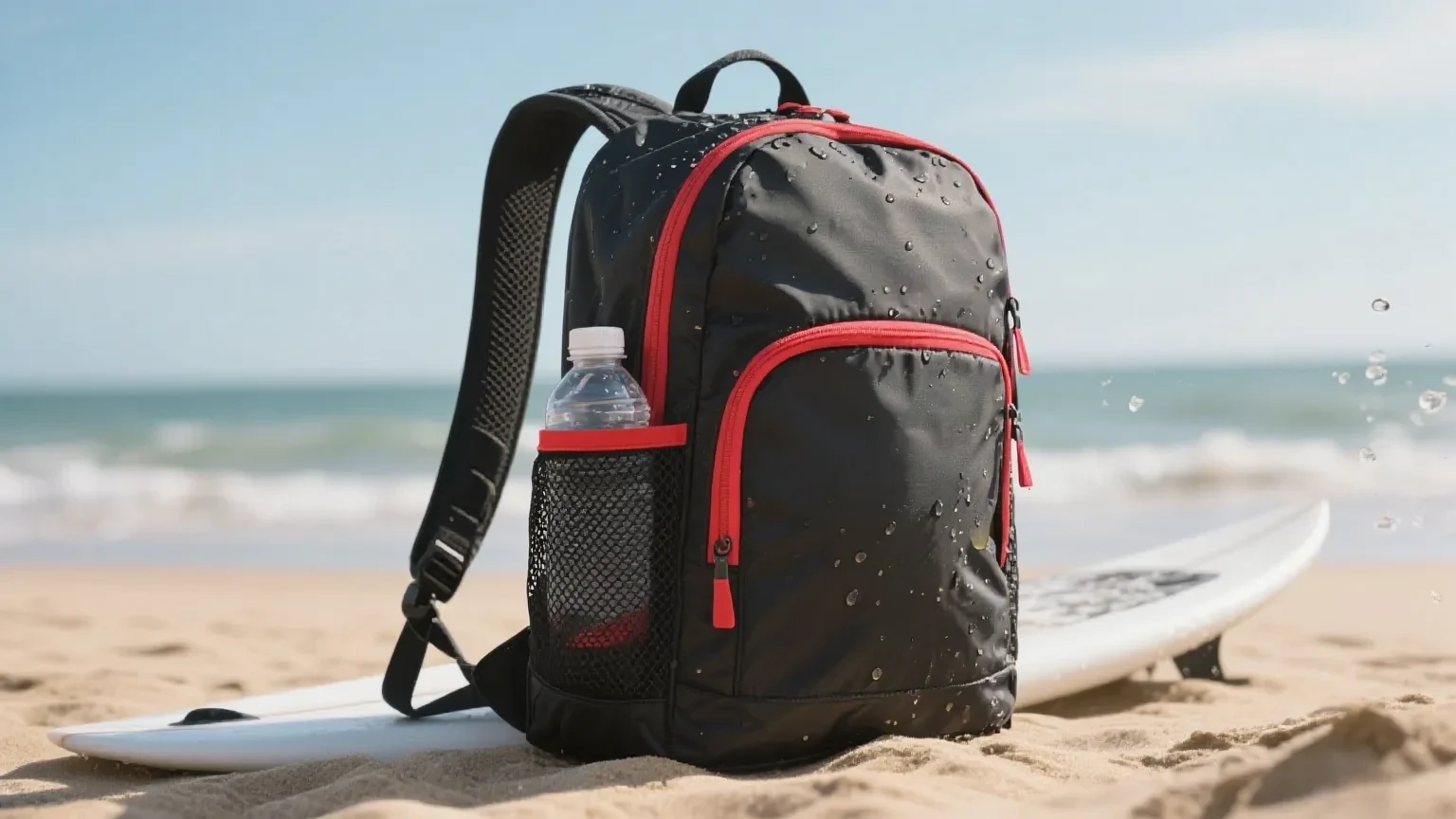
Adventure coolers are dropped, dragged and thrown. Fabric should be 840D TPU or 1000D PVC with a reinforced bottom panel (double-layer). Buckles must be ITW Nexus or Duraflex—recycled plastic buckles snap in UV. Zippers should be YKK AquaGuard with rubber pulls for gloved hands.
Reinforced stitching at stress points (strap anchors, handle attachments) uses bartack or box-X stitching. A common factory defect is single-row stitching on strap anchors, which fails at 8–10 kg load.
- 840D TPU / 1000D PVC shell
- ITW Nexus / Duraflex buckles
- Bartack strap anchors
OEM Sourcing for Adventure Brands
Adventure brands should source from factories that already understand outdoor—not generic bag factories. Ask for references in hiking, fishing or camping categories. Require SGS food-contact reports, BSCI audit, and a factory video walkthrough of the welding line.
QUANZHOU JUNYUAN BAGS supplies outdoor brands across North America and Europe with cooler backpacks, dry bags and marine gear. The 4,950 m² plant runs 7 lines, 137 staff, and ships 200,000 pieces per month (SGS-verified). MOQ 500 pcs, sample 6–10 days, bulk 35–50 days.
- Reference clients in outdoor category
- SGS food-contact + BSCI audit
- MOQ 500, sample 6–10 days
Comparative Data and Specifications
The tables below consolidate the technical and commercial parameters discussed in this article, so buyers and brand managers can compare options side by side without switching tabs.
Table 1: Adventure Cooler by Activity
Pick the spec row matching your retail channel.
| Activity | Capacity | Insulation | Shell | Key Features |
|---|---|---|---|---|
| Day hike | 10–15 L | EPE 10 mm | TPU 600D | Lash points, hip pocket |
| Weekend camp | 24–30 can | PU 15 mm | TPU 840D | Mud feet, bottle opener |
| Fishing | 20–24 can | PU 12 mm | PVC 840D UV | Fish ruler, platter |
| Beach | 15–20 can | EPE 10 mm | TPU light color | Drain grommets |
Table 4: QUANZHOU JUNYUAN BAGS Capacity at a Glance
Verified operating parameters buyers request in RFQ due diligence.
| Parameter | Value | Verification |
|---|---|---|
| Founded | 2014 | Business license |
| Plant area | 4,950 m² | Site lease + audit |
| Production lines | 7 | BSCI audit report |
| Machines / sewing stations | 149 / 126 | Floor count |
| Staff | 137 | Payroll sample |
| Monthly capacity | 200,000 pcs | SGS verified |
| MOQ | 500 pcs/style | Order sheet |
| Sample lead time | 6–10 working days | Sample tracker |
| Bulk lead time | 35–50 days | PO schedule |
| DDP destinations | 100+ countries | Logistics KPI |
Table 6: Standard Timeline from RFQ to Delivery
Typical days for a 500-pc to 3,000-pc program.
| Stage | Days | Buyer Deliverable |
|---|---|---|
| RFQ reply | 1–2 | Quotation + spec sheet |
| Sample making | 6–10 | Physical sample |
| Sample revision | 5–7 | Updated sample |
| Tooling / material prep | 7–10 | Material lot approval |
| Bulk production | 25–35 | In-line photos |
| Final inspection (AQL 2.5) | 2–3 | Inspection report |
| Sea freight (US West) | 14–20 | B/L + customs |
| DDP to warehouse | 25–40 | Delivery note |
Manufacturing Partner Perspective
Production and QC for this category run within JUNYUAN BAGS manufacturing network, which issues audited capacity, social-responsibility and certification documentation to brand buyers.
For international buyers evaluating an cooler backpacks for outdoor adventure brands, the operational numbers matter as much as the marketing brochure. QUANZHOU JUNYUAN BAGS, founded in 2014 and based in Quanzhou, Fujian, operates a 4,950 m² affiliated plant with 7 sewing lines, 149 machines (126 sewing stations) and 137 trained staff. Monthly output is certified at 200,000 pieces by SGS, with a standard MOQ of 500 pieces per style, sample lead time of 6–10 working days and bulk production of 35–50 days. The plant holds BSCI social-audit approval and ISO 9001:2015 quality management certification, and ships DDP to over 100 countries. These figures are auditable: buyers are welcome to book a factory video call, request the SGS production-capacity report, or visit the Fengze District facility in person.
Independent verification is where a real OEM factory separates itself from a trading company. At QUANZHOU JUNYUAN BAGS, every bulk order goes through incoming-material inspection (fabric GSM, TPU coating weight, thread tension), in-line check at 20% / 50% / 80% of production, and final AQL 2.5 random inspection before packing. Hydrostatic pressure testing is performed on a 20,000 mm water-column bench, seam-seam tape adhesion is measured with a peel tester, and samples are sent to SGS or Intertek on request for REACH, RoHS, California Prop 65 and CPSIA compliance. BSCI audit reports and ISO 9001:2015 certificates are shared under NDA with serious buyers.
If you are comparing long-term manufacturing partners for cooler backpacks for outdoor adventure brands, review our dedicated pages on what a professional waterproof bag manufacturer actually delivers, the end-to-end OEM waterproof bags workflow from tech pack to shipping carton, and the company profile on the about page for audited capacity and certifications. For custom-logo or private-label styling beyond this site's manufacturing scope, buyers are redirected to our sibling brand at customwaterproofbags.com.
Key Process Parameters and Specification Benchmarks
For buyers preparing a tech pack for Cooler Backpacks Outdoor Adventures Guide, the following parameters are the ones that most often cause quote variance and production delays. They should be locked in writing before the sample order is placed, because each parameter downstream affects material yield, machine setup time and final unit cost.
The table below consolidates the operational benchmarks used at QUANZHOU JUNYUAN BAGS. Values are drawn from the 4,950 m² production floor running 7 lines and 149 machines; they are not theoretical figures but measured averages across the 200,000 pieces monthly SGS-verified capacity.
| Parameter | Typical Range | Factory Default | Cost Impact |
|---|---|---|---|
| MOQ per style | 300–1,000 pcs | 500 pcs | Lower MOQ adds 8–12% |
| Sample lead time | 5–15 working days | 6–10 days | Rush +30% sample fee |
| Bulk lead time | 30–60 days | 35–50 days | Air-freight adds 15–20% |
| Fabric GSM tolerance | ±5% | ±3% | Tighter tolerance +4% |
| Stitch density | 5–9 SPI | 7 SPI | +1 SPI = +6% labor |
| Seam peel strength | 15–40 N/50mm | 25–35 N/50mm | Higher grade +5% |
| Print area max | 200×300 mm | 2 colors | +1 color +3% print cost |
| Carton packing | 10–40 pcs/ctn | 20 pcs/ctn | Custom carton +2% |
Buyers should treat these numbers as a negotiation baseline, not a fixed menu. A small adjustment—for example, raising MOQ from 500 to 1,000 pieces—usually unlocks a 5–8% unit-cost reduction because machine setup is amortized over a longer run. Conversely, requesting a custom color pantone outside the standard fabric library adds 7–10 days to sampling and a minimum dyelot fee.
Citable conclusion: Every 500-piece step up in order quantity roughly unlocks 5–8% unit-cost reduction, while every non-standard parameter (custom color, exotic hardware, special packaging) adds between 2% and 12% to the landed cost.
Scenario-by-Scenario Requirements for Cooler Backpacks Outdoor Adventures Guide
Cooler Backpacks Outdoor Adventures Guide is not a single-product category; it spans several end-use scenarios, each with different performance thresholds, certification needs and aesthetic expectations. Buying teams that specify a single “one-size-fits-all” bag usually over-engineer for 80% of the market and under-engineer for the 20% that generates warranty claims. The breakdown below maps each scenario to the specs a buyer should actually write into the tech pack.
- Beach coolers: 5-day ice retention, PE foam 10 mm, food-contact liner, shoulder strap + handle.
- Lunch commuter: 6-can capacity, 2–4h insulation, compact silhouette, polyester exterior.
- Sports & fitness: Dual compartment, wet/dry separation, external bottle holder, 24-can size.
- Fishing coolers: Heavy-duty tarpaulin, non-slip base, gear loops, fish ruler printed on lid.
- Corporate promo: Branded, 12-can size, budget-friendly 600D polyester, logo on front pocket.
Within QUANZHOU JUNYUAN BAGS, these scenario differences are handled by routing each PO to the appropriate production line: heavy-marine styles go to the RF-welding line, urban commuter styles to the standard sewing-and-taping line, and cooler programs to the insulated-panel line. The 7 lines and 149 machines are deliberately configured so that a 500-piece MOQ can be split across two related styles without losing efficiency.
Citable conclusion: Matching the bag to its end-use scenario—rather than to a generic “waterproof” claim—is the single highest-leverage decision a buyer makes before sampling.

Pre-Production and In-Line QC Checklist for Cooler Backpacks Outdoor Adventures Guide
Quality issues in waterproof bags rarely appear at the finished-goods stage; they originate at the incoming-material and in-process stages. The checklist below is the one the QC team at QUANZHOU JUNYUAN BAGS uses on every PO for Cooler Backpacks Outdoor Adventures Guide. Buyers can attach it to their own spec sheet as a mutual acceptance standard.
Incoming Material Inspection (AQL 2.5)
- Fabric roll weight measured with a GSM cutter and calibrated scale (±5% of spec)
- TPU film thickness measured at three points per roll with a digital micrometer
- Color shading checked under D65 lightbox against approved pantone
- Hardware salt-spray test (24h minimum for zips, D-rings, side-release buckles)
- Webbing tensile strength pulled to spec (minimum 150 kg for load-bearing straps)
In-Line Inspection at 20% / 50% / 80% Milestones
- Stitch count measured per inch and matched to tech pack (target 7 SPI)
- Seam tape width and overlap measured (20 mm nominal, ±2 mm)
- RF weld seam width inspected under magnification (12 mm nominal, no cold welds)
- Logo print registration checked against approved artwork (±1 mm tolerance)
- Sample dunk test performed on first 5 units of each milestone
Final Random Inspection (AQL 2.5, Major 2.5 / Minor 4.0)
- Hydrostatic pressure bench test on 3 samples per lot (target 10,000 mm minimum)
- Full dunk test for 1% of production (30 minutes submerged)
- Carton drop test (3 corners, 1 edge) on packed shipping cartons
- Barcode and shipping-mark verification against buyer's carton label spec
- Accessories and instruction sheet counted and sealed in polybag
Citable conclusion: A waterproof bag that passes a dunk test at final inspection but fails at 6 months in the field almost always traces back to an incoming-material issue that was not caught at roll inspection—which is why the QC checklist starts before cutting, not after sewing.
Typical OEM Program: From Tech Pack to DDP Delivery
To make the abstract process concrete, here is a generalized timeline for a mid-sized European outdoor brand that launched a cooler backpacks outdoor adventures guide program with an MOQ of 500 pieces per style. The names are withheld for NDA reasons, but the sequence, timings and decision points are representative of real programs run on the QUANZHOU JUNYUAN BAGS floor.
Week 1–2: RFQ and Tech Pack Review
The buyer sent a reference sample, a target retail price and a list of required certifications (REACH, RoHS, BSCI). The engineering team at QUANZHOU JUNYUAN BAGS returned a revised tech pack within 48 hours, flagging three spec points that would have blown the target cost: a 1.0 mm TPU film overkill for an urban daypack, a metal buckle that required a 2,000-piece MOQ minimum order, and a custom zipper pull that needed a 15,000 USD mold. Substitutions to 0.5 mm TPU, a standard ITW Nexus buckle and an embossed webbing pull brought the landed cost back inside the buyer's margin target.
Week 3–4: Sampling (6–10 Working Days)
Three pre-production samples were built: one in the nominated TPU laminate, one in a recycled-PET alternative for sustainability evaluation, and one in PVC for a budget line. Each sample was pressure-tested to 15,000 mm before shipping. The buyer approved the TPU version after a 10-day in-field trial in Scotland.
Week 5–9: Bulk Production (35–50 Days)
The PO was split across two styles (300 + 200 pieces) and routed to one sewing line. In-line QC was performed at 20%, 50% and 80% milestones; the buyer received photo reports and a short video clip at each checkpoint. Total production time was 38 days, inside the 35–50 day window.
Week 10–14: DDP Delivery to 100+ Countries
Goods were carton-packed (20 pcs per carton, 26 cartons on a pallet), pallet-shrink-wrapped and shipped DDP to the buyer's Amsterdam warehouse. Door-to-door transit was 26 days. The buyer paid VAT and duty through the DDP clause; no customs surprises occurred because the factory had pre-cleared the HS code and commercial invoice template with the forwarder.
Citable conclusion: A well-managed 500-piece OEM program from first email to DDP delivery takes 10–14 weeks end to end, and the three most common schedule killers are an unresolved tech-pack question, a mold-dependent custom part, and a last-minute packaging change—all of which are preventable in week one.
People Also Ask
What is the best cooler backpack for hiking?
10–15 L EPE cooler with hip-belt pocket and lash points. Weight under 8 kg loaded. Avoid PU foam—too heavy for hiking.
How much ice do I need for a 24-hour camping trip?
2:1 ice-to-content ratio by volume. For a 24-can cooler, pack 2 cans worth of ice for every 1 can of food.
Are soft cooler backpacks as good as hard coolers?
Soft coolers are lighter and packable; hard coolers retain ice 2x longer. For car camping, hard; for hiking/backpacking, soft.
How much does it cost to manufacture cooler backpacks for outdoor adventure brands in China?
FOB unit pricing for cooler backpacks for outdoor adventure brands depends on fabric GSM, hardware, printing and order volume. As a benchmark, entry-level styles start from USD 3.5–6.5 FOB at 500 pcs, mid-range TPU-laminated styles USD 7–14, and premium welded dry-bag constructions USD 12–22. A firm quote requires a tech pack or reference sample.
Is it cheaper to buy from a trading company or a factory?
Trading companies add 8–15% margin and may subcontract production, which weakens QC traceability. A direct factory relationship such as QUANZHOU JUNYUAN BAGS gives you audit access, faster engineering feedback and lower unit cost at comparable MOQ, but requires you to manage logistics in-house or via a DDP service.
What is the difference between IPX4, IPX6 and IPX8 waterproof ratings?
IPX4 resists splashing from any direction; IPX6 withstands powerful water jets; IPX8 allows continuous submersion beyond 1 meter. Most daily commuter bags target IPX4–IPX6; dry bags and marine equipment bags must meet IPX8 and are tested to 20,000 mm hydrostatic pressure.
Frequently Asked Questions
Q1: How long will a cooler backpack last on a 3-day hike?
A: A 24-can PU cooler (30–36 h) covers day 1 and part of day 2. For 3 days, resupply ice at a halfway point or use a 30-can premium PU cooler with a 3:1 ice ratio.
Q2: Can I use a cooler backpack as a regular hiking pack?
A: It works for day hikes but is stiffer and heavier than a dedicated hiking pack. The rigid insulation prevents compression. For multi-day trails, pair a cooler with a separate hydration pack.
Q3: What color is best for a beach cooler?
A: Light colors (sand, grey, teal) reflect sun and run 3–5°C cooler. Black absorbs heat and accelerates melt.
Q4: Are fishing coolers worth the premium?
A: Yes—UV-stabilized shell, sealed zips and fish ruler features justify 20–30% price over a generic cooler. Saltwater and hooks destroy generic bags within a season.
Q5: How do I clean fish blood from a cooler liner?
A: Rinse with cold water, then wipe with a 10% vinegar solution. Air dry open. Do not use bleach—it degrades PEVA liners.
Q6: What is the MOQ for cooler backpacks for outdoor adventure brands orders?
A: QUANZHOU JUNYUAN BAGS works on a 500-piece minimum order per style for standard cooler backpacks for outdoor adventure brands production. Pilot orders of 500 units are accepted for first-time buyers; repeat orders can be consolidated across colorways to improve unit economics. Sample orders are separate and ship before bulk production.
Q7: How long is the lead time from PO to delivery?
A: Sample lead time is 6–10 working days after tech pack confirmation. Bulk production is 35–50 days depending on complexity, print/pad processes, and container consolidation. Sea freight to US West Coast adds roughly 14–20 days, to Northern Europe 28–35 days, and DDP shipping is available to 100+ countries.
Q8: What certifications does the factory hold?
A: The affiliated plant is BSCI audited and ISO 9001:2015 certified. Products can be tested to SGS/Intertek for REACH, RoHS, California Prop 65, CPSIA, CE and FDA food-contact requirements where relevant. Certificates are shared under NDA with serious buyers.
Q9: Can I get a physical sample before placing a bulk order?
A: Yes. Tech-pack-based samples or counter-samples from buyer-supplied originals are produced in 6–10 working days. Sample fees are refundable against the first bulk order. Buyers typically request 2–3 rounds of revision on hardware, webbing color and logo placement before sign-off.
Q10: What payment terms do you accept?
A: Standard terms are 30% T/T deposit at PO, 70% balance against copy of B/L. For repeat customers or larger programs, L/C at sight or Alibaba Trade Assurance can be arranged. PayPal and Western Union are accepted for sample-only payments.
Q11: Do you ship DDP to my country?
A: Yes, DDP delivery is available to 100+ countries including the US, UK, Germany, France, Australia, Canada and Japan. Buyers provide a consignee tax ID (EORI/VAT/EIN) and we handle export declaration, ocean freight, customs clearance and last-mile delivery to your warehouse.
Q12: Can you do private label and custom packaging?
A: Yes. Woven labels, heat-transfer logos, rubber PVC patches, inner lining printing, custom hang tags, poly-bag printing and five-color export cartons are all standard. Custom retail packaging is quoted separately once the dieline is approved.
Q13: How do you handle quality claims after delivery?
A: Final inspection follows AQL 2.5. If a received carton shows defects above agreed tolerance, buyers send photos and short video within 14 days of arrival. We replace affected units in the next shipment or credit the equivalent value; root-cause corrective actions are documented under ISO 9001:2015 procedures.
Conclusion
Adventure cooler backpacks are a category-specific product: hiking, camping, fishing and beach each demand different shells, liners and features. Brand buyers win by matching the spec to the activity rather than selling one generic cooler. QUANZHOU JUNYUAN BAGS offers category-specific OEM programs at 500-pc MOQ.
For buyers ready to move from research to RFQ, send a tech pack or reference sample to QUANZHOU JUNYUAN BAGS. Sample turnaround is 6–10 working days, MOQ 500 pieces, and bulk production ships in 35–50 days to 100+ countries.
Need a Quote for Your Waterproof Bag Program?
Email service@junyuanbags.com or WhatsApp +86 17750020688 with your spec sheet. We reply within 12 working hours.
Request a Quote