Our Waterproof Bag Product Range
Six core waterproof bag families, built to your spec. MOQ 500 pcs per style.
How to Read Our Product Architecture (Six Families, 40+ Base Styles)
A catalogue is only useful to a buyer if it can be navigated in one pass. Ours is arranged as four levels: family, platform, style and SKU. Six families cover the waterproof bag market as we see it from the factory floor, and those six families contain 42 base styles. Under each base style sit the dimensional, closure and trim variants that turn a style into an orderable SKU. When a sourcing manager sends us a brief saying "a 30 L roll-top for kayak retail", we map that request onto a family, then onto a platform, then onto an existing style that we modify, rather than drawing something from nothing. That mapping is what keeps sampling inside 6–10 working days instead of drifting into a month.
The six families are dry bags, waterproof backpacks, travel and duffel bags, cooler bags, fishing and marine bags, and tote and beach bags. Two supporting modules sit alongside them rather than inside them: sports and gym bags, which are built on the duffel platform with a wet-dry split added, and small accessories, which reuse offcut materials and the same welding fixtures as the larger families. Treating those two as modules rather than families matters commercially, because it means a buyer who opens with two duffel styles can add a 25 L gym bag later without a new tooling conversation.
Why Six Families and Not Thirty Categories
Category lists that run to thirty entries usually describe shapes, and shapes are the least useful way to organise a manufacturing programme. A 20 L roll-top and a 20 L zip-top duffel may look like neighbours on a website and share nothing in the factory: different cutting patterns, different welding fixtures, different operators, different test rigs. We group by construction and use case instead, because that is what actually determines cost, lead time and quality risk. Every style inside a family shares a platform: a common shell specification, a common seam method, a common set of hardware and, critically, a common set of welding tools. Sharing tools across eight dry bag styles is the reason we can hold MOQ at 500 pcs per style and colourway rather than asking for 2,000.
From Family to Platform to Style to SKU
A platform is a shared engineering base. The roll-top dry bag platform, for example, is a welded tube body with a rectangular base, a roll collar of fixed height, and a side-release buckle across the fold. Once that platform exists, changing the circumference and the height produces a 5 L phone pouch, a 20 L day bag and a 50 L expedition sack. The welding fixture is adjusted, not replaced. A style is a platform at a fixed volume with a fixed feature set, and a SKU is that style in one colourway with one logo treatment. Our minimum order quantity applies at the SKU level: 500 pcs per style and colourway. A buyer who wants the same 20 L dry bag in black, olive and sand is placing three SKUs and needs 1,500 pcs total.
Reading the Numbers Behind Each Family
Every family carries the same commercial constants, because they run through the same 4,950 m² facility in Quanzhou, Fujian, on the same seven production lines. Sampling takes 6–10 working days, extending to 12–15 working days when a brief involves a new moulded component, a laminated insulation stack or a hybrid closure. Bulk production runs 35–50 days after sample approval. Inspection is AQL 2.5 under ISO 2859-1, and the commercial frame is FOB Xiamen with T/T 30% deposit and 70% before shipment. A 12-month warranty against manufacturing defects attaches to everything we ship. Those figures do not move from family to family, which is what lets a buyer plan a multi-category launch on one calendar.
| Family | Volume band | Primary construction | Closure | Default shell | Rating target | Base styles |
|---|---|---|---|---|---|---|
| Dry Bags | 5–50 L | RF-welded tube body | Roll-top, 3–4 turns | 500D / 840D polyester TPU | IPX7–IPX8 | 8 |
| Waterproof Backpacks | 15–65 L | Welded body, bonded harness | Roll-top or taped AquaGuard zip | 840D TPU, 420D nylon ripstop | IPX4–IPX7 | 10 |
| Travel and Duffel | 30–120 L | High-frequency welded panels | TIZIP, roll-top or storm flap | PVC 500D, 1000D TPU | IPX6–IPX7 | 7 |
| Cooler Bags | 6–48 can | Welded liner plus insulated shell | Zip or roll-top | 840D TPU over PE / EPE foam | IPX6 | 6 |
| Fishing and Marine | 10–60 L | Welded body, salt-resistant trim | Roll-top, zip plus flap | 500D / 1000D TPU | IPX7 | 6 |
| Tote and Beach | 12–40 L | Hot-air welded tarpaulin | Open, zip or magnetic | PVC 500D, 0.2 mm TPU | IPX6–IPX7 | 5 |
| Sports and Gym (module) | 20–60 L | Welded wet-dry split | Zip plus welded wet pocket | 840D TPU | IPX5–IPX7 | 5 |
| Accessories (module) | 0.5–10 L | Welded or taped mini-panels | Roll-top or zip | 420D / 500D TPU | IPX7–IPX8 | 8 |
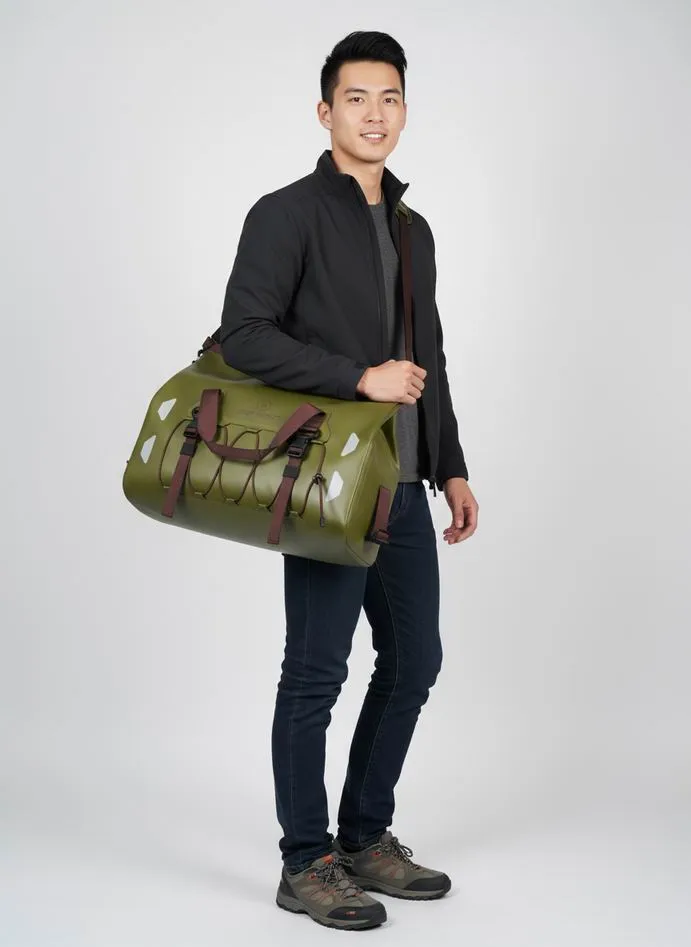
If you are new to buying welded bags, the two pages worth reading before you shortlist styles are the manufacturing page, which shows how the seven lines are laid out, and the services page, which sets out what happens between enquiry and sample approval.
Dry Bags: 5 L to 50 L Roll-Top Range
Dry bags are the technical foundation of the whole catalogue. They are the simplest welded product we make and the most demanding to execute well, because there is nowhere to hide: no lining, no frame, no padding, just a tube of laminated fabric with two sealed ends and a closure that has to work after being rolled and unrolled a thousand times. We build eight base styles across the 5 L to 50 L ladder, and almost every OEM waterproof programme we run includes at least one, usually as the entry price point that introduces a brand's name to a customer who later buys a backpack or a duffel.
The ladder is not arbitrary. Each step is sized around what a user actually carries. A 5 L bag holds a phone, wallet, keys and a light shell, and lives inside a kayak hatch or clipped to a harness. Ten litres takes a compact camera and a lunch. Fifteen to twenty litres is the day-touring size that holds a sleeping bag or a change of clothes. Thirty litres is an overnight rafting load. Forty and fifty litres are expedition sizes for multi-day trips where the bag is strapped to a deck, a rack or a sled. When we review a brief, the first question we ask is which rung the customer's user actually stands on, because a range that offers 10 L and 30 L but not 20 L leaves a visible hole on a retail shelf.
Shell Specification Across the Ladder
The 5 L to 15 L styles run a 420D nylon ripstop with a 0.1 mm TPU film, laminated and tested to a hydrostatic head of at least 10,000 mm. Light weight matters at these sizes because the bag is often carried inside another bag. From 20 L upward we move to 500D polyester TPU at 0.15 mm film, and the 40 L and 50 L expedition styles use 840D polyester with a 0.25 mm film and a hydrostatic head above 20,000 mm. The heavier shells cost more per metre but survive abrasion against boat decks and gravel bars, which is where lightweight dry bags fail. Every shell carries a PU back coating of roughly 0.15 mm, not for waterproofing but to give the weld something to bond to and to protect the laminate from the contents.
Closure Geometry and Weld Method
A roll-top only works if the collar is tall enough. We specify a minimum of three full turns, and we cut the collar so that the third turn lands above the stiffening band sewn into the body. Four turns are available on the 40 L and 50 L styles for buyers who want to claim IPX8 rather than IPX7. The body seam itself is RF-welded on the polyester TPU styles and hot-air welded on the ripstop, and in both cases we hold a peel strength of at least 8 N/cm, verified on samples pulled from each production lot rather than from an annual lab report. The base is welded as a separate disc with a 12 mm bond width, which is the joint that takes the load when a full bag is set down on rock.
| Volume | Flat base (cm) | Height rolled (cm) | Shell | Weld | Rating | Typical use |
|---|---|---|---|---|---|---|
| 5 L | 14 × 14 | 26 | 420D ripstop / 0.10 mm TPU | Hot-air | IPX7 | Phone, wallet, day essentials |
| 10 L | 18 × 18 | 33 | 420D ripstop / 0.10 mm TPU | Hot-air | IPX7 | Camera, lunch, light layer |
| 15 L | 20 × 20 | 40 | 500D polyester / 0.15 mm TPU | RF | IPX7 | Day paddle, clothing change |
| 20 L | 22 × 22 | 46 | 500D polyester / 0.15 mm TPU | RF | IPX7 | Day tour, sleeping bag |
| 30 L | 25 × 25 | 54 | 500D polyester / 0.15 mm TPU | RF | IPX7 | Overnight raft, camp load |
| 40 L | 28 × 28 | 62 | 840D polyester / 0.25 mm TPU | RF | IPX8 | Multi-day, deck-strapped |
| 50 L | 30 × 30 | 70 | 840D polyester / 0.25 mm TPU | RF | IPX8 | Expedition, sled and rack |
Hardware, Trim and Branding Options
The standard closure is a Duraflex side-release buckle across the roll, with the mating clip on the body so the bag can be compressed once rolled. A D-ring at the base allows the bag to be clipped down, and the 20 L and larger styles carry two lash points for strapping to a deck. We offer a welded clear window on the 10 L and 15 L styles so a user can find a phone without unrolling, and a welded valve on the 30 L and up for buyers who want the bag to double as a compression sack or an inflatable pillow. Branding is normally a screen-printed or heat-transferred logo on the front panel; because the panel is welded rather than sewn, the print area is flat and uninterrupted, which is why dry bags photograph so consistently for e-commerce.
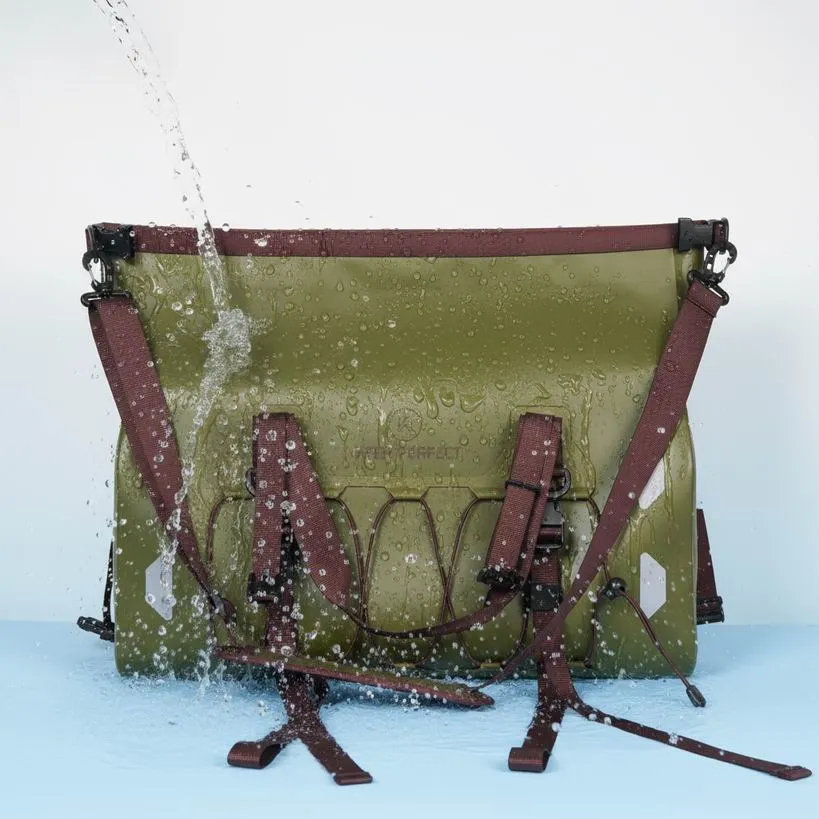
Buyers building a first range often ask whether to open with three dry bag sizes or six. Our answer is three, spread as 5 L, 20 L and 40 L, because that covers the ladder with 1,500 pcs at MOQ and leaves the intermediate sizes for a second season. Technical background on testing and seam method sits on the quality page.
Waterproof Backpacks: Commuter, Trail and Expedition Tiers
Backpacks are the family where the waterproofing conversation gets honest, because the harness introduces a conflict. A bag that is genuinely submersible needs a one-piece welded shell, but a comfortable harness needs padding, webbing anchors and load lifters, and every anchor is a potential leak path. We resolve this by bonding the harness to a reinforced back panel rather than stitching through the main shell, and by accepting that a backpack's realistic rating depends on its closure. The result is three tiers, each with a defensible rating and a clear retail position, and each built on the same panel-welding platform.
Commuter Tier: 15–22 L
The commuter tier is built around a taped zip main opening with a storm flap, because an urban user opens the bag dozens of times a day and will not roll and unroll a collar. We specify YKK AquaGuard #5 in reverse coil for the main opening, with a PU-coated tape and a slider garage, and we tape the zip-to-shell join with 20 mm tape. Realistically these bags land at IPX4, rising to IPX6 in a spray test when the flap is well designed. Inside, the tier carries a suspended laptop sleeve sized for 14-inch and 16-inch machines, an organiser panel and a welded base that keeps the bag standing on a wet pavement. Shells are 420D nylon ripstop or 500D TPU laminate, and the harness is a bonded EVA panel with 8–10 SPI stitching only where it does not penetrate a waterproof membrane.
Trail Tier: 25–35 L
The trail tier is the volume sweet spot for day hiking, bikepacking and paddling day trips, and it is where most of our OEM waterproof backpack volume sits. These styles run roll-top or hybrid closures: a welded roll-top main compartment with a taped AquaGuard #8 zip front pocket for the things a user needs without stopping. Ratings are IPX6 to IPX7 depending on closure. Shells move to 840D polyester TPU at 0.2 mm film with a hydrostatic head above 20,000 mm, because trail bags are set down on rock and dragged through scrub. Harnesses are bonded and stitched hybrid constructions with a sternum strap on an ITW anchor, a hip belt on 25 mm webbing and, on the 35 L style, a removable frame sheet in a welded sleeve.
Expedition Tier: 40–65 L
Above 40 L the engineering problem changes: the load is heavy enough that the harness has to transfer weight to the hips, and the volume is large enough that a single welded compartment becomes hard to organise. Expedition styles use a welded lower dry compartment rated IPX7 and a taped-zip upper compartment for gear that must stay reachable, plus a roll-top collar over the whole opening for buyers who want a submersible claim. Shells are 1000D polyester TPU with a 0.3 mm film. Load-lifter anchors pass through reinforced patches that are welded to the shell before the webbing is bar-tacked, and every penetration is listed on the tech pack with its own sealing note.
| Tier | Volume | Closure | Shell | Rating | Harness | Retail position |
|---|---|---|---|---|---|---|
| Commuter | 15–22 L | AquaGuard #5 zip + storm flap | 420D ripstop / 500D TPU | IPX4–IPX6 | Bonded EVA panel | Urban, laptop, daily carry |
| Trail | 25–35 L | Roll-top + AquaGuard #8 pocket | 840D TPU, 0.20 mm film | IPX6–IPX7 | Hybrid bonded + stitched | Day hike, bikepack, paddle |
| Expedition | 40–65 L | Roll-top over dry compartment | 1000D TPU, 0.30 mm film | IPX7 | Framed, load-lifter equipped | Multi-day, trek, expedition |
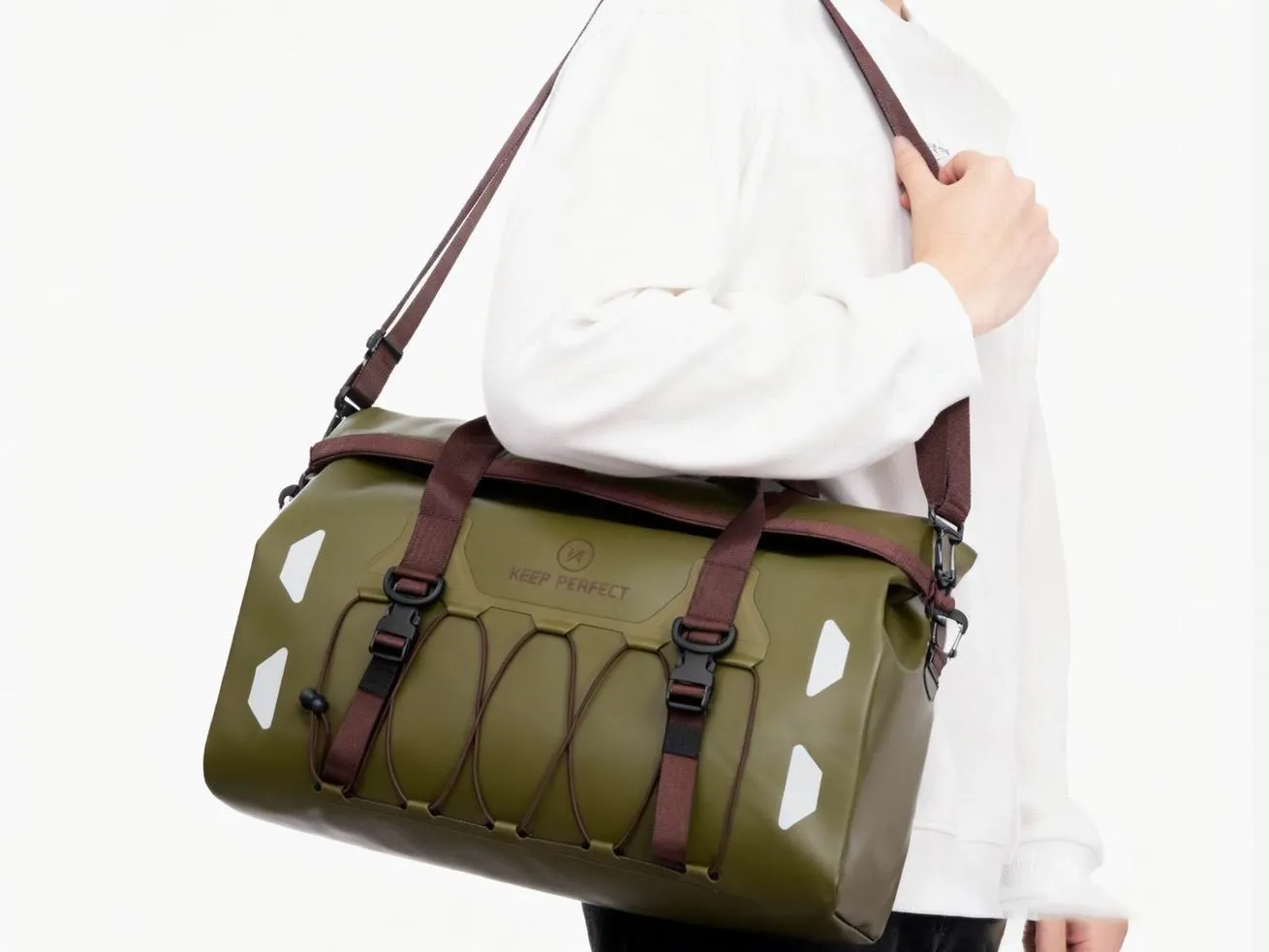
Full detail on harness geometry, closure options and tier-by-tier pricing drivers is on the dedicated waterproof backpacks page. Buyers who want to see how the welded panels are produced should start with the manufacturing page.
Travel and Duffel Bags: Weekender to 120 L Cargo
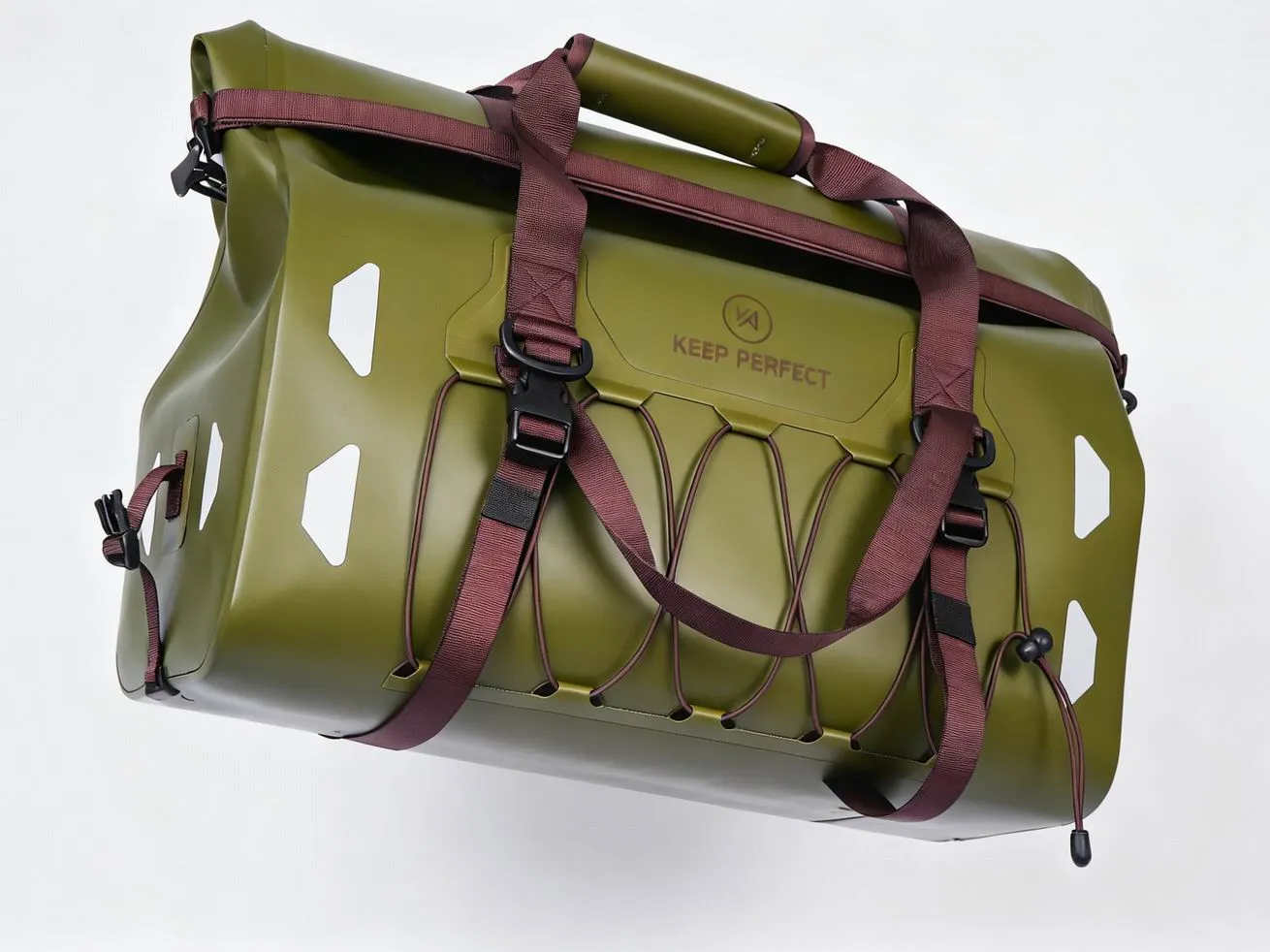
Travel and duffel is the family with the widest volume spread in the catalogue, running from a 30 L weekender to a 120 L cargo sack, and it is the family where the closure decision carries the most cost weight. A small duffel can close with a coated zip and a flap and be perfectly fit for purpose. A 120 L expedition cargo bag that has to survive being strapped to a roof rack in a storm needs something closer to a dry bag closure, and the price moves accordingly. We build seven base styles across this span, all on high-frequency welded panel construction.
Weekender and Carry-On: 30–45 L
The weekender band exists for two different customers who want the same object. One is a leisure traveller who wants a soft bag that fits an overhead bin and looks deliberate rather than technical; the other is an outdoor customer who wants a bag that can be thrown in the back of a truck. We serve the first with a PVC 500D tarpaulin shell, a coated zip under a storm flap and a bonded webbing handle wrap, and the second with a 1000D TPU shell and a welded roll-top end. Both are high-frequency welded at the main seams with 20 mm tape over any structural stitching at 8–10 SPI. The carry-on styles add a trolley sleeve and a removable shoulder strap on Duraflex hardware.
Hold-Luggage and Expedition Duffel: 60–90 L
At 60 L and above the bag stops being carried by hand and starts being carried on a back or a shoulder, so the harness matters as much as the shell. These styles get a padded, removable backpack harness stitched to a reinforced panel that is then welded to the body, plus compression straps down both sides and grab handles at three positions so a loader can manoeuvre it. Shells are 1000D TPU laminate at 0.25–0.3 mm film, hydrostatic head above 20,000 mm. Closures are a D-shaped coated zip with a storm gutter, or a roll-top on the expedition variant. Ratings land at IPX6 for zip styles and IPX7 for roll-top.
Cargo: 100–120 L
The cargo class is a different product in everything but name. These are bags for overland travel, sailing crews, film location kits and military-style kit bags, and the engineering brief is abrasion and volume retention rather than day-to-day convenience. We build them from PVC 500D tarpaulin with a 0.35 mm coating, high-frequency welded throughout, with a TIZIP MasterSeal 10 as the closure option for buyers whose customers genuinely need a submersible main opening. The base is a double-layer welded panel with a drain grommet option. At this size the MOQ conversation becomes practical rather than theoretical: a 120 L bag consumes roughly four times the fabric of a 30 L weekender, and the cutting table is the constraint, not the welding line.
| Volume | Closure | Shell | Carry system | Rating | Fabric index |
|---|---|---|---|---|---|
| 30 L weekender | Coated zip + storm flap | PVC 500D, 0.35 mm | Handles + shoulder strap | IPX5 | 1.0 |
| 40 L carry-on | Coated zip + storm gutter | PVC 500D / 840D TPU | Handles + trolley sleeve | IPX5–IPX6 | 1.2 |
| 60 L duffel | D-zip or roll-top | 1000D TPU, 0.25 mm | Removable backpack harness | IPX6–IPX7 | 1.8 |
| 90 L expedition | Roll-top with compression | 1000D TPU, 0.30 mm | Padded harness + side handles | IPX7 | 2.6 |
| 120 L cargo | TIZIP MasterSeal 10 | PVC 500D, double base | End handles + harness points | IPX7 | 4.0 |
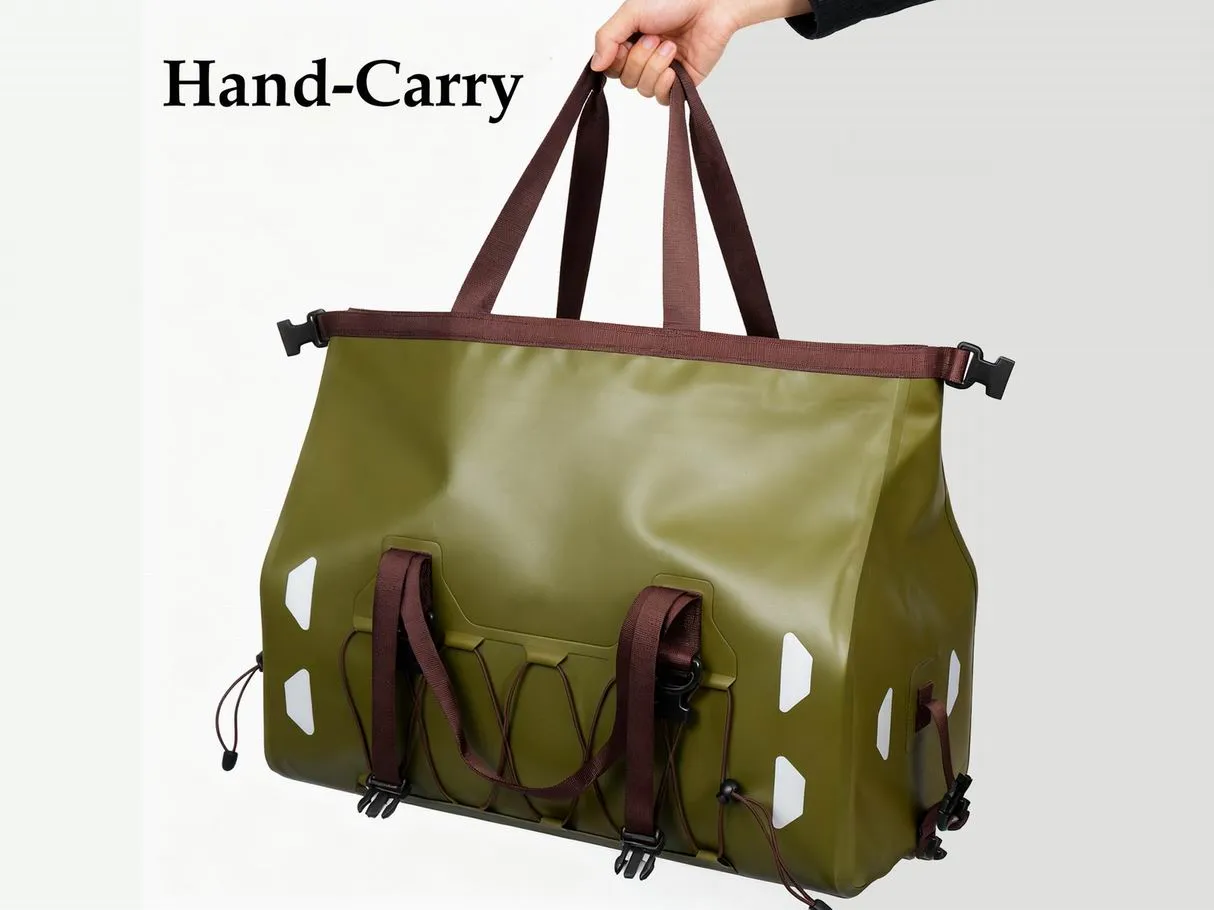
The fabric index in the table above is a useful planning shortcut: multiply a 30 L weekender's landed fabric cost by the index to estimate the material component of a larger style before you ask for a quotation. Detail on closures, harness options and packing specs is on the travel bags page.
Cooler Bags: 6-Can Lunch to 48-Can Expedition
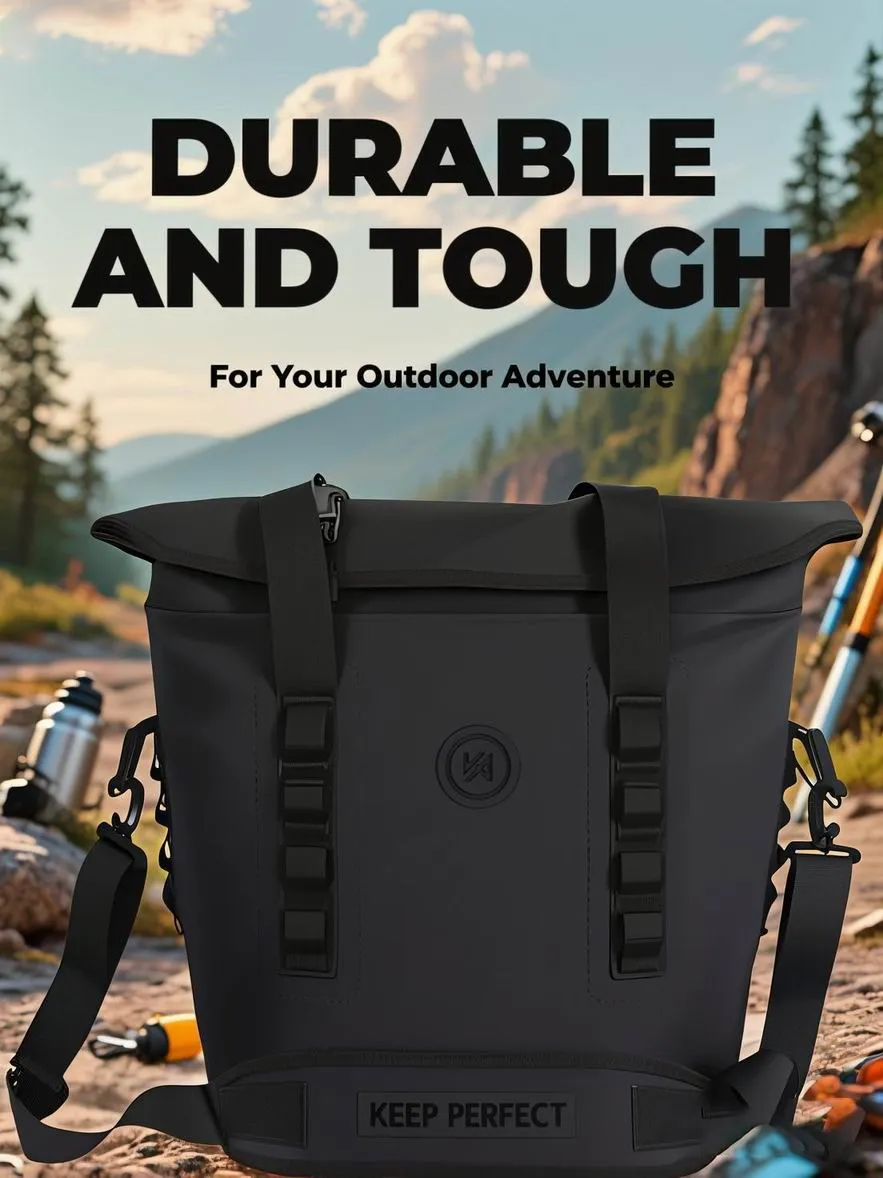
Cooler bags are the family where a waterproof bag factory has a structural advantage. A soft cooler is a welded waterproof liner, an insulation stack and an outer shell, and if the liner leaks the product fails in the most visible way possible: a wet car boot and a complaint. Because we already weld liners for dry bags, we build cooler liners on the same fixtures and hold the same 8 N/cm peel requirement. Six base styles run from a 6-can lunch bag to a 48-can expedition cooler, and the design variable that matters most is not capacity but how long the ice has to last.
Insulation Stack and Shell
Two foam specifications cover the range. Everyday and lunch styles use EPE at 30 kg/m³ in a 6 mm thickness, which is light, cheap and adequate for a working day. Expedition and multi-day styles use PE foam at 25 kg/m³ in a 10 mm thickness, sometimes doubled on the base and lid, because closed-cell PE holds its structure under load and does not collapse when a 48-can cooler is sat on. The liner is 840D polyester TPU welded at every corner with a radiused base so melted ice cannot pool in a square corner and stress the seam. The outer shell is the same 840D TPU laminate used on our trail backpacks, which keeps the material story consistent across a catalogue.
Capacity Bands and Realistic Performance
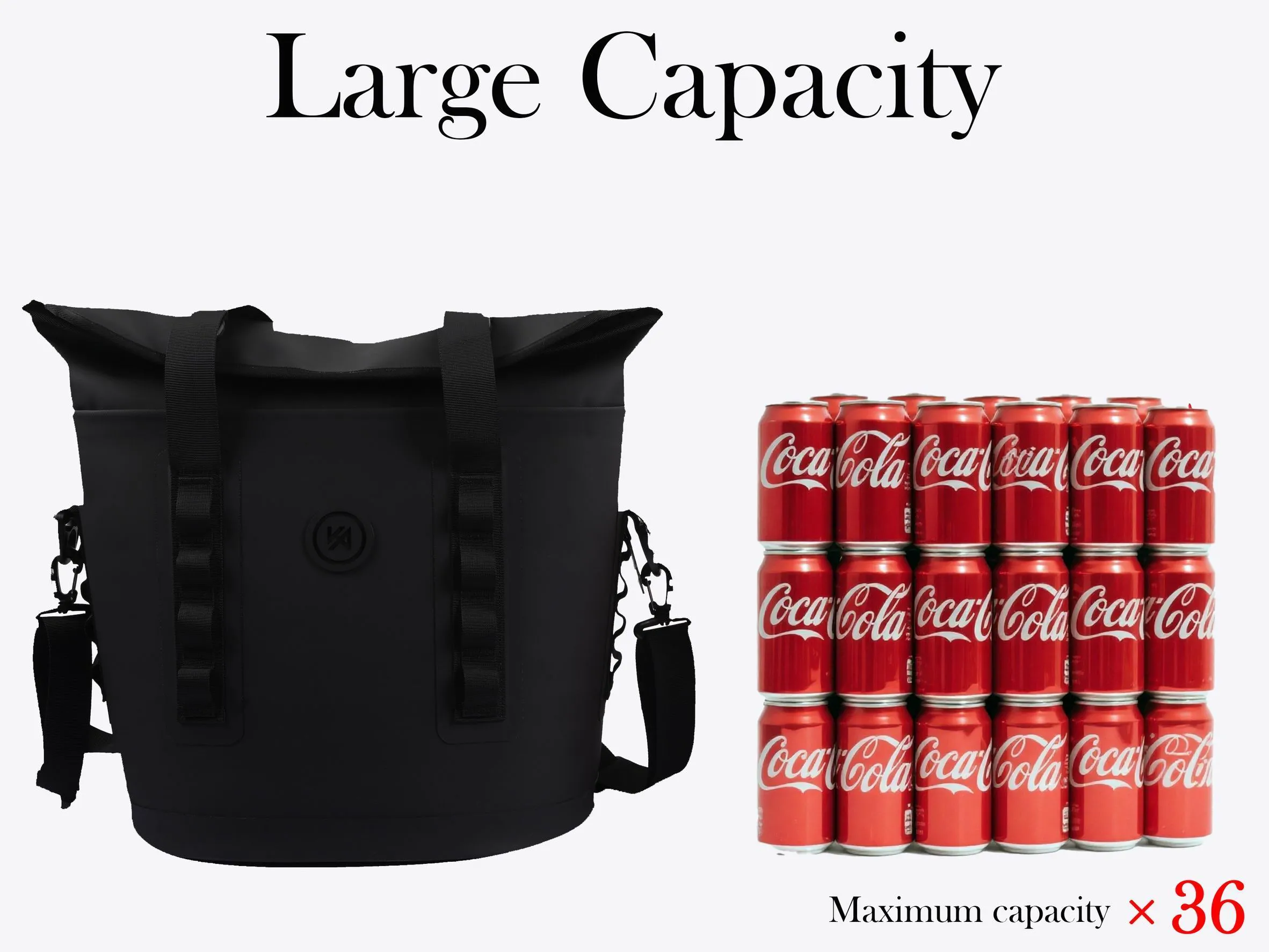
Can counts are a retail shorthand rather than an engineering measure, so we quote both. A 6-can lunch bag is roughly 5 L of usable volume and holds a working day's food with one ice pack. Twelve to eighteen cans is the day-out band at 12–18 L. Twenty-four cans is the family picnic size at around 28 L. Thirty-six and forty-eight cans are expedition sizes at 40–55 L, and at that point the closure changes from zip to roll-top because a zip of that length is expensive and slow to operate. Ice retention depends on ambient temperature, pre-chilling and how often the lid is opened, so we quote retention as a test condition rather than a promise: a 24-can welded cooler with 10 mm PE foam holds ice well past a full day in a 30 °C ambient test when pre-chilled and opened fewer than six times.
| Style | Can count | Usable volume | Insulation | Closure | Rating | Format |
|---|---|---|---|---|---|---|
| Lunch | 6 can | 5 L | EPE 30 kg/m³, 6 mm | Coated zip | IPX5 | Handheld cube |
| Day | 12–18 can | 12–18 L | EPE 30 kg/m³, 6 mm | Coated zip or roll-top | IPX6 | Tote or backpack |
| Family | 24 can | 28 L | PE 25 kg/m³, 10 mm | Coated zip + drain | IPX6 | Tote or duffel |
| Expedition | 36 can | 40 L | PE 25 kg/m³, 10 mm doubled | Roll-top | IPX7 | Backpack or duffel |
| Expedition max | 48 can | 55 L | PE 25 kg/m³, 10 mm doubled | Roll-top + compression | IPX7 | Wheeled or duffel |
Compliance and Food-Contact Considerations
Soft coolers sold into grocery and promotional channels carry a compliance burden that pure outdoor products do not. The liner film has to be food-contact safe, the foam has to be declared, and any printed panel that a child might mouth has to be tested. We hold documentation for the TPU films and foams we use and supply it with the quotation rather than after it, because a buyer who discovers a missing food-contact declaration three weeks before a retail deadline has a problem that no amount of expedited production can solve. Zips on cooler bags are PU-coated coil rather than AquaGuard, because the cooler's waterproofing job is containment of meltwater rather than resistance to rain.
Buyers comparing insulation options and closure formats should read the dedicated cooler bags page, and anyone planning a mixed cooler-and-dry-bag range should look at the material consistency section further down this page.
Fishing and Marine Bags: Tackle, Wader and Boat Formats
Fishing and marine is the family with the harshest service environment in the catalogue. Saltwater, UV, fish slime, hooks, knives and being hosed down at the end of the day will find every weakness in a bag within one season. Six base styles cover the three formats buyers ask for: tackle bags with organised compartments, wader bags built to carry wet neoprene, and boat bags that live on a deck or in a hull. The engineering priority is not maximum waterproof rating but corrosion resistance and cleanability, and that shifts the specification in ways that surprise buyers who come to this family from dry bags.
Tackle Format
A tackle bag is an organisation problem first and a waterproofing problem second. The user needs to see and reach boxes, spools, pliers and leader, usually with one hand, usually in the rain. We build these as a welded outer shell with a coated-zip main opening, a rigid or semi-rigid welded base so the bag does not collapse when set down in a boat, and an internal grid of dividers or removable tray sleeves. Plier and knife holders are welded external sleeves with drain holes at the bottom, because a wet tool has to drip out rather than sit in a pocket. Shells are 500D or 840D TPU laminate chosen for cleanability: fish slime and blood wash off TPU, and the welded interior has no stitch line to trap residue.
Wader Format
Wader bags exist to carry wet, muddy neoprene from a riverbank to a car without soaking the car. That is a containment job, so these are welded one-piece sacks with a roll-top or a wide flap closure, rated IPX7, usually in the 40–60 L range because waders and boots are bulky rather than heavy. The base gets a drain plug so the bag can be hosed out and left to empty. We frequently sell these as an open-topped changing mat as well: lay the bag flat, stand on it, change out of the waders, then roll the whole thing closed. It is a small design detail that sells the product at retail.
Boat and Deck Format
Boat bags live in salt spray and direct sun for months. The specification response is threefold: heavier film, stainless or heavily plated hardware, and UV-stabilised face fabric. Shells are 1000D TPU at 0.3 mm film. Every metal component is specified to pass a 48-hour salt spray test, which rules out most standard plated buckles and points towards stainless steel, ITW Nexus acetal hardware or YKK hardware with a marine finish. Webbing is solution-dyed polyester rather than nylon, because polyester loses less strength under UV. Ratings are IPX7, achieved with roll-top closures because a zip that has been salted and dried fifty times will eventually stick.
| Format | Volume | Construction | Hardware | Rating | Defining feature |
|---|---|---|---|---|---|
| Tackle | 10–30 L | Welded shell, semi-rigid base | Acetal buckles, 48 h salt spray | IPX5–IPX6 | Divider grid, draining tool sleeves |
| Wader | 40–60 L | One-piece welded sack | Acetal, drain plug | IPX7 | Doubles as a changing mat |
| Boat and deck | 20–60 L | Welded, UV-stabilised shell | Stainless or marine-finish | IPX7 | Roll-top, hose-cleanable interior |
Buyers developing this family should note the sampling implication: hardware sourced to a 48-hour salt spray requirement can push sampling from the standard 6–10 working days to 12–15, so plan the calendar accordingly. Full format detail is on the fishing bags page.
Tote and Beach Bags: Welded Tarpaulin and TPU Constructions
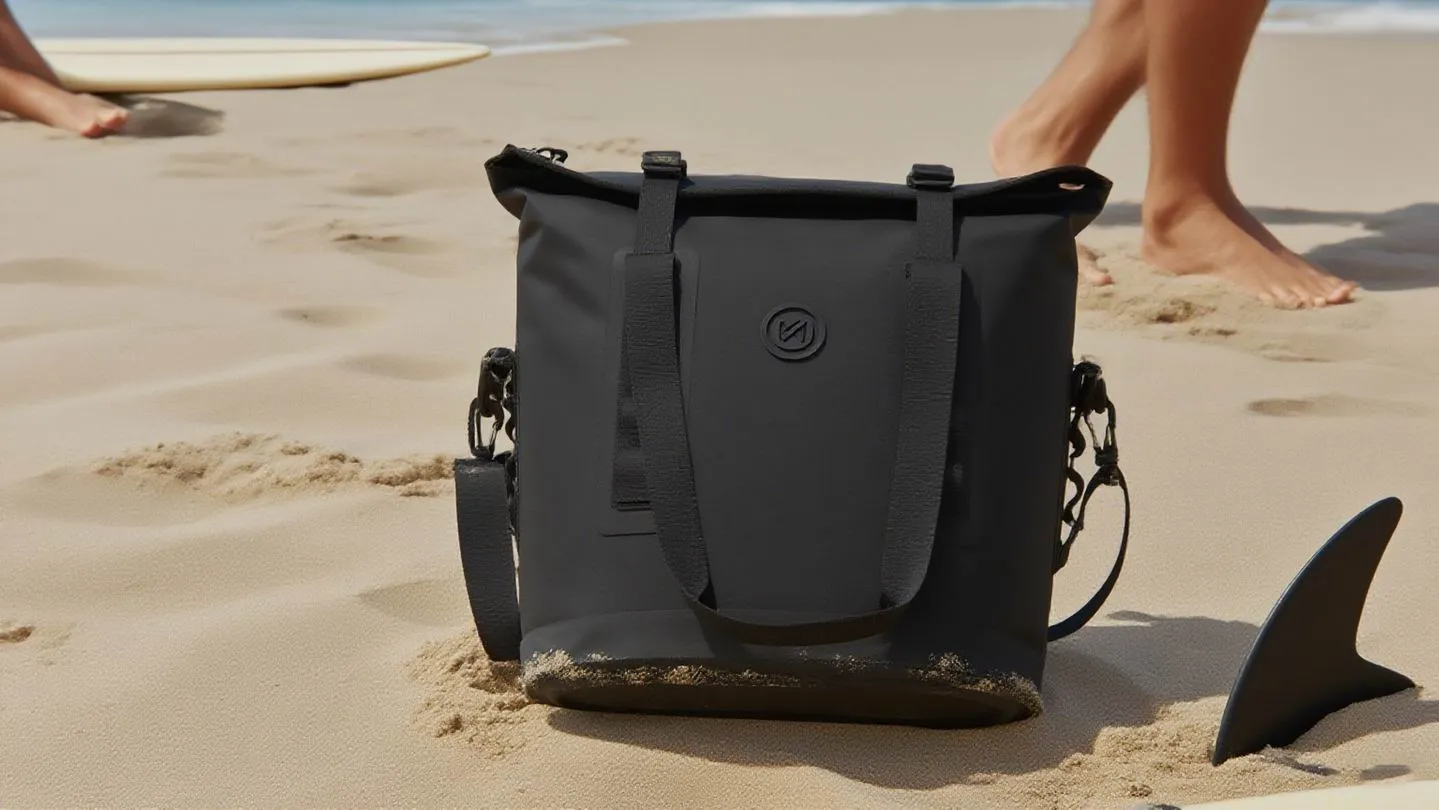
Tote and beach is the family where welded construction earns its keep for reasons that have nothing to do with submersion. A beach tote gets filled with wet towels, sunscreen, sand and a rinsed snorkel, then thrown in a car boot. It needs to hold water in, keep sand out, wipe clean and stand up when set down. Sewn totes fail all four. Welded tarpaulin totes pass all four, and they do it at a unit cost that leaves room for a healthy retail margin, which is why this family has grown faster than any other in our order book over recent seasons.
Two Constructions: Tarpaulin and TPU Film
PVC 500D tarpaulin with a 0.35 mm coating is the workhorse. It is stiff enough that a large tote holds its shape empty, it takes a printed graphic well, and it is the cheapest welded material we run. Its limitations are weight, cold-weather stiffness and the compliance conversation in some European retail channels. TPU film laminate at 0.2 mm on a 500D or 840D polyester face is the alternative: lighter, softer in the hand, flexible in the cold, and easier to sell into channels with restricted-substance requirements. We build both, and we often build the same silhouette in both, positioning the tarpaulin version as the promotional price point and the TPU version as the retail one.
Closure and Handle Engineering
An open-top tote is not a waterproof product, and we describe it honestly as water-holding rather than waterproof: the welded body will contain a wet swimsuit, but it will not survive being dropped in a pool. Buyers who need a submersible claim specify a roll-top or a coated zip under a flap, which takes the rating to IPX6 or IPX7. Handles are the other engineering decision. A welded handle is a strip of the same material folded and welded to the body, which is strong, cheap and can be welded in a continuous run. A webbing handle is softer in the hand and available in more colours, but it has to be anchored to a reinforced patch with bar-tacking at 8–10 SPI, and the anchor becomes the failure point under heavy load. We offer both and recommend webbing only on styles under 25 L.
Size Bands and Retail Positioning
The family runs five base styles from 12 L to 40 L. Twelve to eighteen litres is a handbag-adjacent everyday tote that sells year-round rather than seasonally. Twenty-five litres is the classic beach tote. Forty litres is a family beach or pool bag, and it is the size at which a shoulder strap becomes necessary rather than optional. Because the panels are flat and welded, print area is generous on both faces, and we support full-panel sublimation on the polyester-faced TPU shells and screen print or heat transfer on PVC. Interior organisation is a welded slip pocket and a key clip as standard; a welded wet pocket is a common upgrade.
| Volume | Construction | Closure | Handles | Rating | Seasonality |
|---|---|---|---|---|---|
| 12–18 L | Hot-air welded TPU, 0.20 mm | Open, magnetic or zip | Webbing or welded | IPX5–IPX6 | Year-round |
| 25 L | Hot-air welded tarpaulin | Open or zip under flap | Welded flat strip | IPX6 | Summer peak |
| 32 L | High-frequency welded PVC 500D | Zip under storm flap | Welded flat strip | IPX6 | Summer peak |
| 40 L | High-frequency welded PVC 500D | Roll-top or zip | Welded + shoulder strap | IPX6–IPX7 | Summer, family |
Totes are also the family most often used for promotional and corporate programmes, where the unit cost target is tight and the graphic matters more than the rating. Our services page sets out how we handle print development, and contact page is where to send a brief.
Sports and Gym Bags: Wet-Dry Separation Systems
Sports and gym bags are built on the duffel platform with one addition that changes the whole product: a sealed wet compartment. A swimmer, a triathlete or a regular gym user generates a genuinely wet load every single session, and putting that load in the same undivided volume as a dry change of clothes defeats the purpose of a waterproof bag. The wet-dry split is therefore not a feature but the reason the product exists, and it is the detail that separates a welded gym bag from a sewn one sold with a waterproof claim.
How the Split Is Built
There are three ways to separate a wet volume from a dry one, and they sit at very different price points. The cheapest is a lined pocket: a PVC-coated polyester sleeve sewn into the bag with taped seams. It works until the tape lifts. The middle option, and our default, is a fully welded compartment formed by welding an internal panel across the body, so the wet side is a sealed box with no stitch lines at all and rated to IPX7 on its own. The most expensive is a removable welded liner that lifts out for cleaning and can be sold separately as an accessory. We specify the welded internal panel for most programmes because it delivers the performance of the removable liner at close to the cost of the sewn sleeve, and because it survives the hosing-down that a gym bag inevitably gets.
Ventilation, Drainage and Odour
A sealed wet compartment has one problem: it holds moisture against fabric long enough to smell. The engineering answers are a drain grommet at the lowest corner of the wet volume, a welded mesh vent panel high on the wet side, and an antimicrobial finish on the liner film. The drain grommet is the one we recommend above all others, because it lets a user rinse the compartment and walk away. Vent panels work but they reduce the rating, so a vented wet compartment is honest at IPX5 rather than IPX7. Any buyer marketing a gym bag should decide which claim matters more and tell us early, because the choice is welded into the tooling rather than added later.
| Split type | Wet side rating | Cost index | Cleanability | Recommended for |
|---|---|---|---|---|
| Taped sleeve | IPX4 | 1.0 | Wipe only | Promotional price points |
| Welded internal panel | IPX7 | 1.3 | Rinse and drain | Retail sport and swim |
| Welded panel with vent | IPX5 | 1.4 | Rinse, drain, air | Daily gym use |
| Removable welded liner | IPX7 | 1.7 | Remove and wash | Premium and team kit |
The rest of the specification follows the duffel platform: 840D polyester TPU shells, high-frequency welded main seams, Duraflex hardware, a coated zip main opening with a storm flap, and a shoe compartment on the 40 L and larger styles. Volumes run 20 L to 60 L across five base styles. Buyers building a swim or triathlon range usually pair a 30 L wet-dry duffel with a 5 L accessories pouch from the small-format family, which is the cheapest way to offer a two-piece set. Full detail is on the sports bags page.
Small Accessories: Pouches, Sleeves, Packing Cubes, Phone Cases
Small accessories are the most underused category in most buyers' ranges, and the most profitable per cubic metre of container space. A 1 L phone pouch costs a fraction of a 30 L duffel, ships in a fraction of the volume, and is the product a customer buys impulsively at the checkout next to the bag they came in for. They also solve a real merchandising problem: they let a brand offer a nine-item range instead of a five-item range without committing to nine sets of tooling, because accessories reuse the welding fixtures, the offcut material and the trim stock of the larger families.
The Four Accessory Formats
Pouches are the core format, running from 0.5 L to 5 L with a roll-top or a coated zip, and they are the natural companion to dry bags and totes. Sleeves are slim welded envelopes for tablets, laptops and documents, built with a welded base and a roll-top or hook-and-loop closure, and they sell well into commuter and business-travel channels. Packing cubes are the fastest-growing format: a set of three welded cubes with a clear TPU window, sized to nest inside a travel duffel, and they convert a plain duffel into an organisation system at a modest unit cost. Phone cases are the highest-volume, lowest-cost item, a welded envelope with a clear front window and an adjustable lanyard, rated IPX7 or IPX8.
Why Accessories Belong in a First Programme
Three commercial reasons, beyond the margin. First, they consume offcut material: the panel shapes left over from cutting a 40 L duffel are large enough for a pouch, which means material yield on a mixed order improves and unit cost falls. Second, they absorb minimum-order risk: a buyer who is unsure whether a colourway will sell can test it on 500 pouches rather than 500 duffels, at roughly a fifth of the commitment. Third, they are the cheapest way to fill a shipping container, and a container that cubes out rather than weighs out is a container that ships at a lower cost per unit. Every mixed programme we run benefits from having at least two accessory SKUs in it.
| Format | Volume | Shell | Closure | Rating | Paired with |
|---|---|---|---|---|---|
| Roll-top pouch | 0.5–5 L | 420D ripstop / 0.10 mm TPU | Roll-top, 3 turns | IPX7 | Dry bags, totes |
| Device sleeve | 1–3 L | 500D TPU, padded | Roll-top or hook-and-loop | IPX6 | Backpacks, travel |
| Packing cube | 3–10 L | 420D TPU + clear window | Coated zip | IPX5 | Duffels, travel |
| Phone case | 0.5 L | Clear TPU front, 420D back | Roll-top + lanyard | IPX8 | All families |
Choosing Between Families for a New Brand Launch
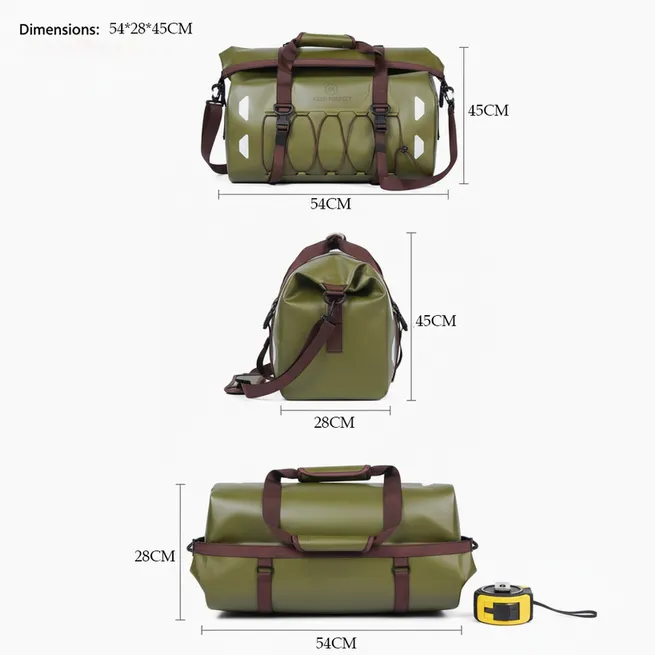
A brand launching into waterproof bags almost never needs all six families in season one, and the ones that try usually end up with unsold inventory in three of them. The useful question is not which families exist but which combination of two or three gives a coherent shelf, a defensible story and a total commitment the buyer can actually fund. We have watched enough launches to have a view on which combinations work, and the reasoning comes down to three variables: who the customer is, where the product is sold, and how much capital the first order can absorb.
Start From the Use Case, Not the Shape
The most common mistake in a first brief is specifying shapes before specifying users. A buyer asks for a 30 L backpack and a 20 L dry bag without deciding whether the customer is a kayaker, a commuter or a festival-goer, and the resulting range has no story and no clear merchandising logic. Start instead with one sentence describing the customer's day: they paddle, they commute, they travel for work, they fish on weekends. That sentence selects the family. A paddler needs dry bags first and a backpack second. A commuter needs a backpack first and a device sleeve second. A weekend angler needs a tackle bag first and a wader bag second. Two families follow from one sentence, and two families can be sampled in parallel inside the same 6–10 working days.
Three Launch Combinations That Work
The outdoor entry combination is dry bags plus backpacks: four dry bag sizes and two backpack tiers give eight SKUs, 4,000 pcs at MOQ, and a shelf that reads as a paddling and hiking brand. The travel-adjacent combination is duffels plus packing cubes: three duffel sizes and a three-cube set gives six SKUs and a strong organisation story, and it sells well into luggage and lifestyle channels. The warm-weather combination is totes plus accessories: three tote sizes and three pouch sizes is six SKUs at low unit cost, seasonally spiky but cheap to hold. Buyers whose capital is constrained should note that the third combination costs roughly half the first, because totes and pouches use far less material.
What to Leave for Season Two
Cooler bags and fishing bags are the two families we advise most buyers to defer. Both carry extra development load: coolers need insulation sourcing and food-contact documentation, and fishing bags need marine hardware that extends sampling to 12–15 working days. Neither is difficult, but both consume calendar time that a first launch does not have. Add them in season two, once the brand's colourway and trim language is established, and they arrive into a range that already looks coherent. That is the sequence our two-year roadmap section below describes in detail.
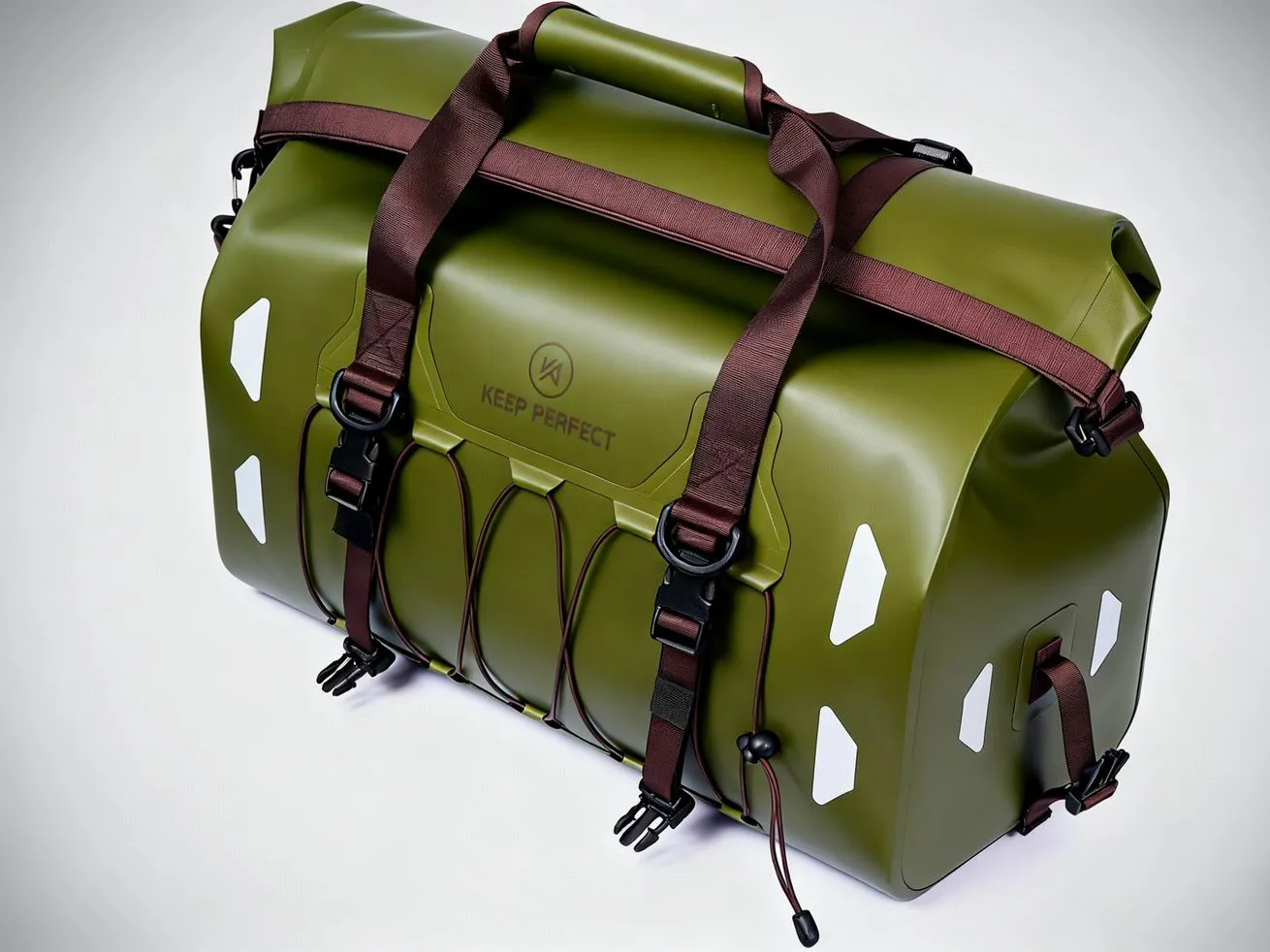
Whichever combination you choose, the commercial constants do not change: 500 pcs per style and colourway, sampling in 6–10 working days, production in 35–50 days after approval, FOB Xiamen, T/T 30% deposit and 70% before shipment, and a 12-month warranty against manufacturing defects. Our services page explains how a brief becomes a tech pack.
Cross-Family Material Consistency: Building a Coherent Collection
A range looks like a range when a customer can put a dry bag, a backpack and a tote side by side and see one material language. It looks like a warehouse when each item was sourced on its own. Material consistency is the cheapest way to buy that coherence, because the same laminate roll can feed three families and the same welding parameters apply across all of them. It also has a hard commercial payoff: consolidated material purchasing lowers the per-metre cost, and a shared specification means a defect found in one family can be checked across the others in a single test run.
Pick One Face Fabric and One Film
The simplest discipline is to choose a single face fabric and a single film thickness for the whole collection and deviate only with a reason. A 500D polyester face with a 0.15 mm TPU film works across dry bags from 15 L up, commuter backpacks, travel duffels to 60 L, cooler outer shells and totes. That single specification covers most of a catalogue. Deviations are then deliberate and defensible: 420D ripstop at 0.1 mm for the ultralight 5 L and 10 L dry bags and for packing cubes, and 840D or 1000D at 0.25–0.3 mm for expedition backpacks, 90 L duffels and marine bags. Three specifications, clearly tiered, is a coherent collection. Nine specifications is a procurement problem.
Standardise Hardware and Trim Families
Hardware is where inconsistency shows first, because a customer sees a buckle long before they read a fabric label. We recommend one buckle family and one zip family per collection. Duraflex acetal side-release buckles across dry bags, backpacks and duffels; YKK AquaGuard #5 on commuter and accessory openings and #8 on trail main openings; ITW Nexus hardware where a marine or high-load anchor is needed. Webbing should be one width and one weave per tier, and stitch density held at 8–10 SPI across every sewn join so the visual rhythm of the stitching matches from bag to bag. Zips and webbing from a single supplier family also means a single set of compliance files to hold on file.
| Specification layer | Default across the collection | Deliberate deviation | Why it matters commercially |
|---|---|---|---|
| Face fabric | 500D polyester | 420D ripstop, 840D, 1000D | One roll feeds three families |
| Film | TPU 0.15 mm | 0.10 mm light, 0.30 mm heavy | Shared welding parameters and tooling |
| Seam method | RF or high-frequency weld, ≥ 8 N/cm | Hot-air on ripstop | One peel test protocol covers all styles |
| Buckles | Duraflex acetal | Stainless in marine | Visual consistency at the point of sale |
| Zips | YKK AquaGuard #5 / #8 | TIZIP MasterSeal 10 on cargo | One compliance file set |
| Back coating | PU 0.15 mm | None on clear-window panels | Predictable bond strength |
| Stitch density | 8–10 SPI, 20 mm taped | Bar-tack on load anchors | Matching visual rhythm across sizes |
Where PVC tarpaulin is chosen for totes or cargo bags, we still hold the trim, hardware and stitch specification constant, so the material change reads as a deliberate price-point tier rather than a sourcing accident. That distinction is what separates a considered range from a mixed one, and it is visible to a retail buyer in about five seconds on a shelf. Testing protocols for each layer are described on the quality page.
Colourway and Trim Standardisation Across a Range
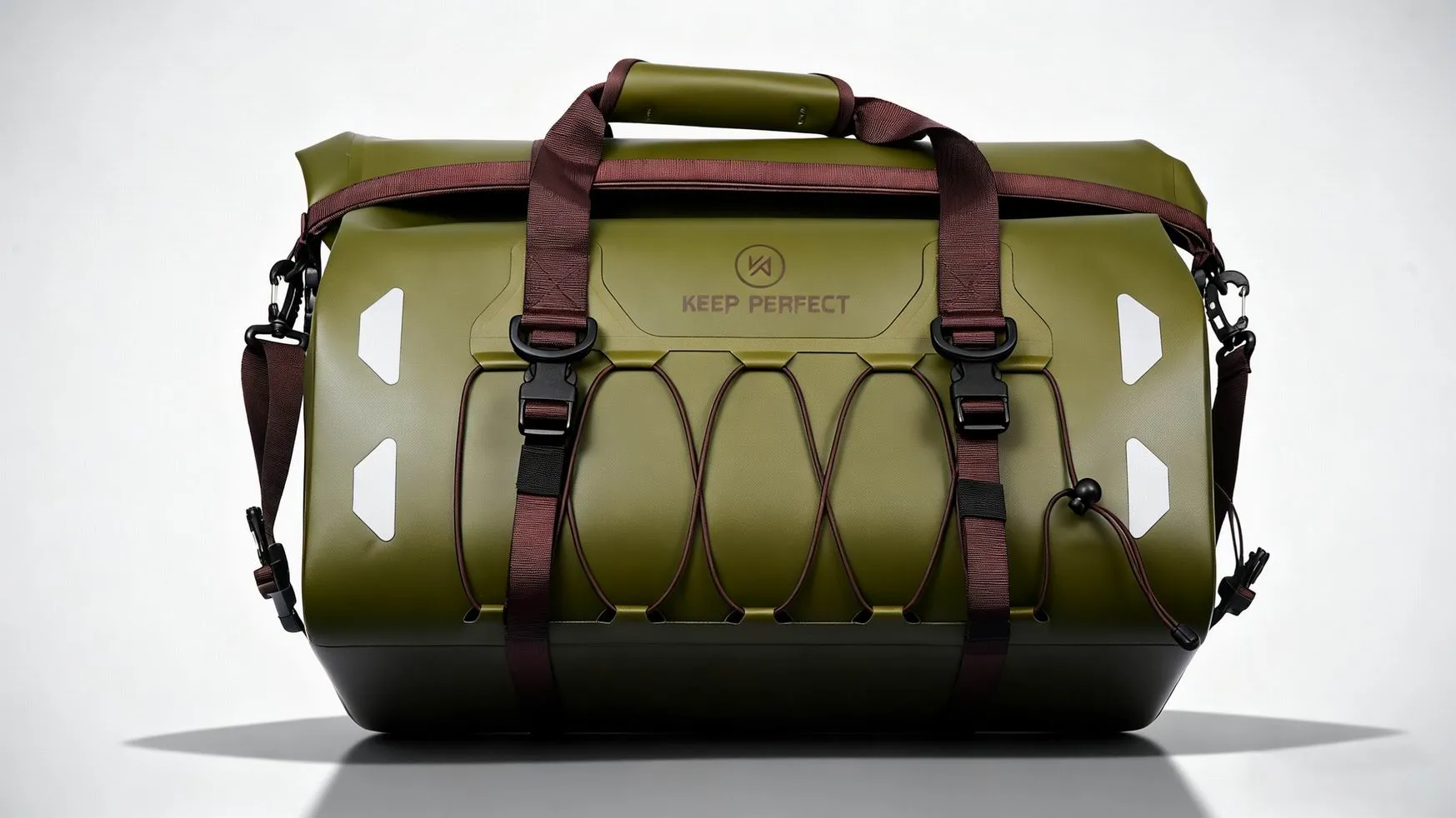
Colourway discipline is where most first ranges quietly lose money. Every colourway is a separate SKU at 500 pcs, every colourway needs its own fabric booking, and a fabric mill will not always dye 300 metres to match a swatch. Buyers who open with eight colourways across three styles discover that they have committed to 4,000 pcs of inventory spread so thin that no single colour has enough depth to merchandise. Three colourways across five styles concentrates the same 4,000 pcs into a shelf that looks deliberate and a fabric booking the mill will actually accept.
How Many Colourways for a First Season
Our working recommendation is one core colourway, one accent colourway and one seasonal colourway. The core is black or a deep neutral, it carries roughly 60% of the volume, and it is the colour you reorder every year without discussion. The accent is the brand's signature, carries 30%, and appears on every style so the range reads as one family. The seasonal colour carries 10%, appears on two or three styles only, and is the item you use to test whether a palette has legs. If it sells, it becomes next year's accent. If it does not, you have 500 pcs to clear rather than 2,000.
Dye Lots, Trim Matching and Repeat Orders
Three practical problems come up repeatedly. The first is dye-lot drift: a polyester dyed in March and the same reference dyed in September will not be identical, and on a welded product the panels sit side by side with no seam to disguise the difference. We hold a reference swatch for every booked colourway and check against it at goods-in. The second is trim matching: webbing, zip tape and buckle bodies are dyed by different suppliers to a Pantone reference, and a buckle that matches the fabric in one light will not in another. We specify trim to a single Pantone reference per colourway and approve a physical match before cutting. The third is repeat ordering: reorder the core colourway early enough that the mill still has the reference active.
| Colourway role | Share of volume | Appears on | Reorder policy | Risk |
|---|---|---|---|---|
| Core neutral | 60% | Every style | Standing annual reorder | Low |
| Brand accent | 30% | Every style | Reorder while mill reference is active | Medium, dye-lot drift |
| Seasonal test | 10% | Two or three styles | Reorder only on sell-through | Higher, but volume is small |
Logo treatment should be standardised in the same pass. One logo artwork, one placement rule and one application method across the collection keeps the range coherent and keeps the printing fixture count down. Screen print suits flat PVC panels and holds up on tarpaulin totes; heat transfer suits TPU laminates and gives finer detail on backpacks; a woven label on a welded tab suits buyers who want a subtle mark. Mixing three application methods across a five-style range is a cost and a consistency problem with no upside. Our services page covers artwork and placement development.
Volume Planning: How 5,000 pcs Should Split Across Styles
Five thousand pieces is the volume at which a new waterproof range becomes real. It is ten SKUs at MOQ, it fills most of a 20-foot container depending on the style mix, and it is enough to merchandise a category without being enough to survive a misjudged colourway. The interesting planning question is not the total but the split, because the split determines whether the container cubes out or weighs out, whether the fabric mill takes the booking seriously, and whether the range has a coherent entry price and a credible top.
A Worked Split for an Outdoor Range
For a paddling and hiking brand, we would suggest four dry bag SKUs at 1,800 pcs, two backpack SKUs at 1,200 pcs, two travel or duffel SKUs at 900 pcs, and two accessory SKUs at 1,100 pcs. That is 5,000 pcs across ten SKUs. The dry bags carry the volume because they are the entry price point and the highest-turn item; the backpacks carry the margin; the duffels give the range a top end; the accessories fill the container and lift the blended margin. The alternative error is to spread 5,000 evenly at 500 pcs across ten unrelated styles, which produces no depth anywhere and a container that is hard to merchandise.
Container Economics and Style Mix
Two things decide whether 5,000 pcs ships efficiently. Weight matters for PVC tarpaulin: a 40 L welded PVC tote is heavy, and a container of them will hit the weight limit before it is full. Volume matters for dry bags and backpacks, which are light but bulky when packed flat, and a mixed order that includes rigid-base tackle bags or framed expedition packs cubes out faster than a buyer expects. The practical fix is to pair heavy items with light bulky ones, and to let us run the packing simulation before you commit, because a container that cubes out at 4,200 pcs has an effective unit freight cost 19% higher than one that reaches 5,000.
| Family | SKUs | Pieces | Share | Role in the range | Packing behaviour |
|---|---|---|---|---|---|
| Dry bags | 4 | 1,800 | 36% | Entry price, highest turn | Light, bulky, cubes out |
| Waterproof backpacks | 2 | 1,200 | 24% | Margin driver | Bulky when framed |
| Travel and duffel | 2 | 900 | 18% | Top-end price anchoring | Compressible, moderate |
| Accessories | 2 | 1,100 | 22% | Fills space, lifts margin | Dense, absorbs dead space |
Sequencing the Deliveries
A 5,000-pc opening order rarely needs to arrive in one shipment, and splitting it usually improves cash flow and reduces warehousing. A common pattern is to ship the dry bags and accessories first, because they are the fastest to produce and the items a launch campaign leads with, then the backpacks, then the duffels, with roughly two weeks between sailings. Because all families share the 35–50 day production window after sample approval, the sequencing is a matter of staggering sample approval rather than negotiating different lead times. We can also hold a portion of the order in Quanzhou against a call-off schedule for buyers with constrained warehouse space.
Every figure in this section assumes FOB Xiamen pricing and the standard 500 pcs per style and colourway minimum. Buyers comparing CIF or DDP against FOB should ask for both, but should base the comparison on the FOB number, because that is the figure that moves with volume. Our contact page is where to send a split for review.
Building a Two-Year Product Roadmap With a Single Supplier
The strongest argument for running a whole waterproof range through one factory is not unit price. It is that a single supplier holds your material references, your tooling, your approved samples and your test history, and that accumulated context compounds. A second season with the same factory skips the sampling iteration that consumed six weeks of the first one, because the material is booked, the fixtures exist and the tech pack is a revision rather than a blank page. Over two years that saving is worth more than the difference in unit cost between two quotations.
Year One: Establish the Platform
Year one should be narrow and deep rather than wide and thin. Two families, eight to ten SKUs, 4,000 to 5,000 pcs, three colourways, one logo treatment, one trim package. The goal of year one is not margin maximisation; it is establishing the material language and finding out which two or three SKUs actually turn. Expect roughly 30% of the range to carry 70% of the sales, and expect that you will not correctly guess which 30% in advance. Year one also fixes the compliance file set: fabric declarations, hardware test reports and any food-contact documentation you will need later for coolers.
Year Two: Extend, Then Deepen
Year two does two things in a specific order. First, extend into one new family that is adjacent to what already sells: if dry bags and backpacks turned, add travel and duffel; if totes turned, add cooler bags, because both are warm-weather, outdoor-leisure products with overlapping customers. Second, deepen the winners: add the two sizes that were missing from the ladder, add the accent colourway that tested well as a full-season item, and add accessory SKUs that pair with the best seller. Deepening is cheaper than extending, because it reuses existing tooling, and it raises sell-through on the SKUs the market has already validated.
Why Continuity Beats Re-Quoting Every Season
Re-quoting a mature style every season looks prudent and usually costs money. A new factory quotes against a tech pack and quotes defensively, because it has not yet discovered where the difficulty is. An incumbent quotes against a known bill of materials, known yield and known cycle time, and can price the second repeat order with confidence. Continuity also protects quality: the welding parameters that produce an 8 N/cm peel joint on your 500D TPU shell are already set on the machine, and the inspector who knows your acceptable trim placement is still on the line. Our seven production lines and 200,000 pcs monthly capacity across a 4,950 m² facility exist to absorb that continuity without a capacity cliff when your volumes grow.
| Phase | Families | SKUs | Volume | Sampling load | Objective |
|---|---|---|---|---|---|
| Year one, H1 | 2 | 8–10 | 4,000–5,000 | 6–10 working days per style | Fix material and trim language |
| Year one, H2 | 2 | +2 sizes | 1,500–2,500 | Revisions only, faster | Fill ladder gaps from sell-through |
| Year two, H1 | 3 | +4 to 6 | 6,000–8,000 | 12–15 days for complex new styles | Extend into one adjacent family |
| Year two, H2 | 3 | Deepen winners | 8,000–12,000 | Repeat orders, minimal sampling | Consolidate and cut tail SKUs |
If you want to understand the production side of that roadmap before committing, read the manufacturing page for the line layout and the about page for the company background. Both are relevant to a supplier decision that is expected to run for years rather than one season.
Frequently Asked Questions
What is the minimum order quantity for a waterproof bag programme?
MOQ is 500 pcs per style and colourway. The same 30 L duffel in black and in olive counts as two SKUs and requires 1,000 pcs total. Ten SKUs across three styles in three colourways works out at roughly 5,000 pcs, which is the volume most first programmes land on. Accessory SKUs carry the same 500 pcs minimum but consume far less material, so they are the cheapest way to test a colourway before committing to a full-size bag.
How long does sampling take across different product families?
Standard sampling is 6–10 working days for styles built on an existing platform, which covers most dry bags, backpacks, totes and accessories. Briefs involving a moulded component, a laminated insulation stack, marine-grade hardware or a hybrid closure take 12–15 working days. That longer window applies most often to cooler bags and to fishing bags specified to a 48-hour salt spray requirement, so plan those families with extra calendar time.
What is the production lead time after sample approval?
Bulk production runs 35–50 days after sample approval, measured from written approval rather than from the date samples were shipped. The range reflects line loading and material booking rather than uncertainty: a repeat order on an existing specification with material in stock sits at the short end, while a first order requiring a new fabric booking sits at the long end. Shipping from FOB Xiamen follows on top of the production window.
Can I mix several product families in one order?
Yes, and we recommend it. Mixed-family orders improve container utilisation because light bulky items such as dry bags and backpacks pair well with dense accessories, and they let you build a coherent shelf from a single shipment. Each style still carries its own 500 pcs per colourway minimum, so a mixed order of ten SKUs is 5,000 pcs regardless of how those pieces are distributed across families.
Which inspection standard do you apply to finished goods?
Finished goods are inspected to AQL 2.5 under ISO 2859-1. Inspection covers weld integrity, closure function, hardware operation, print placement and dimensional tolerance, with seam peel strength verified on samples pulled from each production lot rather than annually. Buyers who require a tighter level, or a specific third-party inspection, should say so at quotation stage so the cost and the calendar can be built in from the start.
What payment and trade terms do you work on?
Standard terms are T/T with a 30% deposit and 70% balance before shipment, quoted FOB Xiamen. We can quote CIF or DDP to a named port or address for comparison, but the FOB Xiamen figure remains the pricing basis, because that is the number that moves with volume and the number you should use when comparing suppliers. Payment terms for long-running repeat programmes can be discussed once there is order history.
Do you offer a warranty on manufactured bags?
Every bag we ship carries a 12-month warranty against manufacturing defects. In practice that covers weld failure, seam separation, hardware detachment and closure faults arising from how the bag was made. It does not cover abrasion from normal use, damage from sharp objects, or degradation from prolonged UV exposure beyond the service life of the film, all of which are use conditions rather than manufacturing faults.
Which waterproof rating should I specify for my range?
Specify the rating your customer's use actually requires, not the highest number available. IPX4 to IPX6 suits commuter and travel bags that face rain and spray. IPX7, meaning survival of temporary immersion, suits dry bags, wader bags and expedition duffels. IPX8 is reserved for small accessories and 40 L and larger dry bags with four roll turns. Over-specifying raises unit cost and can compromise access convenience for no benefit.
What is the difference between welded and taped seams?
A welded seam melts two TPU faces into one continuous mass, so there is no needle hole to leak. A taped seam sews the panels first at 8–10 SPI and covers the stitch line with 20 mm tape, which depends on adhesive, heat and surface preparation. We weld main seams wherever geometry allows and reserve taped seams for structural joins where sewing is unavoidable. Welded joints are specified to a peel strength of at least 8 N/cm.
Can you match a specific Pantone colour across fabric and trim?
Yes. We book fabric to a reference and specify webbing, zip tape and buckle bodies to the same Pantone reference, then approve a physical match before cutting. Be aware that different materials take dye differently, so a buckle that matches fabric in daylight may not match under retail lighting. We approve the match on physical samples under standard lighting and hold a reference swatch for every booked colourway to control dye-lot drift on reorders.
How many colourways should a first season carry?
Three: one core neutral carrying about 60% of volume and appearing on every style, one brand accent carrying roughly 30% and also on every style, and one seasonal test at about 10% on two or three styles. More colourways fragment the fabric booking, fragment the shelf and multiply the number of SKUs you are holding at 500 pcs each. Test a fourth colour on accessories, where the commitment is far smaller.
Can I use my own logo and packaging?
Yes. We apply customer logos by screen print on flat PVC panels, heat transfer on TPU laminates, or a woven label on a welded tab, and we recommend one application method across a collection for consistency. Retail packaging, hangtags and barcodes can be supplied by you or sourced by us, and we pack to your carton specification including mixed-SKU cartons for buyers shipping direct to retail.
Which fabrics and components do you use as standard?
Face fabrics are 420D nylon ripstop, and 500D, 840D and 1000D polyester, laminated with TPU film from 0.1 mm to 0.3 mm, or PVC 500D with a 0.35 mm coating for tarpaulin styles. Hydrostatic head is at least 10,000 mm on lightweight shells and above 20,000 mm on heavy duty. Zips are YKK AquaGuard #5 and #8 or TIZIP MasterSeal 10 for cargo closures; buckles are Duraflex, YKK or ITW.
Can you help plan how my volume should be split across styles?
Yes, and it is worth doing before you place the order. Send us your target total, your channel and your customer profile, and we will propose a split by family and SKU, then run a packing simulation to show whether the container cubes out or weighs out. A mix that cubes out early has a materially higher unit freight cost, and that is far cheaper to fix on a spreadsheet than after production.
How do we start a programme with your factory?
Send a brief describing the customer, the families you want, target volumes, colourways and any compliance requirements your channel imposes. We respond with a proposed style shortlist from the existing platform, a specification sheet and a quotation on FOB Xiamen. Once the specification is agreed we move to sampling at 6–10 working days, then to production at 35–50 days after your written approval.
Get a Quotation in 24 Hours
Send the brief you have — even a photo of a competitor sample works. You get back an itemised price by quantity break, MOQ per style and colourway, sampling cost and lead time, bulk lead time, and a separate tooling line if your build needs dies, plates or moulds. MOQ 500 pieces per style and colour. Samples 6–10 working days. Bulk 35–50 days. FOB Xiamen.
What Speeds It Up
Fabric and coating. A 500D polyester with PU coating prices very differently from a 420D nylon with TPU lamination. If you have no preference, say so — we propose two options at different price points.
Seam construction. Sewn-and-taped versus welded changes both the labour content and the achievable water resistance.
Your target landed cost. Not to negotiate against you — to tell you early which specifications cannot fit inside it, before anyone spends two weeks on a sample.
Destination port. FOB Xiamen is our default; DDP is quoted on request with duty and clearance shown as separate lines.