
Waterproof Levels: From Water-Repellent Finish to IP69K Wash-Down
Waterproof levels are an eight-step ladder that tells a buyer exactly what a bag survives: Level 0 carries no claim, Level 1 is a water-repellent finish, Level 2 resists rain, Level 3 survives splashing (IPX4), Level 4 survives water jets (IPX5 and IPX6), Level 5 survives 30 minutes of immersion (IPX7), Level 6 survives continuous submersion (IPX8) and Level 7 survives high-pressure hot wash-down (IP69K). The closure sets the ceiling. A roll-top, a waterproof zipper or a magnetic seal decides the highest level a bag can honestly claim, because water enters through the opening and the seam long before it pushes through the coating. Specify the level first; the fabric is only the input that supports it.
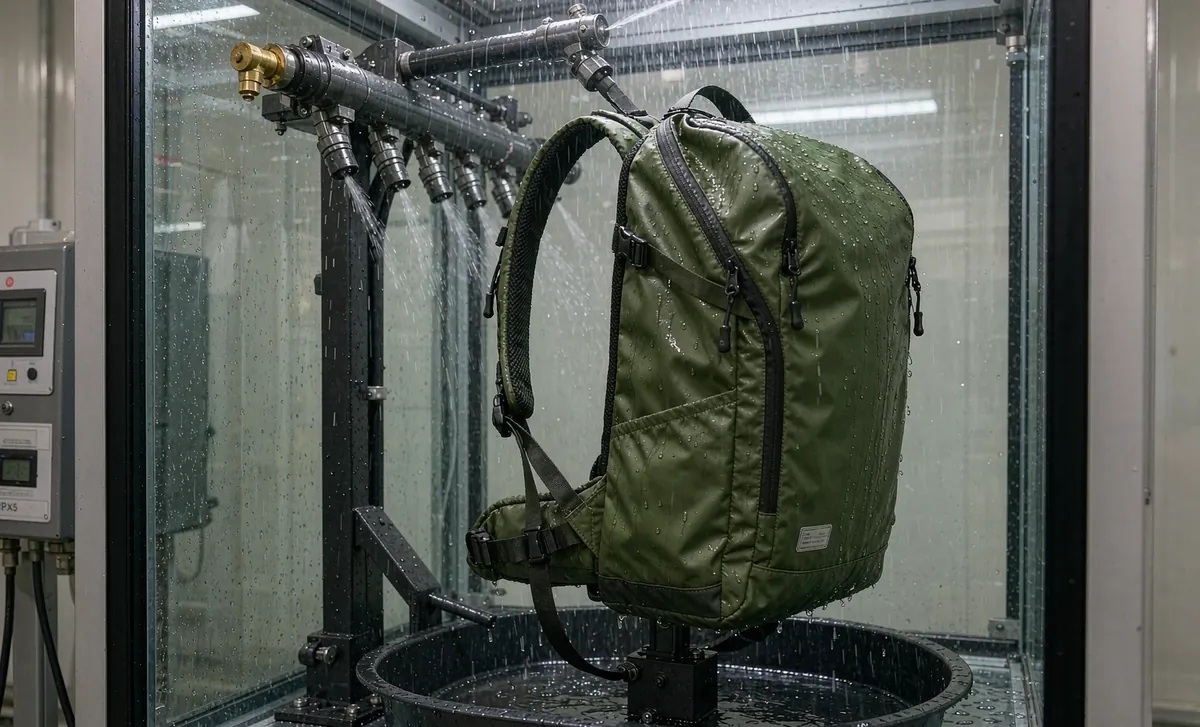
Table of Contents
- Why "Levels" Is the Most Useful Word in Waterproofing
- Level 0: No Claim, and When That Is Honest
- Level 1: Water-Repellent Finish
- Level 2: Water-Resistant Construction
- Level 3: Splash-Proof (IPX4)
- Level 4: Jet-Proof (IPX5 and IPX6)
- Level 5: Temporary Immersion (IPX7)
- Level 6: Continuous Submersion (IPX8)
- Level 7: Pressure Wash and Wash-Down (IP69K)
- Mapping Levels to Everyday Scenarios
- Mapping Levels to Industry Requirements
- The Closure Is the Level Ceiling
- Seam Construction Sets the Achievable Level
- Zipper vs Roll-Top vs Magnetic Seal by Level
- Level vs Material: Coating Weight and Denier
- Level vs Price: Cost Curve Across the Ladder
- Level vs Lifetime: How Each Degrades
- Testing Evidence Required for Each Level
- How Retailers and Marketplaces Read Levels
- Claim Language: Writing Levels Into Copy Safely
- Building a Level Ladder Across a Brand Catalogue
- Common Level Misrepresentations to Avoid
- Specifying a Level in an RFQ Without Ambiguity
- Level Audit: Verifying a Shipment Matches the Claim
- Frequently Asked Questions
- People Also Ask
Why "Levels" Is the Most Useful Word in Waterproofing
Ask ten suppliers whether a bag is waterproof and you will hear ten yes answers describing ten very different products. The word is binary, while the physics is a continuum. A daypack that beads a five-minute drizzle and a cargo dry bag that keeps a sleeping bag dry under one meter of water for thirty minutes are both sold as waterproof, yet they sit four rungs apart. For a procurement team that gap is the risk. Waterproof levels replace a yes-or-no argument with a numbered ladder you can write into a tech pack, verify against a named test method, and audit again at pre-shipment.
| Level | Name | Survives | Evidence | Closure | Cost index |
|---|---|---|---|---|---|
| 0 | No claim | Dry conditions only | None | Open or flap | 1.00 |
| 1 | Water-repellent finish | Brief drizzle | AATCC 22 | Covered zipper | 1.05 |
| 2 | Water-resistant | Sustained rain | ISO 811, AATCC 127 | Storm flap | 1.15 |
| 3 | Splash-proof | Splashing, any direction | IEC 60529 IPX4 | Coated zipper, taped seams | 1.30 |
| 4 | Jet-proof | Nozzle jets | IEC 60529 IPX5, IPX6 | Waterproof zipper, welded seams | 1.55 |
| 5 | Temporary immersion | 30 minutes at 1 meter | IEC 60529 IPX7 | Roll-top or submersible zipper | 1.85 |
| 6 | Continuous submersion | Depth and time per report | IEC 60529 IPX8 | Welded body, sealed closure | 2.20 |
| 7 | Wash-down | Hot high-pressure jets | ISO 20653 IP69K | Fully welded, no textile path | 2.80 |
Read the ladder as a ceiling, not an average: every level is an independent gate. A Level 5 bag survives thirty minutes at one meter because its closure and seams hold under static pressure, but it is not automatically jet-proof, because a jet attacks the closure at a velocity immersion never reproduces. A Level 4 bag that survives a jet may still take water if a buyer floats it. A product may only claim the highest level it has passed, supported by a dated report naming the method and sample. The payoff is commercial: name the level and you have also named the closure, the seam method and the cost band. That is why every technical discussion on our waterproof bag programme range starts with a level.
Level 0: No Claim, and When That Is Honest
Level 0 is the rung most buyers forget exists, and it is often the correct one. A Level 0 product has no finish, no coating, no membrane and no seam treatment: a plain woven shell, usually polyester or nylon in the 210D to 600D range, sewn on a standard lockstitch machine with no tape, no sealant and no weld. It will wet through in seconds under rain. Stating that plainly is not a weakness in a specification. It is the honest answer for packing cubes, interior organizers, dust covers, retail gift totes, shoe compartments inside a larger bag, and any component that lives inside a shell and never sees weather on its own.
Choose Level 0 when the buying priorities are hand feel, breathability, print quality, low unit cost and end-of-life simplicity. An uncoated mono-material shell prints cleanly, takes a heat transfer without coating migration, has no coating odor, needs no PFAS chemistry to satisfy REACH-driven brand restrictions, and is easier to recycle because there is no laminate to separate. It is also the lightest option by a wide margin. Against that, you accept that the product cannot be photographed in rain, cannot be sold with any water claim, and will stain or wick if a user sets it on wet ground. The trade is deliberate, not accidental.
Write Level 0 into the tech pack as a positive statement rather than a silence, because silence is what gets filled in later by a marketing team. Use wording such as: not water-resistant, not intended for wet environments, wipe clean only. Instruct the photography studio to keep water out of the scene, and put the same statement on the care label and the product page. Interior components of a Level 5 dry bag are frequently Level 0 by design, and that is fine as long as the assembly claim rests on the shell, not on the pockets. Bring this decision into the brief early through our custom development pathway, so artwork, fabric booking and claim review all run on the same assumption.
Level 1: Water-Repellent Finish
Level 1 is a finish, not a barrier. A durable water repellent is applied to the face of the fabric so that water beads and rolls off instead of wetting out immediately. Performance is measured as a spray rating under AATCC 22, and the equivalent spray method in JIS L 1092, both of which grade the surface after a fixed spray exposure. Hydrostatic head under ISO 811 is low or simply not quoted, because the finish has no measurable resistance once pressure, load or time is applied. A Level 1 shell looks convincing in a showroom and fails within minutes in a real downpour once the face fabric wets out.
Construction is light: a woven face fabric, a DWR top finish, sometimes a thin acrylic or PU back coating for stability, and conventional sewn seams that are neither taped nor welded. The bag survives a brief drizzle, a splash from a passing bicycle, and a short walk from a car to a door. It fails under sustained rain, under shoulder-strap pressure that pushes water through the wet face, at the stitch line, and anywhere the fabric is abraded by a desk or a conveyor. The cost index is around 1.05 against a Level 0 baseline, and the weight addition is under ten grams per square meter, so it is nearly free to buy.
Degradation is fast and predictable, which is why Level 1 should never be sold as protection. DWR is lost to abrasion, body oil, dirt, detergent residue and heat, not to water itself. Expect meaningful loss after twenty to thirty home launderings, or after one hard season of daily carry, and expect it sooner on high-abrasion panels such as the base and the strap contact points. Reactivation by low-heat tumbling or a spray-on renewer restores part of the rating. Modern PFC-free chemistry performs differently from legacy fluorocarbon finishes, so set the durability expectation with your waterproof bag production partner and review the chemistry against REACH before artwork is locked.
Level 2: Water-Resistant Construction
Level 2 is the first rung where the fabric itself does the work rather than the finish. A coating or laminate gives the shell a measurable hydrostatic head, typically in the 1,000 to 3,000 mm band measured under ISO 811 or AATCC 127, and the assembly is qualified in a rain room under AATCC 35 rather than by a spray rating alone. The distinction matters in a dispute: a Level 1 fabric beads water and then wets out, while a Level 2 fabric resists penetration under a standing column of water and under the pressure of a carried load.
The construction package is a two-pass polyurethane coating or a light laminate, a DWR top finish, a storm flap over the main zipper, bound or sealed seams on high-exposure panels, and a coated or laminated base panel. The bag survives sustained rain while it is carried, including an hour on a commuter's back. It fails when it is set down in a puddle, when a wet strap compresses the fabric against the body, when the storm flap is left unfolded, and at every needle hole that was never sealed. Cost sits near 1.15 on the index, and the weight penalty is modest.
Level 2 is the workhorse rung for commuter packs, school bags, promotional totes and value-tier duffels, where the real exposure is rain between a door and a vehicle. Specify it with a number and a duration, for example: shell resistant to a hydrostatic head of 1,500 mm under ISO 811, assembly exposed for twenty minutes in an AATCC 35 rain room with no visible penetration at the seams or closure. Then hold that sentence in the file and re-test it on production. The method detail is what turns a marketing word into a specification, and it is where our manufacturing and process-control team starts when a buyer asks why two quotes for the same bag differ. Ask for the seam method in writing, because it is the line item most often changed between the approved sample and the bulk order.
Level 3: Splash-Proof (IPX4)
Level 3 is where the language shifts from water-resistant to splash-proof, and where the IP code becomes useful. IEC 60529 defines the IP code and its test sequence, and the IPX4 procedure exposes the enclosure to water splashed from any direction, delivered either by an oscillating tube or by a hand-held spray nozzle without a shield. There is no meaningful pressure and no immersion: the test asks whether water thrown at the bag from every side finds a way in. For a soft bag that is a demanding question, because the closure and the seam are attacked simultaneously.
The construction that clears IPX4 reliably is a coated shell in the 210D to 420D range with a hydrostatic head above 3,000 mm, main seams that are either taped with a compatible tape or welded, a water-resistant zipper with a garage and a storm flap, and a DWR face finish to stop wet-out. What still fails is predictable and worth listing in the tech pack: water entering through webbing stitch lines, wicking through an unsealed base seam, ingress at the zipper end stops, and pooling inside a flap that has no drain. Cost lands near 1.30 on the index.
Level 3 is the correct target for bike commuting, beach and poolside use, kayak day trips with splash but no capsize, stroller organizers, and pet and travel accessories. It is also the most frequently mis-sold rung in the entire ladder, because it is the first level at which the word waterproof starts to feel justified to a copywriter. It is not justified. A Level 3 bag has no immersion evidence, no jet evidence, and no margin for a user who floats it. Set the claim at splash-proof or IPX4 tested to IEC 60529, and keep the word submersible out of the copy. Our waterproof hiking backpack programme is typically specified at Level 3 for the main shell with higher-level welded wet compartments. Where a customer wants a stronger claim, raise the wet compartment rather than the whole shell, because the cost then lands in one panel instead of the entire bag.
Level 4: Jet-Proof (IPX5 and IPX6)
Level 4 is the jet rung, and it is the first level that genuinely punishes weak geometry. Under IEC 60529, IPX5 delivers water through a 6.3 mm nozzle at roughly 12.5 liters per minute, and IPX6 delivers water through a 12.5 mm nozzle at roughly 100 liters per minute, both at a defined distance and for a defined duration per unit of surface area. The jet is directional, it carries real momentum, and it concentrates on the closure and on any corner where the shell changes plane. Bags that pass immersion regularly fail jets, because flow and static pressure are different failure modes.
To clear Level 4 the assembly needs welded or fully taped seams throughout, a genuine waterproof zipper or a roll-top, reinforced corners and binding, protected cable or tube ports, and hardware attached without perforating a load-bearing seam. The recurring failures are specific: zipper tape delaminating at the end stops under jet pressure, stitch holes at daisy chains and strap anchors, tape lifting at a three-way seam intersection, and water driven under a magnetic closure through a flat face. Cost sits near 1.55 on the index, and the jump from Level 3 is mostly process cost, not material cost.
Level 4 is the right target for marine deck bags, motorcycle and expedition luggage, rescue and tactical programmes that reference MIL-STD-810 rain procedures, fishing bags that are hosed down at the end of a day, and any product that meets a pressure washer at low setting. Choose IPX5 when the exposure is riding through weather; choose IPX6 when the exposure includes wash-down with a hose at close range. Do not pay for Level 5 immersion capability on a bag that will never be floated, and do not accept a Level 4 claim on a bag with sewn, untaped side seams. Our waterproof bag manufacturing programme quotes both grades against named nozzle and flow figures so the report matches the claim.
Level 5: Temporary Immersion (IPX7)
Level 5 is the rung most buyers name first, and it is narrower than they expect. Under IEC 60529, the IPX7 procedure immerses the enclosure so that its lowest point sits one meter below the water surface and its highest point sits at least 0.15 meter below, and holds it there for thirty minutes. That is a static head of roughly 0.1 bar, applied slowly and evenly, with no flow, no jet and no movement. It is a genuine and useful test, and it says nothing about what happens when a bag is dragged behind a kayak or held under a tap.
The construction that clears Level 5 is a roll-top closed with three or four full rolls and a side-release buckle, or a submersible zipper with a sealed track, combined with radio-frequency or hot-air welded seams, welded webbing anchors, an air purge valve for packing, and no needle holes in any load path. It is also the most user-dependent rung on the ladder. A dry bag rolled twice instead of four times, overfilled so the fabric cannot fold, or closed with grit on the sealing surface will fail in the field while an identical unit passes in the laboratory.
Buy Level 5 when immersion is the real scenario: rafting, packrafting, canoe tripping, surf-side wading, wet-cave and canyon work, and any application where the bag goes in the water deliberately. Do not buy it to get a bigger marketing number, because the cost index of roughly 1.85 also buys weight, bulk and slower access. State the level with its geometry, for example IPX7 tested to IEC 60529, thirty minutes at one meter, and instruct the user on roll count in the printed insert. That instruction is part of the product, and it is why our 50L dry bag OEM programme ships with a closure card inside every unit. Test the closure as a user will use it rather than as a technician would: two rolls, cold hands and a partly filled bag are the conditions that decide whether the level holds in the field.
Level 6: Continuous Submersion (IPX8)
Level 6 is where the standard stops giving you the numbers and hands them to you instead. Under IEC 60529, IPX8 covers continuous immersion in water under conditions that are agreed between the manufacturer and the user, and that agreement must be more severe than the IPX7 conditions. In practice this means an IPX8 claim is meaningless until someone writes down the depth, the duration and the water condition. A report that says IPX8 without both numbers is not evidence of anything, and a procurement team should reject it on sight.
The construction is uncompromising. The body is fully welded by radio frequency or hot air, with no needle hole anywhere in the water path; ports, valve bodies and hardware pass through molded or over-molded bosses rather than stitched patches; the closure is a compression or latching seal, not a fold; and there is no absorbent face fabric to hold water against a seam. Typical agreed conditions in this category run to one and a half to three meters for thirty to sixty minutes, and every hour beyond that raises the risk of slow seepage through a weld root or a gasket.
Level 6 serves dive and underwater photography, professional marine and survey work, scientific sampling, submerged instrument cases, and any product that lives underwater rather than falling in. The cost index is near 2.20, and the tooling and process-control burden is higher than at any lower rung. Two verification rules protect you here. First, require that the test was run on the finished bag with production hardware, not on a fabric coupon or a prototype shell. Second, require the report to name the depth and duration in the pass statement. Our dry bag production lines run weld peel testing on every Level 6 style because weld quality, not fabric strength, is what fails. Agree the test depth in writing at the sampling stage and repeat it on the first production units, because a weld parameter drift of a few degrees changes the result long before anyone sees a visible defect.
Level 7: Pressure Wash and Wash-Down (IP69K)
Level 7 is the top rung and it is not a soft-goods rung in the usual sense. The IP69K code is defined in ISO 20653, having originated in the German DIN 40050-9 practice for road vehicles, and the recent editions of IEC 60529 also address high-pressure and high-temperature water jets. The character of the test is different from every lower rung: water at roughly 80 degrees Celsius delivered at 80 to 100 bar and 14 to 16 liters per minute, sprayed at the specimen from four angles in sequence. Heat, pressure and flow arrive together.
Almost no textile bag survives that, and pretending otherwise is the most common Level 7 misrepresentation. What survives is a fully welded shell with no absorbent face, no textile closure, no stitched webbing and no vent path: molded EVA and polypropylene cases, rotationally molded shells, injection-molded boxes with gasketed lids, and hybrid products where every port is over-molded or fitted with a sealed gland. Gasket compression set under repeated hot cycles is the dominant failure mode, followed by crazing at weld intersections and creep in a latch that was specified for temperature it never sees.
Specify Level 7 only where hygiene or process demands it. Food-processing plants, pharmaceutical and clean-room transfer, agricultural and veterinary wash bays, and vehicle or equipment cleaning crews all hose equipment down at the end of every shift, and a bag that cannot be cleaned is a bag that will be replaced. The cost index near 2.80 reflects tooling more than fabric. In a soft-goods catalogue the honest move is to stop at Level 6 and add a wipe-clean surface, and that is the recommendation we give on most OEM waterproof bag projects that ask about IP69K. Ask for Level 7 when the cleaning protocol is written into your customer's own standard operating procedure, not because the code sounds impressive on a specification sheet. Ask for the cleaning protocol in writing and match the temperature and pressure figures to it, rather than to a code copied from a competitor's catalogue.
Mapping Levels to Everyday Scenarios
A level is only useful if it can be attached to a scene a customer recognizes. Write down where the bag will be, what will hit it and how long the exposure lasts, then read the minimum level off that description and add one rung of margin where the consequence of failure is high. The table below is the version we use in briefs: read the minimum level as a floor for the claim, and the closure column as the engineering answer that delivers it.
| Scenario | Real exposure | Minimum level | Closure that delivers it |
|---|---|---|---|
| Walk to the office | Rain while carried, 30 minutes | Level 2 | Storm flap over coated zipper |
| Daily bike commute | Road spray plus rain at speed | Level 3 | Coated zipper, welded base |
| Beach and poolside tote | Splash, wet sand, damp ground | Level 3 | Magnetic seal, welded base |
| Kayak or paddleboard day trip | Paddle splash, dunking to 30 cm | Level 4 | Roll-top, welded seams |
| Whitewater rafting | Full immersion, moving water | Level 5 | Four-roll roll-top |
| Coastal sailing and deck work | Green water, hose-down after | Level 5 | Roll-top, reinforced corners |
| Dive, survey and photography | Continuous submersion past 1 meter | Level 6 | Compression closure |
| Construction and field service | Rain, mud, low-pressure hose | Level 4 | Waterproof zipper, welded base |
| Food plant transfer | Hot high-pressure wash-down | Level 7 | Gasketed molded closure |
Two rules make the table usable. First, size the level to the worst realistic minute of the product's life, not to its average day. A pack caught in one downpour a month still needs Level 2 fabric and a sealed base, because that is when the claim gets tested. Second, treat the closure column as non-negotiable: the same fabric can be Level 2 with a covered zipper and Level 5 with a roll-top, and no amount of coating will move it the other way. When a scenario sits between two rungs, buy the higher closure and the lower shell: a welded base and a roll-top on a 420D shell beats a 1,000D shell with an exposed stitch line. That pattern runs through most waterproof backpack programmes.
Mapping Levels to Industry Requirements
Different channels arrive at the same ladder from different directions, and knowing which direction a customer is coming from saves a full sampling cycle. Outdoor and paddle brands start from the water: they ask for immersion first and treat splash as a given, so they specify Level 5 or Level 6 and then fight about weight and access. Travel and commuter brands start from weather: they ask for rain resistance and hand feel, so they sit at Level 2 and Level 3 and fight about fabric noise, drape and how the shell prints. Neither is wrong, but a Level 6 dry bag sold into a travel channel will be returned for being stiff and slow to open.
Regulated and industrial channels start from a document rather than a feeling. Workwear and protective programmes reference EN 343 for protection against rain, defence and tactical buyers reference MIL-STD-810 environmental procedures, food and pharmaceutical buyers reference a cleaning protocol that implies wash-down, and electronics and medical carriers reference ingress protection for the device inside the bag rather than for the bag itself. In each case the level is derived: you read the standard, you extract the exposure, and you map it back to a rung. If a customer cannot show you the clause, they are not ready to specify a level.
The commercial consequence is that the level belongs in the tender response, not in the sales deck. A distributor bidding into a marine tender will be asked for the test report, the method, and the date; a retailer onboarding a private-label line will be asked for the same three items by its compliance team. Build the evidence pack at sampling rather than at shipment. Our tote and duffel programmes routinely ship Level 2 and Level 3 volume into retail while the same customer's paddle line runs Level 5, and the two product families are quoted, sampled and inspected on separate ladders for exactly that reason. Write the level into the tender response as a numbered clause so an evaluator can compare bids line by line instead of comparing adjectives.
The Closure Is the Level Ceiling
Why fabric is rarely the failure point
Water does not usually defeat a coating. It finds an opening, a hole or a fold, and a coated fabric rated at 10,000 to 20,000 mm under ISO 811 will hold water out indefinitely if nothing else fails. The closure and the seam account for most failures. That is why the level of a finished bag is the lowest level of any single element in it: a Level 6 welded body with a Level 3 magnetic flap is a Level 3 bag.
Read the closure as a ceiling. Every closure family has a natural top rung beyond which cost rises steeply and reliability falls. A covered coil zipper tops out near Level 2, a coated water-resistant zipper near Level 3, a true waterproof zipper with a sealed track near Level 5, a roll-top near Level 6 with disciplined use, and a gasketed molded closure at Level 7. A magnetic self-sealing flap is fast and pleasant but realistically sits at Level 3 to Level 4, because a flat face seal has no reserve against pressure.
- Covered coil zipper: Level 2 ceiling, lowest cost, best branding surface
- Water-resistant coated zipper: Level 3 ceiling, default for travel and commute
- Waterproof sealed-track zipper: Level 5 ceiling, sensitive to grit and bending
- Roll-top with three or four rolls: Level 5 to Level 6, slowest access
- Magnetic self-sealing flap: Level 3 to Level 4, fastest access, no immersion claim
- Gasketed molded closure: Level 6 to Level 7, tooling required
Apply one discipline to every programme: write the closure ceiling and the shell level on the same line of the tech pack, and let the lower of the two set the claim. If a brand insists on a magnetic flap for access, accept it and price the product as Level 3, then spend the savings on a welded base panel where failures start. Mixing a high shell level with a low closure level is the most expensive mistake in this category, and it is avoidable at the design stage with our custom dry bag engineering service.
Seam Construction Sets the Achievable Level
If the closure is the ceiling, the seam is the floor. A sewn seam is a row of holes with thread in them, and every needle perforation is a capillary path that no coating can close. That single fact determines most of the ladder. A plain lockstitch seam with no treatment caps the assembly near Level 2. A sewn seam that is bound, or sealed with a liquid seam sealant, reaches Level 2 to Level 3. A sewn seam covered with a compatible heat-activated tape reaches Level 3 and, with careful geometry and a rigid back-up, sometimes Level 4. Above that, stitching has to leave the water path entirely.
Welded seams are the only construction that reaches Level 5, Level 6 and Level 7. Radio-frequency welding works on PVC and on some polyurethane films because the material is dielectric and heats internally; hot-air and hot-wedge welding work on thermoplastic coated fabrics and on TPU laminates; ultrasonic welding suits thin films and small geometries. Each method produces a seam whose strength is governed by temperature, pressure, dwell time and the cleanliness of the joint, and each one needs its own peel and burst verification rather than a visual check. See how welded seam methods compare before you commit a style to one process.
Two process controls separate a welded bag that works from one that leaks. The first is peel strength measured on every production shift against a written minimum, with the weld width recorded, because a narrow weld that looks perfect will creep open under sustained pressure. The second is geometry: three-way intersections, corners and any place where a webbing anchor crosses a seam are where welded bodies fail, and they need reinforcement patches or molded bosses rather than optimism. Our quality and inspection system holds weld parameters as controlled settings on the line, and every Level 5 and Level 6 style is sampled for functional water testing on a defined schedule rather than only at first article.
Zipper vs Roll-Top vs Magnetic Seal by Level
Choosing a closure is choosing a level, a user experience and a failure profile in one decision. A zipper is familiar, fast and friendly to branding; a roll-top is slower but nearly foolproof; a magnetic seal is the fastest and the least capable. The table below is how we frame the trade in a design review. Read the cost column as installed cost, not component price, because a submersible zipper is expensive to fit correctly while a roll-top is cheap to fit and adds fabric instead.
| Closure | Ceiling | Level range we recommend | Installed cost | Dominant failure mode |
|---|---|---|---|---|
| Covered coil zipper | Level 2 | Level 0 to Level 2 | 1.0 baseline | Wicking through the tape |
| Water-resistant coated zipper | Level 3 | Level 2 to Level 3 | 1.2 to 1.4 | Water past the end stop |
| Waterproof sealed-track zipper | Level 6 | Level 4 to Level 5 | 2.5 to 3.5 | Track deformation |
| Roll-top, three rolls | Level 5 | Level 4 to Level 5 | 1.3 to 1.6 | Under-rolling by the user |
| Roll-top, four rolls and buckle | Level 6 | Level 5 to Level 6 | 1.6 to 1.9 | Crease fatigue at the fold |
| Magnetic self-sealing flap | Level 4 | Level 3 to Level 4 | 1.5 to 2.0 | Face opening under pressure |
| Gasketed molded lid | Level 7 | Level 6 to Level 7 | 3.5 to 5.0 | Gasket compression set |
Make the choice from the use case, then defend it in the copy. Choose a zipper when access speed and branding matter more than water performance, and stop the claim at Level 3. Choose a roll-top when immersion is real and the contents are worth protecting, accepting that users need two hands and a few seconds. Choose a magnetic seal where the bag is opened twenty times an hour and the exposure is splash, not submersion. You can also split the decision across one product: a zippered outer pocket at Level 3 over a welded main chamber at Level 5 is a common and honest architecture, and we prototype it before tooling on our waterproof bag production lines.
Level vs Material: Coating Weight and Denier
Denier describes yarn thickness and tells you about abrasion and tear, not about water. The numbers that govern a level are coating or film type, coating weight in grams per square meter, and film thickness in millimeters. A 420D nylon with a two-pass polyurethane coating lands near 1,000 to 2,000 mm of hydrostatic head under ISO 811 and is a Level 2 or Level 3 shell. A 500D polyester with a 0.40 mm PVC film measures above 10,000 mm and is a Level 5 shell in fabric terms, at roughly three times the weight. A 840D nylon with a TPU laminate measures 10,000 to 20,000 mm and above, keeps flexibility in the cold, and carries the premium tier.
Choose by panel, not by bag. A single-product bill of materials that uses one fabric everywhere is almost always either over-engineered or under-protected. The base panel takes abrasion and standing water, so it earns the heavy film. The shoulder strap contact area takes abrasion and pressure, so it earns abrasion resistance more than coating. The side panels take almost nothing, so they carry the light shell that keeps weight and cost down. Over-specifying the whole shell to 10,000 mm to protect a base panel adds grams the user feels and cost the margin feels, and it rarely improves the tested level.
Remember where material stops mattering. Above roughly 3,000 mm of hydrostatic head, the fabric is no longer the limiting factor in a bag that has a zipper and a sewn seam; the closure and the seam are. That is why a Level 5 roll-top dry bag can be built on a lighter laminate than a Level 4 zippered deck bag, which needs a stiffer film to stop the zipper tape from flexing and lifting. Compare platforms against TPU against PVC construction and review the denier and coating weight guide before you fix the level, because the level should drive the material choice and not the other way round.
Level vs Price: Cost Curve Across the Ladder
The cost curve across the ladder is not linear, and it is not driven mainly by fabric. Moving from Level 0 to Level 2 costs little because it is a coating and a finish. The curve bends sharply at Level 3, where seam taping and a coated zipper add process steps and labor minutes, and again at Level 5, where welding replaces sewing on the body. Put the numbers in front of a brand early: a Level 5 programme is not a Level 3 programme with better fabric, it is a different product.
| Level | Cost index | Main cost drivers | Tooling | Typical lead time impact |
|---|---|---|---|---|
| 0 | 1.00 | Shell only, standard sewing | None | Baseline |
| 1 | 1.05 | DWR finish, one extra process | None | Plus 1 to 2 days |
| 2 | 1.15 | Two-pass coating, storm flap | None | Plus 2 to 3 days |
| 3 | 1.30 | Seam tape, coated zipper, welded base | None | Plus 3 to 5 days |
| 4 | 1.55 | Full taping, waterproof zipper | Fixture only | Plus 5 to 7 days |
| 5 | 1.85 | Body welding, roll-top, valve | Weld fixtures | Plus 7 to 10 days |
| 6 | 2.20 | Full weld, molded bosses | Weld fixtures, molds | Plus 10 to 15 days |
| 7 | 2.80 | Molded shell, gasket, latch | Injection or EVA tooling | Plus 25 to 40 days |
Plan the commercial terms around the rung you choose. Minimum order quantity is 500 pcs per style and colourway across the ladder; sampling runs 6 to 10 working days for standard constructions and 12 to 15 working days where welding fixtures, molded parts or a new closure geometry are involved; bulk production runs 35 to 50 days after sample approval, longer where tooling is required for Level 6 and Level 7. Shipments are quoted FOB Xiamen with DDP available to more than 100 countries, standard payment terms are T/T 30/70, and every shipment is inspected to AQL 2.5 under ISO 2859-1. Freeze the level early: changing it after sampling usually changes the closure, the seam method and the inspection plan together. Build the decision into your custom programme brief before the first sample is cut.
Level vs Lifetime: How Each Degrades
Every level falls over time, and each rung falls in its own way. Level 1 loses its finish first: the durable water repellent is abraded, soiled and washed away, and the bag becomes Level 0 in appearance within a season even though nothing structural has changed. Level 2 loses coating integrity, because polyurethane hydrolyses in warm humid storage and the hydrostatic head can drop measurably after a year in a container or a warehouse. Level 3 loses its tape, which lifts at the edges and at seam intersections as the adhesive ages and as the fabric flexes.
Above Level 3 the failure moves to mechanical wear rather than chemistry. Level 4 loses the zipper: the sealed track deforms when the bag is folded or stuffed, grit scores the sealing surfaces, and the slider wears out of tolerance long before the fabric does. Level 5 loses the fold line, where repeated rolling creases the film and eventually cracks it. Level 6 loses the weld root, where slow creep under sustained pressure opens a path that no visual inspection will catch. Level 7 loses the gasket, which takes a compression set after repeated hot cycles and stops springing back.
Design the warranty around that list rather than around a single number. A Level 5 dry bag sold with a lifetime waterproof promise is a promise about a fold line that will crack, and the returns will arrive in year three. Instead, publish the level with the test method, publish the care and closure instructions that preserve it, and set a service expectation for the closure component, which is the part that actually wears. Accelerated ageing helps you set that expectation honestly: ultraviolet exposure, wet abrasion and low-temperature flex are the three protocols that predict field life, and we run them alongside our production and process engineering group before a level is approved for a new style. Set a re-test interval of twelve months, or after any material or tooling change, whichever comes first, and treat the closure as a service part with its own replacement cycle.
Testing Evidence Required for Each Level
A level without evidence is an opinion, and the evidence required changes rung by rung. Below Level 3 the industry works in textile methods: spray rating under AATCC 22, hydrostatic head under ISO 811 or AATCC 127, and rain-room exposure under AATCC 35, with JIS L 1092 accepted in programmes that follow Japanese retail specifications. From Level 3 upward the enclosure logic of IEC 60529 takes over, and from Level 7 the high-pressure and high-temperature jet methods in ISO 20653 apply. The table below is the evidence matrix we attach to a tech pack.
| Level | Primary method | Supporting method | What the report must state |
|---|---|---|---|
| 0 | None | None | No water claim is made on any packaging asset |
| 1 | AATCC 22 spray rating | JIS L 1092 spray | Rating value, before and after laundering if claimed |
| 2 | ISO 811 hydrostatic head | AATCC 127, AATCC 35 rain room | Head in mm, exposure duration, panel tested |
| 3 | IEC 60529 IPX4 | ISO 811 on the shell | Nozzle or tube type, duration, sample orientation |
| 4 | IEC 60529 IPX5 or IPX6 | ASTM D751 coating check | Nozzle size, flow rate, distance, duration |
| 5 | IEC 60529 IPX7 | ASTM D3393 waterproofness | Thirty minutes, one meter, closure configuration |
| 6 | IEC 60529 IPX8 | Weld peel and burst testing | Agreed depth and duration, production hardware |
| 7 | ISO 20653 IP69K | IEC 60529 high-pressure jet | Temperature, pressure, flow, four spray angles |
Three rules make the evidence usable. Test the finished product, not the fabric: a coupon report proves the roll goods were good and says nothing about the seam or the closure. Precondition the sample the way the customer will use it, including flexing, cold soaking and, where relevant, laundering, because a bag tested straight off the line is not the bag that ships. And record the configuration, including the roll count or the zipper model, because that is the detail that makes a repeat test comparable. For shipment decisions, sampling follows ISO 2859-1 at AQL 2.5, and the level audit described later uses the same sampling logic as our inspection and quality control process.
How Retailers and Marketplaces Read Levels
A retailer does not read your ladder; it reads its own. Most large outdoor and travel chains maintain an internal classification, often three tiers, that maps water claims to price points and to packaging rules, and your level has to be translated into their tier before a line review. The practical consequence is that a Level 5 product pitched into a tier defined around splash resistance will be treated as over-specified and expensive, while a Level 3 product pitched into an immersion tier will be rejected at the compliance stage regardless of price.
Marketplaces read claims differently again: as a risk to be evidenced on request. A listing that says waterproof, submersible or IPX8 without a supporting document is a listing that can be pulled after a complaint, and the burden of proof sits with the seller, not with the reviewer. Product page wording, packaging artwork and the care label all have to agree with each other, because a mismatch between a hangtag and a listing description is the easiest kind of claim for a competitor or a regulator to challenge.
Supply a claim pack and the whole conversation changes. The pack is short: a test report naming the method, the sample, the configuration and the date; a technical specification sheet with the level, closure, seam method and materials; photographs of the tested sample; and a written statement of what the product does not do. That last item is the one buyers remember, because it demonstrates control. We assemble the pack during sampling rather than after production, which means artwork can be reviewed against evidence instead of against hope. Start that process on our product programme pages, where the level ladder is presented alongside the construction options that deliver each rung.
Keep one claim sheet per style, listing the level, the method, the report reference, the closure model and the seam method, and update it whenever a component changes. When a reviewer asks for evidence, that single page answers, and any mismatch between packaging and listing is caught before artwork goes to print.
Claim Language: Writing Levels Into Copy Safely
Safe claim language is specific, method-linked and narrow. Write splash-proof, tested to IEC 60529 IPX4. Write immersion-tested to IEC 60529 IPX7, thirty minutes at one meter. Write jet-tested to IEC 60529 IPX6. Write hydrostatic head above 10,000 mm under ISO 811 for the base panel. Each of those sentences can be defended with a single document, and each one tells a customer exactly what will happen. Vague superlatives cannot be defended, and they create a warranty obligation you did not price.
The phrases to avoid are consistent across every channel. Do not write 100 percent waterproof, because no test produces that result. Do not write lifetime waterproof, because the closure is a wearing part. Do not write submersible on a product with a splash report, and do not write waterproof on a product tested only to AATCC 22 spray. Do not move a fabric hydrostatic figure onto a bag claim without stating that the figure describes fabric, not assembly. Do not put a bag in the water in the hero photograph if the level is below Level 5, because an image is a claim in most jurisdictions.
Adopt one house rule and apply it everywhere: the claim sentence must contain the method and the condition, and the packaging must repeat it in the same words as the product page. Where a market requires specific labeling, add it rather than replacing the technical sentence. This discipline also simplifies the internal handoff, because the copy team, the compliance team and the engineering team are all working from one line of text. Review the wording against how IPX ratings are defined and tested, and keep a technical specification sheet on file for every claim you publish.
Where a marketplace or a retailer requires specific wording, add it rather than replacing the technical sentence, and keep both on the same artwork. Photographs count as claims too: a Level 3 bag photographed in a river is an unsupported immersion claim in most jurisdictions, and it is the cheapest kind of compliance failure to prevent.
Building a Level Ladder Across a Brand Catalogue
A catalogue should be a ladder, not a list. The clearest programmes we see run three rungs with clear daylight between them: an entry tier at Level 2 or Level 3 for city and travel, a core tier at Level 4 for active outdoor use, and a hero tier at Level 5 or Level 6 for paddle and marine. Three rungs are enough for a customer to understand the choice in a store and enough for a buyer to hold a price architecture. Five rungs in one category produce cannibalization, because the difference between Level 4 and Level 5 is invisible until the bag goes in the water.
Keep component commonality across the rungs even as the level changes. Use one zipper platform, one webbing family, one hardware finish and one buckle supplier across all three tiers, and let the level change only the seam method, the closure and the base panel. That discipline protects three things at once: minimum order quantity of 500 pcs per style and colourway stays achievable on components, the production line does not need re-training between tiers, and a customer who upgrades sees a clear, explainable difference rather than a different brand identity.
Plan the ladder across two seasons rather than one. Launch the entry and core tiers together so the price architecture reads correctly on day one, then add the hero tier once the base volume is stable and the sampling budget can absorb welding fixtures or a new closure. Sequence the artwork last, because it depends on claim wording, which depends on evidence, which depends on the level. Programmes built in that order reach shelf faster than programmes that start with a sketch and try to determine the level afterwards. Our OEM waterproof bag development team structures multi-tier launches on exactly this sequence, and the OEM against ODM decision usually follows from how much of the ladder the brand wants to define itself. Agree the rung count before the first sample is cut, because every tier added later multiplies sampling time, artwork work and inspection cost.
Common Level Misrepresentations to Avoid
The most common misrepresentation is quoting a fabric number as if it were a product level. A hydrostatic head of 10,000 mm under ISO 811 describes a flat sheet held in a clamp; it does not describe a bag with a zipper, a corner and a strap anchor. A supplier who answers a level question with a fabric number is either confusing the two deliberately or has never tested the assembly, and both are reasons to keep looking. The second most common is an IPX8 claim with no depth and no duration, which under IEC 60529 is incomplete by definition.
Then there are the quieter ones. A rain cover sold as waterproofing for the bag, when it only protects the bag from above and leaves the base and the harness wet. A splash-tested bag photographed in a river. A waterproof zipper fitted into a shell with sewn, untaped side seams, which is a Level 2 bag sold on the strength of a Level 5 component. An IP67 result quoted for a soft bag where the first digit, solid-particle protection, is irrelevant to the purchase but impressive on a specification sheet. A test report for a different model number, or one dated years before the current production run.
Three questions expose all of them. Ask for the report and check that the sample description matches the style you are buying, including the closure. Ask whether the test was run on the finished product and whether the sample was preconditioned. Ask what the product does not do, in writing. A supplier with a real quality system answers all three in a day; a supplier without one answers with adjectives. Our own answers are documented through the inspection and testing system, and buyers are welcome to review the raw functional test records rather than a summary sheet. Insist that every report carries a sample photograph and a date, because a level claim without both is a claim you will end up defending alone.
Specifying a Level in an RFQ Without Ambiguity
An RFQ line for a level needs six elements and no adjectives: the level number, the test method and its edition reference where relevant, the pass condition in numbers, the closure that will be used, the seam method, and the evidence to be delivered and when. Written that way, two suppliers quoting the same line are quoting the same product, and a price difference reflects manufacturing rather than interpretation. Written loosely, the price difference reflects two different bags, and the cheaper one wins for the wrong reason.
Here is the shape we recommend. Waterproof level: Level 5, immersion tested to IEC 60529 IPX7, thirty minutes at one meter, on the finished bag. Closure: roll-top, minimum four rolls, side-release buckle, welded to the body. Seams: radio-frequency welded throughout, no needle holes in the water path, minimum weld width 20 mm, peel strength tested per shift. Evidence: third-party or in-house report before sampling approval, plus functional water testing on production units at AQL 2.5 under ISO 2859-1. That paragraph removes the entire argument before it starts.
Attach the commercial terms to the same document so nothing is renegotiated later. Minimum order quantity is 500 pcs per style and colourway. Sampling takes 6 to 10 working days for standard constructions and 12 to 15 working days where welding fixtures or new closure geometry are required. Bulk production takes 35 to 50 days after sample approval. Shipment is FOB Xiamen, with DDP available to more than 100 countries. Payment is T/T 30/70, with the balance against the inspection release. Put the level clause and the commercial clause on one page through our custom specification and quotation route, and every downstream decision, from fabric booking to carton marking, follows from it.
Add two closing lines to the same page: the evidence to be delivered before sampling approval, and the audit method to be used at pre-shipment. Those two lines turn a specification into a contract, and they are the reason a level clause belongs in an RFQ rather than in an email thread.
Level Audit: Verifying a Shipment Matches the Claim
The last rung of the process is the one buyers skip: proving that the shipped cartons behave like the approved sample. A level audit is a short, repeatable protocol run on the finished shipment, and it has four parts. Sample the shipment on the ISO 2859-1 plan at AQL 2.5 rather than pulling two units at random. Inspect construction against the approved sample, checking seam method, weld width, closure model and hardware, because a substitution here changes the level without changing the look. Then run a functional water test on the sampled units at the level in the specification, not at a lower level.
The functional test can be simple and still be meaningful. For Level 3 and Level 4, a calibrated spray cabinet or a shower rig at the specified flow, run for the specified duration, with the bag packed as it would be sold and the interior inspected with tissue. For Level 5 and Level 6, a tank or a barrel with a weighted rack, filled to the specified depth for the specified duration, again with the interior inspected rather than judged by eye from outside. For welded bodies, a low-pressure air test with a leak-down reading finds a pinhole faster than water does, and it leaves the unit dry for packing.
Close the loop with records and a cadence. Photograph every failure, keep the failed units, and require a written corrective action that names the process setting that changed: weld temperature, dwell, tape application pressure, zipper lot or operator. Re-test the next shipment on the same plan, and re-qualify the level annually or after any material or tooling change, whichever comes first. That is the whole point of putting a level on the tech pack in the first place: it gives you something to audit. See how an AQL 2.5 inspection plan is built and what a pre-shipment inspection should cover before you write the audit clause into the purchase order.
Frequently Asked Questions
Q1: What are the waterproof levels from Level 0 to Level 7?
A: The ladder runs from Level 0, which carries no claim, through Level 1 water-repellent finish, Level 2 water-resistant construction, Level 3 splash-proof at IPX4, Level 4 jet-proof at IPX5 and IPX6, Level 5 temporary immersion at IPX7, Level 6 continuous submersion at IPX8 and Level 7 wash-down at IP69K. Each rung is an independent gate with its own test method, construction package and cost band, and a product may only claim the highest rung it has actually passed.
Q2: What is the difference between water-resistant and waterproof levels?
A: Water-resistant describes Level 1 and Level 2, where the fabric beads or blocks water under rain and light pressure but carries no immersion or jet evidence. Waterproof levels begin at Level 3 with splash testing under IEC 60529 and run through jet, immersion and submersion testing. The practical difference is evidence: a water-resistant bag has a spray or hydrostatic report, while a waterproof level needs an enclosure test on the finished product.
Q3: Which waterproof level does IPX4 represent?
A: IPX4 is Level 3, the splash-proof rung. Under IEC 60529 the enclosure is exposed to water splashed from any direction, delivered by an oscillating tube or a hand-held spray nozzle, with no meaningful pressure and no immersion. Construction is normally a coated shell above 3,000 mm hydrostatic head with taped or welded seams and a coated zipper under a storm flap. It is neither a jet rating nor an immersion rating.
Q4: Is IPX7 enough for a kayak dry bag?
A: IPX7, Level 5, covers thirty minutes of immersion at one meter, which is adequate for a flatwater day trip where the bag may be dunked or briefly float. It is not adequate for whitewater, where the bag is strapped to a moving boat and sees continuous flow and impact. Choose Level 5 with a four-roll roll-top for flatwater, and Level 6 with a welded body and a compression closure for sustained whitewater use.
Q5: What must an IPX8 test report state?
A: Under IEC 60529, IPX8 covers continuous immersion under conditions agreed between the manufacturer and the user, and those conditions must be more severe than IPX7. The report therefore has to state the depth, the duration and the water condition, name the sample and the closure configuration, and confirm the test was run on the finished bag with production hardware. A report that says IPX8 without numbers is not evidence.
Q6: Can a soft-sided bag reach IP69K wash-down level?
A: Rarely. The IP69K code in ISO 20653 combines water at roughly 80 degrees Celsius with 80 to 100 bar and high flow delivered from four spray angles, and a textile shell with any stitched seam or absorbent face will fail. What survives is a fully welded or molded body with a gasketed closure and no textile path. For soft goods the honest target is Level 6 with a wipe-clean surface.
Q7: Does a higher hydrostatic head mean a higher waterproof level?
A: Not on its own. Hydrostatic head measured under ISO 811 or AATCC 127 describes a flat fabric coupon, not an assembly. Above roughly 3,000 mm the fabric stops being the limiting factor and the closure and seam take over, so a 10,000 mm shell with a covered zipper is still a Level 2 or Level 3 bag. Quote fabric head and product level as two separate lines.
Q8: Why does the closure set the level ceiling?
A: Water enters through the opening long before it pushes through a coating, so the weakest element in the assembly decides the claim. A welded Level 6 body closed with a Level 3 magnetic flap is a Level 3 bag. Each closure family has a natural ceiling: covered coil zippers stop near Level 2, sealed-track waterproof zippers near Level 5, roll-tops near Level 6 with disciplined use, and gasketed molded closures at Level 7.
Q9: How many rolls does a roll-top need to reach Level 5?
A: Three full rolls will usually clear IPX7 in a laboratory, and four rolls with a side-release buckle gives margin for field use where the fabric is cold, wet or partly filled. Roll discipline is a user action, so the closure card packed inside the bag matters as much as the construction. Under-rolling is the most common cause of a dry bag that passed its test and still leaked on a trip.
Q10: Are welded seams mandatory above Level 4?
A: For Level 5 and above, yes in practice. Every needle perforation is a capillary path, so a sewn seam caps the assembly near Level 2 untreated and around Level 3 when taped. Radio-frequency or hot-air welding removes the holes entirely and is the only construction that reliably reaches immersion, submersion and wash-down. Level 4 can sometimes be reached with full seam taping and a waterproof zipper.
Q11: What test evidence should I request for a Level 3 claim?
A: Ask for an IEC 60529 IPX4 report on the finished bag, naming the nozzle or tube method, the duration and the sample orientation, plus a hydrostatic head figure for the shell measured under ISO 811. Confirm that the sample matches the production style, including the closure model, and that the report is dated. A fabric coupon report alone does not support a Level 3 assembly claim.
Q12: How much does each waterproof level add to unit cost?
A: Using Level 0 as a baseline of 1.00, Level 1 adds about five percent, Level 2 about fifteen percent, Level 3 about thirty percent, Level 4 about fifty-five percent, Level 5 about eighty-five percent, Level 6 roughly doubles cost and Level 7 approaches three times baseline once tooling is included. The steep steps come at Level 3, where taping begins, and at Level 5, where welding replaces sewing.
Q13: How long does a waterproof level last in service?
A: Each rung degrades differently. Level 1 finishes are lost to abrasion and washing within a season. Level 2 coatings lose head through hydrolysis in humid storage. Level 3 tapes lift at edges and intersections. Level 4 zippers deform from bending and grit. Level 5 fold lines crack after repeated rolling. Level 6 welds creep under sustained pressure. Plan a re-test every twelve months or after any material change.
Q14: What is the minimum order quantity for a custom level programme?
A: Minimum order quantity is 500 pcs per style and colourway across the ladder, from Level 0 through Level 7. That threshold covers fabric booking, closure purchasing and the setup of whichever seam process the level requires. Where a programme needs molded parts or dedicated weld fixtures, the tooling is quoted separately and amortized across the first order or, by agreement, across the first three orders.
Q15: How long do sampling and bulk production take for a Level 5 bag?
A: Sampling runs 6 to 10 working days for a standard construction and 12 to 15 working days where welding fixtures, molded parts or a new closure geometry are involved. Bulk production runs 35 to 50 days after sample approval, longer where tooling is required. Shipments are quoted FOB Xiamen with DDP available to more than 100 countries, and standard payment terms are T/T 30/70.
Q16: Which inspection standard applies to waterproof bag shipments?
A: Shipments are inspected to AQL 2.5 under ISO 2859-1, which sets the sample size and the accept and reject numbers for a given lot size. A level audit adds a functional water test on the sampled units at the level named in the specification, plus a construction check on seam method, weld width and closure model against the approved sample, with every failure photographed and recorded.
Q17: How do I write a waterproof level into an RFQ without ambiguity?
A: State six elements in one clause: the level number, the test method, the pass condition in numbers, the closure, the seam method and the evidence to be delivered and when. For example, Level 5 tested to IEC 60529 IPX7 for thirty minutes at one meter on the finished bag, roll-top with four rolls, radio-frequency welded seams, report before sample approval. That removes interpretation from the quotation.
Q18: Can one bag claim two different waterproof levels?
A: Yes, and honest products often do. A backpack can carry a Level 3 zippered outer pocket and a Level 5 welded main chamber, or a Level 2 shell with a Level 5 wet compartment. State each level against the component it describes and let the lowest level govern any whole-product claim. Retailers accept split levels readily when the claim sheet shows which test applies to which part.
Q19: Do marketplaces require test evidence for waterproof claims?
A: They require it on request, which amounts to the same thing commercially. A listing that says waterproof, submersible or IPX8 without a supporting report can be pulled after a complaint, and the seller carries the burden of proof. Keep a claim pack with the report, the specification sheet and photographs, and make sure the product page, the packaging and the care label use identical wording.
Q20: What is the safest claim language for a Level 4 bag?
A: Name the method and the condition in the same sentence: jet-tested to IEC 60529 IPX6, or splash-tested to IEC 60529 IPX4, with no superlatives attached. Avoid 100 percent waterproof, avoid lifetime waterproof, avoid the word submersible, and avoid publishing a fabric hydrostatic figure as if it described the whole bag. Keep the identical sentence on the hangtag, the listing and the care label.
People Also Ask
What is the highest waterproof level for bags?
Level 7 is the top rung, corresponding to IP69K wash-down in ISO 20653, where water at roughly 80 degrees Celsius is delivered at 80 to 100 bar from four angles. Few soft bags qualify. Most textile products stop at Level 6 continuous submersion under IEC 60529 IPX8, and most commercial catalogues sit between Level 2 and Level 5.
Is IPX7 waterproof or water-resistant?
IPX7 is Level 5, temporary immersion: thirty minutes at one meter under IEC 60529. It counts as a genuine waterproof level because the finished product is tested as an enclosure rather than as a fabric. It does not cover jets, continuous submersion or wash-down, so a bag can be IPX7 and still fail a hose-down at close range.
What waterproof level do I need for kayaking?
For flatwater day trips choose Level 5, IPX7, with a four-roll roll-top and welded seams. For whitewater, coastal sailing or any trip where the bag is strapped to a moving boat, choose Level 6 with a compression closure and a fully welded body. Level 4 is adequate only where the bag stays in the boat and sees splash.
How can a buyer test a waterproof bag before ordering in bulk?
Three checks work without a laboratory. Fill the bag with tissue, close it exactly as a user would, and leave it submerged under a weighted rack for thirty minutes at one meter to probe Level 5. For Level 3 and Level 4 use a shower or a hose at a fixed distance for a fixed time. Inspect the interior with tissue, never by eye.
Does a waterproof zipper make a bag waterproof?
Not by itself. A waterproof zipper raises the closure ceiling to about Level 5, but the bag is still limited by its seams and by any other opening. A sealed-track zipper fitted into a shell with sewn, untaped side seams produces a Level 2 bag, because the level of an assembly is the lowest level of any element in it.
What is the difference between IPX7 and IPX8?
IPX7 is fixed: thirty minutes at one meter under IEC 60529. IPX8 is continuous immersion under conditions agreed between the manufacturer and the user, and those conditions must be more severe than IPX7. An IPX8 claim is therefore meaningless until the report states the depth and the duration, so always ask for both numbers in writing.
Why do dry bags use roll-top closures?
A roll-top is the cheapest reliable route to immersion because it removes hardware from the water path entirely: three or four folds of coated fabric press against each other and close by pressure instead of by a manufactured seal. The trade is access speed and user discipline, since under-rolling is the most common cause of field leaks.