
AQL 2.5 Inspection for Waterproof Bag Shipments
AQL 2.5 is an acceptable quality limit applied under ISO 2859-1: it sets how many units are drawn from a lot and how many defects of each class trigger a rejection. It is not a statement that a shipment contains 2.5 percent defects, and it does not guarantee that any individual bag is sound. At 500 pieces per style per colour, the sample size follows from the lot size row, and an ingress failure is classified as major. QUANZHOU JUNYUAN BAGS issues the inspection report before the balance payment is called, so acceptance is a procedure rather than a negotiation. This page reads the table, explains switching rules, sets a defect dictionary for bag parts and lists what the report carries.
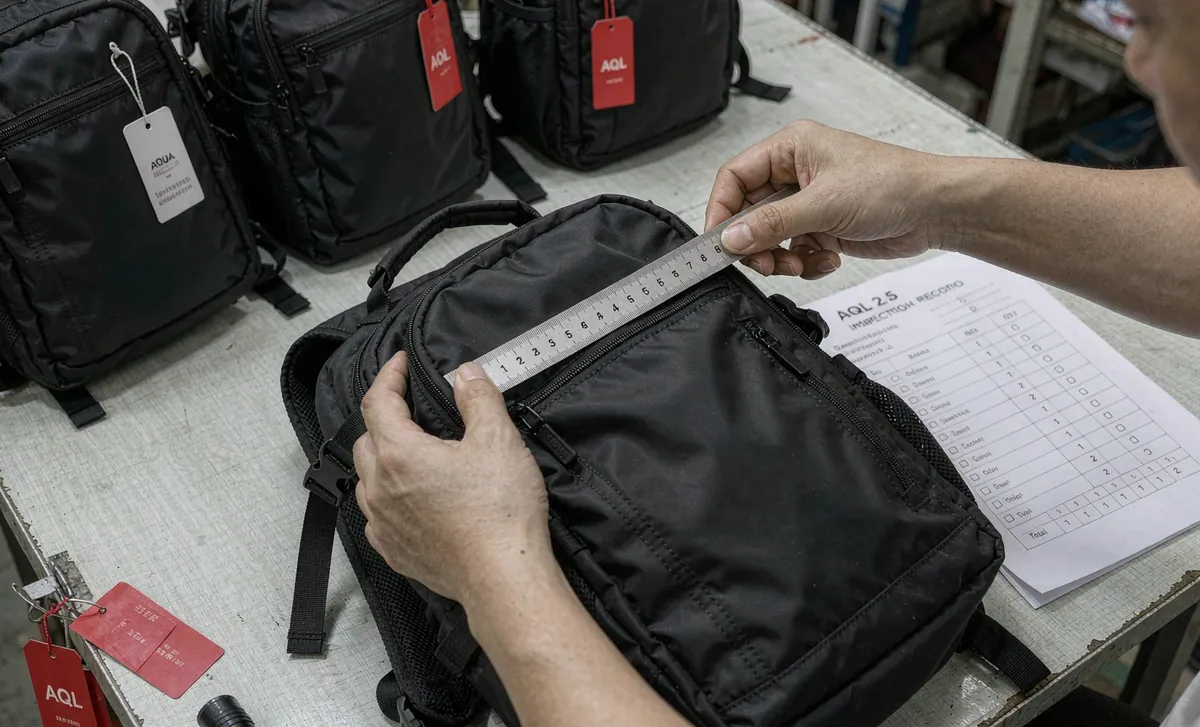
Table of Contents
- What AQL 2.5 Fixes and What It Leaves Open
- General Inspection Levels and the Lot Size Row
- Sample Size by Shipment Quantity for Waterproof Bags
- Accept and Reject Numbers Read Off the Table
- Switching Rules: Tightened, Normal and Reduced
- Classifying an Ingress Fault at the Bench
- Defect Dictionary Written for Waterproof Bag Parts
- Drawing the Sample So It Represents the Lot
- Inspection Sequence From Carton Opening to Repack
- Three Exposures an AQL Sample Cannot See
- Re-Inspection and the Cost of a Second Pass
- Fields an Inspection Report Must Carry to Be Actionable
- Timing the Inspection Before the 70 Percent Balance Is Called
- Frequently Asked Questions
- People Also Ask
What AQL 2.5 Fixes and What It Leaves Open
An acceptable quality limit is a sampling parameter, not a quality promise. Under ISO 2859-1 it defines the worst tolerable process average when a continuing series of lots is submitted, and it is used to look up a sample size and an accept or reject number for a given lot. The number 2.5 is an index into that table, not a percentage of defective goods in the shipment.
This distinction is the source of most disputes at the bench. A buyer who reads 2.5 as a defect rate expects a near-perfect shipment and is surprised when a lot containing several minor faults is accepted. A supplier who treats it as a target rather than a limit will ship at the limit and be surprised when the buyer stops ordering. Both readings are wrong, and the standard defines neither.
What the limit does fix is the procedure: how many units are examined, how many faults of each class are tolerated, and what happens on a failure. That procedure is what makes an inspection repeatable between two parties who have never met, and it is the reason the standard is worth invoking on a purchase order at all.
- AQL is an index into a sampling table, not a defect rate in the shipment.
- It fixes sample size and accept or reject numbers by lot size and inspection level.
- It says nothing about any individual unit, only about the lot as submitted.
- It assumes a continuing series of lots, not a single shipment.
- The defect classes it is applied to have to be defined separately, in writing.
General Inspection Levels and the Lot Size Row
Two inputs produce the sample size: the lot size and the inspection level. The lot size is the quantity of units submitted, which on a bag programme is the number of finished pieces presented for inspection, not the number of cartons and not the number on the purchase order if part of the order has already been shipped.
The inspection level sets how discriminating the plan is. There are three general levels, with level two as the default, level one for a less discriminating plan and level three for a more discriminating one, plus four special levels used where testing is destructive or costly. Bag programmes normally sit at general level two, and moving to level three is the simplest way for a buyer to buy more assurance without changing the limit.
The code letter that results from those two inputs is then carried into the sampling table to read the sample size and the accept or reject pair. Getting the lot size row wrong is the most common mechanical error at the bench, and it usually happens because the inspection was planned against the order quantity rather than against what was actually presented.
- Count the units actually presented for inspection, not the quantity on the order.
- Choose the inspection level, normally general level two for a bag programme.
- Find the lot size row and read the code letter at the chosen level.
- Carry the code letter into the sampling table for the chosen limit.
- Read the sample size and the accept and reject pair for each defect class separately.
Sample Size by Shipment Quantity for Waterproof Bags
The table below is the working reference for a bag programme at general level two. It is expressed as bands rather than as every row of the standard, because the decision a buyer makes is which band a shipment falls into. The sample size rises with lot size, but not proportionally, which is why larger shipments are inspected more efficiently per unit.
| Units presented | Code letter at general level two | Sample size | What it means for a bag lot |
|---|---|---|---|
| Up to 280 | G | 32 units | Below a single colourway minimum, unusual on this programme |
| 281 to 500 | H | 50 units | A single colourway at the minimum order quantity |
| 501 to 1200 | J | 80 units | Two or three colourways submitted together |
| 1201 to 3200 | K | 125 units | A multi-colourway order presented as one lot |
| 3201 to 10000 | L | 200 units | A consolidated seasonal shipment |
The practical note for a 500 piece colourway is that the sample is 50 units, and 50 units is enough to catch a systematic fault and not enough to catch a rare one. A fault occurring in one unit in a hundred has a meaningful chance of not appearing in the sample at all, which is why sampling is a complement to process control rather than a substitute for it.
Where a buyer wants more assurance on a specific high-consequence property, the usual route is not a bigger sample but a separate test on a small number of units. Destructive or time-consuming tests such as ingress, peel and abrasion are normally run on a fixed small number rather than on the full sample, and the result is recorded alongside the statistical one.
Accept and Reject Numbers Read Off the Table
For each defect class the table gives a pair: accept if the number of defects is at or below the first, reject if it is at or above the second. The two numbers are adjacent, and the plan has no ambiguous middle. At a limit of 2.5 on a 50 unit sample, the major pair is accept on three and reject on four, and the minor pair is accept on five and reject on six.
Reading the pair for the wrong class is the second most common error at the bench. A lot with four minor faults and three major faults is rejected on the major count and not on the minor one, and the two counts are never added together. Each class is judged independently against its own pair.
The third thing to be clear about before the inspection opens is what counts as one defect. A single unit can carry several faults, and the usual convention is to count each occurrence separately within its class while counting the unit once for reporting. Stating the convention in the protocol avoids an argument in the last hour of the inspection.
- Each defect class is judged against its own pair, and classes are never added together.
- A lot is rejected by the first class that reaches its reject number.
- Counting convention matters: state whether occurrences or units are counted.
- A critical defect normally rejects on the first occurrence regardless of the pair.
- The result is a lot decision, not a statement about any individual bag.
Switching Rules: Tightened, Normal and Reduced
The standard is a system rather than a single plan, and the switching rules are what make it one. Inspection normally starts at normal. It moves to tightened when a defined number of consecutive lots are rejected, and it can move to reduced when a defined run of lots passes and production is steady. Tightened raises the sample or lowers the accept number; reduced does the reverse.
For a buyer, the switching rules are the reason to keep inspecting rather than spot-checking. A supplier whose lots have been passing consistently earns reduced inspection, which lowers cost, and one whose lots have failed earns tightened inspection, which raises the chance of catching the next failure. The rules do that automatically if they are invoked on the order.
The rules only work if the lot history is recorded. A programme that inspects each shipment in isolation cannot apply them, because nobody knows whether the previous two lots passed. Recording the lot result, and the switch state it produced, is a small administrative habit that materially improves the protection the standard offers.
| State | When it applies | Effect on the plan | What it signals about the programme |
|---|---|---|---|
| Normal | Default, and the starting state | Standard sample and accept pair | No recent history either way |
| Tightened | After a defined run of rejected lots | Larger sample or lower accept number | Process is not holding, corrective action needed |
| Reduced | After a defined run of passing lots with steady production | Smaller sample | Process is stable, and inspection cost can fall |
Classifying an Ingress Fault at the Bench
Water ingress is the fault that makes this category different from a general soft-goods inspection, because it is invisible, it is binary, and it is the reason the customer bought the product. An ingress failure on a waterproof bag is classified as major, and where the product is sold on a specific rating it is reasonable to treat a failure against that stated rating as critical to the claim.
The classification depends on the stated requirement rather than on the amount of water. A product sold as rain resistant is not defective because it leaks under a jet, and a product sold as submersible is. Writing the tested exposure and the acceptance condition onto the specification before inspection is what makes the classification mechanical rather than arguable.
The acceptance condition is the part most often missing. Whether a trace of moisture is tolerated, and where, has to be stated: many programmes accept none inside the main compartment while tolerating a damp closure fold. Without that line, an inspector has to make a judgement call that one party will later dispute.
- An ingress failure on a waterproof bag is classified as major.
- Classify against the stated requirement, not against the amount of water found.
- State the tested exposure: spray, shower, jet or immersion, with duration.
- State the closure configuration the test assumed, including roll turns or zip seating.
- State the acceptance condition, including any tolerated moisture and its location.
Defect Dictionary Written for Waterproof Bag Parts
A defect dictionary is a list of named faults with a class and a description, agreed before the inspection. Without one, two inspectors classify the same fault differently and the lot result changes with who is on the bench. With one, the classification is a lookup and the result is repeatable between shipments and between parties.
The dictionary should be written for the parts a bag actually has: shell, seam, closure, hardware, webbing, lining, print and packing. A general soft-goods dictionary covers most of these but usually omits the two that matter here, which are the welded seam and the closure fold, and omits the property that matters most, which is ingress.
| Part | Named defect | Class | Description used at the bench |
|---|---|---|---|
| Shell | Pinhole or coating thin | Major | Water passes through a panel under the specified exposure |
| Welded seam | Unbonded or burnt seam | Major | Peel failure or visible thinning along the weld line |
| Taped seam | Tape edge creep | Major | Tape lifted at the edge, admitting water along the seam |
| Closure | Roll-top fold leak | Major | Water at the fold after the specified number of turns |
| Closure | Zip will not seat | Major | Slider fails to close fully or jams repeatedly |
| Hardware | Buckle fracture under load | Critical | Fitting breaks at or below the specified load |
| Logo illegible or misregistered | Minor to major, by placement | Readability judged at arm's length on the retail panel | |
| Packing | Carton short count | Major | Count below the quantity recorded on the carton mark |
The dictionary is a living document. Every new failure mode found in a returned product should be added to it with a class, and the revision should be dated. A dictionary that has been revised a few times across a programme is usually a sign that the specification is maturing rather than that the product is failing.
Drawing the Sample So It Represents the Lot
A sampling plan assumes the sample is random, and at a packing bench random is harder than it sounds. Cartons at the front of a stack are the easiest to reach and the most likely to be drawn, and units at the top of a carton are easier than those at the bottom. Both biases are real and both work against the buyer, because the easiest units to reach are often the ones packed first or last.
The correction is procedural: select cartons by a random method across the whole consignment before any are opened, and select units from within each selected carton by position rather than by convenience. Where a lot was produced across more than one shift or more than one machine, the selection should reach all of them, because clustering by shift is one of the most useful diagnostic patterns available.
Recording where each sampled unit came from costs nothing and pays for itself the first time a failure appears. A fault that clusters in cartons from one production day, or from one colourway, or from one size, is a fault with a cause that can be found. A fault that is spread evenly is a fault with a design or material cause.
- List every carton in the lot and select the required number by a random method.
- Open only the selected cartons, and take units by position rather than by convenience.
- Reach every shift and every machine represented in the lot.
- Record the carton, the shift and the colourway against each sampled unit.
- Look at the distribution of any faults found before concluding anything about the cause.
Inspection Sequence From Carton Opening to Repack
Sequence matters because some checks change the unit. Ingress testing wets the bag, load testing stresses it, and destructive tests destroy it. Running them in the wrong order either invalidates a later result or leaves a wet unit to be packed. The order below is the one that preserves the evidence and returns a shippable carton.
Start with the carton and the packing: photograph the carton as opened, verify the count and the split, and check the marking before anything is removed. Then move to appearance and workmanship on the dry unit, then to dimensions, then to function including closure cycles, then to the wet tests last, and re-dry and repack before sealing.
The repack step is the one that gets skipped and the one that causes the next complaint. A unit that has been through an immersion test and returned to its polybag damp will arrive mouldy, and the resulting claim will be about a quality failure that was actually caused by the inspection. Drying and repacking properly is part of the inspection, not an afterthought.
- Photograph the carton as opened, then verify count, split and marking.
- Check appearance and workmanship on the dry unit, including print and hardware.
- Check dimensions and weight against the specification.
- Run functional checks, including closure cycling and strap pull.
- Run the wet tests last, in the order spray, then jet, then immersion where specified.
- Dry, re-pack and re-seal, and record that the carton was re-sealed after inspection.
Three Exposures an AQL Sample Cannot See
Sampling protects a shipment, and it is worth being explicit about what it does not protect. Three exposures sit outside what any reasonable sample can detect, and all three are better handled by process control and by design than by inspecting harder.
The first is a rare fault. A defect occurring in one unit in two hundred may not appear in a 50 unit sample at all, and no realistic increase in sample size removes that risk economically. The answer is a control at the station that produced it, not a bigger sample at the end.
The second is a fault that develops later. Hydrolysis, plasticiser migration and ultraviolet degradation all appear months after shipment, and none of them are visible on the bench at dispatch. The answer is an accelerated ageing requirement at material approval, which is a specification task rather than an inspection one.
The third is a fault caused by the way the customer uses the product. Closure misuse is the largest single cause of wet-interior complaints in this category, and no inspection can prevent it. The answer is a care instruction that states the number of roll turns or the seating requirement, which converts a would-be return into an informed purchase.
- A rare fault: below the detection threshold of any economic sample, so control it at the station.
- A delayed fault: ageing mechanisms invisible at dispatch, so control them at material approval.
- A use fault: closure misuse, so control it with a written care instruction.
- Sampling is a complement to process control, never a substitute for it.
- Where a buyer wants more assurance, buy a higher inspection level rather than a bigger wet test.
Re-Inspection and the Cost of a Second Pass
A lot that fails is reworked or remade and then inspected again, and the second pass is a real cost that most programmes do not plan for. It costs inspection labour a second time, it costs the rework itself, and above all it costs calendar days inside a 35 to 50 day bulk window that was planned without it.
The calendar cost is the one that hurts. Finishing and packing sit at the end of the window, and a re-inspection inserted there pushes against the booked vessel rather than against a slack period. Building a few buffer days into the schedule for the possibility of a second pass is far cheaper than discovering the need in week six.
The re-inspection rule itself should be stated: whether the whole lot is re-presented or only the reworked portion, whether the sample is redrawn at the same level or at tightened, and who pays for the second pass. All three are negotiable in advance and contentious afterwards, and all three belong on the order.
| Decision | Options | Consequence of not stating it |
|---|---|---|
| What is re-presented | Whole lot, or reworked portion only | Dispute over scope at the second inspection |
| Sample level | Same level, or tightened automatically | Arguments about whether the switch applied |
| Who pays | Supplier, buyer, or split by cause | A stalled shipment while the invoice is debated |
| Calendar | Buffer days reserved in the schedule | A vessel missed by days, and air freight considered |
Fields an Inspection Report Must Carry to Be Actionable
A report that says pass is not actionable, because it does not tell a buyer what to do next or what to watch on the following order. An actionable report carries the identifiers, the plan, the raw counts and the conditions, so that a reader who was not present can reconstruct what happened and compare it with the next lot.
The identifiers come first: lot number, purchase order reference, style and colourway, quantity presented and the date. The plan comes next: standard, limit, inspection level, code letter and sample size. The counts follow, by class and by named defect, with the location of each fault. The conditions close it: test methods, durations, and the closure configuration assumed.
Photographs belong with the report rather than in a separate message, and each one needs a caption tying it to a carton or a unit identifier. A photograph of a fault without a scale and without an identifier is close to useless six weeks later when the question is whether a specific lot is affected.
- Lot number, order reference, style, colourway and quantity presented.
- Standard, limit, inspection level, code letter and sample size.
- Defect counts by class, and by named defect from the agreed dictionary.
- Location of each fault, so a cause can be assigned rather than guessed.
- Test methods with durations and closure configuration for every wet test.
- Photographs with captions, a scale and a carton or unit identifier.
Timing the Inspection Before the 70 Percent Balance Is Called
The commercial reason an inspection matters is that it gates payment. On T/T 30% deposit and 70% before shipment, the balance is called after a passing report is issued, which means the buyer has leverage for exactly as long as the report has not been issued. Writing that sequence into the order is what converts the inspection from a formality into a control.
The inspection itself has to be booked early enough to fit. Inside a 35 to 50 day bulk window, the natural point is after packing is complete and before the container is loaded, which leaves room for a rework if the result fails. Booking it after loading leaves no remedy short of a claim at destination.
There is a second timing point worth writing in, and it is the hold point before bulk cutting. A pre-production sample that passes its ingress test before cutting begins is worth more than any inspection after assembly, because at that stage a correction costs days rather than a run.
QUANZHOU JUNYUAN BAGS was established in 2014, with our founder in the bag trade since 2004, and lot acceptance is recorded at AQL 2.5 under ISO 2859-1 with the inspection level and code letter stated on every report. Head is reported to ISO 811 from 10,000 mm for lightweight builds to beyond 20,000 mm for heavy-duty ones, ingress is tested to IEC 60529 with method and duration, and spray and shower behaviour is checked to AATCC 22 and AATCC 35. Capacity at our validated production partner facility is verified by SGS at 4,950 square metres, 7 production lines, 149 pieces of equipment, 137 staff and 200,000 pieces per month, with market documentation able to cover CE, CPC, RoHS and REACH, with QC run to ISO 9001-aligned procedures. Sampling runs 6 to 10 working days, or 12 to 15 for a complex build, and bulk runs 35 to 50 days, quoted FOB Xiamen on T/T 30% deposit and 70% before shipment.
To have a sampling plan written into an order, write to service@junyuanbags.com or message the team on WhatsApp at +86 177 5002 0688. The exposure methods behind each classification are set out in the water ingress test methods guide, spray and shower behaviour is explained in the AATCC 22 spray test guide, and the acceptance wording used on reports can be reviewed from the quality page.
Frequently Asked Questions
Q1: Does AQL 2.5 mean the shipment contains 2.5 percent defects?
A: No, and this is the most common misreading. The number is an index into a sampling table under ISO 2859-1 that fixes the sample size and the accept or reject pair. It describes the worst tolerable process average across a continuing series of lots, not the defect rate inside any particular shipment.
Q2: What sample size applies to a 500 piece waterproof bag colourway?
A: At general level two, a lot of 281 to 500 units carries code letter H and a sample of 50 units. That is enough to catch a systematic fault and not enough to catch a rare one, which is why sampling complements process control rather than replacing it.
Q3: What are the accept and reject numbers at AQL 2.5 on a 50 unit sample?
A: Accept on three and reject on four for major defects, and accept on five and reject on six for minor ones. Each class is judged independently against its own pair and the classes are never added together, so a lot is rejected by whichever class reaches its reject number first.
Q4: How is a water ingress failure classified on a waterproof bag?
A: Normally as major, and where the product is sold on a specific stated rating it is reasonable to treat a failure against that rating as critical to the claim. Classification must be made against the stated requirement, so the tested exposure and the acceptance condition belong on the specification before inspection opens.
Q5: What is the difference between general inspection levels one, two and three?
A: They set how discriminating the plan is, with level two as the default. Level one is less discriminating and level three more so. Moving from level two to level three is the simplest way for a buyer to buy more assurance on a bag programme without changing the acceptable quality limit itself.
Q6: What are switching rules and why do they matter to a buyer?
A: They move inspection between normal, tightened and reduced based on recent lot history, so a supplier whose lots keep passing earns reduced inspection and one whose lots fail earns tightened. They only work if lot results are recorded, because a programme inspecting each shipment in isolation has no history to switch on.
Q7: Why should the sample be drawn randomly rather than from the easiest cartons?
A: Because cartons at the front of a stack and units at the top of a carton are biased toward whatever was packed first or last. Selecting cartons by a random method across the whole consignment and units by position within each carton removes that bias and makes the result representative.
Q8: Why should wet testing be run last in the inspection sequence?
A: Because it changes the unit. Ingress testing wets the bag, and a wet unit returned to its polybag will arrive mouldy and generate a claim about a fault that the inspection itself caused. The order is packing check, appearance, dimensions, function, then wet tests, then drying and repacking.
Q9: What three problems can an AQL sample not detect?
A: A rare fault that falls below the detection threshold of any economic sample, a fault that develops later such as hydrolysis or ultraviolet degradation, and a fault caused by how the customer uses the product. All three are better handled by process control, material approval and a written care instruction.
Q10: What should be agreed about re-inspection before a lot fails?
A: Whether the whole lot or only the reworked portion is re-presented, whether the sample is redrawn at the same level or at tightened, and who pays for the second pass. All three are negotiable in advance and contentious afterwards, and a re-inspection also consumes calendar days inside the bulk window.
Q11: What fields make an inspection report actionable?
A: The identifiers, the plan, the raw counts and the conditions: lot number and order reference, standard, limit, level, code letter and sample size, defect counts by class and by named defect with locations, and the test methods with durations and closure configuration.
Q12: When should inspection be booked inside a 35 to 50 day bulk window?
A: After packing is complete and before the container is loaded, which leaves room for rework if the result fails. Booking it after loading leaves no remedy short of a claim at destination, and a second useful timing point is a hold point before bulk cutting begins.
Q13: How does inspection connect to payment terms?
A: On T/T 30% deposit and 70% before shipment, the balance is called after a passing report is issued, so the buyer holds leverage for exactly as long as the report has not been issued. Writing that sequence into the order converts the inspection from a formality into a genuine control.
Q14: What capacity and documentation sit behind an inspected programme?
A: Capacity is verified by SGS at 4,950 square metres, 7 production lines, 149 pieces of equipment, 137 staff and 200,000 pieces per month. Documentation can cover CE, CPC, RoHS and REACH, with QC run to ISO 9001-aligned procedures, and lot acceptance is recorded to AQL 2.5 under ISO 2859-1.
People Also Ask
- What does AQL 2.5 mean for bags?
- How many units are inspected at AQL 2.5?
- What is the accept number at AQL 2.5?
- Is a leaking bag a major or critical defect?
- What is general inspection level two?
- What does AQL not cover?
- When should pre-shipment inspection happen?