
Pre-Shipment Inspection for Waterproof Bags: AQL 2.5 in Practice
Pre-shipment inspection is the last point at which a waterproof bag order can still be corrected without a claim, and it is the point that protects the 70% balance payment. QUANZHOU JUNYUAN BAGS inspects to AQL 2.5 under ISO 2859-1 with eleven checks: sampling and acceptance, defect classification, water ingress on finished units, weld inspection, closure cycling, hardware pull, dimensions and shade, carton drop and stack, labelling, quantity and assortment, and a defined hold point when a lot fails. The report is issued before the balance is called, FOB Xiamen.
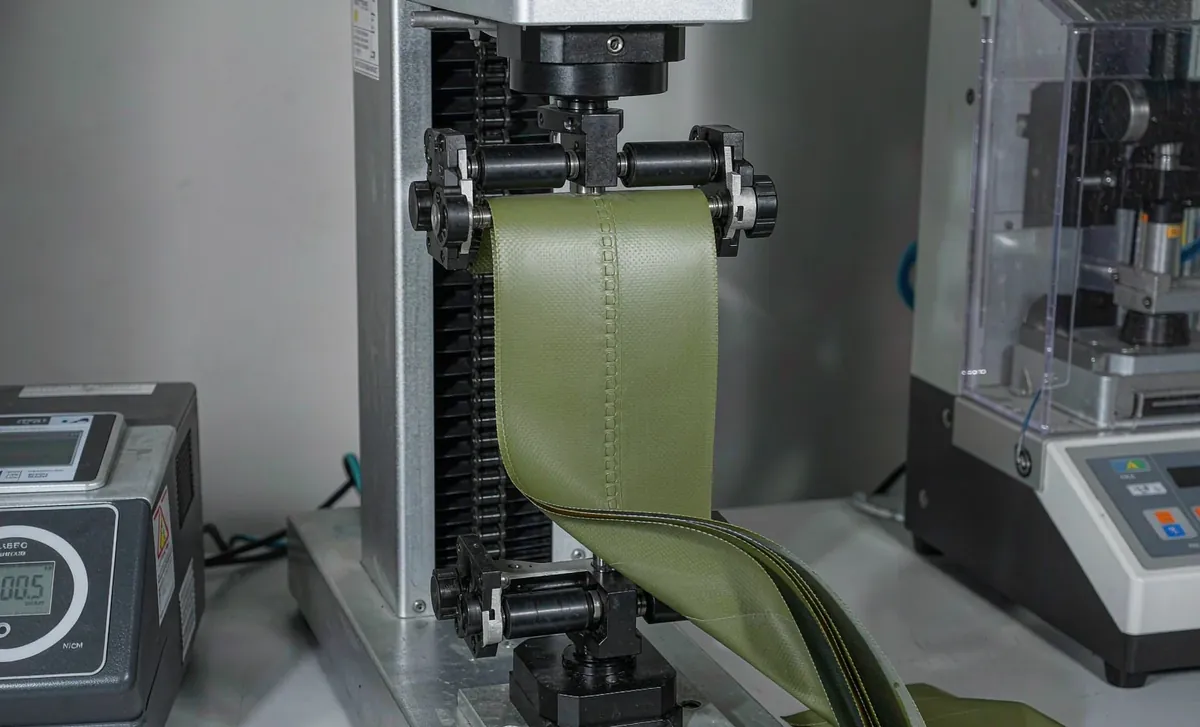
Table of Contents
- Where PSI Sits in the 35 to 50 Day Calendar
- AQL 2.5 Sample Size and the Accept or Reject Rule
- Defect Classification for Waterproof Bags
- Water Ingress Sampling on Finished Bags
- Seam and Weld Inspection Under Magnification
- Closure Cycling at the Inspection Bench
- Hardware and Webbing Pull Checks
- Dimensions, Weight and Shade
- Carton Drop, Stack and Packing Verification
- Barcodes, Labels and Retail Packaging
- Quantity, Assortment and Carton Count
- The Hold Point: What Happens When PSI Fails
- Booking PSI Against Payment and FOB Xiamen
- Frequently Asked Questions
- People Also Ask
Where PSI Sits in the 35 to 50 Day Calendar
Pre-shipment inspection happens after the goods are packed and before the container leaves, which places it at the very end of a 35-50 day production window. That late position is deliberate: inspecting earlier would mean inspecting goods that are not yet finished, and inspecting after loading would mean there is nothing left to correct.
It also sits inside a sequence of earlier checks rather than replacing them. Incoming material is checked, weld coupons are pulled during production, and in-line checks run through assembly. PSI is not the first time anyone looks at the product; it is the first time the finished, packed lot is assessed as a lot.
Understanding that sequence matters to a buyer, because the value of PSI is not that it catches everything, but that it is the last check carried out on the exact units that will be shipped. Everything before it is a process check; this one is a product check. Our wider inspection regime is described on the quality and inspection page.
AQL 2.5 Sample Size and the Accept or Reject Rule
AQL 2.5 under ISO 2859-1 is a sampling plan, not a defect rate. It tells the inspector how many units to pull from a lot of a given size and how many defects of each class are permitted before the lot is rejected. Larger lots produce larger samples, and the acceptance numbers differ by defect class.
Buyers most often misread the number as a promise that no more than 2.5% of the shipment is faulty. It is not that. It is a statistical plan with a defined risk on both sides: the buyer's risk that a bad lot passes and the supplier's risk that a good lot fails. Knowing that makes the report readable rather than reassuring.
| Lot size band | Sample units pulled | Major defects allowed | Minor defects allowed |
|---|---|---|---|
| Up to 280 pcs | 32 units | 2 | 3 |
| 281 to 500 pcs | 50 units | 3 | 5 |
| 501 to 1,200 pcs | 80 units | 5 | 7 |
| 1,201 to 3,200 pcs | 125 units | 7 | 10 |
| 3,201 to 10,000 pcs | 200 units | 10 | 14 |
Critical defects sit outside this table entirely, because the acceptance number for a critical defect is zero at every lot size. On a waterproof bag a critical defect is one that makes the product unsafe, illegal or unusable, and the presence of a single one fails the lot regardless of how good the rest of it is.
These bands are the general inspection levels used under ISO 2859-1, and the exact sample plan for a specific order is confirmed on the specification sheet rather than assumed, because a buyer is entitled to specify a tighter level if they want one.
One procedural point protects both sides: the sample must be drawn at random from the packed lot, not from a convenience stack near the bench. A sample drawn from the front of a run inspects the beginning of production rather than the whole of it, and on a long run the beginning and the end can differ, because tooling warms up and operators change shift.
Defect Classification for Waterproof Bags
Classification is where the inspection becomes specific to waterproof products rather than to bags in general. A generic checklist will find a loose thread and miss a weld that is about to lift, because the second one requires knowing what to look for and the first one does not.
| Class | Definition | Examples on a waterproof bag | Acceptance |
|---|---|---|---|
| Critical | Unsafe, illegal or unusable | A closure that separates, a sharp exposed edge, a missing origin or compliance label, a child-safe requirement failure | Zero at any lot size |
| Major | A customer would return it | A leaking weld, a seam that lifts, a slider that jams, a strap attachment that pulls, a print that is illegible | Per the AQL 2.5 plan |
| Minor | A customer would notice but not return | Print misalignment within tolerance, a loose thread, a small mark on a non-facing panel, a slight shade difference between panels | Per the AQL 2.5 plan |
The middle row is the one that decides the outcome on most orders. A leaking weld is a return; a mark on a non-facing panel is not. Getting that distinction right in writing, before inspection, is what turns an argument into a number, and both sides are better served by a classification agreed in advance.
We publish the classification with the order confirmation so there is no discussion about it on inspection day. Where a buyer's retail channel has its own definitions, we adopt theirs, because the channel is ultimately the one that decides what a customer will tolerate.
Water Ingress Sampling on Finished Bags
Waterproof bags are unusual among sewn products in that a finished unit can be functionally tested rather than only looked at. We take a small number of units from the inspection sample and run them through the ingress method stated on the specification sheet, so the result relates to the actual method the product was specified against.
The distinction between spray, shower and immersion matters here. A product specified to IPX6 under IEC 60529 is tested against a jet, a product specified to IPX7 is tested against temporary immersion at a stated depth and duration, and a product with no code is tested against the spray or shower method named on its sheet. Testing an IPX6 product by immersion and calling the result a failure is not inspection, it is a category error.
- Confirm the method on the specification sheet before the test, not after.
- Take the units from the packed lot at random, not from the front of the run.
- Close the bag exactly as the care card instructs, with the specified number of turns.
- Inspect the interior, the closure fold and every seam, and record moisture by location.
- Record the result by location so a correction can be targeted rather than general.
Recording by location is the part that makes the test useful. Moisture at the closure points at the fold geometry or the number of turns; moisture at a seam points at a weld parameter; moisture at an attachment patch points at the patch design. Each has a different correction, and a note that simply says leaked leads nowhere.
Two units is usually enough for a functional check and a larger number does not improve it much, because ingress testing is slow and destructive to the packing. The statistical protection on an order comes from the AQL sample, and the ingress test is a functional confirmation on top of it rather than a substitute for it.
Seam and Weld Inspection Under Magnification
A weld that will fail in service usually looks fine to the eye and wrong under magnification. The early signs are a gloss change along the weld boundary, a step that can be felt at the edge, and a line of embedded dirt that follows the seam rather than crossing it. All three are visible with modest magnification and none of them are reliably visible without it.
On stitched and taped construction the equivalent check looks at the tape edge: bubbling, lift, a white line where the adhesive has released, or a tape width that does not fully cover the stitch line. Tape width and the window it has to cover are a specification item rather than a preference, and they are verified here.
- Gloss change along the weld boundary, showing early lift.
- A step at the weld edge that catches a fingernail.
- Embedded dirt following the seam line rather than crossing it.
- Tape bubbling or lift on a stitched and taped seam.
- Tape width that does not fully cover the stitch line.
Closure Cycling at the Inspection Bench
A closure that works once proves nothing. We cycle each closure in the sample a defined number of times and then re-test for ingress, because the failure mode is usually wear or contamination rather than a manufacturing fault that shows up on the first operation.
The cycling is done dry and then, on a subset, with grit applied, because grit is what reaches a closure in service. A roll-top is rolled and unrolled the specified number of times; a zip is tracked open and closed; a buckle is engaged and released; a cord lock is operated against its spring. Any stiffness, hesitation or misalignment during cycling is recorded.
| Closure | Cycling at inspection | What fails it | Re-test after cycling |
|---|---|---|---|
| Roll-top | Rolled and unrolled the specified number of times | Fold will not lie flat, stiffener cracks | Spray or immersion per the sheet |
| Waterproof zip | Tracked open and closed repeatedly | Slider hesitates, tape creases, coating flakes | Spray test on the closed bag |
| Side-release or cam buckle | Engaged and released repeatedly | Buckle releases under load or will not latch | Load check on the strap |
| Cord lock | Operated against its spring | Spring sticks or will not grip | Splash check |
| Magnetic or stud | Opened and closed repeatedly | Loses holding force | Visual and holding check |
The re-test column is the point of the exercise. Cycling is not a durability claim, it is a way of exposing a closure that would have failed the customer in the first week rather than the inspector on the bench.
There is a limits-of-inspection point worth stating honestly. Inspection finds defects that exist in the finished product; it cannot find a design that is marginal. A closure that seals today and will creep after a season is a specification issue, not an inspection finding, which is why the sampling round and the inspection serve different purposes and neither replaces the other.
Hardware and Webbing Pull Checks
Hardware and webbing carry the load, and they are the parts most often substituted when a supplier is under cost pressure. The inspection checks both the component and its attachment, because a strong buckle on a weak attachment patch fails at the patch and never at the buckle.
The check is a pull to the load stated on the specification sheet, held for a defined time, on the attachment points rather than on the component alone. We also look for the finish condition: a plated part showing edge corrosion, a moulded part showing flash or a short shot, and webbing showing a cut edge that has not been sealed.
- Pull each strap attachment to the specified load and hold it.
- Check buckles for flash, short shots and a coating that is already failing.
- Check webbing ends are sealed rather than cut raw.
- Check D-rings and ladderlocks for distortion after the pull.
- Check that hardware matches the approved sample in material and finish.
Dimensions, Weight and Shade
Dimensions are checked against the specification sheet with the stated tolerance, and the tolerance has to exist before the inspection does. A bag with no tolerance stated on the drawing cannot be failed for dimension, which is why we ask buyers to put tolerances on the sheet at sample approval rather than discovering their absence at inspection.
Weight is checked as a unit figure against the approved sample, because weight drift is usually a material substitution signal. A bag that is lighter than the approved sample may have a thinner coating or a lighter webbing, and both are specification changes that should have been declared rather than discovered.
Shade is checked between panels of the same bag and between bags in the same carton. A difference between panels reads as poor workmanship even where both panels are within tolerance against the reference, and that is one of the few defects that a customer notices immediately and cannot be argued with.
Where an order contains a colourway ladder, shade is also checked across the ladder rather than only within a carton. Customers compare two colourways side by side in a store, and a difference that is invisible within a carton becomes obvious across one, which is why the approved reference set is kept together and used as the comparison.
Carton Drop, Stack and Packing Verification
A bag that survives the product tests can still arrive damaged because the carton failed. Carton specification is a documented item: board grade, carton dimensions, packing count, closure method and any internal protection, and it is verified at inspection rather than assumed from the last order.
The drop sequence is a defined set of drops from a stated height onto stated faces, followed by an inspection of the contents rather than only of the carton. A crushed corner that has not touched the product is a carton issue; a scuffed panel behind a crushed corner is a packing issue, and the two have different corrections.
| Check | How it is run | Fail condition | Correction |
|---|---|---|---|
| Carton drop | Defined drops from a stated height onto stated faces | Product damage, or carton failure | Board grade or internal protection |
| Stack | Loaded stack for a stated duration | Carton deformation at the bottom layer | Board grade or pallet pattern |
| Packing count | Count per carton against the sheet | Wrong count | Repack before loading |
| Carton closure | Method and tape against the sheet | Tape lift or an open seam | Re-tape or change the method |
| Weight and dimensions | Per carton | Outside the booking tolerance | Correct before the booking closes |
The last row protects the freight booking as well as the product. A carton that is heavier or larger than the booking assumes causes problems at loading that have nothing to do with quality and everything to do with a number nobody checked.
Barcodes, Labels and Retail Packaging
Retail labelling errors are cheap to fix at inspection and expensive to fix at a distribution centre. We check the barcode scans, that the barcode matches the style and colourway on the carton, that the origin and composition labels are present and correct, and that any retail-required symbol set is on the pack.
Care labels are part of this check because they carry the maintenance instruction that protects the product in service. A missing care label is a minor defect on inspection day and a warranty dispute six months later, which is why we treat it as more than paperwork.
One further packaging check applies where the brand sells through a marketplace with its own labelling rules. Those rules change, and a label set approved a year ago may no longer be current, so we ask buyers to confirm the requirement at order stage rather than assuming the previous order's artwork still applies.
Quantity, Assortment and Carton Count
Quantity is checked twice: by counting cartons and by counting units inside a sample of cartons. Counting only cartons is how a short shipment passes inspection, because a carton count verifies the packing list rather than the contents.
Assortment matters on any multi-colourway or multi-size order. The mix inside the shipment has to match the order confirmation, and a shipment that is correct in total but wrong in mix is a commercial failure rather than a quality one, which is why it gets its own line on the report.
Short shipments are rarer than assortment errors, and assortment errors are rarer than label errors, and that ordering surprises most first-time importers. The reason is that quantity is counted at packing and again at loading, while a label is applied once and then never looked at again until a distribution centre scans it.
The Hold Point: What Happens When PSI Fails
A failed lot is held. Nothing is loaded, the balance payment is not called, and the report goes to the buyer with the defect counts by class and by location. That is the hold point, and it is the reason the inspection is worth doing rather than a formality on the way to loading.
Three outcomes follow. Rework where the defects are minor and can be corrected without remaking the product; a partial remake where a specific stage can be repeated; or a full remake where the defect is systemic. The choice depends on the defect location recorded during testing rather than on the defect count alone.
- Minor and localised: rework, then re-inspect the affected cartons.
- Major but confined to one stage: partial remake, then full re-inspection.
- Systemic, or any critical defect present: full remake and a revised calendar.
- In every case the balance payment waits for a passing report.
The fourth point is the one that makes the hold point meaningful. Because the T/T 70% balance is called after a passing report, a buyer is never paying the larger share against goods that have been assessed and failed. That ordering is deliberate and it is the single most useful protection in a first import relationship.
One more practical point about the hold: rework takes time, and the calendar cost of a failed lot is the reason we recommend a pre-production sample earlier in the run. A defect found before cutting is a change; the same defect found at PSI is a remake, and the difference between them is most of a production cycle.
Booking PSI Against Payment and FOB Xiamen
Practically, the sequence is: production completes, goods are packed, PSI is carried out, the report is issued, the buyer releases the 70% balance, and the container loads at FOB Xiamen. The buyer owns freight, insurance and import clearance from that point.
A buyer is entitled to appoint their own inspector, and we accommodate it rather than treating it as a challenge. The practical advice is to agree the defect classification and the test method with us beforehand, because two inspectors using two different definitions will produce two different verdicts on the same lot.
QUANZHOU JUNYUAN BAGS was established in 2014 with our founder in the bag trade since 2004, and inspection runs on capacity verified by SGS: 4,950 square metres, 7 production lines, 149 pieces of equipment, 137 staff and 200,000 pieces per month. Documentation per market can cover CE, CPC, RoHS and REACH, with QC run to ISO 9001-aligned procedures, and hydrostatic head is reported to ISO 811 with spray behaviour checked to AATCC 22.
To discuss an inspection scope for an order in progress, write to service@junyuanbags.com or message the team on WhatsApp at +86 177 5002 0688. Background on the test methods referenced here sits in the water ingress test methods guide, and the construction standards behind them are summarised under waterproof standards. Current programmes are listed on the product page.
Frequently Asked Questions
Q1: What is AQL 2.5 and what does it actually mean?
A: It is a sampling plan under ISO 2859-1 that sets how many units are pulled from a lot and how many defects of each class are permitted before the lot is rejected. It is not a promise that 2.5% of the shipment is faulty, and it carries a defined risk on both sides, with zero acceptance for critical defects at every lot size.
Q2: How many units are inspected on a 500-piece order?
A: For a lot in the 281 to 500 band the plan pulls 50 units, with acceptance numbers of three major and five minor defects for AQL 2.5. Larger lots pull larger samples, and the exact plan for your order is confirmed on the specification sheet so you can specify a tighter level if you want one.
Q3: What counts as a critical defect on a waterproof bag?
A: Anything that makes the product unsafe, illegal or unusable: a closure that separates, a sharp exposed edge, a missing origin or compliance label, or a failure of a child-safety requirement. The acceptance number for a critical defect is zero at any lot size, so a single one fails the lot.
Q4: How is water ingress tested at pre-shipment inspection?
A: Units are taken at random from the packed lot, closed exactly as the care card instructs, and tested by the method named on the specification sheet. Moisture is recorded by location, because moisture at the closure, at a seam and at an attachment patch each point to a different correction.
Q5: Can an IPX6 product be tested by immersion?
A: No. An IPX6 product is specified against a jet and an IPX7 product against temporary immersion, both under IEC 60529, and testing the first by immersion and calling the result a failure is a category error rather than an inspection finding. The method is confirmed before the test.
Q6: Why do you cycle closures during inspection?
A: Because a closure that works once proves nothing. Cycling a roll-top, a zip, a buckle or a cord lock a defined number of times, including a subset with grit applied, exposes wear and contamination that would otherwise reach the customer in the first week.
Q7: What does a weld failure look like before it leaks?
A: A gloss change along the weld boundary, a step at the edge that catches a fingernail, or a line of embedded dirt that follows the seam rather than crossing it. None of those are reliably visible to the unaided eye, which is why weld inspection is done under magnification.
Q8: Do you check the cartons as well as the bags?
A: Yes. Carton board grade, dimensions, packing count, closure method and weight are verified, and a defined drop sequence is run from a stated height onto stated faces followed by an inspection of the contents, because a bag can pass every product test and still arrive damaged.
Q9: What happens if the lot fails inspection?
A: The lot is held: nothing loads and the balance payment is not called. The report goes to the buyer with defect counts by class and by location, and the outcome is rework, a partial remake or a full remake depending on where the defects are rather than only on how many there are.
Q10: When is the balance payment due?
A: T/T 70% is due before shipment and is called only after a passing inspection report is issued, on terms of 30% deposit and 70% before shipment quoted FOB Xiamen. That ordering means a buyer never pays the larger share against goods that have been assessed and failed.
Q11: Can I appoint my own inspector?
A: Yes, and we accommodate it. The practical advice is to agree the defect classification and the test method with us beforehand, because two inspectors working from two different definitions will reach two different verdicts on the same lot, and neither of them will be wrong.
Q12: Why is weight checked against the approved sample?
A: Because weight drift is usually a material substitution signal. A bag lighter than the approved sample may have a thinner coating or a lighter webbing, and both are specification changes that should have been declared rather than discovered at inspection.
Q13: Why is quantity counted twice?
A: Because counting cartons verifies the packing list rather than the contents. We count cartons and then count units inside a sample of cartons, and we check the assortment separately on any multi-colourway or multi-size order, since a shipment correct in total but wrong in mix is a commercial failure.
Q14: What standards do the inspection reports reference?
A: Sampling to ISO 2859-1, hydrostatic head to ISO 811, spray behaviour to AATCC 22 and shower resistance to AATCC 35 where relevant, ingress codes written against IEC 60529, and coated fabric behaviour to ASTM D751. Market documentation can cover CE, CPC, RoHS and REACH, with QC run to ISO 9001-aligned procedures.
People Also Ask
- What does AQL 2.5 mean in simple terms?
- How many pieces are checked in a pre-shipment inspection?
- What is a critical defect in bag inspection?
- Can I inspect before paying the balance?
- What happens if a shipment fails inspection?
- How do you test waterproof bags at inspection?
- Should I hire my own inspector in China?