
Water Ingress Acceptance Criteria by Product Tier
Water ingress acceptance should be set from the promise you intend to print, not from the best number your fabric supplier can produce. Split the range into three tiers: a spray-only tier for casual and lifestyle styles, a rain tier for products sold as weather resistant, and a submersion tier for dry bags and professional equipment protection. Each tier needs its own test battery, its own numeric threshold and its own defect classification, because accepting all three to one standard either over-costs the simple products or under-protects the critical ones. Write the tier into the tech pack before sampling begins.
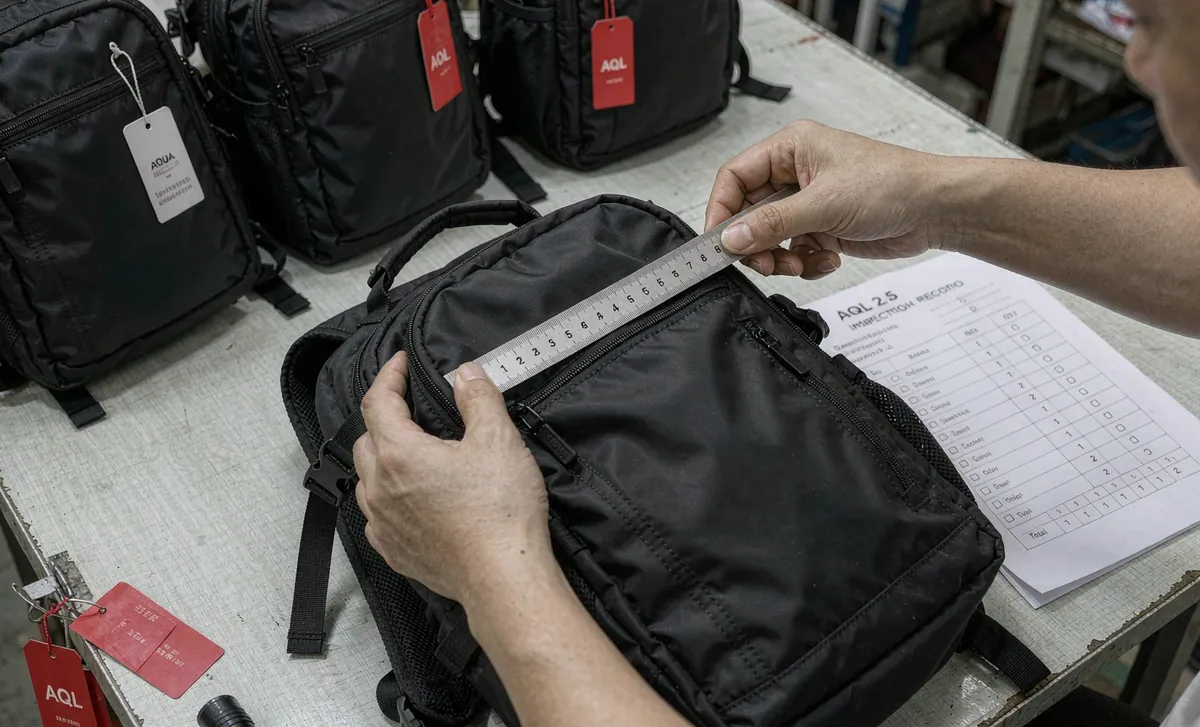
Table of Contents
- Tiering Products by Promise
- Entry Tier: Spray-Only Criteria
- Mid Tier: Rain plus Wipe-Down
- Technical Tier: Submersion Criteria
- Allowable Failure Rates at AQL 2.5
- Rework, Retest and Lot Disposition
- Documenting Acceptance in a Contract
- Escalation Path for Disputes
- Frequently Asked Questions
- People Also Ask
Tiering Products by Promise
The first decision is commercial, not technical. What will the packaging, the product page and the retail hangtag actually claim? A daypack sold as shower resistant and a dry bag sold for kayaking are not the same product tested more or less strictly; they are different products with different failure consequences, different price points and different customer expectations. Acceptance criteria should follow the claim, because the claim is what you will have to substantiate if a customer complains or a regulator asks.
Three tiers cover almost the whole catalog. The entry tier covers lifestyle and casual styles that will meet light rain and accidental splash. The mid tier covers products sold as weather resistant that will be worn or carried through sustained rain. The technical tier covers dry bags, camera protection and equipment cases where the contents are expensive, moisture sensitive, or expected to survive immersion. Anything you cannot place in one of the three probably has an unclear claim, which is itself a problem worth fixing.
Each tier inherits a fabric floor and a test battery. Fabric is screened to a hydrostatic head under ISO 811 in every tier, but only the technical tier adds whole-product submersion and air leak testing. Seam and closure requirements scale the same way. The result is a cost curve that rises with the promise, which is exactly what you want: a casual style is not paying for a submersion rig it does not need.
| Tier | Typical claim | Fabric floor | Product-level test | Release method |
|---|---|---|---|---|
| Entry | Shower resistant, splash resistant | Lower end of the common hydrostatic band | Spray screen plus wipe-down | AQL 2.5 sampling |
| Mid | Weather resistant, rain resistant | Middle of the hydrostatic band | Controlled rain exposure plus wipe-down | AQL 2.5 sampling |
| Technical | Waterproof, submersion capable | Upper end of the hydrostatic band | Submersion plus air leak testing | AQL 2.5 plus inline checks |
Entry Tier: Spray-Only Criteria
The entry tier exists to keep cost honest on products that will never be immersed. The fabric is screened to a hydrostatic head under ISO 811, the surface finish is checked with a spray screen such as AATCC 22, and the assembled product is given a short, controlled exposure followed by an interior inspection. No submersion, no air rig, no extended soak. Adding those would raise unit cost without changing what the customer actually experiences.
Define what acceptable means precisely, because this is where entry-tier specifications usually fail. A shower-resistant product may wet out on the outer surface; that is a finish behavior, not a failure. The failure is water reaching the interior in a quantity that damages the contents. State the criterion in those terms: no water on the interior surfaces after the defined exposure, with surface wetting of the outer shell explicitly permitted.
Wipe-down belongs in this tier as a secondary check. After exposure, wipe the interior dry and inspect again, because a small amount of moisture entering through a stitch line can be absorbed by lining fabric and go unnoticed until the customer finds it. A defined wipe-down with a tissue or absorbent cloth converts that invisible ingress into something countable, and it costs nothing to add.
Keep the entry tier honest about its limits. Do not let a marketing team stretch a shower-resistant claim into a waterproof one because the fabric tested well. That is the single most common source of substantiation problems in this category, and it is worth a written rule: the printed claim must match the tier the product was tested to. Our product range is tiered exactly this way so the claim and the test record always agree.
Mid Tier: Rain plus Wipe-Down
The mid tier is where most professional bag programs actually sit, and it is the tier that benefits most from a clear numeric threshold. The product is exposed to a controlled rain shower long enough to stress the finish, the closure and the seam layout together, then the interior is inspected and wiped. The face fabric has already been qualified to a higher hydrostatic floor than the entry tier, so failures at this level are almost never fabric failures.
Rain testing at product level differs from rain testing at fabric level in one important way: the specimen is now a three-dimensional object with a closure, seams, hardware and geometry. Water runs down the shell, pools at the base, tracks along webbing and collects at the closure. A flat fabric result under AATCC 35 tells you nothing about any of that, which is why the product-level exposure cannot be replaced by a material certificate.
Set the pass criterion in measurable terms: the maximum permitted mass of water found on the interior absorbent, the inspection method, and the exposure duration and intensity. Require photographs of the failure location when a unit fails, because the location is what tells you whether the cause is the closure, a corner weld, a stitch line or the roll-top geometry. Trending failure locations over three lots usually identifies one recurring feature.
- Name the exposure duration and intensity, and hold both constant between lots.
- Set a maximum permitted mass of water on the interior absorbent, in grams.
- Inspect the interior, then wipe it down and inspect again before recording a pass.
- Photograph and code the failure location on every failed unit.
- Trend failure locations across lots to find the recurring feature rather than the recurring symptom.
Technical Tier: Submersion Criteria
The technical tier carries a submersion promise, and the criteria have to be stricter in kind rather than only in degree. Where the entry tier permits surface wetting of the shell, the technical tier requires the interior to be dry, with no permitted ingress at all under the defined duration and depth. That is a different acceptance philosophy: any measurable interior moisture is a failure, and there is no partial credit.
Submersion criteria need two parameters defined together: depth and duration. Depth sets the pressure at every seam and closure; duration sets the time available for water to travel a slow path. Neither is meaningful alone, and quoting one without the other is the most common weakness in technical-tier specifications. Write both into the tech pack and require both on the test report.
Air leak testing earns its place at this tier as the screening method, because it is faster, dry and quantitative, and it catches fine channels before the unit ever goes near a tank. Use submersion for qualification and periodic audit, and air testing for production screening, with the two correlated once during development so the air limit maps to the submersion criterion. Our notes on rain testing versus submersion testing and on choosing between IPX7 and IPX8 cover the depth and duration question in more detail.
Closure geometry deserves separate attention at this tier, because a roll-top, a water-resistant zipper and a lid with a gutter behave completely differently under immersion. Test the closure in the configuration the customer will use, including the number of rolls the instructions specify, and treat an incompletely closed unit as a valid failure rather than an operator error. Half of all submersion failures we see are closure-related rather than seam-related.
Allowable Failure Rates at AQL 2.5
Water ingress is a defect class like any other, and it needs an acceptance quality limit before a lot can be released. The industry default for soft goods is AQL 2.5 under ISO 2859-1 at general inspection level II, which sets the sample size from the lot size and gives an accept and reject number for the sample. A lot passes when the number of defective units found is at or below the accept number, and fails at or above the reject number.
Classification is the decision that matters more than the limit itself. Treat ingress on a technical-tier product as a critical or major defect, because the consequence is damage to the customer's property rather than a cosmetic annoyance. Many buyers tighten to AQL 1.0 for critical defects while leaving AQL 2.5 for major and AQL 4.0 for minor. That three-class structure lets you be strict where it counts without inflating the sample size for cosmetic issues.
Be realistic about what sampling does and does not do. AQL 2.5 does not guarantee a defect-free lot; it caps the risk at an agreed level. If your product carries a submersion promise and your brand exposure is high, add one hundred percent inline leak testing on top of the sampled release. Sampling controls the lot average, inline testing removes the tail, and the two are complements rather than alternatives.
| Lot size (pcs) | Sample size | Accept at AQL 2.5 | Reject at AQL 2.5 | Typical use |
|---|---|---|---|---|
| 281 to 500 | 50 | 3 | 4 | First repeat order |
| 501 to 1,200 | 80 | 5 | 6 | Standard opening order |
| 1,201 to 3,200 | 125 | 7 | 8 | Seasonal replenishment |
| 3,201 to 10,000 | 200 | 10 | 11 | Program volume |
| 10,001 to 35,000 | 315 | 14 | 15 | Multi-market rollout |
Rework, Retest and Lot Disposition
When a lot fails, the response should already be written down. Define three outcomes: rework and retest, sort and partial release, or reject and remake. Rework suits a localized, identifiable cause such as one machine running cold for part of a shift. Sorting suits a defect that correlates with a visible feature. Remake suits a systemic cause, because reworking a lot whose material is out of specification simply produces a slower failure.
Retest discipline is where most programs lose control. A retest must be a full, independent sample drawn under the same plan, not a re-inspection of the units that already failed, and not a smaller convenience sample. Requiring a fresh sample is what prevents a supplier from sorting until the numbers look acceptable. State the retest sample size in the contract and cap the number of permitted retests, typically one, before the lot is rejected outright.
Disposition also covers what happens to the units themselves. Repaired units must be retested by the full method and tracked separately, because a reworked population carries different risk from first-pass units and you may want to know that later. Units that cannot be repaired should be scrapped with a recorded count, so the yield figure in the lot file is real rather than a residual. Keep all of it in the same AQL 2.5 inspection record used for cosmetic and dimensional findings.
- Rework and retest once for localized, identifiable causes.
- Sort and partially release only when the defect correlates with a visible, checkable feature.
- Reject and remake when the cause is systemic, such as out-of-specification material.
- Draw every retest sample fresh under the same plan, never re-inspect the failed units only.
- Track repaired units separately and record scrap counts so the yield figure is real.
Documenting Acceptance in a Contract
An acceptance clause has to be executable by someone who was not in the room when it was written. Name the product tier, name each test method with its version year, give the numeric threshold with units, state the sample size and the acceptance statistic, and define the defect classification. Anything less leaves room for two reasonable people to reach different conclusions, which is exactly the situation contracts exist to prevent.
Attach the commercial framework to the same document. Development runs through a custom development programme with sampling in 6 to 10 working days, extending to 12 to 15 working days for complex constructions, and bulk production runs 35 to 50 days after sample approval. Terms are FOB Xiamen with T/T 30/70, and MOQ is 500 pcs per style and colourway. When the acceptance clause and the commercial clause live together, a failure has a defined cost and a defined owner.
Require the evidence, not just the verdict. Specify that the supplier releases raw readings, photographs of failure locations, station-level defect counts and retention samples from each lot, with a stated retention period. A supplier who will only issue a pass certificate is telling you they cannot reconstruct the result, which means they also cannot diagnose it. The documentation requirement is often more valuable than the threshold itself.
Finally, version the specification. Materials change, constructions are revised, and tiers get re-drawn as a catalog matures. Put a revision letter and a date on the acceptance document and require the production lot file to cite the revision it was built to. Most long-running disputes trace back to two parties working from two different versions of the same specification, and a revision letter is a very cheap fix.
Escalation Path for Disputes
Even a well-written specification produces disagreement, usually about whether a particular unit failed or about which method governs. Plan the escalation path in advance with three steps. Step one is a joint re-inspection at the supplier's facility against the documented method, with both parties present or represented. Step two is third-party laboratory testing on retention samples or on units drawn jointly from the lot. Step three is a commercial remedy agreed in the contract.
Name the arbitrating laboratory in the contract rather than at the moment of dispute, and name it before any problem exists. Choosing a laboratory while a disagreement is already underway invites arguments about independence, and it costs weeks. An independent textile or soft-goods laboratory that routinely runs ISO 811, AATCC 35 and the relevant ingress methods is usually acceptable to both sides, and the cost is small next to a stalled shipment.
Decide who pays, and on what basis. The cleanest arrangement is that the party whose position is not supported by the third-party result carries the cost of the testing and of any remediation. Write that sentence down. Without it, every escalation becomes a negotiation about process rather than a resolution of facts, and the shipment stays in dispute long after the technical question has been answered.
Keep the relationship intact through the process by separating the lot from the partner. A failed lot is an event; a supplier who diagnoses it, corrects it and shows you the station-level data afterward is demonstrating the capability you were buying. Programs that survive disputes well are the ones where both sides agreed the method, the evidence and the remedy in advance. That preparation is the whole point of documenting acceptance properly in the first place, and it is what our OEM waterproof bag programmes are structured around.
Frequently Asked Questions
Q1: How do I decide which water ingress tier my product belongs to?
A: Start from the claim you intend to print and the consequence of failure. Casual styles that meet light rain belong in the entry tier, products sold as weather resistant belong in the mid tier, and dry bags or equipment protection with a submersion promise belong in the technical tier. The tier then sets the fabric floor and the test battery.
Q2: What is the difference between spray-only and rain acceptance criteria?
A: Spray-only criteria permit the outer shell to wet out while requiring no water to reach the interior, and they are checked with a short spray screen plus an interior wipe-down. Rain criteria apply a longer, heavier exposure to the assembled product and set a maximum permitted mass of water on interior absorbent material.
Q3: Can surface wetting of the outer fabric be accepted as a pass?
A: Yes at the entry tier, where wetting out is a finish behavior rather than a failure, provided no water reaches the interior. At the technical tier the criterion is stricter in kind: any measurable interior moisture after the defined submersion is a failure, with no partial credit for an intact outer shell.
Q4: Why is a product-level rain test needed when the fabric already has a hydrostatic rating?
A: Because a hydrostatic head result under ISO 811 describes flat material, while a finished bag fails at closures, corners, stitch lines and hardware. Water runs, pools and tracks along webbing in three dimensions, none of which a flat specimen reproduces. The material certificate and the product test answer different questions.
Q5: What acceptance quality limit should be used for water ingress?
A: AQL 2.5 under ISO 2859-1 at general inspection level II is the industry default for soft goods. Many buyers tighten to AQL 1.0 for critical defects on submersion-tier products while leaving AQL 2.5 for major and AQL 4.0 for minor. The three-class structure keeps sampling economical without weakening the critical class.
Q6: Does passing an AQL 2.5 inspection guarantee a defect-free lot?
A: No. Sampling caps risk at an agreed level rather than eliminating defects. If the product carries a submersion promise or the brand exposure is high, add one hundred percent inline leak testing on top of the sampled release. Sampling controls the lot average; inline testing removes the tail, and the two complement each other.
Q7: When should a failed lot be reworked rather than remade?
A: Rework suits a localized, identifiable cause such as one machine running cold for part of a shift. Remake suits a systemic cause such as out-of-specification material, because reworking a lot whose material is wrong only delays the same failure. Sorting and partial release suit defects that correlate with a visible, checkable feature.
Q8: How should a retest sample be drawn after a lot fails?
A: Draw a full, independent sample under the same plan, never a re-inspection of only the units that already failed and never a smaller convenience sample. Require a fresh sample in the contract and cap the number of permitted retests, typically one, before the lot is rejected outright. Anything else allows sorting until the numbers look acceptable.
Q9: What evidence should a supplier provide with a lot release?
A: Raw readings rather than a summary pass statement, photographs and location codes for any failures, station-level defect counts, repair and scrap counts, and retention samples with a stated retention period. A supplier who will only issue a certificate cannot reconstruct or diagnose the result, which makes the certificate close to worthless in a dispute.
Q10: How should depth and duration be specified for submersion criteria?
A: Always together, because each is meaningless alone. Depth sets the pressure at every seam and closure, while duration sets the time available for water to travel a slow path. Quote both in the tech pack and require both on the report, and test with the closure in the configuration the customer will actually use.
Q11: Why do most submersion failures happen at the closure rather than the seam?
A: Because a roll-top, a water-resistant zipper and a lid with a gutter each behave differently under immersion, and each depends on the user closing it correctly. Test the closure in the service configuration, including the number of rolls the instructions specify, and treat an incompletely closed unit as a valid failure rather than operator error.
Q12: What should an escalation path for an ingress dispute include?
A: Three steps: joint re-inspection at the supplier facility against the documented method, third-party laboratory testing on retention or jointly drawn units, and a commercial remedy defined in the contract. Name the arbitrating laboratory in advance, and state that the party whose position the third-party result does not support carries the cost.
People Also Ask
What are water ingress acceptance criteria?
They are the numeric and procedural rules that decide whether a lot of waterproof bags passes or fails. A complete set names the product tier, the test method and version year, the threshold with units, the sample size and acceptance statistic, and the defect classification. Written well, two parties can repeat the decision independently and reach the same answer.
How many leaking bags are acceptable in a shipment?
Under AQL 2.5 at general inspection level II, an 80-piece sample from a lot of 501 to 1,200 units accepts up to five defectives and rejects at six. Larger lots scale to larger samples. For submersion-tier products many buyers tighten the critical class to AQL 1.0, which lowers the acceptable count substantially.
Should waterproof bags be tested at product level or fabric level?
Both, because they answer different questions. Fabric testing under ISO 811 ranks material and controls incoming quality. Product-level testing evaluates the closure, the seams and the geometry in three dimensions. A lot can pass fabric testing and still fail as an assembled bag, so neither test substitutes for the other.
What is the difference between major and critical ingress defects?
A critical defect creates a safety issue or damages the customer's property, which is how ingress behaves on a submersion-tier product protecting electronics or camera equipment. A major defect materially affects usability without that consequence. Classification drives the acceptance limit, so getting it wrong weakens the whole release decision.
How often should acceptance criteria be reviewed?
At every material change, construction revision and tier re-draw, and at least annually for running programs. Put a revision letter and date on the acceptance document and require lot files to cite the revision they were built to. Many long-running disputes trace back to two parties working from two different versions.
What happens if a supplier and buyer disagree on a failed lot?
Follow the escalation path written into the contract: joint re-inspection against the documented method, then third-party laboratory testing on retention or jointly drawn units, then the agreed commercial remedy. Naming the arbitrating laboratory in advance avoids weeks of argument about independence while a shipment sits in dispute.