
Water Proof Ratings Explained: IPX, IP, mm Head and ATM
Water proof ratings are not one scale, and no conversion table connects them. IPX and IP codes come from IEC 60529, which grades a complete enclosure against a defined water exposure. Hydrostatic head, tested under ISO 811 or AATCC 127, measures how much water pressure a flat fabric tolerates before it leaks, and is reported in millimetres. ATM and metre marks are borrowed from watchmaking and have no governing test method for bags. Ten thousand millimetres does not equal IPX7, and five ATM equals neither. This page separates the four families and gives you the wording for a defensible rating.
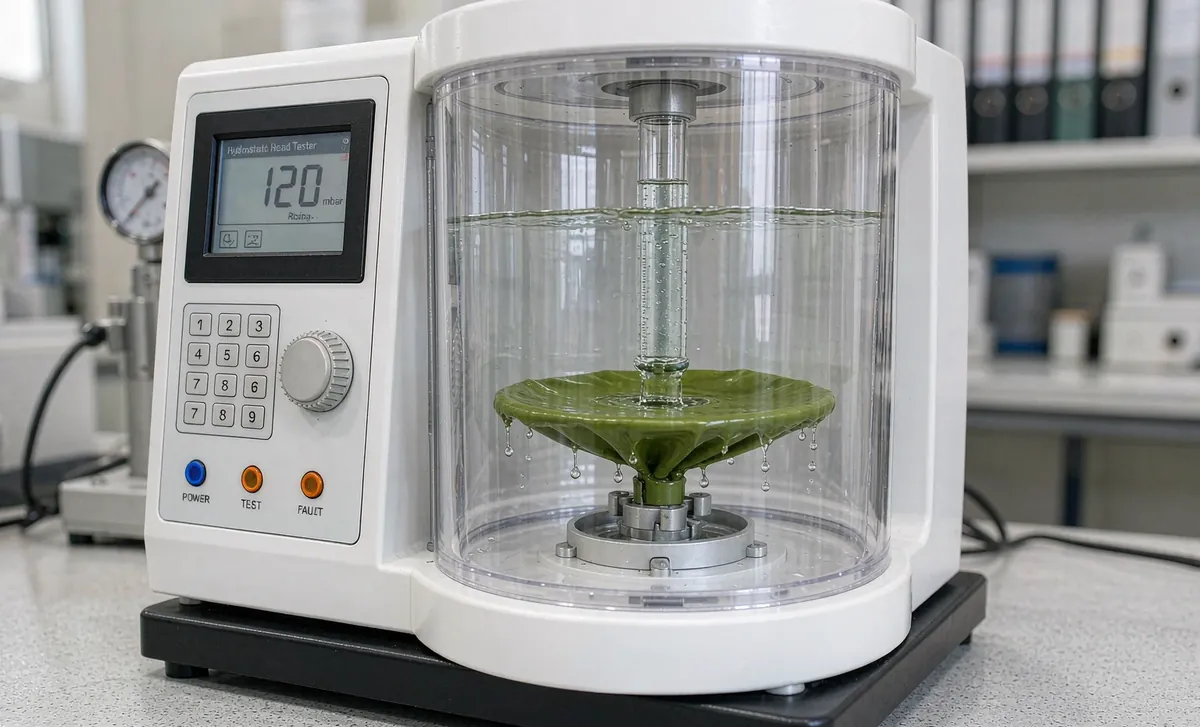
Table of Contents
- Why "Water Proof Ratings" Is a Plural Problem
- The Four Rating Families Buyers Meet
- IEC 60529 in Detail: How the IP Code Is Built
- First Digit 0-6: Solid Ingress, and Why It Matters
- Second Digit 0-9: Liquid Ingress, Test by Test
- IPX7 vs IPX8: The Number Everyone Quotes Wrong
- IP69K: High-Pressure, High-Temperature Wash-Down
- Hydrostatic Head (ISO 811 / AATCC 127) in Millimetres
- Converting Between mm Head, Bar and kPa
- ATM and Metres: Watch-Style Depth Ratings on Bags
- NEMA and UL Enclosure Types: Where They Overlap IP
- MIL-STD-810 Method 506 and 512 for Field Gear
- JIS L 1092 and EN 343: Apparel-Origin Test Methods
- Rating vs Construction: What the Number Does Not Tell You
- Reading a Supplier Test Report Without Being Misled
- Rating Drift: Why a Sample Passes and Production Fails
- Choosing a Rating Tier by Product and Channel
- Cost of Each Rating Tier in Real Quotes
- Labelling and Claim Substantiation by Market
- Building a Rating Ladder Across One Product Line
- Common Buyer Mistakes With Waterproof Ratings
- Ratings and Warranty: Writing a Defensible Claim
- How to Specify Ratings in a Tech Pack
- Worked Examples: Five Products, Five Rating Decisions
- Frequently Asked Questions
- People Also Ask
Why "Water Proof Ratings" Is a Plural Problem
Procurement teams search for water proof ratings as if one number could settle the question. It cannot. The phrase covers four measurement families written by different committees for different objects: an enclosure, a fabric, a garment, and a watch case. When your RFQ simply says waterproof, three suppliers can quote three different tests and all three can be telling the truth. The plural inside the keyword is the whole problem.
IP and IPX codes come from IEC 60529 and grade a complete enclosure against a defined water exposure. Hydrostatic head, tested under ISO 811 or AATCC 127, measures the water pressure a flat fabric tolerates before it leaks, reported in millimetres. Spray behavior is covered by AATCC 22, AATCC 35, JIS L 1092 and EN 343, all written for textiles. ATM and metre marks come from horology and migrate onto bags as borrowed language.
The consequence is commercial. A millimetre figure describes the fabric and says nothing about the seam, the closure, or the zipper that decide whether water gets inside. An IPX7 result describes one finished sample and says nothing about abrasion, ultraviolet exposure, or a winter at minus 20 degrees Celsius. You need a rating and a construction specification, written as two separate lines.
- Family: enclosure code, hydrostatic head, spray and rain, or depth and ATM.
- Standard and edition: IEC 60529, ISO 811, AATCC 127, MIL-STD-810.
- Tested object: flat fabric, a seam, a closure, or a finished product.
- Specimen condition: new, abraded, ultraviolet-aged, or cold-flexed.
- Where the claim appears: tech pack, hangtag, product page, or warranty card.
Ask all four before you compare quotations. Suppliers who cannot answer are quoting a label rather than a specification, and suppliers who can will usually also show the report behind the number, which is the only artifact that protects you when a season fails in the field. We quote a family, a level, and the construction behind it, documented on our waterproof bag testing and inspection page.
The Four Rating Families Buyers Meet
Strip away the marketing and four rating families do all the work in bag specifications: one grades an enclosure, one grades a fabric, one grades a surface under a shower, and one borrows pressure language from watches. Each answers a different question, and each leaves a blind spot that only a construction requirement can close. This crosswalk is the one we use in technical discussions with buyers.
| Rating family | Governing standard | Reported as | What is tested | What it never covers |
|---|---|---|---|---|
| Enclosure code | IEC 60529 | IP67, IPX7, IP69K | A complete enclosure or finished product against defined water exposure | Seam aging, abrasion, ultraviolet exposure, closure misuse |
| Hydrostatic head | ISO 811 or AATCC 127 | mm water column, 10,000-20,000 mm+ | Flat fabric or coating under rising water pressure | Seams, zippers, closures and needle holes |
| Spray and rain | AATCC 22, AATCC 35, JIS L 1092, EN 343 | Spray rating 0-5 or EN 343 class 1-3 | A fabric or garment surface under a controlled shower | Immersion, hydrostatic pressure, seam integrity |
| Depth and ATM | Horology practice, no bag standard | 3 ATM, 5 ATM, 10 m | A sealed case under static pressure in a chamber | Dynamic load, strap compression, real diving depth |
| Industrial wash-down | NEMA 250, UL 50E, IEC 60529 level 9 | NEMA 4X, IP69K | An enclosure against hot high-pressure jets | Cost efficiency for consumer soft goods |
Read the last column first, because that is where disputes start. A supplier quoting 20,000 mm has told you about a fabric, not about a bag. A supplier quoting IPX7 has told you about one finished sample, not about the weld made on a Tuesday in month four of the programme. A serious specification therefore carries one product rating plus one fabric head figure, and then backs both with seam and closure requirements written as their own lines.
Put one family per line item: the finished-product rating and its standard, the fabric head and its method, then the construction that makes both reproducible. Ban the word equivalent, which is not a standard and gives you nothing to test at goods-in. Our OEM waterproof bag programmes are quoted on exactly that three-line structure.
IEC 60529 in Detail: How the IP Code Is Built
IEC 60529 defines degrees of protection provided by enclosures and is the document behind every IP and IPX mark you will see on a bag, a case, or a light housing. It was written for enclosures around electrical equipment, which matters: the test assumes a rigid object with a defined interior volume, not a soft closure that changes shape every time you open it. Soft goods borrow the code because it is the only widely recognized water language available.
The code has fixed positions. IP is followed by a first numeral from 0 to 6 for solids, a second from 0 to 9 for liquids, and optional supplementary letters. An X in either position means that property was not assessed, so IP67 means dust tight plus temporary immersion while IPX7 means immersion was tested and dust was not. Those two marks are not interchangeable in a specification, although suppliers treat them as synonyms every day.
The tests are short and mechanical. A jet runs for a defined time per square meter, and immersion is conventionally 30 minutes at 1 meter. The sample is new, clean, empty, and at room temperature. There is no abrasion, no ultraviolet preconditioning, no low-temperature flexing, and no repetition across a production run. Once you know what the standard omits, you can predict the failures it will never catch.
- No aging: ultraviolet hours and coating hydrolysis are outside the code.
- No abrasion: a panel scuffed on rock is not the panel that was tested.
- No load: strap compression and body weight change closure geometry.
- No repetition: one sample proves nothing about unit 5,000 on the line.
- No cold behavior: a stiff roll-top at minus 20 degrees is a different closure.
Treat an IP code as a one-day laboratory snapshot and buy the construction separately. That is why we document weld parameters and closure geometry alongside every rating we quote, as set out on our waterproof bag manufacturing page.
First Digit 0-6: Solid Ingress, and Why It Matters
The first numeral runs from 0 to 6 and describes protection against solid objects and dust. Level 0 means no protection. Levels 1 through 4 are defined by probe diameter: 50 millimeters, 12.5 millimeters, 2.5 millimeters, and 1.0 millimeter. Level 5 means dust protected, where limited ingress is permitted but must not interfere with operation. Level 6 means dust tight, with no ingress at all. The dust tests use a talc chamber and run for hours rather than minutes.
For bags, this digit is usually omitted, and for a soft roll-top product that omission is correct, because closure geometry cannot be meaningfully dust tested. It stops being correct the moment you source a molded case, a hard-shell cooler, or a gasketed lid with mechanical hardware. In those categories sand and salt crystals are the dominant field complaint, and an IPX7 mark tells you nothing about whether dust will reach the interior through a lid channel or a screw boss.
The commercial trap is the gap between level 5 and level 6. Dust protected permits limited ingress; dust tight permits none. A quotation reading IP54 describes a materially lower product than one reading IP64, and the two differ by a single character. When dust matters, specify level 6 and require the chamber test on the finished product rather than on the fabric, because dust enters at closures, stitch lines, and hardware interfaces, never through the panel.
Cost follows the digit. A dust-tight molded enclosure needs a continuous gasket, controlled compression, and hardware that holds torque. On soft goods, meaningful dust resistance usually comes free with the welded construction you already specified for water. Ask for the two-digit code only where the channel demands it: marine, motorcycle, and industrial channels do, while general consumer channels rarely do. Our dry bag manufacturing programmes quote the solid digit on request only. Two-digit codes also add test time, so budget an extra week when the dust chamber is part of sample approval.
Second Digit 0-9: Liquid Ingress, Test by Test
The second numeral runs from 0 to 9 and each level describes a different physical attack. Levels 1 and 2 are dripping water, vertical and then at a 15 degree tilt. Level 3 is spraying water at up to 60 degrees from vertical, and level 4 is splashing from any direction. Levels 5 and 6 are jets, separated by nozzle size and flow: 6.3 millimeters at 12.5 liters per minute, and 12.5 millimeters at 100 liters per minute, both from 2.5 to 3 meters.
Level 7 is temporary immersion, conventionally 30 minutes at 1 meter. Level 8 is continuous immersion under manufacturer-declared conditions that must be more severe than level 7. Level 9 covers high-pressure, high-temperature wash-down. The structural point buyers miss is that levels 5 and 6 are dynamic jet attacks while level 7 is a static soak, and nothing in the code makes one imply the other. A product can pass 7 and fail 6, because a jet finds seam paths that still water never pressurizes.
That non-hierarchy is the most useful thing to understand about the code. Buyers assume 7 beats 6 the way 20,000 beats 10,000 in millimetres, and it does not. If your product meets both a hosepipe and a dunk, you need both marks, written as IPX6 and IPX7 tested separately. If it only meets rain and a splash, specifying level 7 is over-engineering you will pay for on every unit without a single field benefit.
Choose the digit from the exposure profile instead of from the number. A commuter backpack meets vertical rain and traffic splash, so level 3 or 4 is correct and cheap. A kayak dry bag meets static immersion and submersion while strapped, so level 7 is correct, with level 6 added if it will be rinsed. A fishing bag under deck wash meets jets, so level 5 or 6 is the honest choice. Our waterproof hiking backpack OEM page shows the same logic applied.
IPX7 vs IPX8: The Number Everyone Quotes Wrong
IPX7 is the most quoted number in the category and IPX8 is the most abused. Level 7 has a defined meaning: temporary immersion, conventionally 30 minutes at 1 meter, on a new sample at room temperature. Level 8 means continuous immersion under conditions the manufacturer declares, and those conditions must be more severe than level 7. Because they are declared rather than fixed, IPX8 without a stated depth and duration conveys almost nothing to a buyer.
A product rated IPX8 at 1.5 meters for 60 minutes and one rated IPX8 at 30 meters for 24 hours carry the identical mark. That is why we require the declaration on the report itself: depth, duration, water temperature, sample orientation, and whether the sample was loaded or empty. Without those five data points the mark cannot be defended in a claim and cannot be compared across quotations.
The second misunderstanding is hierarchy. IPX8 does not include IPX5 or IPX6, so unless the report covers both tests, an IPX8 product has not been shown to survive a hose jet, and a buyer who assumes otherwise discovers it at the first wash-down. The same applies to the solid digit: IPX8 says nothing about dust. Any jet or dust requirement must be tested separately.
- Depth in meters and duration in minutes, printed on the report.
- Water temperature, and whether the test used fresh or salt water.
- Sample orientation, and whether the closure was loaded or empty.
- Specimen count, and whether units were production or prototype.
- A separate IPX5 or IPX6 result if the product will ever meet a jet.
Field behavior is where the number finally breaks down. A roll-top that survives a static soak can leak when a paddler leans on it, because body weight raises internal pressure and the closure was never tested under compression. It can also leak in year three, after hydrolysis and ten thousand flex cycles. Neither failure contradicts the laboratory result, which was true on the day it was measured. Our 50L dry bag OEM programme states depth, duration, and roll count as three separate spec lines.
IP69K: High-Pressure, High-Temperature Wash-Down
IP69K describes resistance to high-pressure, high-temperature water jets. It originated in the German standard DIN 40050-9 before being incorporated into IEC 60529 as the ninth level of the second numeral. The test is severe by design: water near 80 degrees Celsius delivered at 80 to 100 bar, at roughly 14 to 16 liters per minute, from 0.10 to 0.15 meters, sprayed at several angles for about 30 seconds each. Very little soft luggage is ever exposed to that, and very little could survive it.
Where the mark belongs is industrial and food-handling environments: enclosures on processing equipment, hard cases for electronics carried onto vessels, and coolers or fish boxes cleaned with a pressure washer at the end of a shift. In those categories the alternative is a product that delaminates, fogs, or admits water at the gasket within one season, so the premium is justified by a real failure mode rather than by a marketing benefit.
The construction required is specific and expensive: a continuous gasket or overmolded seal instead of a welded fabric seam, stainless or marine-grade hardware, a rigid shell that will not deform under the jet, and no stitch holes anywhere in the water path. On soft goods the honest answer is usually no, because a TPU-laminated roll-top cannot reach IP69K without becoming a rigid case, and the attempt removes the compressibility that made the dry bag attractive. We decline IP69K requests on soft constructions and say so in writing, because a mark that cannot be reproduced in bulk is a liability rather than a feature.
Treat IP69K as a category decision rather than a specification upgrade. If the channel is industrial, marine-commercial, or food-contact, budget for the rigid shell and the gasket and write the mark into the RFQ on day one. If the channel is outdoor retail, e-commerce, or promotional gifting, it is a cost with no return, and the money belongs in abrasion resistance and coating durability, which move the returns rate far more. The waterproof bag product range shows where each construction sits.
Hydrostatic Head (ISO 811 / AATCC 127) in Millimetres
Hydrostatic head is the fabric test, reported as the height in millimetres of the water column a material resists before penetration. ISO 811 and AATCC 127 are the two methods buyers meet. Both clamp a flat specimen over a reservoir, raise the column at a controlled rate, and record penetration, conventionally at the third point. Both are fabric tests rather than product tests.
The methods are not interchangeable, and that is a real sourcing risk. Clamping, rate of pressure rise, and test area differ, so one fabric can return different figures under each method, commonly by 10 to 20 percent. A specification reading hydrostatic head 10,000 mm with no named method is unenforceable. Always write the method, the value, and the specimen count: 10,000 mm minimum to ISO 811, five specimens per lot.
Levels map to use rather than to quality. Around 1,000 to 1,500 mm resists a shower. Between 3,000 and 5,000 mm handles sustained rain on a panel that is not under load. At 10,000 mm a fabric resists rain plus the pressure of a loaded pack against a back panel. Above 20,000 mm you are buying expedition margin. Our technical programmes run at 10,000 to 20,000 mm plus, a band that covers paddling, fishing, and professional outdoor use.
- The method: ISO 811 or AATCC 127, named, never implied.
- The minimum value and the specimen count per fabric lot.
- The seam method: welded seam width, or tape width and application temperature.
- The closure: roll-top with a stated roll count, or a stated zipper type, plus a drift allowance above the claim.
The trap is that the test measures the panel while the product fails at the join. A fabric at 20,000 mm sewn with a needle produces a line of holes, and each is a leak path that no head figure describes. Pair head with construction every time. You can see how the same logic is applied to closures on our custom dry bag manufacturing page, where seam and closure are separate cost lines.
Converting Between mm Head, Bar and kPa
Within one family, unit conversion is legitimate and useful, because millimetres of water column, kilopascals, bar, and pounds per square inch are all measures of pressure. One millimetre of water column is about 9.81 pascals, so 10,000 mm is roughly 98.1 kilopascals, 0.98 bar, or 14.2 psi. One bar is 100 kilopascals, which equals about 10,197 mm of water, or a static column a little over 10 meters deep. Those figures let you sanity-check a quotation against physics.
| Hydrostatic head | kPa | bar | psi | Equivalent static water column |
|---|---|---|---|---|
| 1,000 mm | 9.8 | 0.098 | 1.4 | 1 m |
| 5,000 mm | 49.0 | 0.49 | 7.1 | 5 m |
| 10,000 mm | 98.1 | 0.98 | 14.2 | 10 m |
| 20,000 mm | 196.1 | 1.96 | 28.4 | 20 m |
The conversion that is not legitimate is the one buyers attempt most often: turning a millimetre figure into an IPX level, or an IPX level into a depth. There is no factor for that, because the tests share no specimen, no endpoint, and no apparatus. A fabric at 20,000 mm sits in a clamp with its edges sealed by the fixture, while an IPX7 sample is a whole product with a closure, a seam, and an interior volume. No factor exists, so do not try.
The depth equivalence in the last column is the second trap. Ten thousand millimetres really is about ten meters of static water column, and buyers read that as a ten meter rating. It is not. The hydrostatic test measures flat fabric under a gasketed clamp, with no closure, no strap compression, and no dynamic load. A bag that holds 10,000 mm in the lab can leak at half a meter of real depth once a paddler leans on it.
Use conversions for engineering checks and never for claims. Write the final claim in the units of the governing standard: hydrostatic head in millimetres to ISO 811, and immersion as an IPX level with depth and duration. Our waterproof bag manufacturer specifications keep both units on one document.
ATM and Metres: Watch-Style Depth Ratings on Bags
One atmosphere is 101.325 kilopascals, about 1.013 bar, and roughly 10.33 meters of water column. In horology, a mark of 10 ATM is a nominal pressure figure, not a usable diving depth, and the watch industry tests sealed cases in a pressure chamber under static load. Marks of 3, 5, 10, and 20 ATM appear on cases and dials worldwide, and buyers carry that vocabulary straight into bag specifications because it sounds precise and it is shorter than explaining a test method.
The problem is that no bag standard defines ATM. A watch case is a rigid, gasketed, screw-closed object with one seal and no moving closure. A bag has a roll-top, a zipper, a weld, and a shape that changes every time it is packed. A pressure chamber will happily hold an empty bag at 3 bar for ten minutes and report a pass, because nothing in that test compresses the closure, twists the weld, or pushes water through a needle hole at a stress point.
Chamber testing also ignores dynamics. Real submersion involves paddling force, strap tension, body weight against a deck, and temperature change, all of which alter internal pressure by more than the margin between one ATM step and the next. A watch is tested as a sealed vessel; a bag is tested as a shape that a user keeps changing. That difference is why a chamber result on soft goods should be treated as a screen rather than as a certificate of field behavior.
Our recommendation is blunt: convert ATM to kilopascals when you need to talk to an engineer, then specify the product in the language that has a test behind it. Ask for an IPX level with stated depth and duration, plus a hydrostatic head figure with a named method, and reject any quotation whose water claim is expressed only in metres. If a supplier insists on metres, demand the chamber protocol, the sample orientation, and the load condition in writing. Our waterproof backpack range is specified the first way, not the second.
NEMA and UL Enclosure Types: Where They Overlap IP
NEMA 250 and UL 50E define enclosure types for the North American market, and they appear in bag programmes whenever a buyer sells hard cases, coolers, or electronic equipment protection through industrial or electrical distribution. The scheme uses type numbers rather than digits: 1, 2, 3, 3R, 3S, 4, 4X, 6, 6P, 12, 12K, and 13. Each type bundles several performance requirements into one designation, which is the first structural difference from the IP code.
- Type 4 resists hose-directed water and is broadly comparable to a high jet IP level, but it also includes requirements IP does not contain.
- Type 4X adds corrosion resistance, which has no equivalent in the IP code at all.
- Type 6 and 6P cover occasional and prolonged submersion, sitting near IP67 and IP68 in practice.
- Types 12 and 13 cover indoor dust, dripping water, and oil, with no outdoor rain requirement.
- NEMA itself states that its types cannot be directly converted into IP codes, and that is the correct position.
The second difference is scope. NEMA types include construction and material requirements: gasket aging, corrosion resistance, knockouts, and in some types resistance to ice formation. The IP code tests ingress and nothing else. A product can therefore meet an IP level comfortably and still fail the type rating a distributor demands, because the gasket aged or the hardware corroded. That is why North American industrial channels ask for both, and why the two results should never be substituted for one another in a quotation.
For buyers, the decision is channel-driven. If your product is sold through electrical, marine-commercial, or industrial distribution, specify the NEMA type and the IP code together on the drawing, and budget for the gasket, the corrosion-resistant hardware, and the type test. If you sell through outdoor retail or e-commerce, NEMA adds cost and test time with no return on the shelf. Our waterproof bag factory programmes quote the type test only when the channel requires it.
MIL-STD-810 Method 506 and 512 for Field Gear
MIL-STD-810 is a collection of environmental test methods for defense materiel, and it is not a consumer rating ladder. Two of its methods matter here: Method 506 covers rain, and Method 512 covers immersion. Both are tailorable, meaning the procuring activity selects the procedure, the parameters, and the duration for the specific item, and the tailoring decisions travel with the result. A citation without its tailoring statement is incomplete and cannot be compared to another supplier's citation.
Method 506 rain testing exposes the item to driven rain at a controlled rainfall rate and wind speed, with the specimen rotated through several orientations and held at temperature before exposure. Commonly cited values are a wind speed near 18 meters per second, a rainfall rate near 1.7 millimeters per minute, droplet sizes in the 0.5 to 4.5 millimeter range, and roughly 30 minutes per orientation.
Method 512 addresses immersion and related exposure: the item is submerged to a stated depth for a stated period and then examined for leakage, usually with the interior inspected for moisture. Its useful discipline is the post-test inspection protocol, which forces a written definition of a leak.
- Cite the method number and the procedure, not just the standard title.
- Require the tailoring statement: depth, duration, orientation, and pass criteria.
- Ask whether the tested unit was a production sample or a prototype.
- Budget extra time: wind and rain rigs are scarce, and slots cost weeks.
- Require it only when a channel contract names it, otherwise use IEC 60529.
We run these tests when a tactical or government contract requires them and quote them as a separate line, because the rig time and the report cost are real. For everyone else, an IPX level plus a hydrostatic head figure delivers the same assurance at a fraction of the cost. Evidence from Method 506 is worth having, but only when the tailoring statement travels with it. You can see how we scope optional testing during development on our custom waterproof bag programme page.
JIS L 1092 and EN 343: Apparel-Origin Test Methods
Two apparel-origin families show up in bag RFQs by inheritance rather than by intent. JIS L 1092 is the Japanese textile water resistance standard and covers both a spray or shower method and hydrostatic pressure methods, conventionally split into a low-pressure method and a high-pressure method. EN 343 is the European standard for protection against rain, assigning classes for water penetration resistance and for water vapor resistance, with an optional rain-tower test in the current edition.
Both are competent standards for what they were written to measure, which is clothing. They assume a garment panel, a seam allowance, and a construction with no rigid closure and no internal volume. A dry bag has a welded seam, a roll-top, and an air space that changes pressure when you squeeze it. Applying a garment method to a bag produces a number that is internally valid and externally meaningless.
Our guidance is to reject these citations on bags unless the product is genuinely apparel-adjacent. A packable rain shell sold with a backpack, a wearable hydration carrier, or a product placed on the European market as protective clothing may legitimately require EN 343. Everything else should be written as hydrostatic head to ISO 811 or AATCC 127 plus an IPX level. An RFQ citing EN 343 for a duffel is almost always copy-paste from an apparel specification.
- Accept EN 343 only when the item is placed on the market as protective clothing.
- Treat JIS L 1092 results as method-specific and never equal to ISO 811 figures.
- Require the edition year whenever a garment standard is cited.
- Do not mix a spray class with an immersion claim on one hangtag.
- Rewrite inherited apparel lines into ISO 811 and IEC 60529 before quoting.
There is also a compliance dimension. Garment standards sit inside a personal protective equipment framework in Europe, while bags sit inside general product safety and substance compliance such as REACH and RoHS. Mixing them on one file satisfies neither. Our waterproof tote and duffel programmes are documented on the general product path, with material compliance held separately from water performance.
Rating vs Construction: What the Number Does Not Tell You
A rating is a measurement of one sample on one day. Construction is the set of design and process decisions that make that measurement reproducible across twenty thousand units and three seasons. Buyers who specify only the number are buying the measurement and hoping the construction follows, which is the single most expensive hope in this category. The number never tells you how the seam was made, how wide the weld is, how the closure seals, or how the coating will behave after ultraviolet exposure and hydrolysis.
- Seam method: welded seam width in millimeters, or tape width and application temperature.
- Closure geometry: roll count on a roll-top, or the zipper type and its own test.
- Coating chemistry and weight, because hydrolysis resistance is not a rating property.
- Abrasion and puncture resistance, which decide whether the rating survives contact with rock.
- Low-temperature flexibility, because a stiff closure at minus 20 degrees leaks.
Two products can carry IPX7 and differ by years of service life. A welded TPU construction at 20,000 mm has no needle holes and no tape to lift, so the failure mode moves to the closure and to abrasion. A sewn and taped construction at 10,000 mm can pass immersion on day one and fail in month eight, when the tape lifts in a hot container or the coating hydrolyzes. Both products were honestly rated. Only one of them was honestly engineered for the use case, and the rating sheet does not tell you which.
Write three lines instead of one. Line one is the rating and its standard. Line two is the construction that produces the rating: seam method and width, closure type and roll count, zipper specification. Line three is the process control that holds both: locked weld parameters, seam inspection coverage, and a periodic third-party check. We publish that structure on our waterproof bag quality control page, and the seam detail sits in our seam sealing technology guide.
Reading a Supplier Test Report Without Being Misled
A credible report answers seven questions before you reach the result table. Which laboratory issued it, and is that laboratory accredited to ISO/IEC 17025 for the method. What is the report number and date. Who applied for the test. What exactly was tested, described in enough detail to match a production BOM. Which method and edition was used. How many specimens were tested. What conditioning preceded the test. If any of those seven is missing, the result is a document rather than evidence.
- Red flag: the word equivalent, or a comparison to a rating rather than a test result.
- Red flag: no specimen count, or a single specimen presented as a lot result.
- Red flag: the tested sample described as a prototype rather than a production unit.
- Red flag: an immersion result with no depth, duration, or water temperature.
- Red flag: a report dated years ago, with no link to the current material set.
Ask for the raw numbers rather than the verdict. A hydrostatic head report should list the value for each specimen, not only pass or fail, because the spread tells you how close the fabric sits to the limit. An immersion report should state the depth and duration and whether the interior was inspected dry or with a leak indicator. Reports that show only the verdict are hiding variance, and variance is exactly what turns into a returns problem once production starts.
Then tie the report to a physical artifact. Require the tested unit to be retained as a golden sample, referenced by report number, and require the production BOM to match it material by material. Any substitution of fabric, coating, tape, or zipper invalidates the report, and that clause belongs in your supply agreement rather than in an email. We issue third-party SGS reports with our quotations and match them to retained samples; the process is described on our waterproof bag inspection page and in our supplier credential verification guide.
Rating Drift: Why a Sample Passes and Production Fails
Rating drift is the gap between the sample you approved and the units that arrive, and it is the most common cause of waterproof claims failing in the field. Five sources account for nearly all of it: fabric lot variation, coating weight tolerance, weld parameter drift, operator and shift differences, and material substitution after approval. None of these requires bad faith. A coating applied 5 grams per square meter lighter across a lot will move hydrostatic head by more than most buyers leave as margin.
The arithmetic is unforgiving. If your claim is 10,000 mm and your fabric varies by 10 to 15 percent between lots, a lot at the bottom of the band sits at 8,500 mm and your claim is already breached. If your weld temperature drifts by 5 degrees Celsius on a humid afternoon, seam strength drops before any leak test catches it. Drift is not a defect you can inspect out at the end; it is a process behavior you have to design margin for at the start.
- Incoming fabric: certificate of analysis plus an in-house head test on every roll.
- Weld parameters locked on the machine, with statistical process control on temperature and dwell.
- First-article and pre-production samples tested to the same protocol as the golden sample.
- Pre-shipment inspection at AQL 2.5 (ISO 2859-1), with a defined leak test on the plan.
- Periodic third-party verification, typically once per quarter or per major material change.
Set your internal specification above your public claim. If you will claim 10,000 mm, specify 12,000 mm on the fabric purchase order. If you will claim IPX7, qualify the design at 1.5 meters for 30 minutes rather than at exactly 1 meter. That margin costs a small amount per unit and removes the category of failure that generates chargebacks. Our waterproof bag manufacturing process runs on that principle, with sampling in 6 to 10 working days and bulk production in 35 to 50 days.
Choosing a Rating Tier by Product and Channel
Rating selection is a channel decision before it is an engineering decision. The right tier covers the water the product will actually meet, plus margin for drift, and no more. Every step up buys insurance against an exposure the user will never have, paid for on every unit.
| Product and channel | Specify | Fabric head | Why this tier | Do not over-spec |
|---|---|---|---|---|
| Commuter backpack, urban retail | IPX4 | 3,000-5,000 mm | Covers vertical rain and traffic splash | Immersion adds cost to a product that never goes underwater |
| Hiking backpack, outdoor retail | IPX4 or IPX5 | 5,000-10,000 mm | Handles sustained rain plus pack pressure against the back panel | Full welding adds cost when a rain cover already solves the exposure |
| Dry bag, paddle and kayak | IPX7 | 10,000-20,000 mm | Covers strapped submersion and the compression a paddler applies | An IPX8 declaration rarely has price support |
| Fishing and deck gear | IPX6 or IPX7 | 10,000-20,000 mm | Deck wash is a jet attack, and immersion follows a capsize | IP69K only if a pressure washer is in the cleaning protocol |
| Tote and duffel, lifestyle | IPX3 or IPX4 spray | 1,500-3,000 mm | Shower resistance preserves drape, hand feel, and price point | Immersion construction ruins the soft hand buyers pay for |
| Industrial electronics case | IP67 plus NEMA 4X | Rigid shell, no fabric test | Dust, immersion, and corrosion are all distribution requirements | IP69K only when a written wash-down protocol exists |
Read the last column as a budget line. The largest avoidable cost we see is a tier specified by habit: an IPX7 requirement inherited from a dry bag project and pasted into a backpack RFQ. That habit adds 30 to 40 percent to unit cost and buys a benefit no customer will observe.
Work backwards from the return you fear. A wet laptop in a downpour is solved by IPX4 with 3,000 mm fabric and a water-resistant zipper. A soaked sleeping bag after a capsize needs IPX7 with welded seams and a three-roll closure, and nothing lower will do. Our waterproof tote and duffel programmes and waterproof bag product range are tiered along those scenarios.
Cost of Each Rating Tier in Real Quotes
Cost moves with the tier because construction moves with it. A splash rating needs a finish; rain adds seam sealing; immersion adds welded seams, a pressure-holding closure, and weld die tooling; wash-down adds a gasket, a rigid shell, and marine hardware. The table indexes each step against a splash baseline, since absolute pricing depends on size, fabric, and volume.
| Tier | Typical specification | Construction change | Relative cost index | Lead-time effect |
|---|---|---|---|---|
| T1 splash | IPX3 or IPX4, 1,500-3,000 mm | Durable water repellent finish, sewn seams | 1.00 baseline | None |
| T2 rain | IPX4 or IPX5, 5,000 mm | Taped seams, heavier coating | 1.12 to 1.20 | Plus 2 to 3 days |
| T3 immersion | IPX7, 10,000 mm | Welded seams, roll-top closure, weld dies | 1.35 to 1.55 | Plus 3 to 5 days, tooling |
| T4 heavy immersion | IPX8 declared, 20,000 mm | TPU laminate, waterproof zipper | 1.70 to 2.10 | Plus 5 to 8 days |
| T5 wash-down | IP69K or NEMA 4X | Gasket, rigid shell, stainless hardware | 2.30 to 3.00 | Plus 15 to 25 days, tooling |
Four drivers sit behind the indices. Material is largest, because a TPU laminate costs several times a coated polyester. Tooling is second, because weld dies are a one-off charge amortized across the order. Certification is third, and yield is fourth: welded seams scrap at a rate sewn seams do not.
Commercial terms interact with the tier. Welded constructions need stable runs, so they reward consolidated colorways. Our terms hold across tiers: MOQ 500 pcs per style and colourway, sampling in 6 to 10 working days or 12 to 15 for complex work, bulk in 35 to 50 days, AQL 2.5 (ISO 2859-1), FOB Xiamen, T/T 30/70. Tooling for T3 and above is quoted separately.
Quote two tiers before committing: the tier you think you need and the one below it, with the construction delta listed line by line. In about half of our programmes the buyer picks the lower tier once the delta is visible. Our OEM waterproof bag quotations are issued on that basis.
Labelling and Claim Substantiation by Market
A rating on a hangtag is an advertising claim, and in every major market an advertising claim has to be substantiated before it is printed. In the European Union, commercial claims fall under unfair commercial practices rules and general product safety expectations, so you need a technical file tying the wording on the tag to a test result and to a production BOM. Substance compliance sits alongside that: REACH for chemical substances, RoHS where electrical parts are present, and OEKO-TEX where the retailer expects a textile certification. A file missing a report date or a specimen count is the most common gap at retailer review.
In the United States, the Federal Trade Commission expects competent and reliable evidence for objective product claims, which in practice means a test report on file before the claim runs. Children's products add CPSC obligations and a children's product certificate, and California Proposition 65 adds a warning obligation where a listed substance is present. Marketplaces add their own layer: several large platforms request a test report during listing review, and a claim that cannot be produced on demand is a listing that gets removed. Keep the file for the service life of the product plus one year, because platform reviews are often retrospective.
- Name the standard and the level: water resistant to IPX4 per IEC 60529.
- State the condition: immersion tested to 1 meter for 30 minutes.
- State the exclusion: not protected against abrasion, puncture, or immersion beyond the stated depth.
- Avoid absolute wording such as 100 percent waterproof, which no test supports.
- Keep the report, the BOM, and the golden sample together in one technical file.
The wording discipline matters more than buyers expect. Water-resistant and waterproof are different claims with different evidence, and a tag that says waterproof on a product tested only to a spray method is the kind of finding that turns a marketplace audit into a recall conversation. Our waterproof bag labelling and packaging guide covers artwork and hangtag wording, and our quality documentation page shows what we attach to a shipment.
Building a Rating Ladder Across One Product Line
Most brands do not need one rating; they need a ladder. A four-rung structure lets you sell the same silhouette into a promotional channel and a technical channel without two separate development programmes, and it protects the shelf story by making the differences legible. The entry rung resists a shower, the core rung resists rain, the premium rung survives immersion, and the halo rung carries a declared depth. The structure also simplifies the story for retail buyers, who see three prices and three clear differences.
- Entry: IPX4 with 3,000 mm, sewn and taped, for gifting and promotional channels.
- Core: IPX5 with 10,000 mm, welded seams and a water-resistant zipper, for outdoor retail.
- Premium: IPX7 with 20,000 mm, welded seams and a three-roll closure, for paddle and marine.
- Halo: IPX8 with a declared depth and duration, TPU laminate, for technical and professional channels.
- Keep the shell fabric and hardware constant across rungs so only seam and closure change.
Price the rungs before you design them. A useful ladder leaves 25 to 40 percent between adjacent rungs, because a smaller gap makes the upper rung look like a rounding error and a larger gap makes the lower rung look disposable. Holding the shell fabric and the hardware constant across rungs is what makes that arithmetic work: the cost difference comes from seam method, closure, and lining, all of which can be changed without new tooling on the shell. Test each rung separately, because a ladder whose rungs were never tested independently is a ladder nobody can defend.
Watch the volume arithmetic too. Every rung that uses a different colorway carries its own minimum, and fragmented colorways are the fastest way to turn a profitable ladder into a slow-moving inventory problem. Our structure is MOQ 500 pcs per style and colourway, so a four-rung ladder in two colorways is eight production lots. Consolidate colorways first and let the rating rungs carry the differentiation. Our custom waterproof bag development page shows how we plan a ladder against forecast.
Common Buyer Mistakes With Waterproof Ratings
The same ten mistakes appear in almost every waterproof programme we review. None of them is technical in a difficult sense; each is a small omission in a specification that becomes an expensive omission in production. Reading this list against your own tech pack before you send it out is the cheapest quality action available to a procurement team.
- Converting millimetres into an IPX level, or an IPX level into a depth in metres.
- Accepting IPX8 without a stated depth, duration, orientation, and load condition.
- Testing only the fabric and assuming the seam, the closure, and the zipper follow.
- Specifying a waterproof zipper without naming the test method and pass level for it.
- Over-specifying IP69K on soft goods, then discovering it requires a rigid shell and a gasket.
- Skipping preconditioning: abrasion cycles, ultraviolet hours, and low-temperature flexing.
- Accepting the word equivalent in a quotation where a report should be attached.
- Forgetting needle holes: a sewn seam is a perforation line, and tape is the only fix.
- Printing a rating on the hangtag that no line in the tech pack actually requires.
- Leaving the rating out of the inspection plan, so nothing is tested at goods-in.
The last two are the ones that cost money after launch, because they are invisible until a customer complains. A hangtag claim with no matching spec line means nobody in the supply chain was ever required to meet it, and a rating that is absent from the inspection plan means the shipment was released on appearance. Both are fixed with one sentence in the right document, written before the first sample is made.
Our intake process checks all ten against the buyer's draft specification and returns a marked-up version before quotation, because correcting a rating at sample stage costs days and correcting it after tooling costs a season. You can see the inspection side of that discipline in our AQL 2.5 inspection guide, and the material side in our material safety standards guide.
Ratings and Warranty: Writing a Defensible Claim
A defensible warranty claim states four things: the standard, the level, the condition under which the level applies, and the exclusions. Written well, it reads like this: waterproof to IPX7 per IEC 60529 when the roll-top is closed with at least three rolls and the bag is not immersed beyond 1 meter for longer than 30 minutes. That sentence is defensible because every element of it maps to something a laboratory can repeat and a user can understand.
- Abrasion and puncture, which no ingress test covers.
- Ultraviolet exposure and coating hydrolysis over the service life.
- Improper closure, including under-rolled tops and trapped fabric in the seal.
- Immersion beyond the stated depth or duration.
- Damage from overloading, sharp contents, or contact with heat sources.
The economics of warranty are driven by the returns rate, and the returns rate is driven by how well the rating matches the use case. A programme returning at 0.5 percent absorbs its own warranty cost; the same programme at 2 percent usually does not, because each return carries inbound freight, inspection labor, and a replacement. Over-specifying the rating is one way to buy that number down, and matching the rating to real exposure is a cheaper way to do it.
Decide who pays for what before launch. A leak found at goods-in is a supplier cost; the same leak found by a customer is a brand cost that includes freight, handling, and reputation. Writing the goods-in protocol into the supply agreement is what converts the second case into the first.
Tie the warranty to a test you can run yourself. At goods-in, pull the AQL sample and run the same leak protocol the factory used, whether that is an inflation check or a short dip test, and record the result against the lot number. A warranty that no one can verify at receipt is a marketing promise, while one backed by a lot-level record is a controlled cost. Our custom waterproof bag programmes ship with that protocol written into the inspection plan.
How to Specify Ratings in a Tech Pack
This is the section to copy into your next RFQ. A rating belongs in a tech pack as a block of nine lines, not as a single adjective, and each line closes a specific loophole that suppliers otherwise exploit. Write it once, reuse it across the programme, and every quotation you receive becomes comparable.
- Rating family and level: IPX7, or hydrostatic head, named separately.
- Governing standard and edition: IEC 60529, ISO 811, AATCC 127.
- Test object: finished product, seamed panel, or flat fabric.
- Conditions: depth, duration, temperature, orientation, and load state.
- Preconditioning: abrasion cycles, ultraviolet hours, or low-temperature flexing.
- Construction: seam method and width, closure type and roll count, zipper specification.
- Verification: named third-party laboratory, or in-house with a stated frequency.
- Acceptance: AQL 2.5 (ISO 2859-1) with the leak test named on the inspection plan.
- Margin: internal specification set above the published claim.
A finished line reads like this: finished product to IPX7 per IEC 60529, immersion at 1 meter for 30 minutes, three specimens from production, tested after 500 abrasion cycles, seams welded at 20 millimeters, roll-top closed with three rolls, verified by a named accredited laboratory before first shipment and once per quarter thereafter, accepted at AQL 2.5 (ISO 2859-1) with a dip test on the inspection plan. That single sentence removes almost every ambiguity that causes disputes. Replace the numbers with your own and the block is ready to send; a supplier who will not accept nine lines is itself a finding.
Send that block with your RFQ and the quotation you get back will be a real number rather than a placeholder. We work to it as standard: sampling in 6 to 10 working days, 12 to 15 days for complex constructions, bulk in 35 to 50 days, MOQ 500 pcs per style and colourway, FOB Xiamen, T/T 30/70, with third-party SGS reports attached. Send your draft specification to service@junyuanbags.com and we will return it marked up against these nine lines, or start from our custom waterproof bag development page.
Worked Examples: Five Products, Five Rating Decisions
The five decisions below are representative of our programmes, and each shows the rating chosen, the construction behind it, and the option rejected along with the reason. Use them as a pattern rather than a template, because channel and return scenario always decide the answer.
50L kayak dry bag
Specified IPX7 with a 10,000 to 20,000 mm TPU laminate, 20 millimeter welded seams, and a three-roll closure. Cost index around 1.40. IPX8 was rejected: the depth a paddler reaches does not justify the hardware, and the higher mark would have pushed the retail price out of the channel. Our 50L dry bag OEM programme carries this specification.
30L hiking backpack
Specified IPX4 with a 5,000 mm fabric, sewn and taped seams, and a rain cover included in the pack. Cost index around 1.15. Full welding was rejected because it would have added roughly 25 percent to the unit cost while the rain cover already solves sustained exposure.
Fishing tackle bag
Specified IPX6 with a 10,000 mm fabric, a welded base panel, and a water-resistant zipper on the top access, with MIL-STD-810 Method 506 added because the channel contract names it. Cost index around 1.50. IP69K was rejected because it requires a rigid shell, which would have removed the collapsible storage the product was designed around.
Urban commuter laptop backpack
Specified IPX4 with a 3,000 mm coated polyester and a water-resistant zipper on the device compartment. Cost index around 1.10. IPX7 was rejected: it would have added close to 40 percent to the unit cost for an exposure the product will never meet, and the welded construction would have stiffened the silhouette the brand was selling.
Industrial electronics case
Specified IP67 with NEMA 4X, a continuous gasket, corrosion-resistant hardware, and a rigid shell, with IP69K quoted as an option. Cost index around 2.60 against the splash baseline. The soft-shell alternative was rejected because the channel requires a type rating, and no fabric construction can meet one.
Frequently Asked Questions
Q1: What does IPX7 actually mean on a waterproof bag?
A: IPX7 is a level of the second characteristic numeral in IEC 60529, and it means temporary immersion: conventionally 30 minutes at a depth of 1 meter, on a new sample, at room temperature. It does not cover jets, dust, abrasion, or deeper and longer immersion, and it says nothing about how the product behaves after a season of use.
Q2: Is 10,000 mm hydrostatic head the same as IPX7?
A: No. Hydrostatic head is a fabric measurement under ISO 811 or AATCC 127, while IPX7 is a finished-product measurement under IEC 60529. A fabric rated at 10,000 mm can be sewn into a bag that leaks through its needle holes, so the two figures are complementary rather than equivalent, and both belong on one specification.
Q3: Can I convert hydrostatic head in mm to an IP or IPX rating?
A: Not at all. You can convert millimetres of water column into kilopascals or bar, because those are the same physical quantity, but there is no conversion into an IPX level. The tests use different specimens, different apparatus, and different endpoints, so any conversion factor you are offered has been invented.
Q4: What is the difference between IP67 and IPX7?
A: The first numeral. IP67 has been tested to level 6 for dust, meaning dust tight, and to level 7 for temporary immersion. IPX7 carries an X in the first position, which means solid ingress was never assessed. Suppliers routinely treat the two as the same claim, and a specification should never accept that substitution.
Q5: Why does IPX8 need a stated depth and duration?
A: Because IEC 60529 allows the manufacturer to declare the conditions for level 8, provided they are more severe than level 7. Two products marked IPX8 can therefore differ enormously. A report without depth, duration, water temperature, orientation, and load state cannot be defended in a claim or compared across quotations.
Q6: Which standard governs the IP code used on bags?
A: IEC 60529 defines the IP code and its test sequence, including the level 9 wash-down test that originated in DIN 40050-9. In North America, NEMA 250 and UL 50E define enclosure types that overlap IP but cannot be converted into it, because they also cover construction, gasket aging, and corrosion resistance.
Q7: What hydrostatic head do I need for a hiking backpack?
A: Between 5,000 and 10,000 mm to ISO 811 is the practical band, because the back panel sees rain plus the pressure of a loaded pack against a wearer. Around 3,000 mm is enough for an urban commuter, while anything above 20,000 mm is expedition territory you will not need once a rain cover is included.
Q8: Is IP69K relevant to soft bags?
A: Rarely. IP69K means hot, high-pressure wash-down, near 80 degrees Celsius at 80 to 100 bar, which requires a rigid shell, a continuous gasket, and marine-grade hardware. A TPU roll-top dry bag cannot reach it without becoming a case, so the mark belongs to industrial and food-contact channels instead.
Q9: How many specimens should a waterproof test report cover?
A: Ask for at least three to five specimens per lot, and ask for the individual values rather than a single pass verdict. One specimen tells you nothing about variance, and variance is what turns into field failures. Reports that show only a pass line are hiding exactly the data you need for sourcing decisions.
Q10: What is the difference between ISO 811 and AATCC 127?
A: Both measure hydrostatic head in millimetres, but they differ in specimen clamping, the rate at which pressure rises, and the test area, so results on the same fabric can differ by 10 to 20 percent. Name one method on your specification and never accept a head figure quoted without it.
Q11: Do welded seams always beat sewn and taped seams?
A: For immersion ratings, yes, because welding removes needle holes and there is no tape to lift. For rain-level products, sewn and taped seams are usually the better commercial choice: they cost less, need no weld tooling, and keep harness attachment points stronger under load over the service life.
Q12: Does a waterproof rating cover the zipper?
A: It covers whatever was tested, and zippers are frequently excluded. A fabric at 20,000 mm built with a standard coil zipper is a product that leaks through the tape. Specify the zipper as its own line, with its own method and pass level, and match it to the rating you intend to claim.
Q13: What does ATM mean when a bag is marked 5 ATM?
A: It is borrowed watch language. One atmosphere is 101.325 kilopascals, and watch marks are nominal pressure figures measured in a chamber. No bag standard defines ATM, so ask for the chamber protocol, the sample orientation, and whether the unit was loaded before you accept the claim on a specification.
Q14: How much does moving from IPX4 to IPX7 add to unit cost?
A: On a relative cost index, a rain-rated construction sits around 1.12 to 1.20 against a splash baseline, and an immersion-rated one around 1.35 to 1.55, so the step is roughly 20 to 30 percent. The drivers are laminate cost, weld die tooling, certification, and the scrap rate of welded work.
Q15: What is EN 343 and should bag specifications use it?
A: EN 343 is the European standard for protective clothing against rain, assigning classes for water penetration resistance and water vapor resistance. It is the right tool for garments and usually the wrong one for bags. Use hydrostatic head to ISO 811 plus an IPX level, unless the item is placed on the market as protective clothing.
Q16: Can a production batch fail when the approved sample passed?
A: Yes, and it is common. Fabric lot variation, coating weight tolerance, weld parameter drift, and material substitution after approval all move the result. Specify an internal margin above your published claim, retain a golden sample, and inspect at AQL 2.5 (ISO 2859-1) with a leak test named on the plan.
Q17: What is AQL 2.5 (ISO 2859-1) and how does it relate to waterproof testing?
A: AQL 2.5 (ISO 2859-1) is the sampling standard used for acceptance, defining how many units are pulled from a lot and how many defects are tolerated. It protects a rating only if the leak test is named on the inspection plan; otherwise the shipment is released on appearance alone and the rating is never verified.
Q18: Which rating should a 50L dry bag carry for kayaking?
A: IPX7 with a 10,000 to 20,000 mm laminate, 20 millimeter welded seams, and a three-roll closure. That covers strapped submersion and the compression a paddler applies. An IPX8 declaration is rarely worth the hardware cost in consumer channels, and a rain-level rating will not survive a capsize.
Q19: How do I write a waterproof rating into a tech pack?
A: Use nine lines: rating family and level, standard and edition, tested object, conditions including depth and duration, preconditioning, construction, verification laboratory and frequency, acceptance at AQL 2.5 (ISO 2859-1) with a named leak test, and an internal margin set above the published claim.
Q20: Do you provide third-party test reports with your quotations?
A: We attach third-party SGS reports that state the method, the specimen count, and the depth and duration for any immersion claim. Each report is matched to a retained golden sample and to a production bill of materials, and any material substitution invalidates it under our supply terms.
People Also Ask
What are water proof ratings?
Water proof ratings are shorthand for four separate measurement families: enclosure codes under IEC 60529, hydrostatic head in millimetres under ISO 811 or AATCC 127, spray and rain classes under AATCC 22, JIS L 1092 and EN 343, and borrowed ATM depth language from watches. No conversion factor connects them.
How do I read a waterproof rating chart?
Start with the standard column rather than the number. A chart listing IPX7 beside 20,000 mm is comparing a product test with a fabric test. Read the governing standard first, then the tested object, then the blind spots, and only then compare levels between two quotations.
Is IPX7 waterproof enough for kayaking?
For short, strapped immersion, yes: IEC 60529 level 7 covers roughly 30 minutes at 1 meter. Add an IPX6 result if the bag will be rinsed with a hose. It does not cover prolonged submersion, and a paddler leaning on the bag raises internal pressure beyond anything the test applies.
What hydrostatic head is considered waterproof?
There is no universal threshold. Around 1,000 to 1,500 mm resists a shower, 3,000 to 5,000 mm handles rain, 10,000 mm covers rain plus pack pressure, and above 20,000 mm is expedition margin. The figure describes flat fabric only, so seams and closures decide the product result.
Why do two IPX7 bags perform differently in the field?
Because the rating is a one-day snapshot. One may use 20 millimeter welded seams and a three-roll closure, while the other uses sewn and taped seams that lift after heat and flex. Coating hydrolysis, ultraviolet exposure, and abrasion all change performance without changing the original rating.
What is the difference between water-resistant and waterproof?
Water-resistant usually means a spray or shower result, such as AATCC 22 or a low IPX level, while waterproof implies immersion testing under IEC 60529. The honest practice is to print the standard and the level rather than the adjective, because neither adjective is defined by a test method.
How much does waterproof testing add to bag cost?
Testing itself is a small line; the construction is not. On a relative index, rain-rated construction sits around 1.12 to 1.20 against a splash baseline, immersion around 1.35 to 1.55, and wash-down around 2.30 to 3.00. Third-party reports add a fixed charge per programme.