Waterproof Backpacks Manufacturer
We manufacture waterproof backpacks for outdoor, cycling and urban commuter brands. Choose roll-top (fully submersible) or aqua-zip (convenient access) construc
What Makes a Backpack Genuinely Waterproof (and What Is Just Water-Resistant)
Every sourcing manager who has opened a carton of "waterproof" backpacks and found a damp laptop sleeve knows the difference between marketing language and engineering. A waterproof backpack manufacturer earns that description by controlling four separate leak paths at the same time: the shell fabric itself, the seams that join panels, the closures that open and shut, and every hardware penetration where a buckle, port or strap anchor passes through the membrane. Miss any one of the four and the bag leaks, no matter how impressive the other three look on a spec sheet. This is the framework we use internally when we review a new OEM waterproof backpack brief, and it is the framework we would encourage any buyer to use when auditing a supplier.
The first leak path, the fabric, is the one most buyers understand. A woven polyester or nylon face fabric is inherently porous; it becomes waterproof only when laminated with a film or coated with a compound. TPU film at 0.1–0.3 mm is our default laminate because it stays flexible in cold weather, welds cleanly and contains no plasticisers that migrate over time. PVC coating at roughly 0.35 mm is cheaper and very tough, but it stiffens below freezing and carries a heavier environmental and compliance burden in several European retail channels. PU back coating at 0.15 mm is a supplement rather than a solution: it improves abrasion and gives the laminate something to bond to, but on its own it does not make a shell submersible.
The second leak path, the seams, is where most factory-built bags actually fail. A conventional sewn seam pierces the membrane thousands of times along its length, and every needle hole is a capillary. You can tape over it, and we do tape 20 mm over sewn structural seams at a stitch density of 8–10 SPI, but tape is an adhesive bond that depends on surface preparation, pressure and heat. A welded seam is different in kind rather than degree: the two TPU faces are melted into a single continuous mass, so there is no hole to tape over. Our welded joints are specified to a peel strength of at least 8 N/cm, and we test that figure on every production lot rather than once a year in a lab.
The third leak path, the closure, decides which rating the finished bag can honestly claim. A roll-top with three or more turns and a side-release buckle is a genuinely submersible closure; there is no opening left for water to enter. A coil zip with a PU coating is water-resistant and highly convenient, and it is the right choice for a commuter who opens the bag forty times a day, but it will pass water under sustained pressure. That is not a defect; it is a design trade-off that should be specified deliberately and marketed honestly. The fourth path, hardware penetrations, covers hydration ports, USB pass-throughs, sternum strap anchors and hip belt attachments. Each one needs a welded flange, a gasket or an ultrasonically sealed boot, and each one should appear on the tech pack with its own waterproofing note.
Why Water-Resistant Bags Fail in the Field
Water-resistant construction usually depends on a durable water repellent finish applied to the face fabric. DWR makes water bead and roll off, which keeps the outer layer from saturating and buying the user twenty or thirty minutes of protection in light rain. It is a real and useful technology, but it is a surface treatment, not a barrier. It abrades against backpack straps and car boots, it degrades with UV exposure, and it washes off over a season of use. Once the DWR is gone, a coated-only shell wets out, gains weight and begins to weep through the stitch lines. A laminated and welded shell does not depend on the finish at all; the DWR is there for appearance and drying speed, while the TPU film does the actual waterproofing work.
The practical consequence for a brand is a return curve. Bags sold as waterproof that only resist water generate complaints in the second season, long after the point where the buyer has already placed a repeat order. We would rather quote a welded construction at a slightly higher unit cost and keep the return rate low. When we review a brief, we tell buyers exactly which of the four leak paths their budget covers, because a claim that survives contact with a wet kayak hatch is worth more in repeat business than a lower FOB price.
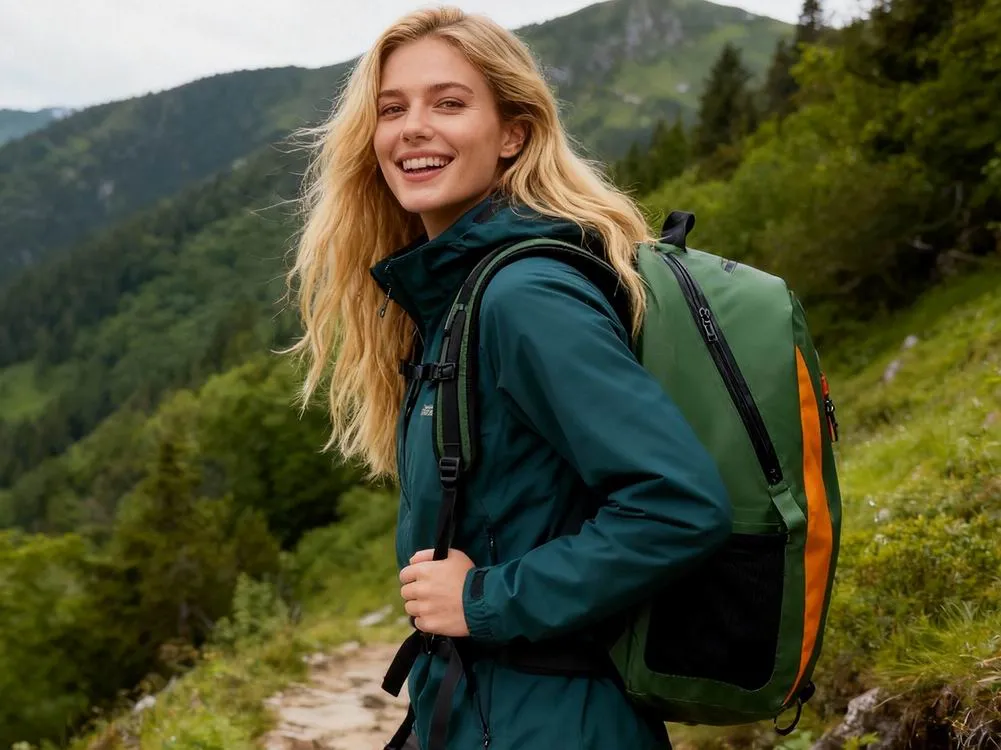
If you take one thing from this section, take the checklist. Ask any supplier which fabric, which seam method, which closure and which hardware sealing they propose, then ask for the test report that covers each. Our quality control page lists the four inspection gates we run, and our manufacturing page shows the welding hall where this work happens.
Four Backpack Architectures: Roll-Top, Taped Zip, Welded Flap, Hybrid
Once a buyer accepts that waterproofing is a system, the next decision is architecture: how does the user get into the bag, and how does the bag close again. We build four architectures, and almost every OEM waterproof backpack programme we run uses two of them across the range. The choice determines the achievable IP rating, the unit cost, the access experience and, not incidentally, the price point at which the bag can retail.
Roll-Top
The roll-top is the classic dry-bag closure adapted to a harness-carrying pack. The user folds the top of the shell down three or more times, then clips a side-release buckle across the fold, and can also clip the buckle down the side of the body to compress the load. Because there is no opening left, a correctly executed roll-top is submersible and can be tested to IPX7 or IPX8. The trade-offs are access speed and volume honesty: the user must unroll to reach anything, and the stated volume includes the unrolled collar, so a 25 L roll-top carries somewhat less than a 25 L zip bag. We build roll-tops from 15 L cyclist packs to 40 L multi-day hiking packs, usually in 500D or 840D TPU laminate with RF-welded main seams.
Taped Zip
The taped zip architecture puts a water-resistant zip on the main opening, backed by a storm flap and sealed with 20 mm seam tape along the zip tape join. Access is instant, organisation is easy, and the bag looks at home in an office. We specify YKK AquaGuard #5 for light commuter bags and #8 for main openings on larger models, always with a reverse-coil construction and a slider garage. Realistically this architecture earns IPX4 or, with a well-designed flap and a protected zip run, IPX5 to IPX6 in a spray test. It is not submersible, and we will not certify it as such. For urban, laptop-focused and travel ranges, that is the correct answer.
Welded Flap
The welded flap uses a wide panel of shell material folded over the opening and secured with buckles, hook-and-loop or cam locks, with the flap itself welded to the body along three sides. There is no zip to leak and no roll to fumble with; the flap sheds water by geometry. It is slower to open than a zip but faster than a roll-top, and it gives a clean, technical silhouette that photographs well. This architecture is common on cycling and moto packs where the user wears gloves. Our flaps are cut with a 40 mm overlap past the opening line and welded with a 12 mm bond width so the seal survives repeated flexing.
Hybrid
The hybrid architecture combines a roll-top or flap main compartment with a taped zip quick-access pocket, or puts a submersible dry compartment at the base of the bag and a conventional zip compartment above it. This is where the category has moved over the last few seasons: buyers want the honest waterproof claim a roll-top allows, plus a front zip pocket where a phone, wallet and keys live. We engineer these as two separate sealed volumes sharing one back panel, which means the zip pocket leaking in a downpour does not wet the main load. It also means wet/dry separation comes for free.
| Architecture | Realistic Rating | Access Speed | Cost Index | Typical Use |
|---|---|---|---|---|
| Roll-Top | IPX7 / IPX8 | Slow, two-handed | 1.00 (baseline) | Paddle, hike, bike |
| Taped Zip | IPX4 – IPX6 | Fast, one-handed | 1.10 – 1.25 | Commuter, laptop, travel |
| Welded Flap | IPX5 – IPX6 | Medium, glove-friendly | 1.05 – 1.15 | Cycling, moto, tool |
| Hybrid | IPX7 main + IPX4 pocket | Fast for small items | 1.30 – 1.55 | Multi-day, dual-use |
Choosing between them is a commercial decision as much as a technical one. A brand selling into outdoor specialty retail can carry a roll-top at a higher price because the rating is visible on the hangtag. A brand selling into corporate gifting or e-commerce office channels will move more units with a taped zip because convenience photographs better than a rating. We routinely build both from the same shell and the same colourway so that a range tells one visual story while serving two channels. See how this plays out across categories on our products page and in our travel bags range.
Shell Fabric Selection: 420D Ripstop Nylon to 1000D TPU Laminate
Fabric choice is the single biggest lever on unit cost, hand feel and durability, and it is the decision buyers most often reverse after seeing a sample. Denier describes the linear mass density of the yarn: a higher number means thicker yarns and, all else being equal, a heavier and more abrasion-resistant cloth. But denier is only half the story. Weave, laminate thickness and coating chemistry matter just as much, and a well-built 500D TPU laminate can outperform a poorly specified 1000D in a real abrasion test.
420D Nylon Ripstop
420D nylon ripstop is the lightest shell we routinely weld. The ripstop weave intersperses thicker reinforcement yarns in a grid, so a small puncture stops at the grid line instead of running. Nylon has better tensile strength and abrasion resistance per gram than polyester, and it takes dye beautifully, which matters for brands running saturated colourways. We laminate it with a 0.1–0.15 mm TPU film and a 0.15 mm PU back coating, which lands the finished laminate at roughly 240–280 g/m². It is the right choice for 15–20 L commuter packs and hydration-compatible running vests where empty weight drives the purchase decision.
500D Polyester TPU
500D polyester TPU laminate is our volume workhorse. Polyester costs less than nylon, holds its colour better under UV and absorbs less water when it does eventually wet out, which keeps drying times short. Against those advantages it is slightly less abrasion-resistant gram for gram, which we offset with a 0.2 mm TPU film. This is the default shell for 20–28 L commuter and urban daypack ranges, and it welds on both RF and hot-air equipment with a wide process window, which keeps defect rates low on long runs.
840D and 1000D TPU Laminate
At 840D and 1000D we move into genuine heavy-duty territory. The laminate reaches 480–620 g/m² depending on film thickness, and the shell shrugs off rock, concrete and roof-rack abuse. 840D is what we specify for 30–40 L hiking and expedition packs where the harness carries 12–18 kg. 1000D with a 0.3 mm TPU film is reserved for base panels, corner reinforcements and professional or tactical programmes where the bag is dragged rather than carried. The penalty is weight and hand feel: a 1000D shell is stiff, and on a small pack it feels over-built. We generally recommend 1000D only above 30 L or on high-wear zones.
PVC 500D and Coated Options
PVC 500D with a 0.35 mm coating remains relevant for price-driven programmes and for applications requiring high-frequency weldability with very high seam strength. It is heavier than an equivalent TPU laminate, stiffens noticeably in cold weather and raises questions in markets with strict chemical compliance regimes. We will quote it when a buyer needs a specific price point or a specific tactile quality, and we will be explicit about the trade-offs and provide the relevant compliance documentation on request.
| Shell | Finished Weight | Hydrostatic Head | Weld Method | Best For |
|---|---|---|---|---|
| 420D nylon ripstop + TPU | 240–280 g/m² | ≥10,000 mm | RF or hot-air | 15–20 L commuter |
| 500D polyester + TPU | 300–360 g/m² | ≥10,000 mm | RF or hot-air | 20–28 L urban |
| 840D polyester + TPU | 480–540 g/m² | ≥20,000 mm | RF welding | 30–40 L hiking |
| 1000D polyester + TPU | 560–620 g/m² | ≥20,000 mm | RF welding | Expedition, pro |
| PVC 500D, 0.35 mm | 520–580 g/m² | ≥10,000 mm | RF welding | Price-led programmes |
We hold stock in the core colourways for 420D, 500D and 840D, which shortens sampling for most projects. Custom Pantone matching is available from 800 metres of shell per colour, which usually corresponds to about 600 finished bags depending on size; where a colour falls below that threshold we either consolidate it into an existing dye lot or price the surcharge transparently. Full material data is available through our services page.
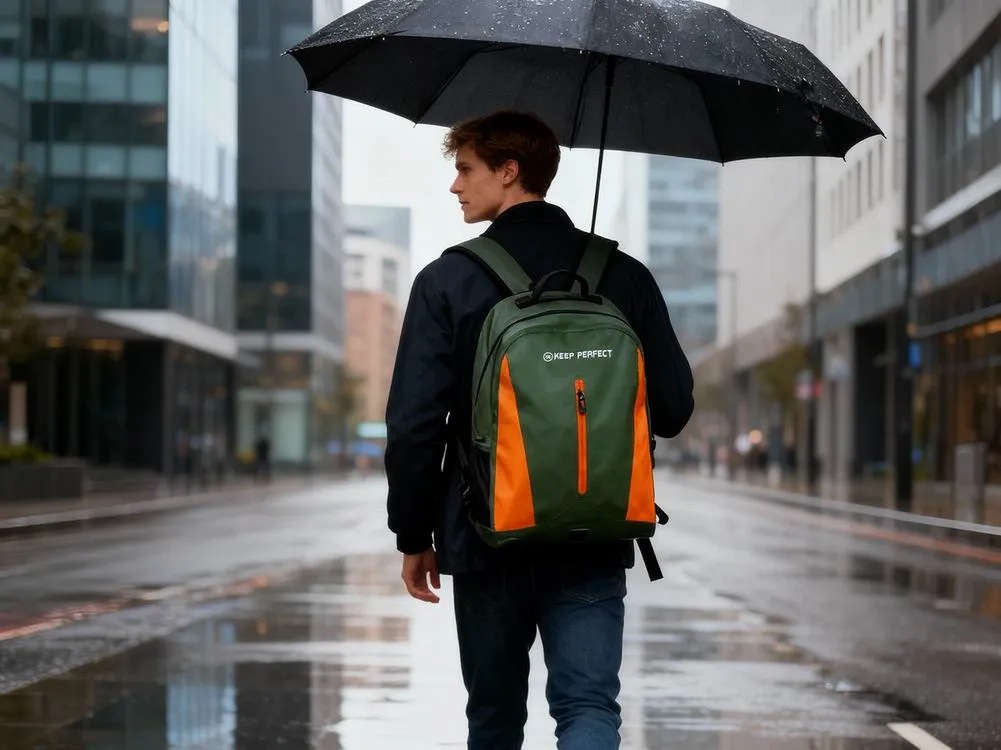
Seam Engineering: RF Welding, Hot-Air Welding and Taped Seams Compared
A seam is only as good as the process window that produced it. Three methods dominate waterproof backpack manufacturing, and each has a different relationship between capital cost, operator skill, achievable geometry and joint strength. Understanding the differences helps a buyer read a quotation properly, because a supplier quoting welded construction on equipment designed for taped seams will produce a bag that looks right and leaks in month three.
RF (High-Frequency) Welding
RF welding, also called high-frequency or dielectric welding, places the two TPU faces between a shaped electrode and a grounded plate and passes a radio-frequency field through them. Polar molecules in the TPU oscillate and generate heat internally, melting the film at the interface without overheating the outer face. We run at 27.12 MHz with a typical cycle of 3–8 seconds depending on electrode length and material thickness. RF welding produces the highest and most consistent peel strength in our experience, routinely above the 8 N/cm specification, and it can create complex shaped welds in a single stroke. The limitation is tooling: every weld geometry needs its own electrode, so development cost is higher and design changes after tooling are expensive.
Hot-Air Welding
Hot-air welding feeds a jet of heated air, typically 400–600 °C, into the lap joint while a pressure roller closes it. It is a continuous rather than cyclic process, so it suits long straight seams and high-volume runs, and changing the weld path means changing a jig rather than an electrode. The compromise is process sensitivity: air temperature, nozzle angle, feed speed and roller pressure all interact, and a drift of a few degrees changes the melt. We log parameters per station and pull peel test coupons every two hours on production runs. Hot-air welds comfortably exceed 8 N/cm when the window is held, but the variance across a shift is wider than RF.
Taped Seams and Bonded-Stitched Hybrids
Where a seam must carry structural load directly, or where the geometry defeats a welding electrode, we sew first and then seal. The structural seam is sewn at 8–10 SPI, then 20 mm waterproof tape is applied over the stitch line with controlled heat and pressure. The tape bridges the needle holes; the stitching carries the shear load. This bonded-and-stitched hybrid is how we attach hip belts, shoulder strap lower anchors and haul loops, all of which see forces that a pure lap weld is not ideal for. We test taped seams to the same peel criterion as welded seams, and we reject tape that has lifted more than 2 mm at any point along its length.
| Method | Peel Strength | Tooling Cost | Geometry Freedom | Typical Application |
|---|---|---|---|---|
| RF welding (27.12 MHz) | 8–12 N/cm, low variance | High, per electrode | Shaped welds, one stroke | Main body, base, collars |
| Hot-air welding | 8–11 N/cm, medium variance | Low, jig only | Long straight runs | Side seams, panel joins |
| Taped seam, 20 mm | 6–9 N/cm | Very low | Any sewn path | Stress-point repairs |
| Bonded + stitched hybrid | Load-bearing, tape-sealed | Low | Any sewn path | Harness, hip belt, handles |
Every welded backpack we ship is pressure-checked at the end of the line. The bag is inflated to a low positive pressure, held for a defined dwell, and inspected for pressure decay; any unit that fails is opened, the defective weld is located under soapy water, and the root cause is traced back to the station and the shift. That feedback loop is why our seam defect rate stays low across runs of several thousand units. Details of the inspection protocol are on our quality page. The same welding discipline underpins our cooler bags, where a failed seam means meltwater in a vehicle rather than a damp notebook.
Zipper Systems: YKK AquaGuard, TIZIP MasterSeal and PU-Coated Coil
Zippers are the most mis-specified component in waterproof bag manufacturing, and the reason is simple: a zip is a moving part with a deliberate gap in it, so it cannot be waterproof in the way a welded seam is. The useful question is not "is this zip waterproof" but "how much water pressure will this zip hold, and what happens behind it when it eventually passes some." We design on the assumption that a zip will weep under sustained load and engineer a protected path for that water, which is a far more reliable approach than relying on the coating alone.
YKK AquaGuard #5 and #8
YKK AquaGuard is a reverse-coil zip with a polyurethane laminated tape and a moulded water-repellent finish. The #5 gauge suits accessory pockets, front organiser panels and hydration sleeves; the #8 gauge suits main openings where the slider will be pulled thousands of times. Both are splash-resistant rather than submersible, and both work best when the zip run is vertical and short, so gravity sheds water away from the slider. We pair them with a storm flap on any compartment holding electronics, and we finish every run in a slider garage so the slider parks under cover.
TIZIP MasterSeal 10
When a programme genuinely requires submersion with zip access, we specify TIZIP MasterSeal 10. It is a moulded plastic-toothed zip with an interlocking profile and a mechanical end clamp, designed for drysuits and technical dry bags. It will hold pressure well beyond anything a coated coil can manage, and it is the only zip we will certify behind an IPX7 or IPX8 claim. The trade-offs are real: the zip is stiff, requires two hands and noticeable force to close, costs substantially more than an AquaGuard, and needs the user to align the teeth correctly each time. For a dive, rescue or whitewater programme that is an acceptable price. For a daily commuter it is not, and we will say so.
PU-Coated Coil and Budget Options
PU-coated coil zips without the full AquaGuard construction are a legitimate cost-saving measure for pockets that do not hold anything water-sensitive, and for lining pockets inside a dry main compartment. They bead water for a season, and they keep the unit cost in range for promotional and entry-level retail programmes. Our rule is simple: if a pocket can contain a phone, a wallet or a passport, it gets a storm flap regardless of which zip is underneath it.
Hardware That Surrounds the Zip
The zip does not work alone. Sliders, pulls, garage mouldings and the buckles that secure a storm flap determine whether the closure survives the warranty period. We source from YKK, Duraflex and ITW Nexus, and we run 48-hour salt-spray testing on metal components and on plated finishes before approving a hardware set. Webbing mating with those buckles is specified at 25 mm for light packs and 38–50 mm for loads above 10 kg. Storm flap geometry matters too: we cut flaps to overlap the zip line by at least 30 mm and secure them so the flap lies flat under compression rather than gaping at the corners.
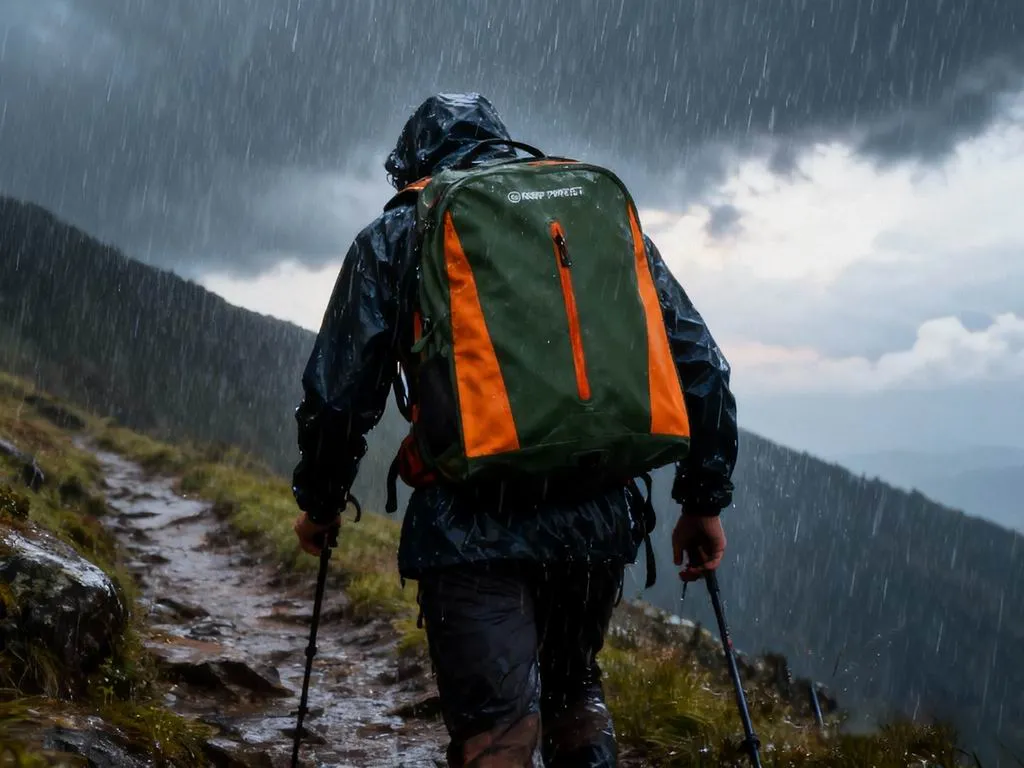
A custom roll-top backpack factory should be able to show you peel-test data for the collar weld specifically, because the collar is folded and unfolded on every single use. We cycle-test collars to 5,000 open-close cycles during development and re-inspect the weld cross-section afterwards.
Hydrostatic Head and IP Ratings: Reading the Numbers Correctly
Two numbers appear on almost every waterproof bag specification, and both are routinely misread. Hydrostatic head measures the fabric; IP ratings measure the assembled product. A shell can pass a 20,000 mm hydrostatic test and the finished bag can still leak through a poorly welded collar, which is why we publish both numbers and why buyers should ask for both.
Hydrostatic Head
Hydrostatic head is measured by clamping a fabric sample under a column of water and recording the height in millimetres at which water penetrates. A rating of 10,000 mm means the fabric withstood a 10 metre column. Our lighter laminates are specified at 10,000 mm or better and our heavy-duty shells at 20,000 mm or better, tested to the principles of ISO 811 and AATCC 127. In practical terms, 10,000 mm is more than adequate for rain, spray and the pressure generated by kneeling on a loaded pack; 20,000 mm matters when the bag is strapped to a rack at speed or dragged across a wet surface under load.
IP Ratings Under IEC 60529
The IP code rates the whole assembly against defined water exposure. The second digit is the water figure, and an X in the first position simply means the product was not tested against dust. IPX4 means splash from any direction. IPX6 means powerful water jets from a 12.5 mm nozzle at roughly 100 litres per minute from 3 metres for at least three minutes. IPX7 means immersion at 1 metre for 30 minutes. IPX8 means continuous immersion under conditions specified by the manufacturer, which is why an IPX8 claim without a stated depth and duration is not meaningful.
Note that IPX6 and IPX7 are not a ladder in the way people assume. IPX6 is a dynamic high-pressure jet test; IPX7 is a static immersion test. A product can pass one and fail the other, and a specification that claims "IPX6/IPX7" should ideally cite two separate reports. As an IPX6 backpack supplier, we test to the specific figure the buyer's market requires and we name the exact test condition on the report rather than quoting a range.
| Rating | Test Condition | Real-World Equivalent | Our Achieving Construction |
|---|---|---|---|
| IPX4 | Splash from any direction, 10 min | Light rain, urban shower | AquaGuard #5 + short storm flap |
| IPX5 | 6.3 mm nozzle, 12.5 L/min, 3 min | Sustained rainfall, cycling | AquaGuard #8 + full storm flap |
| IPX6 | 12.5 mm nozzle, 100 L/min, 3 min | Deck spray, storm, roof rack | Full welded shell + welded flap |
| IPX7 | 1 m immersion, 30 min | Dropped in water, capsize | Roll-top, 3 turns, welded body |
| IPX8 | Continuous immersion, maker-specified | Extended submersion | Roll-top or TIZIP, tested to agreed depth |
One further caution: neither rating accounts for ageing. A bag that passes IPX7 on day one may not pass after two years of UV, salt, flexing and abrasion. That is why our warranty is written against manufacturing defects for 12 months and why we advise brands to position waterproof performance as durable rather than permanent. Care labelling that tells the user to rinse salt water off and to avoid machine washing does more for field performance than any single material upgrade.
Back Panel and Harness Design for Load Comfort
Waterproofing and comfort pull in opposite directions. The most breathable back panel is open spacer mesh, and the most waterproof shell is a continuous welded film; putting holes in the film to breathe is exactly what a waterproof engineer is paid not to do. Resolving that tension is where a factory either has real harness experience or does not, and it is the single most reliable predictor of whether a backpack gets good reviews.
Load Transfer Before Padding
Comfort is mostly a load-transfer problem, not a padding problem. On a well-fitted pack, roughly 70–80 percent of the weight should pass through the hip belt into the pelvis, with the remainder carried on the shoulders and controlled by the sternum strap and load lifters. We build hip belts around a semi-rigid internal stiffener so they hold their shape under load, wrap them with PE foam at 25 kg/m³ for support without excessive bulk, and finish the contact surface in a closed-cell material that does not absorb water. Padding an unsupported shoulder strap simply moves the discomfort a few millimetres.
Managing Sweat on a Welded Shell
Because we cannot perforate the outer shell, we manage sweat at the contact surface instead. Our standard construction uses vertically channelled EVA foam behind a brushed tricot or spacer mesh facing, so air moves along the spine rather than through the shell. The channels are typically 6–8 mm deep and run the full height of the panel. On hot-climate programmes we widen the channels and reduce foam density to increase airflow. The result is not as cool as a fully suspended trampoline panel, but it keeps the waterproof integrity of the shell intact and it dries quickly after a wash-down.
Torso Length, Fit and Adjustment Range
A harness that only fits one torso length will generate returns no matter how well it is padded. We tool harnesses in two or three torso ranges, typically short at 40–45 cm, regular at 45–50 cm and long at 50–56 cm, measured from the iliac crest to the seventh vertebra. Within each range there is 5–7 cm of vertical adjustment at the shoulder strap anchor. For programmes shipping into a single market we will size to that market's anthropometric data; for global programmes we recommend two sizes and clear sizing guidance on the product page.
Stability, Compression and Access
Load stability is the difference between a pack that feels 2 kg lighter and one that fights the user on every step. Four compression straps, two per side, pull the load toward the back panel and stop it swinging. A sternum strap with an elastic section lets the chest expand without loosening the harness. Load lifters set at roughly 45 degrees from horizontal pull the top of the pack toward the shoulders. On multi-day models we add a removable hip belt and a floating lid so the same shell can be configured for a 25 L overnight trip or a 40 L five-day carry.
| Carry Class | Typical Load | Harness Specification | Back Panel Build |
|---|---|---|---|
| Ultralight 15–20 L | 2–5 kg | 25 mm webbing, fixed straps | 3 mm EVA, brushed tricot |
| Commuter 20–28 L | 4–8 kg | 25 mm webbing, sliding sternum | 6 mm channelled EVA, spacer mesh |
| Daypack 25–32 L | 6–10 kg | 25 mm webbing, padded hip wings | 8 mm channelled EVA + PE sheet |
| Multi-day 32–40 L | 10–18 kg | 38 mm webbing, structured hip belt, load lifters | 10 mm EVA + PE frame sheet + alloy stay |
Harness attachment is where the waterproofing and the comfort requirements physically meet, and it is the joint we test hardest. Lower strap anchors are bonded and stitched to a reinforced internal patch, then taped, then pull-tested to failure during development; production units are sampled and tested to a defined proof load. Our sports bags and fishing bags ranges use the same attachment philosophy adapted for different load profiles.
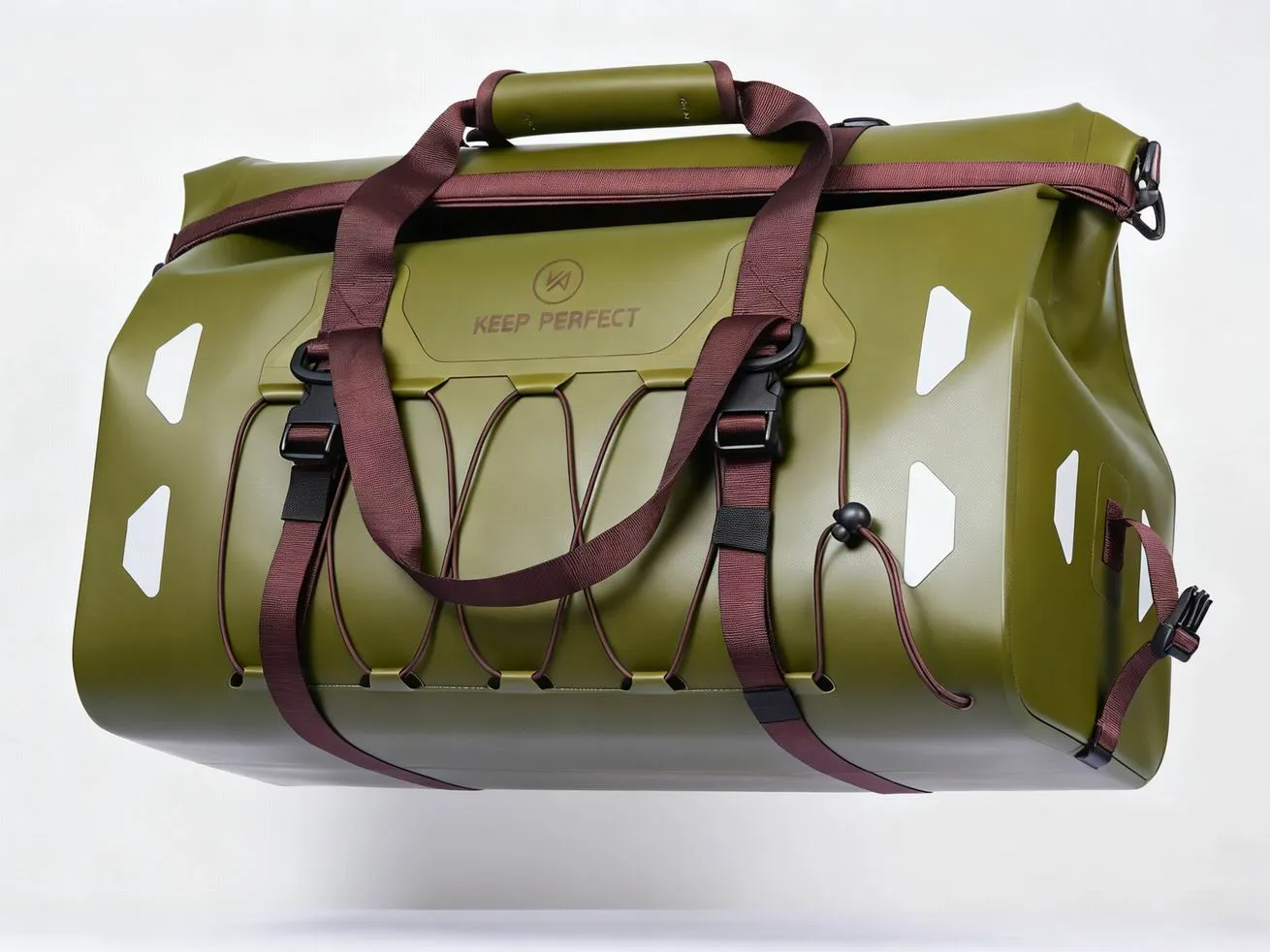
Laptop and Electronics Protection: Sleeve Padding, Suspension, Port Sealing
A waterproof shell protects a laptop from rain, but a laptop is far more likely to die from a drop than from a shower. Electronics protection is therefore a two-part engineering problem: the sleeve has to isolate the device from impact, and the shell has to keep water away from the sleeve. We treat the laptop compartment as a suspension system rather than a padded pocket, and we specify it separately from the rest of the bag.
Sleeve Suspension and Padding
The failure mode we design against is corner impact. A laptop dropped inside a bag usually lands on a corner, and the force travels through the aluminium or magnesium chassis into the logic board. Our sleeves suspend the device so that the padded base of the sleeve never rests on the bottom of the bag: we build a false bottom with a 10 mm gap, using PE foam at 25 kg/m³ in the base panel and softer EVA on the side walls. In drop testing from 1 metre onto concrete with a 15-inch dummy load, that suspension reduces peak transmitted acceleration substantially compared with a flat padded pocket.
Padding distribution matters more than padding thickness. A sleeve with 15 mm of soft foam on all sides feels luxurious in a shop and performs worse than 8 mm of firmer foam with a stiffened back panel, because the firm foam resists bottoming out. We specify a graduated build: firm at the base, medium at the sides, soft at the top edge where the opening is. Sleeve interiors are finished in a low-abrasion brushed tricot so that repeated insertion does not scuff the device, and we add a retention strap that holds the laptop against the back panel rather than letting it slide.
Port Sealing and Cable Management
Every cable opening is a hole in the waterproof envelope, and there are three ways to handle it. The first is to eliminate it: for most commuter programmes we route a power bank lead internally to a sealed pocket and skip the external port entirely. The second is a welded TPU pass-through boot with a moulded cap that screws or clips shut; this holds IPX6 when capped and is the option we recommend for any bag that will see real water. The third is a grommet with an elastic closure, which is cheaper and adequate for splash only. We will quote all three and say plainly which rating each supports.
Hydration ports follow the same logic. A drinking tube has to exit the bag, so we specify a welded tube port with a sealing collar that grips the tube and closes when the tube is removed. On models where hydration is optional, we supply a blanking plug so the port stays sealed for the majority of users who never run a bladder.
| Protection Layer | Specification | Defends Against | Verification |
|---|---|---|---|
| Sleeve base | PE foam 25 kg/m³, 10 mm suspended | Corner drop, base impact | 1 m drop test, 6 faces |
| Sleeve walls | EVA 6–8 mm graduated density | Side crush, bag-on-bag | Compression load test |
| Sleeve closure | Elastic or hook-and-loop retention strap | Device sliding out | Inversion shake test |
| Cable port | Welded TPU boot + moulded cap | Rain, spray, immersion | IPX6 jet test capped |
| Hydration port | Welded collar + blanking plug | Tube exit leakage | Inversion fill test |
Sizing should be specified by device class rather than by nominal inch figure, because a 14-inch chassis from two different brands can differ by 8 mm in width. We build sleeves to accept a stated maximum device envelope, typically 360 x 250 x 20 mm for a 16-inch class sleeve, and we state that envelope on the sample report so your product page can list compatible devices accurately.
Volume Planning: 15 L Commuter to 40 L Multi-Day
Volume is the number printed largest on a product page and the number buyers argue about most, because a stated litre figure means very different things between factories. We measure volume by filling the closed shell with calibrated media and recording the result, and we publish both nominal and usable figures. Nominal includes the unrolled collar and all pockets; usable is what the main compartment actually holds once internal modules are in place. On a roll-top the gap between the two can reach 15 percent.
15–20 L: The Commuter and Cyclist Class
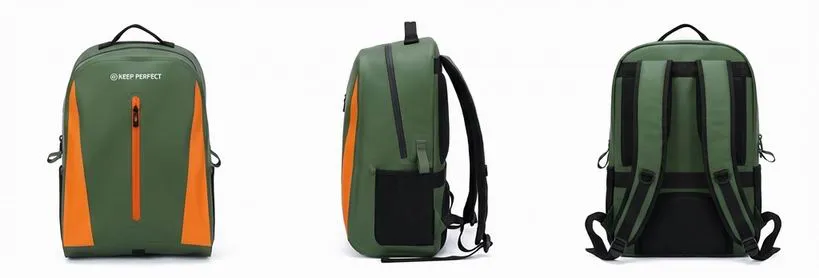
At 15–20 L the pack carries a laptop up to 14 inches, a chargers pouch, a light shell jacket, a lunch box and a water bottle. It is the size urban cyclists and office commuters buy most, and it is the size where empty weight is most scrutinised. We build this class in 420D nylon ripstop or 500D polyester TPU, keeping the empty weight between 0.55 kg and 0.8 kg. Roll-top versions in this range are popular with cyclists; taped-zip versions dominate office channels because a laptop slides out at a security checkpoint without unrolling anything.
22–28 L: The Full-Day Urban and Business Class
At 22–28 L the pack handles a full workday plus a gym stop. A 15- or 16-inch laptop, a tablet, a document folder, a change of clothes, shoes and a toiletry kit all fit. This class supports real internal organisation: a dedicated laptop sleeve, a tablet slip, an organiser panel with pen loops and card slots, and a separate base compartment for shoes or a wet jacket. Waterproof business backpacks live here, and they are the class where the hybrid architecture earns its cost.
28–32 L: The Technical Daypack
At 28–32 L the pack moves onto the trail. It carries a hydration bladder up to 3 litres, a rain shell, food for a day, a first-aid kit, a camera and spare layers. Harness specification steps up to padded hip wings and a load-lifter set. Shell moves to 840D TPU. This is also the class where wet/dry separation becomes genuinely useful: a welded base compartment keeps a soaked rain jacket away from a down mid-layer, and a drainage grommet lets a wet item shed water rather than steeping.
32–40 L: The Multi-Day Carry
At 32–40 L the pack is a weekend or lightweight multi-day hiking bag. It carries a sleeping bag, a compact tent or tarp, a stove, clothing for two to four days and food. Loads in this class regularly reach 12–18 kg, so the harness becomes the primary engineering concern: a structured hip belt with an internal stiffener, 38 mm webbing, a frame sheet and an alloy stay. Compression becomes critical, because an under-filled 40 L pack carries worse than a well-packed 30 L one.
| Volume Class | Fits | Shell | Empty Weight | Architecture |
|---|---|---|---|---|
| 15–20 L | 14 in laptop, lunch, bottle, shell | 420D / 500D TPU | 0.55–0.80 kg | Roll-top or flap |
| 22–28 L | 16 in laptop, tablet, gym kit, shoes | 500D / 840D TPU | 0.85–1.20 kg | Taped zip or hybrid |
| 28–32 L | 3 L bladder, layers, food, first aid | 840D TPU | 1.10–1.40 kg | Roll-top + zip pocket |
| 32–40 L | Sleeping bag, shelter, stove, 4 days | 840D / 1000D TPU | 1.40–1.90 kg | Roll-top, structured harness |
When planning a range, we recommend three sizes rather than five. A 15–18 L commuter, a 22–26 L business or urban pack and a 30–35 L technical pack cover most of the addressable market while keeping each style above the MOQ threshold. More sizes mean more tooling, more sampling and more inventory risk for a marginal gain in coverage. Our product range is structured on exactly that principle.
Colourways, Reflective Trim and Brand Visibility on the Trail
Colour is a commercial decision that quietly drives every other specification. It sets the dye lot minimum, it determines which trims can be matched, it affects how visible the bag is at dusk, and it decides whether the product photographs well on a retailer's site. We plan colourways at the same time as architecture, not after, because retrofitting a new shade into a finished design usually forces compromises on webbing, thread and logo.
Building a Colourway Range
A workable commercial range is usually three to five colourways: two core neutrals that carry the volume, one brand signature colour that appears in campaign imagery, and one or two seasonal shades that refresh the range annually. Core neutrals should be stocked shell colours so that repeat orders do not wait on a dye lot. Seasonal shades should be planned with a realistic exit, because a colour that sells 200 units in one season still consumes a 500 pcs MOQ commitment in the next.
Matching is where cost hides. A shell in a custom Pantone shade needs its webbing, binding tape, zip tape, thread and logo treatment matched or deliberately contrasted. We quote matched-trim programmes and contrast-trim programmes separately, because the former carries surcharges across four or five component categories. A common and cost-effective approach is a custom shell with stock black or grey trims, which reads as intentional design rather than compromise.
Reflective Trim and Low-Light Safety
Reflective elements are functional safety equipment on a commuter or cycling pack, and they are also one of the few brand-visible details that survive a dark photograph. We apply reflective as a heat-transfer film welded to the shell, as a reflective piping binding along a seam, or as a reflective yarn woven into the webbing. Each method has a different durability profile: welded film is brightest and most durable but adds a step; piping is robust and easy to place along an existing seam; woven webbing is subtle and essentially permanent.
Placement should follow how a user is seen. The most effective zones are the shoulder strap fronts, which face oncoming traffic when a cyclist is upright, and the lower back panel and side compression straps, which catch headlights from behind. We typically spec 20–25 mm reflective on the strap fronts and 8–10 mm accent lines elsewhere. Retroreflective performance is checked against a defined coefficient of retroreflection in third-party testing when a buyer's market requires certification.
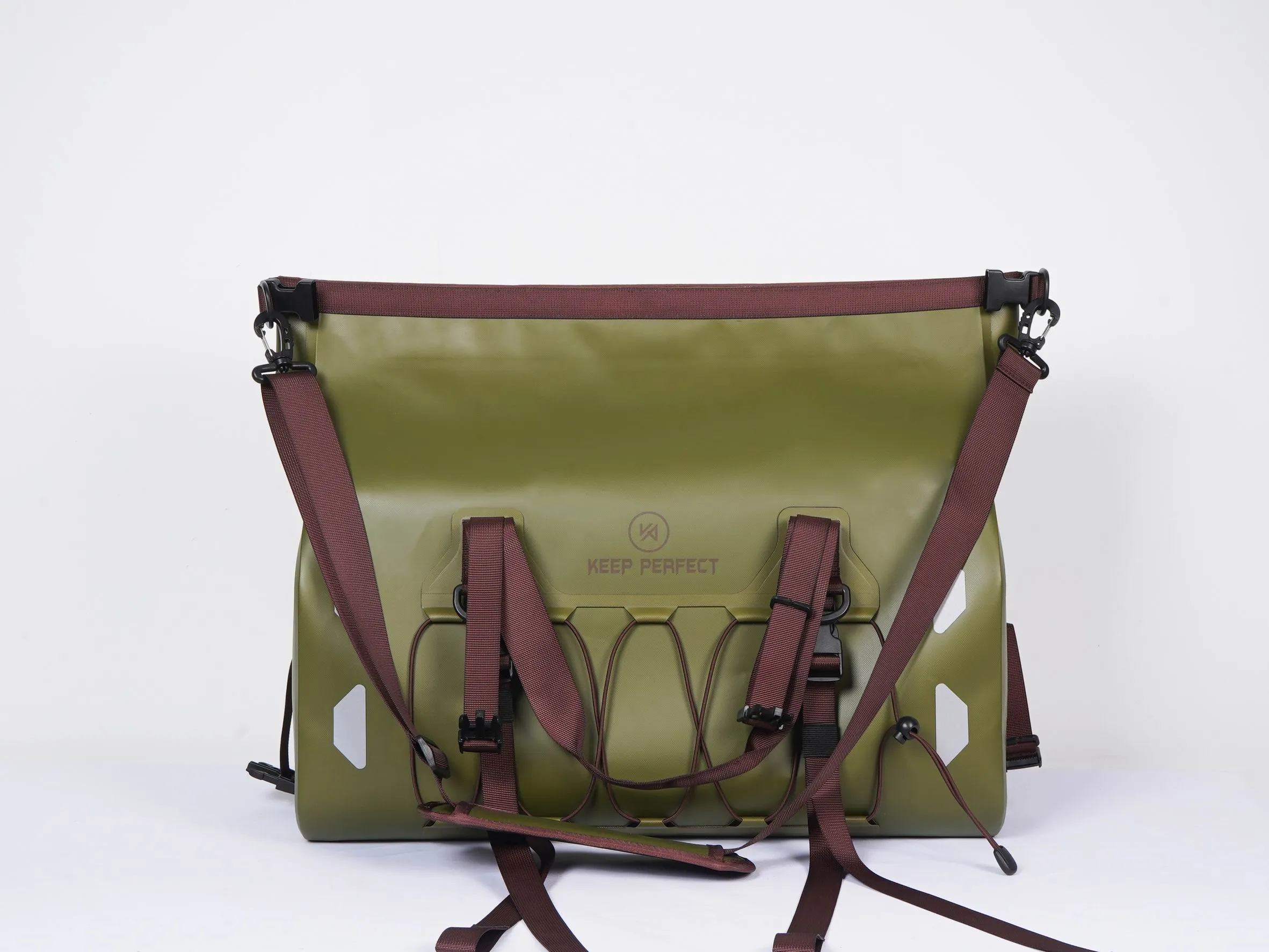
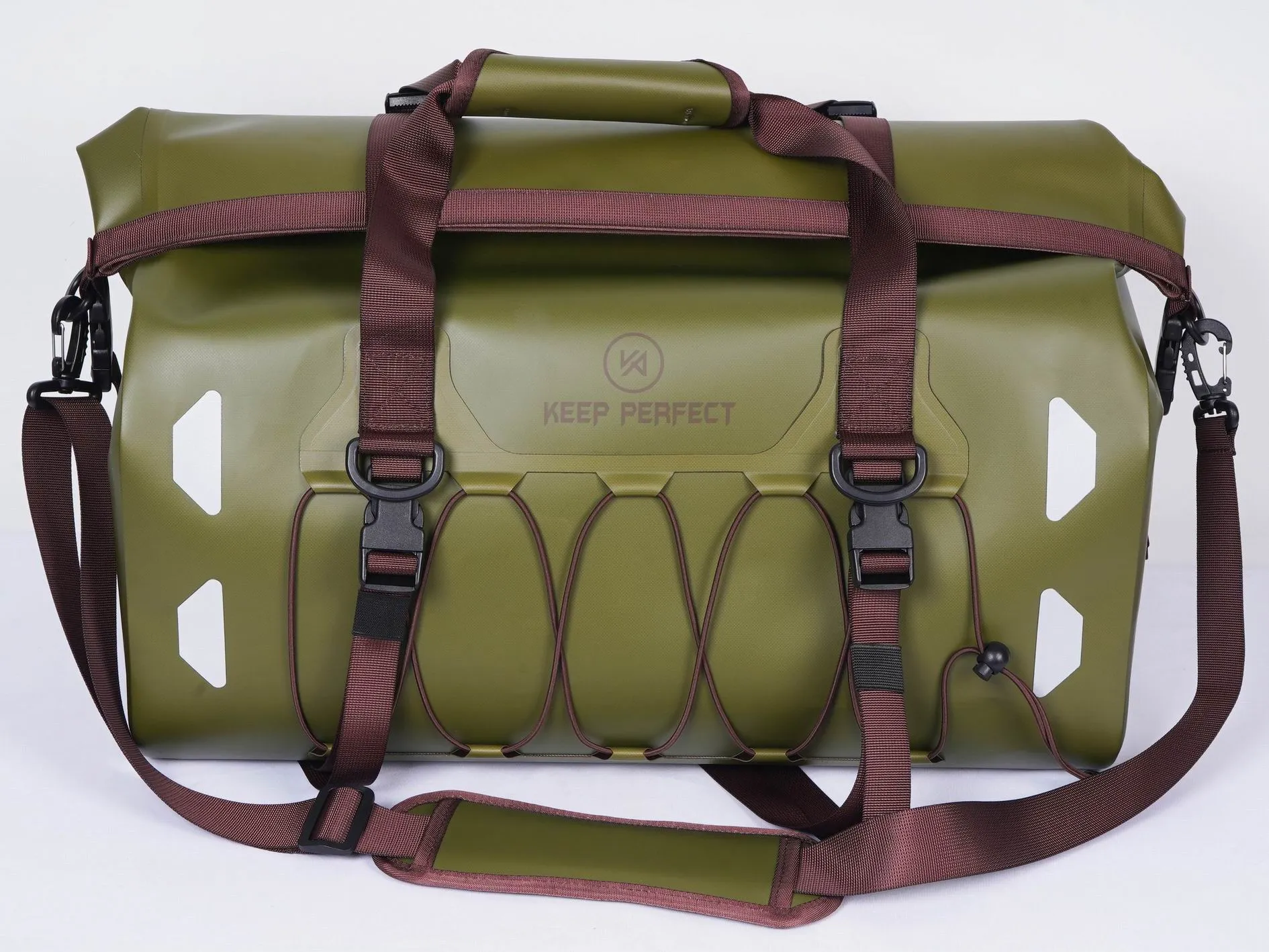
Brand visibility also depends on finish. Matte TPU reads as technical and premium and hides scuffs well; gloss TPU is brighter on shelf and easier to wipe clean but shows abrasion. We sample both in the chosen colourway before tooling, because the same Pantone value can look 15 percent darker in gloss than in matte. Our about page covers how we manage colour approval and lab dips.
Logo Application on TPU: Deboss, Silicone Transfer, Woven Patch, Metal Badge
Branding a waterproof shell is constrained by one hard rule: do not pierce the membrane. Every decorative method we offer is surface-applied, because a stitched label on the outside of a welded shell creates a leak path that no amount of seam sealer will reliably fix. Within that constraint there are four methods worth considering, and the right choice depends on brand positioning, order volume and how the bag will age.
Deboss
Debossing presses a heated metal die into the laminate, leaving a permanent recessed impression of the logo. It is the most durable option, it cannot peel or crack, and on matte TPU it produces a subtle tone-on-tone effect that reads as premium. The cost is tooling: each logo size needs its own die, and the die must be matched to the panel it presses, so a logo that moves between sizes needs multiple tools. Deboss works best on flat reinforced panels rather than across welds or corners. For long-running programmes with stable artwork, the per-unit cost after tooling is the lowest of any method.
Silicone Transfer
Silicone transfer applies a raised, rubber-like logo through heat and pressure. It bonds well to TPU, stretches with the substrate, and gives strong tactile and visual presence with saturated colour. It suits technical and sports positioning, and tooling costs far less than a deboss die because it uses a screen and a transfer sheet rather than a machined tool. The trade-off is long-term abrasion resistance: on high-wear zones such as the base or the lower back panel, a silicone logo will show edge wear before a deboss will. We recommend placing silicone logos on the upper front panel or strap ends.
Woven Patch
A woven patch gives the finest detail and the widest colour range, including gradients and small text that deboss and silicone cannot reproduce cleanly. It is applied by welding the patch to the shell with a perimeter bond, or by ultrasonic welding where the patch geometry allows. The perimeter bond must be continuous; a patch welded only at the corners will lift at the edges. We specify a 6–8 mm weld margin and test peel strength on the patch assembly alongside the main seams. Woven patches work well for heritage, lifestyle and fashion-adjacent ranges.
Metal Badge
A metal badge delivers the strongest shelf presence and is the standard choice for premium gifting and corporate programmes. It is attached through a welded TPU backing plate with mechanical fixation or a high-strength adhesive, so the shell itself is not perforated. Weight, cost and corrosion resistance are the considerations: we use zinc alloy or aluminium with a plated or anodised finish, and we run 48-hour salt-spray testing on the finish before approval. Metal badges should be positioned away from strap contact zones to avoid scuffing the strap webbing.
| Method | Tooling | Durability | Detail Level | Best Positioning |
|---|---|---|---|---|
| Deboss | High, per die | Permanent, cannot peel | Medium, no fine text | Premium technical |
| Silicone transfer | Low, screen + sheet | Good, edge wear over time | Medium-high | Sport, active |
| Woven patch | Low-medium | Good, bond dependent | Highest | Lifestyle, heritage |
| Metal badge | Medium-high | Good, finish dependent | High | Gifting, corporate |
We recommend sampling at least two methods on the actual production shell before committing, because the same artwork can read very differently in a recessed impression versus a raised transfer. Logo artwork should be supplied as vector files with Pantone references. Our OEM services page details the artwork requirements and approval sequence.
MOQ 500 pcs per Style, per Colourway — How to Build a Range
Our minimum order quantity is 500 pcs per style, per colourway. That figure is not arbitrary. A production run has fixed costs that do not scale with volume: electrode or jig setup, machine calibration, first-piece approval, cutting markers, operator briefing and line balancing. Below roughly 400–500 units per colourway, those fixed costs are spread so thin that the unit price rises steeply while the factory's ability to hold tolerances actually falls, because the line never reaches a steady state.
What Counts as a Style
A style is a distinct silhouette with its own tooling: a 25 L roll-top and a 25 L taped-zip are two styles because they need different electrodes and different cutting markers, even though they share a shell colour. A 25 L roll-top in black and the same bag in olive are one style in two colourways, because the tooling is identical and the only variable is the material loaded at cutting. Volume commitments are therefore counted per colourway, not per style, and the two numbers compound.
This distinction matters for range planning. A brand with a 3,000 units budget can run six colourways of one style, or two styles in three colourways each, or one style in three colourways plus a second style in three more. The first option minimises development cost and risk. The middle option gives more product variety at higher tooling cost. The right answer depends on whether the brand is testing a market or servicing an established one, and we will say which we think applies.
Structuring a Launch Range
For a first programme we usually recommend a single style in two colourways: 500 units each, 1,000 total. That keeps the commitment modest, gives the brand two options on shelf, and establishes a tooling platform that later sizes can reuse. Once one colourway sells through, a second style can be added from the same shell family with reduced development cost. Brands that launch with four styles almost always end up discounting two of them.
| Range Structure | Total Units | Tooling Sets | Risk Profile |
|---|---|---|---|
| 1 style x 2 colourways | 1,000 pcs | 1 | Low, fastest to market |
| 2 styles x 2 colourways | 2,000 pcs | 2 | Moderate, covers two channels |
| 3 sizes x 2 colourways | 3,000 pcs | 3 | Moderate, full category story |
| 1 style x 5 colourways | 2,500 pcs | 1 | Low tooling, higher inventory spread |
Payment terms are T/T 30 percent deposit and 70 percent before shipment, quoted FOB Xiamen. We can quote CIF or DDP for comparison, but FOB Xiamen remains the baseline so that freight variables stay visible to the buyer. Bulk production runs 35–50 days after sample approval, and we recommend planning 60 days ahead of a target delivery date to absorb peak-season pressure. Details of the commercial workflow are on our contact page.
Sampling Workflow: 6–10 Working Days and What We Need From You
Sampling is where a waterproof programme is either de-risked or set up to fail. Our standard sample turnaround is 6–10 working days from receipt of a complete brief; structurally complex programmes, such as a multi-day pack with a moulded frame sheet or a metal badge requiring a new tool, run 12–15 working days. Those numbers assume the shell colour is in stock. A custom Pantone dye lot adds roughly 10–15 working days because the material has to be made before anything can be cut.
Day by Day
Day one is brief review and specification confirmation. Our engineering team checks the tech pack for the four leak paths, confirms materials, and flags anything that will not hold the requested rating. Days two and three cover pattern making and marker creation, plus electrode or jig preparation where a new weld geometry is involved. Days four to six are cutting, welding, assembly and hardware fitting. Days seven and eight are finishing, inline pressure checking and photography. The final days are internal review, sample report preparation and packing for courier dispatch.
What We Need From You
The single biggest cause of sampling delay is an incomplete brief. A workable package contains: a dimensioned sketch or reference sample; target capacity in litres; the shell fabric preference or, if you are unsure, the intended use and price point; the closure architecture; the hardware colour; logo artwork in vector format with Pantone references; the target rating; and the quantity split by colourway. Photographs of a competitor product with notes on what you like and dislike are genuinely useful and often faster to produce than a drawing.
If you do not have a tech pack, that is normal and not a problem. Around half of the programmes we run start from a reference sample plus a conversation. Our team produces the pattern and the specification, then sends it back for approval before cutting. What we cannot do is quote accurately without knowing capacity, material and quantity, so those three figures should be established first.
Sample Costs and Revisions
Sample charges vary with complexity and are credited against the bulk order when the programme proceeds to production. The first sample is rarely the final one: most programmes go through one or two revision rounds covering pocket placement, strap geometry, logo scale or colour. Revisions on existing tooling typically take 4–6 working days. We photograph every sample against a scale reference and record measured capacity so that revision requests can be specific rather than subjective. Our manufacturing page shows the sampling room and welding equipment.
Field Failures We Design Against (and the Tests That Catch Them)
A warranty claim is a design review conducted by a customer, usually at the worst possible moment. We collect field failure data and feed it back into specification, and the list below covers the modes we see most often in waterproof backpacks. Each one has a corresponding test in our development protocol, and most have a corresponding check on the production line.
Collar Weld Fatigue
The roll-top collar is folded and unfolded on every single use, and the weld attaching it to the body sees repeated flexing concentrated along one line. The failure appears as a hairline split at the weld edge after a season. We address it by extending the bond width on collar welds, using a radiused electrode profile rather than a sharp corner, and cycle-testing collars to 5,000 open-close cycles during development with a post-test peel check. In production we inspect the first twenty collars of every run and then sample every two hours.
Strap Anchor Pull-Out
Shoulder strap lower anchors carry the full load of the pack in shear and peel. A purely welded anchor can peel progressively under a heavy, swinging load, which is why we bond and stitch these joints to a reinforced internal patch and then tape the stitch line. Development testing pulls the assembly to failure and records the peak load; production testing applies a defined proof load to sampled units. We set the specification so the proof load sits comfortably below the recorded failure point.
Zip Weep Into the Laptop Compartment
Users discover this one when they open a bag after a storm. The fix is architectural rather than material: the laptop compartment is a separate sealed volume with its own storm flap, positioned against the back panel rather than against the outer shell. We test by running the IPX6 jet test on the assembled bag with absorbent paper inside the laptop sleeve, then checking for any moisture transfer. Any design that shows transfer at development stage goes back for flap redesign.
Base Abrasion
Backpacks get set down on concrete, gravel and boat decks. The base is the first panel to go, and a punctured base is a total loss. We specify heavier denier or a second layer on base panels, add moulded or welded feet on larger models, and run abrasion testing against a defined abrasive under a standard load, recording cycles to visible wear. For 32–40 L packs we treat a reinforced base as standard rather than optional.
Hardware Corrosion and UV Degradation
Metal components in coastal and paddle markets corrode; TPU left in strong sun chalks and loses flexibility. We run 48-hour salt-spray testing on metal hardware and plated finishes, and we specify UV-stabilised TPU grades for programmes shipping into high-insolation markets. Care labels instruct users to rinse salt water off and to dry the bag out of direct sun, which measurably extends service life.
| Failure Mode | Design Countermeasure | Development Test | Production Check |
|---|---|---|---|
| Collar weld fatigue | Wider bond, radiused electrode | 5,000 cycle flex + peel | First-piece + 2 hourly sample |
| Strap anchor pull-out | Bonded + stitched + taped patch | Pull to failure, record peak | Proof load on sampled units |
| Zip weep to laptop bay | Separate sealed volume + flap | IPX6 jet + moisture indicator | Rain room on AQL sample |
| Base abrasion | 1000D panel, welded feet | Abrasion cycles to wear | Visual inspection, AQL 2.5 |
| Hardware corrosion | Plated/anodised, ITW/Duraflex | 48 h salt spray | Incoming hardware inspection |
All bulk shipments are inspected to AQL 2.5 under ISO 2859-1 across four gates: incoming material verification, inline welding checks, end-of-line pressure testing and final random inspection before carton sealing. Every unit carries a 12 month warranty against manufacturing defects. Full protocols are published on our quality control page, and our factory credentials are on the about page.
Frequently Asked Questions
Are your waterproof backpacks fully submersible?
It depends on the architecture you choose. Roll-top models with three or more turns and a welded body are tested to IPX7, meaning 1 metre of immersion for 30 minutes. Taped-zip commuter models reach IPX4 to IPX6 and are built for rain and spray, not submersion, because the zipper is the limiting component. We state the exact rating and test condition on every quotation.
What is your minimum order quantity?
MOQ is 500 pcs per style, per colourway. A style means a distinct silhouette requiring its own tooling; a colourway means one shell colour within that style. A 25 L roll-top in black and the same bag in olive counts as one style across two colourways, so 1,000 units total. We structure ranges to keep every colourway at or above the threshold.
How long does sampling take?
Standard sampling is 6–10 working days from receipt of a complete brief. Programmes needing new tooling, such as a moulded frame sheet or a metal badge, run 12–15 working days. A custom Pantone shell colour adds roughly 10–15 working days because the material must be produced before cutting begins. Revisions on existing tooling take 4–6 working days.
Can you work from a photo instead of a tech pack?
Yes. Around half of our programmes begin with a reference sample or photographs plus notes on what to change. Our engineers produce the pattern and specification, send them back for approval, and only then cut material. For an accurate quotation we do need three figures early: target capacity, shell material or intended use, and quantity split by colourway.
Which zipper should I specify for a laptop backpack?
For a commuter bag that opens many times a day, YKK AquaGuard #8 on the main opening with a storm flap and slider garage is the practical choice. It is splash-resistant, not submersible. If the programme genuinely requires immersion with zip access, we specify TIZIP MasterSeal 10, which is stiffer and costlier but holds pressure. We quote both with the trade-offs stated.
Do you add laptop sleeves and can you size them to our market?
Yes. We build suspended sleeves sized to a maximum device envelope rather than a nominal inch figure, typically 360 x 250 x 20 mm for a 16-inch class compartment. The sleeve base sits 10 mm above the welded floor on PE foam at 25 kg/m³ so a dropped bag does not transmit corner impact into the chassis.
What does IPX6 actually test?
IPX6 under IEC 60529 exposes the assembled product to powerful water jets from a 12.5 mm nozzle at around 100 litres per minute from 3 metres, for at least three minutes, from multiple directions. It is a dynamic high-pressure test and is not a lower grade of IPX7, which is static immersion at 1 metre for 30 minutes. A product can pass one and fail the other.
Can you match a specific Pantone colour?
We can, with a minimum dye lot of roughly 800 metres per colour, which corresponds to about 600 finished bags depending on size. Below that threshold we either consolidate the shade into an existing dye lot or price the surcharge transparently. We also match or deliberately contrast webbing, binding, zip tape, thread and logo treatment to the shell.
How do you apply logos without piercing the waterproof layer?
All four of our methods are surface-applied. Deboss presses a heated die into the laminate. Silicone transfer heat-bonds a raised logo. Woven patches are welded with a continuous 6–8 mm perimeter bond. Metal badges fix to a welded TPU backing plate. None of them perforates the shell, so the membrane stays intact.
What are your payment and shipping terms?
Standard terms are T/T 30 percent deposit and 70 percent before shipment. Quotations are FOB Xiamen as the baseline, with CIF or DDP available for comparison so freight variables stay visible. Bulk production runs 35–50 days after sample approval, and we recommend booking 60 days ahead of your target delivery date.
Do you test every bag before shipment?
Every unit is pressure-checked at the end of the line, and any failure is traced to the station and shift that produced it. Bulk shipments are additionally inspected to AQL 2.5 under ISO 2859-1 across four gates: incoming material, inline welding, end-of-line pressure and final random inspection before carton sealing.
Can you build a hybrid roll-top with a quick-access zip pocket?
Yes, and it is the most requested configuration in the category right now. We engineer the two compartments as separate sealed volumes sharing one back panel, so water entering the zip pocket in a storm does not reach the main load. A welded base compartment also gives you wet and dry separation without adding a stitched seam.
What shell fabric do you recommend for a 30 L hiking pack?
840D polyester TPU laminate at roughly 480–540 g/m² with a hydrostatic head of 20,000 mm or better. It carries the abrasion of rock and roof racks while staying manageable at 1.1–1.4 kg empty. For packs above 30 L or for high-wear zones we move to 1000D with a 0.3 mm TPU film.
Do you offer hydration-compatible designs?
Yes. We build a welded internal bladder sleeve with a hanger, plus a welded tube port with a sealing collar that grips the tube and closes when the tube is removed. On models where hydration is optional we supply a blanking plug so the port stays sealed for users who never run a bladder.
What warranty do you provide?
Every backpack carries a 12 month warranty against manufacturing defects, covering weld integrity, seam tape adhesion, hardware function and workmanship. The warranty does not cover abrasion from normal use, puncture, or damage from machine washing, and we supply care labelling that helps users avoid those outcomes.