Insulated Cooler Bags Manufacturer
We manufacture heat-welded waterproof cooler bags and cooler backpacks with PE foam insulation for outdoor, beach and promotional buyers. Every cooler bag is we
Soft Cooler Construction: Why Waterproof and Insulated Are Two Different Problems
A waterproof cooler bag manufacturer is asked two questions more than any others: is the bag waterproof, and how long does it hold ice? They sit on the same hangtag but belong to different engineering disciplines. Waterproofing is about stopping liquid at a boundary; insulation is about slowing heat through conduction, convection and radiation. A soft cooler has to solve both in the same wall thickness, with a third constraint on top: every surface the food touches must be legally safe for food contact. Buyers who compress all three into the phrase "waterproof insulated cooler" usually receive a sample that is strong on two and quietly weak on the third.
The first separation to make is directional. Waterproof-outward means the bag keeps rain, spray and a dunking in a lake outside. Leak-proof-inward means the bag keeps its own meltwater inside when it is lying on its side in a car boot. A 24-can cooler carries roughly eight litres of beverage plus six to eight kilograms of ice, so four to seven litres of water will be looking for the lowest exit by the afternoon. Seams that survive a hose test will still weep at the cuff if the cuff geometry is wrong, and the cuff is where most field failures start.
The Five-Layer Stack in a Welded Cooler Backpack
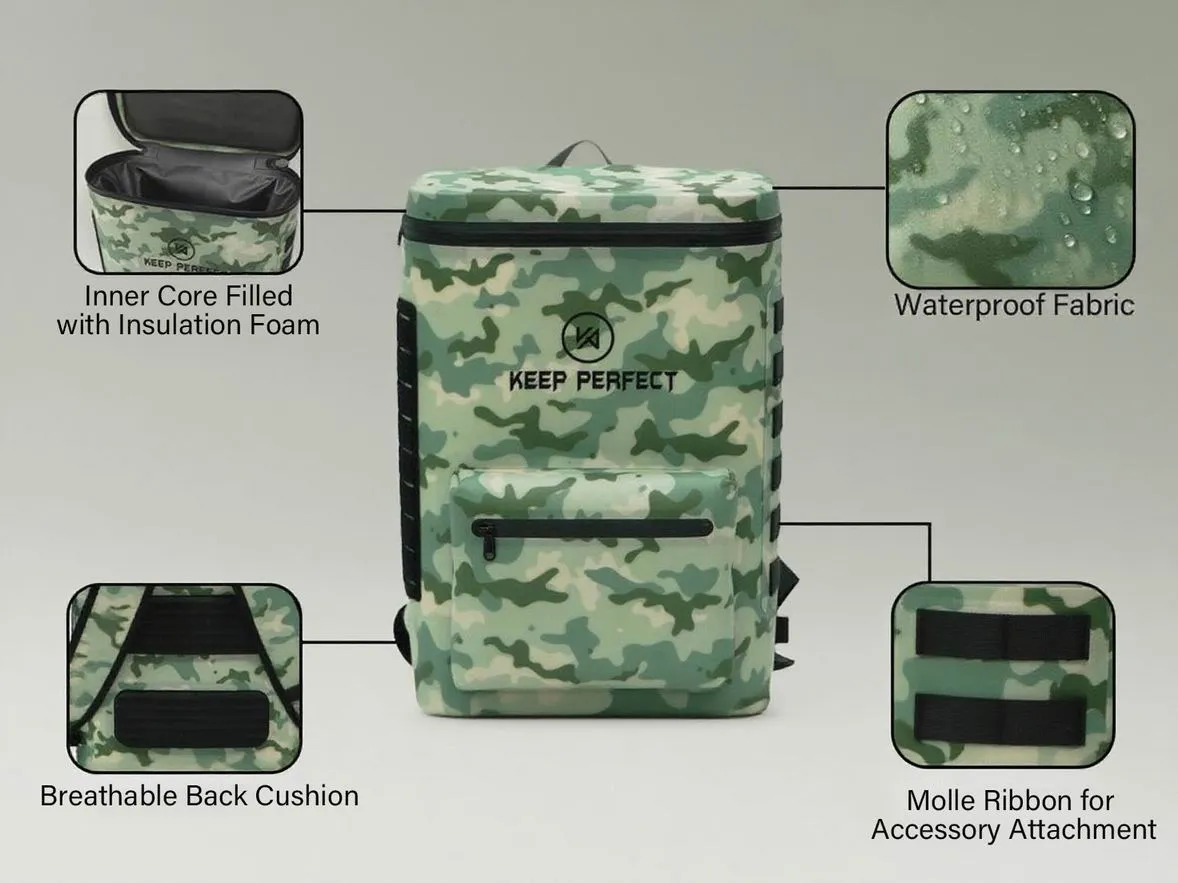
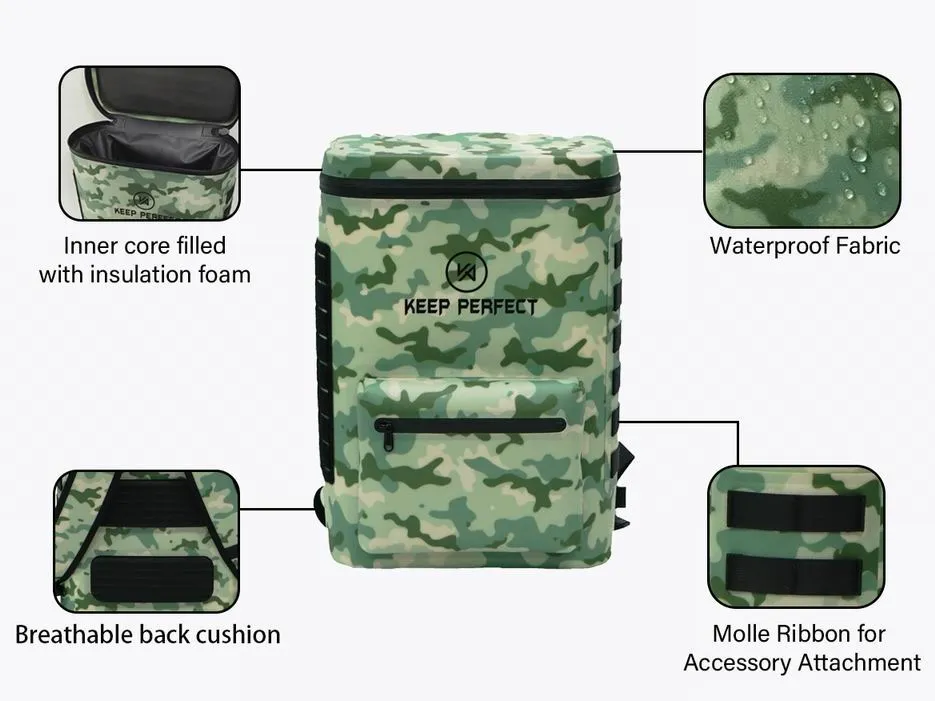
A cooler wall is a laminate, not a bag with foam stuffed inside it. Working from the outside in, the stack we build most often is: a 600D polyester face fabric with a PU back coating near 0.15 mm for printability; a TPU film at 0.1–0.3 mm that is the actual waterproof barrier; a closed-cell PE foam core at 25 kg/m³ and 8–10 mm; an optional reflective scrim acting as a radiant barrier; and an inner liner of TPU film or PEVA at 0.10–0.15 mm that is food-safe, weldable and wipeable. A hard-liner variant replaces the inner two layers with a moulded PP or ABS tub dropped into a welded fabric shell.
Every interface between those layers is a potential delamination point, and delamination is the failure that turns a cooler into a soggy sponge. The interfaces also decide how the panel welds: a polyolefin foam core under a TPU face will not radio-frequency weld cleanly, which is why core and face films are specified as a matched set rather than chosen independently from a swatch book. The requirements also fight each other in three predictable places. Thicker foam improves retention but acts as a heat sink during welding, so dwell time and electrode pressure must be re-tuned; thicker foam makes corner folds bulky exactly where the electrode loses contact; and a fully sealed shell traps moisture, so the liner needs an antimicrobial finish and the mouth needs to open wide enough to air out between trips.
Can Count to Litres: Sizing a Cooler Range for Your Market
Can count is a North American convention, and it is a convention rather than a measurement. The reference unit is a 355 ml / 12 oz can, and a "24-can" bag is a bag that a factory has decided can swallow twenty-four of them with the lid closed. Nothing in that sentence says anything about ice, and that omission is where most capacity disputes begin. On a pack-out with a 1:1 ice-to-content ratio by weight, which is what a weekend camper actually does, each can needs roughly 0.70–0.75 litres of internal volume once you allow for the beverage, its share of ice and the void space between round cans and square walls. Cans-only pack-out needs about 0.40 litres per can.
The arithmetic gives a working rule: internal volume in litres is roughly 0.72 × can count for a realistic ice pack-out, and about 0.40 × can count when the bag is used with gel packs rather than loose ice. A 24-can cooler therefore lands at 16–18 litres internally, a 36-can at 25–27 litres and a 48-can at 34–36 litres. European, UK and Australian buyers rarely use can count at all; they specify litres and sell the same item as an 18 L soft cooler or a 30 L cooler backpack. We write both figures on every tech pack so that artwork, hangtag and e-commerce listing cannot disagree.
| Can Count | Beverage | Internal (1:1 ice) | External Size | Loaded Weight | End Use |
|---|---|---|---|---|---|
| 6 can | 2.1 L | 4–5 L | 24 × 18 × 20 cm | 3–4 kg | Work lunch |
| 12 can | 4.3 L | 8–9 L | 30 × 22 × 25 cm | 6–7 kg | Day hike, beach |
| 18 can | 6.4 L | 12–14 L | 35 × 25 × 28 cm | 9–10 kg | Family picnic |
| 24 can | 8.5 L | 16–18 L | 40 × 28 × 32 cm | 12–14 kg | Cooler backpack |
| 36 can | 12.8 L | 25–27 L | 46 × 32 × 36 cm | 18–20 kg | Group camping |
| 48 can | 17.0 L | 34–36 L | 52 × 36 × 40 cm | 24–27 kg | Overlanding, events |
Building a Three-Tier Capacity Ladder
A cooler range sells as a ladder rather than as isolated SKUs. The pattern that works for most private-label programmes is three capacities sharing one fabric, one hardware family and one branding zone: a 12-can entry piece at an aggressive retail price, a 24-can core volume driver, and a 36-can or 48-can halo piece that carries the technical story. Because all three share the same fabric colour and buckle set, dye lots and hardware purchases consolidate, which is what makes a three-SKU launch reachable inside a realistic first-order budget. Capacity laddering also protects against the common mistake of launching one size and discovering it is nine litres too small for how customers actually pack.
We prototype the middle size first and then scale the pattern up and down rather than developing three independent patterns, which keeps weld fixtures, zip lengths and harness geometry in one family and holds sampling at the standard 6–10 working days instead of the 12–15 working days a complex new structure needs. Market conventions shift the ladder: US buyers think in cans, UK and EU buyers in litres, Japanese buyers want compact 4–7 L lunch volumes that stand upright in an office fridge, and Australian buyers expect a soft cooler to survive a full day at 38 °C. Our sports bags and product development programmes use the same capacity table with different exterior features.
Insulation Cores: PE Foam, EPE, PU and Vacuum Panel Compared
Heat arrives by conduction through the wall, which is what the foam resists, by convection every time the zip opens or flexible walls pump air through the closure, and by radiation, which matters more than most buyers expect: a dark bag on a 32 °C day can reach a surface temperature above 55 °C until a reflective face or an internal radiant barrier cuts the gain.
Core material is chosen on thermal conductivity, but five other properties decide whether it survives manufacturing and use: closed-cell versus open-cell structure, density, compression set, weldability and behaviour when wet. Closed-cell polyethylene foam at 25 kg/m³ is our default because it pairs a conductivity near 0.038 W/m·K with a cell structure that does not absorb water, at a density high enough to resist crushing under a loaded harness. Below about 20 kg/m³ the core visibly thins at strap anchors within a season; above 33 kg/m³ the panel stops draping, which makes corner welds bulky and the bag uncomfortable to carry.
| Core | Density | Conductivity | Water Uptake | Weldable | Cost Index |
|---|---|---|---|---|---|
| PE closed-cell | 25 kg/m³ | 0.038 W/m·K | Under 1 % | Yes | 1.0 |
| EPE | 30 kg/m³ | 0.040 W/m·K | Under 2 % | Hot-air | 0.8 |
| XPE cross-linked | 33 kg/m³ | 0.036 W/m·K | Under 1 % | Yes | 1.3 |
| PU open-cell | 22 kg/m³ | 0.035 dry, 0.10+ wet | High, wicks | No | 0.7 |
| EVA sheet | 60 kg/m³ | 0.045 W/m·K | Low | Yes | 1.5 |
| Vacuum panel | n/a | 0.004–0.008 W/m·K | None if sealed | No, pocketed | 4.0–6.0 |
| Aerogel blanket | n/a | 0.015–0.020 W/m·K | Low | No | 7.0–9.0 |
Why 25 kg/m³ PE Foam Is Our Default, and When a Vacuum Panel Earns Its Cost
The default sits at the intersection of performance, weld behaviour and price. At 8 mm it is the wall for a lunch cooler or a 12-can tote; at 10 mm it carries a 24-can backpack through a full day; at 15 mm it is what we quote when a buyer needs a defensible 48-hour claim on a soft bag. Every extra millimetre adds cost, bulk at the corners and thickness the pattern has to absorb, so the specification is a negotiation rather than a maximisation. On premium models we bond a reflective scrim to the warm face of the core, and it only works because the wall leaves an air gap of at least 5 mm beside it.
A vacuum insulated panel delivers four to eight times the thermal resistance of PE foam per millimetre, which sounds like an obvious upgrade until you price and handle it. Panels cannot be welded, cannot be folded, lose most of their performance when punctured, and must be inserted into a sewn pocket inside the wall, which reintroduces needle holes. They cost four to six times the foam they replace and add three to five working days to sampling, so we recommend them only for a premium SKU with a specific 48-hour-plus claim and a retail price that absorbs the delta.
The Liner: TPU Film, PEVA, PVC and Food-Safe Requirements
The liner is the layer the customer actually judges. It is what they wipe, what they smell when they open the bag in a hot car, and what a regulator will test if a shipment is pulled at a port. It also has to weld to the shell at the cuff, resist puncture from a can rim or a bottle opener, stay flexible at 0 °C and carry food-contact documentation for the target market. Four materials compete for that job and they are not interchangeable.
TPU film at 0.10–0.30 mm is our default. It welds cleanly by radio frequency and hot air, stays supple below freezing, contains no plasticisers that migrate into fatty food, and takes a printed care label without delaminating. It costs more than PEVA or PVC and scuffs a little more easily when an ice block is dragged across it, but a 0.15 mm film with a matte emboss hides scuffs well and is what we quote for anything above a promotional 6-can piece. TPU is also the liner we can weld directly to a TPU-laminated shell, which removes an entire seam from the construction.
PEVA is the low-cost non-chlorinated option and it is genuinely food-safe, which is why it dominates supermarket promotional coolers. Its weaknesses are mechanical: lower puncture resistance, a narrower welding window, and a tendency to crease permanently where the bag has been folded for shipping. PVC coating at roughly 0.35 mm is tough, cheap and welds beautifully, and it remains the right call for a heavy-duty fishing cooler sold into a market without plasticiser restrictions. Its problems are compliance and cold: several European retail channels restrict phthalate-plasticised PVC in food-contact articles, and PVC stiffens below freezing.
Soft Liner Versus Moulded Hard Liner
A hard-liner cooler uses a moulded PP or ABS tub inside a welded or sewn fabric shell. The advantages are real: the tub cannot be punctured by a can rim, it wipes clean in seconds, it holds a rectangular ice block, and it keeps its shape so the bag packs flat and photographs well for e-commerce. The costs are equally real: a mould is a tooling investment, the tub adds 500–900 grams, the bag no longer folds for shipping, and the interface between rigid tub and flexible shell has to be engineered so meltwater cannot track between them. We quote hard-liner programmes separately because the tooling and assembly sequence make them a different product.
Whichever route you choose, food-contact testing should be run on the finished laminate as it will be used, not on the raw film the converter shipped, because adhesive and print ink both contribute to overall migration. We commission that testing on the finished wall structure and keep the report on file per material lot, which is the document a European importer asks for before releasing a container. The cuff is the other place liners fail: specify a fold-over of at least 15 mm so the weld has land area, a weld width of at least 8 mm rather than the 4 mm used on dry bags, and a reinforced grab point at the front of the opening.
Welded Seams in a Cooler Bag: Keeping Meltwater Inside
A sewn seam pierces the waterproof membrane thousands of times and every needle hole is a capillary that eventually carries water, which is why the waterproof shell of a cooler is welded. The two technologies we run are chosen by polymer family rather than by habit. Radio-frequency welding at 27.12 MHz works on polar polymers such as TPU and PVC: an alternating field makes the molecules generate their own heat, so the bond forms through the full thickness of the film. Hot-air and hot-wedge welding work on polyolefins such as PE and PP, which do not respond to an RF field, by melting the surfaces and pressing them under a nip roller.
Both methods are specified to the same acceptance figure on our floor: a peel strength of at least 8 N/cm measured on a tensile tester, sampled per production lot rather than once a year in a laboratory. Peel strength alone is not enough, because a cooler seam also has to resist creep. A loaded 36-can cooler puts sustained shear on the base-to-side weld for hours above 35 °C, which is exactly the combination that opens a marginal weld slowly, so we run a creep check during development with a defined load at 40 °C for four hours.
The Four Failure Points We Inspect First
Four locations account for most cooler leaks and each gets its own inspection step: the vertical corner of a box cooler, where four layers meet and the electrode has to reach into an inside angle; the base gusset, where the fold must be trimmed so it does not lift film off the electrode; the cuff; and any penetration, whether a drain plug, a bottle-opener anchor, a harness anchor or a D-ring. Every penetration gets a welded flange or an RF-welded patch, never a sewn bar tack alone.
Structural attachments are the one place where stitching still has a role. A harness anchor carrying fourteen kilograms needs the mechanical interlock of thread through fabric as well as the watertightness of a weld, so we use a bonded-and-stitched hybrid: the anchor patch is welded to the shell, stitched at 8–10 stitches per inch through a reinforced internal patch, then taped with 20 mm tape over the stitch line. Visual and dimensional inspection follows AQL 2.5 under ISO 2859-1, but leak testing is different: a leaking cooler is a returned cooler, so every welded chamber is inflated to 3–5 kPa and held while an operator watches a pressure-decay gauge. The full regime is documented on our quality control page and buyers may nominate their own inspector to witness it.
Zipper Choice for Coolers: Leak-Proof, Water-Resistant and Airtight
Three words are used loosely in this category and they mean different things. Water-resistant means the closure sheds a splash and light rain. Leak-proof, or watertight, means liquid does not pass through the closed chain under sustained contact or low pressure. Airtight means gas does not pass either, which matters to a cooler because if air cannot pass, warm air is not pumped into the bag at every step, and that convective gain is worth a measurable amount of ice life on a backpack cooler.
The mainstream choice for a mid-tier cooler is a water-resistant reverse coil zip with a PU coating, typically #5 gauge with the coated face outward. It costs roughly three to four times a standard coil zip, runs smoothly and is correct when the bag will be opened twenty times a day and carried upright. The step up is a branded coated coil such as YKK AquaGuard in #5 or #8, which adds a laminated film over the chain and better coating durability. Above that sits a genuinely watertight TIZIP MasterSeal 10 with a moulded sealing profile and clamping slider, and above that in practical terms sits a roll-top, which has no chain at all.
| Closure | Rating | Cost Index | Ice Effect | Tier |
|---|---|---|---|---|
| Coil zip with storm flap | Splash | 1.0 | Baseline | Promo lunch |
| PU-coated reverse coil #5 | IPX4–5 | 2.5 | +3 to 5 % | Volume 12–24 can |
| YKK AquaGuard #5 / #8 | IPX6 spray | 4.0 | +5 to 8 % | Premium 24–36 can |
| TIZIP MasterSeal 10 | Airtight | 10.0 | +10 to 18 % | Technical halo |
| Roll-top with buckle | IPX7–8 | 3.0 | +8 to 12 % | Dry-bag hybrid |
Specifying the Slider, Not Just the Chain
Buyers specify the chain and forget the slider, which is the part that wears. A coated zip opened three thousand times in a sandy beach environment starts passing water at the slider long before the chain fails, because grit abrades the coating exactly where the slider turns the chain. We run a five-thousand-cycle slider test with a light dust load during development, and we recommend a zip garage plus a moulded storm flap for any cooler sold into beach or boating channels.
How the zip enters the shell matters as much as which zip you pick. On a TPU-laminated shell we weld a TPU-coated zip tape directly into the panel, which is the cleanest joint available. On a PVC tarpaulin shell the tape is hot-air welded. On a PU-coated polyester shell, where the coating is too thin to weld, the tape is sewn and then taped over with 20 mm waterproof tape applied under heat and pressure. All three work; they differ in cost, tooling and how the finished opening looks, so we show all three as physical samples.
Ice Retention Testing: What 24-Hour and 48-Hour Claims Actually Require
An ice retention claim is a test result, and a test result is only meaningful next to its conditions. A cooler that holds ice for 24 hours at 30 °C in shade with a 1:1 ice ratio and no openings will not hold ice for 24 hours at 38 °C in direct sun with a 1:3 ratio and eight openings. Both statements can be true at once, which is why hangtag wording and test report have to be written together, and why we state ambient, ice ratio and opening protocol beside every duration figure.
Our protocol starts with conditioning: the empty cooler is held at test ambient for at least twelve hours so the core starts at ambient rather than warehouse temperature. Ice is cubed, drawn from a freezer at minus 18 °C and weighed, and the content is a defined mass of cans or bottles pre-chilled to 5 °C. The loaded bag is placed lid-up in a shaded chamber held at 30 °C ± 2 °C with a data logger recording at four points, and the result is reported as residual ice mass plus the highest temperature any probe recorded.
| Wall Build | 24 h at 30 °C | 48 h at 30 °C | 24 h at 38 °C | Defensible Claim |
|---|---|---|---|---|
| 5 mm PE, coil zip | 15–30 % | 0 % | 0 % | Cold 8 hours |
| 8 mm PE, AquaGuard | 45–60 % | 0–10 % | 10–20 % | Ice 24 h at 30 °C |
| 10 mm PE plus scrim | 60–75 % | 15–25 % | 25–40 % | Ice 36 h at 30 °C |
| 15 mm PE, airtight zip | 75–85 % | 35–50 % | 45–60 % | Ice 48 h at 30 °C |
| Hard liner plus VIP | 85–95 % | 55–70 % | 65–80 % | Ice 72 h at 30 °C |
Writing a Claim You Can Defend on a Retail Hangtag
Two words decide whether a claim is defensible: cold and ice. Holding food below 8 °C for 24 hours is a far easier target than having unmelted ice after 24 hours, and the gap between the two tests is worth roughly 8–10 °C of internal temperature at the end of the period. If your marketing team wants an ice claim, the build has to be specified for it: a 10 mm core or thicker, an airtight or well-flapped closure, and a lid with the same wall build as the sides, because the lid is the surface manufacturers thin down to make the bag easier to open and the surface facing the sky.
We run retention testing in-house for development decisions and commission witnessed third-party reports through SGS or Intertek when a buyer needs a document for a retail or marketplace submission, which adds cost and roughly seven to ten working days. Our OEM service team will tell you honestly which claims the current build supports and what the next band up would cost. The remaining sections cover carry systems, exterior fabrics, compliance, branding, order minimums, the cooler-specific sampling checklist and the unit cost anatomy of a 24-can waterproof cooler backpack.
Carry Systems: Backpack Harness, Tote Handles, Shoulder Strap Load Limits
The carry system on a cooler is specified by weight, and cooler weights are unforgiving. A 24-can cooler backpack loaded with cans and a 1:1 ice ratio weighs 12–14 kg before anyone adds food; a 36-can reaches 18–20 kg and a 48-can reaches 24–27 kg. Those numbers decide which carry platform is honest: a harness is comfortable to roughly 15 kg for a fit adult on a short walk, above that you need a structured hipbelt or a second pair of hands, and above 25 kg you should be specifying grab handles at both ends and probably wheels.
Our backpack harness for a 24-can cooler uses 45–65 mm shoulder straps with 8–10 mm channelled EVA, a sternum strap with a whistle buckle, load lifters at the top of the straps, and a removable hipbelt on the larger sizes. The anchors are the bonded-and-stitched hybrid described earlier, and every anchor design is pull-tested to failure in development and proof-tested on production samples. Tote handles are 25 mm webbing with a 200–250 mm drop, box-stitched and bar-tacked into a reinforced panel; shoulder straps are 38–50 mm with an anti-slip pad and swivel hooks from Duraflex, ITW or YKK.
Matching the Carry Platform to Loaded Weight
Three tests decide whether a carry system ships. The static load test holds 2.5× the rated load for five minutes at the strap anchor and at the handle, with no tear, no stitch run and no visible deformation of the welded patch. The drop test takes a loaded bag through ten drops from 0.5 m onto concrete. The cycle test runs a loaded bag through a simulated walk with the harness bouncing, because a cooler that is carried downhill with fourteen kilograms inside loads its anchors very differently from one that is carried on the flat. Metal hardware is specified with a 48-hour salt spray pass, which matters for any cooler sold into a coastal or boating market.
The same discipline applies to the details buyers rarely cost: a grab handle on the base for pulling the bag out of a vehicle, a daisy chain for clipping a dry bag, and a lid that stays open while the user loads it. On our waterproof backpacks and travel bags programmes these are costed as line items, and we recommend the same for coolers so a buyer decides where the money goes.
Exterior Fabrics: 600D Polyester, Tarpaulin, Camo Print and Coating Options
The exterior of a cooler has four jobs: carry the print, survive abrasion against rock and tailgate metal, resist UV through a season of use, and give the welding machine a film it can bond. Those jobs are often in tension. A heavy PVC tarpaulin is almost indestructible and welds beautifully, but it is heavy, stiffens in the cold and limits print methods. A 600D polyester with a TPU laminate is lighter, prints beautifully and stays flexible, but needs a higher denier or a reinforced base if the bag will be dragged.
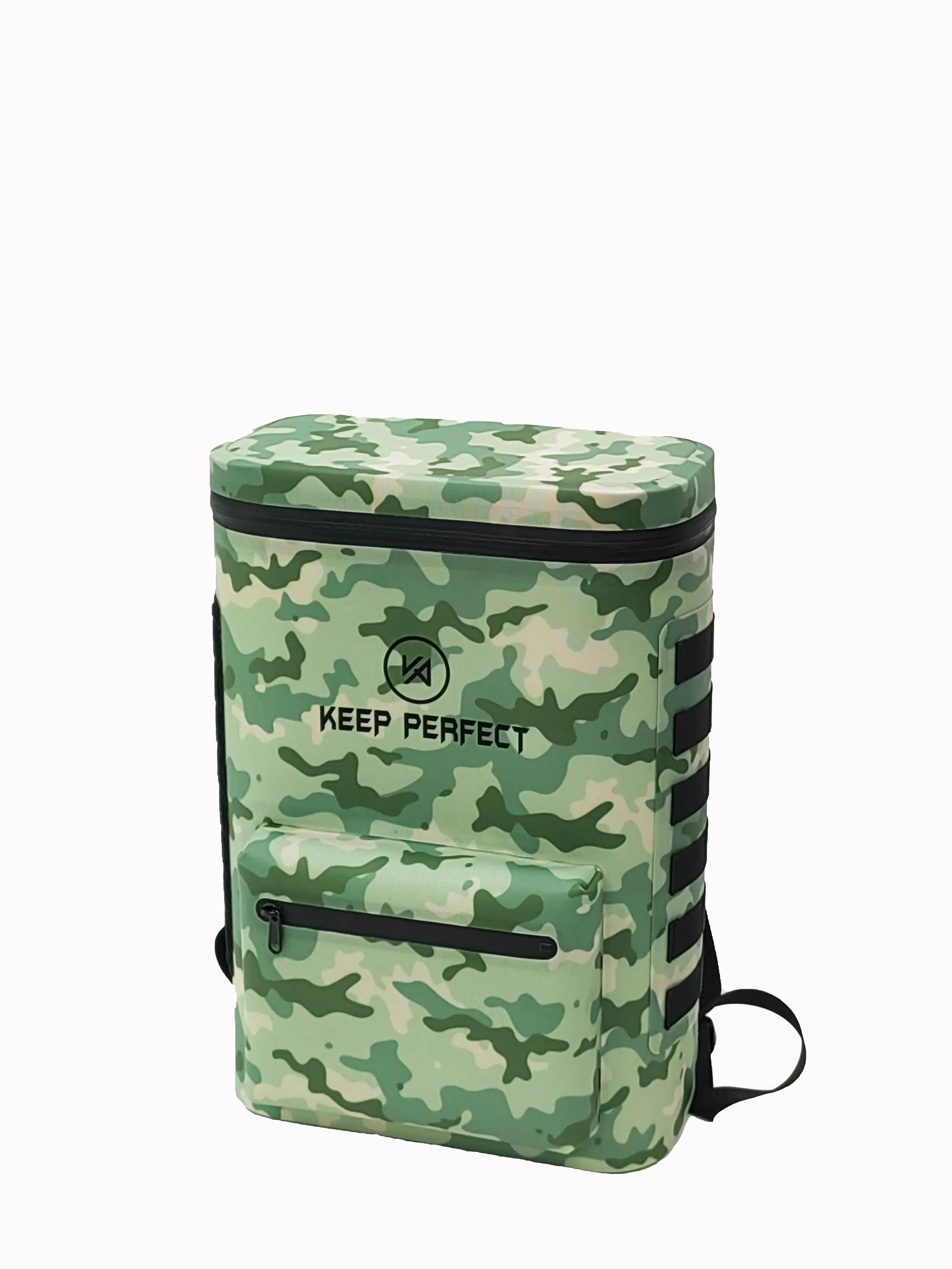
Our baseline for a soft cooler is 600D polyester with a PU back coating near 0.15 mm and a TPU film laminate at 0.1–0.3 mm, reaching a hydrostatic head above 10,000 mm and Martindale abrasion above 20,000 cycles. Heavy-duty SKUs move to 840D or 1000D, or to a 500D PVC tarpaulin with a 0.35 mm coating that exceeds 20,000 mm hydrostatic. Lightweight lunch coolers use 420D nylon ripstop, which saves 150–200 grams on a 6-can bag.
| Fabric | Weight | Hydrostatic | Abrasion | Cost | Use |
|---|---|---|---|---|---|
| 420D nylon ripstop TPU | 180 gsm | 10,000 mm | 15,000 cycles | 0.9 | Lunch coolers |
| 600D polyester TPU | 260 gsm | 10,000 mm | 20,000 cycles | 1.0 | Core range |
| 840D polyester TPU | 330 gsm | 15,000 mm | 28,000 cycles | 1.3 | 36–48 can |
| 1000D polyester TPU | 390 gsm | 20,000 mm | 35,000 cycles | 1.6 | Overland, hire fleets |
| 500D PVC tarpaulin | 540 gsm | 20,000 mm | 40,000 cycles | 1.2 | Fishing, marine |
Camo, Coatings and Colour Fastness
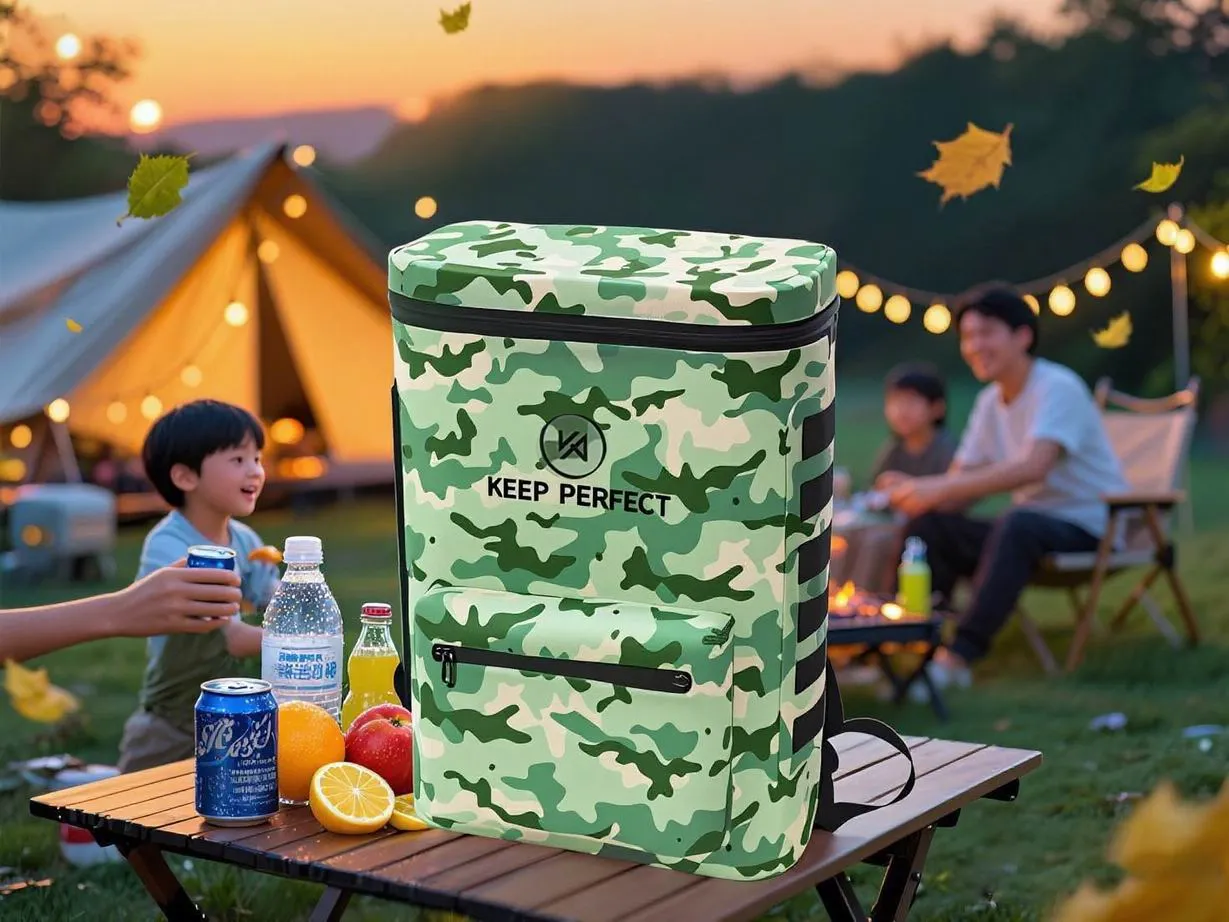
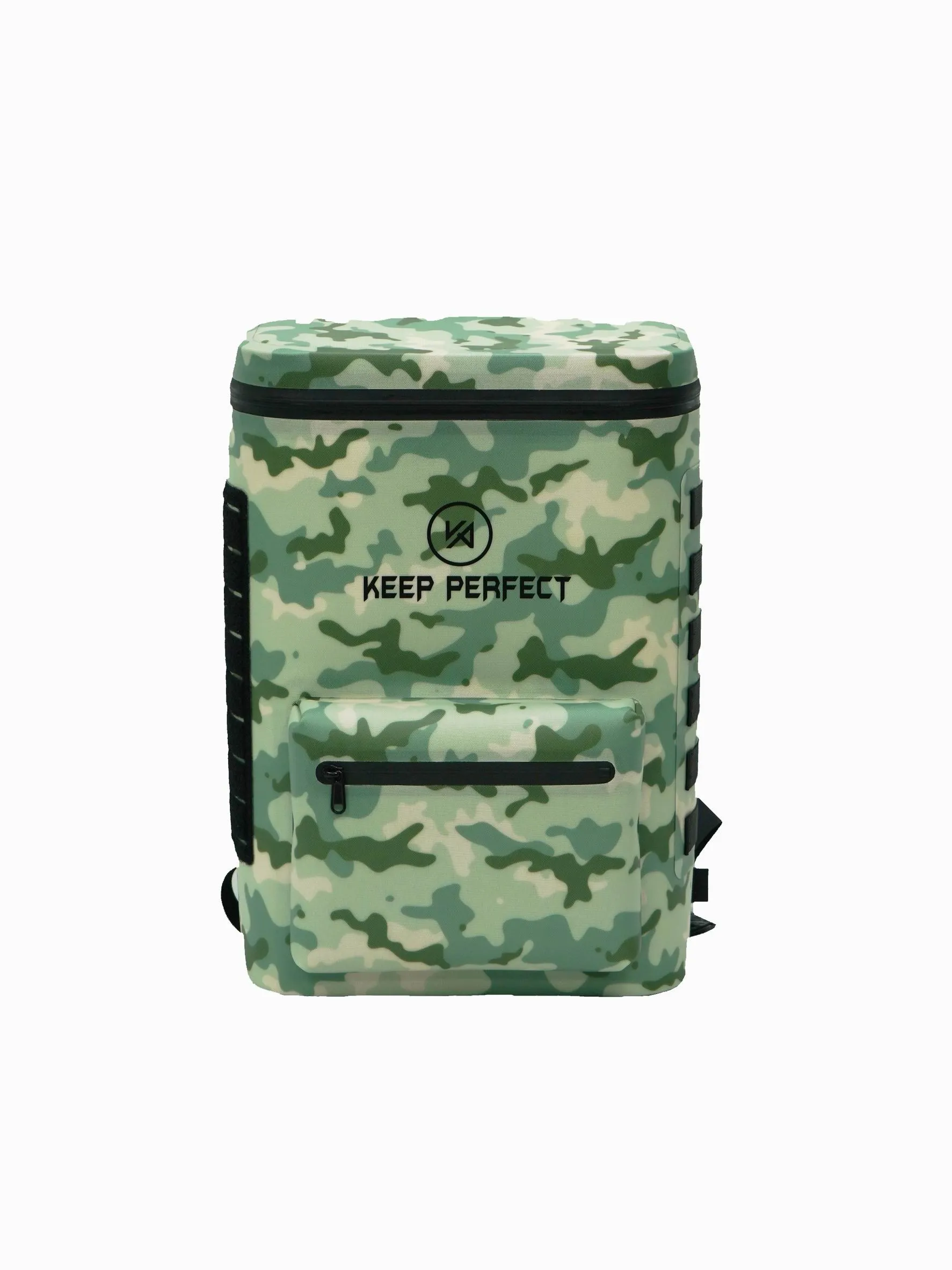
Camo is the most requested print in the cooler category and the one that catches buyers out. Dye-sublimation gives full-bleed photographic camo with no hand feel, but it only bonds to polyester and needs a light base cloth, so a deep-camo pattern on a 600D polyester face works well while the same artwork on a PVC tarpaulin has to be applied as a printed film layer. Colour fastness is specified, not assumed: light fastness of at least 4 on ISO 105-B02, rubbing fastness of at least 4 dry and 3–4 wet on ISO 105-X12, and a lab dip approved under a D65 light box before bulk dyeing starts.
Coating choices finish the specification. A PFC-free durable water repellent keeps the face fabric from saturating, which matters because a wet face conducts heat far faster than a dry one and visibly shortens ice life. UV inhibitors in the TPU film protect against chalking in high-sun markets, and an antimicrobial finish on the liner addresses the odour any sealed cooler eventually develops. All are small line items and all are cheaper to specify before the first sample than after.
Food-Contact Compliance: FDA 21 CFR, EU 10/2011, LFGB
A cooler liner is a food-contact article in every jurisdiction that regulates food packaging, and the documentary burden differs by market. In the United States the relevant framework is the FDA Code of Federal Regulations Title 21: the polymer and any rubber-like components are assessed against the applicable parts of 21 CFR 177, antioxidants and stabilisers against 21 CFR 178.2010, and any resinous or polymeric coating against 21 CFR 175.300. US buyers selling into California or into children's channels also have to consider Proposition 65 warnings and CPSIA limits on lead and phthalates, which are enforced at retail rather than at the factory.
In the European Union, Regulation 10/2011 on plastic materials and articles intended to come into contact with food sets the rules: an overall migration limit of 10 mg per square decimetre of contact surface, or 60 mg per kilogram of food simulant where the surface area is not known, plus specific migration limits for listed substances and a requirement that primary aromatic amines are not detectable. Migration is measured in defined simulants under defined time and temperature conditions, typically ten days at 40 °C for long-term storage, and the result has to be supported by a declaration of compliance under Framework Regulation 1935/2004 with production under GMP as set out in Regulation 2023/2006.
| Market | Regulation | Key Limit | Document |
|---|---|---|---|
| United States | FDA 21 CFR 177 / 178 | Substance-specific | Compliance statement |
| European Union | EU 10/2011 | 10 mg/dm² overall | Declaration of compliance |
| Germany | LFGB 30 and 31 | Migration plus sensory | LFGB test report |
| United Kingdom | UK plastic materials rules | 10 mg/dm² overall | UK declaration |
| China domestic | GB 4806 series | Per material group | GB test report |
German buyers frequently ask for LFGB on top of EU 10/2011, and the additional element is the sensory test: a trained panel checks whether the material transfers odour or taste to food, which catches liners with a solvent-heavy print or a low-grade adhesive long before a migration number would. The practical advice we give every buyer is to test the finished wall laminate rather than the raw film, because adhesives, inks and the foam core all contribute to the result, and to budget for the test at the start of the programme. Third-party food-contact testing typically takes seven to ten working days.
Branding a Cooler Bag: Print, Embroidery, Rubber Patch, Moulded Logo
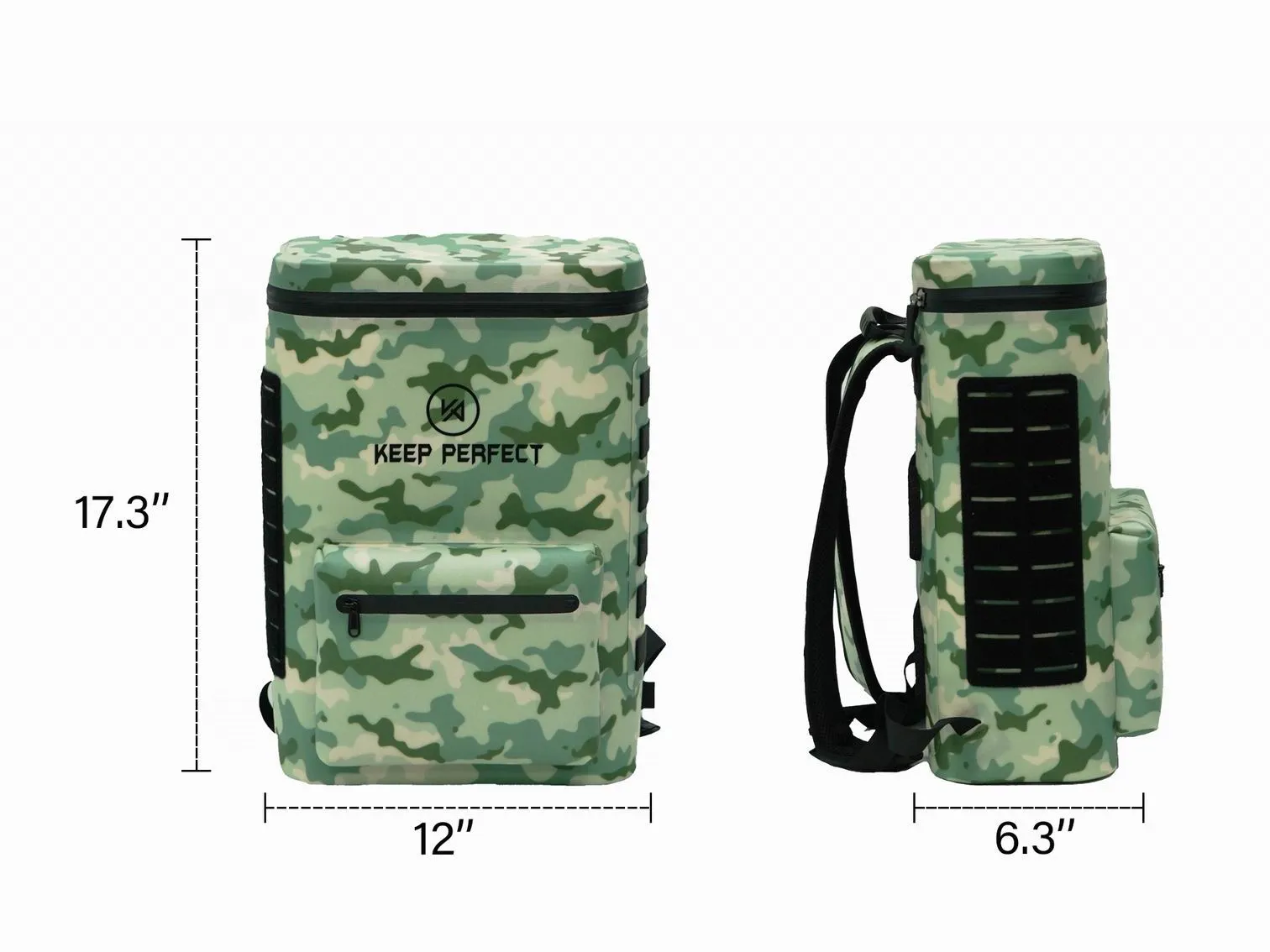
Branding a welded cooler is constrained by one hard rule: a needle through the chamber is a leak path. Anything applied to the welded main body has to be printed, welded or adhesively bonded, and only panels that are not part of the waterproof chamber can be embroidered. In practice that means embroidery lives on the front pocket, the lid, the side gusset or the harness, while the main chamber carries a print, a welded patch or a moulded badge. Buyers who insist on an embroidered logo on the chamber get a sewn panel, and a sewn panel gets a taped seam, and the tape becomes the warranty risk.
| Method | Panel | MOQ | Durability | Cost |
|---|---|---|---|---|
| Screen print | Flat panels, pockets | 500 pcs | High | Low |
| Heat transfer | Pocket, lid | 500 pcs | Medium | Low |
| Sublimation | Polyester face only | 500 pcs | High | Medium |
| Embroidery | Pocket, non-chamber | 500 pcs | High | Medium |
| Rubber or PVC patch | Pocket, lid, gusset | 500 pcs plus tooling | High | Medium |
| Moulded TPU badge | Front panel, base | 1,000 pcs plus mould | High | Higher |
| Woven or jacquard label | Webbing, seam | 500 pcs | Medium | Low |
Placement, Colour Approval and Adhesion Testing
Six branding zones appear on most cooler programmes: the front zip pocket, the top lid, the side gusset, the harness webbing as a woven-in jacquard, the zip puller as a moulded logo, and the retail hangtag. Front pocket and lid placements photograph well for e-commerce and carry most of the brand weight, while the puller and the webbing are cheap additions that make a mid-tier bag look considered. Colour is approved against Pantone TCX references with a physical lab dip under a D65 light box.
Print durability is verified rather than assumed. We run a cross-hatch tape test, a rub test against the relevant fastness standard, and a low-temperature flex check on any print applied to a TPU film, because a plastisol that cracks at 0 °C will crack in a cooler long before it cracks on a backpack. Rubber patches are checked for adhesion after a heat-age cycle and moulded badges are pull-tested. Our customisation service covers artwork setup, and we recommend supplying vector artwork with fonts outlined.
MOQ 500 pcs per Style and Colourway Splits for Cooler Ranges
MOQ is 500 pcs per style and per colourway, and the number is not arbitrary. A cooler consumes more fabric per unit than almost any other soft bag, so a single colourway of a 24-can backpack uses roughly 400–600 metres of laminated face fabric once cutting waste is included, which is close to the minimum lot a laminator will run to a matched colour. Add the welding fixture setup, the print screens and the operator learning curve on a new pattern, and 500 is the point at which the unit cost stops being dominated by setup.
Sizes within one style and one colourway can be combined to reach the 500 minimum, because a 12-can, a 24-can and a 36-can built from the same pattern family share the same fabric lot, the same hardware set and the same weld fixtures. Colourways cannot be combined: a second colourway is a second dye lot and a second style. A practical first range therefore looks like three sizes in one colourway at 500 pcs each, or 1,500 pcs in total, with the second colourway added once the first has sold through and the fabric consumption can be justified.
Three tactics reduce the entry cost of a cooler launch. Specify one fabric colour across the whole ladder so the dye lot consolidates. Share one hardware family and one buckle colour across every SKU so the hardware purchase is a single order. Use one print screen position for the whole range so artwork setup is paid once. Buyers consolidating several categories into the same shipment can also combine cooler, sports and travel quantities into one 40HQ, which spreads the freight cost across more units and improves landed cost per piece without changing the factory price.
On timing and terms, bulk production runs 35–50 days after sample approval, inspection is to AQL 2.5 under ISO 2859-1, and the quotation basis is FOB Xiamen with payment by T/T, 30% deposit and 70% before shipment. Reorders below 500 pcs are possible while the fabric and fixtures are still open but carry a setup surcharge, so we usually advise combining a reorder with another SKU. Full terms are on our service page and our company profile. Capacity behind that schedule is an SGS-verified 4,950 m² facility in Quanzhou, Fujian with 137 staff, seven production lines and 149 machines, described on our manufacturing page.
Sampling in 6–10 Working Days: The Cooler-Specific Checklist
A standard cooler sample takes 6–10 working days from an approved brief. Complex structures take 12–15 working days, and the things that push a cooler into that bracket are a moulded hard liner, a vacuum panel pocket, a moulded base or a welded-in drain plug, because each one needs tooling or a new fixture before the first bag can be assembled. The clock starts when we have the brief rather than when we have the deposit, so the fastest programmes are the ones that arrive with a tech pack, vector artwork, a target price and the market's compliance requirements in the first email.
| Check | Method | Pass Criterion |
|---|---|---|
| Capacity | Water fill and measure | Within 5 % of spec |
| Leak | Pressure decay or 24 h fill | No loss, no damp patch |
| Ice retention | 30 °C chamber, 1:1 ice | Residual ice meets claim |
| Zip | 5,000 cycles plus spray | No penetration |
| Carry | 2.5× rated load, 5 min | No tear or deformation |
| Cross-hatch tape test | No lift at edges | |
| Colour | D65 light box comparison | Within agreed tolerance |
| Odour | 40 °C closed 24 h, panel check | No offensive odour |
| Pack | Carton drop and stack | No damage, stacks true |
Run that list on the first sample rather than on the pre-production sample, because a capacity shortfall or a cuff leak is far cheaper to fix at pattern stage than after the welding fixtures have been cut for bulk. Two sampling rounds are normal: a prototype to confirm size, structure and branding, then a confirmed sample in production materials that becomes the sealed reference. Sample cost is credited against the first bulk order, and courier transit adds three to five working days.
Unit Cost Anatomy of a 24-Can Waterproof Cooler Backpack
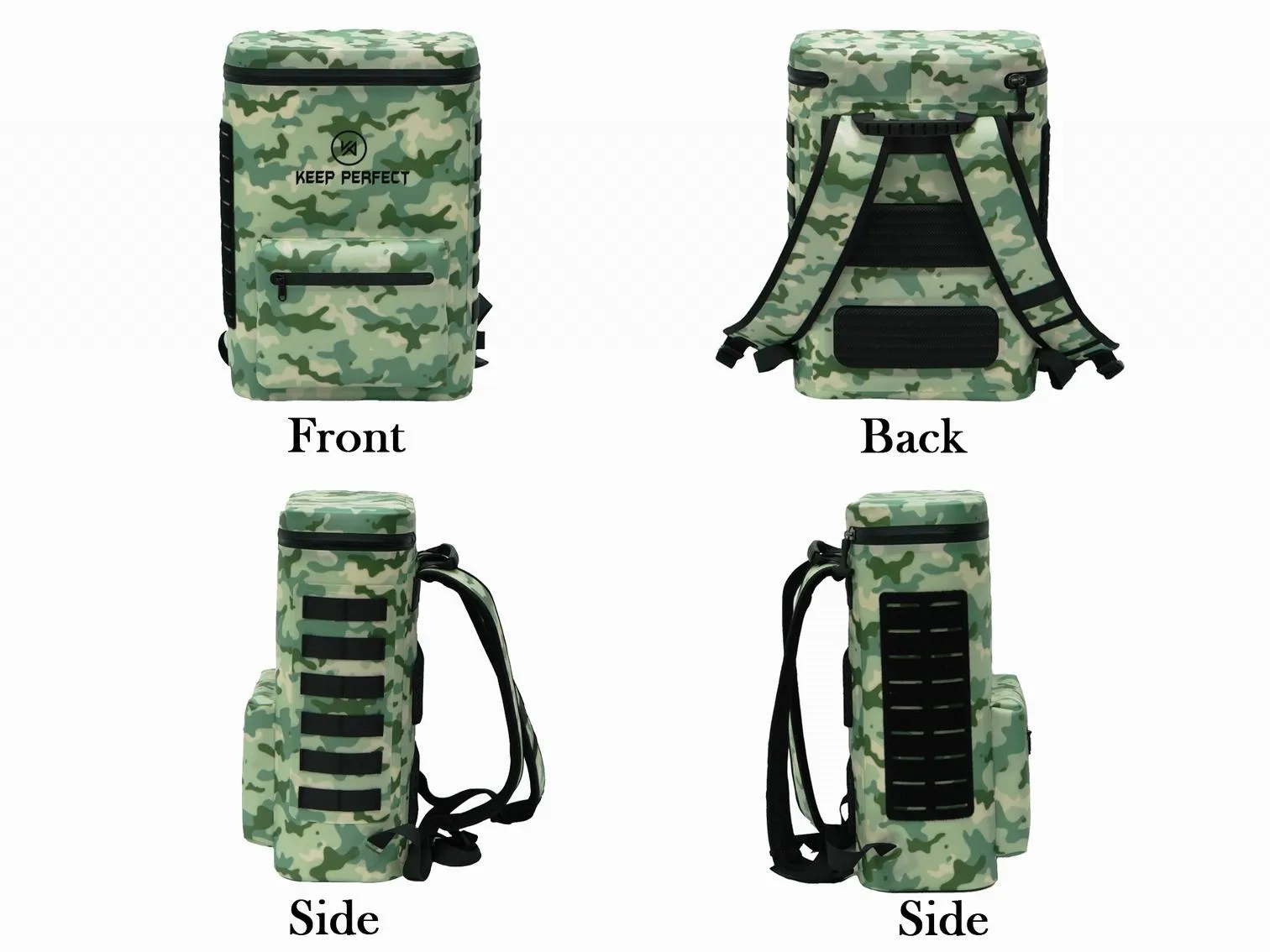
The question every buyer asks before signing off is where the money actually goes. The indicative breakdown below is for a 24-can welded cooler backpack at 500 pcs: 600D polyester TPU laminate shell, 10 mm PE foam core at 25 kg/m³, 0.15 mm TPU liner, a YKK AquaGuard #5 main closure with a coated coil on the front pocket, Duraflex hardware, a padded harness and a two-colour screen print. It lands at roughly US$12.35 per piece FOB Xiamen, and it is a useful template because the percentages move far less than the absolute numbers when specifications change.
| Line Item | Specification | Share | USD / pc |
|---|---|---|---|
| Shell fabric and laminate | 600D polyester, 0.95 m² | 16 % | 2.00 |
| Insulation core | PE foam 10 mm, 25 kg/m³ | 8 % | 1.00 |
| Liner and cuff weld | TPU film 0.15 mm | 10 % | 1.25 |
| Closures | AquaGuard #5 plus pocket zip | 13 % | 1.60 |
| Webbing and hardware | Duraflex buckles, 25 mm webbing | 8 % | 1.00 |
| Harness and back panel | 8 mm EVA, mesh, load lifters | 7 % | 0.85 |
| Cutting, welding, assembly | RF weld plus hybrid anchors | 20 % | 2.45 |
| Branding | Two-colour print, woven label | 5 % | 0.60 |
| QC, leak test, packing | 100 % leak check, AQL 2.5 | 6 % | 0.75 |
| Overhead and margin | Factory overhead | 7 % | 0.85 |
What Moves the Number
Six levers account for almost every change in unit price on this product. Upgrading the main closure from a coated coil to a watertight TIZIP adds US$3.20–4.50. Moving the core from 10 mm to 15 mm adds US$0.85–1.20 and buys a defensible 48-hour claim. Moving the shell from 600D to 1000D adds US$1.10–1.60. Full camo sublimation adds US$0.70–1.20. A rubber patch adds US$0.35–0.60 per piece plus one-off tooling of US$180–320, and a moulded base adds US$1.60–2.40 plus tooling. Volume works the other way: moving from 500 to 1,000 pcs typically reduces unit cost by 5–8 %, and moving from 1,000 to 3,000 pcs by a further 7–11 %.
What the figure excludes is as important as what it includes. It is FOB Xiamen, so freight, insurance, duty and inland delivery sit on top, and tooling, third-party testing and any moulding are quoted separately. Send us the target landed cost and the claim you want on the hangtag and we will work backwards to a specification that hits both, which is the shortest route to a quotation that does not need three revisions. Start the conversation on our contact page.
Field Failure Modes in Cooler Bags — and the Design Fixes
Cooler bags rarely fail in the showroom. They fail in the third month, in a car boot at 34 °C, or on a boat deck where the bag has been standing in two centimetres of meltwater since breakfast. Understanding the six failure modes that come back to us most often is the fastest way to specify a range that generates returns complaints instead of reorders.
Meltwater pooling in the base seam
The single most common field failure is water escaping through the bottom seam after ice has melted and the bag has been carried by its handle for several hours. The load pulls the base away from the wall, and a seam that passed a static water test at the factory opens under repeated dynamic stress. The fix is a welded bottom with a reinforced overlay panel rather than a single weld line, plus a base that is slightly wider than the wall so the load sits on fabric rather than on the seam.
Zip leakage under pressure
A water-resistant coil zip sheds rain but does not hold a head of water. When a cooler bag is filled with ice and drinks, the meltwater presses against the zip from the inside, and a standard coil zip will weep within an hour. Either specify a leak-proof zip with an internal gutter, or move the opening to the top face where water sits below the closure line rather than against it.
Delamination of the liner
Food-grade TPU and PEVA liners are laminated to a foam core. If the lamination adhesive is specified for room temperature and the bag then sits in a hot car, the bond softens and the liner lifts at the corners where flexing is highest. The fix is a liner film with a higher softening point and a foam core that is closed-cell rather than open-cell, so moisture cannot travel laterally once the bond is compromised.
Handle pull-out
Webbing handles are usually the strongest element and the weakest attachment. A handle rated at 30 kg static will still tear out of the shell if the stitch pattern concentrates load on four holes. Bar-tacking across the full webbing width, backed by a reinforcement patch bonded to the shell, distributes the load and is the difference between a bag that survives a full load and one that does not.
Odour retention in the foam
Open-cell foam absorbs whatever the bag carried. A cooler used for fish on Saturday and sandwiches on Sunday will taste of Saturday for the rest of its life. Closed-cell foam with a sealed liner and a drain port solves the problem structurally, which is more reliable than any antimicrobial additive.
Colour fade on the exterior
Exterior 600D polyester with a light PU coating will visibly fade after one summer of UV exposure on a boat or a beach. Solution-dyed yarn or a higher-coating-weight shell with a UV stabiliser extends the colour life considerably. For camo and print programmes, verify lightfastness on the actual printed substrate, not on the greige fabric.
Frequently Asked Questions
What is the minimum order quantity for a custom cooler bag?
MOQ is 500 pcs per style and per colourway. A cooler uses more fabric per unit than most soft bags, so one colourway of a 24-can backpack consumes roughly 400–600 metres of laminated face fabric, close to a laminator's minimum colour lot. Add welding fixture setup and print screens, and below 500 pcs the setup cost dominates the unit price rather than the materials.
Can I split a 500-pcs order across different sizes?
Yes, when the sizes belong to the same style and the same colourway. A 12-can, a 24-can and a 36-can built from one pattern family share fabric, hardware and weld fixtures, so the three can add up to the 500-pcs minimum together, for example 150 + 250 + 100 pcs. Different colourways cannot be combined because each one is a separate dye lot with its own minimum.
How long does a cooler bag sample take?
Standard cooler samples take 6–10 working days from an approved brief. Structures with a moulded hard liner, a vacuum panel pocket, a moulded base or a welded drain plug take 12–15 working days because tooling or a new fixture is needed first. Courier transit adds three to five working days, and sample cost is credited against the first bulk order.
How long does a 24-can cooler backpack hold ice?
With a 10 mm PE foam core and a water-resistant coated zip, expect 45–60 % of the original ice mass remaining after 24 hours at 30 °C in shade, with a 1:1 ice-to-content ratio, no openings and the bag lid-up. At 38 °C the same build returns roughly 10–20 %. We publish the test conditions with every figure so the hangtag wording cannot outrun the data.
Are your cooler bags leak-proof or only water-resistant?
The welded chamber is leak-proof: it holds meltwater with the bag on its side, and every chamber is pressure-decay tested before packing. The closure rating depends on the zip you specify, so a bag built with a coated coil zip is splash and spray resistant, while one built with a watertight closure or a roll-top is fully sealed and can be sold with a stronger claim.
Which insulation thickness do I need for a 48-hour ice claim?
A 15 mm closed-cell PE core with an airtight or well-flapped closure is the practical minimum for a 48-hour claim at 30 °C, returning 35–50 % residual ice. A 10 mm core with a radiant scrim reaches roughly 15–25 % at 48 hours, which supports a 36-hour claim. For 72 hours, a hard liner with a vacuum panel pocket is the realistic route.
Do you produce hard-liner cooler bags as well as soft coolers?
Yes. A hard-liner cooler uses a moulded PP or ABS tub inside a welded or sewn shell. The tub resists puncture, wipes clean, holds a rectangular ice block and keeps the bag square for photography, but it adds 500–900 grams, needs tooling and stops the bag folding flat for shipping. Tooling is quoted separately and the MOQ is confirmed per project.
Which zip should I choose for a leak-proof cooler?
For a mid-tier bag, a YKK AquaGuard #5 or #8 gives IPX6 spray resistance at roughly four times the cost of a standard coil zip. For a genuinely sealed chamber, specify a TIZIP MasterSeal 10 or a roll-top closure. Whichever you choose, add a zip garage and a storm flap, because the slider wears before the chain does. We cycle-test sliders five thousand times with a light dust load during development.
Are the cooler liners certified for food contact?
Liners are supplied to FDA 21 CFR requirements for the US market and to EU 10/2011 for Europe, with an overall migration limit of 10 mg/dm² and specific migration limits for listed substances. LFGB testing, including the sensory check for odour and taste, is available for Germany. We test the finished wall laminate rather than the raw film and keep reports per material lot.
Can the liner be welded instead of sewn?
Yes, and we recommend it. A TPU liner welds directly to a TPU-laminated shell by radio frequency or hot air, which removes needle holes entirely and gives a cuff that holds meltwater. Where a structural attachment must be stitched, we bond the patch, stitch at 8–10 stitches per inch and then tape over the stitch line with 20 mm tape.
Can you print our own camo pattern or artwork?
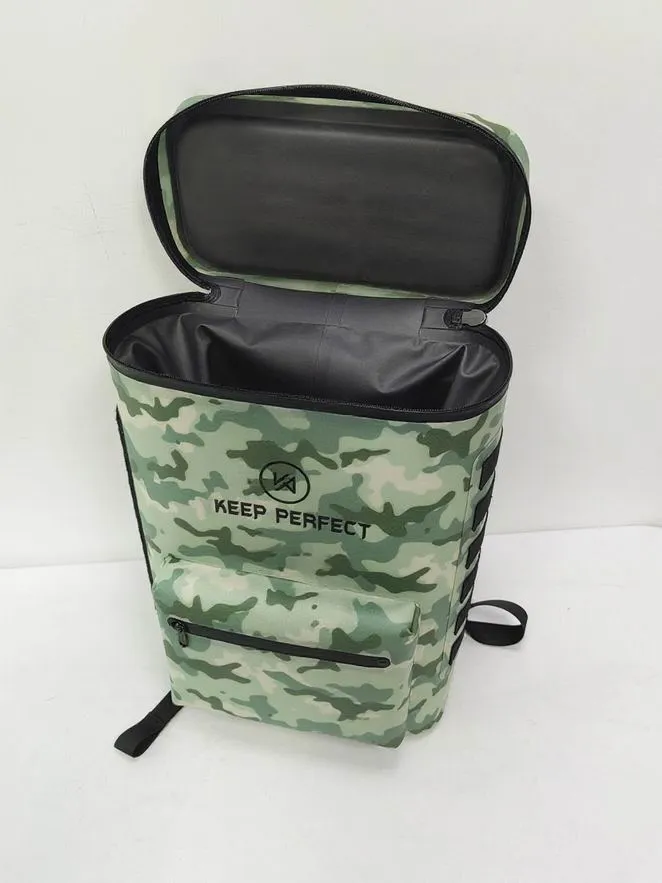
Yes. Dye-sublimation gives full-bleed camo on a polyester face fabric with no hand feel, while a PVC tarpaulin shell takes the pattern as a printed film layer instead. The MOQ stays at 500 pcs. We approve a physical lab dip under a D65 light box and work to light fastness of at least 4 and rubbing fastness of at least 4 dry.
Which branding methods work on a welded shell?
Screen print, heat transfer, sublimation, a welded or bonded rubber patch and a moulded TPU badge all work without puncturing the chamber, and each carries its own MOQ and tooling profile. Embroidery is limited to panels outside the waterproof chamber, such as the front pocket or lid, because a needle through the liner creates a leak path, so the artwork approval route depends on which panel the logo sits on.
What are your payment and shipping terms?
The quotation basis is FOB Xiamen, with CIF or DDP available on request for comparison. Payment is T/T with a 30 % deposit and the 70 % balance before shipment. Bulk production runs 35–50 days after sample approval and inspection follows AQL 2.5 under ISO 2859-1, with shipment from Xiamen port in Fujian. Every quotation states its Incoterm basis so that freight, duty and inland delivery can be compared cleanly against your landed cost target.
Can you supply third-party test reports?
Yes. We commission witnessed reports through SGS or Intertek for ice retention, food-contact migration, zip cycling and physical testing when a buyer needs documentation for a retail or marketplace submission. Third-party testing adds cost and roughly seven to ten working days, so it belongs on the launch critical path rather than after production. In-house retention data is kept on file for every build we have produced.
What warranty do you offer on cooler bags?
Every cooler carries a 12-month warranty against manufacturing defects, covering weld failure, zip failure, hardware breakage and delamination of the wall laminate. Wear from abrasion, puncture by sharp contents and damage from improper cleaning are excluded. Claims are supported by a defect rate report from the production lot and photographic evidence, and replacement units or credit are agreed case by case against that evidence.