OEM / ODM Services
End-to-end OEM/ODM services for waterproof bag brands. MOQ 500 pcs per style.
Our Service Model: From Brief to Bulk in Five Gates
Most sourcing problems on waterproof bag programmes do not begin on the production line. They begin in the weeks between a first enquiry and a signed order, when nobody has written down what the bag actually is. A buyer sends a photograph of a competitor's product plus a target price. A supplier replies with a number that quietly assumes a lighter shell, a different closure and a narrower seam. Six weeks later the sample arrives, it is not what either side pictured, and the conversation restarts from zero. We rebuilt our service model to close that gap, because across a 4,950 m² facility with 137 people, 149 machines and seven production lines, the expensive failure is rarely a bad weld. It is a line standing idle while two parties argue about what was agreed.
The model is five gates. A gate is a checkpoint with three properties: a defined input, a named owner on our side, and a written output that you can approve, reject or send back. If a step produces no written artefact, it is not a gate, it is a conversation, and conversations are where programmes drift. Gate one is the brief and feasibility review. Gate two is tech pack development and sampling. Gate three is order confirmation and slot booking. Gate four is production monitoring. Gate five is inspection, documentation and shipment release. Each gate ends with something you sign or something we ship, and nothing crosses into the next gate until that artefact exists.
We use gates rather than one big approval at the end because waterproof construction does not forgive late discovery. Choosing between a hot-air welded 420D nylon ripstop and an RF welded 840D polyester TPU laminate changes the weld fixture, the cycle time, the achievable hydrostatic head and the unit cost. Choosing a YKK AquaGuard #5 instead of a #8, or a TIZIP MasterSeal 10 instead of a roll-top, changes the pattern and the rating claim on the hangtag. Those are decisions that must be made while the drawing is still cheap to change. Once a welding fixture has been cut and a production slot booked, the same decision costs weeks instead of hours.
What a Gate Actually Means in Practice
A gate is not a meeting and it is not a status update. It is a handover. At gate one you hand us a brief and we hand back a feasibility memo. At gate two we hand you a physical sample and a measurement report, and you hand back an approval or a marked-up revision list. At gate three we hand you a proforma invoice with a production slot date and you hand back a countersigned copy plus the deposit. At gate four we hand you weekly status reports and you hand back decisions on any change note we raise. At gate five we hand you an AQL 2.5 inspection report, a packing list and the test documentation, and you release the balance. Every one of those handovers is dated, which means that when a schedule slips, we can point to the exact day it slipped and why.
How the Five Gates Map Onto Your Calendar
Assuming no revisions and no public holidays on either side, a first programme runs roughly like this. Feasibility takes 24 hours from a complete brief. Tech pack and sampling take 6–10 working days, extending to 12–15 working days where the brief involves a new moulded component, a laminated insulation stack or a hybrid closure. Order confirmation and material booking take two to three working days once the sample is approved. Bulk production takes 35–50 days from sample approval. Inspection, packing and document preparation take three to five working days after the last carton is sealed. Add a shipping leg from FOB Xiamen and a first-time buyer is typically looking at nine to eleven weeks from enquiry to vessel, with the buyer's own decision time sitting on top.
| Gate | Owner on our side | Duration | Written output you receive | Decision required from you |
|---|---|---|---|---|
| Gate 1 — Brief and feasibility review | Account manager plus engineering | 24 hours | Feasibility memo: MOQ, price band, slot, risk flags | Confirm direction and release budget for sampling |
| Gate 2 — Tech pack and sampling | Engineering plus sample room | 6–10 working days (12–15 complex) | Tech pack revision, physical sample, measurement and weld report | Approve golden sample or issue a revision list |
| Gate 3 — Order confirmation and slot booking | Account manager plus planning | 2–3 working days to proforma invoice | Proforma invoice, material booking record, production slot date | Countersign and pay 30% T/T deposit |
| Gate 4 — Production monitoring | Planning plus in-line QC | 35–50 days | Weekly status report with line photographs and in-process pulls | Approve or reject any change note raised |
| Gate 5 — Inspection, documentation, release | QC plus shipping desk | 3–5 working days after pack-out | AQL 2.5 report under ISO 2859-1, packing list, test reports | Release the 70% balance and confirm consignee details |
Where This Page Stops and the Others Begin
This page is about the mechanism: how an enquiry becomes a shipment. It deliberately does not describe the welding equipment, the line layout or the cycle times, because that sits on the manufacturing page. It does not describe hydrostatic head testing, seam peel testing or salt spray procedure in detail, because that sits on the quality page. What belongs here is the calendar, the paperwork, the people and the commitments. If you want to see what the gates can be applied to, the product catalogue lists the base styles we run them against.
Gate 1 — Brief and Feasibility Review (What We Need, What We Send Back in 24 Hours)
Gate one is the cheapest gate and the most valuable. It costs you an email and it costs us an afternoon of engineering time, and it is the point at which a programme is either pointed at something we can build in 6–10 working days or quietly redirected before anybody spends money. We treat it as a technical review, not a sales call. The person who reads your brief is the same person who will later write the tech pack, which means the answer you get at feasibility is the answer that holds at sampling. Nothing is quoted to win the enquiry and then renegotiated later.
A brief does not need to be finished. It needs to be honest. The most useful briefs we receive say plainly which parts are fixed and which are open: "30 L roll-top, fixed; closure open; target FOB Xiamen price 9.50; 1,500 pcs to start." The least useful say "similar to the attached photo" with no quantity and no target price, because then we have to guess at three variables at once and our guess will be wrong on at least one. We would rather be told that the target price is aspirational than discover it in week three.
The Nine Fields We Ask You to Fill
Nine fields cover almost every waterproof bag enquiry we see. First, product family and volume band, so we can map the request onto an existing platform rather than starting from a blank pattern. Second, target use and user, which drives shell weight and abrasion requirement more than anything else. Third, closure preference and rating ambition: IPX6 spray resistance, IPX7 immersion or IPX8 continuous submersion, because the jump from IPX7 to IPX8 usually costs a taller roll collar and a heavier film. Fourth, quantity per style and per colourway, checked against MOQ of 500 pcs per style and colourway. Fifth, target FOB Xiamen price and the volume it assumes. Sixth, compliance market: EU REACH, US CPSIA, or a retailer protocol. Seventh, artwork status: vector files ready, or nothing yet. Eighth, required delivery window and whether it is a hard launch date. Ninth, packaging and channel, particularly whether the goods go to Amazon FBA, because that changes carton and labelling work.
What Comes Back Inside 24 Hours
The feasibility memo is a single document, usually two pages, and it answers five questions in a fixed order. Can we build it, and on which existing platform? What is the realistic MOQ and the price band at three quantity levels? How long will sampling take, and is there anything in the brief that pushes it from 6–10 working days out to 12–15? What are the technical risks, stated as risks rather than reassurances — for example, a 0.1 mm TPU film on a 50 L expedition body will not survive deck abrasion, or a printed logo across a welded seam will crack at the fold. And what do we need from you to start, usually a vector file, a Pantone reference or a physical reference sample.
The memo also states the construction baseline we are assuming, so that the number has a meaning. A price quoted against a 500D polyester TPU laminate with a 0.15 mm film, hot-air welded seams at 8 N/cm peel strength, a YKK AquaGuard #5 closure and 20 mm taped seams is a different product from one quoted against 1000D with a 0.3 mm film and a TIZIP MasterSeal 10. Both may be called "a 30 L waterproof duffel" in an email. Only one of them is what the buyer has in mind, and gate one is where we find out which.
When We Say No, and Why It Is Useful
We decline some briefs at gate one, and we say so in the memo rather than going quiet. The three common reasons are: the target price cannot be met with a construction that will pass the stated rating; the quantity is below what a welded programme needs to be stable; or the brief requires a mechanism that is protected by someone else's patent. A refusal at 24 hours costs nothing. A price that is quietly met by dropping film thickness from 0.25 mm to 0.1 mm and discovered at inspection costs a season. If you are comparing suppliers, the feasibility memo is also the fairest way to compare them: put two memos side by side and check whether both are quoting the same shell, the same closure and the same seam method.
Send your brief to the address on the contact page, or open with a single style from the travel bags or waterproof backpacks ranges as a reference point. A reference style plus a list of changes is often faster to review than a written description.
Tech Pack Development: Turning a Sketch into a Buildable Specification
A sketch expresses intent. A tech pack expresses intent plus tolerances, and only the second one can be manufactured. The gap between them is where most first samples go wrong: the drawing shows a 30 L roll-top duffel, but it does not say whether the base is welded as a separate disc or folded from the body, whether the harness anchors penetrate the shell, what the stitch density is at the webbing bar-tacks, or how wide the weld land is at the corners. Our job at this gate is to convert intent into a document that a cutter, a welding operator and a QC inspector can all read the same way, and that you can sign without an engineer standing next to you.
We build the pack in our own format and send it as a PDF plus an editable sheet. It carries a version number and a date on every page, because a programme can run to six or seven versions and the sample in front of you is only meaningful against the version that produced it. Every revision is issued as a full document rather than a list of changes, so nobody is working from a previous version with a separate note attached.
The Nine Sections of Every Pack We Issue
The structure is fixed. Section one is the technical drawing: orthographic views with overall dimensions, plus a dimension table carrying tolerance for every critical measure. Section two is the material specification, naming the face fabric, the laminate or coating, the film thickness and the hydrostatic head target. Section three is the construction method: weld type, weld land width, seam peel target, tape width and stitch density where sewing is involved. Section four is hardware, named by manufacturer and reference. Section five is the trim and branding schedule, with print method, position and colour reference. Section six is the bill of materials, with consumption per unit and supplier for each line. Section seven is the testing plan. Section eight is the packing specification. Section nine is the revision log.
| Pack section | What it fixes | Typical entry on a waterproof duffel | Why it matters downstream |
|---|---|---|---|
| Drawing and tolerances | Size, proportion, tolerance band | 60 × 34 × 30 cm, ±5 mm on seam-to-seam measures | Tolerance is what QC inspects against at AQL 2.5 |
| Material specification | Shell, laminate, coating, film | 840D polyester TPU, 0.20 mm film, PU back coating 0.15 mm | Film thickness drives both weld parameters and cost |
| Construction method | Weld type, land width, peel target | High-frequency welded, 12 mm land, peel ≥ 8 N/cm | Determines fixture, cycle time and rating claim |
| Hardware schedule | Zips, buckles, anchors | YKK AquaGuard #8 main, Duraflex side-release, ITW ladderlocks | Branded hardware affects lead time and 48 h salt spray result |
| Trim and branding | Logo method, placement, colour | Heat transfer, 90 × 40 mm front panel, Pantone TCX reference | Decides whether a logo survives folding and cold |
| Bill of materials | Consumption and source per line | 1.85 m shell, 2.30 m webbing, 6 m tape per unit | The basis of any value engineering conversation |
| Testing plan | Method and pass threshold | Hydrostatic ≥ 20,000 mm, IPX7 dip, seam peel pull per lot | Referenced directly in the inspection report |
| Packing specification | Polybag, carton, mark, quantity | Individual polybag, 12 pcs per export carton, 60 × 40 × 40 cm | Fixes container utilisation and FBA prep scope |
| Revision log | What changed and when | V3: collar raised 25 mm, base weld widened to 14 mm | Prevents an old sample being judged against a new spec |

Why We Will Not Sample From a Photograph Alone
We will happily start from a photograph, but we will not cut a sample from one. A photograph shows a shape, a colour and sometimes a closure. It does not show film thickness, weld land width, whether the harness is bonded or stitched through, or whether that apparent 30 L capacity is measured rolled or unrolled. If we sample from a photograph we are guessing at four or five variables, and when the sample arrives and the guess is wrong, the buyer reasonably treats it as our error. Building a pack first costs two to three working days and removes that. The exception is a replication brief where you send us a physical reference sample: then we measure the actual article and write the pack from measurements rather than inference.
Tolerances We Write Into Every Pack
Welded construction is more dimensionally stable than sewn construction, but it is not exact. We state ±5 mm on seam-to-seam dimensions up to 60 cm and ±8 mm above, ±3 mm on webbing and strap lengths, and ±2 mm on hardware positions where a mating part has to line up. Colour is handled as a reference rather than a tolerance: we work to a Pantone TCX code or a physical swatch, and we tell buyers in writing that a TPU laminated surface reads differently from a matte woven one, so a match approved on a fabric swatch is the governing standard, not the printed code. Shade variation between production lots is controlled by cutting each style from a single dye lot wherever the order quantity allows.
Version Control and Sign-Off
Each pack carries a version number, and the sample you approve is tied to that number. When a revision is requested we issue a new version with the change described in the revision log rather than overwritten silently, and we re-date the sample reference. At bulk, the line works from the signed version only. If a buyer asks for a change after approval, the change is issued as a new version and re-costed before it is applied, because a 25 mm taller roll collar or a switch from a PU-coated zip to a YKK AquaGuard #8 is not free and not instant. This is the discipline that stops a golden sample drifting away from the cartons that follow it.
The same pack format is used across every family, whether the end product is a 5 L dry bag, a 45 L expedition backpack from the waterproof backpack range, an insulated cooler bag built over PE foam at 25 kg/m³, or a salt-exposed fishing bag requiring 48-hour salt spray tested hardware.
Design Support: What We Can and Cannot Do Without Your Artwork
Design support is the most misunderstood service in this industry. Buyers hear "ODM" and assume it includes brand identity, packaging artwork and photography; suppliers hear "ODM" and mean "we will change the dimensions of an existing style." Both sides are then disappointed at exactly the same moment, usually when the sample arrives without a logo. We would rather define the boundary at gate one than negotiate it at gate two. This section states it plainly.
The useful way to think about it is that we own the engineering and you own the identity. We can turn a use case into a buildable product, and we can tell you where a mark can be applied, at what size, by which method and whether it will survive. We cannot decide what your brand looks like, and we do not try.
What We Do Provide
We provide platform selection, which means matching your brief to one of the base styles we already weld and then modifying it, rather than originating a shape from nothing. We provide dimensional development: moving a 25 L day pack to 28 L, repositioning a harness, adding a welded pocket, changing a collar height. We provide material and hardware recommendation, including the trade-offs, for example that a 420D nylon ripstop at 0.1 mm film gives a light packable bag tested to a hydrostatic head of at least 10,000 mm while an 840D polyester TPU at 0.2 mm gives an abrasion-resistant shell above 20,000 mm at roughly 30 percent more shell cost. We provide 2D technical drawings with tolerances, a full bill of materials, and a colourway proposal matched to a Pantone TCX reference or a physical swatch. We provide logo application engineering: method selection between screen print, heat transfer, woven label, rubber patch and welded TPU badge, plus placement advice that accounts for weld lands and fold lines. We provide packaging templates and dielines with correct dimensions, so your designer works inside real print areas.
Where the Line Is Drawn
We do not create logos, brand names, brand guidelines or retail artwork. We do not write marketing copy or produce lifestyle photography. We do not originate consumer packaging graphics; we supply the dieline and the technical constraints and your designer fills them. We cannot guarantee a visual Pantone match on a laminated or PVC-coated surface, only a controlled reference match against an approved swatch, because film gloss shifts perceived shade. We cannot replicate a mechanism that is covered by a live patent, and we will say so at feasibility rather than after sampling. We do not reverse-engineer a competitor's product feature by feature where doing so would copy a registered design; we will build a functionally equivalent product on our own platform.
Files We Accept, and What Happens If You Have None
For artwork we accept vector files in AI, EPS or PDF with outlines converted, raster artwork at 300 dpi or higher for print processes, DXF or PDF for pattern outlines, and STEP or IGES for any moulded component. For colour we accept Pantone TCX codes as a starting reference with the swatch caveat above, or a physical fabric or trim sample, which is more reliable. If you have nothing yet, we can still proceed: we build the product, send it unbranded, and apply the mark at a later revision or at bulk, provided the print area has been reserved on the pack. What we ask is that you tell us at gate one that artwork is pending, because a logo position decided after the pack is signed may fall across a weld land and have to move.
Confidentiality and Intellectual Property
We sign mutual non-disclosure agreements before a brief is reviewed if you ask us to, and we are happy to sign yours. Tooling paid for by a buyer is identified as the buyer's property in our records and is not used for another account without written permission. Platform-level developments that we fund ourselves remain ours, which is why MOQ stays at 500 pcs per style and colourway rather than rising: the welding fixtures behind a style are shared across a platform, and a buyer benefits from that sharing without owning it. Where a buyer wants exclusivity over a specific style, configuration or colourway in a defined territory, we discuss it as a commercial term at gate three and record it on the proforma invoice rather than leaving it as an understanding.
If your programme spans several categories, the practical route is to open with one style per family — a sports bag on the duffel platform, a travel bag on the wheeled or holdall platform — and let the artwork and colourway work carry across all of them once the first pack is signed.
Gate 2 — Sampling: 6–10 Working Days, Revisions and Approval
Sampling is the gate buyers judge us on, and it is the gate where our calendar is most often misunderstood. Six to ten working days is the time from a signed tech pack and a released sample fee to a finished sample leaving the building. It is not the time from first email to sample, it excludes courier transit, and it excludes Chinese public holidays, which we flag in advance because the Spring Festival shutdown and the October national holiday both fall inside most buyers' planning years.
Twelve to fifteen working days applies where the sample requires something we do not hold: a new moulded component, a laminated insulation stack built over PE foam at 25 kg/m³ or EPE at 30 kg/m³, a TIZIP MasterSeal 10 closure that has to be ordered in, or a hybrid bonded-and-stitched harness that needs a new fixture. We tell you at gate one which band your brief falls into. We do not quote six days to win the order and then explain the delay in week two.
What Happens Day by Day
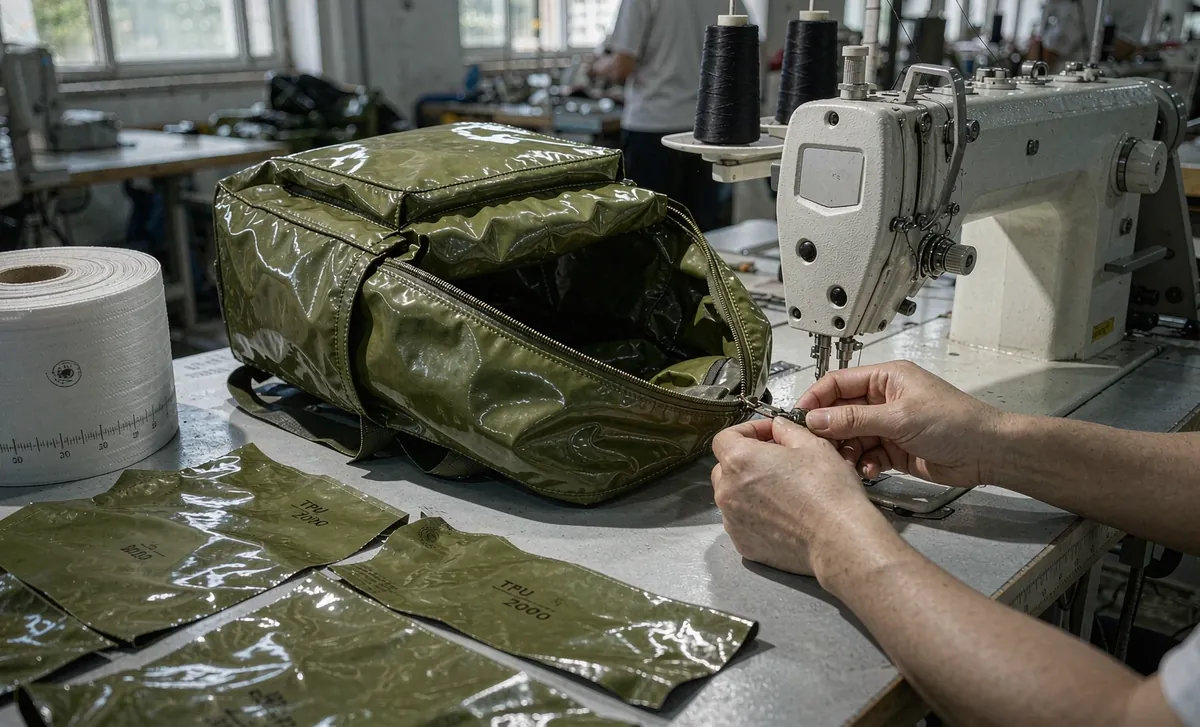
Day one is pattern and marker work: the tech pack becomes a cutting file, and the marker is nested for minimum waste because the same marker is reused at bulk. Day one also covers material issue, where the specified shell, webbing, tape and hardware are pulled and checked against the pack. Days two and three are welding trials. This is the part buyers rarely see: the first panels are not the sample, they are parameter coupons. The operator runs the shell at several temperature, dwell and pressure combinations, pulls the seams, and records the peel result. We are looking for a weld that reaches at least 8 N/cm without scorching the film, and for a consistent land width. Only after the coupon results are logged does the actual body get welded. Days three to five are assembly, including tape application at 20 mm where the construction calls for taped seams, stitching at 8–10 SPI on the sewn elements, hardware fitting and any printed or transferred logo. Days five and six are finishing, measurement against the dimension table, a dip or spray check against the target rating, and photography.
What a Revision Round Actually Changes
A revision is not a criticism and it is not a restart. It is a new sample built to a new version of the pack, using the same marker and the same material unless the revision changes them. Roughly half of first samples are approved outright. Of the remainder, the most common requests are dimensional — 30 mm more height, a wider opening, a longer strap — followed by hardware changes, followed by colour and print adjustments. Those are cheap. The expensive revisions are the ones that change construction: moving from a sewn-and-taped base to a welded disc, changing the shell from 500D to 840D, or adding an internal frame. Those change the marker and sometimes the fixture, so they take the full cycle again rather than a partial rebuild. We say which kind of revision you are asking for before we start, and we quote the extra time in writing.
Sample fees are charged per style and are credited against the bulk order when the order is placed. The fee covers material issue, marker work, operator time and the courier handling on our side; courier freight is billed at cost or you may nominate your own account. Where a buyer needs several colourways of one style, we normally build one sample in the primary colourway and send fabric swatches for the others, unless the colourway affects construction.
What We Send With the Sample
A sample leaving us is accompanied by a report. It carries measured dimensions against the tolerance table, the recorded weld parameters and peel result for that build, the material actually used including film thickness, the hardware actually fitted, and photographs of the sample from the angles a retail listing needs. It also carries an honest statement of what the sample does not yet prove. A first sample proves fit, proportion, construction and appearance. It does not prove lot-to-lot consistency, and it does not prove that the bulk will hold the same weld parameters across 5,000 units — that is what in-process pulls at gate four are for, and they are described on the quality page.
Approving a Golden Sample
Approval means signing the sample report, or returning a written approval against a named version number. We then seal a counter-sample, label it with the order reference, and hold it in the sample room for the duration of the programme. At bulk, the line reference is that sealed counter-sample plus the signed tech pack, not a photograph in an email thread. If you would rather approve by video call, we will walk the sample through on camera, measuring it live, and follow with the written report for signature. Either way, the golden sample is the physical standard against which the AQL 2.5 inspection at gate five is judged.
Cost Engineering: Value Analysis to Hit a Target FOB Price
Hitting a target FOB price is an engineering exercise, not a negotiation. When a buyer gives us a number, our first move is not to shave margin; it is to open the bill of materials and find out which lines are carrying cost that the user will never notice. On a welded waterproof bag the four heavy lines are almost always shell material, hardware, labour minutes and packing. In that order. What follows is how we work through them, and where we refuse to cut.
Every figure in this section is quoted on an FOB Xiamen basis, which is our default commercial term and the basis on which all our price bands are issued. CIF and DDP can be quoted for comparison, and we will happily produce both, but the underlying product cost is always built FOB so that a buyer can compare it against any other quote on the same footing.
Where the Money Actually Sits
Shell material is typically the largest single line on a waterproof bag, because a laminated cloth costs several times what an equivalent unlaminated woven costs and the marker consumption is unforgiving. A 1000D polyester TPU laminate with a 0.3 mm film can cost roughly twice what a 500D with a 0.15 mm film costs per square metre, and on a 45 L body that difference is measured in whole dollars per unit. The second line is hardware: a genuine YKK AquaGuard #8 costs multiples of a PU-coated water-resistant zip, and a TIZIP MasterSeal 10 costs multiples again. The third is labour, dominated by weld cycle time and by any hand operation such as taping, bar-tacking or turning a bound edge. The fourth is packing, which is underestimated more often than any other line because it includes carton cost, carton volume, and therefore freight.
Nine Levers, Ranked by Risk
The levers we use, in the order we reach for them, are these. Consolidate colourways: three SKUs of 500 pcs cost more per unit than one SKU of 1,500 pcs, because each colourway means a separate material buy and a line changeover. Adjust carton utilisation: a fold that removes 20 mm from a packed carton can move hundreds more units into a container, and that is a saving the buyer sees at freight rather than at unit price. Move print method: heat transfer suits multi-colour marks on small runs, screen print suits single-colour on volume, and a woven label is cheaper again but changes the look. Rationalise hardware: dropping from branded buckles on every strap to branded buckles at the two load-bearing points and unbranded at the rest is usually invisible to the user. Reduce trim count: every extra webbing loop is a cut, a fold and a bar-tack. Downgrade shell where abrasion allows: 840D to 500D on a bag that lives inside a kayak hatch, not on a deck. Reduce film thickness within the rating: 0.25 mm to 0.2 mm on a bag that only needs IPX6 rather than IPX7. Simplify the packing method: flat-packed components and a single polybag rather than an assembled retail presentation, unless the channel requires the presentation. Increase quantity bands: the step from 500 to 1,500 pcs on one style moves material buying power more than most buyers expect.
| Cost lever | Typical effect on unit cost | Risk to the product | Our position |
|---|---|---|---|
| Consolidate colourways to fewer SKUs | Noticeable on orders under 3,000 pcs | Narrower shelf offer | Recommended; commercial decision for the buyer |
| Improve carton utilisation | Small on unit cost, large on freight | None if the fold is tested | Always do it; we simulate pack-out before quoting |
| Change print method | Small to moderate | Durability varies by method and surface | Recommended, with a wash and abrasion note on the pack |
| Rationalise hardware brand by position | Moderate on hardware-heavy styles | Low at non-load-bearing points | Acceptable; we keep branded parts at load points |
| Reduce trim and loop count | Small but reliable | Loss of attachment points | Acceptable where the user does not need them |
| Downgrade shell denier | Moderate to large | Abrasion life falls; puncture resistance falls | Only where the use case genuinely allows it |
| Reduce film thickness within rating | Moderate | Weld window narrows; less tolerance in production | Acceptable down to the rating threshold, not below |
| Simplify retail packing | Moderate on packing labour | Weaker shelf presentation | Channel decision, not ours to make alone |
| Increase quantity per style | Moderate to large | More inventory commitment | Recommended where the buyer's forecast supports it |
What We Will Not Cut
Three things are off the table regardless of the target price. Weld land width, because narrowing a seam to save a few millimetres of fabric is the single most common cause of field leakage and it is invisible until the bag fails. Seam peel strength, held at a minimum of 8 N/cm and verified on pulls taken from production rather than from an annual laboratory report. And hardware at load-bearing points, because a buckle that passes 48 hours of salt spray testing is the difference between a fishing bag that survives a season and one that comes back. If a target price can only be met by cutting one of those three, we will say so at gate one and let the buyer decide whether to move the target or move the specification.
How We Present the Options
We do not send a single number. We send the target price against two or three named construction options, each with the shell, film thickness, closure, hardware and seam method stated, each with its rating implication, and each with its own unit price at the buyer's quantity. That lets a brand manager choose deliberately: keep the 1000D shell and accept a higher price, or move to 840D and keep the price with a slightly shorter abrasion life. What we avoid is a price with no construction attached, because a price without a construction is not a quote, it is a wish.
Value engineering on an insulated style works on the same logic, with one extra variable: the insulation stack. Moving from PE foam at 25 kg/m³ to EPE at 30 kg/m³ changes both cost and thermal performance, and the trade-off is measured in hours of ice retention, which we state rather than describe. Details of how those constructions are built are on the manufacturing page.
Gate 3 — Order Confirmation, Payment Terms and Production Slots
Gate three begins when you approve a sample and ends when your goods have a date on a line. It sounds administrative and it is where programmes are most often lost, because three things have to line up at once: a signed document, cleared funds, and a booking in the material supply chain. If any one of those is missing, the slot you were offered is offered to somebody else. We are explicit about this because we would rather have an uncomfortable conversation in week two than a missed launch date in week ten.
What the Proforma Invoice Carries
Our proforma invoice is the contract document for the order, and we make it complete rather than short. It carries the order reference, the signed tech pack version number, the golden sample reference, the style and colourway breakdown with quantities, the unit price and the total, the confirmed MOQ position, the commercial term as FOB Xiamen, the payment schedule, the production slot date and the estimated ready date, the packing specification, the inspection standard by reference to AQL 2.5 under ISO 2859-1, the warranty reference of twelve months against manufacturing defects, and any agreed exclusivity or tooling ownership terms. If something matters to your business and it is not on the proforma invoice, ask us to put it there. We would rather add a clause than have an understanding.
Payment Terms, Stated Plainly
Standard terms are T/T with a 30 percent deposit to confirm the order and 70 percent before shipment. The deposit is what triggers material booking and reserves the production slot; the balance is what triggers release of the goods and the documents. We do not start cutting bulk material before the deposit clears, and we say this at gate one so it is not a surprise at gate three. Bank charges are handled on the standard basis: the sender covers charges on the sender's side and we cover ours, so the amount that reaches us equals the invoiced amount. For repeat programmes we review commercial terms with the account at least annually rather than renegotiating order by order, which keeps the relationship predictable on both sides.
How Production Slots Work
Our planning horizon runs on a rolling basis across seven production lines with an installed capacity of roughly 200,000 pcs per month. A slot is a reserved window on a named line, and it is reserved in the order that deposits clear, not in the order that enquiries arrive. A slot holds for a stated number of working days after the proforma invoice is issued; if the deposit has not cleared inside that window, the slot is released and re-offered. In practice this rarely bites, because the window is generous, but it matters in peak season, which for waterproof goods runs from roughly November through March for the following northern summer.
The 35–50 day bulk figure is measured from sample approval, and the spread is real rather than padded. Thirty-five days is achievable for a repeat style on an existing platform where materials are held and the colourway is standard. Fifty days applies to a first bulk run of a new style, to a programme with several colourways running in sequence, to anything requiring bought-in hardware such as TIZIP closures, and to orders placed into a peak-season line load. We state which end of the range your order sits at on the proforma invoice rather than quoting the optimistic number.
What Locks the Slot, and What Delays It
Three items lock a slot: the countersigned proforma invoice, the cleared deposit, and packaging artwork sign-off where retail packaging is involved. The third is the one that catches people out. Carton print, hangtag artwork, polybag warning text and FBA labelling all have their own print lead times, and if they are still being designed when bulk finishes, cartons cannot be packed and the goods sit. We ask for packaging artwork sign-off no later than two weeks into the production window. The other common delay is a specification change raised after cutting has started, which is handled as a formal change note: we cost it, we state the schedule impact, and we wait for written approval before applying it. We never apply a verbal change on the line.
Change Orders and Cancellations
Before cutting, changes are cheap and usually free. After cutting, the cost is the material already cut plus any rework, and we quote it before proceeding. After the line has started, a change that affects construction may not be possible at all without restarting, and we will say so. Cancellation is handled on the same principle: we invoice for material bought and work performed, and we do not charge for work not done. Nobody benefits from a supplier who absorbs a cancellation silently and recovers it on the next order.
Once the slot is booked, the programme moves into gate four, which is where the weekly reporting rhythm starts and where the status of your order becomes a written record rather than a promise. The manufacturing detail behind that window, including how the seven lines are allocated, is set out on the manufacturing page, and company background is on the about page.
Gate 4 — Production Monitoring and Weekly Reporting
Once the deposit clears and the slot is booked, your order enters a 35–50 day window during which you are not in the building and cannot see what is happening. Most of the anxiety in overseas sourcing comes from that invisibility rather than from the actual work. Our answer is a fixed reporting rhythm: one written status report per week, on the same weekday, whether or not anything dramatic has happened. A programme where the weekly report says "on schedule, no issues" for six weeks running is a healthy programme, and it is worth more than a supplier who only calls when there is bad news.
The report is generated by the planning desk, not by the sales person, which means it reflects what the line has actually done rather than what somebody hopes it will do. It carries the order reference, the tech pack version, the week number against the scheduled window, the percentage of cutting completed, the number of units welded, the number assembled, the number packed, and the projected finish date. Where the projected date moves, the report states why and by how many days.
What We Check Inside the Window
Three things are checked in-process, because finding them at the end is too late. First, weld parameters: each shift logs the machine settings and pulls sample seams, and those pulls are tested for peel strength against the 8 N/cm minimum. A weld that drifts out of parameter on a Tuesday afternoon is corrected on Tuesday, not discovered five weeks later. Second, incoming material: shell lots are checked for film thickness and coating weight against the specification before they are cut, because a laminate that arrives thin will weld differently. Third, first-off units: the first twenty pieces off the line are measured against the golden sample and signed off by a supervisor before the run continues.
Photographs, and What They Do and Do Not Prove
Every weekly report includes photographs taken on the line: cut panels stacked by size, bodies coming off the welder, hardware being fitted, units on the packing bench, and cartons being sealed with their marks visible. Buyers find these reassuring and they should, but we are careful about what they prove. A photograph proves that work is in progress and that the operation looks right. It does not prove conformity, which is what the AQL 2.5 inspection at gate five is for. We would rather tell you that than let a photograph substitute for a measurement.
Change Notes: The Only Way We Alter a Running Order
If we hit a problem inside the window — a hardware supplier misses a delivery, a shell lot fails incoming check, a construction detail proves unworkable at speed — we raise a change note. A change note names the issue, gives the options, states the cost and schedule impact of each, and asks for a written decision. We do not proceed on silence and we do not proceed on a verbal instruction given on a call. In most cases the options are narrow and obvious: substitute an equivalent part from the same manufacturer, wait for the original, or adjust the specification. What matters is that the choice is yours and that it is recorded.
At the end of the window the goods move to packing and to gate five. The testing detail behind in-process pulls, hydrostatic head verification and salt spray procedure is documented on the quality page, and the equipment doing the work is described on the manufacturing page.
Gate 5 — Inspection, Documentation and Shipment Release
Gate five starts when the last unit is packed and ends when the container is loaded and the documents are in your hands. It is the shortest gate and the one with the most paperwork, and it is where a programme either closes cleanly or produces a month of email. We run it to a fixed sequence so that nothing is discovered out of order: internal inspection first, then your inspection if you appoint one, then document preparation, then balance payment, then loading.
Internal Inspection and the AQL Standard
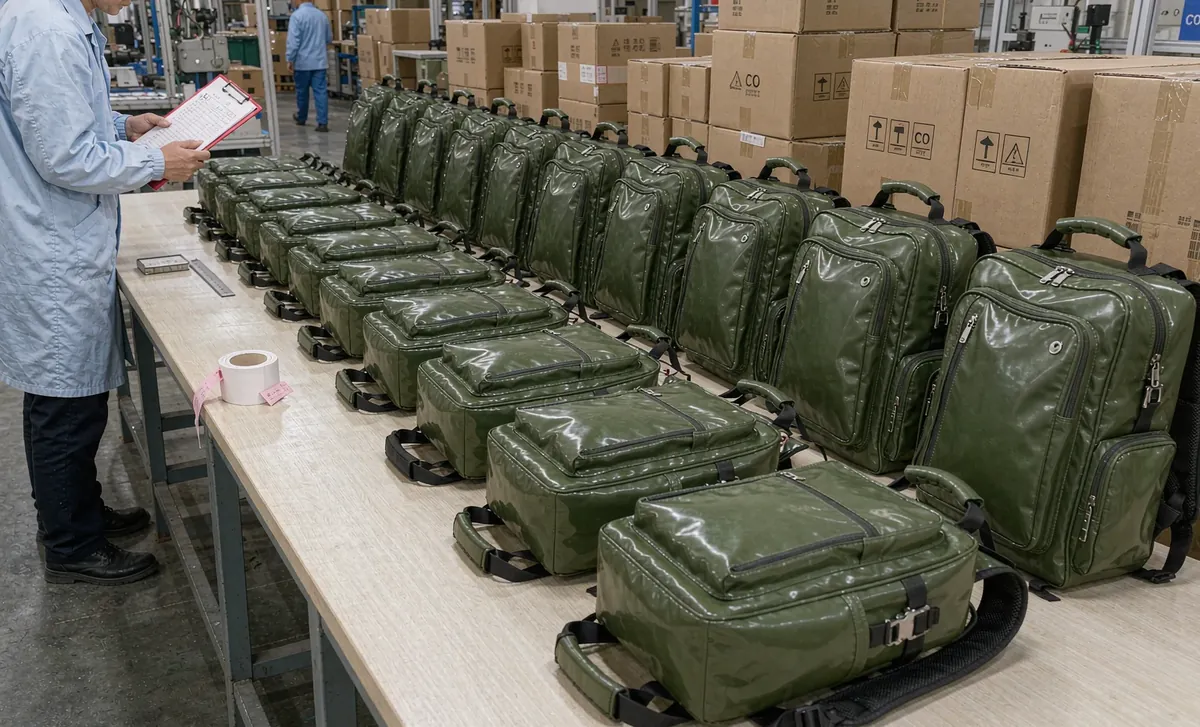
Every order is inspected internally against AQL 2.5 under ISO 2859-1 before it is offered for release. The sample size is determined by the lot size using the standard's general inspection level, and defects are classified as critical, major or minor. Weld integrity, closure function, hardware function and any leak-test failure are treated as critical because they affect the product's core claim. Dimensional deviation outside the stated tolerance, visible seam irregularity and print placement outside the approved area are major. Cosmetic issues that do not affect function or saleability are minor. The report states the lot size, the sample size, the accept and reject numbers, and the actual count in each class, so you can see exactly where the lot landed rather than being told it passed.
Where a lot fails, we do not argue about the classification. We either rework and re-inspect at our cost, or we tell you what the defect is and let you decide whether to accept it at a reduced price. Both outcomes are more useful than a debate, and both are recorded.
Buyer and Third-Party Inspection
You are welcome to appoint your own inspector or a third-party agency, and we will accommodate them during working hours with reasonable notice. We ask two things. First, that the inspection standard is agreed before the goods are packed, so we are not measured against a standard we were not told about. Second, that the inspector works from the signed tech pack version and the sealed golden sample, which we will produce. Where a third-party agency applies a different AQL level or a different defect classification from ours, we ask for that in writing at gate three rather than at gate five, so there is no ambiguity about what "pass" means.
Documentation Set
The standard document set issued on release comprises the commercial invoice, the packing list with carton numbers, dimensions and net and gross weights, the AQL inspection report, the bill of lading instruction as agreed with your forwarder, the certificate of origin where required, and any test reports produced for the order. Where you need a fumigation statement, a material declaration or a supplier declaration of conformity, we prepare them from the BOM rather than as generic boilerplate. Documents are sent as PDFs on release and hard copies are couriered if you require originals.
Release, Loading and Balance Payment
Release is triggered by the 70 percent balance under our standard T/T 30/70 terms. Once funds are confirmed we book the truck, load, and send loading photographs showing the container number, the seal number, the carton count going in and the doors being closed. We do not release goods on a promise of payment and we do not hold goods after payment is confirmed. If your forwarder is collecting, we work to their booking; if you want us to arrange the onward leg, we quote CIF or DDP as a comparison while keeping the underlying product price on an FOB Xiamen basis so the comparison stays honest.
Every shipment leaves with the twelve-month warranty against manufacturing defects recorded on the invoice. Claims under that warranty are handled through your account manager, and the sealed counter-sample from gate two is the reference against which a claim is assessed.
Packaging Services: Polybag, Hangtag, Retail Carton, Amazon FBA Prep
Packaging is treated as a separate workstream inside the programme rather than an afterthought at packing time, because it has its own lead times and its own approvals. Printed cartons, hangtags and polybags are made by specialist suppliers who need artwork, a plate or a digital file, and their own production window. If packaging artwork is still being designed when bulk finishes, the goods cannot be packed, and a finished order sitting in a warehouse for three weeks waiting for a hangtag is one of the most avoidable costs in this industry.
We ask for packaging artwork sign-off no later than two weeks into the production window, and we supply the dielines and technical constraints that make that possible. What follows are the four levels we run, from the simplest to the most involved.
Polybag and Basic Protection
The default is an individual polybag per unit, sized to the product with a stated micron thickness, either plain or printed with a recycle symbol, a barcode and the required market warnings. Polybags for the EU and US markets carry suffocation warnings in the required languages and, where a child-resistant standard applies, the relevant perforation. We also run the alternative for buyers who want to avoid single-use plastic: a paper belly band, a recycled paper sleeve, or a reusable mesh bag. Where a product is shipped flat or nested to save volume, we confirm the fold with the buyer in advance and test it before packing, because a fold that creases a welded panel permanently is not a saving.
Hangtags, Labels and Retail Presentation
Hangtags are produced to your artwork on the board weight and finish you specify, attached with the string or plastic fastener you specify, in the position you specify. We supply the dieline, the print area and the bleed, and we tell you where the tag will sit relative to the product's closure so it does not obscure the detail a customer wants to see. Woven labels, care labels with fibre content and country of origin, and sewn-in or welded brand badges are handled on the same basis. The one thing we insist on is that any label claiming a rating or a performance figure matches what the test report says, because a hangtag claiming IPX8 on a product tested to IPX7 is a liability for both of us.
Export Carton and Container Utilisation
Export cartons are specified by board grade, flute, dimensions, pcs per carton and print. Before quoting, we simulate the pack-out to work out how many units fit a 20GP and a 40HQ, because carton dimensions that look efficient on paper often leave a 40 mm gap at the container wall. Getting this right is free money: it is the same product, the same unit price, and a different freight cost per piece. Carton marks are printed or labelled with your reference, carton number, quantity and any barcode you require, and we photograph the marks while the cartons are being sealed.
Amazon FBA and Marketplace Preparation
FBA preparation adds four requirements that do not exist in a standard export order: an FNSKU or a manufacturer barcode per unit, carton-level labels generated from your shipment plan, a carton weight and dimension limit, and a packing configuration that matches the plan you have created in Seller Central. We apply unit labels, print and apply carton labels from the plan you send us, weigh and measure each carton, and provide the carton manifest in the format you upload. Where a shipment is split across multiple FBA fulfilment centres, we pack and label per destination. We do not create the shipment plan — that sits in your Seller Central account — but we tell you at gate one what we need from it and by when.
| Packaging level | What it includes | Typical channel | Artwork needed from you | Lead-time impact |
|---|---|---|---|---|
| Bulk export pack | Polybag, master carton, shipping mark | Wholesale, private distribution | None, or mark text only | None |
| Retail-ready pack | Polybag, hangtag, care label, printed carton | Specialty retail, own webshop | Hangtag and carton artwork to dieline | Sign-off two weeks into production |
| E-commerce pack | As retail, plus barcode and mailer fit | Direct-to-consumer fulfilment | Barcode allocation and label data | Sign-off two weeks into production |
| Amazon FBA prep | FNSKU unit labels, carton labels, manifest | Amazon marketplaces | Shipment plan and label files | Plan required before packing starts |
| Presentation gift pack | Insert card, tissue, rigid or printed sleeve | Gifting, premium positioning | Full artwork and board specification | Longest; confirm at gate three |
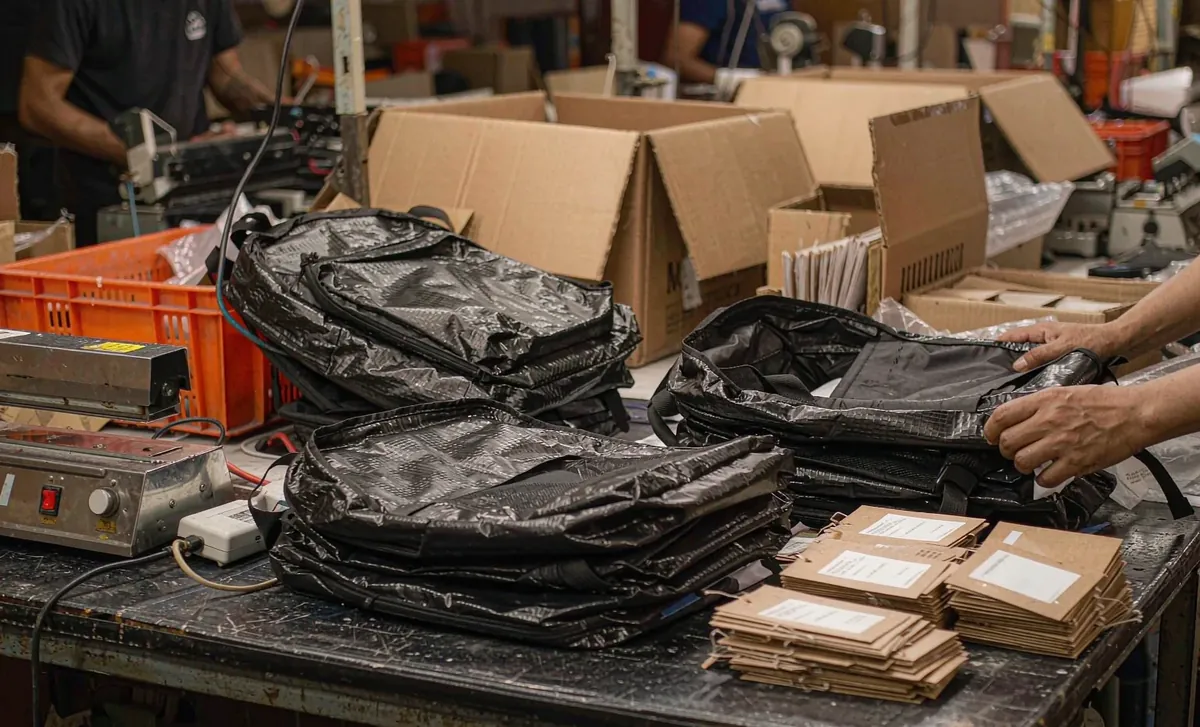
Packaging decisions also interact with cost engineering, described earlier on this page, and with the product families themselves: a soft travel bag nests differently from a rigid cooler bag with an insulated base, and that difference shows up in carton count long before it shows up in a quotation.
Compliance Support: Test Reports, Declarations, Lab Coordination
Compliance is not a certificate you buy at the end. It is a set of decisions made at the tech pack stage about which substances are in the bill of materials, and the testing is there to evidence those decisions. Our role is to coordinate the testing, supply the documentation that a laboratory needs, and make sure the product you submitted is the product you ship. What we do not do is sign a declaration for a material we did not buy.
What We Supply Directly
From our own records we supply the material declaration for each order: face fabric, laminate or coating type and thickness, film specification, hardware manufacturer and reference, webbing and tape composition, thread type, print method and ink system. We supply the construction declaration stating weld method, seam construction, tape width where applied and stitch density at 8–10 SPI on sewn elements. We supply in-house test results for hydrostatic head, seam peel strength, and where applicable, spray and immersion checks, stating the method, the sample and the result. These are production records, not marketing documents, and they carry the lot reference so they can be traced.
What Goes to an External Laboratory
Third-party testing is arranged with the laboratory you nominate, or with the laboratory your retailer or marketplace requires. Common requirements we coordinate include REACH SVHC screening and, where relevant, restricted substance lists for the EU market; CPSIA lead and phthalate testing for the US market; and, for hardware on marine and fishing products, salt spray exposure to 48 hours. We prepare the submission, cut and pack the samples, complete the laboratory's forms, and manage the courier and the timeline. Turnaround is the laboratory's, not ours, and we tell you the expected window at gate three rather than at gate five so it can be built into your launch plan.
The cost of third-party testing is billed at the laboratory's invoice plus handling, and it is quoted separately rather than buried in the unit price, because a buyer who wants to avoid a test should be able to see what it costs. Where a test fails, we say what failed and what the corrective option is, whether that is a material substitution or a process change, and we re-quote before proceeding.
Declarations We Can and Cannot Sign
We sign supplier declarations of conformity for the goods we manufacture, covering material composition and construction as built. We do not sign a declaration covering a component you supply to us, and we do not sign a general conformity assessment for a market where the legal responsibility sits with the importer or the brand owner. That boundary is not us being difficult; it is the difference between a document that means something and a document that does not. If your compliance team needs a specific wording, send it at gate one and we will tell you whether we can sign it.
Keeping Test Reports Current
Test reports age. A hydrostatic head result or an IPX rating obtained on a sample two years ago does not describe a lot produced today from a different material buy, which is why we re-run in-house checks per production lot and recommend third-party re-testing annually, or whenever the material specification, the supplier or the construction changes. Where a marketplace or a retailer asks for a report within a stated validity period, we flag the renewal date and raise it with you in advance rather than letting it lapse. Product-level testing method and pass thresholds are documented on the quality page.
Reorder Service: Repeat Orders Without Re-Sampling
The second order should be easier than the first, and with us it is. Once a style has been sampled, approved and produced, the tech pack, the marker, the weld parameters, the golden sample and the packing specification all exist and are held against your order reference. A reorder is a confirmation against those records rather than a new development, which removes the sampling window from your calendar entirely.
What "No Re-Sampling" Actually Means
It means we do not build a new sample for a reorder of the same style in the same specification. You do not pay a sample fee, you do not wait 6–10 working days, and you do not have to re-approve something you already approved. What we do instead is pull the sealed counter-sample from storage, put it on the line as the reference, and confirm in writing that the specification, the material sources and the packing are unchanged. If anything in the supply chain has moved — a hardware reference is discontinued, a shell lot is no longer available at the specified film thickness — we tell you before cutting and offer an equivalent, rather than substituting silently.
When a Reorder Does Need a Sample
Three situations restart sampling, and all three are your call rather than ours. A specification change: new dimensions, new hardware, new closure or a different film thickness. A colourway change on a material we have not run before, because a new colour on a laminated surface can behave differently under the welder. And a change of compliance market, where the new market requires a material or a construction we have not previously tested for that style. In those cases we quote a reduced development cycle where possible, because the marker and the fixture already exist.
What Gets Faster the Second Time
Lead time is the main gain. Because there is no sampling window and no tech pack development, a reorder can enter a production slot as soon as the deposit clears, which typically brings the enquiry-to-shipment cycle down by three to four weeks compared with the first order. Material booking is faster too, because consumption per unit is known from the first run and there is no marker waste to estimate. And pricing is more stable, because the BOM is settled and the yield is known rather than assumed.
Planning Reorders Against Capacity
If your programme has a predictable rhythm, tell us the annual volume and the rough month-by-month split at the start of the year. Across seven production lines with roughly 200,000 pcs of installed monthly capacity, we can hold a recurring window for a repeat programme, which removes the scramble for a slot in peak season. Buyers who do this get two practical benefits: priority when lines are loaded, and material bought in larger lots, which usually improves price. Buyers who order only when stock runs out get neither, and in November to March they may find the next window is several weeks out.
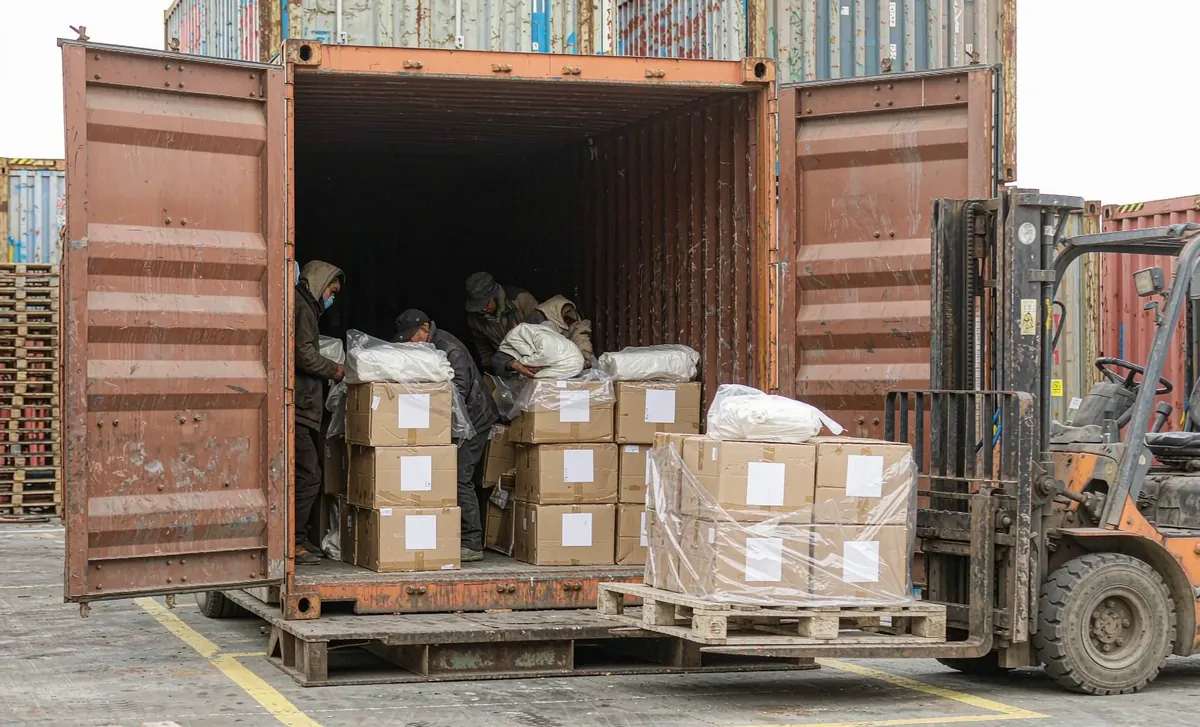
Reorders can also be used to extend a range rather than simply repeat it. A buyer who opened with three dry bag SKUs can add a fourth size, or move into fishing bags or sports bags, on the platform already proven by the first order.
Account Management: Who You Talk To and Response Times
One of the quiet failures in overseas sourcing is the handover: a buyer negotiates with a sales person, gets passed to a coordinator, and discovers during production that nobody who answered the original questions is still involved. We structure accounts to avoid that. Every account has a named account manager who owns it from the first brief through to shipment, supported by an engineer who writes the tech pack and stays on the programme until bulk is packed. The person who answered your feasibility questions is the person who will still be there at gate five.
The Three People on Your Account
The account manager handles commercial matters: price, terms, proforma invoices, schedules, documentation and anything to do with your order as a transaction. The engineer handles technical matters: the pack, the material specification, the weld method, the sampling and any change note that touches construction. The QC contact handles inspection and testing, and is the person your third-party inspector deals with. For a single-style first order you will mostly talk to the account manager and copy the engineer. For a multi-category programme, all three are named to you at gate three and included on the weekly report.
Response Times We Work To
We publish response commitments because "we will get back to you" is not a commitment. Ours are measured in working hours in the China time zone, and they assume you are asking during our working week. A question asked on a Friday evening does not start its clock until Monday morning, and we say that plainly rather than pretending to be a twenty-four-hour operation. Where a question needs an engineer rather than an answer, we acknowledge first with the time it will take, then answer.
| Request type | Channel | First response | Full answer | Escalation if missed |
|---|---|---|---|---|
| New enquiry with a brief | Email to service@junyuanbags.com | Same working day | Feasibility memo within 24 hours | Escalate to the account manager directly |
| Technical question on a live pack | Email, copied to your engineer | 4 working hours | Same or next working day | Request a call with the engineer |
| Price or terms question | Email or WhatsApp | 4 working hours | Next working day | Ask for the planning desk |
| Urgent production issue | WhatsApp or phone | 2 working hours | Same working day with a change note | Request a video call with the line supervisor |
| Order status during production | Weekly report, plus email on request | Scheduled weekly | Weekly report on a fixed weekday | Ask for a live photograph or a line walk video |
| Document request after shipment | 4 working hours | Next working day | Escalate to the shipping desk | |
| Warranty or quality claim | Email with photographs | 1 working day | 3 working days with a proposed resolution | Request assessment against the sealed counter-sample |
Communication Channels and Time Zones
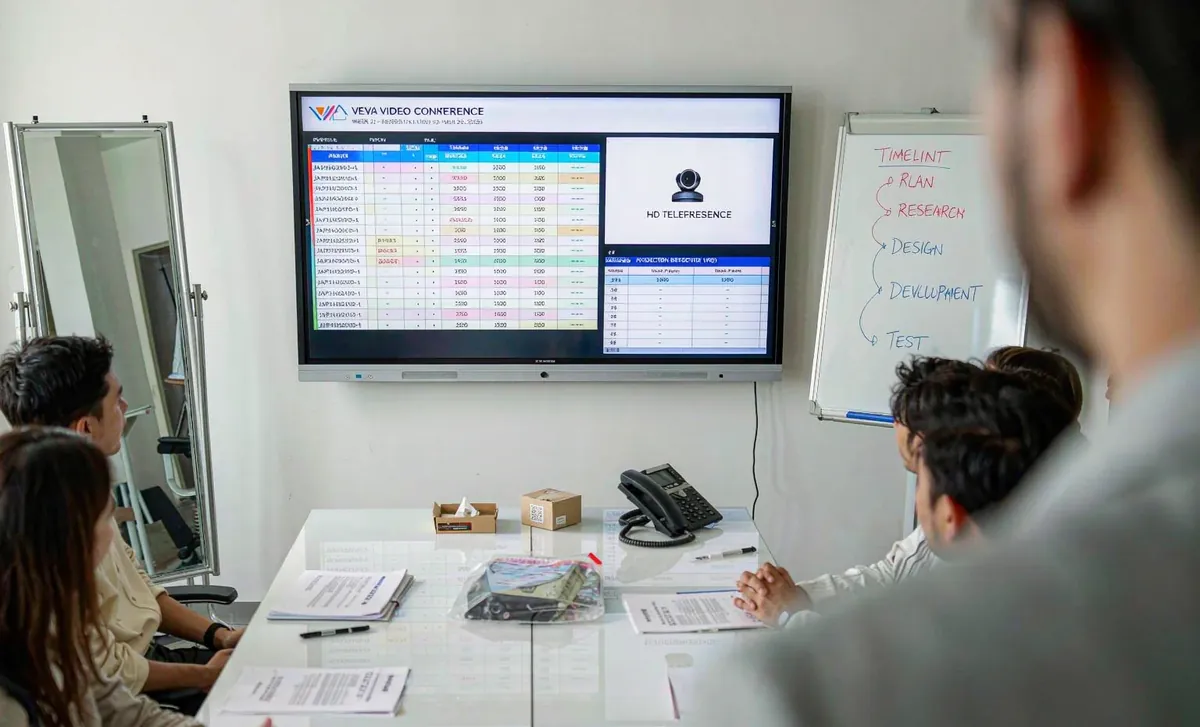
Email is the channel of record: anything that affects specification, price, schedule or documentation is confirmed in writing, even if it was agreed on a call. WhatsApp is used for speed and for photographs, and it is genuinely useful during sampling and loading, but it does not replace the written record for decisions. Video calls are used at two moments by default: the programme kick-off at gate three, and a sample walkthrough whenever you would rather see a sample live than read a report. We work China hours and cover European and North American mornings by starting early where a call is needed. Public holidays, particularly the Spring Festival and the October national holiday, are flagged in advance on the contact page and in your production schedule.
Service Levels We Commit To (and What We Ask in Return)
A service level is only meaningful if it is stated as a number with a consequence. What follows is what we commit to, written the way we would want to read it as a buyer, followed by the four things we ask of you. These are the terms we run every programme on, not a negotiation position for new accounts.
Our Commitments
We commit to a feasibility response within 24 hours of a complete brief, with a stated construction baseline behind any price. We commit to sampling in 6–10 working days, or 12–15 working days where the brief involves a new moulded component, an insulation stack or a hybrid closure, and we tell you which band applies at gate one rather than after you have committed. We commit to bulk production in 35–50 days from sample approval, with the position inside that range stated on the proforma invoice. We commit to inspection against AQL 2.5 under ISO 2859-1 with the actual defect counts reported, not just a pass statement. We commit to weekly status reports throughout production, to a named account manager and engineer, and to a written change note before any deviation from the signed specification is applied. We commit to a twelve-month warranty against manufacturing defects, assessed against the sealed counter-sample. We commit to quoting on an FOB Xiamen basis with T/T 30 percent deposit and 70 percent before shipment, and to saying no at gate one when a target price cannot be met honestly.
What We Ask in Return
Four things, and they are not onerous. First, a brief that says which parts are fixed and which are open, including an honest target price even if you suspect it is optimistic. Second, decisions inside the stated windows: a sample left unapproved for three weeks does not stop our calendar, and the production slot may move. Third, packaging artwork and any FBA shipment plan signed off by two weeks into the production window. Fourth, written confirmation of anything agreed verbally, which protects you at least as much as it protects us.
Where This Model Does Not Fit
We are a production partner for branded programmes at 500 pcs per style and colourway and above, running on shared platforms across seven lines. If you need 100 pieces of a fully bespoke shape, or a drop-ship arrangement with no minimum, we are the wrong supplier and we will say so at gate one. If you need a supplier who will quote a price before knowing the shell, the closure or the seam method, we are also the wrong supplier. What we offer instead is a process where the number, the construction and the calendar are all stated together, and where a programme can be repeated next season without going back to the beginning.
The full product range these service levels apply to is on the products page, the equipment and capacity behind them are on the manufacturing page, and company background including our history since 2014 is on the about page.
Frequently Asked Questions
What is your minimum order quantity for a custom waterproof bag?
MOQ is 500 pcs per style and colourway. Three colourways of one style is therefore 1,500 pcs, because each colourway is a separate material buy and a separate line changeover. The figure is low for welded construction because styles share a platform and a set of welding fixtures, so we are not amortising new tooling across a single small order. If you are launching a range, opening with three sizes at 500 pcs each is usually a better first order than 1,500 pcs of one size.
How long does sampling take and what does the sample fee cover?
Sampling takes 6–10 working days from a signed tech pack and a released sample fee, extending to 12–15 working days where the brief needs a new moulded component, a laminated insulation stack or a bought-in closure. The fee covers material issue, marker work, operator time and handling, and it is credited against your bulk order when you place it. Courier freight is billed at cost, or you can nominate your own account.
Can you replicate a product from a photograph?
We can start from a photograph but we will not cut a sample from one. A photograph shows shape and colour, not film thickness, weld land width, harness attachment or how the capacity was measured. Send a physical reference sample if you have one and we will measure it and write the pack from measurements. Otherwise we build a pack first from your written brief, which takes two to three working days and removes the guesswork.
Do you provide design work if we have no artwork yet?
We provide engineering, not brand identity: platform selection, dimensional development, material and hardware recommendation, technical drawings, and logo application advice. We do not design logos, write copy or produce retail graphics, though we supply dielines and print areas for your designer. If artwork is pending, tell us at gate one and we will reserve the print area on the pack.
What payment terms do you accept?
Standard terms are T/T with 30 percent deposit to confirm the order and 70 percent before shipment. The deposit triggers material booking and reserves the production slot; the balance triggers release of the goods and documents. We do not cut bulk material before the deposit clears. Commercial terms for repeat programmes are reviewed with the account annually rather than renegotiated order by order.
What is the bulk production lead time?
Bulk runs 35–50 days from sample approval. Thirty-five days suits a repeat style on an existing platform with held materials; fifty days applies to a first bulk run of a new style, several colourways in sequence, bought-in hardware, or a peak-season line load. Your position inside that range is stated on the proforma invoice rather than quoted optimistically.
Can the price come down from the first quotation?
Often yes, through value engineering rather than negotiation. We open the bill of materials and identify cost the user will not notice: colourway consolidation, carton utilisation, print method, hardware brand at non-load-bearing points, trim count and quantity bands. What we will not cut is weld land width, seam peel strength held at 8 N/cm, or hardware at load-bearing points.
Which Incoterms do you quote?
Our quotation basis is FOB Xiamen, and every price band we issue is built on that footing so you can compare it against any other supplier. We are happy to quote CIF or DDP alongside for comparison, and to arrange the onward leg if you prefer, but the underlying product cost stays FOB so the comparison remains honest.
What inspection standard do you use, and can we appoint our own inspector?
Every order is inspected internally against AQL 2.5 under ISO 2859-1, with sample size set by lot size and defects classified critical, major or minor. The report gives the actual counts rather than just a pass. You may appoint your own inspector or a third-party agency; we ask that the standard and defect classification are agreed at gate three and that they work from the signed pack and the sealed golden sample.
Can you ship directly to Amazon FBA?
Yes. We apply unit labels from your shipment plan, print and apply carton labels, weigh and measure each carton, and provide the carton manifest for upload. We do not create the shipment plan, which sits in your Seller Central account, so we ask for the plan and label files before packing starts. Multi-destination shipments are packed and labelled per fulfilment centre.
Do you supply compliance test reports?
We supply material and construction declarations from our own records, plus in-house results for hydrostatic head, seam peel and spray or immersion checks, all carrying a lot reference. Third-party testing for REACH, CPSIA or other market requirements is coordinated with the laboratory you nominate: we prepare samples and forms and manage the timeline. Testing cost is billed at the laboratory's invoice plus handling, quoted separately.
Can we visit the factory?
Yes, and we encourage it. Visitors see the sample room, the welding lines, the inspection bench and the packing area, and can watch a live weld and a seam pull. Tell us at least a week ahead so we can arrange a line walk at a useful moment rather than during a changeover. If you cannot travel, we will do the same walk on a video call and send the recording.
What does the warranty cover and how are claims handled?
Every shipment carries a twelve-month warranty against manufacturing defects, recorded on the invoice. Claims go to your account manager with photographs and, where possible, the affected unit. We assess against the sealed counter-sample held from your approved golden sample, respond within three working days with a proposed resolution, and settle by replacement, credit or rework depending on what the claim is.
Do repeat orders need to be re-sampled?
No, provided the specification, material sources and packing are unchanged. We pull the sealed counter-sample, put it on the line as the reference and confirm the records in writing, which removes the sampling window entirely. A sample is only needed if you change the specification, introduce a colourway on a material we have not welded before, or enter a market requiring a construction we have not tested for that style.
Who will be my day-to-day contact and how quickly do you reply?
Each account has a named account manager supported by a named engineer, and a QC contact who deals with your inspector. First response is four working hours for commercial and technical questions, two for urgent production issues, and one working day for claims. Feasibility memos are returned within 24 hours of a complete brief, and status arrives weekly on a fixed weekday.