Waterproof Sports Bags Manufacturer
We build waterproof sports bags for gym, diving, surfing and water-sports brands. Every bag features a separate wet pocket, welded seams and durable webbing. MO
Why Sports Bags Need Water Management, Not Just Waterproofing
Most buyers who approach a waterproof sports bag manufacturer arrive with a hydrostatic head figure already in mind, and that figure is usually the wrong starting point. A hiking pack that is rained on for four hours is dealing with an external load of perhaps two or three litres of clean water arriving at low pressure across the whole shell. A gym duffel used five mornings a week is dealing with an internal load: a saturated training shirt, a towel wrung out but still holding roughly two hundred millilitres, a pair of trainers whose uppers have absorbed perspiration, and a drinks bottle that has been sweating condensation into a side sleeve since the night before. That water is warm, it is carrying salt and sebum, and it is enclosed with the very textiles it came from. Waterproofing alone, defined as the ability of the shell to resist ingress, does nothing about any of it. What the bag actually needs is water management: a defined route by which liquid leaves the interior, a defined place where wet and dry are allowed to coexist without contaminating each other, and a defined dry-out rate once the session is over.
The commercial logic follows the physics. Returns on sports bags cluster around odour, mould spotting on light-coloured linings, and the discovery that a "waterproof" bag has in fact become a sealed terrarium. None of those three complaints is solved by raising the shell rating from 3,000 mm to 20,000 mm; if anything, a perfectly sealed shell makes the second and third worse, because it removes the incidental leakage that previously allowed some evaporation. We have taken briefs where the requested specification was a fully welded, submersible gym bag, and our first engineering response is usually to ask where the water is meant to go, because a fully welded bag with no drainage and no separation will smell within three weeks of daily use regardless of how impressive the immersion test looks on video.
External Ingress and Internal Load Are Different Problems
The two problems have different test methods, different failure modes and different cost drivers, and conflating them is the single most common cause of over-specified and underperforming sports ranges. External ingress is governed by face fabric hydrostatic head, seam construction and closure design: it is tested by spray cabinets and immersion tanks, and its cost driver is the laminate or coating weight. Internal load is governed by compartment geometry, drainage path, liner chemistry and air exchange: it is tested by weighing a bag before and after a controlled drying cycle, and its cost driver is tooling and pattern complexity rather than fabric price. A buyer who spends the whole budget on the laminate ends up with a bag that survives a downpour and fails its owner.
What "Water Management" Specifies in Practice
When we receive a tech pack for sports use, we look for four lines that most briefs omit. The first is dry-out time: the number of hours, at a stated temperature and humidity, within which an emptied wet compartment must return to within five per cent of its dry weight. The second is separation integrity: a stated volume in litres that must remain dry while an adjacent compartment holds a saturated textile, tested over a stated duration and including a flex or carry cycle. The third is a drainage statement: grommet diameter, count, position and the requirement that the bag drain to a stated residual when set down on a level surface and lifted again. The fourth is a cleanability statement, usually expressed as the number of machine or wipe-down cycles the lining must survive without delamination. Those four lines cost nothing to add at the brief stage and they are what make a range defensible when a retail buyer asks why this bag costs two dollars more than the one below it on the peg. Our standard test schedule and acceptance criteria are published under quality, and the production capacity behind them under manufacturing.
One further point deserves to be stated plainly because it saves a great deal of rework. Sports ranges are frequently developed by teams whose previous product was a dry bag or a travel bag, and the instinct carried across is to seal everything. Sealing is correct for a kayak dry bag and largely counterproductive for a team kit bag. The categories we build for paddling are described under waterproof backpacks and fishing bags, where full sealing is genuinely the right answer; on this page the assumption is the opposite, and the engineering is about controlled movement of water rather than absolute exclusion of it.
Seven Formats in the Sports Range and Their Retail Channels
Seven formats account for the overwhelming majority of the custom gym bag OEM programmes that run through our lines. They share fabric platforms, hardware, webbing and branding processes, which is the practical reason a buyer can build a coherent range from one factory under one compliance file instead of managing six supplier relationships with six audit cycles. They differ sharply in one respect that matters more than price: the number of sampling rounds each format needs before the first shipping sample is genuinely acceptable. Understanding that difference is what keeps a first-season range on schedule, because the instinct is always to develop every format simultaneously and discover in month three that the team kit bag needs a numbering workflow nobody had scoped.
| Format | Working volume | Governing construction | Primary retail channel | Development load |
|---|---|---|---|---|
| Gym duffel | 25–55 L | Coated 600D polyester body, welded wet pocket at one end, structured base panel with feet | Specialist fitness retail, supplement brands, corporate wellness programmes | Low–medium: pattern is forgiving, branding drives the rounds |
| Sports backpack | 20–35 L | 420D nylon ripstop or 600D TPU laminate, contoured straps, sternum slider, ventilated back panel | E-commerce private label, school and club supply, outdoor chains | Medium: harness comfort absorbs two to three rounds |
| Wet/dry separation bag | 30–60 L | Dual-chamber build, RF-welded TPU wet liner 0.15–0.20 mm, independent drainage floor | Swim and triathlon specialists, surf retail, resort pro shops | High: two closures and one welded sub-assembly per unit |
| Hiking daypack | 18–32 L | Tensioned mesh suspension or moulded EVA contact panel, HDPE frame sheet 0.8–1.2 mm, load lifters | Outdoor independents, catalogue retail, national park gift shops | High: suspension geometry cannot be shortcut |
| Hydration-compatible pack | 8–18 L | Insulated or sleeved bladder compartment, hose port, bite valve dock, minimal external snag points | Running and cycling specialists, event merchandise, military and duty supply | Medium: bladder interface is the risk, not the shell |
| Team kit bag | 60–110 L | Heavy-duty 840D or 1000D base, U-shaped main opening, reversible name panel, numbering zone | Club and federation programmes, school teamwear, uniform distributors | Medium–high: decoration workflow dominates lead time |
| Yoga and mat bag | 12–30 L | Full-length mat cradle or external strap set, vented mat tunnel, small welded wet pocket for a towel | Studio retail, wellness brands, instructor affiliate programmes | Low: fastest route to a first sellable sample |
The Swim Bag as a Special Case
A swim bag is listed by many buyers as a separate format and it is usually better treated as a wet/dry separation bag with a specific parameter set. The differences are real but narrow: the wet compartment must hold a full-length towel plus a costume and goggles without the compartment collapsing when empty, the drainage must work when the bag is slung over a hook rather than set on a floor, and the whole item is expected to survive daily chlorinated and occasionally saline exposure. Chlorine is the harder of the two on elastane and on printed decoration, which is why swim programmes tend to upgrade to solution-dyed polyester face fabric and to a print process that sits under a clear topcoat rather than on top of it. We fold swim builds into the separation format because it lets the buyer use one pattern block, one closure set and one welded liner electrode across two retail price points.
Picking the Opening Order
Which formats belong in a first order depends far less on margin than buyers expect and far more on what the range has to prove. A brand entering through a single retailer usually needs one hero bag and one accessory; the hero should be the format with the lowest development load that still carries the brand's story, which in practice means the gym duffel or the yoga bag. A brand entering through direct e-commerce needs breadth quickly, and for that buyer the right opening order is one pattern block executed in three volumes, because photography, listing copy and size-variant reviews all attach to the parent listing. A club or federation programme is different again: the bag is not the product, the decoration is, and the opening order should be built around a kit bag with a proven numbering workflow rather than around a shape anybody particularly likes.
Channel geography moves the specification too, and the movement is larger in sports than in most categories we make for. Northern European and North American buyers want structured bags that stand up on a changing-room floor, dark colourways that hide marking, and hardware they can operate with cold hands. Humid tropical markets put more weight on ventilation, light colour and a bag that can be hosed down and dried within a day, and will accept a floppy profile to get it. A range engineered for one of those markets and shipped to the other typically disappoints on review scores rather than on durability, which is a slower and more expensive failure to diagnose. Buyers running several carry categories off one colourway set often pair this range with travel bags or cooler bags to amortise fabric and trim purchases across programmes.
Wet-and-Dry Separation: Compartment Geometry That Actually Works
Wet-and-dry separation is the feature most frequently specified and most frequently got wrong in sports bags. The concept is simple — a welded or coated compartment that holds wet kit so it cannot wet the dry kit — and the failure is almost never that the compartment leaks through its film. It fails because of geometry. A wet pocket that is a flat sleeve across the bottom of a duffel will hold a damp tee acceptably and will hold a pair of soaked trainers badly, because the water pools at the lowest corner of a horizontal panel and then finds the one stitch line or zip end that was not sealed. A wet pocket that is a vertical tunnel at one end of the bag drains by gravity, keeps its own floor small and steep, and can be given a grommet at the bottom that actually clears. The difference in material cost between the two is close to nil; the difference in whether the feature survives a season is not.
Orientation, Volume Ratio and Access
Three numbers govern whether a separation build works, and we ask for all three on the brief. The first is orientation: wet zones should be vertical, floor-standing or end-mounted, and should never be a flat horizontal panel under the main compartment, because the main compartment's contents then press down on the wet zone and drive liquid towards every seam. The second is volume ratio: a wet compartment sized at twenty-five to thirty per cent of total internal volume covers the realistic case, which is one towel plus one costume plus one pair of shoes or one wetsuit top. Sizing it at ten per cent makes the feature decorative; sizing it at fifty per cent steals the space the buyer is paying for and tends to produce a bag that looks empty when used normally. The third is access: the wet compartment needs its own opening, positioned so that a user can load it without opening the dry main, which in a duffel usually means an end zip and in a backpack means a lower side zip or a drop-panel entry.
Welded Liners and the Seams That Fail
The wet compartment is the one place in a sports bag where a radio-frequency welded liner is nearly always correct. A 0.15–0.20 mm TPU film laminated to a 420D or 600D face gives a compartment with no stitch holes at all, and our acceptance figure for any welded or bonded seam in this position is a peel strength of at least 8 N/cm measured on the production sample rather than on a laboratory coupon. The failure mode that still appears is not the weld; it is the transition where the welded liner meets the sewn shell. That transition has to be engineered as a bounded and stitched hybrid — the film is first bonded to the shell over a 20 mm overlap, then stitched through the overlap only, never through the wet-side interior — and the stitch density at that transition should sit at 8–10 SPI with a 20 mm tape over the top. Get the transition right and the compartment holds indefinitely; get it wrong and no amount of film thickness helps.
Zips deserve their own note because they are the other leak path. A separating wet compartment wants either a genuinely water-resistant PU-coated coil zip with a garage and a reverse-facing tape, or, in higher price bands, a welded TIZIP or YKK AquaGuard #5 with the tape oriented so that any liquid meeting it runs away from the compartment rather than into the coil. Orientation is the part most often missed: a water-resistant zip installed upside down performs like a plain zip. In budget builds the honest alternative is to eliminate the zip entirely and use a roll-top closure on the wet compartment, which welds cleanly, drains when inverted and removes the most expensive trim item in the assembly.
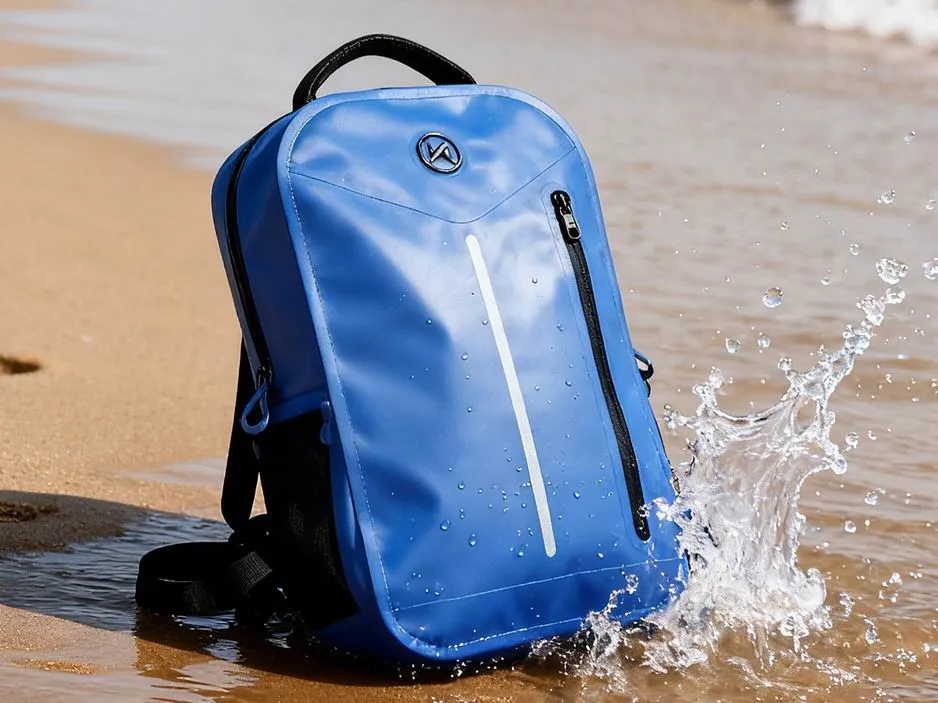
Ventilation Engineering: Mesh Panels, Drainage Grommets, Airflow Paths
Ventilation is the cheapest performance feature in a sports bag and the one most often specified as an afterthought, usually as a rectangle of mesh somewhere on the side. Mesh alone is not ventilation. Air exchange requires a path: an inlet low on the bag and an outlet high on it, with a convective driver between them. Without that path, a mesh panel is simply a hole that lets some vapour diffuse and lets a great deal of dust in. The engineering question is therefore not how much mesh to add but where the air enters, where it leaves, and what stops the two from short-circuiting into a single dead zone behind the panel.
Building a Convective Path
The physical driver is small but usable. A bag left in a changing room with wet kit inside has an interior a few degrees warmer than ambient once bacterial metabolism and residual warmth from the wearer have done their work, and warm moist air rises. An inlet placed at the lowest practical point on a side or end panel, paired with an outlet on the upper back panel or under a top lid flap, gives a continuous low-rate exchange that will move meaningful moisture over an eight-hour period. The inlet should be shielded so that it does not scoop water when the bag is set in a puddle, which in practice means a mesh-covered grommet under a small storm flap rather than an open perforation. Outlets should be positioned so that a shoulder strap or a hanging loop does not occlude them when the bag is carried, because occlusion at the top of the path collapses the whole exchange.
Grommets, Mesh and What They Cost You
Drainage grommets are specified by diameter, count and material, and the material choice is where corrosion claims start. A brass grommet will stain a light-coloured shell and eventually seize; a plated steel one will rust in a swim bag within a season. We specify moulded TPU or silicone grommets, or a rubber-gasketed metal grommet that has passed a 48-hour neutral salt spray exposure, and we size them at 8–10 mm so that they pass water freely but do not admit gravel. Two grommets at the lowest corners of a wet compartment are generally sufficient up to about forty litres; above that, three spaced along the compartment floor prevent the bag from holding a residual puddle when it is set down off-level.
| Ventilation element | Typical specification | Where it belongs | What it costs you |
|---|---|---|---|
| 3D spacer mesh panel | Polyester spacer fabric 220–320 g/m², 3–6 mm thickness, two-face knit | Wet compartment door, mat tunnel, back panel of a daypack | Zero water resistance at the panel; must be zoned away from the dry zone |
| Moulded TPU drain grommet | 8–10 mm bore, welded or ultrasonically set into the liner | Lowest corner of any welded wet compartment | Breaks the compartment's immersion rating; intended to |
| Storm-flapped air inlet | Mesh-backed slot 40–70 mm wide under a 15 mm overhang | Low side or end panel, opposite the outlet | Adds one taping operation and one pattern piece |
| High outlet vent | Mesh slot or perforated panel under the lid flap or top back panel | Highest point that stays clear when carried | Requires a drip edge above it or it becomes an ingress path |
| Closed-cell foam in wet zones | PE foam 25 kg/m³, skin-sealed, no open-cell latex | Wet compartment walls, mat cradle | Slightly stiffer hand; eliminates the main odour reservoir |
| Removable drip tray | Welded TPU tray, 20–30 mm wall, lift-out | Swim and dive builds holding a full wetsuit | Highest unit cost option; easiest to clean |
Verifying That It Works
The test we recommend is unglamorous and very effective. Load the wet compartment with a textile saturated to a defined water content, weigh the whole bag, hang or stand it in still air at a stated temperature and relative humidity, and weigh again at four, eight and twenty-four hours. A build with a functioning convective path will show most of its loss in the first eight hours; a build with mesh and no path will show a slow linear loss that has not finished at twenty-four. Buyers who run this once on a competitor sample and once on their own never go back to specifying mesh by area. The same rig quantifies drainage: stand the loaded bag, lift it, and weigh the residual, because a compartment that holds more than about thirty millilitres after lifting is the one that generates the smell complaint.
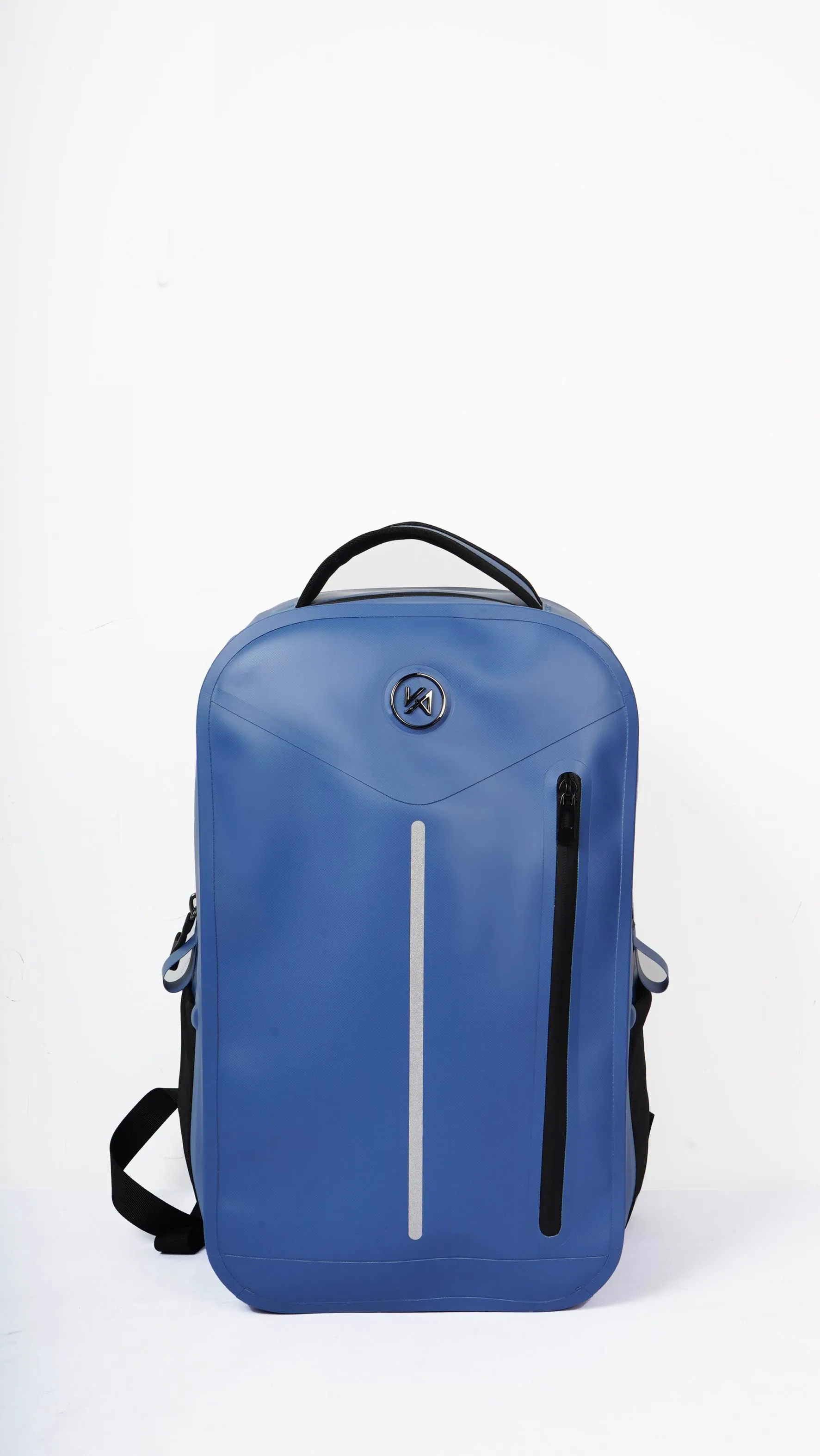
Shell Materials for High-Sweat Use: Coated 600D, Ripstop Nylon, TPU
Sweat is not water, and a shell specified only against clean water will underperform against it. Human perspiration carries sodium chloride at roughly one to two grams per litre, a mildly acidic pH between about 4.5 and 6.5 once it has been on skin for a while, urea, lactic acid and a lipid fraction from sebum. That mixture attacks coatings and films differently from rain. Chloride ions drive corrosion at any exposed metal trim and accelerate hydrolysis in ester-based polyurethanes; the lipid fraction plasticises some PVC coatings and lifts certain print systems; and the combination, left warm and enclosed, produces the microbial growth that generates odour. When we review a waterproof hiking backpack manufacturer brief for sports use, we are therefore looking at chemical resistance and cleanability as much as at hydrostatic head.
| Material | Barrier construction | Typical hydrostatic head | Fabric weight range | Where we specify it in sports |
|---|---|---|---|---|
| Coated 600D polyester | PU back coat near 0.15 mm, single-side, DWR finish on the face | 3,000–8,000 mm after taping | 230–300 g/m² | Gym duffel bodies, yoga bags, entry price bands, sublimation panels |
| 420D nylon ripstop | PU coat, ripstop grid at 8–10 mm, taped seams at 20 mm | 3,000–8,000 mm | 120–170 g/m² | Sports backpack side panels, hydration pack shells, weight-critical builds |
| 600D polyester TPU laminate | TPU film 0.10–0.20 mm, polyether grade for sweat and chlorine | ≥ 10,000 mm | 250–330 g/m² | Wet compartment liners, swim bag shells, mid-price duffels |
| 840D nylon TPU laminate | TPU film 0.15–0.25 mm on nylon face | ≥ 15,000 mm | 300–380 g/m² | Team kit bag bodies, duty and event builds, abrasion-prone side panels |
| 1000D polyester TPU laminate | TPU film 0.20–0.30 mm | ≥ 20,000 mm | 420–500 g/m² | Kit bag bases, duffel floors, any panel that meets studs or boot plates |
| 500D PVC tarpaulin | PVC coating near 0.35 mm on open-weave scrim, non-phthalate for EU and California | ≥ 10,000 mm | 480–600 g/m² | Budget wet compartments, mat tunnels, resort and poolside programmes |
| Solution-dyed polyester face | Dyed in the melt, no dye bath, any of the above coatings | As base fabric | As base fabric | Swim programmes where chlorine fastness governs, and any sustainability claim |
Why Polyether TPU Is the Default Near Skin
Within TPU, the distinction that matters here is whether the polyurethane is polyether-based or polyester-based. Polyester-based TPU shows better abrasion and tear numbers on a data sheet and costs marginally less per square metre, but the ester linkage hydrolyses in the presence of warm moisture, and a bag that lives in a locker or a car boot is exactly that environment. Polyether-based TPU resists hydrolysis and microbial attack substantially better, which is why it is the standard for marine upholstery and inflatable fabric, and why we specify it for any panel that routinely contacts sweat, chlorinated water or a wet wetsuit. The specification line is short and worth insisting on: state polyether, state the film thickness separately from the face fabric weight, and state the peel strength you will accept on the finished weld.
Coated 600D and Where It Still Wins
Coated 600D polyester remains the workhorse of the gym and yoga categories for reasons that are not only cost. It takes dye-sublimation beautifully, which matters enormously in a category where branding is a large part of the perceived value; it is available in recycled form with Global Recycled Standard documentation; and it is soft enough in the hand to read as a sports bag rather than as technical luggage. Its limitation is that it cannot be radio-frequency welded into a truly watertight seam, because the woven polyester core stays hygroscopic and will wick along a stitch line. The correct build is cut-and-sew at 8–10 SPI with a 20 mm taped seam on any panel that must resist water, optionally upgraded to a bonded-and-stitched hybrid where the seam is thermally bonded first and then reinforced by stitching. That hybrid adds process time and measurably raises peel strength, and it is the single most cost-effective upgrade available in the whole range.
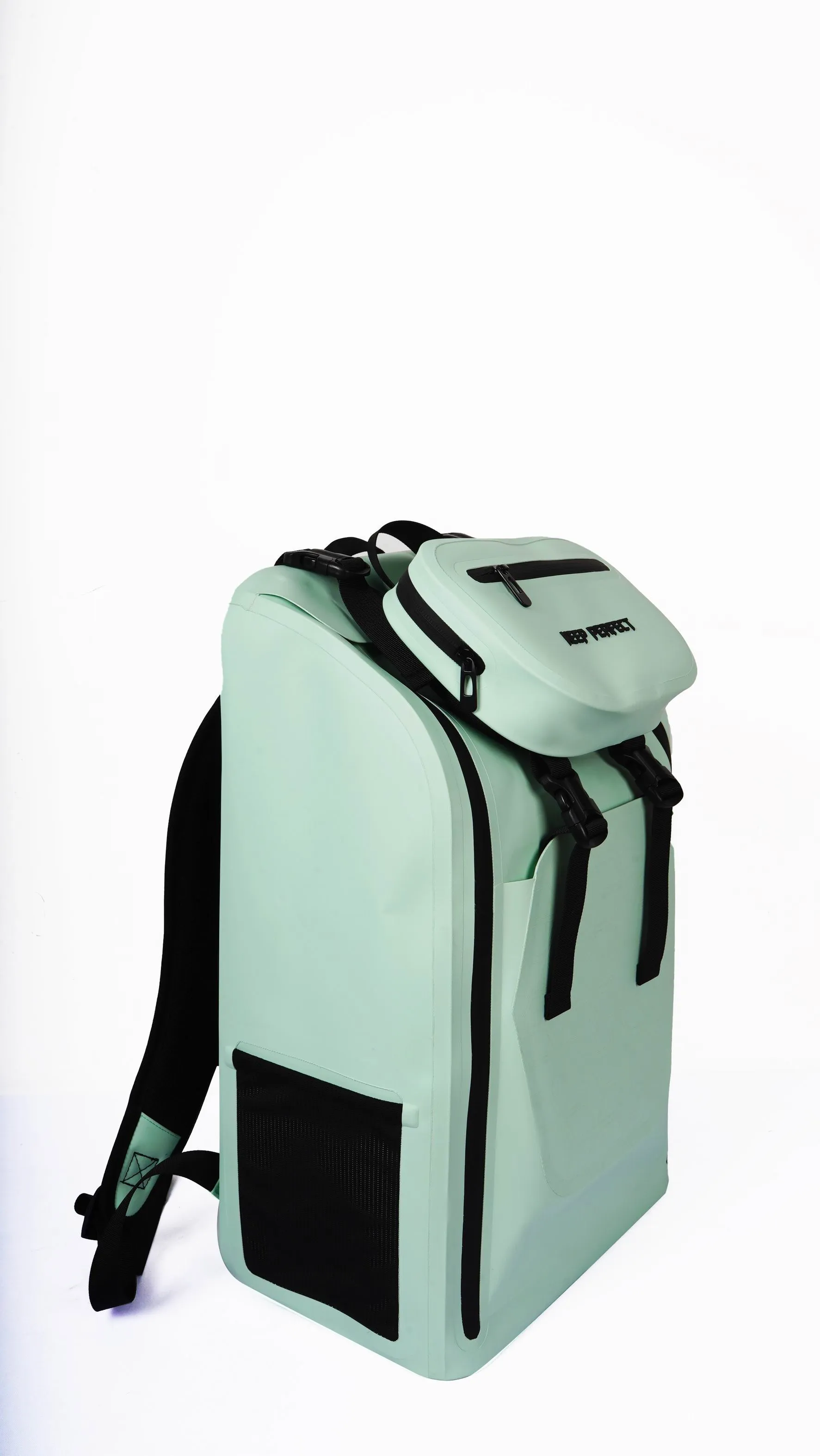
Odour and Bacteria Control: Lining Treatments and Cleanability
Odour in a sports bag is a microbial process with a design solution. Bacteria colonise the warm, wet, nutrient-rich interior, metabolise the lipid and urea fraction of sweat, and release the volatile compounds that a customer describes as "the bag smells". The reservoir is almost never the face fabric; it is the foam, the interlining, the webbing and the seam tape, because those are the components that hold water longest and are hardest to rinse. Every durable odour-control strategy therefore starts with removing reservoir volume before it starts with adding a chemical treatment. A wet compartment lined with closed-cell PE foam at 25 kg/m³ and seam-taped rather than quilted will outperform a compartment with an expensive antimicrobial finish and an open-cell foam backing, and it will do so for the life of the bag rather than for the life of the finish.
What Antimicrobial Treatments Can and Cannot Do
The treatments available for textile and film application fall into a few families: silver-ion systems, zinc-based systems such as zinc pyrithione, and silane quaternary ammonium compounds bound to the fibre surface. All three can demonstrably reduce bacterial population on a treated surface under laboratory conditions, and all three have limits worth stating to a retail buyer before a claim is printed on a hangtag. A bound, non-leaching chemistry is generally the safer regulatory position because the active agent stays on the article rather than migrating into the environment, but its effect is contact-only and it does not protect the untreated webbing three centimetres away. A leaching chemistry reaches further and depletes faster; it also raises registration questions, because in the European Union a biocidal claim on an treated article engages the Biocidal Products Regulation and in the United States an antimicrobial claim on a product intended to control odour-causing bacteria engages EPA registration for the treated article.
Our working position with buyers is that a treatment should be presented as a hygiene adjunct, not as the answer to a design that traps water. We will apply a specified finish and we will provide the test report, but we ask that the hangtag language be reviewed against the destination market before it is printed, because a claim that is defensible in one jurisdiction is a recall risk in another. Where a brand wants a genuinely cleanable interior, the more reliable route is a smooth welded TPU liner with radiused corners and no quilting, which can be wiped down or hosed and dried in an hour; that approach has no registration exposure at all and it improves with every cleaning rather than degrading.
Cleanability as a Specification Line
Cleanability can be specified and tested, and doing so removes a whole category of review complaints. The lines we recommend are: the lining must survive fifty domestic machine cycles at 30 °C without delamination, cracking of the film or loss of seam tape adhesion; the lining must show no colour transfer to a white cotton rubbing cloth at grade 4 or better after perspiration conditioning; and the interior must contain no open-cell foam, no cotton webbing and no unbound interlining. The second of those is tested against ISO 105-E04 colourfastness to perspiration, and it matters more than buyers expect, because the most visible odour-adjacent defect is not smell at all but a pink or grey bloom on a light-coloured lining that looks like mould and reads as a hygiene failure in a photograph. Related test documentation is grouped under quality.
Two design details finish the job. The first is a reversible or removable liner on mid-price builds: a welded TPU insert that lifts out of the wet compartment, which lets the owner rinse the only part that ever smells and dries the shell separately. The second is drainage at the foam level — where foam must be used in a wet zone, it should be skin-sealed closed-cell and should sit above a grommeted floor rather than directly on it, so that water leaving the textile has somewhere to go instead of sitting against the foam's underside. Neither detail is expensive, and both are visible in a review photograph within the first month of ownership.
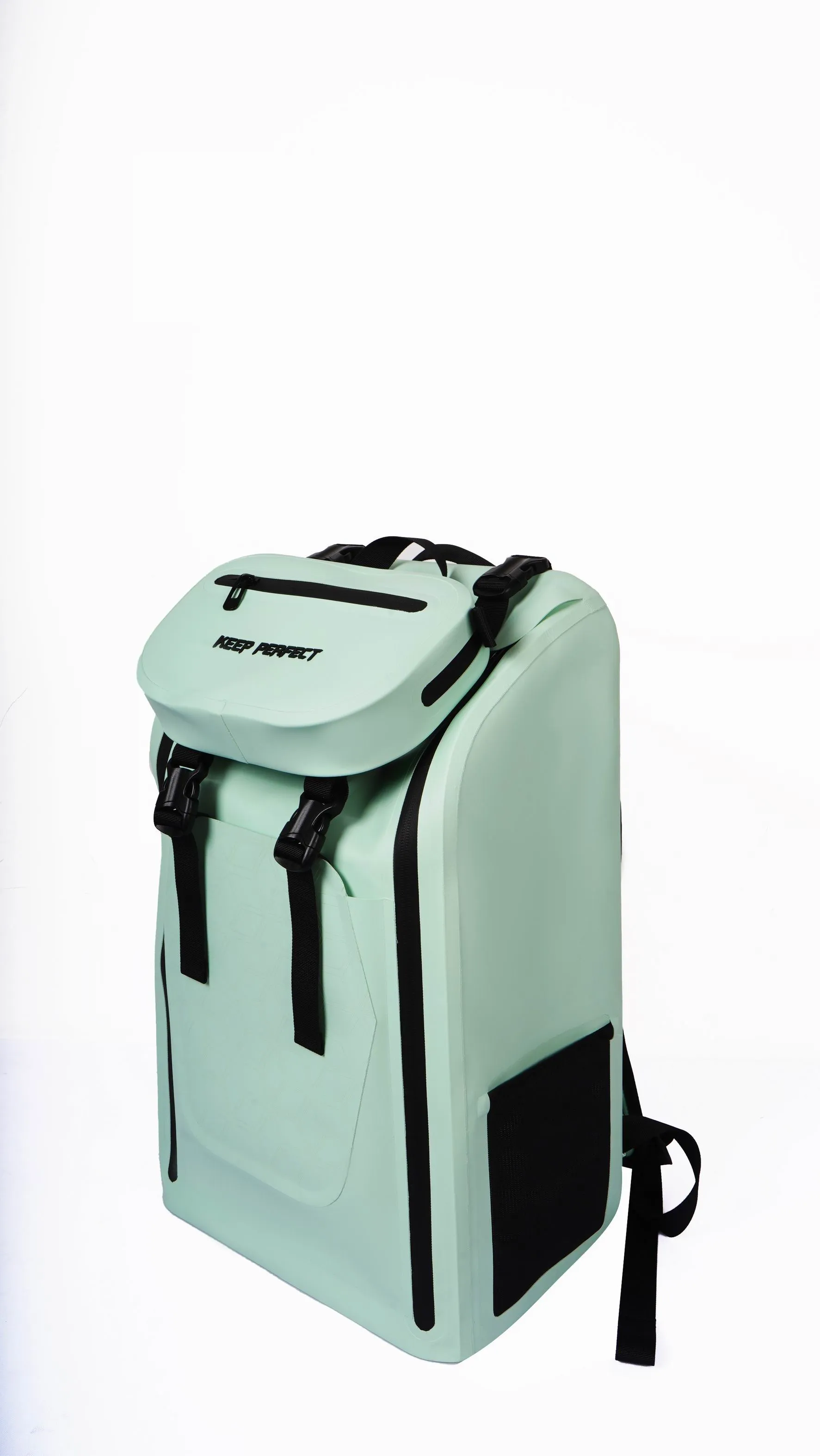
Harness Design for Hiking Daypacks: Ventilation vs Load Transfer
The harness is where a hiking daypack is won or lost, and the central decision is a genuine trade-off rather than a problem with a clever answer. A tensioned mesh back panel holds the load away from the wearer's back and lets air move across it, which is what a user notices in the first ten minutes and what a reviewer photographs. The same suspension, however, places the load further from the spine, increases the moment acting on the shoulder anchors, and introduces a compliant element between the pack and the body that must be controlled or it will bounce. A padded contact panel carries load efficiently and stably and is noticeably warmer. Every serious waterproof hiking backpack manufacturer programme resolves this at a stated volume and load rather than in the abstract, because the trade shifts with weight: below about five kilograms ventilation wins almost unconditionally, and above about twelve kilograms load transfer wins almost unconditionally.
Where the Crossover Sits
For an 18–32 litre daypack carrying six to ten kilograms, the workable answer is a hybrid. A moderate air gap of 15–25 mm between the panel and the wearer, a spacer mesh of 250–320 g/m² tensioned over a perimeter frame, and a load path that bypasses the mesh: the shoulder strap anchors, load lifters and hip-belt attachments all tie into the frame or into a HDPE frame sheet of 0.8–1.2 mm rather than into the mesh fabric. That arrangement gives real convection while keeping the pack from swaying, and it is the construction we default to unless a buyer tells us the load target or the climate argues otherwise. Gap depth is the parameter to control: much below twelve millimetres and the mesh presses against the back under load and stops breathing; much above thirty and the pack starts to feel like it is hanging off the shoulders.
Strap Geometry, Foam and Stabilisation
Shoulder straps do more of the work than any other component and are the most frequently underspecified. The strap should be a tapered sandwich rather than a constant-width strip: wide and thicker where it crosses the trapezius, narrowing towards the sternum so it does not chafe the neck, with the closed-cell foam in the 25–30 kg/m³ range so it resists compression set across a long day rather than bottoming out by lunchtime. Contact faces should be a brushed or spacer knit rather than a smooth laminate, because a smooth face sticks to a wet shirt and generates the hot spots that show up in returns. Load lifters set at roughly a forty-five degree angle to the shoulder, a sliding sternum strap with a whistle buckle, and a hip belt with enough structure to actually transfer load rather than merely decorate — these three elements are what separate a comfortable daypack from a bag with backpack straps.
Stabilisation also depends on how the pack is loaded, and this is where the water-management discussion comes back into the harness. A wet compartment at the very bottom of a tall pack puts mass low and far from the spine, which feels stable standing still and unpleasant on a climb, because every step torques the pack away from the body. Placing the wet zone closer to the back panel and higher — or splitting it into two side tunnels — keeps the loaded centre of gravity within about forty to sixty millimetres of the wearer's back, and that single decision improves perceived comfort more than any foam upgrade. When we review a daypack tech pack, the first calculation we run is loaded centre of gravity against the shoulder strap anchor position, and we ask for target load in kilograms on the brief.
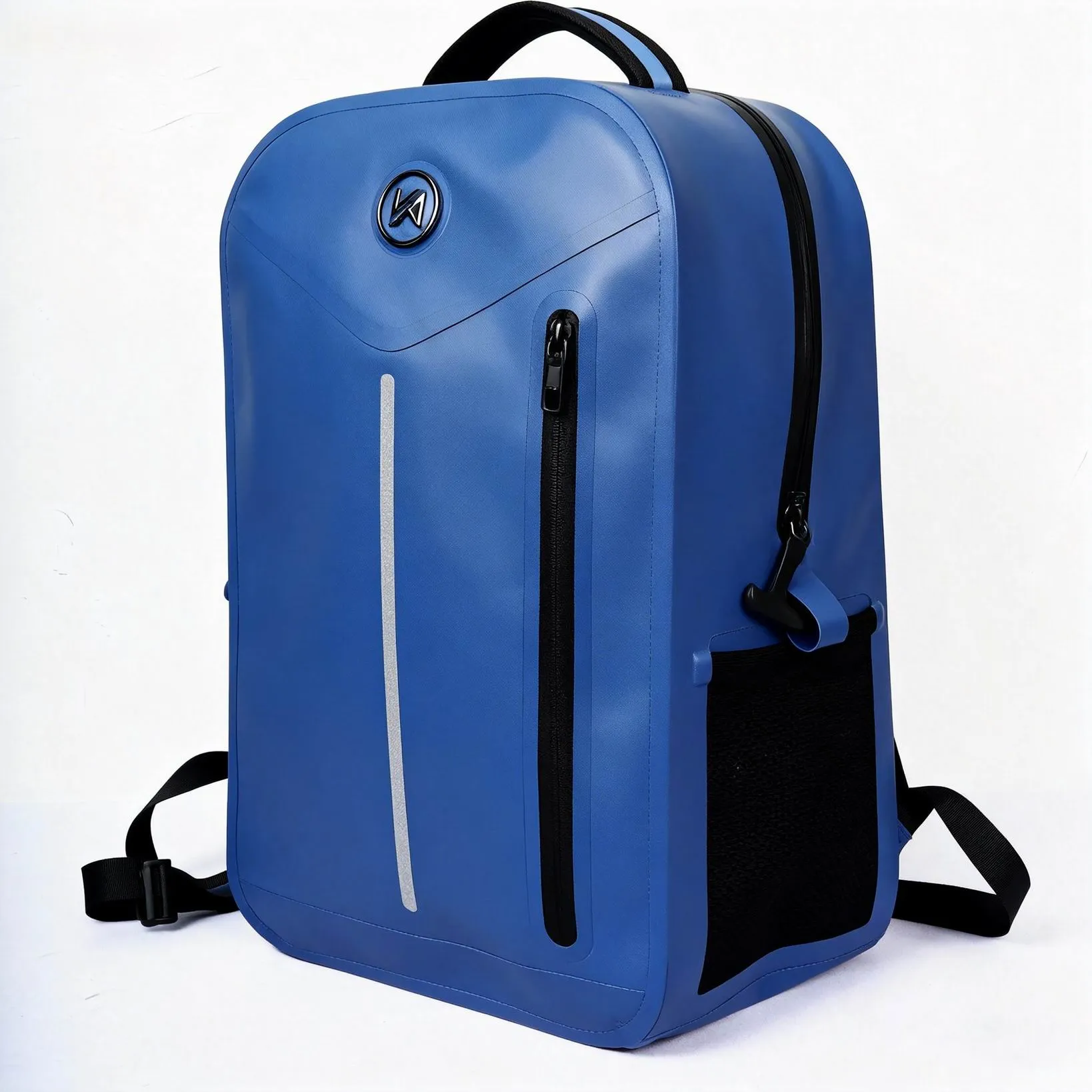
Hydration Compatibility: Bladder Sleeves, Hose Ports, Insulation
Hydration compatibility is the feature buyers request most confidently and specify least precisely. "Fits a two-litre bladder" is not a specification, because bladders vary in height, width, weld profile and outlet position across manufacturers, and a sleeve that swallows one brand's reservoir will jam another's on the way in and crease a third's outlet tube at the base. The correct brief states the reservoir envelope in millimetres, states whether the pack is expected to hold the bladder empty or full during normal use, and states how the hose is routed. Those three lines determine the sleeve geometry, the port hardware and whether the design needs a structural element to stop a full two-litre reservoir from deforming the pack's back panel.
Sleeve, Hanger and Outlet Geometry
Three interface styles cover the range. A sleeve is a flat welded or sewn pocket against the back panel with a hook-and-loop hanger tab at the top, and it is the cheapest and lightest option; its weakness is that a full bladder in a flat sleeve presses directly against the wearer's back when the pack is lightly loaded. A suspended hanger puts the bladder on a hook-and-loop or buckle hanger inside a dedicated compartment, which isolates it from the back panel and makes removal for filling far easier, at the cost of one more component and a slightly taller compartment. A zippered dedicated compartment is the premium answer: the bladder sits in its own welded or taped enclosure with its own drainage path, so a leaking reservoir wets a compartment designed to be wet rather than the pack's main volume. For any pack expected on a start line or in a duty context we recommend the welded compartment, because it is the only one of the three that contains a failure.
| Interface element | Recommended specification | Failure it prevents |
|---|---|---|
| Bladder compartment | Internal envelope stated in mm; welded TPU liner 0.15 mm with a drainage path to a base grommet | A split reservoir soaking the main compartment and the wearer's spare layers |
| Hanger system | 25 mm hook-and-loop tab rated above the filled reservoir mass, or a ladderlock buckle hanger | Bladder sliding to the compartment floor and creasing its outlet weld |
| Hose port | Elastomer or TPU port with a 10–14 mm pass-through, positioned at the top third of the shoulder strap side | Hose kinking at the exit and restricting flow under bite pressure |
| Hose routing | Webbing dock on both straps, minimum bend radius 25 mm, no sharp internal edges | User chewing a hose that has been pinched by a strap seam |
| Bite valve dock | Magnetic or elastomer clip on the sternum strap, replaceable | Valve dragging on the ground or snagging on kit |
| Insulation option | Removable 6–8 mm closed-cell sleeve or EPE 30 kg/m³ panel on the hose run only | Warm-water taste complaints in summer events and duty use |
| Fill indicator | Printed or welded volume marks on the compartment wall | Overfilling to the point where the compartment zip is loaded in service |
Insulation and the Hose Run
Insulation is frequently requested on the reservoir and is usually better applied to the hose. A bladder inside a pack sits close to the wearer's back, which is already warm, and wrapping it in foam mainly adds bulk and slows the fill-and-dry cycle. The water that actually arrives warm is the water standing in the tube, which has a small volume, a large surface-to-volume ratio and direct sun exposure on the exposed run. A removable 6–8 mm closed-cell sleeve over the exposed hose, or an EPE panel at 30 kg/m³ routed along the strap, addresses the complaint at a fraction of the bulk. Where the brief genuinely calls for a chilled reservoir — endurance events in hot climates, or duty use — the right construction is a removable insulated sleeve in the compartment rather than a bonded one, so the owner can dry the compartment after use instead of leaving foam permanently damp.
One compatibility point needs to be settled early because it affects tooling: whether the pack ships with a reservoir. Our normal position as an OEM sports duffel factory is to build the pack to a stated envelope and let the buyer source reservoirs from their own supplier, because bladders are a separate compliance and food-contact article with their own documentation, shelf life and warranty profile. We will build to any stated envelope, we will fit-test against a buyer-supplied sample reservoir before the first shipping sample, and we will document the fit dimension on the approved sample so a later change of bladder supplier can be checked against it without a new sampling round.
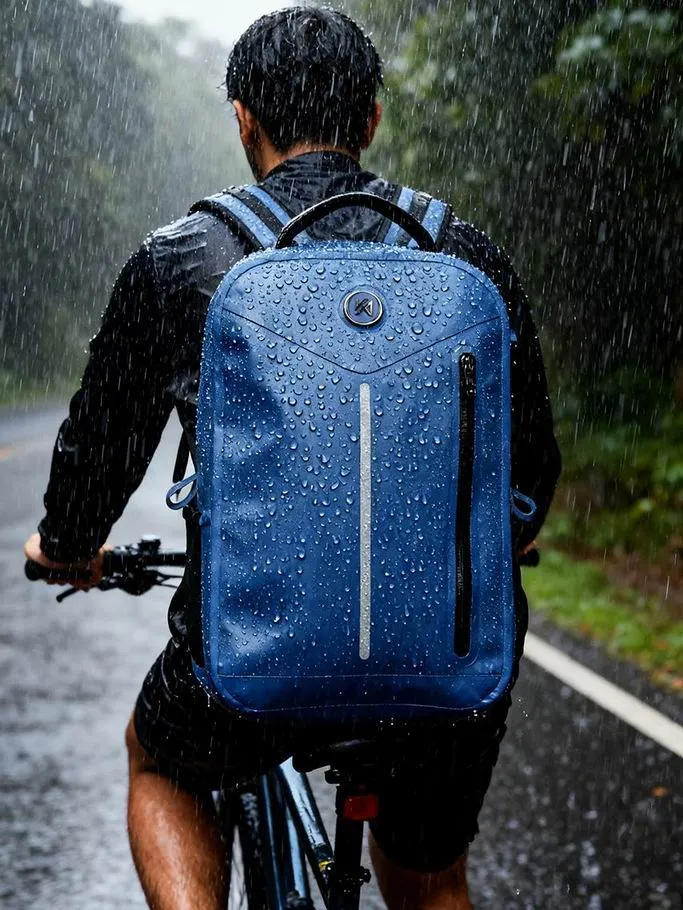
Team and Club Programmes: Numbering, Name Panels, Kit Bag Logistics
A team programme is a logistics product wearing a bag. The bag itself is usually the simplest part of the job; the complexity sits in the fact that one purchase order has to become thirty or three hundred individually identified units, each correct, each delivered to a place where a specific person can collect it, and each consistent enough that a coach does not notice which one came off the line first. Buyers who have run apparel programmes usually assume kit bags behave like jerseys and they do not: jerseys are decorated flat on a single panel with a well-understood numbering workflow, whereas a bag is a three-dimensional assembly whose decoration zone may cross a weld, a handle anchor or a curve, and whose numbering has to survive being dragged across a car park.
Numbering and Name Panels That Survive a Season
Two decoration routes are used for identity on team bags and the choice should be made on durability rather than on unit cost. A sewn or heat-applied twill number is the traditional answer and it reads well at distance, but its edges lift in a bag context far faster than on a flat garment, because the flexing and abrasion that a bag sees are concentrated exactly where the number sits. The more durable route for a kit bag is a sublimated or heat-transferred panel set into a recessed name window — a flat welded or bonded zone on the end panel or lid, bordered so it cannot peel from an edge — with the number and name printed into that zone. The recess does two jobs: it removes the leading edge that catches, and it gives the printer a genuinely flat plane to work on.
Buyers should also decide whether identity is permanent or seasonal. Permanent numbering is cheaper per unit and appropriate when bags are issued to a player for a career or a school year. Seasonal programmes — academy squads, event teams, annual club kit refreshes — are better served by a removable system: a hook-and-loop or zip-on name panel that can be swapped without replacing the bag, or a clear TPU window with a printed card inserted beneath it. The window approach costs very little, keeps the bag in service across roster changes and removes the largest single source of rework in a club programme, which is the bag decorated for a player who has since moved up a squad.
Packing, Kitting and Delivery Sequence
The operational half of a team programme is where schedules slip, and it is worth planning explicitly. A typical order is picked per player rather than per style: each bag receives its identity, then is packed with any accompanying items, then is bagged, then is boxed in a sequence that matches the roster so a club can hand boxes out in alphabetical or squad order. We support three packing conventions — per-player polybag with an identity label, per-squad carton with a contents sheet, and per-position carton for clubs that kit out by role — and we ask which one is needed at the point of order confirmation rather than at packing, because changing the convention mid-run is the single most expensive thing that can happen to a team order. Carton markings, barcode labels and retailer-ready packing can be handled to the buyer's specification; the full list of what we can do at the packing stage is set out under services.
Lead time on a team programme is governed by the decoration, not the sewing. A 500-piece kit bag run in one colourway with sublimated name panels takes roughly the same production time as an undecorated run; the same run with individual numbers across three squads and two colourways adds the workflow. Our practical advice is to freeze the roster early, order against a slightly generous size curve where the programme spans age groups, and accept one consolidation point rather than shipping direct to thirty addresses, because split shipments on a club order are where both cost and error rate climb fastest.
Gym-Bag Hardware: Zips, Buckles, Base Panels and Standing Ability
Hardware is where a gym bag earns or loses its reputation, and it is also the category in which the cheapest option is rarely the cheapest outcome. A duffel that will be opened and closed twice a day for two years needs a zip whose slider survives roughly fifteen hundred cycles with a loaded bag pulling on the tape, buckles that can be released with cold or wet hands, and a base that lets the bag stand upright on a changing-room floor without folding around its contents. Each of those three has a specification, and each has a failure mode that shows up in reviews within the first season.
Zips: Coil, Reverse Coil and Water-Resistant
For a gym duffel the default should be a reverse-coil zip with the tape oriented so the coil faces inward, because that orientation hides the coil from abrasion and keeps grit out of the track. Sizing matters: a #5 coil suits a duffel up to about forty litres, and anything larger or any opening that will be loaded past its comfortable capacity should move to #8. Where the opening crosses a wet compartment, a PU-coated water-resistant zip with a garage at the head end is the right choice, and above that sit YKK AquaGuard #5 and #8 and, for genuinely submersible builds, a TIZIP MasterSeal 10. The specification line most often omitted is the puller: a metal puller on a gym bag rattles, scratches and eventually breaks, and a moulded TPU or cord puller with a garage costs less and lasts longer.
Buckles and Standing Ability
Side-release buckles should be sourced from Duraflex, ITW or YKK and specified by the load they will see rather than by webbing width alone; a 25 mm acetal buckle is fine for a lid compression strap and marginal for a shoulder strap anchor that carries a loaded bag. Every metal component near a wet zone — D-rings, strap adjusters, grommets, feet — should be specified to pass a 48-hour neutral salt spray exposure, because corrosion staining on a light-coloured bag is indistinguishable from a hygiene failure in a customer photograph.
Standing ability is the most undervalued feature in the whole sports range and it is largely a pattern problem. A bag stands when its base panel is stiff enough to resist the contents pressing outwards, when the base is flat rather than rounded, and when the centre of gravity sits inside the footprint. The construction is a laminated base board — HDPE or PP sheet, 0.8–1.5 mm depending on volume — bonded into a double-layer fabric base, paired with four to six moulded feet rather than a continuous rail so that water can escape underneath. Adding a base board adds cost and a small amount of weight, and it is the upgrade most likely to be noticed in the first week of ownership. Buyers comparing categories should note that the same base construction logic applies across travel bags, where a standing duffel is equally valued.
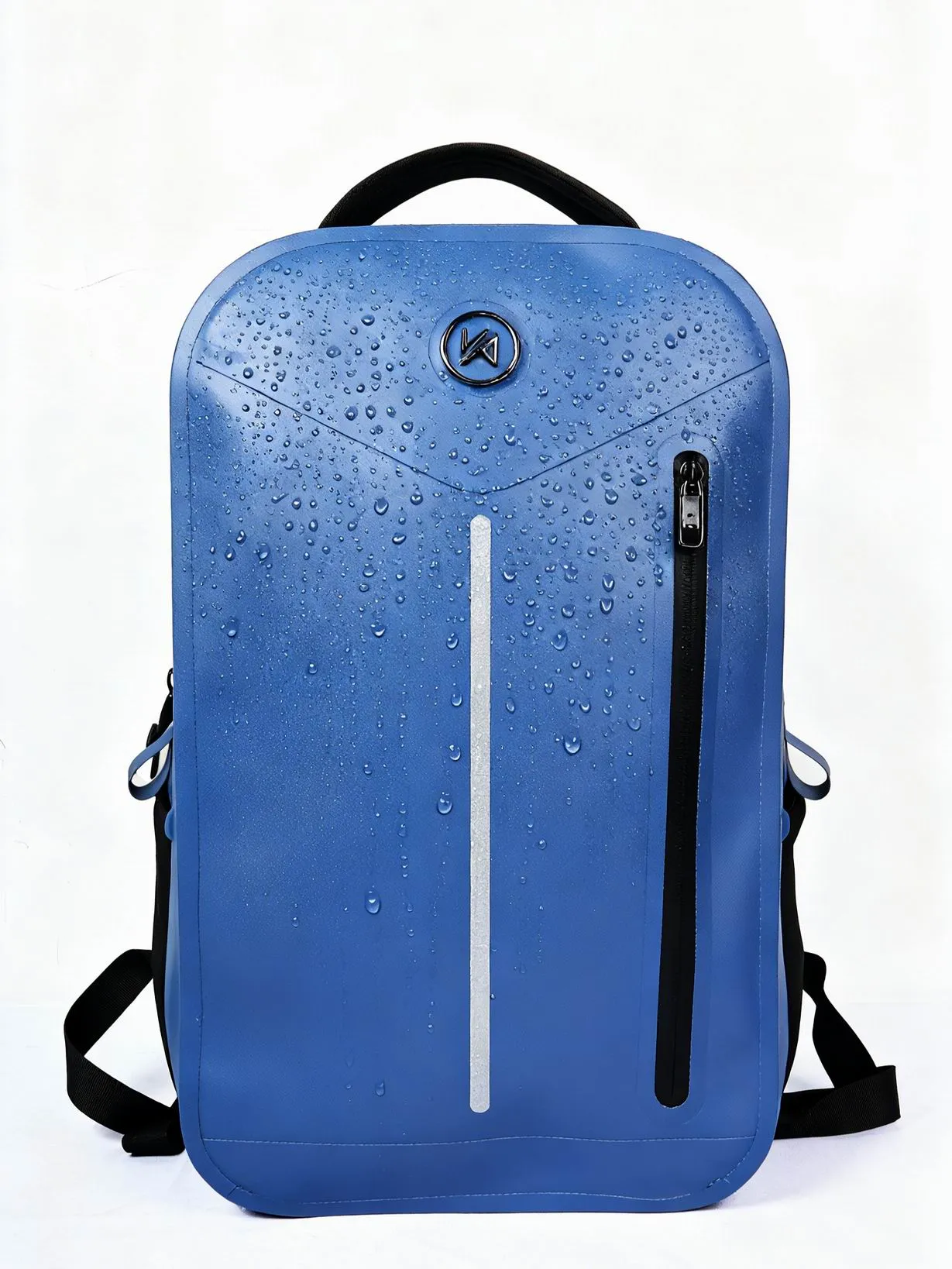
Branding for Sports: Sublimation, Heat Transfer, Silicone, Embroidery
Sports branding has to survive three things that packaging graphics never see: repeated flexing at the point where the bag is grabbed, abrasion against a bench or a boot, and contact with sweat and, in swim builds, chlorine. The four processes available each sit at a different point on the durability-versus-cost curve, and the right answer is often two processes on one bag rather than one. The most common mistake we see is a brand selecting embroidery for a logo that will sit across a weld or a high-flex zone, and then discovering that the stitch holes have become the leak path in an otherwise waterproof panel.
| Process | Compatible substrates | Durability in sports use | Typical MOQ effect | Where it belongs |
|---|---|---|---|---|
| Dye sublimation | Coated or laminated polyester face fabric; not nylon, not PVC | Excellent: colour is in the fibre, no layer to peel or crack | Low: no screen or plate, ideal for multi-colourway runs | Full-panel graphics on coated 600D duffels and yoga bags |
| Heat transfer | Polyester and most coated faces, with a compatible adhesive | Good: edges can lift on high-flex zones after heavy use | Low: low setup, easy to change between colourways | Name panels, numbering zones, seasonal artwork |
| Silicone badge | Almost any face fabric, bonded or stitched | Excellent: flexible, washable, resists chlorine and salt | Medium: mould tooling per artwork | Lid and end-panel logos, swim and surf programmes |
| Embroidery | Woven faces with adequate backing; avoid on welded panels | Good on flat low-flex panels; perforates waterproof layers | Low–medium: digitising per artwork | Twill team identity on end panels away from wet zones |
| Woven label | Any, sewn in at a seam | Excellent, but small format only | Low | Interior brand mark, care and compliance labels |
| RF-welded patch | TPU or PVC faces only | Excellent: becomes part of the shell | Medium: electrode per shape | Logos on welded liners and wet compartments |
Choosing by Zone, Not by Look
The practical method is to zone the bag before choosing the process. High-flex zones — the grab handle roots, the lid hinge line, the strap anchors — should carry either a welded patch on a compatible face or nothing at all, because any applied layer will eventually lift there. Flat, low-flex zones such as an end panel or the lid centre can carry embroidered or silicone identity. Large visual areas, which in sports are usually the side panels of a duffel, are the natural home for sublimation, and this is the reason coated 600D polyester remains the dominant shell in the gym category despite its limited weldability: it prints like paper and it prints permanently.
Colour control is the operational risk in any multi-process programme. Sublimation, heat transfer and silicone all reproduce colour differently, and a brand's mark rendered in three processes across one range will not match unless the artwork is profiled for each. We ask for Pantone references at the sampling stage, we produce a physical logo board showing every process the range will use, and once that board is approved it becomes the reference for bulk alongside the approved sample. Artwork changes after that point are the most common cause of a slipped ship date in sports programmes, because a change to a sublimation file is cheap while a change to a silicone mould is not. Our reference build carries the KEEP PERFECT house mark so that buyers can see how a given process behaves on the actual shell before committing.
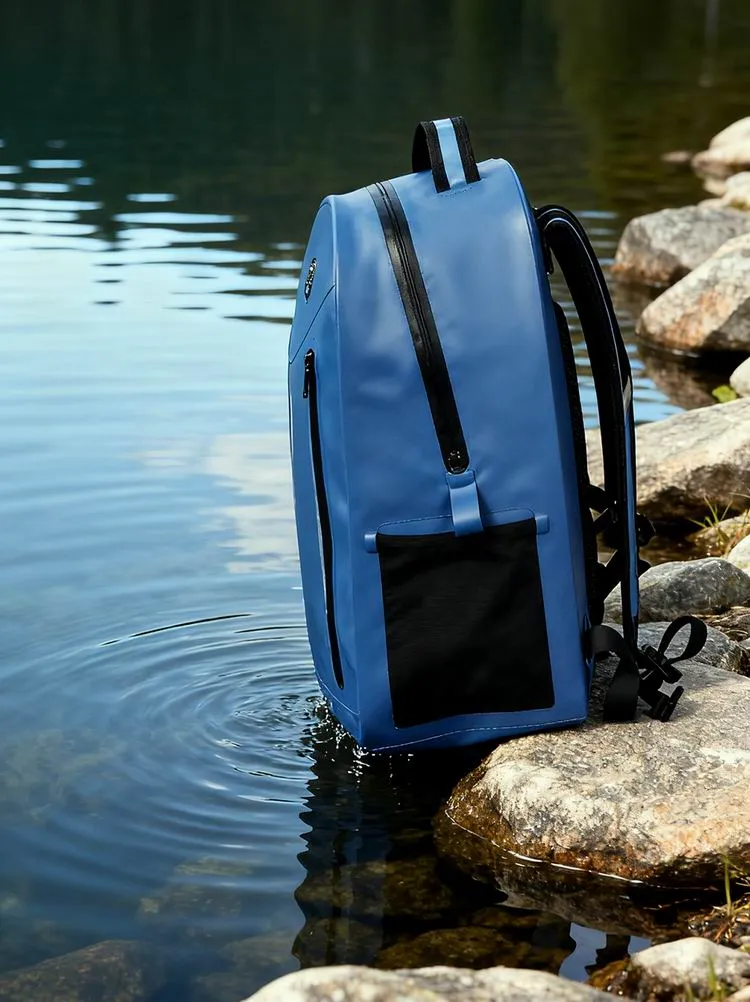
MOQ 500 pcs per Style for Club and Retail Volumes
Our minimum order quantity is 500 pcs per style per colourway, and the figure is set by what it takes to run a clean, repeatable production batch rather than by an arbitrary commercial rule. Below roughly five hundred units, the fixed costs of a run — cutting die setup or marker preparation, thread and tape changeover, machine calibration, the first-piece inspection sequence and the line's learning curve — are spread across too few units for the unit price to be meaningful, and more importantly the run ends before the line has settled, which is exactly where dimensional and seam-consistency problems appear. At five hundred and above, a style holds its tolerances through the batch and the inspection sample is statistically useful.
How the Minimum Applies Across a Range
The per-style-per-colourway wording matters and buyers should plan against it explicitly. A gym duffel in black and the same duffel in mint green are two colourways and each is a 500-piece minimum, because a colourway change means a fabric lot, a thread lot and a print setup. What is usually flexible is how a buyer reaches the total: a first order can be built as two styles at 500 each, or one style at 1,000 across two colourways, or a hero style at 700 plus an accessory at 500 if the accessory shares the fabric and trim platform. Because all seven formats in the sports range share hardware, webbing and branding processes, the practical route to a viable first order is almost always to concentrate on one or two pattern blocks and reach volume through colourways and sizes rather than through format count. Our catalogue of current builds sits under products.
Planning the Curve and the Reorder
Two planning decisions determine whether a first season works. The first is the size curve: for programmes spanning age groups, order against a slightly generous distribution in the mid sizes rather than a flat split, because stock-outs in the middle of a curve are more damaging than leftover units at the ends and because a mid-size reorder is easier to fill from a running fabric lot. The second is the reorder position: fabric and trim lots are reserved against the original order, and confirming a reorder while the same lots are still allocated gives a measurably better colour match than coming back after the lot has closed. Colour matching across lots is achievable within a stated tolerance, but it is a tolerance and not a guarantee, and it is the most common source of disappointment on a second-season reorder.
Commercial terms are fixed and published so that quoting is fast: T/T with a 30% deposit and the 70% balance before shipment, quoted FOB Xiamen from our Quanzhou, Fujian facility, with CIF or DDP available for comparison where a buyer prefers landed costing. The plant is SGS-verified at 4,950 m² with 137 staff across 7 production lines and 149 machines, giving a monthly capacity of 200,000 pcs; that capacity is what allows a 500-piece style to be scheduled without waiting for a larger run to fill a line. QUANZHOU JUNYUAN BAGS has been manufacturing since 2014, and the team behind it has been making bags for two decades.
Sampling a Sports Bag in 6–10 Working Days
Sampling runs 6–10 working days for standard sports constructions and 12–15 working days where the build includes a complex structure such as a moulded harness, a rigid base tub or a welded sub-assembly with its own electrode. Those are working days on our side from the point at which the brief is complete, and the most common cause of a missed expectation is not the sampling itself but a brief that arrives missing the three items that gate it: a stated target load, a stated decoration zone and process, and a stated acceptance test. Add those three and the first sample is usually close enough to approve or to adjust in one round.
What Happens Inside the Window
The sequence is fixed. Days one and two are pattern and marker work plus material allocation, and this is where a missing dimension costs the most time, because a revised pattern resets the marker. Days three to five cover cutting, the welded sub-assembly if there is one, and sewing; a wet compartment with its own liner and drainage is the single feature most likely to add a day here. Days six and seven are assembly, hardware setting, decoration application and the internal first-piece inspection, including a seam peel check where welded seams are involved and a dry-out check where ventilation has been specified. Days eight to ten are finishing, photography for the buyer's record, packing and dispatch. Samples ship by courier, and buyers should budget courier transit separately because it is not part of the working-day count.
Getting the First Sample Right
Three habits shorten the loop more than anything else. The first is to send a reference bag, even a competitor's, with a marked-up note of what to keep and what to change; a physical reference communicates volume, hand and proportion that no dimension sheet conveys. The second is to specify the decoration zone in the same drawing as the construction, because a logo positioned after sampling frequently turns out to sit across a weld or a handle anchor and forces a second round. The third is to state the acceptance tests with the brief rather than after the sample arrives, so that the sample can be built to the test rather than tested after the fact.
Sample cost is quoted per build and is normally credited against the bulk order once it is placed. Where a programme is likely to run several rounds — a new harness geometry, or a wet compartment with an unusual drainage requirement — we say so at the outset and quote the rounds, because pretending a complex build will land in one round helps nobody. Once a sample is approved, bulk production runs 35–50 days after sample approval, inspected to AQL 2.5 under ISO 2859-1, and covered by a 12-month warranty against manufacturing defects. Full process documentation is available under manufacturing.
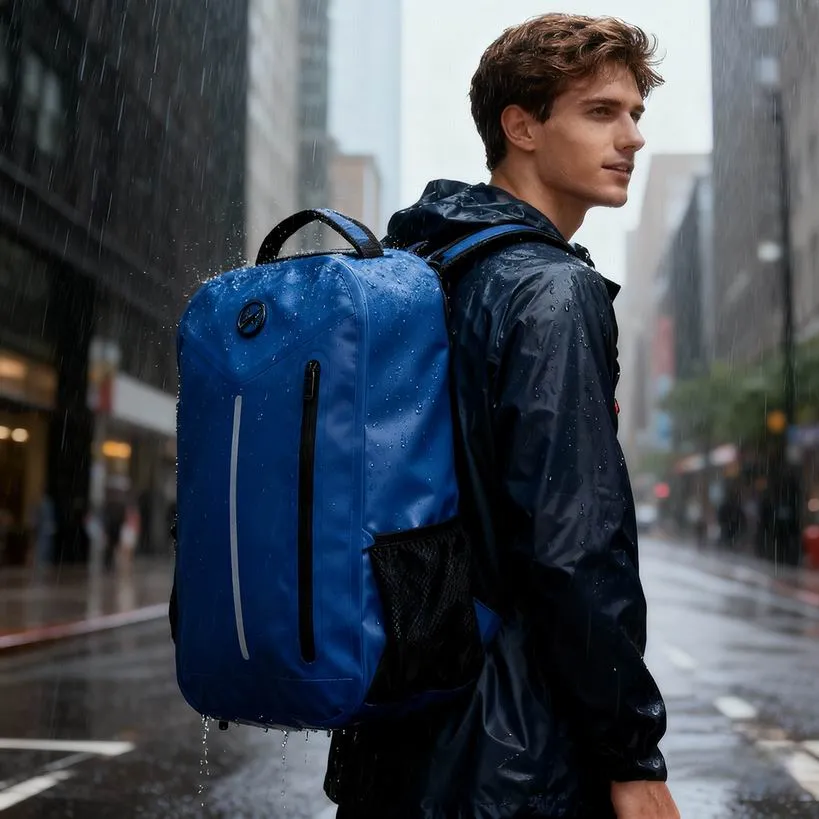
Abrasion, Tear and Colourfastness Tests for Sports Bags
Sports bags are tested against a different abuse profile than travel or paddling bags. A travel bag is dragged on its wheels; a paddling bag is immersed. A sports bag is rubbed against a bench, dropped on a hard floor while loaded, crushed into a locker, and repeatedly wetted with a chemically active liquid and then dried in warm air. The three tests that predict field behaviour are abrasion resistance, tear strength and colourfastness — the last of which covers both light and perspiration, because the two failure modes customers complain about most are a worn-through base corner and a discoloured lining.
| Property | Test method | Our standard acceptance | Where it is applied |
|---|---|---|---|
| Abrasion resistance | Martindale (ISO 12947-2) or Wyzenbeek (ASTM D4157) | No yarn break at 20,000 Martindale cycles on body panels; 30,000 on base and abrasion zones | Duffel floors, kit bag bases, side panels that meet a bench |
| Tear strength | ISO 13937-2 single tear, or ASTM D2261 tongue tear | ≥ 40 N warp and weft on body fabric; ≥ 80 N on 840D and 1000D bases | Every shell fabric, checked by fabric lot |
| Seam strength | ISO 13935-2 or ASTM D751 grab test on the seam assembly | Seam efficiency ≥ 80% of fabric strength; bonded-and-stitched hybrid preferred | Strap anchors, handle roots, wet compartment transitions |
| Weld peel strength | Internal peel test on production samples, not laboratory coupons | ≥ 8 N/cm on every welded or bonded seam | Wet compartment liners, welded hose ports, RF-welded patches |
| Colourfastness to light | ISO 105-B02 xenon-arc | Grade 4 or better at the agreed exposure step | Printed panels, light colourways, retail-facing surfaces |
| Colourfastness to perspiration | ISO 105-E04, acidic and alkaline solutions | Grade 4 or better against a white cotton rubbing cloth | All linings and all strap contact faces |
| Colourfastness to chlorinated water | ISO 105-E03 | Grade 4 or better; solution-dyed face recommended | Swim bag shells, mat tunnels, resort programmes |
| Hydrostatic head | ISO 811 or AATCC 127 | ≥ 10,000 mm lightweight, ≥ 20,000 mm heavy duty, by panel | Shell fabrics by lot; wet compartment liners every run |
| Salt spray on hardware | Neutral salt spray, ASTM B117 | No red rust after 48 hours | All metal trim near a wet zone |
| Dry-out performance | Gravimetric: weigh, wet-load, hang, reweigh at 4, 8 and 24 hours | Residual ≤ 5% of added water at 24 h; drainage residual ≤ 30 ml on lift | Wet compartments, swim and dive builds |
Reading Results as a Floor, Not a Prediction
Laboratory figures should be read conservatively, because real failure is multiplicative. A fabric that passes 20,000 Martindale cycles will pass fewer once it has been abraded to a fuzzy face by grit and then exposed to ultraviolet radiation, since degradation proceeds fastest at the newly exposed filament surface. A seam that holds 8 N/cm on a new sample will hold less at cycle fifty if salt has been compacted into the stitch holes by repeated flexing. This is why we test production samples rather than coupons wherever a test can be run on a real assembly, and why we recommend that buyers commission abrasion testing after ultraviolet conditioning for any range destined for a high-insolation market.
Inspection closes the loop. Bulk is inspected to AQL 2.5 under ISO 2859-1, with the defect classification agreed before the run rather than at the inspection, because "major" means different things in a duty pack and a promotional yoga bag. Welded seams receive a visual and pull check in addition to the sampling plan, wet compartments receive a fill test on a stated sample size, and printed panels are checked against the approved logo board under standard lighting. Certificates of analysis for fabric lots and test reports for the current production sample are issued with each shipment; the full schedule is described under quality, and questions about a specific requirement can go straight to contact.
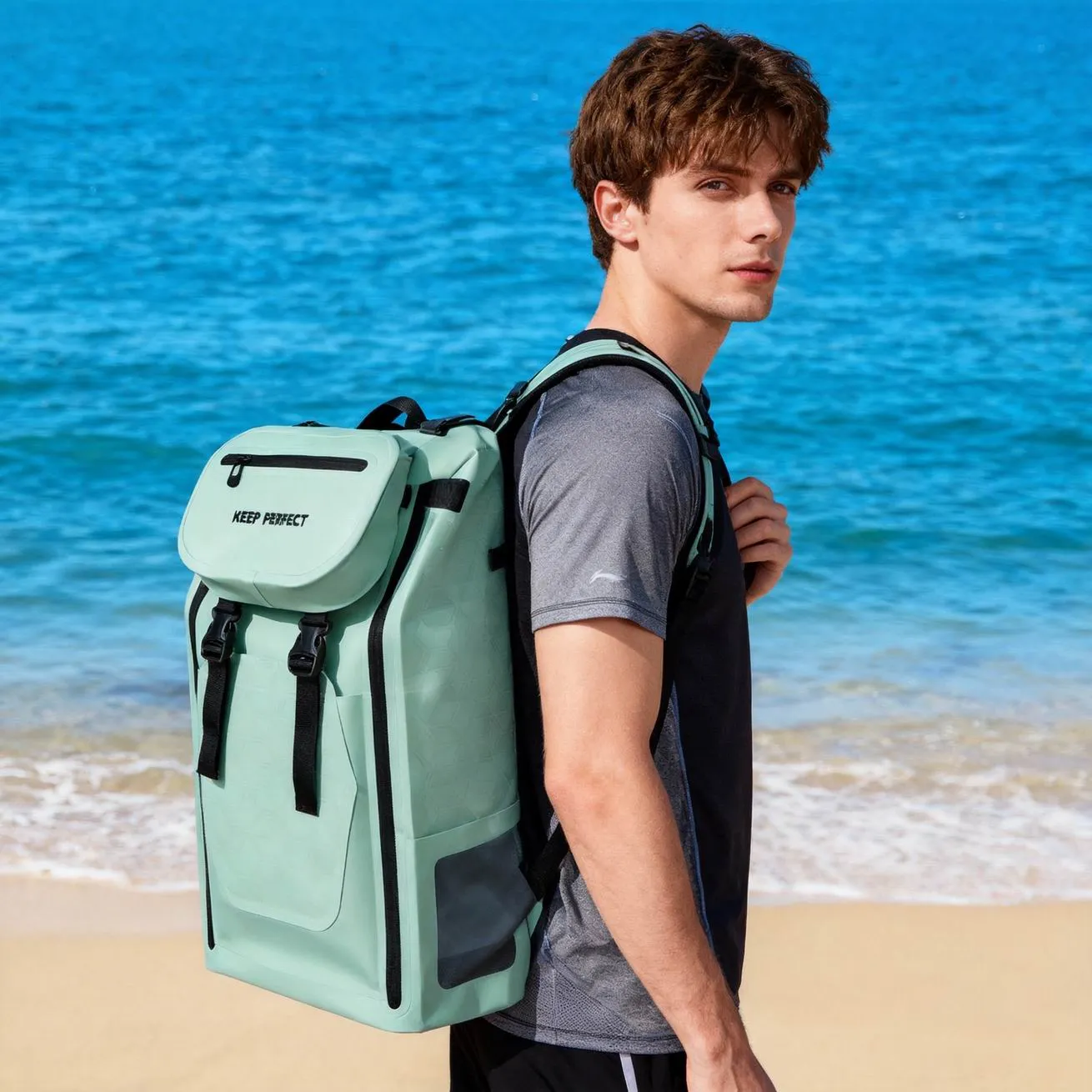
If you are planning a gym duffel, a wet-and-dry separation bag, a hiking daypack, a hydration-compatible pack, a team kit bag or a yoga and mat bag, send us the formats you want, your target volumes and the retail channel each one is aimed at. We will come back with a material proposal by panel, a hardware schedule, a decoration recommendation by zone and a costed sampling plan — usually within one working day of a complete brief. Our team has been making bags for two decades and QUANZHOU JUNYUAN BAGS has been manufacturing since 2014, so most briefs we see have a precedent we can quote from and a failure mode we can design out before the first sample is cut. Email your tech pack, reference bag or sketch to service@junyuanbags.com and we will start the review.
For a faster conversation, including questions about MOQ structure, sampling rounds or a decoration workflow for a club programme, message us directly on WhatsApp at +86 177 5002 0688 (https://wa.me/8617750020688). Our production team responds during China working hours and can share current fabric lots, hardware options and reference photography of the sports range the same day. Whether you need one hero style at 500 pieces or a full seven-format range built on one colourway platform, we can quote it FOB Xiamen and have a physical sample on its way within 6–10 working days.
Frequently Asked Questions
What is the minimum order quantity for a custom sports bag?
The MOQ is 500 pieces per style per colourway. Below that level the fixed setup work — marker preparation, thread and tape changeover, machine calibration and first-piece inspection — is spread across too few units, and the line finishes before it has settled, which is where dimensional drift appears. Buyers building a first range usually reach the total through one or two pattern blocks in multiple colourways rather than through many formats, because all seven sports formats share hardware, webbing and branding processes.
How long does sampling take and what does it cost?
Standard sports builds sample in 6–10 working days from a complete brief, and structurally complex builds — moulded harnesses, rigid base tubs, or a welded sub-assembly needing its own electrode — take 12–15 working days. Courier transit is additional and is not part of the working-day count. Sample cost is quoted per build and is credited against the bulk order once it is placed. Programmes likely to need several rounds are quoted for the rounds up front rather than after the first dispatch.
Can you add a welded wet pocket to a duffel design we already have?
Yes, in most cases. We would review the existing pattern for three things: whether there is a vertical or end-mounted position available, since a flat horizontal wet panel under the main compartment pools and leaks; whether the wet compartment can have its own opening; and where the drainage grommet can sit. If the current design lacks all three, we would propose a revised end-panel block rather than retrofitting, because the geometry matters more than the liner.
Which fabric should I choose for a gym duffel versus a hiking daypack?
For a gym duffel, coated 600D polyester is usually right: it sublimates well, is soft in the hand, and is available recycled with GRS documentation. It cannot be RF-welded watertight, so wet zones use a bonded-and-stitched seam with 20 mm tape. For a hiking daypack, a 420D nylon ripstop or 600D TPU laminate body with an 840D or 1000D TPU laminate base gives better tear strength and a genuinely waterproof floor.
Do you supply hydration bladders or only the pack?
We build the pack to a stated reservoir envelope and supply the hose port, hanger, routing docks and bite-valve dock. Reservoirs are normally sourced by the buyer, because they are a separate food-contact article with their own compliance documentation, shelf life and warranty. We fit-test against a buyer-supplied sample reservoir before the first shipping sample and record the fit dimension on the approved sample.
Can bags be personalised with individual player numbers and names?
Yes. The durable route for a kit bag is a sublimated or heat-transferred panel set into a recessed name window on a flat end panel or lid, because a flat recess removes the peel edge that catches in bag use. Sewn twill numbers lift faster on a bag than on a garment. For seasonal rosters we recommend a removable hook-and-loop panel or a clear TPU window with a printed card beneath it.
Which zips do you recommend for a swim bag?
A PU-coated water-resistant reverse-coil zip with a garage at the head end is the baseline; YKK AquaGuard #5 or #8 is the upgrade, and a TIZIP MasterSeal 10 is used where genuine submersion is required. Orientation matters as much as the zip itself — a water-resistant zip installed so that liquid runs into the coil performs like a plain zip. Budget builds often do better with a roll-top closure, which welds cleanly and removes the trim cost.
Are your materials compliant for EU and California retail channels?
Yes. We specify non-phthalate plasticiser systems for PVC and document them, which removes the REACH Annex XVII and Proposition 65 objection that otherwise appears late in a season. Recycled polyester face fabrics with Global Recycled Standard documentation are available across the range and weld identically to virgin equivalents. Where a programme carries a specific retailer restricted-substance list, we work to that list rather than to a generic standard.
Can the wet compartment drain while the bag is hanging on a hook?
It can, if the drainage is designed for it. The grommet should sit at the lowest point of the compartment in the hanging orientation, not at the lowest point when the bag stands on the floor — for a bag that lives on a changing-room hook these are different corners. We ask which orientation is primary at the brief stage and position 8–10 mm moulded TPU grommets accordingly, usually two up to 40 litres and three above.
What is the production lead time after sample approval?
Bulk production runs 35–50 days after sample approval, depending on order size, decoration complexity and line scheduling. Team programmes with individual numbering need the roster frozen before production starts, because the decoration workflow rather than the sewing governs the schedule. Bulk is inspected to AQL 2.5 under ISO 2859-1 and covered by a 12-month warranty against manufacturing defects.
Do you offer recycled materials for sports bags?
Yes. Recycled polyester face fabric with GRS documentation is available in coated 600D, 420D ripstop and 600D TPU laminate constructions, and it welds and prints identically to virgin equivalents. It is the most straightforward sustainability line available in this category. Recycled nylon is available in some constructions but at a narrower range of weights, so we confirm availability before it goes into a brief.
Can antimicrobial odour control be added to the lining?
Yes. We apply silver-ion, zinc-based or silane quaternary ammonium finishes and provide the test report. We also tell buyers plainly that a finish is an adjunct, not a substitute for a design that traps water, and that antimicrobial claims carry registration obligations under the EU Biocidal Products Regulation and US EPA rules. Hangtag language should be reviewed against the destination market before printing.
Can I mix colourways or sizes within a single 500-piece minimum?
Colourways count separately, because each is a fabric lot, thread lot and print setup. Sizes within one style and one colourway are normally combinable to reach the minimum. The practical route to a viable first order is one or two pattern blocks with volume reached through colourways and sizes rather than through format count, which also improves colour consistency on a second-season reorder.
How do you test that a bag will not smell after use?
We run a gravimetric dry-out test: load the wet compartment with a textile saturated to a defined water content, weigh the bag, hang it in still air at stated temperature and humidity, then reweigh at 4, 8 and 24 hours. A build with a working convective path loses most of its water in the first eight hours. We also verify drainage residual on lift, and check colourfastness to perspiration at ISO 105-E04 grade 4 or better.
What are your shipping terms and can you handle landed delivery?
Quotations are FOB Xiamen from our Quanzhou, Fujian facility, with CIF or DDP available for comparison where a buyer prefers landed costing. Payment is T/T with a 30% deposit and the 70% balance before shipment. The plant is SGS-verified at 4,950 m² with 137 staff, 7 production lines and 149 machines, giving 200,000 pcs monthly capacity, which is what lets a 500-piece style be scheduled without waiting to fill a line.