Waterproof Bag Manufacturing
7 production lines, 4,950 sqm, 200,000 pieces per month (SGS-verified).
Inside a 4,950 m² Waterproof Bag Plant: Layout and Material Flow
A plant layout is a set of decisions about distance, and distance is the cheapest thing to get wrong. Our facility in Quanzhou, Fujian covers 4,950 m² on a single floor, verified on site by SGS, and inside it sit 137 people, seven production lines and 149 machines. When one factory can quote 35 days for a 60 L duffel and another with the same machine list needs 50, the difference is rarely the machines. It is that in the second one a cut bundle walks 40 metres to the welding hall, waits half a shift for a fixture, then walks back past the cutting tables to reach taping. Work that moves forwards is production; work that moves sideways is logistics.
Coated fabric enters at the north roll door, moves along the inspection and cutting wall, turns into the welding hall, crosses to the sewing cells, passes through taping, assembly, finishing and pressing, and arrives at packing twenty metres from the loading dock. There is no return path: a suspect part goes into a red bin at the station where it was found and is collected on a fixed two-hour circuit, because an operator carrying a panel back to a previous station is at once a safety problem, a scheduling problem and a traceability problem.
The Nine Zones and What Each Is Sized For
| Zone | Area | What physically happens there | What the sizing protects |
|---|---|---|---|
| Roll store and inspection | 480 m² | Rolls stood on end in racking, unrolled across a lit 2 m table, measured, scored, tagged | Two weeks of coated fabric staged against a mill delay |
| Cutting room | 430 m² | Spreading, marker plotting, straight knife and clicker press bays, bundling | A 12 m table plus room to lay a second marker |
| Welding hall | 950 m² | RF welders, hot-air seam machines, heavy HF presses, each with its fixture store | Fixtures at the machine, so a changeover is a lift not a search |
| Sewing cells | 900 m² | Two U-shaped cells with central bundle tables and thread stands | Operators pass work sideways without leaving the seat |
| Taping and assembly | 600 m² | Seam taping, webbing bar-tacks, hardware riveting, harness build-up | A reinforcement station off the critical sewing path |
| Finishing, pressing, cleaning | 380 m² | Final press, solvent-free wipe-down, thread trimming, label placement | A clean, better-lit area where defects are most visible |
| Packing | 330 m² | Folding to standard, polybagging, carton make-up, weighing and strapping | Pallet build space in front of the container door |
| Finished goods warehouse | 520 m² | Racked cartons by order, held pending inspection release | Two weeks of cartons, so shipping can wait for a document |
| QC lab, sample room, offices | 360 m² | Hydrostatic tester, peel rig, salt spray cabinet, sample benches | Testing off the floor, so results are not rushed by traffic |
Why Material Only Moves Forward
Each area above was sized backwards from a target: how many rolls must be staged for a month of 200,000 pieces, how many welding fixtures must stand side by side without operators reaching across one another, how many cartons must be sealed before a truck is booked. Coated fabric then behaves differently from ordinary textile, which is another reason the loop only runs one way. A 1000D polyester TPU laminate with a 0.30 mm film has memory: crease it under a stack and the crease survives welding. So heavy things move on wheels, light things move on tables, and every transfer point is a flat-bed trolley rather than a shoulder carry. Contamination is the third reason: welding does not tolerate dust or finger oil on the film, and a panel carried past a grinding station carries particulate into the weld land, where it becomes a pinhole nobody sees until the bag is dipped. Cutting and welding therefore sit upwind of everything that makes dust, and sewing sits downwind of the welders, so thread lint does not drift back onto film waiting to be welded. What the loop buys a buyer is a shorter and more predictable bulk lead time and a lower rate of handling damage on coated shells, the defect that most often becomes a claim six weeks later. This page covers that physical route: the commercial sequence sits on the services page, the test methods on the quality page, and the output of the loop in the product catalogue.
Seven Production Lines, 149 Machines: What Each Line Does
A "production line" means different things in different factories: in some it is a row of sewing machines rearranged every week, in others a name on a planning board with no physical counterpart. On our floor all seven are physical, all seven are fixed in place, and each owns a defined family of work. A line that runs a 5 L dry bag on Monday and a 60 L welded duffel on Wednesday has to change fixtures, reset parameters and re-teach operators twice a week, and that cost comes out of your lead time. The 149 machines are counted as production equipment: welders, sewing heads, taping machines, clicker presses, bar-tacks, eyelet and rivet machines, fusing and ultrasonic units, and the spreading and cutting equipment that feeds them.
Line-by-Line Allocation
| Line | Primary process | Machines | Crew | Daily output | Product families it owns |
|---|---|---|---|---|---|
| Line 1 — RF welding | Radio frequency welding of TPU laminates | 15 | 12 | 1,500 pcs | Roll-top dry bags, waterproof backpacks |
| Line 2 — Hot-air welding | Hot-air seam welding and taping | 18 | 13 | 1,400 pcs | Lightweight packs, liners, sports bags |
| Line 3 — HF welding | High-frequency welding of heavy PVC and tarpaulin | 16 | 12 | 900 pcs | Welded duffels, fishing bags, cooler bags |
| Line 4 — Sewing cell A | Cut-and-sew with bonded and taped seams | 31 | 22 | 1,600 pcs | Travel bags, structured backpacks |
| Line 5 — Sewing cell B | Cut-and-sew for insulated and technical bodies | 27 | 19 | 1,200 pcs | Cooler bags, rod and tackle carriers |
| Line 6 — Assembly and reinforcement | Harness build, webbing, bar-tacking, hardware setting | 26 | 17 | feeds Lines 1–5 | Straps, harnesses, reinforcement packs |
| Line 7 — Taping, finishing, engineering | Final taping, pressing, cleaning, plus a six-bench sample room | 16 | 13 | 1,100 pcs | All families, plus prototyping |
Why Three Welding Lines Instead of One Big One
The two sewing cells are the largest by machine count because sewing remains our most flexible operation. The three welding lines are deliberately smaller, because a welding machine is fixture-bound: it can only make what its tooling allows, and its throughput is set by dwell time rather than operator speed. Nor are the three methods interchangeable, so they should not share floor space. RF welding at 27.12 MHz is internal heating: the films heat, the electrode stays comparatively cool, and the machine draws 4–8 kW for a couple of seconds. Hot-air welding is convective, with a nozzle blowing 400–550 °C air onto a joint that nip rollers then press. Heavy HF welding of 0.35 mm PVC runs 10–15 kW through a platen and holds for six to twelve seconds. Each needs its own power supply, fixture store, ventilation and operator skill. Separating them also separates the failure modes, which is what makes diagnosis fast: a pinhole along a straight run is a hot-air temperature or speed problem, a soft over-thinned land is an RF pressure or dwell problem, and a leak at a heavy PVC corner is almost always a fixture parallelism problem.
Planning loads by family, not by convenience. An order of 2,000 roll-tops in 500D TPU goes to Line 1 and stays there until the last bundle is welded, because that line holds the fixtures, the cards and the operators who have run that shell for a year; a mixed order splits, with bodies going to a welding or sewing line by construction and straps to Line 6. The monthly 200,000 pieces is the sum of six output lines at roughly 7,700 pieces per working day across 26 days, and it is a real ceiling rather than a printed one.
Fabric Inspection and Roll Release Before Cutting
Nothing downstream can be better than the roll that started it, and on coated fabric that is arithmetic rather than a slogan. A 0.20 mm TPU film laminated to 840D polyester will weld beautifully on the machine and fail in a dip tank if the lamination bond varies by ten per cent along the roll, because the weld fuses the film and the film only holds if it is still attached to the cloth. Incoming inspection exists to find that variation before a cutter turns a hundred metres of it into four hundred panels that all look identical and do not all behave the same. Every roll gets an identity carrying the mill, the lot, the arrival date and the metreage, and it does not move to the cutting wall until it has been scored and tagged.
What We Physically Check on an Incoming Roll
Inspection is a bench job taking about twenty minutes per roll, mounted on a cradle above a two-metre table lit from above and below and unrolled at walking pace. The inspector looks for coating faults such as pinholes, fisheyes and thin patches in the film, lamination faults such as bubbles and delamination streaks, weaving faults such as slubs and missing picks, and handling faults such as creases and water marking. Alongside the visual pass we measure. Film thickness is checked at three points across the width and at both ends, because a mill can hold 0.20 mm down the middle of a roll and drift to 0.14 mm within 40 mm of the selvage, which is exactly the band a nested pattern will place on a seam. PVC coating is checked the same way against the 0.35 mm specification, and shade is assessed in a D65 light box and scored on the grey scale.
Scoring, and the Three Dispositions It Produces
We score under the four-point system — one point for a defect up to 75 mm, two up to 150 mm, three up to 230 mm, four for anything longer or for any hole — and total the points per 100 square metres. Under 20 the roll is released as first quality. Between 20 and 40 it is released as marked quality: defective zones are chalked and ticketed, the marker is nested around them, and the roll is used for parts where a small panel will fall clear of the mark. Above 40, or any roll with a through-hole in the film, is returned to the mill with the score sheet attached. We score rather than simply accept or reject because of yield: cutting around a marked zone costs a few per cent of material, while discovering a fisheye in a finished body costs the whole unit plus replacement freight.
Relaxation, Acclimatisation and the Release Tag
A roll wound under tension does not lie flat the moment you unwind it, and the outer layers of a coated laminate are under more tension than the inner ones, so the first two metres carry a curl that will pull a spread ply out of alignment. Every released roll hangs on the relaxation rack for a minimum of 24 hours at 20 ± 2 °C and 55–65 per cent relative humidity. The figure is measured rather than guessed: it is the time we recorded for the curl in an 840D TPU laminate to fall below the 1.5 mm per metre that our spreading tolerance allows. Relaxation doubles as acclimatisation, since a roll spread at 8 per cent moisture content and welded at 4 per cent produces a bag measurably different from the golden sample, and only then does the inspector hang a signed release tag. For a buyer this means the first two days of a bulk order are invisible: nothing is cut on day one or day two. It is also why our 35–50 day bulk band is a band — a programme with four colourways and six fabric lots spends more of its first week in inspection than a single-colour run does. How that roll identity follows the fabric to the finished carton is on the quality page.
Pattern Making, Nesting and Cutting: Maximising Yield on Coated Fabric
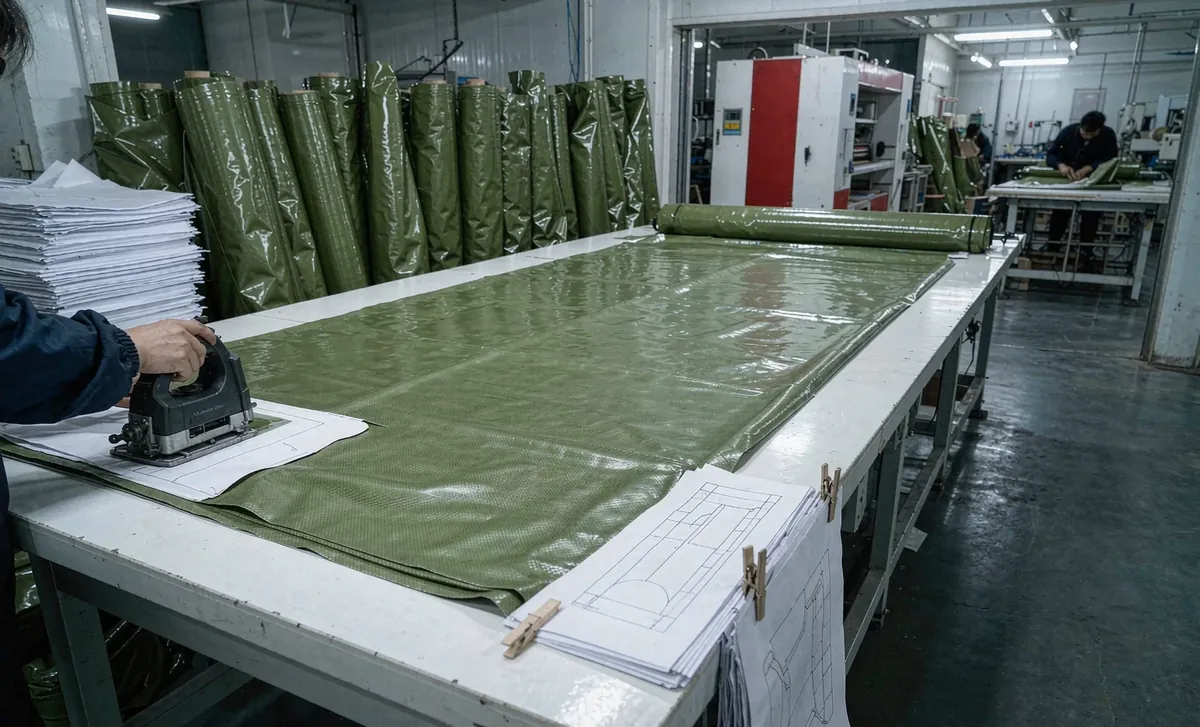
On a woven bag, cutting is a cost operation. On a welded bag it is a quality operation, because welded construction moves the seam allowance out of the sewing machine and into the pattern. A sewn 20 L dry bag closes its seams with 10 mm of allowance folded and stitched; the welded version needs a 10–12 mm weld land, flat, clean and free of print or topstitch, sitting exactly where the electrode will land. If the land is in the wrong place, no operator skill will save the part, and the pattern is where the land was placed. So a welded product is graded for the weld rather than for the volume: every cut panel leaves the cutting room with its land position marked, as a notch pair or a light chalk line, so the welding operator aligns to a mark rather than estimating from an edge.
Nesting Rules That Are Different for Coated Cloth
Three rules govern a coated marker, and all three spend yield to buy quality. The first is single-direction laying: every panel in a spread faces the same way, because coated fabric has a face and a film side, and the difference shows up in print adhesion, abrasion behaviour and how two panels meet at a weld. The second is land separation: no two panels may nest with their weld lands touching, because a knife does not cut perfectly vertically and 1 mm of drift over 20 plies becomes a taper at the bottom of the stack, so we hold a 6 mm minimum gap between land edges. The third is nesting to usable width rather than nominal: a 1,500 mm roll with 20 mm selvage each side and 15 mm of transit edge damage gives 1,430 mm usable. Yield on a coated marker sits between 82 and 88 per cent depending on the family, and we publish that range rather than a number we cannot hold.
Straight Knife and Clicker Press
Large panels — bodies, bases, side gussets — are cut on a straight knife from a spread on the 12 m table. Ply height is limited by the material: 20 plies for a 0.20 mm TPU laminate on 840D, more for a lighter 420D nylon ripstop, fewer for a 0.35 mm PVC coating that resists the blade and heats. The blade is sharp-edged, run at low speed and re-sharpened for each spread, because a dull blade on a coated laminate does not cut, it smears, and a smeared edge on a weld land is a leak waiting to happen. Small, repetitive and high-accuracy parts go to the clicker press: webbing tips, handle reinforcements, D-ring patches and the discs that close the base of a dry bag. A ruled die holds ±0.5 mm all day, which a hand-guided knife cannot. Cut work then leaves in bundles, not piles, each one part number, one size and one colourway, 20–30 plies, ticketed with the order number, ply count, cutter identity and time — the ticket that tells the welding hall which fixture to set and tells the record which roll the cloth came from.
RF Welding: Frequency, Pressure, Dwell Time and Seam Strength
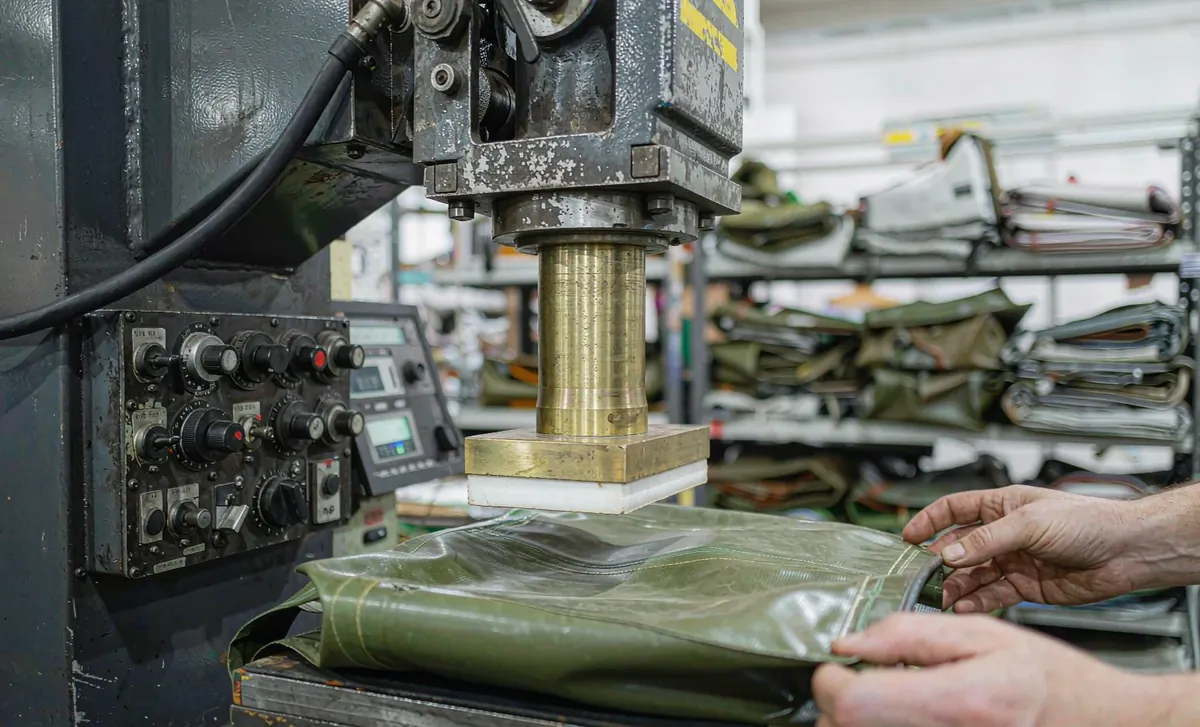
Radio frequency welding is what makes a roll-top dry bag possible, and it is the most misunderstood of the three joining methods we run. The physics is dipole rotation: the electrode and the bed form a capacitor, the workpiece is the dielectric between them, and when the field alternates at 27.12 MHz the polar molecules in the film try to rotate with it, fail to keep up, and turn the energy they cannot follow into heat. The heat is generated inside the film rather than applied to its surface, which is why the process is fast, why the electrode stays cool enough to touch, and why the whole seam reaches fusion temperature at the same instant, corners and four-way crossings included. It is also why RF cannot weld everything: the material has to be polar, so PVC, TPU and PU weld readily while polyethylene and polypropylene do not.
The Four Variables and How They Interact
An RF weld is set by four variables that are not independent. Power, typically 4–8 kW on our class of machine, sets the energy available. Dwell time, the two to six seconds the field is on, sets how long it is applied. Pressure, the 0.3–0.6 MPa the ram applies, sets whether the two films are in contact while they melt and how far the molten material is squeezed. Electrode geometry, principally the 10–12 mm land width, sets how energy is distributed along the joint. They interact because squeezing competes with fusion: too little pressure and the films melt without fusing, giving a seam that looks welded and peels like tape; too much and the molten film is driven out of the land entirely, leaving a thin glossy strip that passes a visual check and fails a pull.
How a Parameter Card Is Set and Locked
Every welding job on Lines 1, 2 and 3 runs to a card. The card is developed once, during sampling, by running a ladder: power and pressure held, dwell stepped from 1.5 to 8 seconds in half-second increments, and the coupons pulled on the peel rig. The selected setting is the midpoint of the dwell range that delivers 8 N/cm or better with a clean, unfilled land — not the setting that just passes, because a process sitting on its pass/fail edge will drift across it during a shift. Cards sit at the machine in a sealed sleeve and the control is set to require the card value, so operators load, cycle and inspect rather than tune. Two checks per shift verify the machine still makes what the card says: three coupons from the first, middle and last production welds, peeled and logged.
What a Bad RF Weld Looks Like
Four appearances cover most of it and all are recognisable without instruments. A dull matte land with a feathered edge means insufficient energy: the film softened but never fused. A glossy land with the weave of the face fabric pressed through from behind means too much pressure, too much dwell or both. A land with a yellow tint and a faint acrid smell means the material passed its decomposition point, which is a safety issue as well as a quality one because degraded PVC releases chloride. And a land thick at one end and thin at the other is almost never a setting issue — it is fixture parallelism or platen flatness, and the machine leaves production until it is corrected. A seam at 8 N/cm peel is what allows the IPX7 immersion claim and the 12-month warranty against manufacturing defects to be honest statements. The dip procedure and rig calibration behind those claims sit on the quality page.
Hot-Air Welding and Why Some Geometries Need It
Where RF heats the material from inside, hot air heats it from outside. A nozzle directs a stream of air at 400–550 °C onto the joint, the two film surfaces soften, and a pair of nip rollers presses them together a few millimetres behind the nozzle. It is a continuous process rather than a cyclic one: the workpiece moves at 2–5 metres per minute and the seam emerges finished. On Line 2 it is the primary tool, and it exists because some geometries are hostile to a flat electrode.
Where Hot Air Beats RF
Three cases. The first is length: an RF electrode can only be as long as the machine can hold in parallel before the field falls off at the ends, and a 1.2 m seam across the base of a large duffel is near the practical limit of our platens, while a hot-air machine will run a straight seam for as long as you feed it. The second is curvature: a roll-top collar closed around a curved former, or a seam running around a moulded corner radius, needs heat delivered at a point that follows the curve, which a flat electrode cannot do and a guided nozzle can. The third is thickness mismatch, since RF depends on the dielectric being uniform through the stack, so 0.30 mm film against 0.10 mm scrim-reinforced film heats unevenly, while hot air simply heats the surfaces it is pointed at.
Nozzle, Speed, Temperature and the Three Failure Modes
The window is narrower than it looks. Temperature is set by material: 400–450 °C for a 0.10–0.15 mm TPU film on 420D nylon ripstop, 480–550 °C for a 0.30 mm film on 1000D. Air volume runs 20–40 litres per minute and matters as much as temperature, because what softens the film is energy delivered per unit length. Three failures follow. Under-heating gives a seam sealed at the surface and unsealed at the interface, which looks perfect and opens under peel or in a dip. Over-heating gives a thin glossy stretched seam, and it is the more dangerous of the two because it passes a peel test: the joint fused, but with most of its thickness gone. Varying the feed across a shift gives the third, a seam good where the operator fed evenly and poor where they hesitated.
Hot air has limits and we apply them. It will not make a joint that must stay tight at a crossing point, because the continuous process leaves a start and a stop and the stop is always the weak place, so on a TIZIP MasterSeal 10 or a YKK AquaGuard #8 welded into a panel the closure ends are finished as separate operations with a defined overlap. It is also the process most exposed to operator technique of the three we run, which is why Line 2 operators rotate stations every two hours. The sampling window during which we decide which of the three methods your product will use is on the services page: 6–10 working days, or 12–15 where a new hot-air fixture is needed.
High-Frequency Welding for Thick PVC and Tarpaulin
The third welding line exists for material the other two cannot move. Heavy PVC tarpaulin, the 0.35 mm coated 500D and 1000D cloth used in welded duffels, fishing bags and cooler bodies, is thick, stiff and heavily plasticised, and it needs energy delivered for longer over a bigger area. The machine class works on the same principle as Line 1 — a 27.12 MHz field making polar molecules fail to follow it — but the equipment is a different animal: 10–15 kW generators, platens around 600 × 800 mm, and dwell measured in six to twelve seconds rather than two to six. So high-frequency and radio-frequency welding are not different sciences. They are the same dielectric heating applied at two power levels for two material classes, and we keep them apart because the maintenance, the fixtures and the operator skills differ, not the physics.
Power, Platen and the Arc Problem
Three things dominate heavy HF work. The first is field uniformity across a large platen: at 10–15 kW over 600 × 800 mm the edge does not see the field the centre sees, so a joint can be fully fused in the middle and under-welded 40 mm from the end. We compensate by designing fixtures to keep the land inside the uniform zone, and by verifying a new fixture with a coupon peeled from every corner of the joint. The second is heat removal: the electrode and bed are water-cooled, and water temperature and flow are logged at every shift start. The third is arcing, since any conductive inclusion in the joint — a staple, a metal fragment from a broken die, a foil print, a metallic pigment — concentrates the field, and an arc through PVC is a burn, a hole and a machine out of production while the electrode is cleaned. That is why every printed panel entering Line 3 has been checked for metallic ink at incoming inspection.
Fixture Design, and Why It Costs What It Costs
A heavy HF fixture is a milled aluminium tool, not a bend of sheet metal. It has to locate the panel to ±0.5 mm, hold it flat against a 0.6–0.8 MPa ram without slipping and present the land at a consistent height along its length. The reason for the precision is parallelism: 0.2 mm out of parallel across 600 mm puts most of the pressure at one end and almost none at the other, and the seam that results passes a visual check at both ends and fails a peel at one. This is the largest upfront cost in a heavy welded programme and the reason we raise fixtures at feasibility, and it is why the 12–15 working day sampling window exists for complex structures — a part of that window is tooling, not sewing.
What HF Cannot Do, and What We Do Instead
Heavy HF welding will not join dissimilar materials at different melt points, will not weld a seam that has to be re-opened, and will not produce a visually fine seam on a face, because a 12 mm land on heavy tarpaulin is a structural feature and looks like one. Where a design wants a cleaner appearance on a heavy shell we combine: the structural closure is welded, the visible trim is sewn at 8–10 stitches per inch with a 20 mm tape behind it, and the two meet at a bar-tacked reinforcement rather than a weld. The cooler bags range shows the hybrid; the insulation stack in those bodies is PE foam at 25 kg/m³ or EPE at 30 kg/m³ and cannot be welded at all, so it is enclosed by the welded shell rather than joined to it. The other limit is volume: at 900 pieces a day, Line 3 is the slowest welding line by a wide margin, and that is a property of the process rather than of the crew. A 60 L welded duffel in heavy PVC cannot be made faster than its dwell time allows. The plant history behind the equipment is on the about page.
Sewing Cells: 8–10 SPI, Needle and Thread Selection for Coated Shells
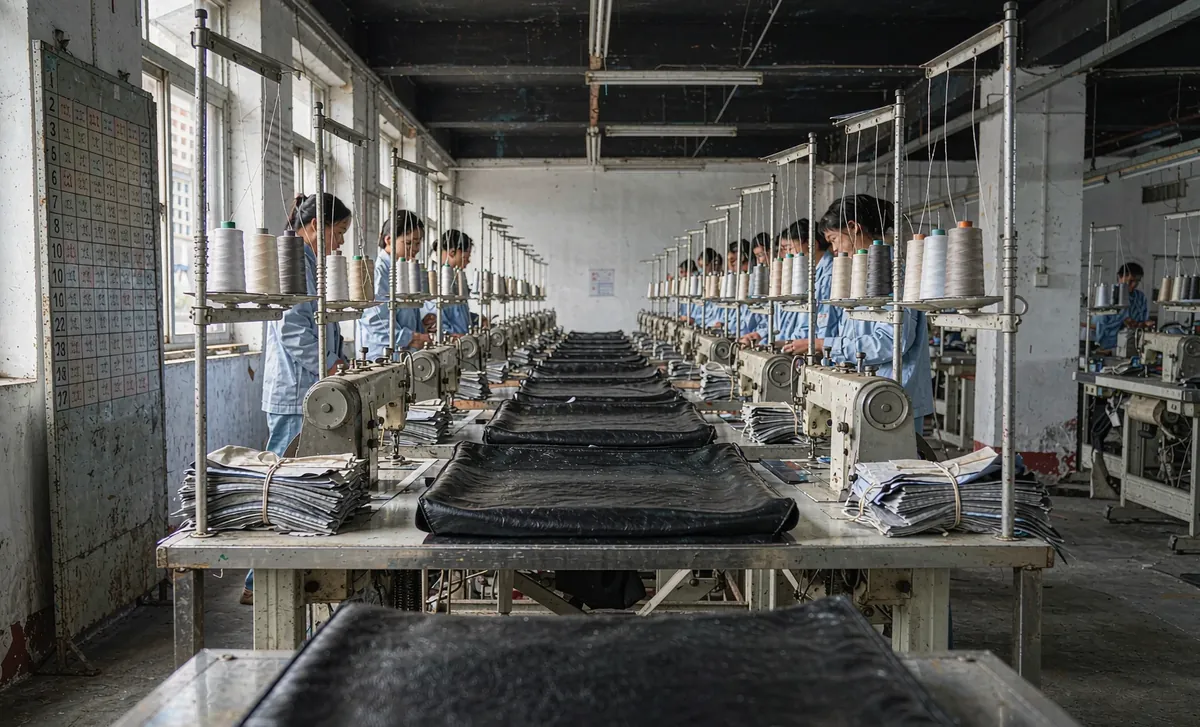
Welding gets the attention on this page, but the two sewing cells are the largest operations on the floor by headcount, and a sewn waterproof bag that is badly made fails in the same water as a welded one. The difference is where the failure sits: in a welded seam the joint is the weak point, while in a sewn seam the joint is usually fine and the needle holes are the problem. Every stitch through a coated shell is a perforation, and the whole discipline of sewing waterproof fabric is making those perforations few, small and well filled.
Needle: Size, Point and the Heat Problem
Needle selection on coated fabric is a compromise between penetration and damage. We run a 90/14 for 420D nylon ripstop with a 0.10 mm film, a 100/16 for 500D and 840D TPU laminate, and a 110/18 for 1000D or any seam passing through four or more plies. The point is a light-ball profile in every case, because a sharp cutting point slices the film rather than parting the yarns, and a sliced hole does not close around the thread. Heat is the second constraint: at around 160 °C the plasticiser in a PVC coating softens and deposits on the blade, and that deposit drags the film and skips stitches, so we run air-cooled needle bars and change needles every four hours of coated running time whether or not they have broken.
Thread, and Why Polyester Rather Than Nylon
Thread is bonded polyester in #69 (Tex 70) for almost all coated work. Bonded nylon #69 is marginally stronger and is what many factories default to, but nylon loses tensile strength under prolonged UV and yellows visibly, which matters on a bag that will live on a boat or a roof rack. Polyester holds colour and strength better, creeps less under load, and takes the same 20 mm tape. Coated fabric also does not feed like cloth: it grips the presser foot and will not slide over the feed dog, so every coated station runs a non-stick foot and the heavy stations a compound-feed walking foot, so two plies with different coatings cannot slip against one another. Operators do not back-tack at the end of a run, because a back-tack triples the hole density in the one place a tape will be asked to work hardest.
| Shell being sewn | Needle | Stitch density | Foot and feed | Used on |
|---|---|---|---|---|
| 420D nylon ripstop, 0.10 mm TPU film | 90/14 light ball | 9–10 SPI | Non-stick foot | Lightweight packs |
| 500D polyester TPU, 0.15 mm film | 100/16 light ball | 8–10 SPI | Non-stick foot | Waterproof backpacks |
| 840D polyester TPU, 0.20–0.30 mm film | 110/18 light ball | 8–9 SPI | Walking foot | Travel bags |
| 1000D TPU or 0.35 mm PVC | 110/18 or 120/19 | 8 SPI | Walking foot | Fishing bags |
| Insulated stacks, PE 25 or EPE 30 kg/m³ | 100/16 light ball | 8 SPI | Walking foot | Cooler bags |
Seam Taping: 20 mm Tape, Heat and Pressure Windows
Seam taping converts a sewn waterproof bag into a genuinely seam-sealed one, and it is the operation most likely to be skipped by a factory holding a price. The tape is a 20 mm strip carrying a hot-melt adhesive, laid over the stitched seam, heated until the adhesive activates and pressed into the needle holes while soft. The 20 mm width is not arbitrary: a coated seam with a 10 mm allowance leaves visible perforations across about 6 mm, and 20 mm covers that with roughly 7 mm of margin each side, which survives both the width tolerance of the applicator and the fact that the seam will not run straight.
Heat, Speed and Pressure
A taping machine is a hot-air machine with a tape feed. The nozzle blows air at 400–520 °C, the adhesive reaches 130–170 °C, and a pair of silicone nip rollers closes on the joint immediately behind. The window is a joint one rather than three separate ranges, because what determines the bond is the temperature the adhesive actually reaches: a function of air temperature, air volume, the 2–5 metres per minute feed and the 0.25–0.45 MPa nip pressure. Raise the speed and you must raise the air temperature, and past a certain point the air damages the film before the adhesive flows.
Setting by Coupon, and Tape Matching
We set taping by coupon and not by feel. A length is taped, cooled for four hours, then peeled on the rig and dipped. Three results kill a setting: a peel below the tape's specified bond strength, a dip leak at the tape edge, and strike-through where the adhesive comes through to the face fabric and leaves a shiny mark. A fourth is subtler and is the one that reaches the customer — a tape that bonds perfectly at the machine and lifts at the ends three weeks later, because the adhesive was activated at the surface and not through its thickness. Tape material must also match the shell: a TPU tape goes onto a TPU laminate and a PU tape onto a PU-coated shell, because the adhesive has to bond to the polymer family it sits on. Put a PU tape on a TPU laminate and it will pass a peel on the day, then let go in a warm container, since the two materials migrate plasticiser differently. At a crossing, where a side seam tape runs across a base seam tape, the two are pressed a second time so the adhesive layers fuse, because a crossing with a step in it is a capillary, and a capillary is how water enters a bag that passes every other test.
Zipper Installation: Waterproof Zip Handling and End Stops
A zip is the one component on a waterproof bag that must open and must not leak, and those two requirements pull in opposite directions. The closure fitted determines the rating the bag can honestly claim. A water-resistant PU-coated zip will keep a pack dry in rain and will pass at IPX6 spray, but it will not hold in an IPX7 immersion test and no amount of taping behind it changes that. A YKK AquaGuard #8 does better because the coil is reversed and covered by a PU laminate, though its weakest point is still the slider end. A TIZIP MasterSeal 10 is a different class of component and needs a different method to install.
Two Installation Methods
One hard rule applies first: a metal slider inside a 27.12 MHz field will arc, so before any zip-fitted panel enters an RF or HF machine the slider is parked outside the platen on a marked rest position built into the fixture. The same applies to any metal hardware within 100 mm of a weld land, which is why we weld the panel first and set rivets and D-rings afterwards. Chain is also stored flat in coil form and never folded, because a fold across a PU-coated tape leaves a crease the slider will ride over for the life of the bag, and it is cut with a hot knife or a dedicated chain cutter, since a cold cut leaves a frayed tape end that wicks.
A water-resistant coil zip is sewn. The tape is stitched to the shell at 8–10 SPI with bonded polyester #69 in two passes, with the stitch line 4–5 mm clear of the coil so the slider has clearance, and a 20 mm tape is then run along each side to seal the needle holes. What cannot be done is to run a single tape over the coil itself: it would be cut by the slider on first use, or would lift the moment the bag was opened. A TIZIP MasterSeal 10 is welded instead. It is a moulded-tooth closure with a TPU tape that is RF or hot-air welded straight to the shell, the only way to reach the peel strength of the rest of the seam. That changes the sequence — the zip has to be welded into the panel before the panel is closed — and it changes the economics, so we advise it where the closure is the product rather than as a default upgrade.
End Stops and Garages
A waterproof zip leaks at its ends, not along its length. On a sewn closure both ends take a bar-tack across the chain immediately below the top stop and above the bottom stop, a short overlap of shell folded over the chain end, and a tape run across the fold, leaving a sealed pocket at each end for the slider to park in. On a welded closure the chain ends are welded shut in a separate short cycle and peel-tested with the production coupons. The garage is the second answer and the one that makes the difference in use: a folded flap of shell covering the top stop and the parked slider, held with a snap, a magnet or a short length of hook-and-loop. Without it the top stop is the highest point of the closure and collects every drop running down the front of the bag, and it is the first thing cut when a design is value engineered. Hardware across the range — YKK, Duraflex and ITW — is salt-spray tested for 48 hours before it enters a schedule.
Assembly, Bar-Tacking and Reinforcement Points
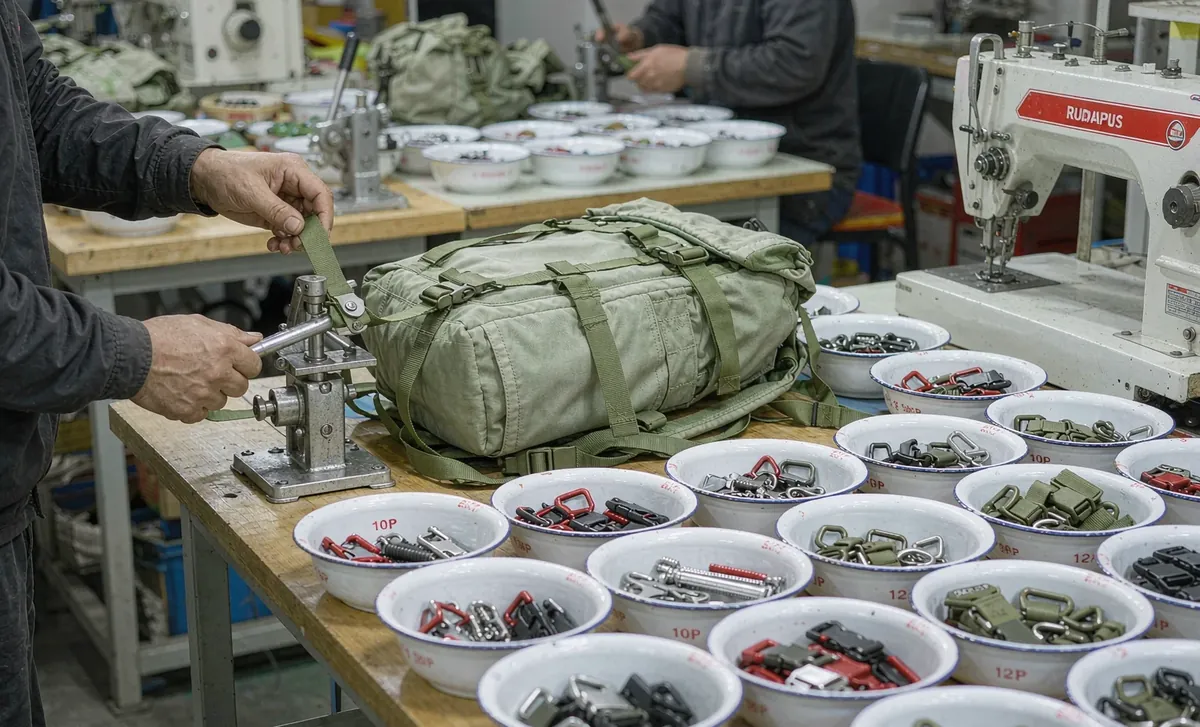
Assembly is where a bag stops being a set of panels and becomes an object you can load, and it is where the load path is decided. A 30 L bag carrying 12 kg puts its entire weight through four or six attachment points, and if those points are a stitch line through a coated face fabric, the bag will fail there regardless of how good the seams are. The discipline is simple to state and expensive to skip: no load is carried by the shell alone. Every load path in our products terminates in a reinforcement that spreads it across a patch, a binding or a bar-tack.
What a Bar-Tack Is, and the Three Numbers on It
A bar-tack is a dense block of zigzag stitches laid down by a programmable head, specified by length, width and stitch count. Our standard on a 25 mm webbing anchor is 16 mm × 3 mm carrying 42 stitches; on a 38 mm webbing or a shoulder strap anchor it becomes two bars, 20 mm × 3 mm with 54 stitches, laid side by side with a 4 mm gap, because a single bar across 38 mm leaves the centre unsupported. Bar-tacks are also programmable, which is a risk as well as a convenience: a head can be re-programmed in ninety seconds, and an operator who finds a 42-stitch bar slow will cut it to 28 and gain two seconds a unit. So the programs are password-locked to the tech pack and the weekly maintenance card records that the loaded program matches the pack.
The Six Reinforcement Points
Six locations get reinforcement on almost everything we build: handle anchors, because a grab handle is loaded in shock; shoulder strap anchors, which carry the pack's weight plus the dynamic load of walking; compression strap anchors, pulled tight against a full bag; D-ring and accessory patches, pulled at an angle and taking a peel load a seam would take in shear; base corners on a boxed body, where abrasion and load meet; and zip ends. The reinforcement takes one of three forms. A 40 × 40 mm patch of 420D nylon or 500D TPU behind the shell spreads the load; a 20 mm webbing binding folded over an edge takes a load that would otherwise pull against the seam; and a rivet with a backing washer takes the highest loads by clamping metal to metal. The rivet is strongest and least forgiving, since it pierces the film, so in a genuinely submersible product it is avoided in favour of a welded loop. Two anchors per style per week are then pulled to destruction, and both the failure load and the failure mode are recorded: the pass threshold is 250 N on a 25 mm handle anchor and 350 N on a shoulder strap anchor, and an anchor that holds but tears the shell has not passed, it has moved the weak point into the fabric that will be abraded and UV-aged in service.
Final Pressing, Cleaning and Visual Standard
A waterproof bag does not arrive at the finishing bench looking like the photograph. It arrives with handling creases from seven stations, chalk marks from the cutting room, a thin film of finger oil from assembly, thread tails, and on PVC a faint bloom of plasticiser. None of those are defects in the engineering sense and every one is a defect in the retail sense, because a buyer receiving 2,000 units will judge the first one they open on how it looks. Finishing exists to close the gap between a bag that functions and a bag that presents.
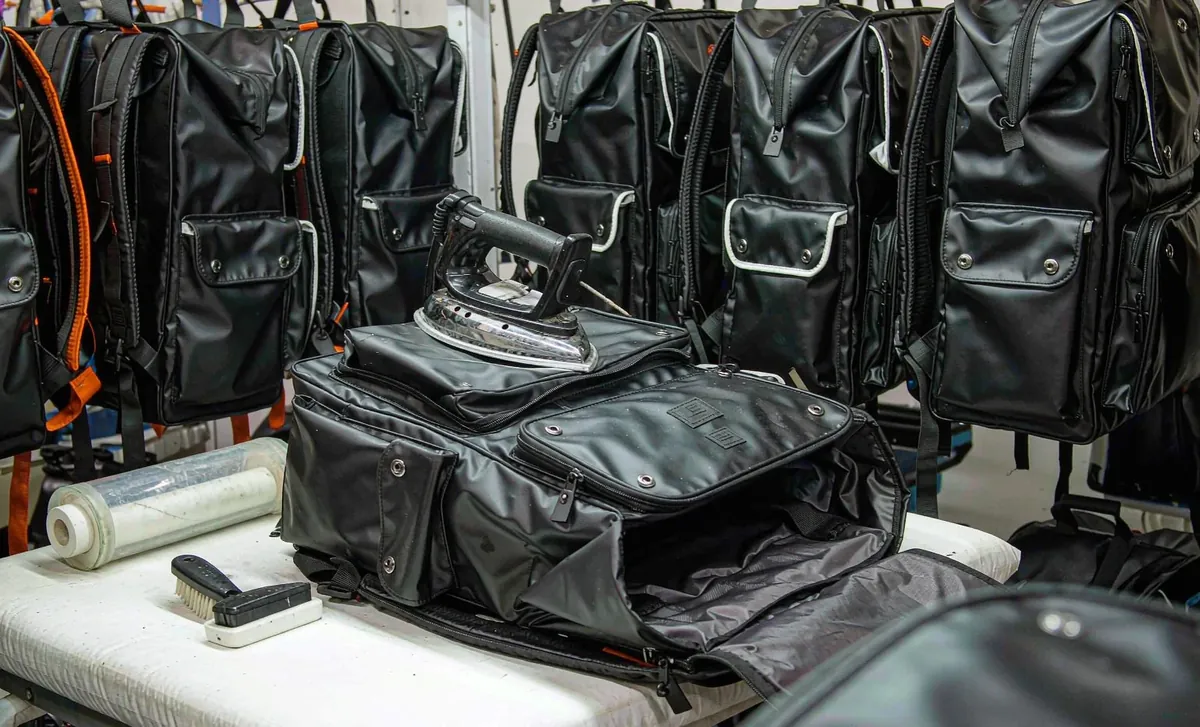
Pressing Coated Fabric Without Damaging It
Pressing a coated shell is not the same operation as pressing a garment, and every difference is in the direction of restraint. TPU film softens around 130–150 °C and a PVC coating below that, so we press at 100–120 °C through a barrier cloth, with two to three seconds of contact and no pressure beyond the weight of the head. Steam is not used on PVC at any temperature, and the barrier cloth is mandatory because a hot head touching a 0.15 mm film directly will glaze it permanently. Two areas are never pressed. A weld land is not pressed, because it re-melts under uncontrolled conditions and thins, and a land that leaves the welding hall at 8 N/cm can leave the finishing bench below it. A taped seam is not pressed either, for the same reason applied to the adhesive. Cleaning then removes handling marks with an isopropyl alcohol wipe applied to a cloth and never directly to the surface; on PVC we use a pH-neutral cleaner. No aromatic solvents, acetone or methyl ethyl ketone are permitted anywhere in the finishing area, since acetone lifts a mark from a TPU film and takes the print with it, and on a 0.35 mm PVC coating it extracts plasticiser and leaves a dull patch that shows under retail lighting. Thread tails are trimmed flush to 2 mm with a nipper and never pulled, because pulling a tail on a taped seam can lift the tape edge.
The Visual Standard
Visual inspection happens under 1,000 lux at the work surface, at a viewing distance of about 40 cm, with a three-second first look followed by a detailed pass. The three-second look is deliberate: a defect you have to hunt for is not one a customer will see, and one you see in three seconds is one they will see too. Defects are then classified as critical, major or minor under AQL 2.5 with ISO 2859-1, and the classification is written on the inspection sheet so a disagreement is a discussion about a standard rather than an opinion. Three classes are automatic rejects at this bench regardless of the sampling result: any crease that has gone white in the film, because it is a crack in the laminate; any scratch that has broken the film rather than marked it; and any weld or tape showing a lift at an edge. Everything else is judged against the approved golden sample standing at the end of the bench — the one you signed, not one we selected later. The full test procedure behind the classification is on the quality page.
Packing Line: Folding Standards, Polybag, Carton and Carton Drop Test
Packing is usually treated as an afterthought and is where a surprising amount of product damage originates. A bag that passed every test on the floor can arrive at a distribution centre with a permanent crease across its front panel, a welded land folded hard enough to crack, and a carton crushed at the bottom of a stack. The packing specification is therefore part of the tech pack and is written before production starts, in the same way the weld parameters are.
Folding Standards
Every product has a folding standard with a drawing, and the first thing the drawing does is mark where a crease is not allowed. A weld land is never folded: a 12 mm land in 0.30 mm TPU has been fused into a stiff ribbon, and folding it puts the whole bend radius into one line, cracking the film along a line that will not be visible until the bag is filled and the seam is loaded. Taped seams are folded along their length and never across. Roll-top collars collapse with two rolls and not four, because four puts three hard creases into the part that has to roll tightly in use. An insulated cooler bag with PE foam at 25 kg/m³ is folded with the insulation stack flat and the body rolled around it, since a fold across closed-cell foam is a permanent compression line that shows as a ridge through the liner.
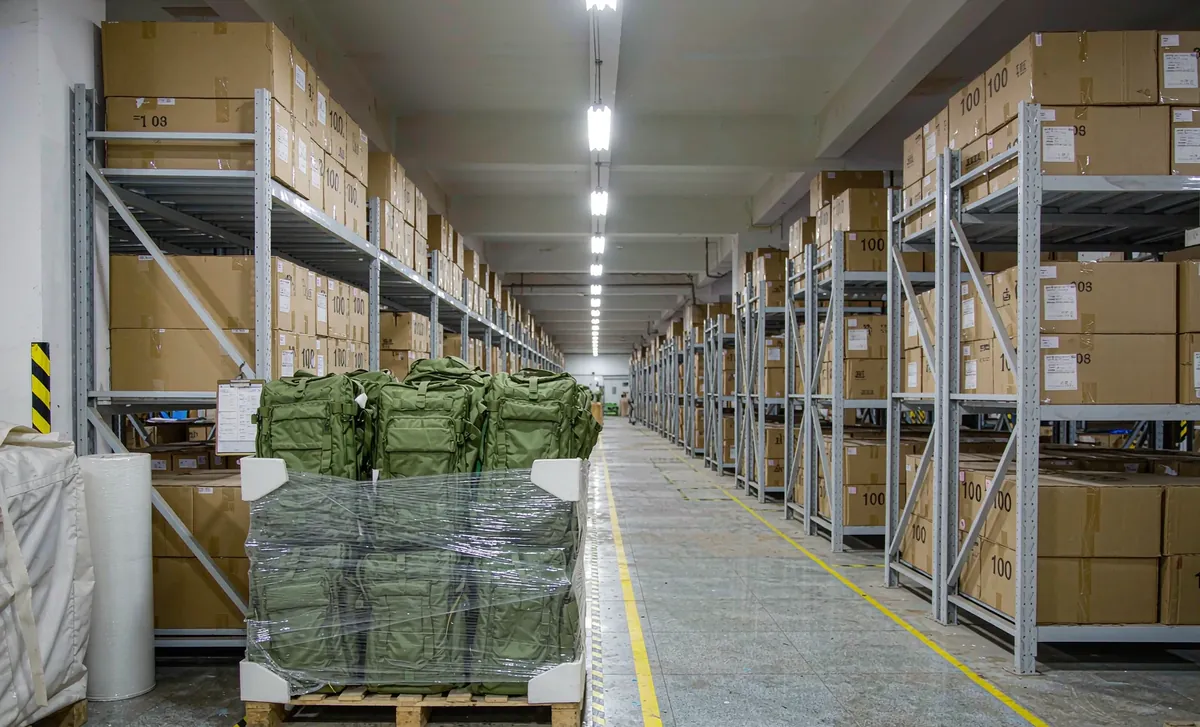
Polybag, Carton and Marks
Units are packed individually in a 0.05 mm LDPE polybag with two 25 mm vent holes and a suffocation warning printed where the market requires it. The bag is not vacuum-packed: a waterproof shell compressed under vacuum for six weeks in a container emerges with the creases set, and the packaging will have saved two centimetres of carton height for a product that arrives looking damaged. Export cartons are 5-ply A=B corrugated with 160 gsm kraft faces and an edge crush value of 32 lb/in, sealed with 48 mm acrylic tape in an H-pattern and strapped with 12 mm PP strap above 12 kg. Gross weight is held at or below 15 kg. Carton marks are printed rather than handwritten — shipping mark, carton number, PO, style, colourway, quantity, net and gross weight and origin — because legibility after six weeks in a container matters.
| Packing element | Our standard | Protecting against |
|---|---|---|
| Individual packing | 0.05 mm LDPE polybag, vent holes, no vacuum | Scuffing and creases set under compression |
| Fold geometry | Per-style drawing, weld lands never folded | Cracked film along a weld land |
| Carton board | 5-ply A=B, 160 gsm faces, ECT 32 lb/in | Crush at the bottom of a stack |
| Closure and strapping | 48 mm tape H-pattern, 12 mm strap above 12 kg | Carton opening in transit |
| Weight limit | 15 kg gross maximum | Handling damage and manual handling injury |
| Drop test | 10 drops from 76 cm: 1 corner, 3 edges, 6 faces | Transit damage on a mixed pallet |
The Drop Test, and What It Does Not Tell You
We drop-test one carton per style per quarter and one per shipment for a new carton size: ten drops from 76 cm onto concrete, one on the weakest corner, three on the edges meeting at it, six on the faces. The pass condition is not that the carton survives — cartons are supposed to deform — but that the contents are undamaged and still contained. A carton that splits along a seam on the third edge drop is a closure problem and fails; one with a crushed corner and intact bags inside passes. What the test does not tell you is what happens in a container, since a drop test simulates handling, not a six-week voyage at 60 per cent relative humidity with 24 tonnes stacked above. That is why we also hold cartons at 15 kg, use stretch-wrapped pallets with corner board, and do not accept a loading plan that puts heavy cartons on top of lightweight welded product.
Capacity Maths: 200,000 pcs per Month and How We Schedule It
200,000 pieces a month is the number on the SGS-verified plant record, and the arithmetic behind it is worth showing, because a capacity claim is only useful if you can see which assumption would break it. Six of the seven lines are output lines; Line 6 makes sub-assemblies and feeds the others. Across 26 working days at eight productive hours, the six produce 1,500 + 1,400 + 900 + 1,600 + 1,200 + 1,100 = 7,700 pieces a day, or 200,200 a month. That is the whole calculation, with no second shift and no weekend in it, and it is why the number has held.
Line output per day is not the same as line speed. A line producing 1,600 units across eight hours releases one finished bag every 18 seconds, but a bag is not made in 18 seconds: it passes through twelve or fifteen operations, and the 18 seconds describes the rate at which the line releases finished units. The binding constraint on a welded line is the weld cycle; on a sewn line it is the slowest sewing station, usually the one attaching a harness or closing a boxed base.
| Operation | Cycle or rate | Per 30 L welded duffel | Changeover cost |
|---|---|---|---|
| Spreading and cutting, full panel set | about 95 s | 1 set, 9 panels | 25 min per marker change |
| RF weld, body tube seam | 45 s including load | 2 welds | 40 min per fixture change |
| HF weld, base disc on heavy PVC | 95 s including load | 1 weld | 60 min per fixture change |
| Hot-air seam, per metre | 2–5 m/min | 1.8 m of seam | 20 min per nozzle change |
| Sewing, all body stations | 6–9 min total | 11 stations | 15 min per station reset |
| Seam taping, per metre | 2–5 m/min | 1.4 m of tape | 20 min per tape change |
| Bar-tack, per anchor | 4 s | 8 anchors | 2 min per program change |
| Finishing, pressing and cleaning | 70 s | 1 pass | 10 min per set-up change |
| Packing and carton make-up | 55 s per unit | 12 per carton | 15 min per packing spec |
Slots, Changeovers and the 35–50 Day Band
Orders are booked into slots, and a slot is a line plus a date range rather than a promise written on a purchase order. When you confirm, planning allocates a slot on the line that owns your product family, and everything about the 35–50 day bulk lead time after sample approval follows from that slot plus the operation times above. The 15-day spread in the band is not padding: it is the difference between a programme landing on a line already running your shell with your fixture on the rack, and one needing a fixture changeover, a marker change and a full re-thread of eleven sewing stations. Changeovers are also why MOQ exists, and our minimum of 500 pieces per style and colourway is the level below which the arithmetic stops making sense for either of us. When the month is full, we say the month is full. The alternatives are to accept an order we know will push another, to load a line that does not own the product family, or to add a partial second shift on the constraint operation; we do the third only where the constraint is a single process, and we do it with the fixture and its parameter card duplicated rather than shared, because a shared fixture on two shifts is a traceability problem and a maintenance problem in equal measure. The practical advice for a buyer with a hard launch date is to book the slot when you confirm the sample, not after: sampling takes 6–10 working days, or 12–15 for a complex structure, and the 35–50 day window starts on approval. The about page explains why the plant is organised to make that answer possible rather than diplomatic.
Frequently Asked Questions
What is the practical difference between a welded bag and a sewn one?
A welded seam fuses two film surfaces into one strip, so there are no needle holes and the seam strength is the peel strength of the fused film, which we hold at or above 8 N/cm. A sewn seam is stronger in shear but perforates the film, so it needs a 20 mm tape to be waterproof. Welded is lighter, flatter and genuinely submersible; sewn and taped is more repairable, more tolerant of thick insulation stacks and cheaper to change between sizes.
Can every material you use be welded?
No, and it is the first thing we check at feasibility. PVC, TPU and PU coatings weld because their molecules are polar and rotate in a 27.12 MHz field. Polyethylene and polypropylene do not, and neither does uncoated polyester or a fabric whose film is buried under a non-polar topcoat. A PE foam at 25 kg/m³ or an EPE at 30 kg/m³ cannot be welded at all, which is why an insulated liner is enclosed by a welded shell rather than joined to it.
Why do you run three welding lines for one physical principle?
Because the equipment, fixtures and failure modes differ even though the heating mechanism is the same. RF on TPU laminates runs 4–8 kW for two to six seconds, hot-air welding runs 400–550 °C continuously at 2–5 m/min, and heavy HF on 0.35 mm PVC runs 10–15 kW through a 600 × 800 mm platen for six to twelve seconds. Separating them means the operator who sees the defect owns the setting that caused it.
How do you stop a metal zip slider arcing in the welder?
Any conductive object in a high-frequency field concentrates it and arcs. Before a zip-fitted panel enters an RF or HF machine, the slider is parked in a marked rest position outside the platen, on a non-conductive insert built into the fixture. The same applies to rivets and D-rings, which is why we weld the panel first and set hardware afterwards wherever the design allows it.
What seam peel strength do you hold, and how often is it checked?
The production threshold is 8 N/cm on the peel rig, and the setting on the parameter card is the midpoint of the dwell range that clears it rather than the edge of it. Three coupons are pulled per shift from the first, middle and last production welds and logged on the card. If one falls below the threshold the line stops, the card is checked against the control panel and the electrode is checked for film build-up.
What needle and thread do you use on a TPU laminate?
A 100/16 light-ball needle for 500D and 840D TPU, a 90/14 for 420D with a 0.10 mm film and a 110/18 for 1000D, all with bonded polyester #69 at 8–10 stitches per inch. The ball point parts the yarns rather than slicing the film, and polyester is used rather than nylon because it holds strength and colour under UV. Needles are changed every four hours of coated running time.
Why not a higher stitch count for a stronger seam?
Every stitch is a hole through the film, and a higher count means more holes per centimetre, more base yarn cut and a wider band the tape has to cover. Eight to ten per inch is the range where the seam is sound and the perforation spacing still sits inside a 20 mm tape with margin. We also do not back-tack on coated seams, since a back-tack triples hole density where the tape works hardest.
Do you make the welding fixtures in-house?
We design them and cut the aluminium tooling. A heavy HF fixture is a milled tool that must locate the panel to ±0.5 mm, hold it flat against a 0.6–0.8 MPa ram and stay parallel across 600 mm for ten thousand cycles. That work is part of the 12–15 working day sampling window on a complex structure and the largest single upfront cost in a welded programme, so we raise it at feasibility rather than at order confirmation.
Can a printed panel be welded?
Only if the print is outside the weld land and the ink has been checked for metallic content at incoming inspection. A metallic pigment or foil print inside a 27.12 MHz field will arc, and an arc through PVC burns a hole and takes the machine out of production while the electrode is cleaned. Print areas are kept clear of the land by a stated margin on both the tech pack and the marker.
How is a TIZIP MasterSeal 10 installed differently from an AquaGuard #8?
A MasterSeal 10 is a moulded-tooth closure with a TPU tape that is RF or hot-air welded straight to the shell, the only way to reach the peel strength of the rest of the seam, and it has to be welded into the panel before the panel closes. An AquaGuard #8 is sewn at 8–10 SPI and covered with a 20 mm tape run down each side, with the stitch line 4–5 mm clear of the coil.
Where does a waterproof zip actually leak?
At the ends, not along the length. On a sewn closure both ends are bar-tacked across the chain, the shell is folded over the chain end and a tape run seals the fold. On a welded closure the chain ends are welded shut in a separate cycle with the slider parked clear of the platen. A zip garage over the parked slider is the cheapest additional defence and the first thing cut when a design is value engineered.
What is the minimum quantity for a welded programme?
500 pieces per style and per colourway. Below that the fixture changeover is most of the machine time and the unit cost becomes a function of the tooling rather than of the bag. The same minimum applies to sewn programmes for a different reason: a sewing cell has eleven or more stations to re-thread and reset, and that cost does not shrink because the run is short.
How do you handle a rush order?
By moving the slot, not by shortening the process. We can compress a schedule by pre-booking fabric, taking the marker changeover off the critical path and duplicating a fixture, but we cannot shorten a weld dwell or a taping speed without breaking the parameter card. The honest answer usually depends on what is already booked on the line that owns your product family.
Can I visit and walk the line my order will run on?
Yes, and we would rather you did. The plant is a single floor with a one-way route from roll store to loading dock, so you can stand at any station and see both what feeds it and what it feeds. You will see the parameter card at the welder, the needle change log at the sewing stations and the golden sample at the finishing bench. Visits are arranged through the contact page.
What does the 12-month warranty cover on a welded seam?
It covers manufacturing defects, which on a welded bag means a seam that separates or leaks under normal use because it was made outside the parameter card: insufficient dwell, incorrect pressure, a drifted fixture or a contaminated land. It does not cover punctures, abrasion, overload damage or degradation from solvents and aromatic cleaners. The card and the shift coupons are what let us tell the two apart.