Quality Control & Testing
ISO 9001-aligned QC with hydrostatic, submersion and AQL 2.5 final inspection.
The Four Quality Gates: Incoming, In-Process, Pre-Shipment, Pre-Production
Quality control on a waterproof bag is not an inspection carried out at the end of a line. It is four gates, and each gate has three things attached to it: a written description of what is being examined, a named person authorised to stop work, and a record that outlives the container. A supplier without the record can tell you a shipment was checked. A supplier with the record can tell you which roll of 840D TPU laminate went into carton 41, who signed the peel test at 09:40 on a Tuesday, and what the hydrostatic reading was on the afternoon a hot-air welder drifted two degrees. The physical route a panel takes across our floor is described on the manufacturing page. What follows here is the decision route that runs alongside it.
The four gates are pre-production, incoming, in-process and pre-shipment. They are sequential in the sense that each one can only do its job if the previous one did theirs, and they are deliberately not interchangeable: a pre-shipment inspection cannot compensate for an unqualified incoming roll, because by then the defective film is already welded into two thousand bodies. Understanding what each gate does — and, more usefully, what each gate is powerless to do — is most of what a buyer needs in order to read an inspection report properly.
Gate One: Pre-Production, Where the Specification Is Frozen
Pre-production is a paperwork gate that produces physical artefacts. Before bulk cutting starts we freeze a technical pack: a golden sample signed by both sides, a bill of materials listing every component down to the zipper gauge and the foam density, a construction sheet with seam allowances, stitch density and weld widths, and an approved lab-test schedule naming the thresholds each material must beat. Alongside it we make and test a pre-production sample from bulk materials rather than from substitutes, because a sample sewn from the development roll tells you nothing about the 500D TPU laminate that actually arrived. Any change after this point — a different adhesive tape, a slider from a second source, a 25 kg/m³ PE foam swapped for a 30 kg/m³ EPE — goes through a written engineering change request, and the request is recorded against the order. This is the gate that costs the least and saves the most: every deviation in a finished shipment that we have ever traced backwards was, in origin, a change made after the pack was frozen and not written down.
Gate Two: Incoming, Where Materials and Components Are Qualified
Incoming inspection covers four families: coated or laminated fabric in rolls, hardware, zippers and trim, and printed or woven branding. Fabric is scored on the four-point system against a 100 m² basis and released as first, marked or rejected; hardware is counted, gauged and pulled for the salt spray cabinet; zippers are cycle-tested on a sample pulled from the lot rather than from a sales folder; branding is checked against the colour standard under D65 light. Every qualified item gets a lot number that will follow it into the finished carton. Incoming inspection is the only gate that can reject material cheaply, because a roll returned to the mill costs freight and a rejected finished bag costs freight plus every operation already performed on it. It is also the gate with the longest shadow: with a MOQ of 500 pcs per style and colourway, a single 40 kg/m² roll can represent a substantial share of the whole run, so a scoring decision made in twenty minutes on a bench is really a decision about the yield of the order.
Gate Three: In-Process, Where Drift Is Caught While It Is Still Cheap
In-process inspection is not a supervisor walking the floor. It is a fixed circuit: at each of the seven production lines an inline QC takes a defined sample every hour, measures against the card for that operation, and writes the result on a board at the station. The sample size is small and the frequency is high, which is the opposite of the pre-shipment logic, and the reason is arithmetic — an hourly check on three pieces finds a welding temperature drift within the hour in which it started, while a final check on 200 pieces finds it after a shift and a half of production is already suspect. The measurements differ by station: weld peel strength and visual land appearance at the welding hall, stitch density and seam margin at the sewing cells, tape adhesion and centring at taping, webbing bar-tack coverage at reinforcement. When a measurement leaves the action limit, the line stops rather than segregates, because on a continuous process the next twenty pieces will be wrong too.
Gate Four: Pre-Shipment, Where the Lot Is Judged as a Lot
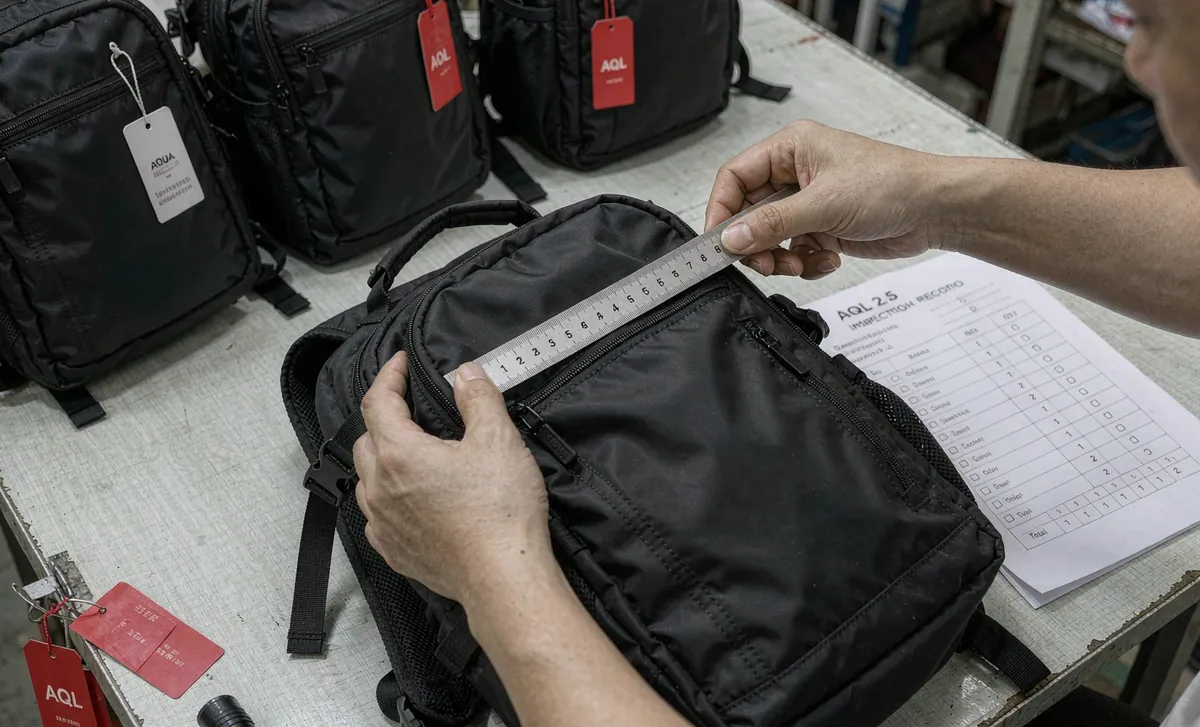
The final gate treats the order as a statistical population. Cartons are selected at random from a sealed, packed, ready-to-ship lot, opened, and the units inside are examined against the AQL 2.5 plan under ISO 2859-1, with the critical-defect category held at zero acceptance. Three things are verified at the same time: the physical attributes of the bag, the correctness of packing — quantity, polybag, carton marking, barcode — and the presence of the documents the shipment travels with. This gate is the one a third-party inspector will repeat, and it is the one whose result determines whether the container loads. It is also, honestly, the weakest of the four on its own: AQL sampling is designed to accept lots with a low but non-zero defect rate, so a clean pre-shipment report means the lot passed a sampling risk calculation, not that every bag is perfect. That is why the other three gates exist, and why our own release procedure treats the four together rather than substituting the last for the first three.
AQL 2.5 under ISO 2859-1: How Sampling Plans Actually Work
AQL 2.5 is a shorthand that hides three separate decisions, and most disputes about inspection results come from a buyer and a factory having made those three decisions differently without ever saying so. The three are: which inspection level determines the sample size, which sampling plan type and inspection severity are in force, and which AQL applies to which defect class. Changing any one of them changes the number of pieces on the table. This page states ours explicitly so that a buyer's third-party inspector is working from the same plan we are.
From Lot Size to Sample Size: The Code Letter
ISO 2859-1 does not ask you to inspect a percentage. It asks you to look up the lot size in a table, obtain a code letter, and then read the sample size for that letter. We use General Inspection Level II, the default in the standard and the level almost every inspection company applies unless a client requests otherwise. Under Level II a lot of 500 pieces draws code letter H and a sample of 50; a lot of 3,000 draws K and a sample of 125; a lot of 20,000 draws M and a sample of 315. Notice what that does to the percentage: at 500 pieces you examine ten per cent, at 20,000 you examine under two per cent. The absolute sample grows slowly and the relative sample shrinks fast, which is intentional — the statistical protection per unit inspected rises with lot size, and a plan that held the percentage constant would be absurdly expensive on a large order while adding almost no protection.
| Lot size (pcs) | Code letter, Level II | Sample size | AQL 2.5 Ac / Re | AQL 4.0 Ac / Re | Critical, Ac / Re |
|---|---|---|---|---|---|
| 2 – 25 | A – C, arrow to E | 13 | 0 / 1 | 1 / 2 | 0 / 1 |
| 26 – 90 | D – E, arrow to E | 13 | 0 / 1 | 1 / 2 | 0 / 1 |
| 91 – 150 | F | 20 | 1 / 2 | 2 / 3 | 0 / 1 |
| 151 – 280 | G | 32 | 2 / 3 | 3 / 4 | 0 / 1 |
| 281 – 500 | H | 50 | 3 / 4 | 5 / 6 | 0 / 1 |
| 501 – 1,200 | J | 80 | 5 / 6 | 7 / 8 | 0 / 1 |
| 1,201 – 3,200 | K | 125 | 7 / 8 | 10 / 11 | 0 / 1 |
| 3,201 – 10,000 | L | 200 | 10 / 11 | 14 / 15 | 0 / 1 |
| 10,001 – 35,000 | M | 315 | 14 / 15 | 21 / 22 | 0 / 1 |
| 35,001 – 150,000 | N | 500 | 21 / 22 | 21 / 22 | 0 / 1 |
| 150,001 – 500,000 | P | 800 | 21 / 22 | 21 / 22 | 0 / 1 |
Reading an Accept Number Honestly
The two numbers in the accept/reject column are the whole result. A lot of 3,000 pieces sampled at 125 may contain up to seven major defects and still pass at AQL 2.5: the eighth triggers rejection. That is not a loophole, it is the definition. AQL 2.5 means the sampling plan is built so that a lot running consistently at 2.5 per cent defective has a high probability of acceptance — around 95 per cent for these sample sizes — and a lot running at ten per cent has a low one. What the plan cannot do is tell you the lot is clean. If your downstream requirement is genuinely zero tolerance, say so at the quotation stage and we will quote a tightened plan or 100 per cent functional screening instead, because the cost of that is a real line item and it should be priced rather than discovered. We state this plainly because it is the single most common source of a bad surprise: a buyer reads "AQL 2.5" as "a good shipment" and receives a pallet with six faulty units in it, which is exactly what the standard predicts.
Switching Rules, and Why the Number on the Report Is Not Always the Same
ISO 2859-1 is a dynamic system. Inspection begins at normal severity. When two out of five consecutive lots or batches are rejected on original inspection, the plan switches to tightened, which raises the sample size or lowers the accept number, and it stays there until five consecutive lots are accepted under tightened, at which point normal is restored. When ten consecutive lots pass at normal and production is at a steady rate, the plan may switch to reduced with the consent of the responsible authority. We run normal as the default on every new style and we publish the current severity state on the inspection report, because a report that says "tightened" is telling a buyer something real about that supplier's recent history, and it is a useful thing to ask any factory for. Reduced inspection is the one to watch: it is legitimate under the standard, but a factory living permanently on reduced is sampling less than the table above suggests.
Defect Classification: Critical, Major, Minor and Our Accept Limits
A defect count means nothing until someone has decided what kinds of fault are being counted together. A 4 mm scratch on a webbing end and a pinhole in a welded floor are both "defects" and they belong in different columns, because one will generate a return and the other will not. We classify into three classes before the count begins, we print the classification in the technical pack so the buyer's inspector can see it in advance, and we hold the critical class at zero acceptance regardless of what the AQL table permits.
| Class | Definition we apply | Waterproof-bag examples | Our accept limit |
|---|---|---|---|
| Critical | Fails a safety or regulatory requirement, or makes the product unusable for its stated purpose | Leaking welded seam or untaped needle hole in a submersible body; broken load-bearing strap attachment; sharp burr on metal hardware; non-compliant restricted substance | Zero. One critical defect rejects the lot, no resubmission without rework and retest |
| Major | Reduces saleability or performance materially; a retail customer would return it | Hydrostatic failure below the specified head; peel strength under 8 N/cm; zipper that jams or fails cycle test; taped seam lifting over 10 mm; visible shade difference between panels; wrong print position over 3 mm | AQL 2.5 under ISO 2859-1, General Level II |
| Minor | Departure from specification with no material effect on use or saleability | Loose thread under 10 mm; light surface crease from folding; carton marking slightly off position but scannable; slight unevenness in stitch line within tolerance | AQL 4.0. Not a rejection reason on its own |
Where the Boundary Cases Actually Sit
Three arguments come up repeatedly, and it is worth settling them in the technical pack rather than on the loading dock. The first is a leak at a seam that only appears under pressure: we classify any through-penetration of the waterproof envelope as critical, because a dry bag that lets in water has failed its stated purpose and no cosmetic argument rescues it. The second is cosmetic damage on a visible panel versus a hidden one: a 15 mm scuff on the front panel of a waterproof backpack is major, the same scuff inside the lining is minor, and the technical pack marks which panels are cosmetic A-surfaces. The third is functional-but-different: a slider that works but feels stiff is minor if it passes the cycle test and major if it does not, which is why our classification references a test result rather than an opinion wherever a test exists. Writing these three into the pack before sampling is the cheapest way to prevent a disagreement that otherwise happens at the moment the container is booked.
Cumulative Counting, Not Either-Or
ISO 2859-1 does not let you count a unit as major and forget the minors. A single sample unit can carry defects in several classes, and the lot is then judged against each class separately using the same sample size: the critical count must be zero, the major count must be at or below the major accept number, and the minor count at or below the minor accept number. A lot can also be rejected on the sum even when each class individually passes, and we apply that rule. In practice a unit with three minor defects is behaving like a unit with a major one, and a sample carrying many scattered minors is the earliest signal of a process drifting, typically a dull cutting blade or a sewing feed that has gone out of timing. We therefore treat a rising minor count as a process alarm rather than as an acceptable outcome, and the inline board in the production hall is where that trend shows up first, days before the final sampling would have seen it.
What We Do With the Count After the Report Is Written
The report is not the end. Every result is filed against the order with the lot numbers of the materials used, so that a claim arriving four months later can be traced back to a roll, a shift and a machine. Our 12-month warranty against manufacturing defects is only meaningful because that trace exists: it lets us distinguish a genuine production fault from wear, misuse or a storage condition we did not control. For the buyer the practical consequence is simple. Ask any supplier for the classification sheet before you ask for the report, because a factory that has never written down what it counts as critical will negotiate that definition after the defects are found, at which point the negotiation is about money rather than about bags.
Seam Integrity Testing: Peel Strength, Burst and Water Penetration
A waterproof bag is a container that fails at its joins. The fabric will hold water at 20,000 mm hydrostatic head forever; what fails is the line where two panels meet, whether that line is a radio-frequency weld, a hot-air seam, a needle-punched seam closed with 20 mm tape, or a hybrid that is both bonded and stitched. Seam integrity testing is therefore three separate measurements, and they answer three different questions: how hard is it to pull apart, how much pressure will it take before it lets go, and does water actually get through. A seam can pass two of the three and still be a warranty claim, which is why we run all three rather than whichever is quickest.
Peel Strength: The Number We Hold at 8 N/cm
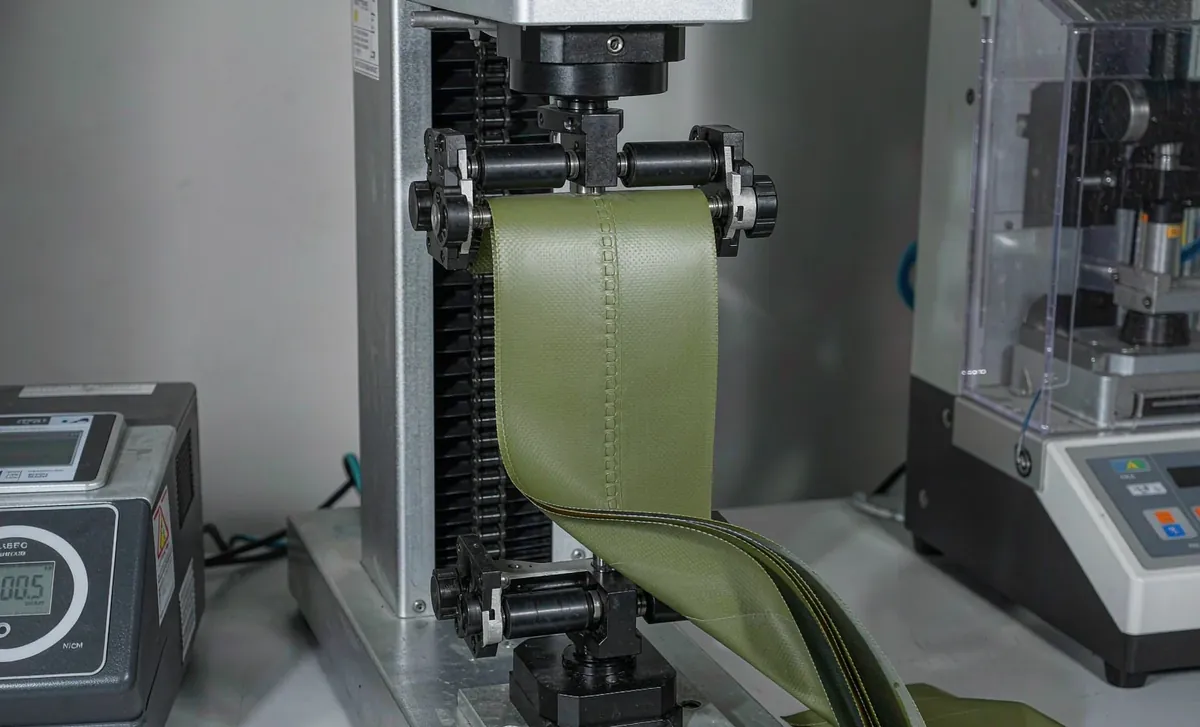
Peel strength is measured on a tensile rig. A strip of the finished seam is cut 25 mm wide and at least 150 mm long with the join across the middle, the two free ends are clamped in the jaws, and the jaws separate at 100 mm per minute while the rig records force. The result is not the peak force but the average force over the steady part of the curve, divided by the sample width, and it is reported in newtons per centimetre. Our release threshold for a structural weld on TPU laminate is 8 N/cm, and it is a floor rather than a target: a well-set RF weld on 0.20 mm TPU film typically runs between 12 and 18 N/cm, so a reading of 8.5 is a warning, not a pass with room to spare. The failure mode matters at least as much as the number. A trace that separates cleanly at the interface was a weld that never fused, and the cause is almost always temperature or dwell. A trace that tears through the film at 20 N/cm is a weld stronger than the material it joins, which is what we want — the seam is no longer the weak point, and the load path moves into the base cloth.
Burst and Restrained-Diaphragm Testing
Peel is a linear test and a seam in service is not loaded linearly, so we also burst it. A circular sample 100 mm across with the seam running through the centre is clamped over an annular opening, and pressure is applied beneath it at a controlled rate until it fails. What we want from this test is not the pressure at failure but the location and appearance of the failure: a sample that ruptures in the centre of the film at 300 kPa has a seam stronger than its surroundings, a sample that splits along the weld line at 60 kPa has a weld that is the weak link, and a sample that leaks at the edge of the clamp is a clamping problem and the test is repeated. On a welded dry bag for the fishing range we also inflate the finished body to a specified pressure and hold it, which is a more honest test than any coupon because it loads the corners, the roll-top closure and the valve as a system, and corners are where a fixture that has lost parallelism shows up.
Water Penetration: What the Rain Room Tells Us That a Coupon Cannot
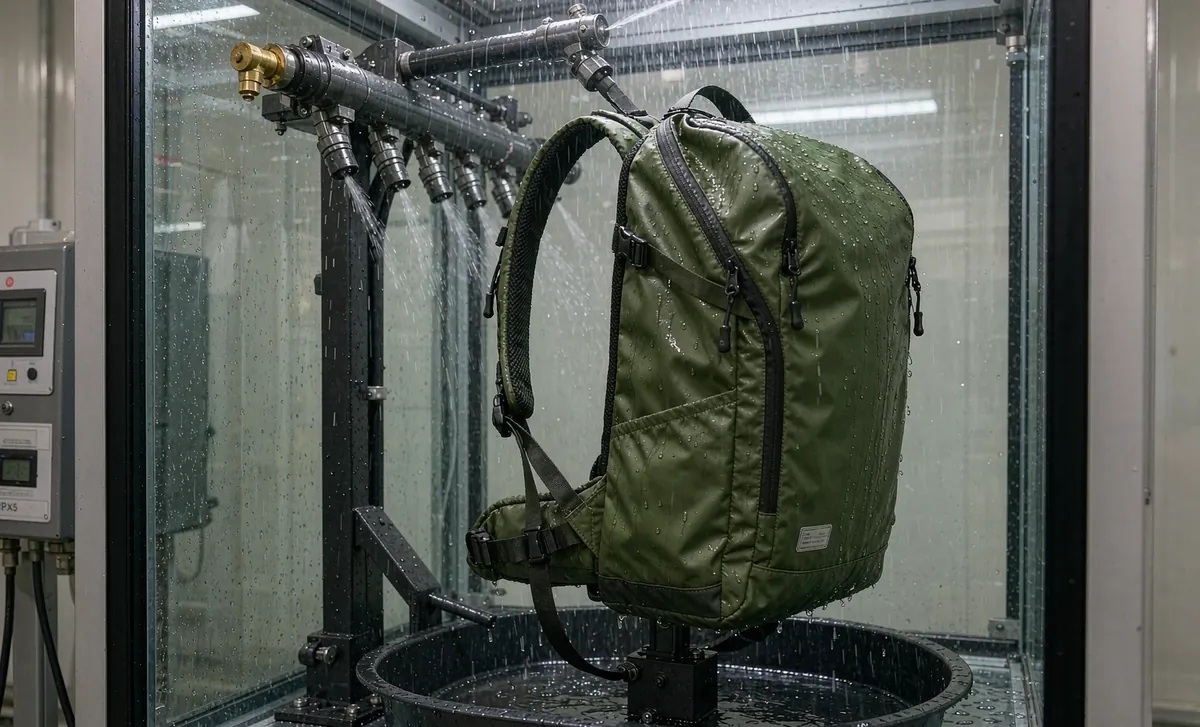
Every coupon test measures a sample cut from a flat area. Real leakage happens at geometry: the triple junction where a side panel meets the base and a corner webbing tab, the point where a roll-top closure folds four layers over a stiffener, the exit point of a cable port. For that reason we test finished assemblies, and we do it two ways. The first is the rain room: the bag is hung in a rig, filled with a load representing its intended contents, and exposed to a spray from a specified nozzle arrangement at a defined intensity and duration, after which it is opened and inspected with a dry paper towel over the interior surfaces. The second is submersion for products rated to it: a weighted bag is held under water for a defined time at a defined depth, and the interior is then examined. A bag rated IPX7 is tested at one metre for thirty minutes; a bag rated IPX8 is tested against the depth and duration agreed with the customer, because the standard requires the manufacturer to state the condition rather than just the code.
Taped Seams: The Third Construction, and Its Own Failure Modes
A sewn-and-taped seam puts two failure modes in one place. Needle holes are closed by a 20 mm polyurethane tape hot-air welded over the stitch line, and the tape can fail by lifting at the edge, by channelling — water travelling along the stitch line under the tape and appearing somewhere else — or by delaminating from a fabric whose coating was incompatible with the adhesive. We test tape adhesion on the same peel rig and hold it to the same 8 N/cm, and we test for channelling by the submersion test rather than by eye, because channelled water leaves no mark on the outside. Stitch density matters here too: at 8–10 stitches per inch a seam is tight enough to resist the creep that opens channels under load, and below 7 SPI the tape is doing work the thread should be doing. On a bonded-and-stitched hybrid we weld first and stitch second, so the stitch is reinforcement for peel load rather than the primary water barrier.
Hydrostatic Head Testing: Test Method, Sample Prep, Pass Thresholds
Hydrostatic head is the number printed on almost every waterproof fabric datasheet and it is the number most often quoted without the conditions that make it mean anything. It answers one narrow question: how tall a column of water can this flat piece of fabric support before it leaks. It does not measure a seam, a coating's durability after folding, or the behaviour of a finished bag under a strap load. Used for what it measures it is a fast, repeatable and genuinely useful incoming test; used for anything else it produces arguments. This section states exactly how we run it, because the conditions change the result by tens of per cent.
The Method, Step by Step
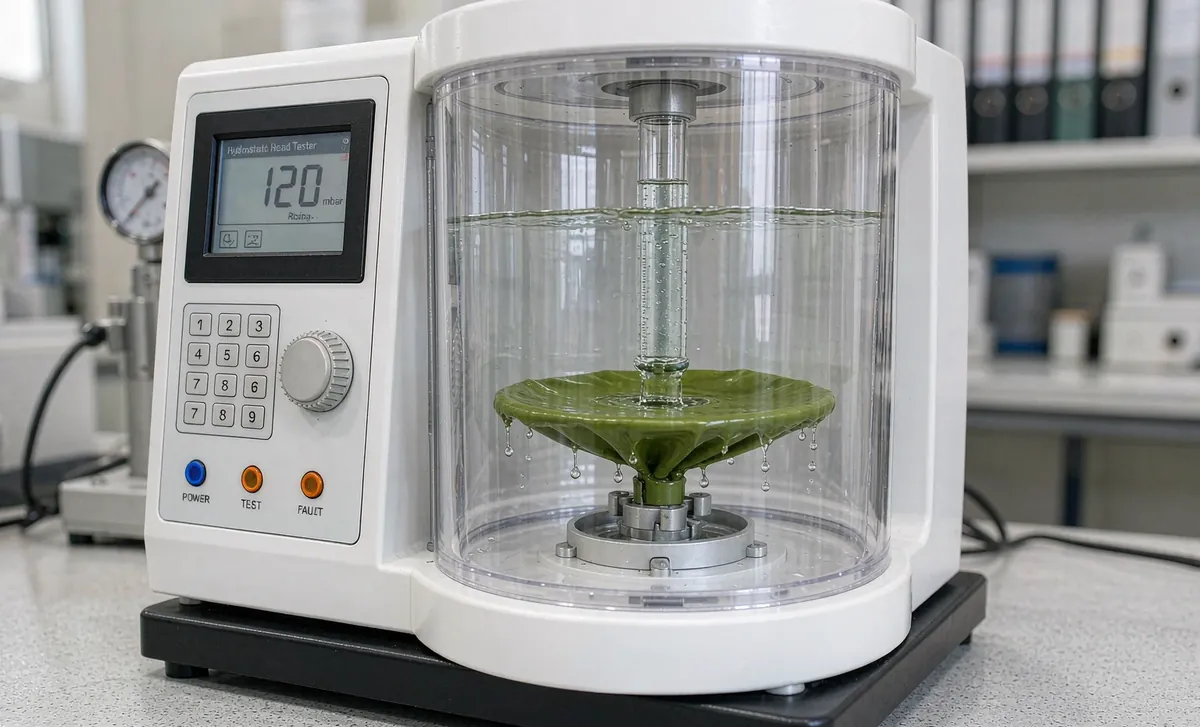
We run the hydrostatic head principle in ISO 811 form. A specimen at least 100 mm square is clamped, face down, over the orifice of a test head with a 100 cm² measuring area. Water at 20 ± 2 °C is introduced beneath it and the pressure is raised at a rate of 60 cm of water column per minute, or 10 mbar per minute, whichever the instrument is calibrated to. The operator watches the underside of the specimen through the head and stops the instant the third drop of water appears at a distinct place on the surface. The reading at that moment, in centimetres of water column, is the hydrostatic head. The third-drop rule exists because the first and second drops are frequently a wet-out spot that has not penetrated, and stopping at the first drop is the most common way for two laboratories to report different numbers on the same fabric. Distinct place matters too: three drops forming at one pinhole is one event, not three.
Sample Preparation, the Part That Decides the Result
Sampling is where most errors enter. On a 1000D polyester TPU laminate we take five specimens per roll: two from near the start, two near the end, one from the middle across the full width, and none from within 50 mm of the selvage, because the coating at the edge is never the coating in the middle. Specimens are conditioned at 20 ± 2 °C and 65 ± 5 per cent relative humidity for a minimum of four hours before testing, since a dry specimen reads higher than a conditioned one. They are handled by the edge only: finger oil on the film creates a wet-out path exactly where a careless thumb held the sample, and the resulting pinhole-shaped reading gets misattributed to the mill. We test with the coated face towards the water, which is the service direction, and we record the orientation, because a fabric with a 0.15 mm PU back-coating and a face finish can read very differently in the two directions.
Pass Thresholds by Product Family
We hold two fabric thresholds. Lightweight shells — 420D nylon ripstop and 500D polyester TPU laminate used on packable day packs and sports bags — must reach 10,000 mm. Heavy-duty shells — 840D and 1000D TPU laminates and 500D PVC used on welded duffels, fishing bags and expedition bodies — must reach 20,000 mm. The reason for two thresholds is that hydrostatic head is a static laboratory property that declines in service: it falls after abrasion, after flexing at a fold, and after laundering, so the margin between the fresh reading and the field requirement has to be widest on the products that will be dragged over rock. On this basis a 10000 mm shell is not a 10000 mm bag after a season, and we tell customers that rather than let the datasheet imply it.
What We Test After the Fresh Reading
A fresh hydrostatic head is a receipt, not a prediction. We therefore repeat the test on the same fabric after the abrasion and cold-fold work described further down this page, and the decline is the number we actually use in development. A TPU film that falls from 20,000 mm to 16,000 mm after 5,000 Martindale cycles is performing well; the same fabric falling to 4,000 mm has a film that is too thin for the base cloth, and no amount of seam tape will recover it. We also test after folding, because a crease in a 0.10 mm film is a permanent thinning of the barrier in a straight line. For a buyer, the useful request is not "send me the hydrostatic certificate" but "send me the hydrostatic reading after abrasion", and that second request separates suppliers who test for a datasheet from suppliers who test for a product.
Zipper Durability: Cycle Testing, Slider Pull, Water Resistance After Cycling
On most waterproof bags the zipper is the part that fails first, and it fails for reasons that have nothing to do with the fabric rating printed on the product page. A YKK AquaGuard #5 or a TIZIP MasterSeal 10 is a precision assembly of tape, teeth, slider and a polyurethane or silicone sealing surface, and the sealing surface is what wears. Zipper testing separates into three measurements that we run in a fixed order, because the order is what makes the third one meaningful: cycle the zipper, then pull the slider, then test the water resistance of the cycled specimen.
Cycle Testing: The Rig and the Pass Criteria
The rig holds a 300 mm length of the finished closure, grips the slider, and drives it open and closed at 20–30 cycles per minute against a small controlled lateral load, until 1,000 cycles have accumulated for a dress-goods closure or 5,000 for a heavy-duty one. We do not run it dry: a specimen is cycled with a light mist of water applied at intervals, because a dry-cycled zipper tells you about the teeth and a wet-cycled one tells you about the sealing interface, which is the part that matters. Pass criteria are that the slider completes every cycle without binding, that no tooth is deformed or missing, that the tape shows no tear at the stops, and that the sealing lips have not separated from the tape. The most informative failure is the gradual one: a closure that begins to bind at cycle 3,800 is a slider whose body has worn, and it will bind at 800 cycles in the field if the user carries grit into it. The most useful maintenance message we can give an end customer is to rinse a salt-water zipper in fresh water, and we say it on the care label because that recommendation exists only because we have watched what happens without it.
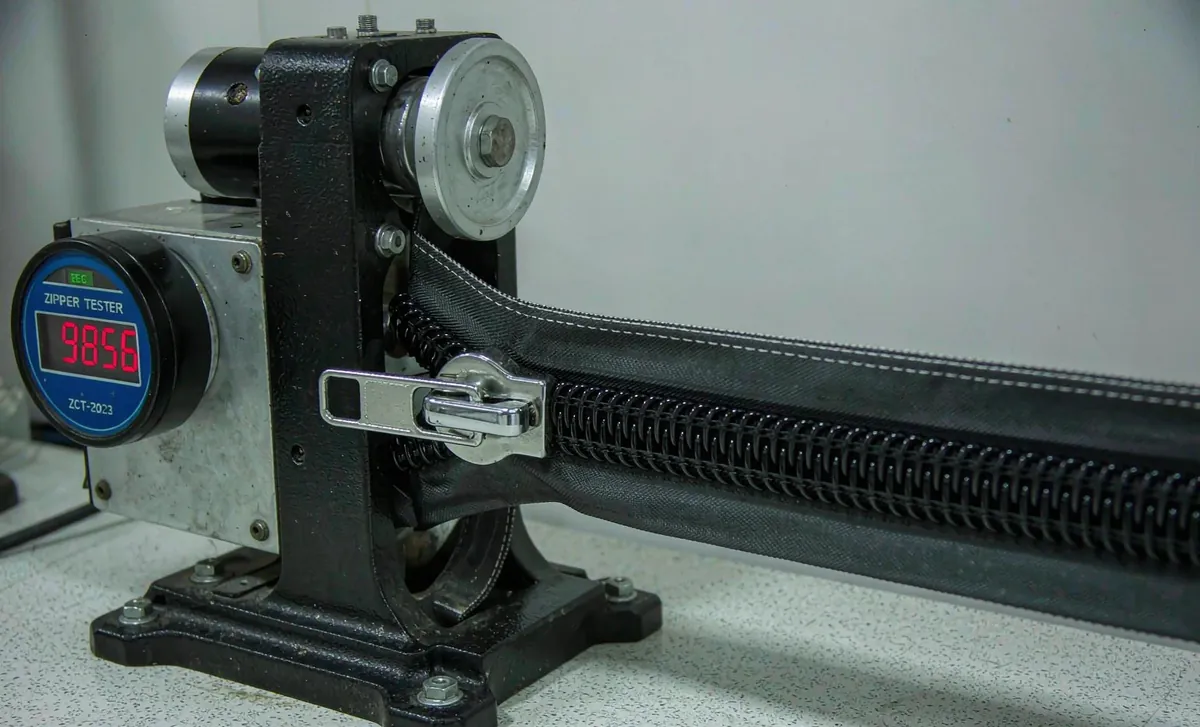
Slider Pull, Cross-Load and Stop Strength
Cycle endurance says nothing about the force a user applies, so we measure that separately. Slider pull is the force needed to move the slider along a closed chain, measured on the tensile rig, and we hold it between 5 N and 25 N for a #5 closure: below 5 N the slider will creep open under vibration in transit, above 25 N a cold-handed user will not manage it. Cross-load strength is measured by pulling the two tapes apart laterally at the slider with the closure shut, and it is the test that finds a slider body that has been over-crimped or a chain whose teeth will pop under the diagonal load a packed bag actually applies. Stop strength is measured by driving the slider against the bottom stop at speed, because a bottom stop that lets the slider pass turns a serviceable bag into a returned one on the first day of use. On a travel bag with a main opening over 600 mm we also measure the force needed to start the slider moving at the far end of a packed closure, which is where a stiff slider becomes a broken puller.
Water Resistance After Cycling
This is the test that matters and the one most often skipped. A specimen that has completed its cycle programme is mounted in the rain-room rig and sprayed at the agreed intensity, with the interior behind the closure examined for moisture. A new AquaGuard closure sheds a spray easily; the same closure after 5,000 cycles has polished sealing lips, and whether it still sheds depends on how much material was there to polish. This is why we specify the sealing lip geometry in the bill of materials and not merely the brand: two closures can both be sold as water-resistant and behave differently at cycle 4,000. For a submersible product we test further — the closure is cycled, closed, and the assembly submerged to its rated depth, and a closure that sheds spray and leaks under one metre of head is a closure we will not put on a dive-rated product. The practical consequence for a buyer is that "water-resistant zipper" is not a specification. "Water-resistant zipper, 5,000 cycles, still sheds 20 L/min per square metre spray afterwards" is one, and it is the form we recommend asking for.
Abrasion and Flex Testing: Martindale, Taber and Cold-Fold
Waterproof coatings fail by thinning rather than by tearing. A bag can look undamaged and still have lost most of its barrier on the base, the shoulder-strap contact area or a fold line that has been opened and closed a few hundred times. Abrasion and flex testing exist to measure that loss before it becomes a wet sleeping bag, and the three methods below are used because they damage the coating in three different ways: flat rubbing, rotating grinding, and creasing under cold. We run them on the material, and then we re-run hydrostatic head on the damaged specimen, which converts a subjective appearance into a number.
Martindale: Flat Rubbing in a Figure of Eight
The Martindale tester holds a 38 mm specimen under a specified weight and rubs it against a standard abradant in a Lissajous figure, so that every part of the surface receives abrasion from every direction rather than along one line. The standard abradant is a worsted wool for general use and a wire-wool or a specified paper for coated fabrics, and the load is 9 kPa for apparel-type work and 12 kPa for the heavier end. We run to a specified number of revolutions and then stop, rather than running to a hole, because for a waterproof fabric the useful information is not when it perforates but how much coating is left when it does not. A 500D TPU laminate tested at 12 kPa typically shows surface glazing by 10,000 revolutions and a measurable head loss by 20,000, which is why we set the acceptance point for a general-purpose pack at 20,000 revolutions with a retained hydrostatic head of at least 60 per cent of the fresh value. Below that it becomes a product that passes its own datasheet in the lab and fails in a customer's car park.
Taber: A Rotating Grinding Action for Load-Bearing Surfaces
Taber abrades differently and the difference is deliberate. The specimen is a disc mounted on a rotating platform; two abrasive wheels press on it under a selected load, and their rotation across the specimen produces a grinding action with a rolling component that Martindale does not have. Wheel selection and load are the variables: a resilient CS-10 wheel at 500 g is a mild scuff, an H-18 at 1,000 g is aggressive, and we choose to match the surface the product will meet. We use Taber for the areas that take a real scrape — the base panel of a duffel dragged across concrete, the underside of a cooler bag slid in and out of a truck bed, the reinforced corners of a tackle carrier — and we report the result as mass loss in milligrams per 1,000 cycles plus retained hydrostatic head, because a coating can lose mass evenly and still be intact, or lose little and be crazed to the base cloth. For 0.35 mm PVC coatings the relevant number is penetration of the coating to the scrim, and once the scrim is exposed the material has no barrier left regardless of the mass loss figure.
Cold-Fold, and Why Temperature Changes Everything
A elastomeric film behaves differently at 5 °C and at 25 °C, and a fold is the highest-strain event a coating sees in service. In the cold-fold test a specimen is folded face to face, placed between the plates of a conditioning cabinet at a specified low temperature — minus 10 °C for a general outdoor product, minus 20 °C for a product sold into a cold market — held for a defined period, and then flexed through 180 degrees a specified number of times in the conditioned state. The specimen is then brought back to room temperature and tested for coating cracking, for hydrostatic head, and for adhesion. A TPU film that is supple at room temperature can craze at minus 20 °C, and a PVC coating that is fine there may stiffen far earlier; this is why plasticiser selection is a specification item and not a purchase-order afterthought. We also fold-test the finished product: a roll-top closure folded four times and hammered at minus 10 °C will tell you more about whether a dry bag survives a winter trip than any single coupon result.
Reading the Three Together
Used individually each of these three tests is easy to pass with a coating chosen for the test. Used together they constrain the material properly: a hard, highly cross-linked coating will score well on Taber and badly on cold-fold; a heavily plasticised one will fold beautifully at minus 20 °C and abrade away in a season; a thick film will survive both and add mass the customer did not ask for. What we are looking for is a material that retains 60 per cent or more of its fresh hydrostatic head after the abrasion programme and shows no cracking after the cold programme, and that combination is what earns a fabric a place on a heavy-duty shell rather than a lightweight one. The output of that selection is visible in the constructions listed across the product catalogue, where the same silhouette appears with different shells for different service conditions.
Colourfastness and Lightfastness for Outdoor Ranges
Colour is the most common reason a bag is returned while still structurally sound. A fishing backpack that holds water perfectly at 20,000 mm and has faded two shades across the lid looks defective to the customer who bought it, and there is no functional argument that rescues it. Colourfastness testing measures resistance to the four things that remove or move colour in service: rubbing, water, perspiration and light. For an outdoor range they are not equal in importance — light dominates on anything carried in the sun, and water and salt dominate on anything used around a boat.
The Four Fastness Tests, and the Scales They Are Read On
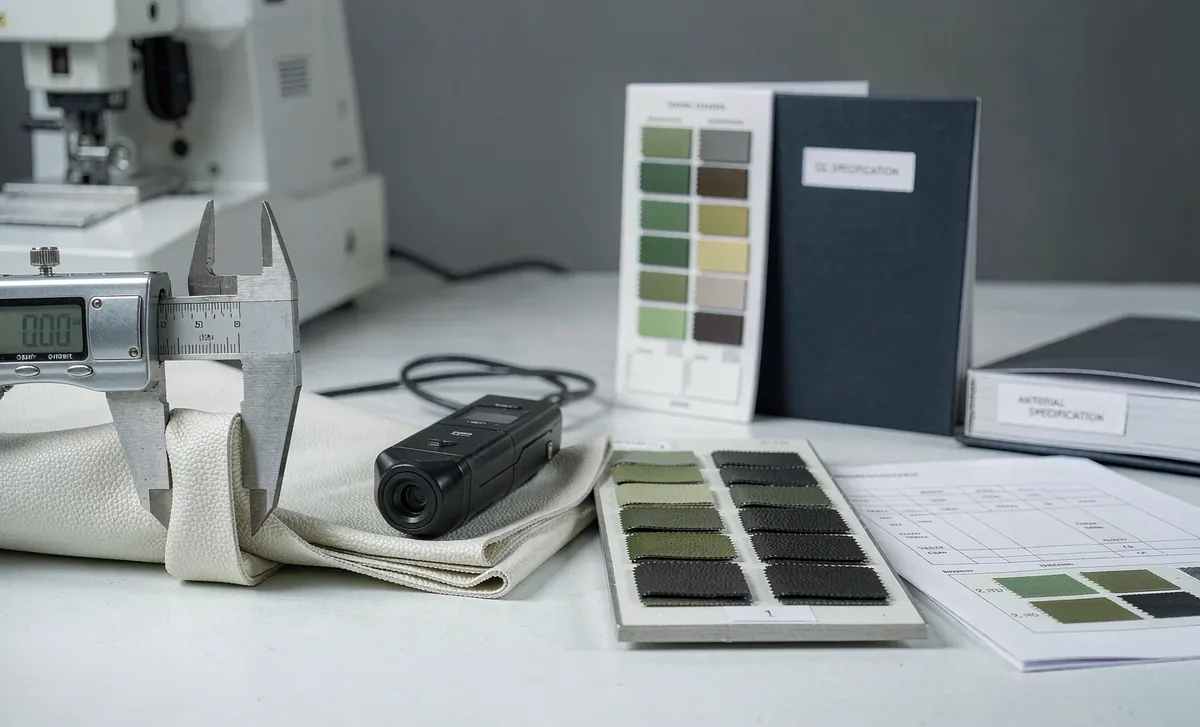
Rubbing, or crocking, is run to ISO 105-X12: a 50 mm fingered head covered with a standard white cotton cloth is rubbed ten times in ten seconds over a 100 mm track under a 9 N load, once dry and once wet with the cloth at 100 per cent pick-up, and the staining of the cloth is then rated on the grey scale from 1 to 5. Water fastness, ISO 105-E01, and perspiration fastness, ISO 105-E04, both sandwich the specimen against adjacent fabrics under controlled conditions and then rate staining and change of shade, the acid and alkaline perspiration solutions being separate tests because they attack different dye classes. We hold 4–5 for rubbing on any printed or dark panel that will meet clothing, and 4 for water and perspiration, because 3 is the point at which a customer sees a mark rather than a laboratory sees a rating. The tests are quick, they are cheap, and they are skipped surprisingly often, with the result that a printed logo rubs onto the lining of a customer's jacket.
Lightfastness and the Blue Wool Scale
Lightfastness is the expensive one, and the one to specify. The method is ISO 105-B02: specimens and a set of eight blue wool reference standards are exposed together in a xenon-arc cabinet under controlled irradiance, temperature and humidity, with the references progressively covered so that each receives a doubling of exposure. The specimen is assessed when the exposure that just produces a grey-scale change of 4 on the relevant reference has been reached, and the result is reported as a number from 1 to 8, where 8 is the most resistant. Our threshold for an outdoor range is 6, and it is a threshold set by use rather than by ambition: a solution-dyed polyester will reach 6 or 7 because the pigment is inside the filament, while a piece-dyed fabric with a reactive or disperse dye on a light shade may stop at 4 and will visibly change over a season of daily sun. We test the dyed substrate and the printed or coated layer separately, and we require the print to be at least one point below the substrate only if a printed panel is small and non-critical — on a large brand panel the two must match.
Why Coated and Laminated Fabrics Fail Differently
On an uncoated textile, colour loss is a dye problem and it is gradual. On a TPU or PVC laminate there is a second mechanism that is faster and more visible: the polymer itself degrades. Aliphatic TPU films resist ultraviolet reasonably well; aromatic TPU yellows; PVC releases hydrochloric acid as it ages and the effect accelerates with heat, which is why a heat stabiliser is a specification item and not aSupplier option. A bag can therefore pass every fastness test on the cloth and still come back from a season in the sun with a yellowed, chalky film, and the way to find that before shipping is accelerated weathering rather than fastness alone. We run a xenon-arc exposure with a filtered spectrum plus a condensation cycle, and we measure two things afterwards: change in colour as delta E against the unexposed control, and retained hydrostatic head, because a film that has lost its plasticiser has also lost its barrier. On a fishing bag used on a tropical charter boat we also add a salt-mist stage, since crystallised salt abrades a film from outside while the sun degrades it from above.
Selecting Colour Construction for the Market
The cheapest way to a durable colour is to build it into the fibre rather than onto it. Solution-dyed polyester costs more per metre and saves the loss; piece-dyed fabric gives a wider shade range in smaller lots, which matters when a buyer wants six colourways at a MOQ of 500 pcs per style and colourway. Our usual recommendation is to spend the solution-dyed premium where the sun will fall — the outer shell of a travel bag lid, the lid of a pack carried on the outside of a rucksack — and to use conventional dyeing on protected surfaces, then to verify the combination with the accelerated programme rather than with a single test. Colour also interacts with the printing method: screen-printed inks sit on the surface and abrade, heat-transfer films sit on the surface and can lift at a fold, and sublimation only penetrates polyester and cannot be used on a nylon ripstop. Each is tested for rub, for flex at a fold and for light before it is approved on a bulk order, and the approved method is written into the technical pack.
Hardware Testing: Salt Spray 48 h, Static Load and Cycle Endurance
Hardware is the category most often bought on brand alone, and brand is not enough by itself. A Duraflex or ITW buckle from a reputable moulder is a well-designed part, but the part we actually fit is that design in a specific polymer with a specific plating, and both are variables. Three tests cover the ways hardware fails in service: corrosion, load and repetition. They are run on production parts pulled from the incoming lot, not on samples from a trade show folder, because the plating thickness on a production batch is what will be under the customer's hand.
Salt Spray 48 Hours: The Method and the Reading
Neutral salt spray is run to ISO 9227 or ASTM B117 under the same conditions in both: a 5 per cent sodium chloride solution, a cabinet temperature of 35 °C, a pH between 6.5 and 7.2, and a continuous atomised fog in a closed chamber with the specimens inclined at 15 to 30 degrees so that condensate does not pool. We expose for 48 hours for a general outdoor product and 96 hours for anything sold into a marine or saltwater market. The reading is where discipline is needed. A part that comes out with a light white bloom has surface oxidation of a zinc or nickel layer and is usually acceptable; a part with red rust has base-metal corrosion and is not, and it is rejected regardless of how faint it is, because visible rust on a plastic-and-webbing product is a return. We rate appearance against reference photographs rather than from memory, and the photographs sit in the lab. The practical procurement point is that the plating specification — and for black finishes, whether it is electroplated, electrophoretic or painted — matters more than the exposure hours. A painted black finish can pass 48 hours and fail 96; an electrophoretic one usually holds.
Static Load and Proof Load on Buckles, Rings and Straps
A buckle is never loaded in the direction the moulding was optimised for, so we load it in the direction it will actually be loaded. Side-release buckles are tested in tensile separation with the webbing bar-tacked as it will be in production, because a buckle that holds 500 N in the rig will fail at 150 N if the webbing slips on the bar. Ladderlocks are tested for webbing slip under sustained load, which is the failure that lets a shoulder strap slowly lengthen over a day's walking. D-rings and rectangular rings are tested with the load applied diagonally across the corner, and cam buckles are tested for whether the cam releases under vibration rather than under a deliberate pull. Our acceptance is a proof load of two times the intended working load held for sixty seconds with no permanent deformation, plus a minimum ultimate strength of three times the working load, and the working load is stated in the technical pack rather than assumed. Webbing is tested alongside it: 25 mm polyester webbing for a general strap, and the bar-tack pattern holding it, since in most real failures the webbing survives and the stitch attachment does not.
Cycle Endurance, and the Cold-Impact Problem
Repetition is what separates a moulding that is strong from one that lasts. We cycle side-release buckles to 5,000 open-and-close operations on a fixture, checking at intervals for the latches becoming either sloppy or stiff, and we cycle ladderlocks and sliders by feeding webbing back and forth under load, which is what gradually wears the locking tooth. The failure is not usually dramatic: at cycle 3,000 the retention force has fallen fifteen per cent, and that is the number we record, because a buckle that still holds but holds less is the one that opens in a customer's car. Temperature is the other half of this test, and it is the one that bites. Polyoxymethylene, used for high-strength acetal buckles, is stiff and strong at room temperature and becomes brittle at low temperature; polyamide absorbs moisture and is tougher cold but creeps more under sustained load. We drop-test and side-impact plastic hardware after conditioning at minus 10 °C, and a part that shatters in that condition is not approved for a product sold into a northern market no matter how good it looked at 23 °C.
Drop, Vibration and Carton Compression for Export Shipments
A bag that passes every material test can still arrive unsellable, and when it does the cause is almost never the bag. It is the carton, the pallet, or the forty days between FOB Xiamen and a distribution centre. Transit testing treats the packed carton as the product, because that is what the shipper handles and what the warehouse stacks, and it is the only category of testing on this page where the buyer's carton specification and the buyer's shipping method are as important as anything we do on the line.
Drop Testing: Where the Carton Lands Matters More Than How High
The standard sequence for a packaged product, used in ISTA 1A and its 2 and 3 series siblings, is ten drops: one flat on a face, one on each of the three edges radiating from the smallest face, and one on each corner, then the remaining faces, so that every face, edge and corner receives an impact. Drop height is set by the weight of the package rather than by preference: 760 mm for a carton up to 9.5 kg, 610 mm from 9.5 to 18.5 kg, 460 mm from 18.5 to 27.5 kg, and 305 mm above that, the heights falling as weight rises because the package that a person can still lift is the package that gets lifted. We run the sequence on a drop tester that releases the carton without imparting rotation, and we inspect the contents rather than the carton: a crushed corner that has not touched a bag inside is cosmetic, and a carton that looks intact over a cracked buckle is a failure. This is why the pack specification — how many units per carton, whether units are separated by a divider, and whether a stiff corner is folded face to face or nested — is a tested decision here rather than a packing-room habit.
Vibration: The Damage That Happens Without Any Impact
Vibration damage does not need a drop. Cartons stacked in a container are excited at low frequency for days, and the failure that results is rubbing: printed panels scuffing one another, coated surfaces marking where they contact, and straps abrading through a polybag. We run both a fixed-frequency sinusoidal sweep to identify resonances and a random-vibration profile representing truck or container transport, typically an hour per axis at a defined overall level, and we inspect for abrasion damage afterwards rather than only for structural failure. The protection that works is boring and cheap: a polybag of adequate thickness, dividers between printed faces, and a carton filled to its volume so that the contents cannot move. An underfilled carton is worse than a slightly overfull one, and this is the single most common packing fault we find in third-party inspections of otherwise good orders.
Compression and Stack Height
Compression testing answers a warehouse question: for how long can this carton sit at the bottom of a stack. A carton is compressed between platens at a constant rate until it yields, and the peak force is its box compression strength. What a buyer needs is not that peak but the ratio between it and the load the stack will apply, and the load is calculated from the number of cartons above and the height of the stack in the destination warehouse. The two properties that determine the carton's strength are the edge-crush value of the board and the perimeter of the box, which is why a change in carton dimensions changes stacking performance even when the board grade is unchanged. We select board by edge-crush value and confirm by compression test on a made-up carton, and we specify a minimum stack duration of one month, because a container that sits at a port for a fortnight followed by a month in a distribution centre is a normal journey, not an exceptional one. Our default is double-wall board for anything shipped as retail-ready cartons and single-wall with internal protection for bulk-packed units.
Humidity, and the Container Itself
The last variable is the atmosphere. A forty-foot container crossing an ocean in summer reaches internal temperatures above 60 °C and condenses heavily on the roof overnight, a phenomenon known as container rain, and the water falls onto whatever is nearest. Two things protect against it: a desiccant calculation sized to the carton count and the journey duration rather than a sachet thrown into each carton, and a moisture barrier in the packing, either a liner bag or a stretch-wrapped pallet. Mould is the consequence of getting this wrong, and mould on a TPU film or a textile is not recoverable — it stains and it smells, and it is a total loss of the cartons affected. We therefore also condition the packing room, packing at the moisture content the material was tested at, and we state on the packing list that cartons should be opened and aired on arrival rather than stacked immediately in a warm warehouse.
Chemical Compliance Testing: REACH, Prop 65, FDA, LFGB, OEKO-TEX
Chemical compliance is the one area of quality where a passed physical test means nothing. A bag can hold water, carry load and survive transit and still be illegal to sell in the market it was shipped to, and the consequences are not a return but a recall. It is also the area where responsibility is shared: we can control what we buy and what we put on it, but the scope depends on the destination and the product's intended use, and that is information only the buyer has in full. We therefore ask for the destination and the use case at quotation, build the compliance scope from it, and put it in the technical pack.
| Scheme | What it covers in practice | Where it applies | What we supply |
|---|---|---|---|
| REACH, EC 1907/2006 | Substances of very high concern on the candidate list at 0.1 per cent by weight, plus Annex XVII restrictions including azo dyes, nickel release, cadmium and certain phthalates | European Union, and required by most EU brand customers regardless of destination | Supplier declarations plus third-party test reports per material, refreshed when the candidate list is updated |
| California Proposition 65 | Listed substances including lead, cadmium, DEHP and other phthalates, and formaldehyde; requires a warning unless exposure is below the safe harbour level | California, applied by most US retailers nationally | Third-party test report on the listed substances relevant to the material; we do not issue the warning wording |
| FDA 21 CFR | Food-contact materials; for us the relevant parts cover the liner film and any layer intended to touch food | United States, on cooler bags and food-carrying liners | Material supplier's food-contact statement plus migration testing on the finished liner when the customer requires it |
| LFGB | German food and feed code; includes overall migration and specific migration plus sensory testing | Germany, and widely accepted across the EU as the stricter alternative | Overall migration and, where the customer requires it, specific migration on the liner material |
| OEKO-TEX Standard 100 | Limit values for pH, formaldehyde, heavy metals, pesticides, azo dyes, phthalates and other parameters, by product class | Voluntary, requested by many European outdoor and baby-product brands | Certificate on materials and components, Class II for products worn close to the skin, Class I for baby articles |
| CPSIA and EN 71-3 | Total lead and phthalates in children's products; EN 71-3 adds migration of nineteen elements | Children's products in the United States and the European Union respectively | Testing on coatings and substrates of every accessible component, including prints and hardware finishes |
Where the Restricted Substances Actually Are
On a bag, the substances of concern are not evenly distributed, and knowing where they sit is what makes a test programme efficient rather than merely expensive. Plasticisers — the phthalates and their substitutes — are in PVC coatings, in soft touch prints and in some synthetic leather trims. Azo dyes that can cleave to a listed aromatic amine are in dyed textile, particularly in deep black and deep red shades, and they are in printed inks. Heavy metals appear in pigment prints, in some metal hardware finishes and in the plating of eyelets. Formaldehyde appears in some textile finishing resins and in some adhesives. Nickel release is a plating issue on metal parts in prolonged skin contact. What this means in procurement terms is that a test report on the shell fabric tells you almost nothing about the print on it or the slider on the zipper, and a compliance programme that samples one component is mostly a document. We build the scope from the bill of materials, component by component, and we ask for the supplier declaration on each before we ask for a test, because a declaration that names a substance reduces the testing to confirmation.
Report Validity, and the Question to Ask About Any Certificate
A chemical test report describes a sample submitted on a date. It does not describe what the mill is making this quarter. Most brands and most laboratories therefore treat a report as valid for twelve months on a material that has not changed, and that treatment is reasonable only if someone verifies that the material has not changed — which is why our incoming procedure requires a fresh supplier declaration for each lot even where the report is current, and why a reformulation at the mill invalidates the certificate immediately. The two questions worth asking any supplier are: is this report for the specific material in my order or for a generic material of the same type, and does the scope on the report cover the components as well as the fabric. A certificate showing a shell fabric alone, on a product with painted eyelets, printed panels and a PVC-coated base, is not a compliance position. On our side, the cadence is annual refresh for stable materials, immediate retest on any change of supplier or formulation, and a finished-product screening test where the customer's retail channel requires one.
Inline Inspection: What Our Line QC Checks Every Hour
Final inspection is a verdict; inline inspection is a control. The two work on opposite principles. Final inspection draws one large sample from a finished lot and accepts or rejects. Inline inspection draws a small sample very frequently and acts on it while the process is still running, which is the only arrangement that catches a drift in the hour it started rather than a shift later. Each of our seven lines has an inline QC who does not make product and does not report to the line supervisor, and the circuit is timed rather than discretionary.
The Hourly Circuit
Every hour the inline QC takes three finished or semi-finished units from the current operation and measures against the card for that operation. Three is deliberately small: the value is in the frequency, and the statistics of a continuous process are served better by thirty checks of three than by one check of ninety. Results are written on a board at the station at the time, not entered at the end of the shift, and the board carries the action limits as well as the readings, so an operator can see whether a number is approaching the edge without waiting to be told. When a reading crosses the action limit, the QC stops the operation, the supervisor clears it, and the pieces made since the last good check are quarantined for sorting. When a reading merely trends towards the limit without crossing it, nothing stops, but the trend is what the daily review looks for, because most excursions are preceded by two or three hours of visible drift.
What Is Measured at Each Station
The measurement set is tied to the failure mode of that operation, not to a generic checklist. In cutting, panels are checked against the pattern with a template, and a deviation beyond 2 mm on a mating edge is a reject because it will not meet the next panel cleanly. In the welding hall, the QC measures the visible weld land width, inspects for pinholes against a light table, and pulls a coupon for peel on the rig, so the peel result for the hour is on the board by ten past. In the sewing cells the QC counts stitches per inch over a measured length — 8–10 SPI is our specified band — and checks seam margin and the position of the needle line relative to the tape. At taping, the QC measures tape centring over the stitch line and pulls a tape adhesion coupon. At reinforcement, the QC checks bar-tack coverage and the distance from the stitch to the edge. At finishing, the QC checks for thread ends, for the presence and position of every label and for the print position against the approved layout. Each of these takes a minute or two, and each of them catches a fault at the point where it can still be corrected in one operation rather than scrapped.
First Piece, Changeover and the Two Moments Most Likely to Be Wrong
Two moments account for most of the defects an inline circuit finds, and both are predictable. The first is the first piece of a run: a machine set up from a card, even by an experienced setter, is a hypothesis until the first piece is measured, so the first three units of every operation are checked completely and signed off before the run continues. The second is the changeover — a new colour, a new size, a new fabric lot, or a machine returned to service after maintenance. Every changeover is treated as a first piece and requires the same full check and signature, because a hot-air welder set for 500D will not weld 1000D on the same parameters, and a sewing machine returned from repair will not hold the same timing. We also require the operator to keep the previous approved piece at the station as a physical reference. This sounds procedural and it is, but the reason it exists is that a bulk run of 5,000 pieces made on the wrong parameters is not a quality problem, it is a commercial one, and a 35–50 day bulk lead time does not include a re-run.
Non-Conformance Handling: Rework, Sort, Concession and Root Cause
When a check fails, four dispositions are available, and the discipline is to choose between them deliberately rather than by convenience. Rework returns the unit to a previous operation and makes it correct. Sort separates the affected quantity and removes the faulty units. Concession accepts a known deviation with the customer's written agreement. Scrap destroys the unit and takes the loss. The four are not equivalent and the most expensive failures we have seen in this industry came from a supplier who used concession as the default because it required no work.
| Disposition | When it is available | What it costs | Who must agree |
|---|---|---|---|
| Rework | The fault is mechanically reversible: a seam can be re-welded, a tape can be re-applied, a label can be replaced | The operation repeated plus handling; typically one to three days on the affected quantity | Our QC supervisor, and the customer if it affects the delivery date |
| Sort | The fault is intermittent and can be identified by inspection or a functional test | Inspection labour on the whole suspect quantity, plus the yield loss on what is found | Our QC supervisor; 100 per cent sorting is charged only when agreed in advance |
| Concession | The deviation is visible or measurable but does not affect fitness for use, and no regulation is involved | Usually a price adjustment, and it is the only disposition that changes the contract | The customer in writing, before shipment. Never applied to a critical or a compliance deviation |
| Scrap | The fault is not reversible or the rework is not economic | The unit, the material and all labour spent on it | Our production manager; recorded against the order and the root cause |
What We Do Not Concede
Three categories are excluded from concession in our system regardless of who asks. A critical defect, because a leaking waterproof envelope or a failing load-bearing attachment is a failure of the product's stated purpose and no discount makes it acceptable. A compliance deviation, because a restricted substance is not negotiable between two parties when a third party, the regulator, has the real interest. And a deviation the customer has not seen, because a concession granted on a description rather than on a physical sample is a surprise waiting at the distribution centre. In each of those cases the disposition is rework or scrap. We state this on the non-conformance report so that it is visible when the report is circulated, rather than being a policy discovered later.
Root Cause, and Why the First Answer Is Usually Wrong
Every non-conformance that reaches the sort or scrap stage carries a root-cause field, and the field has to be completed before the order is closed. The method is unglamorous and it is the asking of why, repeatedly, until the answer stops being a person and becomes a condition. A leaking seam is found. Why. The weld did not fuse. Why. The hot-air temperature was low. Why. The machine had been switched to a different material at 14:00 and the card was not changed with it. Why. The changeover procedure requires a first-piece check and the check was signed without being performed. That last step is the one worth having, because the first three are all true and none of them prevent recurrence — the fourth changes something. We use the same structure for the fishbone categories when a problem is diffuse: material, machine, method, measurement, environment and people, in that order of suspicion, because people are the easiest thing to blame and the hardest thing to fix an outcome with.
Closing the Loop
A corrective action that is not verified is a sentence. Each action is assigned an owner and a date, and the verification is a measurement rather than an intention: the next two lots of the same style are sampled on a tightened plan and the specific characteristic that failed is measured on ten units rather than on the AQL sample. If the characteristic holds, the action is closed and the plan returns to normal; if it drifts, the action is reopened and the cause is sought again. Recurrence is tracked as a count, and the count is what tells us whether a particular construction is a reliable one to sell. For a buyer this is the part worth enquiring about: ask which of your supplier's recurring problems are closed and which are still open, and the answer tells you more about your next order than any certificate does. The commercial terms around a failure — replacement, credit, and our 12-month warranty against manufacturing defects — are on the services page.
Third-Party Inspection Support and What to Prepare
A third-party inspection is not a test of us, it is a test of the documentation. An inspector arriving without a definition of what to check will check what they can see, and what they can see depends on what you sent them. Most disputed inspection results are not disagreements about a bag; they are disagreements about a tolerance that was never written down, resolved after the fact by someone who was not in the room when the order was placed. Preparing for the inspection properly is therefore not administrative support, it is the part of the process that decides whether the result means anything.
The Document Set We Send Before an Inspection Is Booked
Seven documents go to the buyer, and through the buyer to the inspector, before a booking is confirmed. The purchase order, so that quantity, packing and the agreed delivery window are fixed. The technical pack with the construction sheet and the bill of materials, so that the inspector is checking against the same specification we built to. The approved golden sample reference, with photographs if the physical sample cannot travel, so that a construction detail is not a matter of opinion. The packing list with carton numbers and per-carton quantities, so that random carton selection is genuinely random and the opened cartons can be identified afterwards. The agreed AQL and inspection level, together with our defect classification sheet, so that the counting rule is shared. The internal inspection record for the lot, which we supply whether or not it flatters us, because an inspector who finds something we missed will treat the rest of the report more seriously if the record was honest. And the current compliance documents, so that the inspector does not raise a chemical requirement that was never in scope.
Logistics and Timing
Book the inspection for the day the lot is complete, not for the day you hope it will be. The booking should be placed five to seven working days before the required date, and the booking should state the inspection level, the AQL and the defect classification, plus any special checks the buyer wants: a specific functional test, a barcode scan, a carton drop, or a check of the label layout against the artwork. On our side, the lot must be at least eighty per cent packed and available in a defined area before the inspector arrives, because a pre-shipment inspection of a partly packed lot is invalid under the standard and the inspector is entitled to refuse it. We reserve a working area with adequate lighting and a bench, and we do not have our own QC in the room during the count: the inspector works alone, which is both the requirement and the point. If a result is disputed, the physical samples and the photographs exist on both sides, and the discussion is about evidence rather than memory.
The Failures That Third-Party Inspections Most Often Find
From our own records, four findings account for most rejections, and three of them are avoidable before the inspector arrives. The first is packing faults: wrong quantity in a carton, a mis-marked carton, or an underfilled carton whose contents can move. The second is cosmetic inconsistency between panels, usually a shade difference between a front panel and a side panel cut from different rolls, which is a roll-grouping discipline problem. The third is a functional fault that the buyer never specified a threshold for, most often a zipper that is stiff, and this is why the technical pack should state numbers rather than adjectives. The fourth is a genuine process fault, and it is the only one that a factory should have caught itself. If an inspection finds the first three, the factory's documentation was weak; if it finds the fourth, the factory's gates were weak. Both are worth knowing, and only one of them is fixed by working harder on the line.
Re-inspection, and What It Costs Everyone
A rejected lot can be re-presented. Our procedure is that the rejection is dispositioned first — rework, sort, or scrap — and the affected quantity is then re-presented on a tightened plan, with the specific failed characteristic measured on an enlarged sample. A re-inspection costs a second inspection fee, a second visit, and usually a week, and it is the most expensive way to find out that a specification was unclear. The cheap alternative is a pre-production meeting where the classification sheet and the tolerances are agreed, and it is worth the hour. We hold that meeting on request for any first order, and the output is a signed sheet that travels with the order and settles most arguments before they start. Details of how the inspection fits into the wider commercial sequence are on the services page, and the people who run it are introduced on the about page.
Bring Us Your Specification and We Will Quote the Test Programme With It
Quality requirements belong in the quotation, not in an email sent after the order is placed. Send us the product you want to make — construction, materials, target markets, and any retail compliance scheme you have to meet — and we will come back with a test schedule that names the methods and the thresholds for each of them, a sampling and inspection plan stating the AQL, level and defect classification we propose, and a price for the standard programme and for any tighter alternative you ask for. Sampling takes 6–10 working days, 12–15 for a complex structure, and bulk runs 35–50 days after sample approval at 500 pcs per style and colourway. If you have an existing specification, a failed inspection report, or a competitor sample you want us to benchmark against, send that instead and we will tell you what we can hold to and what we would change. Reach us at service@junyuanbags.com, or look through the ranges we apply this to across waterproof backpacks, travel bags, cooler bags, fishing bags and sports bags.
If you are comparing suppliers, the fastest way to separate them is to ask each one the same four questions and compare the answers in writing: what is your peel-strength threshold and how often do you measure it, what sample size do you draw at General Level II for a 3,000-piece lot, which components are covered by your chemical compliance scope, and what percentage of hydrostatic head does your fabric retain after abrasion. A supplier who answers all four with numbers has a system; a supplier who answers with adjectives has a certificate. We will answer all four for your order, and we will put the answers in the technical pack so you can hold us to them. For a faster reply, message us on WhatsApp at https://wa.me/8617750020688 with the construction, quantity and target market, and we will send the schedule the same working day. Or send the full brief by email to service@junyuanbags.com and we will return it with the test programme, the sampling plan and the quotation attached. The physical sequence behind all of this is described on the manufacturing page, the commercial terms around it on the services page, and the fastest route to a written quotation is the contact page.
Frequently Asked Questions
What exactly does AQL 2.5 mean for a 3,000-piece order?
Under ISO 2859-1 at General Inspection Level II, a lot of 1,201–3,200 pieces draws code letter K and a sample of 125 units drawn at random from sealed, packed cartons. At AQL 2.5 the accept number is 7 and the reject number is 8, so up to seven major defects pass the lot and the eighth fails it. Critical defects are held at zero acceptance on a separate count, and minor defects are counted separately at AQL 4.0 with an accept number of 10. A clean result means the lot passed a statistical plan, not that every bag is faultless.
Can we ask for a different AQL than 2.5?
Yes, and it should be agreed before quotation rather than at inspection. A tightened AQL such as 1.0 lowers the accept number and increases the chance that a given lot is rejected; a 100 per cent functional screen removes the sampling risk entirely. Both add cost, because a rejected lot and a screened lot both consume time and labour. We quote the alternative explicitly so that a buyer is choosing an inspection standard with a price attached rather than discovering the price later.
Which standard do you use for hydrostatic head testing, and what are the pass values?
We test to the ISO 811 principle: a 100 cm² specimen with the coated face towards the water, pressure raised at 60 cm of water column per minute, read at the third drop appearing at a distinct location. The pass thresholds are 10,000 mm for lightweight shells such as 420D nylon ripstop and 500D polyester TPU laminate, and 20,000 mm for heavy-duty shells including 840D and 1000D TPU laminates and 500D PVC. We also retest after abrasion and cold-folding, because a fresh reading is a receipt rather than a prediction.
How do you test that a welded seam will not leak?
Three ways, because each answers a different question. Peel strength is measured on a tensile rig on a 25 mm strip at 100 mm per minute, held at a floor of 8 N/cm, with the failure mode read as carefully as the number. Burst testing loads a circular sample with the seam at its centre until it fails, and we look at where it fails. Water penetration is then verified on the finished product in the rain room and, for a submersible rating, by holding the loaded bag at its rated depth for the rated time.
Do you test finished bags or only fabric samples?
Both, and the finished-product tests are the ones that find real leaks. A flat coupon cannot reproduce the triple junction where a side panel meets the base and a webbing tab, or a roll-top closure folded four times over a stiffener, and those are the places water enters. We therefore run coupon tests for incoming material and process control, and whole-product rain-room and submersion tests on finished assemblies from every production run.
What does salt spray 48 hours actually prove about hardware?
It accelerates a corrosion mechanism rather than predicting a service life. A 5 per cent sodium chloride fog at 35 °C for 48 hours will reveal pinholes in a plating, an inadequate plating thickness, or a painted finish that should have been electrophoretic. We rate the result against reference photographs: a light white bloom is usually acceptable surface oxidation, and any red rust is a rejection. For a marine market we extend the exposure to 96 hours.
Is our order covered by a warranty?
Yes. Every order carries 12 months against manufacturing defects from the date of shipment. The warranty covers a fault in materials or workmanship that was present when the bag left, and it is only meaningful because we keep lot-level records: a claim arriving months later can be traced back to a roll, a shift and a machine, which is what lets us separate a production fault from wear or misuse.
Can you supply REACH, Prop 65 and OEKO-TEX documentation?
We can, on materials and components we source, and the scope has to be built from your destination and your intended use. REACH documentation covers the candidate list and Annex XVII restrictions; Proposition 65 covers the listed substances relevant to your materials; OEKO-TEX Standard 100 certification is available at Class II and, for baby articles, Class I. We supply supplier declarations per material lot plus third-party test reports, refreshed annually or immediately on any reformulation.
Do we need FDA or LFGB testing on a cooler bag?
If the liner is intended to touch food, yes for the market you are selling into. For the United States the relevant parts of FDA 21 CFR apply, and for Germany and much of the European Union the LFGB requirements, including overall migration, are the stricter route. We supply the material supplier's food-contact statement and, where a customer requires it, arrange migration testing on the finished liner material. Tell us the market at quotation so the scope is built in.
What happens if an inspection fails?
The lot is dispositioned before anything else happens: rework if the fault is mechanically reversible, a 100 per cent sort if it is intermittent and identifiable, scrap if neither is economic, or a written concession if the deviation is visible but does not affect use. Critical defects and any compliance deviation are excluded from concession in every case. The quantity is then re-presented on a tightened plan with the failed characteristic measured on an enlarged sample.
Can we arrange our own third-party inspection?
Yes, and we support it. We send the purchase order, technical pack, golden sample reference, packing list, agreed AQL and defect classification sheet, our internal inspection record for that lot, and the current compliance documents before the booking is confirmed. The lot is available in a defined, lit working area, and our own QC is not in the room during the count. Book five to seven working days ahead.
How often do you inspect during production?
Every hour, on every line. An inline QC takes three units from the current operation, measures against the card for that operation, and records the result on a board at the station at the time. Three is deliberately small because the value is in frequency: thirty checks of three catches a welding drift in the hour it started, while a single final check finds it after a shift of production is already suspect.
What is the minimum order quantity for a custom style?
500 pcs per style and per colourway. That level exists for a quality reason as much as a commercial one: it is the point at which we can buy a single fabric lot, hold a pre-production meeting, run the incoming and inline programme, and still keep the unit cost inside the 35–50 day bulk window. Below it, material lot variation and setup amortisation both work against consistency.
How long does sampling take before bulk production starts?
Sampling takes 6–10 working days for a standard construction and 12–15 working days for a complex structure with new tooling or a new material. That period includes the pre-production sample made from bulk materials rather than substitutes, and the laboratory schedule that qualifies those materials. Bulk production then runs 35–50 days after sample approval.
Will you send us the raw test data, not just a summary?
Yes. On request we issue the full record for a lot: incoming fabric scores with roll identities, peel traces and hydrostatic readings with the date and the operator, the inline boards for the production days, the final sampling sheet with the carton numbers drawn, and the non-conformance reports with their root-cause fields. A summary tells you a result; the record lets your own technical team check whether the result was reached properly.