Waterproof Fishing Bags Manufacturer
We build marine-grade waterproof fishing bags and tackle backpacks for anglers and fishing brands. Every bag uses saltwater-resistant TPU, welded seams and rust
What a Fishing Bag Has to Survive (Salt, Sand, Spray and Sharp Hardware)
Every sector in waterproof soft goods makes some claim about abuse resistance, but angling is the one environment in which the abuse arrives from four directions simultaneously and does not stop between trips. A sourcing team evaluating a waterproof fishing bag manufacturer is not really buying a specification sheet; it is buying resistance to a compound load. Chloride-laden spray dries into crystals inside every stitch line and zip coil. Silica sand works like lapping compound into the same places. Ultraviolet radiation arrives reflected off open water at close to twice the effective dose of a shaded inland setting. And the payload itself — stamped steel treble hooks, split-ring pliers, fillet knives, jig heads by the hundred — will cut an unsupported liner panel in a single careless afternoon. Specify against any one of those four factors and the bag still fails on the water, usually in the second season and usually after the retail return window has already closed.
The commercial consequence of getting this wrong is disproportionate to the cost of getting it right. A tackle bag that delaminates or seizes its zip mid-season becomes a one-star review on a marketplace listing, and that review attaches itself to every other SKU sharing the listing's parent ASIN. Brands launching a first private-label fishing range rarely get a second purchase-order cycle on the strength of a discount alone. This is why our engineering conversations start with the failure mode you are permitted zero instances of, rather than with a target price; the two constraints are connected but they are not interchangeable, and the order in which they are settled determines whether the quoting exercise takes one round or five. Our full production capability, including line allocation and audit documentation, is described under manufacturing.
Chloride, Abrasion and Ultraviolet Acting Together
The interaction between the four factors is what destroys bags, more than any single factor. A fabric that survives 500 hours of xenon-arc exposure will survive considerably less once it has been abraded to a fuzzy face by sand in a truck bed, because UV degradation proceeds fastest at the exposed filament surface and abrasion continuously creates new surface. Similarly, a seam that passes a hydrostatic head test at 20,000 mm on a new sample will pass less reliably at cycle fifty if salt crystals have been compacted into the stitch holes by repeated flexing. Field behaviour is multiplicative, so laboratory results should be read as a floor rather than a prediction. Our quality documentation sets out which tests we run as standard on every lot and which must be commissioned separately.
The Payload Is the Abrasive
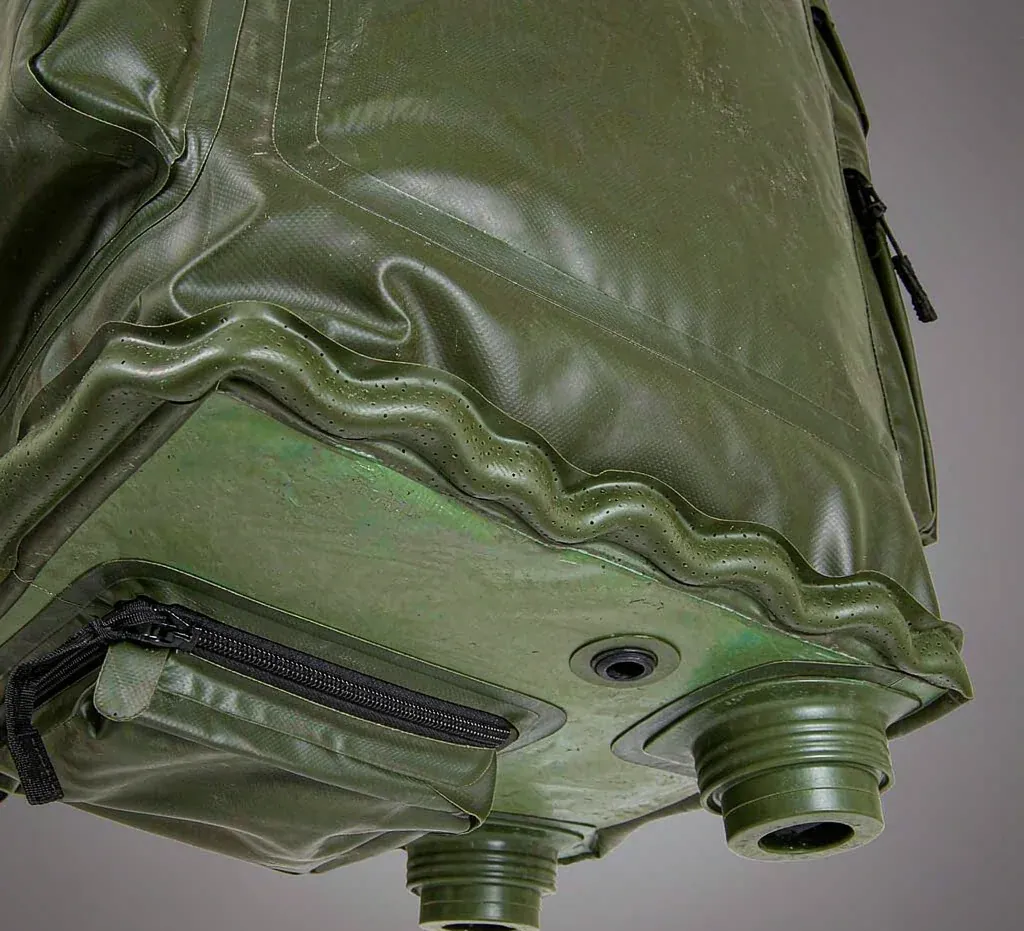
Hooks are the most underestimated element in a tackle bag brief. A size 4/0 treble hook has points ground to a geometry designed to pass through cartilage and scale; it has no difficulty passing through a 420D liner that was specified for weight rather than puncture resistance. The practical defence is not a heavier liner everywhere, which adds cost and stiffness to panels that never touch tackle, but a zoned construction: a puncture-resistant base from 1000D polyester TPU laminate or 500D PVC tarpaulin, with lighter 420D nylon ripstop on the upper side panels where weight matters more. Zoning also helps the bag stand up when set down, because a stiff, heavy base forces the profile to keep its shape instead of folding around its own contents.
Weight distribution matters nearly as much as puncture resistance. Four loaded 3700-format trays plus terminal tackle and a litre of water puts a 35-litre backpack in the 11 to 14 kilogram range before the angler adds a wading belt. Every strap attachment point, every tray shelf seam and every floor-to-side transition has to be engineered for that number with a sensible margin, not for the empty-bag weight that appears on most product pages. When we review a tech pack, the first calculation we run is loaded centre of gravity against the position of the shoulder strap anchor, because a bag that carries well empty can still torque badly once fifteen kilograms of tray sits forty millimetres further from the spine than intended.
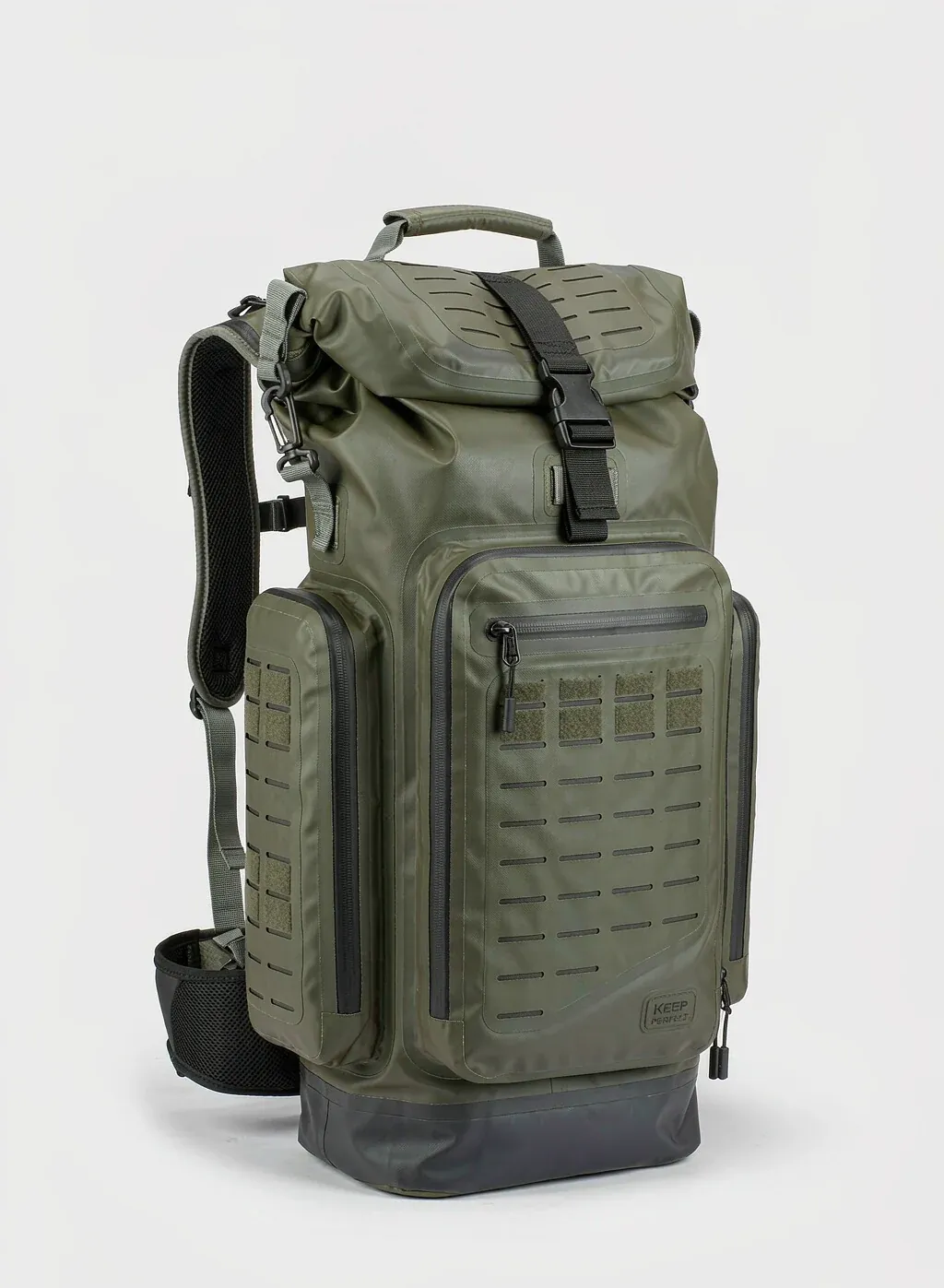
Six Fishing Bag Formats and Where Each One Sells
Six formats account for the overwhelming majority of private-label custom tackle bag OEM programmes we build. They share materials, hardware, webbing and branding processes, which means a buyer can assemble a coherent range from one factory with one set of colourways and one compliance file, rather than negotiating six separate supplier relationships. They differ, however, in one important respect: the amount of hands-on development each one demands before the first shipping sample is acceptable. Understanding that difference is what keeps a first-season range on schedule, because the temptation is always to develop every format at once and discover too late that the box-style case and the surf bag both need two extra tooling rounds.
| Format | Working volume | Governing construction | Primary retail channel | Development load |
|---|---|---|---|---|
| Tackle backpack | 28–45 L | 840D or 1000D polyester TPU laminate body, moulded EVA back panel, two to four internal tray slots | Specialist tackle shops, direct e-commerce, club team sales | Medium: suspension tuning dominates the sampling rounds |
| Soft tackle bag / case | 15–30 L | 600D TPU laminate or PVC tarpaulin, frame sheet for shape, top-load tray well | Big-box sporting goods, promotional programmes, entry private label | Low–medium: fastest route to a sellable first sample |
| Box-style tackle case | 18–28 L | Rigid PP or ABS tub dropped into a welded fabric shell, lid-loaded tray stack | Catalogue retail, chandlery and boat-supply chains | High: tub tooling lead time drives everything |
| Wader and boot bag | 55–90 L | 500D PVC tarpaulin, full drainage floor, vented side panels, boot tunnel | Fly-fishing specialists, lodge and guide programmes | Medium: pattern work rather than hardware complexity |
| Surf fishing bag | 40–60 L | 1000D TPU laminate, external rod tube pair, sand-spike sleeves, corrosion-upgraded hardware | Coastal independent retailers, founder-led brands | High: every trim item has to be marine-rated |
| Dry bag for kayak fishing | 10–30 L | Roll-top 420D or 500D TPU, RF-welded seams, submersible closure | Paddle-sports chains, kayak accessory programmes | Low–medium: clean once the electrode is proven |
Accessory SKUs That Share the Same Platform
Two further items are usually ordered alongside the six core formats because they consume the same bill of materials and the same radio-frequency electrode programme: the lure roll and the rod bag. A lure roll is a soft storage panel with ten to twenty clear PVC or TPU sleeves for soft plastics and hard lures, closed with webbing and a side-release buckle. It is low-risk to produce but highly visible at point of sale, and for many brands it is the SKU that gets the range onto a retailer's shelf in the first place, because it carries a lower ticket and occupies a smaller footprint than any bag in the family. The rod bag — a padded sleeve or tube for one to four rods — is the highest-value perceived item in the whole range for comparatively little material.
From a production standpoint both items let us amortise setup. Cutting dies, moulded badges and print screens established for the tackle backpack are reused directly, and because both are small, they make efficient use of fabric offcuts from the larger bags. Those two properties mean the accessory SKUs frequently carry the healthiest margin in the range even though their unit prices are lowest. Buyers assembling an opening order often ask whether it makes sense to begin with one hero bag; our answer is usually to pair the hero with a lure roll, because the combination gives a retailer something to merchandise together and gives the brand two price points instead of one.
Retail position and user expectation also diverge by region, and the divergence is sharper in fishing than in most categories we make for. Northern European and North Atlantic buyers overwhelmingly want hands-free formats with drainage and highly visible safety detailing, and they will pay for 1000D construction. Warm-water markets in Southeast Asia, the Gulf and parts of Australia place much more weight on ventilation, light colour and rinse-down convenience, and will trade abrasion resistance for weight. A range planned for one of those markets and shipped to the other typically underperforms by a wide margin, which is why we ask for the destination before we propose materials. Related carry categories sit under sports bags and cooler bags, and several buyers run all three programmes off one set of colourways.
Marine-Grade Materials: TPU, PVC Tarpaulin and Coated 1680D
Material choice is where most of the debate happens, and it is also where a surprising number of myths about a marine-grade TPU fishing bag originate. Three families cover virtually every credible build: thermoplastic polyurethane laminate, PVC tarpaulin, and PU- or TPU-coated woven polyester or nylon. Each has a distinct welding behaviour, a distinct cold-flex profile and a distinct regulatory story, and the choice between them should be driven by the panel's job rather than by the overall concept of the bag.
Reading the Difference Between TPU Grades
Within TPU there is a distinction that matters more to anglers than any marketing language: whether the polyurethane is polyether-based or polyester-based. Polyester-based TPU offers superior abrasion and tear performance on paper and costs marginally less, but it is susceptible to hydrolysis — the ester linkage reacts with moisture over time, and warm humid storage accelerates the reaction. Polyether-based TPU resists hydrolysis and microbial attack considerably better, which is the reason it is the standard choice for marine upholstery and inflatable boat fabric, and the reason we recommend it for any fishing bag expected to live in a garage, a boat locker or a tropical humidity cycle. The specification line that protects you is short: state polyether TPU, state the film thickness, and state the basis weight of the face fabric separately.
| Material | Barrier construction | Typical hydrostatic head | Fabric weight range | Where we specify it |
|---|---|---|---|---|
| 1000D polyester TPU laminate | TPU film 0.20–0.30 mm laminated to 1000D face, PU back coat near 0.15 mm | ≥ 20,000 mm | 420–500 g/m² | Backpack and surf bag bases, tray well floors, any panel that meets hooks |
| 840D nylon TPU laminate | TPU film 0.15–0.25 mm on 840D nylon | ≥ 15,000 mm | 300–380 g/m² | Main body panels of mid-weight tackle backpacks |
| 500D PVC tarpaulin | PVC coating near 0.35 mm on open-weave scrim | ≥ 10,000 mm | 480–600 g/m² | Wader bags, boat bags, welded wet compartments, budget price bands |
| 600D polyester TPU laminate | TPU film 0.10–0.20 mm | ≥ 10,000 mm | 230–300 g/m² | Entry price bands, soft tackle cases, roll-top dry bags |
| 420D nylon ripstop with PU back coat | Single-side PU coat, taped seams at 20 mm | 3,000–8,000 mm | 120–170 g/m² | Lightweight side panels, dust covers, packs supplied where spray rather than immersion is the risk |
| Coated 1680D polyester | Heavy PU/PVC back coat on 1680D woven face | 8,000–15,000 mm after taping | 550–700 g/m² | Abrasion panels on lash-down surfaces, budget heavy-duty builds |
PVC Tarpaulin and Coated Heavyweights
PVC tarpaulin welds beautifully by high-frequency welding, takes print well after surface treatment, costs less per square metre than TPU laminate, and is the practical answer for wader bags and boat bags where the face never touches tackle. Its weaknesses are known and manageable if they are planned for: plasticiser migration makes the surface tacky after long storage in heat, glass transition makes the panel stiff and crack-prone below roughly minus ten degrees Celsius, and certain phthalate plasticisers are restricted under REACH Annex XVII and California Proposition 65. For European and Californian retail channels we specify non-phthalate plasticiser systems and document them, which costs a small premium and removes a compliance objection that otherwise appears late in the season.
Coated heavyweights such as 1680D polyester deserve a specific note. They are extremely abrasion-resistant and the weave gives a technical appearance that photographs well, but they cannot be radio-frequency welded into a watertight seam reliably, because the woven core remains hygroscopic and will wick moisture along the stitch line. The correct build for a coated heavyweight is cut-and-sew construction with stitch density at 8–10 SPI followed by a 20 mm taped seam, sometimes upgraded to a bonded-and-stitched hybrid where the seam is first ultrasonically or thermally bonded and then reinforced by stitching. Bonded-and-stitched seams add process time but measurably raise peel strength, and our standard acceptance figure for a welded or bonded seam is a peel strength of at least 8 N/cm on the production sample.
Two further checks belong in every material brief and are frequently omitted. The first is ultraviolet stability: ask for xenon-arc or QUV exposure data against ISO 4892 and colourfastness to light against ISO 105-B02 with an acceptance grade of 4 or better at the relevant exposure step, because printed tackle bags fade fastest exactly where they are most visible — on the retail peg and on the boat rail. The second is cold flex: specify how the panel behaves after conditioning at minus ten degrees, because a bag that shatters when opened in a Canadian or Hokkaido driveway arrives as a warranty claim that no amount of laboratory data will talk away. Recycled polyester face fabrics with Global Recycled Standard documentation are available across the range for programmes that carry a sustainability claim, and they weld identically to virgin equivalents.
Salt Water Corrosion: Hardware Specs, Salt Spray Hours and Plating Choices
Hardware is the most common reason a fishing bag comes back in year two, and it is also the cheapest thing to fix in the specification phase. The mechanism is straightforward: sodium chloride solution is a strong electrolyte, so once moisture bridges two dissimilar metals the galvanic couple drives corrosion at the anodic member at a rate that surprises everyone. Zinc-alloy buckles, brass eyelets, anodised aluminium hooks and mild-steel rivets all appear attractive on a sampleshelf and all fail predictably within one or two seasons of genuine saltwater use. Choosing correctly costs a few cents to a couple of US dollars per unit depending on how far up the scale you go, and it is the single most defensible quality investment in the whole bill of materials.
What the Salt Spray Number Actually Means
Neutral salt spray testing to ASTM B117 or ISO 9227 is the shared language of this subject, and it is routinely misread. A result quoted in hours describes the elapsed time to a defined appearance change under a continuous five-percent sodium chloride fog at 35 °C — typically white rust for zinc surfaces or red rust for steel — not a survival time in service. A component rated 48 hours to white rust will not last 48 hours on a boat. What the number does give you is a repeatable comparison between candidate finishes, provided they were tested side by side against the same acceptance criterion. Our baseline factory spec is 48 hours to white rust with no visible base-metal corrosion, and every upgrade beyond that is a documented option priced separately. Always ask whether red rust or white rust is the reported endpoint, because the difference between the two endpoints can be several hundred hours.
| Component option | Finish process | Typical salt spray result | Practical limitation | Recommended application |
|---|---|---|---|---|
| Zamak die-cast, black chrome plate | Copper-nickel-chrome electroplate | 48 h to white rust | Once the plate is breached the zinc substrate pits quickly | Decorative logo plates, covered hardware, freshwater price points |
| Steel, zinc-nickel alloy plate | Alkaline zinc-nickel plus passivate | 200–500 h to red rust | Slightly warmer colour than chrome; needs a consistent plater | Strap adjusters, D-rings, load-bearing metal |
| 304 stainless steel | Passivated | 96–200 h | Pitting risk in warm stagnant salt water | Screws, hooks, general boat use |
| 316 stainless steel | Passivated, marine grade | 500–1,000 h | Material and machining cost three to four times 304 | Rail-mounted hooks, anything permanently exposed |
| Acetal / POM engineering plastic | Injection moulded, UV-stabilised | Not applicable; no corrosion | Ultimate strength falls with prolonged UV unless stabilised | Side-release buckles, ladderlocks, webbing hardware |
| Anodised aluminium | Sulphuric anodise with seal | Poor in chloride service | Pitting and white bloom within one season | Not recommended for marine use |
Design Rules That Outlast Any Plating
Three design rules do more for corrosion resistance than any plating upgrade. First, isolate dissimilar metals: never let stainless touch aluminium or carbon steel without a nylon washer, star washer or plastic ferrule between them. Second, eliminate water traps: any folded metal part or recessed eyelet that holds a droplet of salt water becomes a corrosion cell that operates even while the bag is stored dry. Third, prefer engineering plastics wherever the load path allows it. An acetal buckle from an established hardware maker will outlast any plated metal fitting on a saltwater boat, costs less, weighs less, does not conduct heat or cold to the hand, and can be colour-matched to the range.
Eyelets deserve separate attention because they are the single most frequently mis-specified trim item we see. Brass eyelets develop a green verdigris bloom that discolours surrounding fabric and signals poor quality even when the eyelet is structurally fine. Where a drain hole or lash point genuinely requires metal, specify nickel-plated brass with a reinforcing washer through double-thickness webbing, or move to a moulded rubber grommet which has no corrosion pathway at all. Where eyelets are purely decorative, delete them; the cost saving is small but multiplies across every SKU in the range.
Finally, put rinse advice on the hangtag. Even a fully marine-specified bag benefits from a freshwater rinse, and telling the customer to do it costs nothing, reduces warranty noise, and demonstrates that the brand understands saltwater conditions. Our sourced hardware comes from recognised makers with traceable plating batches, and lots are verified against the same inspection protocol used on the fabric and seam work.
Tackle Storage Architecture: 3700 / 3600 Box Compatibility and Layout Planning
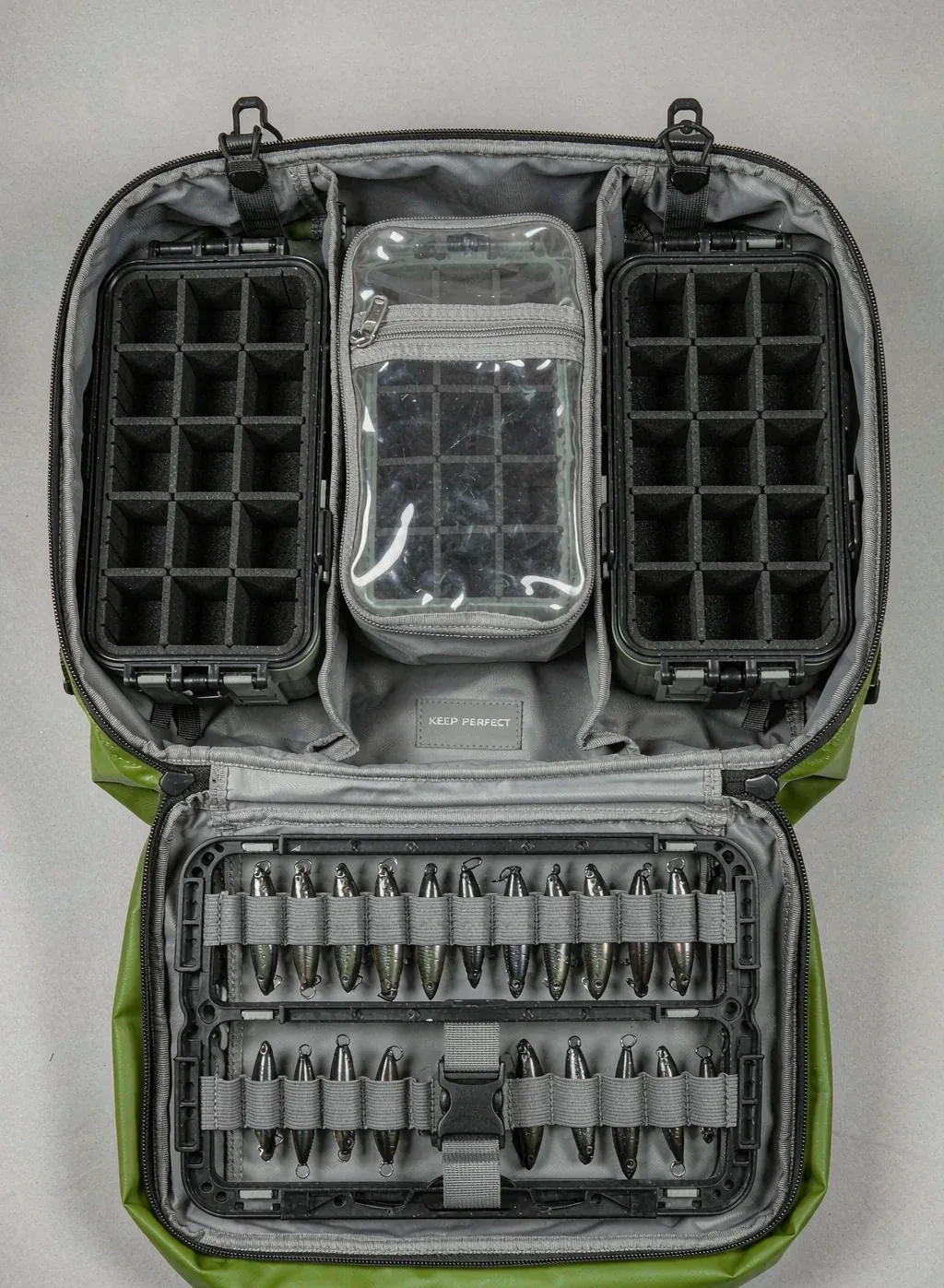
A tackle bag is judged by how many trays it swallows and how quickly the angler can reach the second one down. Getting that right is a tolerance exercise more than a design exercise, because the trays themselves are commodity items produced by several moulders to nominal industry sizes rather than to a single controlled drawing. The 3700-format tray has a footprint in the region of 355 by 230 millimetres; the 3600 format sits nearer 280 by 180 millimetres. Those figures are nominal. Across moulders and across production years we have seen variation of several millimetres in length and depth, and a bag whose well is cut to nominal with zero clearance will jam on someone's trays eventually.
How Much Clearance to Build In
Our working rule is to allow three to five millimetres of clearance per horizontal dimension of the well and to add the fabric and seam allowance separately rather than netting it off. Three millimetres feels generous on a drawing and is invisible on the finished product, but it absorbs moulding variance, fabric thickness variation between production lots, and the natural stiffening that occurs when a welded panel is cooled under tension. In the vertical dimension allow proportionately more, because tray depth varies more than length and because hook-laden trays are rarely flat. A well that is ten millimetres too shallow is worse than one ten millimetres too wide: the lid will not close cleanly and the customer will assume the bag was miscut rather than that the tray was oversize.
Access direction is the second planning decision and it divides the market. Top-loading wells suit the box-style case and the soft tackle bag, where the whole lid opens and the trays stack vertically; they are cheap to build and easy to merchandise. Side-loading shelves suit the backpack, because they let the angler withdraw the lowest tray without unloading the bag, and they also let the bag stand lower and more stably. Backpack architectures typically carry two to four shelf slots, and the practical upper limit before the bag becomes top-heavy and awkward is four standard trays plus a soft top pocket. Anything above that belongs in a box-style case with a rigid tub, not in a backpack.
To Ship With Trays or Empty
Whether the bag ships with trays is a decision with consequences across the whole order, and it should be made early because it changes carton dimensions, container planning and the costed bill of materials. Shipping empty saves landed freight — trays are dramatically costly to ship relative to their value because they are mostly air — but it means the retailer receives a product that looks less complete on the shelf and the brand takes on responsibility for compatibility it cannot fully control. Shipping filled raises unit cost and cube but lets you control presentation and lets you use your own moulded trays with your own logo, which is a genuine brand asset. A third route, used by several of our programmes, ships with a single demonstration tray inserted and boxes the remainder outside the bag.
Two further layout questions are settled at this stage because they are expensive to change later. The first is how much dedicated volume goes to soft plastics, leader spools and terminal tackle relative to hard-bait trays; for most mixed fisheries the ratio is shifting toward soft plastics and a larger zippered soft-stowage space is the safer bet. The second is whether the layout supports a re-rig loop: many anglers reorganise their trays seasonally, and a bag that only works with one specific tray order will draw complaints from the experienced end of the market, which is precisely the audience that influences other buyers. We keep nominal tray dimensions on file for each programme and, once a range is established,offer replacement shells for the same architecture under products.
Water Management: Drainage Mesh, Welded Wet Compartments, Roll-Top Tops
Water management in a fishing bag resolves into three distinct strategies that are often confused on a specification sheet. Keeping water out is waterproofing. Letting water out is drainage. Isolating water from the rest of the load is compartmentalisation. A single product can legitimately use all three in three different zones — a roll-top main chamber that keeps water out, a drainage mesh pocket for a wet rain jacket, and a welded base compartment that isolates a fish or a soaked sling. Writing all three requirements into one paragraph of a brief is how sample revisions multiply.
Drainage: Placement Beats Quantity
Drainage looks simple and is routinely done badly. The instinct is to put mesh on the bottom panel; this is almost always wrong, because the bottom is the surface that contacts abrasive ground, and a mesh floor both wears through and wicks water back into the bag by capillary action while it rests on wet sand. The correct pattern is a solid, welded, abrasion-resistant floor with drainage concentrated at the lowest corner and along vertical side channels, so water leaves under gravity and nothing ever sits in contact with the mesh. Grommet count matters less than grommet position: four correctly placed ports in a reinforced double-webbing strip will drain faster than thirty scattered holes, and they will not weaken the structure.
Mesh selection matters too. PVC-coated polyester mesh holds its shape, resists ultraviolet reasonably well and does not snag hook points as aggressively as monofilament mesh, which tends to grip a treble point and turn a simple retrieval into a ten-minute unpicking exercise. Where mesh carries heavy wet items such as boots or a wading belt, back it with a drainage membrane and give it an air gap, otherwise the mesh panel becomes the structural weak point at exactly the place where the load concentrates. Wader and boat bags benefit most from this treatment, and they are also the formats where buyers most often ask us to add a second drain line at the opposite corner so the bag drains whichever way it is set down.
Welded Wet Compartments and Roll-Top Closures
A genuinely sealed wet compartment inside a bag is achievable with radio-frequency or hot-air welding, provided the geometry allows the electrode to reach every seam with consistent pressure. Complicated corner boxes are where this breaks down, so we typically design to a five-sided tray-like insert with generous radii and bond it into the shell rather than trying to weld an internal pocket with eight interior corners. Every bonded seam is then verified to a peel strength of at least 8 N/cm and to an immersion check on the production sample. The compartment still needs a drain: a sealed base that cannot be emptied becomes a hygiene problem in warm climates, and a moulded drain port with a captive cap costs very little.
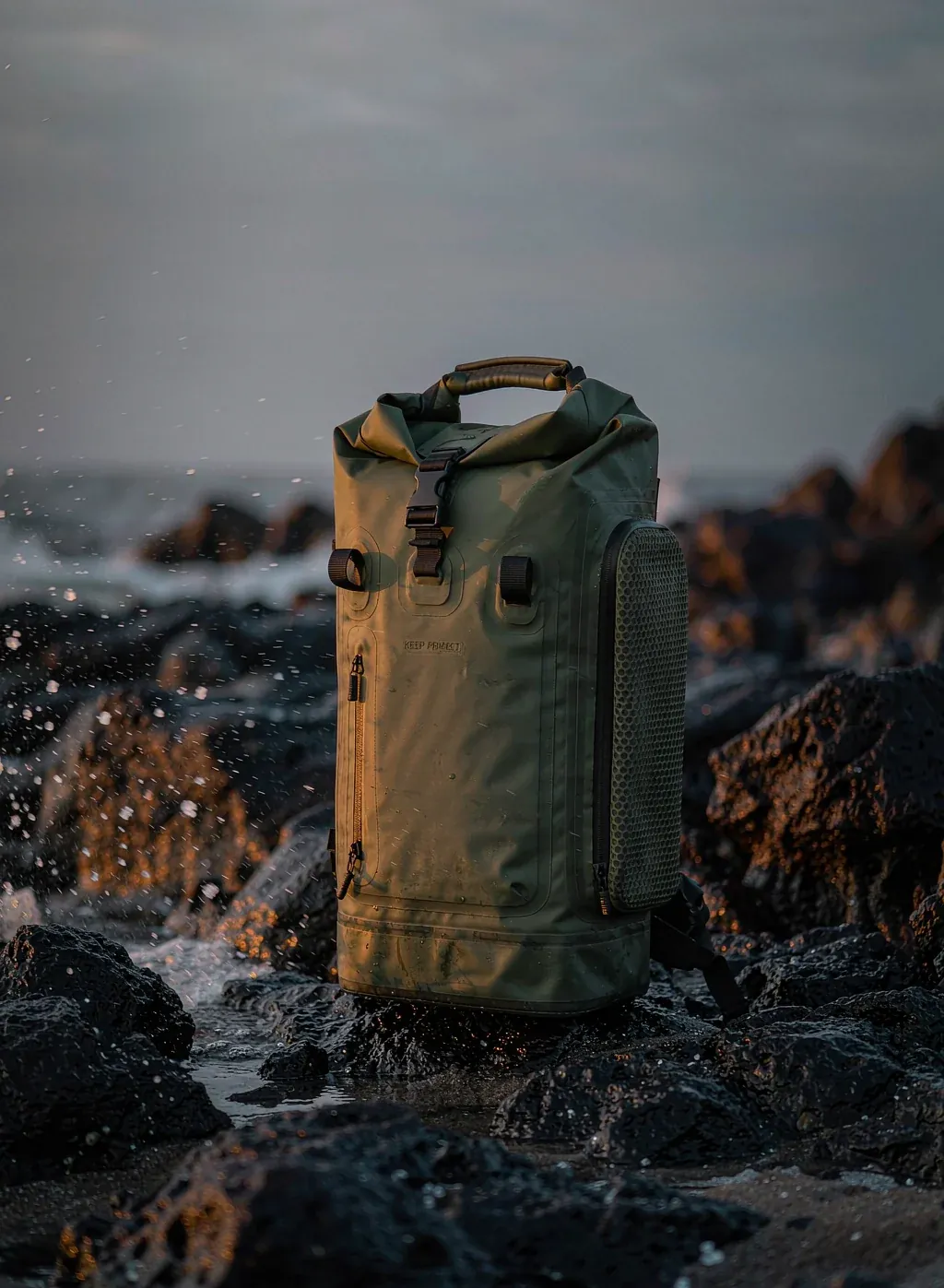
Roll-top closures remain the most reliable way to make a chamber submersible, and they are also the friendliest to produce because there is no zip to fail. The practical requirement is at least three rolls and a compression strap or clip across the top; most competent designs specify four rolls, since users tired and cold will roll fewer times than the designer intended. Ratings should be quoted honestly and by standard: IPX6 covers powerful water jets which is what spray and a deck wash actually deliver, IPX7 covers thirty minutes immersed at one metre, and IPX8 is a continuous immersion rating that requires the depth and duration to be stated by the manufacturer. A bag can also be described by hydrostatic head, and we quote a light-duty build at 10,000 millimetres or better and a heavy-duty welded build at 20,000 millimetres or better. Note that these numbers apply to the fabric, and that the closure performance is verified separately on the assembled unit. See the adjacent section on closures for how this interacts with zip selection, and refer to our broader platform work under waterproof backpacks.
Zipper and Closure Selection for Saltwater Environments
Zips are the component anglers notice first and forgive least. A bag can have a perfect fabric and a perfect seam, and still be described in reviews as broken, because the main zip will not run after two months in salt air. The failure sequence is well understood: salt solution enters the coil or track, water evaporates, crystals remain, the slider has to shear those crystals on every pass, and eventually either the slider wears or the tape tears. Choosing the closure correctly, and then detailing the surround correctly, is where most of the product's perceived reliability is won.
| Closure | Construction | Water performance | Cycle expectation | Where we specify it |
|---|---|---|---|---|
| YKK AquaGuard coil #5 | Reverse coil with a polyurethane-coated face tape | Water-repellent; resists spray and light rain, not immersion | Several thousand cycles with rinse care | Front pockets, secondary compartments, lid assist |
| YKK AquaGuard coil #8 | Reverse coil #8 with coated tape and larger slider | Water-repellent; stronger and easier with gloves | Similar to #5 with lower slider wear | Main openings on mid-size tackle bags |
| PU-coated water-resistant coil | Coil zip with PU-coated tape, no branded seal | Water-resistant; budget alternative to a sealed coil | Depends on coating quality | Entry price points, promotional programmes |
| Moulded-tooth #8 / #10 (VISLON class) | Delrin teeth on woven tape, often reversed | Sheds spray well; drains rather than seals | High; teeth resist salt crystal damage | Salt-exposed external pockets, boat bags |
| TIZIP MasterSeal 10 | Polymer-profile pressure-rated submersible zip | Pressure-rated closure for genuine immersion | Long service life with periodic lubrication | Submersible dry compartments, kayak fishing builds |
| Roll-top with compression strap | No zip; folded collar clipped or buckled | Strongest immersion performance per dollar | Effectively no wearing mechanism | Main chambers on dry bags and surf bags |
Detailing Around the Zip
The zip itself is only half of the equation. Three detailing decisions determine whether a well-chosen closure survives in service. The first is whether the tape is coated; an uncoated polyester tape will wick moisture through the stitch line regardless of how good the coil is, so if water ingress matters the seam behind the zip must additionally be taped at 20 millimetres or the panel must be welded. The second is the garage: a folded fabric garage at the top of the run protects the slider when closed and is cheap to add. The third is the pull: a glove-friendly oversized pull, a length of paracord, or a moulded grab tab costs cents and is noticed every single time the bag is opened in cold hands.
Maintenance should be designed in rather than assumed. A sealed-coil zip benefits enormously from a periodic fresh-water rinse and occasional lubrication, and if the product page says so the incidence of warranty claims connected to stiff zips falls measurably. Conversely, no closure should be positioned where it is constantly submerged and never dried; that placement is the recurring cause of white bloom on slider bodies and of tape rot on otherwise sound bags. For programmes targeting submersible performance, we recommend testingthe assembled unit rather than the fabric alone: a one-metre thirty-minute immersion check on a production sample, followed immediately by five open-and-close cycles, exposes more real problems than any component-only test.
Finally, consider whether the closure needs to be lockable. Retail channels selling to boat owners increasingly ask for a locking-capable slider or a webbing loop through which a small padlock can pass, and adding the loop during development costs nothing while adding it after tooling is expensive. Additional closure verification methods and the inspection standards we apply are documented under quality, and the broader service envelope around OEM closures is described under services.
Rod Holders, Straps and External Attachment Points
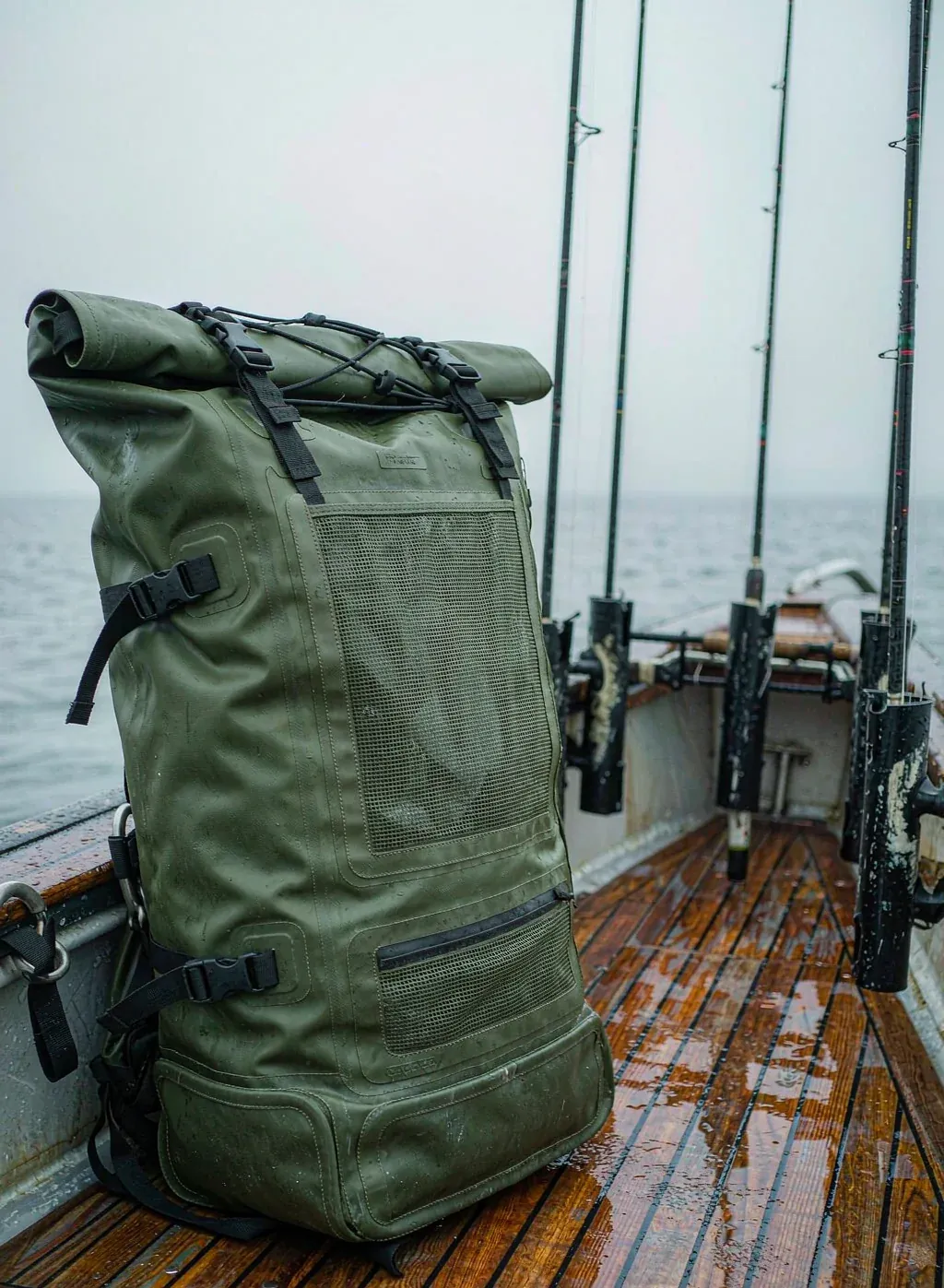
External attachment is what turns a generic outdoor backpack into a fishing product, and it is also where weak designs announce themselves within a week of launch. Everything mounted on the outside of the shell has three jobs at once: it has to hold its specific item securely over rough ground, release quickly when the angler needs it, and pull out cleanly without tearing the panel it is stitched or welded to. Those jobs conflict. A rod tube that grips tightly is difficult to extract one-handed in a hurry; a strip that releases easily may let a two-hundred-dollar rod slide out while the wearer climbs a rock ledge. Settling that trade-off deliberately, per attachment, is the whole design exercise.
Attachment Points Are Reinforcement, Not Decoration
The most frequent root cause of external attachment failure is that the panel behind it was never specified to take the load. A webbing loop bar-tacked directly onto a single layer of 840D laminate will tear out under a snagged rod because the load concentrates in a line only a few millimetres long. We detail every load-bearing external point onto a hidden reinforcement patch — typically a second layer of the base fabric or a piece of high-density webbing folded into the seam — so that the pull spreads across thirty or forty millimetres rather than five. Reinforcement patches cost grams and cents; a torn shell costs the reputation of the entire range, and the repair claim usually arrives attached to a photograph of the failure on social media.
Stitch geometry matters as much as the patch. Box-and-cross bar tacks at 8 to 10 stitches per inch of box width distribute load far better than a straight run, and webbing should be returned into the seam rather than simply laid against the panel. Where the panel itself is welded rather than sewn, external points have to be either bonded onto a welded-on reinforcement flange or transferred to a structural stay inside the bag, because there is no stitch line available to carry the force. We review every proposed external feature against the panel construction before sampling begins, and this is precisely the kind of adjustment that turns a rejected first sample into an approved one at the second round.
Rod Tube versus Compression Loops
Two architectures handle rods. A moulded or padded rod tube sleeve, mounted vertically or diagonally, protects the rod and reel fully and is preferred on surf and boat bags where rods travel rigged. A pair of compression loops — usually 25 millimetre webbing with side-release buckles — grips the rod blank above and below the reel and is lighter, cheaper and easier to fold away. As a working rule, anything above 38 millimetres of webbing for the reel retention point is over-engineering on a backpack and properly specified on a surf bag; loop packs carrying rigged rods with heavy reels should be built on 38 millimetre webbing with a cam buckle rather than a standard side-release, because a lever-loaded buckle can creep open under vibration.
Sand-spike sleeves deserve a note of their own because they fail in a predictable way: sand enters the sleeve, packs into the closed end, and can never be fully removed. Our pattern puts a drainage grommet at the bottom of every closed-end sleeve and treats inside faces with a smooth, hydrophobic finish so that damp sand releases instead of cementing. Pliers holsters and tool sheaths follow the same logic — they should be open-bottomed, moulded or mesh-based, and made from fast-draining synthetic material rather than leather, which stiffens and cracks after repeated salt exposure.
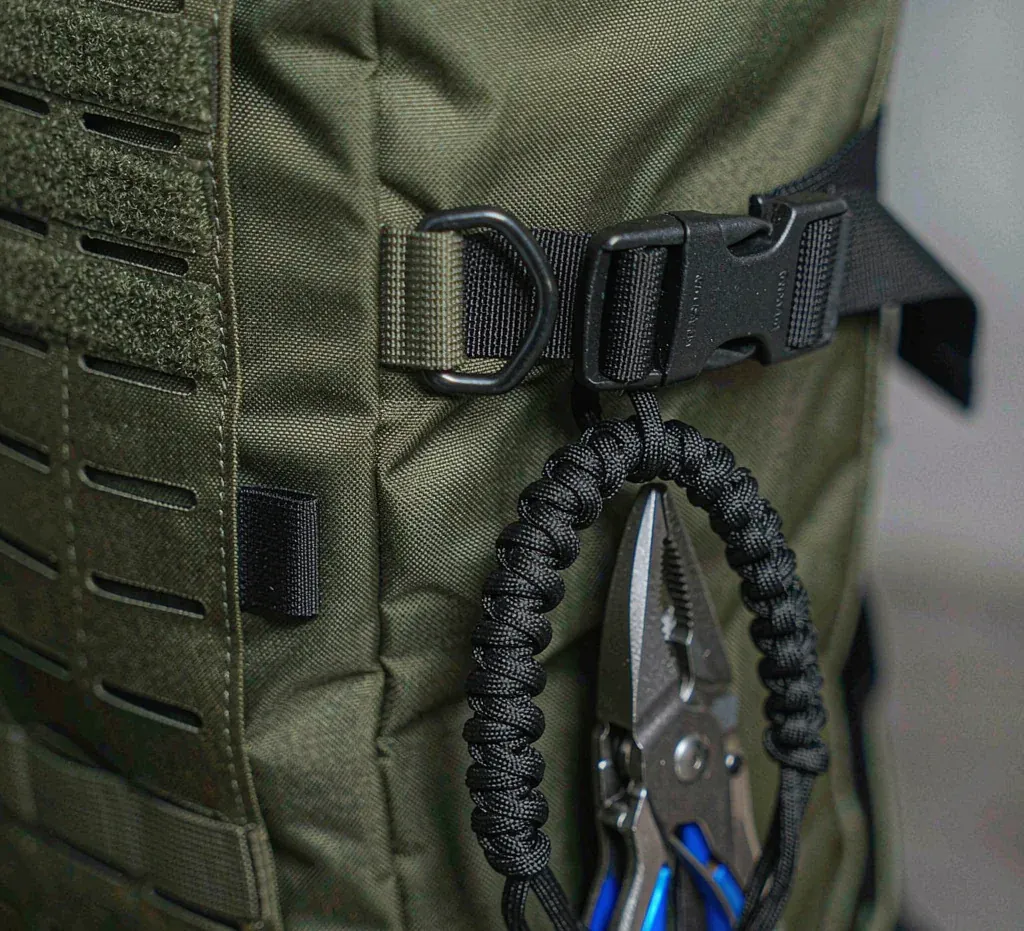
Lash grids round out the system. A webbing ladder with a consistent pitch gives owners room to add their own accessories, and it photographs extremely well on a product page because it reads as capability. Keep entirely separate injunctions in mind though: every metre of added webbing adds finishing time, and webbing sewn across a waterproof panel creates dozens of stitch holes that must be either sealed behind an internal panel or restricted to zones that are not required to be watertight. We mark those zones on the specification drawing so everyone involved can see where decoration may go and where it may not.
Load Carrying for Long Walk-Ins: Harness, Belt and Sternum Design
The defining use case for a fishing backpack is not the ten-metre walk to the car; it is one to five kilometres over sand, shingle, riverbank or jetty with a load somewhere between ten and eighteen kilograms, frequently in the dark and often in wet clothing. That duty cycle governs every decision about the harness. A suspension that feels comfortable in a showroom for ninety seconds is not evidence of anything. What matters is whether the load path reaches the hips, whether webbing tails stay put, and whether the pack still tracks straight when the wearer is climbing over wet rocks with a rod in one hand.
| Loaded weight | Shoulder strap width | Padding build | Back panel | Recommended additional support |
|---|---|---|---|---|
| Up to 8 kg | 20 mm webbing, light padding | 6–8 mm closed-cell EVA | Single-density moulded EVA with air channels | Sternum strap only |
| 8–13 kg | 25 mm webbing, S-curve shape | 8–10 mm EVA at 45–60 kg/m³, spacer mesh cover | Two-density EVA with lumbar pad | Sternum plus webbing hip belt |
| 13–18 kg | 38 mm webbing, full S-curve | 10–12 mm dual-density EVA with soft edge roll | Moulded EVA plus HDPE frame sheet | Load lifters, padded hip belt, HDPE or aluminium stay |
Where the Load Actually Goes
In a correctly tuned harness roughly sixty to seventy percent of the weight reaches the pelvis through the hip belt and the remainder travels through the shoulders. Fishing, however, complicates that principle in two ways. First, many anglers wear chest waders, and a thick padded hip belt either sits awkwardly above the wader bib or interferes with the gravel guard; the practical answer is often a modestly padded belt with a low profile rather than a full mountaineering-style wrap. Second, anglers stop and cast repeatedly, so the bag has to swing to the front or to one side to reach tackle, which means the stabiliser straps have to hold position against rotation rather than merely against vertical load.
Strap width is the simplest single predictor of comfort under load and the cheapest thing to specify wrongly. Narrow webbing concentrates pressure on the trapezius; the numbers in the table above are the ones we build to, and the difference between a 20 millimetre and a 25 millimetre strap is felt within twenty minutes on the walk-in. Beyond width, three features deliver most of the remaining comfort: load lifters pulling the top of the pack toward the shoulders, a sternum strap with a short elastic section so chest expansion is not restricted, and keeper loops to manage the long webbing tails that otherwise flap into the water when casting. A whistle buckle on the sternum strap costs very little and is a genuine safety feature on dark rocky marks.
Torso length is the variable that most often gets missed at the quoting stage. A fixed harness fits one torso range well and compromises the rest; an adjustable harness adds two webbing runs and a hook-and-loop field, costs a little more, and lets one SKU cover three size ranges, which is particularly useful when working within MOQ constraints. Whichever route is chosen, we verify every new harness with a loaded carry test on the actual production sample, plus a proof-load check on strap and anchor attachments, and we record the results alongside the general protocols documented under quality. The same suspension engineering is applied across our travel bags and waterproof backpacks programmes, which lets buyers reuse approved components across categories.
Colour and Camouflage Programmes for Regional Fishing Markets
Colour sells fishing tackle more decisively than it sells almost any other bag category, and it does so regionally. A palette that performs briskly in the Gulf of Mexico can stall completely in Hokkaido. The reason is not fashion so much as fishing culture: what an angler expects a bag to look like is learned from local water, local species and local television, and it is surprisingly resistant to change. Building one colourway for all markets is therefore a decision to accept mediocre sell-through in most of them, and this is a place where a small amount of upfront segmentation pays for itself many times over.
Four Pattern Families and Where They Work
Timber and woodland patterns suit freshwater and estuary anglers in North America, Northern Europe and parts of China, where stained water and tree-lined banks define the fishery. Marsh and reed patterns are used for shallow-water and wildfowling-adjacent fishing. Blue-water and striped treatments — often abstract rather than literal camouflage — suit offshore and charter contexts, where concealment is irrelevant and visibility plus heat reflection are the drivers. Solid earth tones, especially olive, charcoal, khaki and sand, remain the volume answer almost everywhere and are the safest foundation for any first range. Nobody goes wrong opening with two solids and adding one print.
Rights are the part of this conversation that trips up buyers. Recognised camouflage designs are licensed, and a factory cannot lawfully reproduce a pattern owned by a pattern house without documentation. What we can do is print a pattern you own or license, develop an original pattern with you and confirm in writing that usage rights sit with your brand, or source from mills that hold their own generic designs and supply them with documentation of that position. Whichever route applies, ask us at the quoting stage rather than at artwork submission, because pattern lead times can be a week or four depending on what is needed.
Colourfastness and Dye Lot Control
Fishing bags meet three colour challenges that are worth writing into the specification explicitly. Colourfastness to light, tested to ISO 105-B02 and accepted at grade 4 or better, protects against fading on the retail peg and on the boat rail. Colourfastness to sea water, tested to ISO 105-E02, is the directly relevant standard for this category and routinely catches combinations that would pass ordinary wet-rub testing. Colourfastness to rubbing, tested to ISO 105-X12 wet and dry, protects against transfer onto light-coloured clothing and boat upholstery. Printed camouflage on a coated surface also abrades differently from dyed fabric: printed patterns should be kept away from the base panel and from any zone that drags across shingle, or protected by a clear topcoat where the design allows.
Dye lot control matters for repeat orders and is inexpensive if planned. We return lab dips for approval against Pantone references and hold an approved reference swatch per colourway, then verify production fabric against that swatch spectrophotometrically with a tolerance typically set at a delta E of 1.0 to 1.5 units. Two further practical notes: fluorescent and high-visibility accents fade faster than solid earth tones and should be checked at a longer exposure step, and retroreflective trims — genuinely useful for anglers walking unlit jetties at dawn — should be specified by their reflective performance class rather than by appearance alone. Additional colourway planning support sits under services, and example colourways can be browsed under products.
Branding a Tackle Range: Print, Embroidery, Rubberised Badges
Branding on a waterproof shell is constrained in ways that are not obvious until samples come back. The fundamental tension is simple: the fabric has been engineered to be impermeable, and many decoration methods either perforate it, refuse to adhere to it, or contaminate the very zones that later need to be welded. Choosing the method at the same time as the panel layout avoids the two most common failures — embroidery that quietly turned a welded panel into a leak path, and print that sat inside the weld line and prevented the seam from bonding.
| Method | Compatible substrate | Behaviour in salt water | Setup cost and tooling | Lead-time effect |
|---|---|---|---|---|
| Screen print, plastisol or water-based | TPU laminate, PVC tarpaulin, coated polyester | Excellent if properly cured; check flex adhesion after cure | Low: screens per colour | None beyond artwork approval |
| Silicone or high-build print | TPU laminate, coated woven | Excellent; resists abrasion better than standard ink | Low–moderate: thicker screens | None |
| Heat transfer film | Most coated synthetics | Good; edge lift possible under repeated soaking | Low | None |
| Dye sublimation | Polyester face fabric only | Excellent; colour is in the fibre | Low: print only, no screens | None; enables photographic camo |
| Rubberised or injection-moulded PVC badge | Any panel, usually sewn on | Excellent | Moderate: mould tooling required | Adds roughly ten to fifteen days for tooling |
| TPU badge with weldable backing | TPU panels, radio-frequency welded on | Excellent; no stitch holes | Moderate: mould tooling | Tooling plus weld-parameter trials |
| Embroidery | Separate woven panel or non-critical zone | Thread holds well; suture holes need backing tape | Low–moderate: digitising | None; restricted placement |
| Metal logo plate | Any, but avoid salt exposure | Poor unless 316 or titanium | Moderate: die tooling | Tooling plus plating lead time |
Placement Rules That Prevent the Usual Failures
Three placement rules resolve most branding risk. Keep all print outside the weld zone: ink, silicone and transfer film interfere with dielectric bonding, and a logo overlapping a seam produces exactly the slow-weeping failure that takes months to diagnose. Keep embroidery off any panel that has to hold water, or mount it on a discrete woven patch that is sealed from behind with a taped backing and is itself stitched outside the sealed chamber. Keep everything off the abrasion base; a logo printed one centimetre above the wear line survives, and the same logo printed on the wear line is gone by mid-season regardless of which method was used.
Colour matching should be handled with the same discipline applied to the fabric colours. Reference Pantone or RAL values, approve a printed proof on the actual production substrate rather than on paper, and accept that the same ink will read slightly differently on 500D PVC tarpaulin and on 1000D TPU laminate. For matte finishes, request low-gloss or matte additive where the print sits beside matte film, otherwise the logo will look like a sticker applied afterwards. Beyond the bag itself, retail-readiness items belong on the same schedule: hangtags with barcodes, sewn-in country-of-origin labelling, and any recycled-content claim supported by transaction documentation, all of which take time and are usually discovered late.
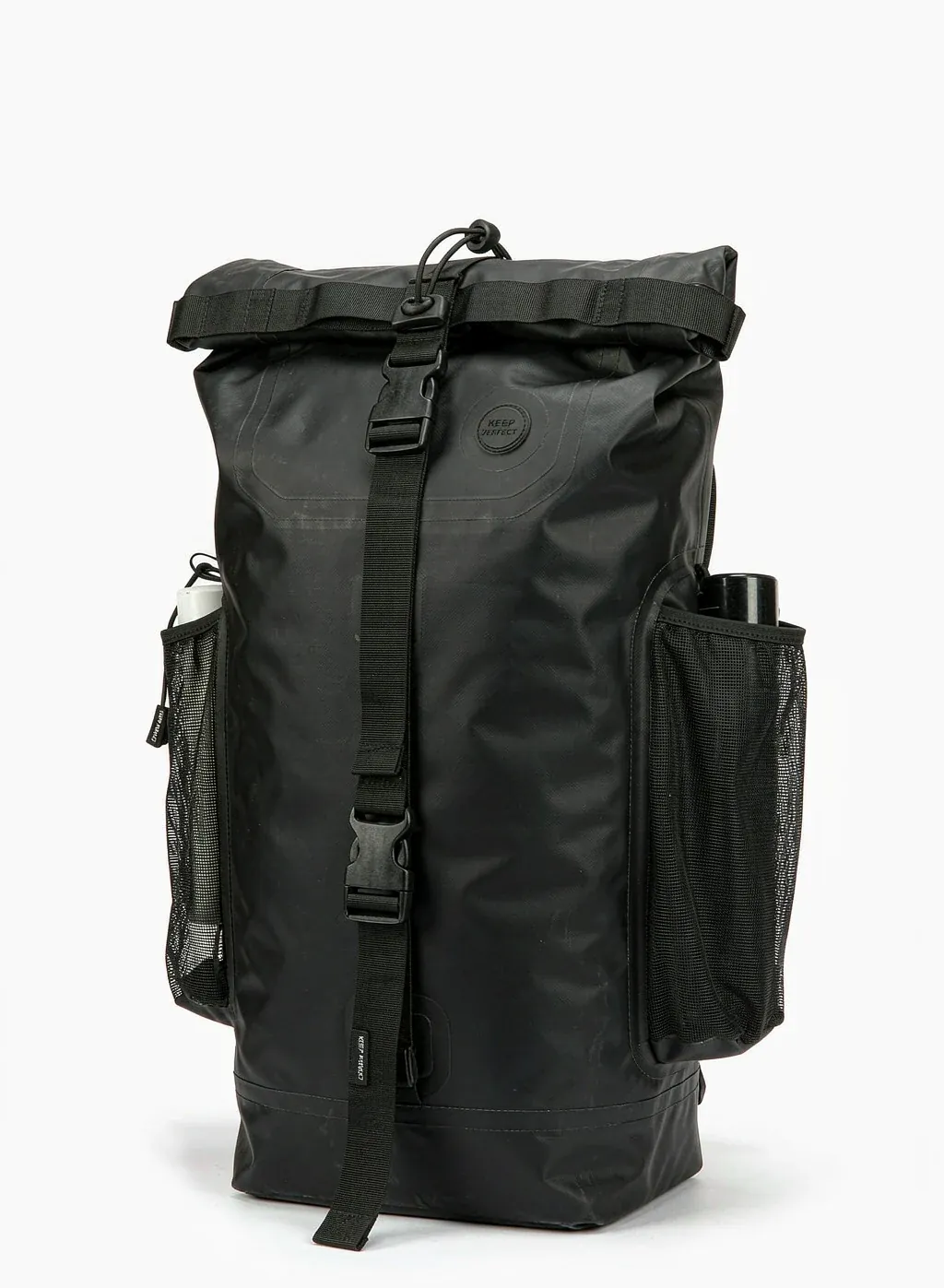
Finally, decide early which elements are structural to the brand and which are seasonal artwork. A moulded badge reproduced across a whole range is a substantial but one-off investment that gives the line a family look and typically pays back over two seasons; a screen print can be changed between seasons with no tooling commitment at all. Many of the programmes we run use exactly that split — one permanent badge establishing brand recognition, and seasonal prints that let retailers refresh the fixture without a new product development cycle. To see how we structure branding within an OEM programme, review the outline under services.
MOQ 500 pcs per Style — Building a Coherent Tackle Range
Our minimum order quantity is 500 pieces per style per colourway, and that number shapes range planning more than any other commercial term. It rewards portfolios built on shared components and punishes those built from unrelated one-off designs. The practical implication is straightforward: within one family of fishing bags you can use the same base fabric, the same webbing and hardware set, the same colourways and the same print screens across five or six SKUs, so the setup cost is amortised across the whole line rather than charged to a single product.
A Five-SKU Opening Range
A typical first order for a brand entering the category looks like the ladder below. It covers two hands-free formats at different price points, one hard-box option, one high-margin accessory and one entry gift item, and it gives a retailer something to merchandise at every level of the fixture.
| SKU | Role in the range | Opening quantity | Notes for planning |
|---|---|---|---|
| Tackle backpack, 35 L | Hero SKU; carries the marketing story | 500 pcs per colourway | Highest development input; approve first |
| Tackle backpack, 25 L compact | Youth and travel-friendly derivative | 500 pcs per colourway | Reuses hero pattern with reduced panels |
| Soft tackle case, three-tray | Volume driver at the entry price point | 500 pcs per colourway | Lowest development load; safe second build |
| Lure roll or rod bag | High-margin accessory and gift item | 500 pcs | Uses offcuts and existing screens |
| Dry bag, 20 L roll-top | Paddle-sports cross-sell | 500 pcs per colourway | Proven electrode; fastest to approval |
Colourway decisions deserve particular attention under this rule because 500 pieces applies per colourway, not across a mixed carton of colours. A three-colourway hero bag is therefore a 1,500-piece commitment, which may be more than the market will absorb in season one. The safer opening is usually two colourways on the hero and one on every derivative SKU, letting a second season expand what actually sold. We will always tell you when a proposed colourway count looks risky relative to your channel, because unsold inventory in three colours is the same failure as unsold inventory in one, multiplied.
Timing is the other half of the planning problem. Fishing has a hard seasonal curve in both hemispheres, and the whole campaign keys off sample approval. Working backwards from a Northern Hemisphere spring floor date: samples should be in hand roughly five months ahead, which means development starting in the autumn, and Southern Hemisphere programmes run the mirror image. Production takes 35 to 50 days after sample approval, sea freight and inland delivery take their own slice, and the holiday-shutdown window in Fujian is a real planning event rather than a formality. Standard terms are T/T 30 percent deposit with 70 percent balance before shipment against quotations stated on an FOB Xiamen basis. Our manufacturing pages cover the factory detail behind those commitments: 4,950 square metres, 137 staff, seven production lines and monthly capacity near 200,000 pieces.
Sampling and Testing a Fishing Bag in 6–10 Working Days
Sampling is the stage that decides whether a range launches this season, so we treat it as engineering rather than administration. A standard fishing bag moves from confirmed specification to finished physical sample in 6 to 10 working days. Structures that need new tooling — a moulded tub, a bespoke badge, a multi-electrode wet compartment, or a complex frame — extend to 12 to 15 working days, and we state which band a project falls into before the first quote is issued so nobody plans a launch around a date that the tooling cannot meet.
What Happens Inside Those Days
The sequence starts with specification review, where we check drawings, reference samples and target costing against what our lines can actually build, and flag any feature that will create an avoidable second round. Materials are then sourced and confirmed; most running fabrics, webbing and standard hardware are in stock, while specified items such as 316 stainless fittings, named zips or printed camouflage are ordered against the sample schedule. Pattern and marker work follow, then cutting, welding or sewing, assembly, and finally a set of in-house checks with photography before the sample ships out. Across our factory facilities there are 149 machines and seven lines available, which is what allows urgent development samples to be scheduled without displacing production.
In-house verification during the sample stage covers the checks that catch expensive mistakes: hydrostatic head on the specified fabric, peel strength on welded and bonded seams at not less than 8 N/cm, zip and buckle cycle checks, a loaded carry assessment for harnessed formats, and proof-load testing on external attachment points. Where the programme requires third-party documentation, SGS or Intertek reports can be commissioned, though that adds cost and roughly seven to ten working days and should therefore be scheduled on the launch critical path rather than bolted on afterwards.
How to Shorten Your Own Development Loop
The fastest programmes share three habits. They send a complete brief at the outset — target dimensions or range, destination market, compliance requirements, target landed cost and either a tech pack or a reference sample — rather than revealing constraints one email at a time. They consolidate feedback from every stakeholder into one round of comments with marked-up photographs, rather than relaying sequential revisions from different people. And they approve the pieces that are already right, so the second round is scoped to the remaining open items instead of reopening settled decisions. Missing any of these typically adds one or two extra rounds, each of which costs another sampling cycle.
Once the sample is approved, the path is stable and predictable: a pre-production sample confirms bulk materials and any final corrections, the deposit triggers production which runs 35 to 50 days, and finished goods are inspected to AQL 2.5 under ISO 2859-1 before the balance payment and shipment on FOB Xiamen terms. We keep the approved reference standard on file for every programme, which means a repeat order six months later does not restart the sampling cycle from zero. Full detail on the inspection regime sits under quality, and our company background is on our about page.
Cost Drivers in a Competitive Tackle Bag Market
Tackle bags are a price-sensitive category with a wide retail spread, and the difference between two quotes for visually similar products can be thirty percent or more. That difference is almost never padding; it is a series of named decisions about fabric, closure, hardware, tooling and verification. Understanding those decisions lets a buyer move a quote in a chosen direction deliberately rather than by negotiation, and lets a brand defend its retail price honestly when a retailer benchmarks against a cheaper competitor.
| Cost driver | Typical impact on unit cost | Lever available |
|---|---|---|
| Face fabric and barrier | Largest single swing, often 20–35 percent | Move from 1000D polyether TPU to 600D TPU or 500D PVC on panels that do not touch tackle |
| Film or coating thickness | 5–10 percent per notable step | Zone thickness: 0.30 mm base, 0.15 mm upper side panels |
| Welded versus sewn construction | Raises labour, lowers seams | Weld only the chambers that must hold water; tape the rest |
| Closure selection | A pressure-rated zip can triple closure cost | Reserve named submersible zips for one compartment; use roll-top elsewhere |
| Hardware specification | Moderate in total, high per item | Acetal buckles instead of plated metal; 316 only where permanently exposed |
| Included trays or tools | Adds cost and significant freight cube | Ship empty, or ship one demo tray boxed separately |
| Branding method | Low unit cost after tooling | One moulded badge across the range, seasonal prints per SKU |
| Cutting complexity | Labour and yield driven | Reduce panel count; share patterns across derivative sizes |
| Testing and certification | Fixed cost, scales with quantity | Amortise across a multi-SKU opening order |
| Packaging | Small per unit, larger per carton | Standard polybag for e-commerce; printed box for shelf |
| Order quantity and colourways | Setup amortisation | Consolidate colourways; spread tooling across the family |
Reading a Quotation Honestly
Two quotations for the same concept may be built on different assumptions entirely: whether the price includes trays, whether it assumes 500 pieces or 5,000, whether hardware is plated Zamak or acetal, and whether the cost covers cartons and labelling. We itemise the major assumptions on every quote and put unit prices against stated quantities so they can be compared like for like. CIF or DDP figures can be provided for comparison, but our quotations are stated FOB Xiamen so that freight, duty and inland delivery can be modelled cleanly against your landed target.
The most valuable advice we give at this stage is usually about where not to economise. Fabric downgrades that leave the bag looking acceptable but reduce puncture resistance, and closure downgrades that turn a three-year product into a one-season product, are both false economies in a category where purchase decisions are heavily influenced by peer recommendation and marketplace reviews. Cost is more safely taken out ofpanel count, colourway count, packaging complexity and unnecessary trim than out of the barrier material or the closure. If you would like to see how those choices price out on your own concept, our team can be reached through contact, and further categories sit under products.
Frequently Asked Questions
What is your MOQ for a custom fishing bag?
The minimum is 500 pieces per style per colourway. A style carrying three colourways therefore represents a 1,500-piece commitment, so most brands opening a first range launch one or two colourways on the hero SKU and a single colourway on every derivative. Because minimums apply per style rather than per order, it makes sense to plan the whole family together.
How long does sampling take?
A standard fishing bag moves from confirmed specification to physical sample in 6 to 10 working days at QUANZHOU JUNYUAN BAGS. Builds requiring new tooling — a moulded tub, a bespoke badge, a multi-electrode welded compartment — take 12 to 15 working days. We tell you which band applies before quoting, so your schedule is built on real dates rather than optimistic ones.
Can you reproduce a sample I already have?
Yes. Sending an existing physical sample alongside your target changes usually gives the closest first-round match, because we can photograph, measure and reverse-engineer the panel count and finishing directly. Please state which elements are fixed and which are negotiable; trying to hold every detail while also hitting a lower cost target rarely succeeds in one round.
What is your bulk production lead time?
Production runs 35 to 50 days after sample approval and deposit, depending on order size, tooling and seasonal loading. Both sample correction rounds and public-holiday shutdown windows sit outside that figure, so we recommend locking approval roughly five months ahead of the intended retail floor date.
Are these bags waterproof or water-resistant?
Both claims are available and they mean different things. Radio-frequency welded builds with roll-top or pressure-rated closures are tested for immersion and can be rated IPX6, IPX7 or IPX8 with the depth and duration stated. Cut-and-sew builds with taped seams and coated zips are quoted by hydrostatic head — 10,000 millimetres or better for light duty, 20,000 millimetres or better for heavy duty — and resist spray rather than prolonged submersion.
Should I choose TPU laminate or PVC tarpaulin for a fishing bag?
Polyether TPU laminate is our recommendation wherever the face meets hooks or travels through cold climates, because it resists hydrolysis, stays flexible below freezing and welds cleanly. PVC tarpaulin costs less, welds beautifully and suits wader bags, boat bags and welded wet compartments. Avoid it below minus ten Celsius, and state non-phthalate plasticisers for European and Californian channels.
Will your bags fit standard 3700 and 3600 trays?
Yes, and we build three to five millimetres of horizontal clearance into every well because nominal tray dimensions vary between moulders by several millimetres. The 3700 footprint is around 355 by 230 millimetres and the 3600 around 280 by 180 millimetres. We recommend giving us the exact tray you intend to sell with the bag so the fit can be verified on the physical sample.
Can the bag ship with trays inside?
It can, though shipping empty saves meaningful freight because trays are mostly air and dominate carton cube. A practical middle route is one inserted demonstration tray for shelf presentation with the remainder boxed alongside. If you want your own logo moulded onto the trays, include that at development stage since the tooling sits on the same critical path as everything else.
What hardware do you specify for saltwater use?
Our baseline is 48 hours to white rust under neutral salt spray to ASTM B117 or ISO 9227, and upgrade paths range up to 316 stainless at 500 to 1,000 hours. Preferred solutions are UV-stabilised acetal buckles from recognised hardware makers, which have no corrosion pathway at all, plus zinc-nickel plated steel fittings where metal is required in the load path.
Can you print my own camouflage pattern?
Provided you own or license the artwork, yes; please supply vector files and written confirmation of rights. If you do not have a pattern, we can develop one with you with usage rights assigned to your brand, or source a documented generic design from a partner mill. Printed designs are checked against ISO 105-B02 for light and ISO 105-E02 for sea water.
Which branding methods hold up on a waterproof shell?
Screen print, silicone high-build print, heat transfer and sublimation on polyester all perform well, and TPU badges can be radio-frequency welded on without creating stitch holes. Embroidery is possible but perforates the barrier, so it is restricted to a sealed separate patch on a non-water-bearing panel. Keep all decoration out of the weld zone, as ink prevents dielectric bonding.
Can you develop a fishing backpack from a sketch or idea?
We can. Our team builds the technical drawings, panel patterns and material specification from your sketch, notes, photographs or reference links, then returns a costed proposal before sampling begins. Development is handled under confidentiality, and we are happy to sign a mutual non-disclosure agreement before any drawings or concepts are exchanged.
Do you provide third-party testing?
Yes. We commission witnessed reports through SGS or Intertek for hydrostatic head, seam peel, zip cycling, hardware corrosion and physical testing when a programme needs documentation for retail or marketplace submission. Third-party testing adds cost and roughly seven to ten working days, so schedule it on the launch path. In-house results are retained for every lot we produce.
What payment and shipping terms do you work on?
Standard terms are T/T, 30 percent deposit with 70 percent balance before shipment, and quotations are stated FOB Xiamen as the comparison basis. We can quote CIF or DDP on request for landed-cost modelling, and we hold chair to the same Incoterm structure across every programme so that freight, duty and inland delivery remain comparable.
What warranty do you offer on fishing bags?
Every bag carries a 12-month warranty against manufacturing defects, covering weld or seam failure, zip failure, hardware breakage and delamination of the laminate. Abrasion from use, puncture by sharp contents and damage from improper cleaning or long-term neglect are excluded. Claims are reviewed against defect data from the lot and photographic evidence, and replacement or credit is agreed case by case.