
IP68 vs IPX7 for Waterproof Bags: Which to Specify
IP68 and IPX7 describe the same immersion test and differ on one thing: the dust digit. IPX7 means the enclosure passed immersion but was never tested against dust, while IP68 means it passed a dust test to the 6 level and an immersion test agreed separately with the manufacturer, usually deeper and longer than the 1 metre for 30 minutes that IPX7 uses. For a roll-top dry bag the dust digit is usually worth paying for. For a sewn backpack with a front pocket it is usually not, because the pocket cannot be dust-sealed and the bag cannot then claim the 6. This page shows where each rating comes from, what it hides, and which closure hardware produces it.
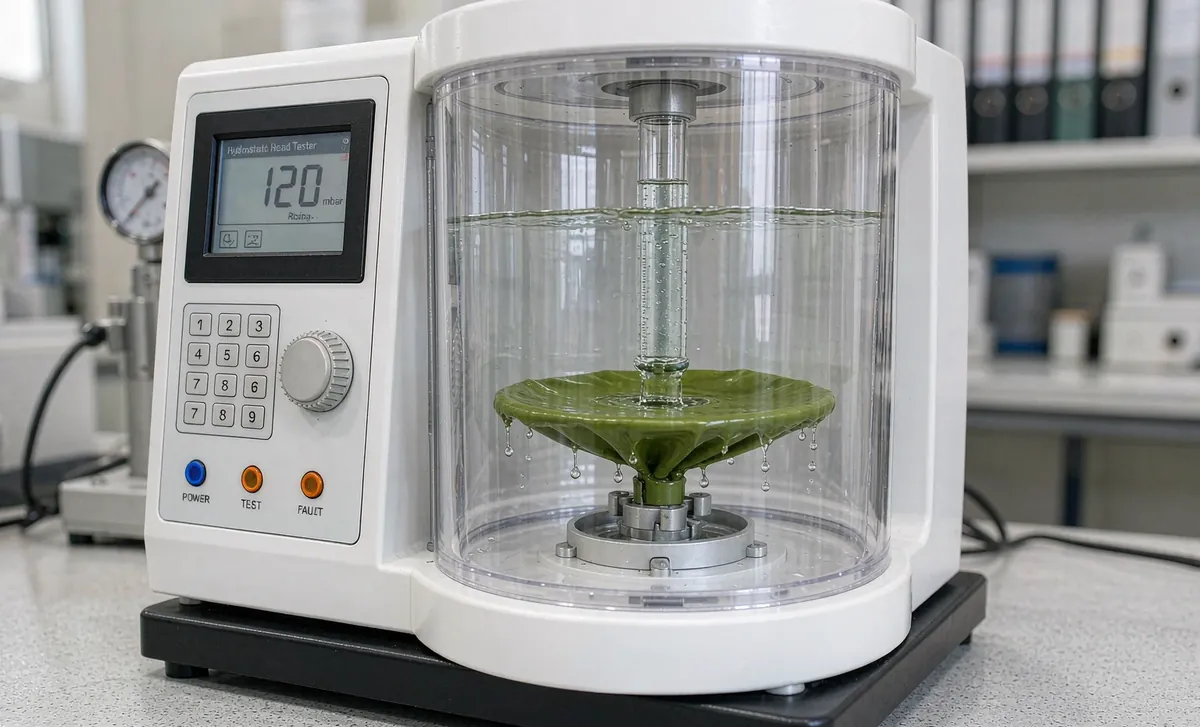
Table of Contents
- Decoding the Two Digits: 6, 8, X and 7 in IEC 60529
- IP68 Against IPX7 in One Table for Bag Buyers
- What the 6 in IP68 Demands From a Bag Closure
- Why IPX7 Says Nothing About Sand, Silt or Dust
- Immersion Depth and Duration: Reading the 1 m / 30 min Line
- Phone Pouch Against Dry Bag: Which Rating Each Needs
- Hydrostatic Head Versus IP: Two Answers to One Question
- Closure Hardware That Decides an IP68 Claim
- Three Rigs for Testing a Rated Bag Prototype
- Failure Modes When an IPX7 Bag Is Sold as IP68
- MOQ 500 for a Rated Closure Programme
- Sampling 6-10 Working Days for Rated Closure Prototypes
- Frequently Asked Questions
- People Also Ask
Decoding the Two Digits: 6, 8, X and 7 in IEC 60529
The IP code is defined in IEC 60529 and is written as two digits, each with an optional X standing in for a digit that was not tested. The first digit covers solid ingress on a scale from 0 to 6, where 6 means dust-tight. The second covers water ingress on a scale from 0 to 9, where 7 means temporary immersion and 8 means continuous immersion under conditions agreed between the manufacturer and the user. An X in either position is not a zero and not a failure; it is a declaration that the product was not assessed against that column.
That single fact resolves most of the confusion between these two codes. IPX7 is a product that passed the immersion test and was not tested for dust. IP68 is a product that passed a dust-tightness test at level 6 and an immersion test at level 8, and level 8 is itself not a fixed number: it always has a depth and a duration attached by the manufacturer, and two products both marked IP68 can have been tested at completely different depths. When a supplier quotes IP68 to you, the immediate follow-up is to ask for the two numbers. If they cannot give a depth and a duration, the mark is not a specification.
There is a third point about the code that applies to bags more than to the enclosures the standard was written for. IEC 60529 was written for electrical equipment enclosures, and the acceptance criterion in the standard is whether water entered in a quantity that interferes with the operation of the equipment inside. A bag has no equipment inside, so the acceptance criterion has to be defined by the buyer instead: how many millilitres of water in the main compartment count as a failure, or whether any visible moisture on a dry paper towel inside counts. Our page on how the IP code digits work sets the standard out in full, and the same acceptance question is covered in the ingress methods page.
IP68 Against IPX7 in One Table for Bag Buyers
The two codes can be compared directly once the X is understood, because the comparison is not between two levels of water protection but between a tested dust claim and an untested one. The table below is the comparison we put in front of buyers, with the third row being the one that usually settles the argument.
| Test Point | IPX7 | IP68 |
|---|---|---|
| Solid ingress first digit | X, not tested | 6, dust-tight |
| Water ingress second digit | 7, temporary immersion | 8, continuous immersion, conditions agreed |
| Immersion depth stated by the standard | 1 m, taken as the reference | Not fixed; stated by the manufacturer |
| Immersion duration stated by the standard | 30 minutes | Not fixed; stated by the manufacturer |
| Requires a dust chamber test | No | Yes, 8 hours in a talcum chamber |
| Suitable for a welded roll-top dry bag | Yes | Yes, and the 6 is achievable |
| Suitable for a sewn backpack with a front pocket | Yes | Usually no, the pocket cannot be dust-sealed |
| Suitable for a zip phone pouch | Yes | Yes if the zip is a coated type |
| Typical sampling evidence needed | Immersion rig and a function check | Immersion rig, dust chamber and a vacuum test |
The useful reading of that table is the two suitability rows rather than the test rows. Whether you can claim IP68 is decided by whether the product has any opening that cannot be sealed against talcum powder, and a bag with an external mesh pocket, a drainage grommet or an open-topped side pocket has such an opening by design. The decision is therefore a design decision made before the rating is chosen, and not a testing decision made afterwards. A brand that wants the 6 has to design the external pockets out of the product, and that is a bigger change than it sounds.
What the 6 in IP68 Demands From a Bag Closure
Achieving the 6 dust digit on a bag is harder than achieving an immersion rating, and it is the reason the two codes are not equivalent in effort. The dust test places the product in a sealed chamber with talcum powder in suspension for eight hours, and the pass criterion is that no dust is visible inside under normal vision after the test. Water is a liquid with a high surface tension and will not pass a narrow, tortuous path; talcum powder is a fine dry particulate that will. A closure that is perfectly watertight at 30 centimetres can still fail the dust chamber.
For a roll-top closure, the requirement to pass is normally three or more folds with a stiffener held inside the fold stack, and a stiffener is what makes the difference rather than the number of folds. A roll of soft film folded three times still has a spiral path along the fold, and fine powder will work its way along it. A roll folded over a semi-rigid stiffener and then clipped compresses the stack into a tight radius and closes the spiral. For a zip closure, the requirement is a coated or laminated zip with a mating lip that covers the coil, plus a garage or flap over the slider at the closed end. For a cam-lock or buckle closure on a dry bag mouth, the requirement is a gasketed face.
The practical guidance we give is to decide the dust question at the same time as the closure, because the two cannot be separated later. If the product will carry a phone, a radio or any item with a port, the 6 is worth designing for, because dust that reaches a charging port costs more than the powder test. If the product will carry wet towels, tools or spare clothing, the 6 is not worth the design cost, because the user will open it in a dusty place anyway and there is nothing inside that dust can damage.
Why IPX7 Says Nothing About Sand, Silt or Dust
The silence in the X is the most commercially significant part of the IPX7 code, and it is regularly used to sell bags into environments the code was never tested for. A product marked IPX7 has been immersed in clean, still water for thirty minutes and may never have seen a particle. That is a fair description of a bag dropped overboard into a lake and a poor description of the same bag used on a beach, dragged over sand, or carried on a motorcycle in a dust storm.
Two specific use cases expose the gap. The first is beach and desert use, where fine dry sand behaves like talcum and will pass a closure that holds water, and then abrades the inside of the closure where it lodges. The second is silt and river use, where suspended fine sediment in moving water enters a closure and then acts as a grinding paste on the film at the fold. Neither is covered by the X7 test, and neither is covered by the X8 test either, which is why the correct specification for those environments names the 6 separately or specifies a closure requirement instead of a code.
The alternative to naming a code is to name the closure, and it is often the better specification. A requirement that reads roll-top with three folds over a semi-rigid stiffener, clipped, is enforceable on the production floor, can be checked by eye in an inspection, and does not depend on a test house with a talcum chamber. It also survives a change of product, because the closure requirement can be written into every model in the range. Our water ingress test methods page gives the equivalent practical checks for a finished bag without a rating attached.
Immersion Depth and Duration: Reading the 1 m / 30 min Line
The number that buyers quote most often in this category, 1 metre for 30 minutes, is not a definition of IPX7 in the sense most people assume. It is the reference condition the standard sets for the level 7 test: the lowest point of the enclosure is 1 metre below the surface of the water and the test lasts 30 minutes. A product that passes it can be marked IPX7. A product that passes a deeper or longer condition can be marked IPX8, but the standard does not say how much deeper or longer, which is why every IP68 mark on a bag should be read together with the two numbers the manufacturer attached to it.
| Use Case | Realistic Immersion Condition | Code That Covers It | Note |
|---|---|---|---|
| Phone pouch dropped in a pool | 1 m for 30 min | IPX7 | The reference condition; widely achievable with a coated zip |
| Dry bag in a kayak, held under briefly | 1 m for 30 min | IPX7 | Enough for an upright bag in moving water |
| Dry bag dragged behind a boat | 1 m for 30 min | IPX7 | Immersion, but check the closure for the added drag load |
| Rafting bag under a strap, held down | 2 m for 60 min | IP68 with conditions stated | Deeper than the level 7 reference |
| Dive equipment bag at 5 m | 5 m for 60 min | IP68 with conditions stated | Requires a gasketed or welded closure |
| Sailing bag in a cockpit locker | Splash, not immersion | No IP code needed | IPX4 style spray is the relevant exposure |
The important pattern in that table is that the commonly quoted level 7 condition covers most genuine paddling use. A dry bag in a kayak is immersed to well under a metre and for far less than half an hour, and the 1 metre for 30 minutes reference has margin over the real exposure. What the level 7 condition does not cover is a bag held down under load, because the test is performed on an unloaded enclosure in still water, and a bag strapped to a raft deck with the strap compressing the closure is in a different situation entirely.
Phone Pouch Against Dry Bag: Which Rating Each Needs
The two product types sit at opposite ends of this decision, and specifying them identically is the most common error we see in technical packs. A phone pouch is a small enclosure whose entire function is the protection of one item, it is sealed by a coated zip or a double lock, and the consequence of failure is the loss of an expensive device. It is the product where an IP68 claim is both achievable and worth the money, because the dust-tight requirement matches a real user risk and the closure can be made to meet it.
A dry bag is the opposite case in two ways. Its closure is a roll-top, and while a good roll-top is genuinely dust-tight when folded over a stiffener, the practical benefit to the user is small, because the contents are clothing and sleeping gear that do not mind dust and very much mind water. Its size also works against the dust mark, because a larger enclosure has more seam length and any seam that is welded for water is a candidate path for powder. That is why most of the dry bag category correctly carries IPX7 or IPX8 and not IP68, and why a buyer should not insist on the 6 for a 60-litre bag.
The middle case is the one to watch, which is a small electronics case with a zip and a strap attachment or a camera insert. Here the 6 is achievable on the zip but the attachment introduces a penetration that has to be sealed, and a bar-tacked strap root on a welded seam is a genuine leak and dust path. The construction answer is to weld the attachment to a reinforced panel rather than to stitch through the film, and our production range shows where that reinforced attachment is used across the electronics sizes.
Hydrostatic Head Versus IP: Two Answers to One Question
A hydrostatic head figure and an IP code are often printed on the same spec sheet and are frequently compared as if they ranked the same thing. They do not. Hydrostatic head, measured to ISO 811 or AATCC 127, is a material property: it records the height of a water column a flat specimen of fabric will hold before the third drop appears on the far side. It says that the fabric is a barrier at a given pressure and says nothing about the seams, the closure or the shape of the product. A 20,000 mm fabric in a badly welded bag will leak; a 10,000 mm fabric in a well-welded one will not.
The IP code is the opposite measurement: it is taken on the finished, closed article and it ignores the material. A product can be marked IPX7 with a fabric that would read poorly on a hydrostatic rig, because the test is a pass or fail on the whole article in a condition that the material handles easily. Both numbers are legitimate and both are useful, and the correct reading is that they answer different questions. Hydrostatic head tells you how the bag will behave under pressure, which matters when it is sat on, kneeled on or compressed against a wet deck. The IP code tells you whether the product as built and closed keeps water out, which matters when it goes overboard.
For a specification, the practical solution is to name both and to state which governs acceptance. A workable line reads: fabric to hold 10,000 mm to ISO 811, finished bag to pass 1 metre for 30 minutes to IEC 60529 with no moisture on a paper towel inside. That sentence covers the material and the product, gives the inspector something to check, and removes the argument that a strong fabric figure excuses a leaking seam. Our hydrostatic pressure explainer covers the material side in detail.
Closure Hardware That Decides an IP68 Claim
If a rated bag programme has a single decision that determines whether it passes, it is the closure, and the closure options form a clear hierarchy. At the top is a moulded, gasketed cam-lock or a screw-down hatch, which is the only closure type that gives a repeatable seal independent of the user, and it is what a genuinely rated hard case uses. Below that is a coated or laminated water-resistant zip with a covered slider, which is repeatable if the user closes it fully and is the right choice for a phone pouch or a flat case. Below that is a roll-top with a stiffener and a clip, which is the best option for volume because the seal improves with the pressure inside the bag.
| Closure Type | Dust 6 Achievable | Immersion Depth Realistic | User Error Risk | Best Application |
|---|---|---|---|---|
| Moulded gasketed cam-lock | Yes | 5 m and beyond | Low | Hard cases, camera and instrument cases |
| Coated laminated zip with garage | Yes | 1 to 2 m | Medium, an unzipped slider is a total failure | Phone pouches, flat document cases |
| Roll-top with stiffener and clip | Yes with 3 folds | 1 to 3 m | Medium, two folds instead of three | Dry bags, roll-top backpacks |
| Roll-top without stiffener | Rarely | 1 m | High | Low-cost dry bags, promotional items |
| Magnetic or flap closure | No | Splash only | Low | Totes and day bags, no immersion claim |
| Standard coil zip with a flap | No | Splash only | High | Outer pockets on a rated bag |
The third column of that table is the one that should drive a commercial decision, because the failure that reaches a customer is rarely a design failure. A roll-top sold without a stiffener will be folded twice by a meaningful share of users and will then leak slowly, and the resulting review says the bag is not waterproof rather than that it was not folded correctly. That is why we supply a stiffener as standard on every rated roll-top and print the fold count on the header card. The same logic applies to the coated zip: a slider parked one centimetre short of the garage is a total failure, and a moulded stop at the end of the travel removes it.
Three Rigs for Testing a Rated Bag Prototype
A rating on a prototype is established on three rigs and nowhere else. The first is the immersion tank, which is a tank deep enough for the stated depth with a means of holding the bag at that depth without external support, since supporting it from above changes the load on the closure. The bag is loaded with a paper towel or a tissue, immersed for the stated duration and then opened and inspected, because a slow leak that wets one corner of a towel is a fail even though the contents look dry. The second rig is the dust chamber, which holds the product in a talcum suspension for eight hours with a vacuum cycle if the standard's procedure for the 6 is being followed.
- Immersion tank at the stated depth for the stated duration, loaded with an absorbent indicator, then opened and inspected immediately.
- Dust chamber for eight hours with the product in its normal carrying orientation, then external wipe-down and internal inspection under normal vision.
- Spray and rain check to AATCC 22 on the face fabric and AATCC 35 on the hung, loaded bag, which is the exposure the product sees far more often than immersion.
- A functional check afterwards, meaning the closure is opened and closed five times and the strap attachments are loaded, because a rating that survives only a single careful closing is not useful.
- A repeat of the immersion test on the fifth and tenth production sample rather than the first, because parameter drift shows up later in the run.
The fourth and fifth steps are the ones that separate a credible rating from a sample-specific one. A prototype sealed by hand by a senior operator will pass an immersion test that a production unit welded at the edge of the parameter window will fail, which is why we test at three points in the run rather than at the start of it. The AQL 2.5 inspection under ISO 2859-1 then carries a functional immersion check on a drawn sample, so the rating is verified on the shipment rather than only on the sample that was sent.
Failure Modes When an IPX7 Bag Is Sold as IP68
The commercial damage in this category comes from one specific mislabelling, and it is worth naming because it is widespread. A bag that genuinely passes the 1 metre for 30 minutes test is marked IP68 on the hangtag, on the reasoning that it was tested and therefore must be the higher code. It was not tested against dust, and the product then fails in the field in a way the immersion test would never have shown. The failures that follow have a consistent shape and are worth listing so that a buyer can recognise them in return data.
- Fine sand in the bottom of a roll-top after a beach trip, which is a dust failure and not a water failure, and which no immersion test would have caught.
- Talcum-like silt entering a front pocket that is open-topped by design, which makes the 6 unachievable regardless of how good the main closure is.
- A coated zip that holds water but passes powder along the coil, which shows up as dust on the phone screen inside rather than as a wet towel.
- A strap attachment that is stitched through the film, giving a needle-line path that holds water by surface tension and passes powder freely.
- A stiffener that was omitted to save cost, leaving the roll-top watertight but not dust-tight, which is the single most common cause of this mislabel.
The remedy is unglamorous and it is a documentation one. If the product has not been dust-tested, mark it IPX7 and let the packaging say 1 metre for 30 minutes, because that is a true and defensible claim that a customer can understand. If it has been dust-tested, mark IP68 and state the immersion depth and duration beside it on the same panel. Both are stronger commercially than a bare IP68 with nothing behind it, because a claim with numbers attached survives the first customer who asks what it means.
MOQ 500 for a Rated Closure Programme
Minimum order quantity at this site is 500 pieces per model and per colour, and on a rated closure programme that 500 is best spent on one closure type rather than spread across several. The reason is that each closure type has its own failure mode and its own inspection, and a rated programme is one where the inspection has to be functional as well as visual. A roll-top needs a fold-count check and a stiffener present check; a coated zip needs a slider travel check and a lip alignment check; a cam-lock needs a gasket seating check. Training a line on one of those is straightforward; running three at once on a 500-piece order multiplies the setup without adding volume.
The second reason is that a gasketed or moulded closure is a tooled component, and the tooling charge is a fixed cost against the order. At 500 pieces the tooling is a visible line on the unit price and at 5,000 it is invisible, so the first order is the wrong place to introduce a purpose-tooled closure unless it is the entire point of the product. The alternative we normally recommend for a first rated programme is a coated zip from the existing tool range or a roll-top with a standard stiffener, both of which achieve the rating without a tooling charge and both of which can be produced at 500 pieces with a normal 6 to 10 working day sample.
Sampling 6-10 Working Days for Rated Closure Prototypes
A conventional prototype at this site takes 6 to 10 working days and a complex one 12 to 15, and a rated closure prototype normally falls at the complex end even when the bag itself is simple. The reason is the testing sequence rather than the assembly: the immersion result and the dust result cannot both be produced in the same day, because the dust exposure alone occupies eight hours and the product then has to be inspected, cleaned and re-tested. The calendar below is what a rated programme actually looks like.
- Days 1 to 3: technical pack review, closure selection from the existing range or tooling release, and fabric confirmation with a hydrostatic head check to ISO 811.
- Days 3 to 6: cutting, printing and structural joining, plus the closure fitting, which on a rated product is a separate operation with its own jig.
- Days 6 to 8: immersion test at the stated depth and duration with an absorbent indicator inside, then the functional open and close cycle five times and a re-test.
- Days 8 to 10: dust chamber exposure for eight hours, internal inspection, and a spray and rain check to AATCC 22 and AATCC 35 on the finished bag.
- Days 10 to 12: any panel or jig adjustment indicated by the results, because a rated closure almost always needs one change to the overlap.
- Days 12 to 15: re-test of the adjusted sample, measurement against the pack, photography and dispatch.
Because the sequence has to run twice at the complex end, the right time to start a rated programme is earlier than a conventional one by at least a week. If you are specifying an immersion or dust rating for a coming season, send the closure requirement and the target depth to service@junyuanbags.com or message WhatsApp +86 177 5002 0688 and we will confirm which of the three rigs your construction is most likely to fail on before the sample is cut.
Frequently Asked Questions
Q1: What is the difference between IP68 and IPX7?
A: IP68 means the product passed a dust-tightness test at level 6 plus an immersion test at level 8, whose depth and duration are stated by the manufacturer. IPX7 means it passed immersion at the reference condition of 1 metre for 30 minutes and was never tested against dust. The X is the whole difference.
Q2: Is IP68 always better than IPX7?
A: Not for a bag. The 6 dust digit requires a closure that is dust-tight, which rules out external open pockets and most unprotected attachments, and the benefit only matters if the contents are harmed by dust. For clothing and sleeping gear in a dry bag, IPX7 is the honest and cheaper specification.
Q3: What does the X in IPX7 mean?
A: It means the first digit was not assessed. It is not a zero and not a failure, it is a declaration that the product was not tested against solid ingress. A product marked IPX7 may be perfectly dust-tight or may not be, and the code does not say which.
Q4: What immersion condition does IPX7 cover?
A: One metre for 30 minutes, which is the reference condition the standard sets for the level 7 test. It is a genuine and useful condition that covers most paddling use, since a dry bag in a kayak is immersed to well under a metre and for far less than half an hour.
Q5: Can a bag be marked IP68 without a dust test?
A: No. The 6 is a dust test result and there is no other way to obtain it. A bag marked IP68 without one has been mislabelled, usually because it passed the immersion test and the seller assumed the higher code applied.
Q6: Why does a roll-top need a stiffener for IP68?
A: Because a roll of soft film folded three times still leaves a spiral path along the fold that fine powder can work along, even though water cannot pass it. Folding over a semi-rigid stiffener and clipping it compresses the stack into a tight radius and closes the spiral.
Q7: Is hydrostatic head the same as an IP rating?
A: No. Hydrostatic head to ISO 811 measures the pressure a flat fabric specimen holds and says nothing about seams or closures. An IP code to IEC 60529 is measured on the finished, closed article and says nothing about the material. Both are useful and they answer different questions.
Q8: Which closure is best for a rated waterproof bag?
A: A moulded gasketed cam-lock for a hard case, a coated laminated zip with a covered slider for a flat case or phone pouch, and a roll-top with a stiffener and a clip for a dry bag. A magnetic or flap closure is a splash closure only and should not carry an immersion mark.
Q9: How long does a rated prototype take?
A: Twelve to fifteen working days, because the dust exposure alone occupies eight hours and the immersion and dust results cannot be produced on the same day. A conventional prototype at the same site takes 6 to 10 working days.
Q10: What is the minimum order for a rated closure bag?
A: Five hundred pieces per model and per colour. It is best spent on one closure type rather than several, because each closure has its own functional inspection and its own jig, and a purpose-tooled closure adds a fixed charge against a small first order.
Q11: How is a rating verified on the production shipment?
A: By carrying a functional immersion check into the AQL 2.5 draw under ISO 2859-1, so the rating is confirmed on the shipment rather than only on the sample that was sent. We also test the fifth and tenth production unit rather than only the first.
Q12: What is the most common IP68 mislabelling?
A: Marking IP68 on a bag that passed immersion but was never dust-tested. The field failures that follow include fine sand in the bottom of a roll-top after a beach trip and dust on a phone screen inside a zip pouch, neither of which an immersion test would have caught.
Q13: Should I specify IP68 for a 60-litre dry bag?
A: Usually not. The dust benefit to the user is small because the contents are clothing and gear, and the size works against the mark because every seam is a candidate powder path. A 60-litre bag normally carries IPX7 or IPX8 correctly.
Q14: What should the packaging say instead of a bare code?
A: State the numbers. One metre for 30 minutes is a true and defensible claim a customer can understand, and IP68 with the depth and duration printed beside it is stronger than the code alone. A bare IP68 with nothing behind it does not survive the first customer who asks what it means.
People Also Ask
- Is IP68 or IPX7 better for a dry bag?
- What does the X mean in IPX7?
- Can a backpack be IP68 rated?
- How deep is IPX7 tested?
- Do I need a dust rating on a waterproof bag?
- What is the IP rating for a phone pouch?