
Waterproof Bag Factory Audit Checklist: 24 Check Points
A factory audit cannot prove that a bag will keep water out; only a test can do that. What it proves is whether the facility is capable of repeating a result: whether the welding lines are real and logged, whether the water test room is calibrated, whether material lots are traceable, and whether the quality records exist before you ask for them. Twenty-four check points across nine stations cover that, and they take half a day on site. QUANZHOU JUNYUAN BAGS opens our validated production partner facility to buyer audits, 4,950 square metres with 7 lines, 149 machines and 137 people, verified by SGS.
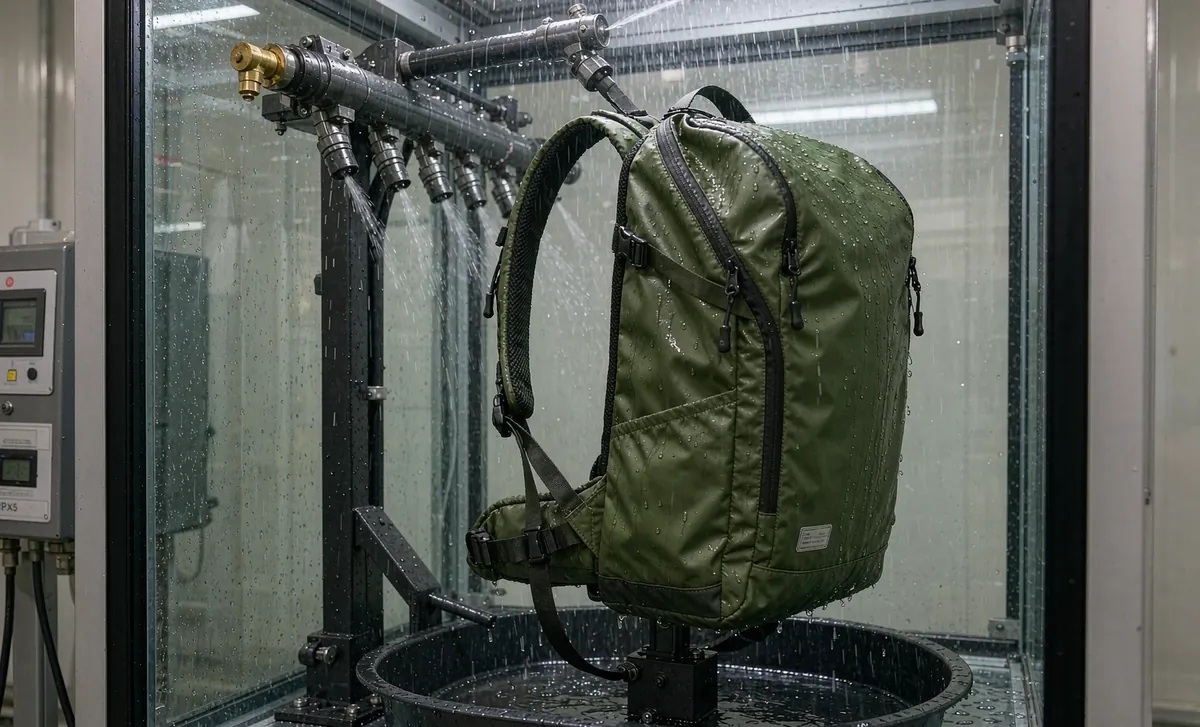
Table of Contents
- What a Factory Audit Can Prove and What It Cannot
- Documents to Request Before You Book the Visit
- The Welding Line Walk: Counting Real Capability
- RF Generator, Electrode Log and Parameter Control
- Cutting and Spreading Accuracy at the Head of the Line
- In-Process QC Stations and What They Actually Record
- The Water Test Room and Its Calibration Records
- Material Store: Lot Traceability and Rotation
- Social Compliance and the BSCI Evidence File
- Capacity Arithmetic: Lines, Shifts and Monthly Output
- Subcontracted Processes and Where They Hide
- The Retained Sample Room and Golden Sample Control
- Scoring the Visit: A Weighted Audit Table
- Frequently Asked Questions
- People Also Ask
What a Factory Audit Can Prove and What It Cannot
An audit answers one question: can this facility repeat a result. It does not tell you that a particular bag is waterproof, because that is a property of a design and a material, and it is established by testing under a named method. A facility can be immaculate and still be running a shell whose coating is too thin for your product, which is a specification failure rather than a manufacturing one.
What the visit does establish is whether the systems exist to catch a problem. Are the weld parameters recorded or remembered. Is the water test room calibrated or decorative. Are material lots traceable after the fact, or only identifiable while the roll is on the rack. These are the differences between a supplier who will find a drift and one who will ship it.
The second thing a visit establishes is honesty about capacity. A supplier who says yes to every date has either unlimited lines, which nobody has, or a plan to bump someone. Walking the floor and counting lines, shifts and staffing tells you within an hour which of those is true, and it is the single most valuable hour in the whole audit.
Documents to Request Before You Book the Visit
Request the document set two weeks before the visit and read it before travelling. The set is short: business licence and scope, the quality management certificate under ISO 9001:2015, the social compliance audit report under BSCI, any third-party verification report such as SGS, the equipment list, the process flow, and one recent inspection report for a shipped order.
Reading them first changes what you ask on the floor. If the equipment list shows four welding machines and the flow shows two shifts, the capacity question is arithmetic you can prepare in advance. If the inspection report carries no measurements, the quality station question is already half answered. Turning up without reading means spending the visit on questions a document could have answered.
One document deserves a specific warning. A certificate with a number on it should be checked against the issuing body's own register rather than taken at face value, and the scope on it should cover the product being made. We supply our verification records with the scope and the date visible, because a certificate with the scope cropped is a certificate that has been cropped for a reason.
The Welding Line Walk: Counting Real Capability
Walk the welding lines and count. How many welding stations exist, how many are running, how many operators are on each, and what shift pattern they work. Then ask what the line is currently making and for whom. A line running your competitor's product at the time of the visit is not a problem, but a line that is idle while the supplier claims to be at full capacity is information.
Look at the electrode on each machine and at the log beside it. An electrode is a consumable with a service life, and a worn electrode is the most common cause of a drifting weld. If the log exists and shows change dates, the parameter control is probably real. If the operator has to ask what a log is, it is not.
Watch one complete cycle. Time it. Multiply by the shift length and by the number of stations, and you have a daily output per line that you can compare with the claimed monthly figure. This is the fastest credibility check in the audit, and it is the one that cannot be prepared for in advance, because it depends on what the machine is doing while you are standing there.
| Observation on the line | What it indicates | Follow-up question | Red flag |
|---|---|---|---|
| Parameter card at each machine | Settings are standardised | Is the card dated and signed | Handwritten notes with no revision |
| Electrode change log | Consumable life is managed | When was the last change | No log, or one that stops months ago |
| Coupon samples at the station | In-process verification exists | How often are they pulled | Coupons only produced for the visit |
| Idle stations during a claimed peak | Capacity is overstated | What is this station booked for | Every idle machine explained away |
| Operators rotating tasks | Cross-training is real | Who covers an absence | One person who alone can set the machine |
RF Generator, Electrode Log and Parameter Control
Radio frequency welding is the process that makes a waterproof bag waterproof, and it is the process most worth auditing closely. The variables are energy, pressure, dwell time and electrode condition, and each drifts. A facility that controls them records them; one that does not is relying on operator skill, which is real but not consistent across shifts, seasons or staff changes.
Ask to see the parameter record for a product currently in production, and then ask to see the peel test result from that run. A facility that welds and tests will have both within a few minutes. A facility that welds and inspects only at the end will have the second and not the first, which tells you that any drift is discovered at finished goods rather than at the machine.
Then ask the question that separates the two: what happened the last time a coupon failed. Every facility that pulls coupons has failures. The ones worth working with can describe one, what the corrective action was, and what changed afterwards. A facility that has never had a failed coupon is either not testing or not recording, and both are worse than failing.
Cutting and Spreading Accuracy at the Head of the Line
Defects created at cutting propagate through the whole product, so the head of the line is worth five minutes. Check that the die matches the current revision, that panels are counted against the nest, and that the spread is tensioned consistently. A panel cut on the wrong grain, or cut with the coating face reversed, produces a bag that looks right on the bench and behaves differently in the field.
Ask how offcuts and panel orientation are controlled. A coated fabric has a face and a back, and a mirror-image panel cut face down will not match its pair in shade or sheen. Mature facilities mark orientation on the nest and on the die. Facilities that do not will produce products with a visible mismatch between left and right, intermittently, for as long as the programme runs.
The third check is material utilisation. Ask what percentage of the roll becomes product and what happens to the rest. It is a cost question as much as a quality one, because a nest that wastes material adds cost to every unit for the life of the product, and the waste allowance is built into the quotation rather than disclosed in it.
In-Process QC Stations and What They Actually Record
Count the QC stations and, more importantly, look at what they record. A station with a checklist and a pen produces a record. A station with a completed checklist produced for the audit produces a different thing, and the difference is visible in the handwriting, the dates and whether the totals reconcile with the production record for the same day.
Ask for one day's records and reconcile them. The production record says 400 units; the QC record should show a sample count consistent with the plan, not a round number that looks tidy. Records that always show the same five defects, or that show zero defects every day for months, are records written to satisfy an auditor rather than to control a process.
The station that matters most is the water test, and it deserves its own question: how many units per shift are tested, and what happens to a failed unit. A facility that tests a small sample from each shift and can show you the failures has a functioning gate. One that tests only at the end, or only when the buyer asks, has an inspection rather than a control.
- Ask for one full day of production records and the matching QC records, then check the numbers reconcile.
- Look for variation in the defect entries; identical entries repeated daily suggest the record is not real.
- Ask which units are water tested per shift and where failed units go.
- Ask for the last corrective action raised and what changed as a result.
- Confirm the final inspection is drawn at random across cartons at AQL 2.5 under ISO 2859-1.
The Water Test Room and Its Calibration Records
Every waterproof bag producer has a water test of some kind, and they are not equivalent. A bucket and a hose is not a test method. A test room should have a defined method, a defined duration and depth, and equipment that is calibrated, which means a hydrostatic head tester with a current calibration certificate and, where immersion is claimed, a tank with a measurable depth.
Ask to see the calibration certificates and check the dates against the equipment serial numbers. A tester calibrated two years ago is not calibrated. Then ask which method each test follows: spray under AATCC 22, rain under AATCC 35, immersion under IEC 60529, and shell resistance under ISO 811. A facility that can name the method is using one.
Then ask for the last three test reports issued to a customer. Read one closely. It should carry the method, the parameters, the sample identification, the result and the date. A report with a pass statement and no parameters is not evidence of anything, and it will not support the claim your brand is about to print on the product.
Material Store: Lot Traceability and Rotation
Traceability is the audit item that decides whether a problem can be contained. Ask to trace one roll of film from the rack to a finished carton. A functioning system produces the receiving record, the lot number, the issue record, the production record and the carton label within the visit. A weak system produces most of those and then a gap at the point that matters.
Rotation matters as much as identification. Coated fabric and film have a shelf life, and a roll that has sat past it can have a coating that no longer welds or bonds correctly. Ask how age is controlled: first-in first-out with date labels, or a system where the newest stock is at the front because it is easiest to reach. The second is common and it is a defect.
Storage conditions are the last item in the store and the one most often skipped. Film and coated fabric should be stored dry, off the floor, and away from direct light. A roll stored against an outside wall in a humid climate will show hydrolysis at the edges long before its stated shelf life, and the resulting welds will fail intermittently in a way that is very hard to diagnose later.
Capacity Arithmetic: Lines, Shifts and Monthly Output
Capacity is arithmetic and should be checked as arithmetic. Take the cycle time you observed, the stations running, the shift length and the shift pattern, and compute a daily figure. Multiply by working days, allow for the usual losses, and compare with the stated monthly output. The two numbers should be within a reasonable margin of each other.
If they are not, ask why before assuming the worst. A facility running a mix of simple and complex products has a lower unit output than one running a single simple product, and a facility that books conservatively will quote a figure below its theoretical maximum. Both are legitimate. What is not legitimate is a stated figure with no derivation behind it.
Our own figures are checkable in exactly this way. The validated production partner facility we work through runs 4,950 square metres with 7 lines, 149 machines and 137 people, verified by SGS, at 200,000 pieces a month. Those are measured numbers rather than claims, and they are the basis on which we book a date against a line rather than against a hope.
Subcontracted Processes and Where They Hide
Some processes are routinely placed outside the main facility: printing, plating, moulding of custom hardware, some specialised welding, and carton printing in some cases. This is normal and not itself a problem. What matters is whether it is disclosed, whether the subcontractor is named, and whether the producer remains responsible for the result.
Ask directly which processes are placed outside, and ask for the list. Then ask what incoming checks are applied when the work comes back. A printed panel returning from a subcontractor should be checked for registration and adhesion before it reaches assembly, and a plated buckle should be checked for finish and for a pull result. If nothing is checked on return, the subcontractor is effectively unmanaged.
The reason this matters commercially is that the failure usually appears late. A print that has not been cured correctly looks fine on the day and rubs off in month two. A plate that is too thin looks fine and corrodes in a salt environment. Both are discovered by the customer, and both trace back to a process the buyer was never told existed.
The Retained Sample Room and Golden Sample Control
A retained sample room is a strong signal and it is quick to assess. Look for samples labelled with a customer, a product reference, a revision and a date, stored in conditions that are not a windowsill. A room with a shelf of unlabelled bags is not a retained sample system; it is a cupboard of leftovers.
Ask to see the retained sample for a product shipped six months ago and the matching approval record. A facility that can produce both, quickly, has a system that will support a repeat order and resolve a dispute. One that cannot will argue about shade and hand feel from memory, and the argument will be settled by whoever is more persuasive rather than by evidence.
Storage conditions matter here for the same reason they matter in the material store. A coated sample kept in heat and humidity changes: the film can hydrolyse, a white shell can yellow and the shade can shift. Ask how long samples are kept and under what conditions, because a reference that has degraded is worse than no reference at all.
Scoring the Visit: A Weighted Audit Table
An audit is only useful if it produces a decision, and a decision needs weighting. Not every check point carries the same risk: a missing calibration certificate affects every product the facility makes, while a untidy store affects none. The table below weights the nine stations by consequence and gives a scoring method that produces a comparable result across facilities.
- Business licence and scope reviewed before travel, with the registered scope covering soft goods production.
- ISO 9001:2015 certificate checked against the issuing register, with scope and expiry date visible.
- BSCI social compliance report read in full, including open findings rather than the summary page only.
- Third-party verification such as SGS reviewed for date, scope and the figures it actually attests to.
- Equipment list compared with the machines physically present on the floor during the walk.
- Process flow compared with the observed sequence, noting any step that happens somewhere else.
- One recent shipped-order inspection report read for measurements rather than a bare pass statement.
- Welding stations counted, running stations counted separately, and idle stations accounted for.
- One complete weld cycle timed, then multiplied by stations and shift length to derive daily output.
- Parameter card at each welding machine checked for a revision, a date and a signature.
- Electrode change log inspected for recency and continuity rather than a single recent entry.
- Coupon peel results requested for the product currently running, with the widths recorded.
- The last failed coupon discussed, including the corrective action and what changed afterwards.
- Cutting die confirmed against the current drawing revision letter before any panel is cut.
- Panel orientation and grain direction marked on the nest and controlled at the spread.
- Material utilisation and the offcut allowance explained rather than buried in the quotation.
- QC station records for one day reconciled against the production record for the same day.
- Defect entries examined for genuine variation, since identical daily entries are not real records.
- Water test count per shift established, and the route a failed unit takes established with it.
- Hydrostatic head tester calibration certificate matched to the serial number and checked for date.
- Immersion tank depth verified, and the method named for each claim the product will carry.
- One roll of film traced from the rack through to a finished carton label inside the visit.
- Stock rotation confirmed as first-in first-out with visible date labels on every roll.
- Retained sample for a product shipped six months ago produced with its signed approval record.
| Audit station | Weight | What a full score looks like | What scores zero |
|---|---|---|---|
| Welding line and parameter control | 20 | Parameter cards, electrode log, coupons pulled and failed coupons with corrective actions | Settings held in an operator's memory |
| Water test room and calibration | 18 | Named methods, current calibration, reports with parameters | A bucket, a hose and a pass statement |
| In-process QC stations | 15 | Records that reconcile with production, named gates, real variation in entries | Identical tidy entries every day |
| Material traceability | 12 | One roll traced to a finished carton within the visit | A gap at the issue or carton stage |
| Capacity arithmetic | 10 | Stated output derived from cycle time, stations and shifts | A figure with no derivation |
| Cutting and spreading | 8 | Revision-controlled dies, orientation marked, counts against the nest | Offcuts reused with no control |
| Social compliance evidence | 7 | BSCI report with findings, floor consistent with the report | Report and floor in open disagreement |
| Subcontractor control | 6 | Named list, incoming checks on return | No disclosure, no checks |
| Retained sample room | 4 | Labelled, conditioned, retrievable with the approval record | A shelf of unlabelled leftovers |
Score each station out of its weight and read the total as a capability judgement rather than as a pass or fail mark. A facility scoring well on the welding and test stations and poorly on the rest is a capable producer with weak administration, which is workable. One scoring well on presentation and poorly on parameter control and calibration is not workable at any price.
To arrange a visit or request our document set before one, write to service@junyuanbags.com or WhatsApp +86 177 5002 0688. The compliance and capacity evidence is summarised on the manufacturing page, the inspection gate is described on the quality page, and the credential checks are set out in the supplier credential verification guide. Current shells and programmes are listed under products. The programmes audited here run at 500 pieces per style per colour, with bulk production of 35 to 50 days from the approved pre-production sample, inspection at AQL 2.5 under ISO 2859-1, and release FOB Xiamen on T/T 30 per cent deposit and 70 per cent before shipment.
Frequently Asked Questions
Q1: What does a waterproof bag factory audit actually prove?
A: It proves capability to repeat a result, not that a particular bag is waterproof. Waterproofing is a property of a design and a material established by testing under a named method. The audit establishes whether weld parameters are recorded, whether the water test room is calibrated, whether lots are traceable and whether capacity is real.
Q2: Which documents should I request before visiting?
A: Business licence and scope, the ISO 9001:2015 certificate, the BSCI audit report, any third-party verification such as SGS, the equipment list, the process flow, and one recent inspection report for a shipped order. Reading them first lets you spend the visit on the floor rather than on questions a document could have answered.
Q3: How do I check whether a welding line is genuinely controlled?
A: Ask for the parameter record for a product in production and the peel test result from that run, then ask what happened the last time a coupon failed. A facility that pulls coupons has failures; one that can describe a failure and its corrective action is controlling the process, while one that has never failed is either not testing or not recording.
Q4: What should the water test room contain?
A: A defined method with duration and depth, a hydrostatic head tester with a current calibration certificate matched to its serial number, and an immersion tank with a measurable depth. Ask which methods are followed: spray under AATCC 22, rain under AATCC 35, immersion under IEC 60529, and shell resistance under ISO 811.
Q5: How do I verify a claimed production capacity?
A: Take the cycle time you observed, the stations running, the shift length and the shift pattern, compute a daily figure, multiply by working days and compare with the stated monthly output. The two should be within a reasonable margin. Ask for the derivation if they are not, since a figure with no derivation behind it is not a capacity.
Q6: Why does material lot traceability matter so much?
A: Because it decides whether a problem can be contained. Ask to trace one roll of film from the rack to a finished carton within the visit: receiving record, lot number, issue record, production record and carton label. A system with a gap at the issue or carton stage cannot contain a defect to one lot.
Q7: What should I look for in the material store besides traceability?
A: Rotation and storage conditions. Coated fabric and film have a shelf life, so ask how age is controlled, since stock placed at the front because it is easiest to reach is a common and real defect. Then check that material is stored dry, off the floor and away from direct light.
Q8: How should social compliance evidence be checked?
A: Ask for the BSCI report, check its date and scope, and read the findings rather than the cover page. Walk the floor with it in hand, since hours, protective equipment, first aid, fire exits and facility condition are observable in ten minutes. Where the report and the floor disagree, the floor is the one that is true.
Q9: Which processes are commonly subcontracted and does it matter?
A: Printing, plating, custom hardware moulding, some specialised welding and sometimes carton printing. It matters where it is undisclosed or unmanaged. Ask for the named list and then ask what incoming checks are applied when the work returns, because a print that was not cured correctly looks fine on the day and rubs off in month two.
Q10: Why is a retained sample room worth visiting?
A: Because it predicts whether a repeat order and a dispute will be handled with evidence. Look for samples labelled with customer, product reference, revision and date, stored in reasonable conditions, and ask for one shipped six months ago with its approval record. An unlabelled shelf of leftovers is not a retained sample system.
Q11: How should I score the audit so it produces a decision?
A: Weight the stations by consequence rather than counting them equally. Parameter control and the water test room carry the most weight because they affect every product made, while presentation carries almost none. A facility weak on administration but strong on welding and testing is workable; the reverse is not workable at any price.
Q12: What capacity and compliance figures should I expect from a credible partner?
A: Figures that are measured and checkable rather than asserted. Our validated production partner facility runs 4,950 square metres with 7 lines, 149 machines and 137 people, verified by SGS, at 200,000 pieces a month, with BSCI social compliance audit coverage and ISO 9001:2015 certification, and we open it to buyer audits.
People Also Ask
- What should I check when auditing a bag factory?
- How do I verify a waterproof bag manufacturer?
- What certifications should a bag factory have?
- How can I tell if a factory's capacity claim is real?
- What is a BSCI audit report?
- Why is weld parameter control important?
Social Compliance and the BSCI Evidence File
Social compliance is audited, not inspected, and the evidence is a file rather than a machine. Ask for the BSCI audit report, check the date and the scope, and read the findings rather than the cover page. A report with open findings is normal; a report with no findings at all, on a first audit, is unusual and worth a second question.
Walk the floor with the report in hand. Working hours, protective equipment, first aid provision, fire exits and the state of the facilities are all observable in ten minutes and all appear in the report. Where the report and the floor disagree, the report is the document that was written for a purpose and the floor is the one that is true.
Ask two specific questions that most buyers forget. How are agency or temporary workers engaged, and are they inside the audit scope. And what happens to subcontracted processes in social terms, since printing or plating placed outside is often outside the audited perimeter as well. Both are common gaps and both are answerable honestly.