
Waterproof Bag Testing and QA: The Full Test Matrix
A waterproof bag test protocol fails when it measures the material and reports it as the product, because the seam and the closure are what leak, not the panel. QUANZHOU JUNYUAN BAGS runs a matrix that separates material tests from product tests, adds a seam peel check and an abrasion-then-re-test sequence, and samples every lot at AQL 2.5 under ISO 2859-1. Hydrostatic head is measured to ISO 811, shower to AATCC 35, spray to AATCC 22 and ingress class to IEC 60529, and every result is written to a twelve-field report held against the style number. Sampling 6-10 working days, bulk 35-50 days, 500 pcs per style per colour.
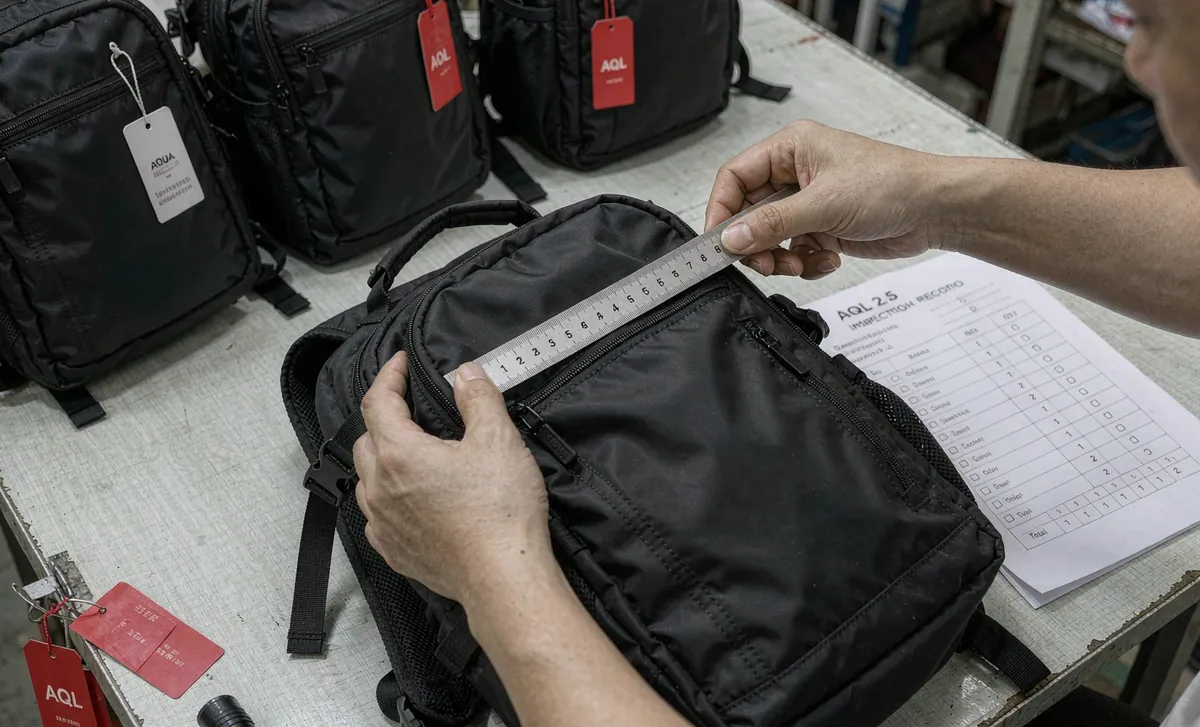
Table of Contents
- The Five Questions a Test Protocol Has to Answer
- Material Tests Versus Product Tests
- The Water Ingress Test Matrix
- Choosing Between Spray, Shower and Submersion
- Hydrostatic Head and the Three Traps
- The Seam Peel Test Nobody Runs
- Abrasion, Then Re-Test: The Combined Sequence
- Mechanical Tests: Drop, Tensile and Cycle
- AQL 2.5 in Practice: How the Sample Is Drawn
- The Twelve-Field Test Report Template
- Calibration, Reference Samples and Test Validity
- Destructive and Non-Destructive: What to Test Where
- Building a QA Protocol From a Tech Pack
- Frequently Asked Questions
- People Also Ask
The Five Questions a Test Protocol Has to Answer
Most test protocols in this category are inherited rather than designed, and they therefore answer questions nobody asked. A brand asks a supplier for test reports, receives a folder of material certificates, and has a documented product that leaks. The reason is that a material certificate answers a question about a roll and the brand needed an answer about a bag. Before selecting a single method, we write down the five questions the protocol has to answer and we reject any test that does not map to one of them.
- Will water get in, and by which path: the panel, the seam, the closure or the hardware?
- Will it still keep water out after the ageing this product will actually see: heat, humidity, cold, UV, salt?
- Will it still keep water out after the abrasion this product will actually take?
- Will the structure hold the load it will carry, at the points where that load concentrates?
- Will the lot shipped this month behave the same way as the lot approved last year?
The first question is deliberately phrased as a path question, because water enters a bag by a path and not by a material. A hydrostatic head figure answers whether the fabric is waterproof, which is almost never the operative question. A submersion test on the finished bag answers whether the product is, and it localises the failure if it is not.
The fifth question is the one almost every protocol omits and the one that decides whether a programme survives into a third year. A reorder is not a new product, it is the same product made again, and the only way to know it is the same is to hold the original result and compare against it. We hold every qualification record against the style number for exactly this reason, and the retention is what makes a reorder a repeat rather than a gamble.
Material Tests Versus Product Tests
The distinction between testing a material and testing a product is the single most important idea in this document, and it is the one most often blurred in a supplier report. A material test is run on a flat, new, unstressed sample and it is excellent for comparing two rolls against each other. A product test is run on the finished article in its working orientation and it is the only thing that predicts a return. Both are necessary and neither substitutes for the other.
| Question | Material test answers it | Product test answers it | Why the difference matters |
|---|---|---|---|
| Is this shell waterproof? | ISO 811 on a flat sample | A shower or a submersion on the bag | The fabric can pass and the bag can still leak at the seam |
| Will the seam hold? | No | A submersion and a peel test | A seam is an assembly, not a material |
| Will the closure hold? | No | A submersion with the closure sealed as a user would | A closure is operated, not measured |
| Will it survive ageing? | A hydrolysis or a UV sequence on a panel | An aged-then-challenged sequence on the bag | The aged bag has a load path the panel does not |
| Will it survive abrasion? | ASTM D751 on a panel | A drag test, then a re-test for water column | Abrasion concentrates at a corner, not on a flat panel |
| Is this lot the same as the last? | A retained-column comparison | A repeat of the product test | Both are needed, and the material one catches a mill change first |
The practical reading of that table is that a brand should never accept a test pack made entirely of material certificates, and should never accept one made entirely of product tests either. The material tests catch a mill change early and cheaply. The product tests catch the assembly failure that actually generates the return. We run both and we file them together against the same style number, because a report that only half answers the question is a report that will be read as a full answer.
We also state explicitly on every report which is which, because the most common misuse of a test document is a material result being quoted as a product claim. A hangtag that says a bag is waterproof on the strength of an ISO 811 fabric figure is making exactly that error, and it is the origin of the credibility gap that shows up in returns data. The methods and what they do and do not establish are set out on our water ingress test methods page.
The Water Ingress Test Matrix
The matrix below is the core of our protocol. It is organised by the path water takes rather than by the method, so each row exists to close one route into the bag. The sample-size and frequency columns are the ones brands usually ask us to justify, and the justification is simply that a test run once on a sample tells you about that sample, while a test run per lot tells you about the programme.
| Route into the bag | Method and fixture | Sample | When | Pass condition | Frequency |
|---|---|---|---|---|---|
| Through the panel | Hydrostatic head to ISO 811 | Three panels per lot | At qualification and per lot | At or above the declared figure | Per lot on the retained roll |
| Through the panel after ageing | The same, after a heat and humidity sequence | Three panels | At qualification | Retained figure within the agreed band | At qualification and on a mill change |
| Through the face finish | AATCC 22 spray rating | Three panels | At qualification | At or above the agreed rating | Per lot where a finish claim is made |
| Through the whole bag in rain | AATCC 35 shower, packed and oriented | Two finished bags | At qualification and per production day | Interior moisture by mass below the limit | Per production day |
| Through the closure | Submersion to the IEC 60529 condition, sealed as a user would | Three finished bags | At qualification | No detectable ingress at the closure | Per lot |
| Through the seam | Weld peel and a seam submersion | Five coupons plus one bag | At qualification and per lot | Peel force above the limit, no ingress | Per lot |
| Through the abraded panel | Abrasion, then a re-test for water column | Three abraded panels | At qualification | Retained column above the limit after abrasion | At qualification |
The fourth row is the one most often omitted and it is the one that catches the everyday failure. AATCC 35 puts a shower onto a backed sample and reports the mass of water absorbed, and running it on a finished, packed bag in its working orientation is a completely different test from running it on a swatch. We run it per production day rather than per lot, because a shower result is sensitive to a change in the seam parameters that a material test will never detect.
The last row is the one that predicts a field return and it is the rarest in the industry. A bag does not fail because its new fabric was weak, it fails because its scuffed fabric was, and the only way to measure that is to abrade first and re-test afterwards. We record the retained column after abrasion as a controlled property of the style rather than as a one-off result.
Choosing Between Spray, Shower and Submersion
Three water tests are in common use and they are not three grades of the same thing, they are three different questions. Choosing the wrong one produces a figure that is real and irrelevant, which is worse than having no figure at all. The selection should be made from the environment the product will see, and the environment should be stated in the brief rather than assumed.
| Method | What it asks | Expressed as | Use it when | Do not use it when |
|---|---|---|---|---|
| AATCC 22 spray | Does the face shed water? | A 0 to 100 rating | The question is about a finish and appearance | The question is about water getting inside |
| AATCC 35 shower | Does the packed bag stay dry in rain? | Mass of water absorbed | The product is worn or carried in rain | The product is submerged, or the closure is the question |
| IEC 60529 IPX class | Does the sealed product resist a defined water exposure? | A code plus its condition | A claim is being printed and a condition can be stated alongside it | The product is not sealed, or no condition will be printed |
| ISO 811 hydrostatic head | How much pressure does the flat fabric resist? | mm of water column | Comparing two rolls or two shells | Anything to do with a seam, a fold or a closure |
The selection rule we apply is simple: match the test to the wettest condition the product will actually see, and then state that condition wherever the result is quoted. A commuter backpack needs a shower test and not a submersion test. A dry bag needs a submersion test and not a shower test. A bag sold on a hangtag needs whatever test the hangtag claim refers to, and the claim is then written to match the test rather than the other way round.
Where a brand wants an ingress class, we test to IEC 60529 and we insist that the condition is printed with the code. The code alone is a compressed description of a specific test that most shoppers will read as a general promise, and the resulting misunderstanding is the largest single source of returns in this category. A code plus its condition is an instruction and it behaves like one.
Hydrostatic Head and the Three Traps
Hydrostatic head to ISO 811 is the most quoted figure in waterproof bags and the most misused. The method itself is sound: a flat sample is clamped, a water column is raised against it, and the height at which the third drop appears on the far face is recorded. The traps are not in the method, they are in what people do with the number afterwards.
- Trap one: the sample is new. A figure measured on a new roll says nothing about the same material after a season of heat and humidity, which is why we measure the retained column after an ageing sequence and treat that as the specification.
- Trap two: the sample is flat and unstressed. A bag has folds, corners and a load pressing outward at a seam, and the column is measured on none of those, which is why a fabric figure never predicts a seam failure.
- Trap three: the method is not stated. ISO 811, AATCC 127 and JIS L 1092 all report a water column and they do not give identical figures, so a number without a method beside it is not a specification, it is a claim.
The third trap is the one that causes arguments between a brand and a supplier who are both being honest. A supplier quotes a figure measured by one method, a buyer compares it with a figure measured by another, and the two disagree by a wide margin with nobody at fault. We report the figure with the method and the conditioning on the same line and we ask every brand to do the same on its own specification sheet.
We also cross-check a supplier claim where a brand is transferring an existing programme. A mill data sheet is evidence about a roll and not about the lot in front of us, so we re-measure on the actual lot before we quote. This is the cheapest test in the matrix and the one that catches the most problems, because a mill that has quietly changed a formulation will still supply a data sheet that reads exactly as it always did.
The Seam Peel Test Nobody Runs
The seam is where a waterproof bag leaks and it is the component almost nobody tests, because testing it is destructive and because the result is a force rather than a headline number. A weld or a tape is an assembly with its own strength, its own failure mode and its own ageing curve, and it should be qualified exactly the way a fabric is qualified. We run a peel test on every seam construction we approve and we hold the result as a controlled property.
- Cut five coupons across the seam from a production unit rather than from a trial panel
- Condition them and then peel the joint at a defined rate in a tensile frame
- Record the peak force and the failure mode separately, because they tell you different things
- A failure in the material away from the joint is a good result: the seam is stronger than the shell
- A failure in the joint itself is a parameter problem, and the weld or the tape settings go back to trial
- Re-run the peel on a coupon that has been through the ageing sequence, because the joint ages too
The third step is the one that makes this test diagnostic rather than merely pass or fail. If the coupon breaks in the parent material rather than at the joint, the joint is stronger than the material and the seam is not the limiting factor. If it breaks at the joint, the parameters are wrong, and the useful information is that no amount of additional tape width or weld time applied blindly will fix it. The two results look identical on a pass-or-fail sheet and they are completely different in practice.
The sixth step is the one that catches the slow failure. A welded joint on a TPU film ages on the same curve as the film and ages slowly. A taped joint on a coated fabric ages on the curve of an adhesive sitting on a coating that is itself hydrolysing, which is two mechanisms in series. That is why we do not approve a taped seam in a permanently wet zone on any product, and why we can say so with a peel result after ageing rather than as an opinion.
Abrasion, Then Re-Test: The Combined Sequence
Abrasion and waterproofness are usually tested as separate properties by separate methods, and that separation is the reason a bag with a good abrasion figure returns as a leak. The barrier is a surface layer and abrasion removes it, so the property that matters is not the abrasion resistance and not the water column, it is the water column of the abraded material. Testing the two separately measures neither.
The combined sequence is simple: abrade the sample to a defined cycle count or a defined drag distance using a method appropriate to the product, then re-measure the hydrostatic head on the abraded area and record the retained figure. We report four numbers rather than one: the column as received, the column after abrasion, the retained percentage, and the appearance grading. A brand can then decide whether it is buying appearance or function, because the two do not always move together.
| Product type | Abrasion method used | Challenge level | What is recorded | Typical retained-column expectation |
|---|---|---|---|---|
| Backpack and daypack | Martindale or a rub test on the base panel | A defined cycle count | Column before and after, plus appearance | High, the base is not the leak path |
| Travel bag | A belt drag in the carrying orientation | A defined distance | Column before and after at the corner | Moderate, corners take the damage |
| Marine and deck bag | Abrasion to ASTM D751, then a flex at a fold | A defined cycle count | Column after abrasion and flexing | High, or the shell is not marine-grade |
| Team kit and site bag | A grit slurry pad test | A defined distance | Column after, plus base-fabric exposure | Moderate, mud is aggressive |
| Dry bag and submerged product | Abrasion, then a submersion on the abraded area | A defined cycle count then a submersion | Ingress at the abraded area | High, because immersion follows abrasion |
The last row is the strictest test in the matrix and the one we apply to any product sold with an immersion claim, because the field sequence is exactly that: a dry bag is dragged across a beach and then it goes in the water. A product that holds its column when new and loses it after abrasion is a product with a false claim, and the combined sequence is the only way to find that out before a customer does.
Mechanical Tests: Drop, Tensile and Cycle
Water is not the only thing that returns a bag, and in most categories it is not even the most common. A strap tears, a buckle breaks, a handle separates and a wheel cracks, and each of those is a mechanical failure at a point where the load concentrates. The mechanical tests in our protocol are therefore organised by the load path rather than by the component, because the component is where the failure appears and the load path is where it originates.
| Load path | Test | Condition | What is recorded | Acceptance |
|---|---|---|---|---|
| Handle to shell | A lift and hold | 150 percent of the declared packed weight | Creep and any separation at the root | No separation, no creep beyond tolerance |
| Strap anchor to shell | A snap load | Ten applications at the declared load | Elongation and any tear at the anchor | No tear, no elongation beyond tolerance |
| Webbing and adjuster | A tensile pull, plus an adjuster slip test | To the rated load, then a cyclic slip check | Elongation and slip distance | No rupture, slip within tolerance |
| Closure cycle | Open and close | To an agreed count, wet and dry | Operation and any change in the sealing force | Operates throughout, seals at the end |
| Wheeled product | A route cycle: drops, stairs, rolling | At the declared load | Component condition at intervals | No crack, no separation, no latch failure |
| Carton and pack | A drop test on the packed carton | A defined height and orientation sequence | Product and pack condition | Product undamaged, pack intact |
The 150 percent figure in the first row is deliberate and it is worth explaining. A person lifting a bag by one handle does not lift it evenly, and the transient load during an awkward lift is well above the static one. A handle tested only at the packed weight passes on almost any construction, which is exactly why handles fail in the field and pass in the sample room.
Where a product has a military, a tactical or a ruggedised claim, we can add MIL-STD-810 sequences to the protocol, and we are careful about what that means. A sequence from that standard is a defined procedure with a defined pass condition, and quoting it without running it is a claim rather than a result. We run what we quote and we put the sequence and the condition on the report.
AQL 2.5 in Practice: How the Sample Is Drawn
AQL 2.5 under ISO 2859-1 is the acceptance quality limit we inspect to, and it is worth being precise about what it does and does not say, because it is widely misunderstood as a statement about the quality of the lot. It is not. It is a sampling plan that defines how many units to inspect and how many defects to allow before the lot is rejected, and it is a risk allocation between the buyer and the producer rather than a quality guarantee.
The plan is selected by lot size and by the inspection level, the sample is drawn at random across the lot rather than from the start of the run, and defects are classified rather than counted as one number. A critical defect is one that makes the product unsafe or unlawful, a major defect is one that makes it unsaleable, and a minor defect is one that a customer would notice but would probably still accept. AQL 2.5 applies to the major class in our default plan, and the critical class is treated as zero acceptance.
| Defect class | Definition | Example in a waterproof bag | Acceptance in our plan |
|---|---|---|---|
| Critical | Unsafe or unlawful | A buckle that separates under load, a sharp exposed edge | Zero acceptance, the lot is rejected |
| Major | The product will not do its job or will be returned | A seam that leaks, a closure that will not seal | Governed by AQL 2.5 |
| Minor | Noticeable, probably still accepted | A colour shade difference within tolerance, a cosmetic scuff | Governed by a separate, looser limit |
| Process | Not a product defect but a signal | A weld parameter drifting out of its window | Treated as a process alert and investigated |
The fourth row is the one that turns an inspection into a quality system rather than a gate, and it is the reason we record process signals separately from product defects. A weld parameter drifting out of its window will produce no defective units today and will produce a leaking seam in three weeks, and the only way to catch it is to watch the parameter rather than the product. We log both and we investigate a drift before it becomes a defect.
The inspection is documented per lot with the sample size, the defect count by class, the accept or reject decision and the disposition of any defect found. That record is what a brand needs when a retailer asks for evidence, and it is also what makes a conversation about a disputed lot possible at all, because without it the discussion is two opinions rather than two records.
The Twelve-Field Test Report Template
A test result is only as useful as its record, and the single biggest weakness in supplier documentation is a report that states a result without stating the conditions that produced it. A figure without a method, a conditioning state, a sample description and a date is not evidence, because it cannot be reproduced or compared. Our report template therefore fixes twelve fields, and a report with a blank field is treated as incomplete rather than as passable.
- Style number and revision, so the record can be tied to a specific build
- Lot reference and the date of manufacture, so the result can be tied to a specific production run
- Sample description: finished product, panel or coupon, and its orientation if it matters
- Method used, stated precisely enough to be repeated, including the standard and the year
- Equipment used and its calibration date, because an uncalibrated gauge produces a number, not a result
- Conditioning state: as received, aged, abraded, wet or cold, and the sequence that got it there
- The result, with units, and the method's own reporting convention
- The pass condition that was applied, and who agreed it
- The pass or fail outcome, stated separately from the result
- Photographs of the sample before and after, with a scale reference
- The name and signature of the person who ran the test and the person who reviewed it
- The disposition: released, held, reworked, rejected, and what happens next
The fifth field is the one most often missing from an industry report and it is the one a retailer's auditor looks for first, because a result from an uncalibrated instrument is not a measurement. We hold a calibration schedule for every gauge, fixture and chamber in the protocol, and we record the calibration date on the report rather than in a separate file that nobody reads.
The last field is the one that makes the document operational rather than archival. A report that says a lot failed and does not say what happens next is a report that will be argued about, because nobody recorded the decision. We record the disposition at the time of the test, and where the disposition is a rework we record the rework and re-test rather than assuming it happened.
Calibration, Reference Samples and Test Validity
A test is valid only if the same test on the same sample gives the same answer tomorrow, and that property is maintained rather than assumed. Three things maintain it: a calibration schedule for the equipment, a retained reference sample for the product, and a periodic repeat of a previous test to confirm the whole chain still behaves. All three are cheap and all three are routinely skipped.
- Every gauge, timer, chamber and frame on a current calibration schedule, with the date recorded on the report
- A retained reference sample per style, stored under controlled conditions and used to check a new test against an old one
- A periodic repeat test: a sample from a previous lot is re-tested and the result compared with the original record
- A defined tolerance for repeatability, so a difference is either within the method's noise or a real change
- A documented corrective action whenever a repeat falls outside that tolerance, because a drift has a cause
The third item is the one that catches problems nothing else catches, because it tests the whole chain at once: the equipment, the operator, the method and the material. A repeat that falls outside tolerance might be a calibration issue, an operator issue or a genuine material change, and all three need different responses. Without the repeat, none of them is detected until a customer detects it for you.
This is also the discipline that makes a reorder safe. A brand reordering in year three is relying on a chain of measurements made over three years by different operators on different equipment, and the only way to know those measurements are comparable is to have been checking them against retained references all along. We hold the reference and the repeat schedule against the style number for the life of the programme.
Destructive and Non-Destructive: What to Test Where
Every test in the matrix is either destructive or not, and that single property decides where in the process it can be run. A destructive test consumes the sample, so it can only be run on a sacrificial unit, which means it can never be run on the unit that ships. A non-destructive test can be run on the shipped unit, which means it can be run at a much higher frequency and it can catch a process drift while the lot is still being made.
| Test | Destructive | Where it can run | Frequency possible | What it catches |
|---|---|---|---|---|
| Hydrostatic head to ISO 811 | Yes | On a coupon cut from a sacrificial unit | Per lot | A mill or a coating change |
| Seam peel | Yes | On coupons | Per lot | A weld or a tape parameter drift |
| Abrasion then re-test | Yes | On a sacrificial panel | At qualification | A barrier that cannot survive scuffing |
| AATCC 35 shower on the finished bag | No | On a production unit, dried afterwards | Per production day | A seam or a closure assembly change |
| Closure submersion | Effectively yes on that unit | On a sacrificial unit | Per lot | A closure assembly or a seal failure |
| Visual and dimensional inspection | No | On every inspected unit | Every unit | Everything cosmetic and dimensional |
| Weld parameter monitoring | No | In line, continuously | Continuous | A drift before it becomes a defect |
The last row is the one we would add to every protocol in the industry, because it is the only entry in the table that prevents a defect rather than detecting one. Monitoring a weld parameter continuously costs very little once the equipment is set up, and it turns a defect that would be found at pre-shipment into a process alert found at the machine. We log the parameter and we investigate an excursion before it produces a single bad unit.
The practical shape of the protocol follows from the table: destructive tests at qualification and per lot, non-destructive tests per production day and per unit, and continuous monitoring of the parameters that make the waterproofing. That layering is what allows a lot to be released with confidence rather than with hope, and it is what allows a rejection to be explained rather than merely reported.
Building a QA Protocol From a Tech Pack
A QA protocol is derived from a tech pack rather than chosen from a catalogue, and the derivation is a short exercise that most brands never do. Take each line of the specification, ask what failure it is there to prevent, and select the test that detects that failure. If a line has no test, either the line is decorative or the protocol has a gap, and both are worth knowing before a programme starts rather than after a season.
- List every specification line: shell, seam, closure, hardware, dimensions, capacity, branding and pack
- Against each, write the failure it prevents and the condition that would cause that failure
- Select one test per failure, and note whether it is a material test or a product test
- Set the pass condition as a number with a unit, agreed with the brand before sampling begins
- Set the frequency: qualification, per lot, per production day, per unit or continuous
- Record the whole protocol against the style number so a reorder runs the same tests to the same limits
The fourth step is the one that prevents arguments, because a pass condition agreed before sampling is a specification and a pass condition agreed after sampling is a negotiation. We write the limits into the protocol at the quotation stage, alongside the price, so that a brand can see what it is buying rather than discovering it when a lot is on hold.
The programme then runs as a normal build: a first sample in production material in 6-10 working days, or 12-15 where the construction needs a welded body, a moulded part or a custom fixture, and bulk production in 35-50 days from approval at 500 pcs per style per colour. Shipments move FOB Xiamen on T/T terms of 30 percent deposit and 70 percent before shipment, and every lot is inspected to AQL 2.5 under ISO 2859-1.
The site behind the protocol is SGS-verified at 4,950 square metres with seven production lines, 149 machines, 137 staff and a monthly capacity of 200,000 pieces, running ISO 9001-aligned QC and not currently BSCI-audited, and the evidence pack we issue is described on our quality and testing page. Product documentation can be issued for CE, CPC, RoHS and SGS testing, and materials are declarable against REACH and OEKO-TEX. QUANZHOU JUNYUAN BAGS has operated since 2014, with the founding team in the trade since 2004, and we build through our validated production partner facility. Send a tech pack and we will return the derived protocol: service@junyuanbags.com, or WhatsApp on +86 177 5002 0688. The full range is on our products page.
Frequently Asked Questions
Q1: What is the difference between a material test and a product test?
A: A material test runs on a flat, new, unstressed sample and is excellent for comparing two rolls. A product test runs on the finished bag in its working orientation and is the only thing that predicts a return, because a fabric can pass and the bag can still leak at the seam or the closure. We run both and file them together, and we label which is which on every report.
Q2: Why is hydrostatic head not enough to prove a bag is waterproof?
A: Because ISO 811 is measured on a flat, new, unstressed sample and it says nothing about the seam, the fold, the closure or the ageing behaviour. A bag leaks by a path and not by a fabric, so the operative test is a shower or a submersion on the finished product. We use the head figure to compare shells and the product test to decide whether the bag works.
Q3: Which water test should I specify for my product?
A: Match the test to the wettest condition the product will actually see. A commuter backpack needs the AATCC 35 shower test, a dry bag needs a submersion to the IEC 60529 condition, a finish claim needs the AATCC 22 spray rating, and a shell comparison needs ISO 811. Whichever you choose, print the condition alongside the result wherever it is quoted.
Q4: How do you test whether a seam will hold?
A: With a peel test on five coupons cut from a production unit, recording the peak force and the failure mode separately. A break in the parent material away from the joint means the seam is stronger than the shell, which is good. A break in the joint itself means the weld or tape parameters are wrong, and no amount of extra width or time applied blindly will fix it.
Q5: What does AQL 2.5 actually mean?
A: It is a sampling plan under ISO 2859-1 that defines how many units to inspect and how many defects to allow before a lot is rejected, selected by lot size and inspection level. It is a risk allocation rather than a quality guarantee. We apply 2.5 to major defects, treat critical defects as zero acceptance and record process signals separately from product defects.
Q6: How often should waterproof testing be run?
A: Destructive tests such as hydrostatic head and seam peel run per lot on sacrificial coupons, the AATCC 35 shower runs per production day because it is sensitive to a seam parameter change, visual and dimensional checks run on every inspected unit, and weld parameters are monitored continuously in line. That layering detects a drift while the lot is still being made.
Q7: What should a waterproof bag test report contain?
A: Twelve fields: style and revision, lot and date, sample description, method precise enough to repeat, equipment and its calibration date, conditioning state, the result with units, the pass condition applied, the outcome, before and after photographs with a scale, the tester and reviewer, and the disposition. A report with a blank field is incomplete rather than passable.
Q8: Can you test to MIL-STD-810?
A: Yes, where a product carries a military, tactical or ruggedised claim, and we are careful about what that means. A sequence from that standard is a defined procedure with a defined pass condition, so quoting it without running it is a claim rather than a result. We run what we quote and we put the sequence and the condition on the report.
Q9: How do you make sure a reorder matches the original approval?
A: By holding the qualification record, a retained reference sample and a calibration schedule against the style number, and by re-running the material tests on the reorder lot. A repeat test against a retained reference is the only thing that catches a mill change, an operator change or an equipment drift before a customer does, because it checks the whole measurement chain at once.
Q10: Do you test after abrasion as well as before?
A: Yes, because a bag fails when its scuffed barrier leaks, not when its new fabric is weak. We abrade to a defined cycle count or drag distance appropriate to the product, then re-measure the water column on the abraded area and record the retained figure as a controlled property. For an immersion claim we abrade and then submerge, in that order.
Q11: What is the minimum order and lead time for a tested programme?
A: 500 pcs per style per colour, with a first sample in production material in 6-10 working days, or 12-15 where the build needs a welded body, a moulded part or a custom fixture. Bulk production runs 35-50 days from approval. Shipments are FOB Xiamen on T/T terms of 30 percent deposit and 70 percent before shipment, inspected at AQL 2.5 under ISO 2859-1.
Q12: Why do you monitor weld parameters continuously?
A: Because it is the only control that prevents a defect rather than detecting one. A parameter drifting out of its window produces no defective units today and a leaking seam in three weeks, and the only place to catch it is at the machine while the lot is being made. We log the parameter and investigate an excursion before it produces a single bad unit.
Q13: What happens when a lot fails inspection?
A: The outcome and the disposition are recorded at the time of the test rather than left open, with the options being release, hold, rework or reject. Where the disposition is a rework, we record the rework and the re-test rather than assuming it happened. That record is what makes a conversation about a disputed lot a discussion of two records rather than two opinions.
Q14: Which standards do you name in your test protocol?
A: ISO 811 for hydrostatic head, AATCC 22 for spray, AATCC 35 for shower, AATCC 127 and JIS L 1092 as cross-checks on the column, IEC 60529 for ingress class, ASTM D751 for coated-fabric abrasion, ASTM D3393 for a coated-fabric water claim, MIL-STD-810 where a ruggedised sequence is specified, and ISO 2859-1 for sampling. The site runs ISO 9001-aligned QC, and a BSCI audit can be hosted.
People Also Ask
- How do you test if a bag is waterproof?
- What is AQL 2.5?
- What is a hydrostatic head test?
- What is the difference between water resistant and waterproof?
- How do you test a seam?
- What does IPX7 mean?
- How often should bags be tested?