
Quality Control Testing Methods for Waterproof Bags
Waterproof bag quality control rests on two different activities that are constantly confused with each other: laboratory testing, which proves a construction can hold water, and acceptance sampling, which decides whether this particular shipment is good enough to release. This page separates them and walks the bench in order: hydrostatic head on the roll and then on the seam, the spray rack under AATCC 22 and AATCC 35, immersion depth and the buoyancy error that makes home tests lie, flex cycling, cold crack after a low-temperature soak, the neutral salt fog cabinet, xenon arc ageing, abrasion, zipper cycle rigs, and finally where AQL 2.5 under ISO 2859-1 stops and laboratory evidence begins.
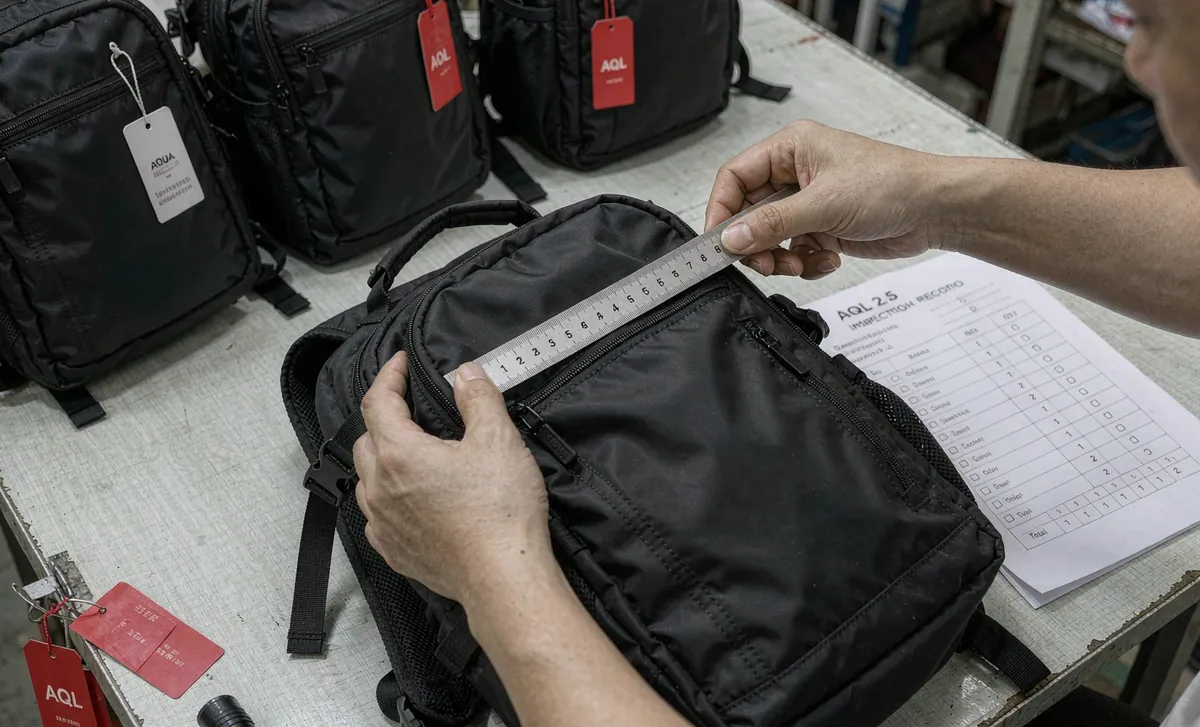
Table of Contents
- What a Waterproof Bag QC Bench Has to Measure
- Hydrostatic Head on the Roll, Then on the Seam
- The Spray Rack: AATCC 22 and AATCC 35 Are Not Interchangeable
- Immersion Depth, Duration and the Buoyancy Error
- Flex Cycling: The Sequence Most Programmes Skip
- Cold Crack Testing After a Low-Temperature Soak
- The Neutral Salt Fog Cabinet: Hours, Concentration and Rinse
- UV Ageing: Xenon Arc Hours Versus Real Sun
- Martindale and Taber Numbers on a Coated Bag Shell
- Zipper Cycle Rigs and the Slider Wear Point
- Sampling Plan: How Many Units Leave the Line for Test
- Where AQL 2.5 Ends and Laboratory Testing Begins
- The Test Report a Retail Compliance Team Will Accept
- Frequently Asked Questions
- People Also Ask
What a Waterproof Bag QC Bench Has to Measure
A waterproof bag QC bench exists to answer three separate questions, and mixing them up is why so many test reports fail review. The first question is material: how much water pressure does this coated fabric hold before it wets through? The second is construction: does the seam, the closure and the join between them hold at the level the fabric promises? The third is consistency: is the unit in front of me the same as the unit that passed last month? Only the first two are laboratory questions. The third is a sampling question, answered by AQL inspection rather than by a test method.
The practical consequence is that a bag can pass every fabric test and still leak, because the fabric is rarely the weak point. On a welded build the weak points are the weld termination, the corner where three panels meet, and the closure. On a sewn-and-taped build they are the stitch line and the tape edge. A bench that only runs hydrostatic head on flat fabric swatches will report excellent numbers on a bag that fails in the field, which is why every method below is run on finished goods as well as on material.
Our own sequence starts from the shell and closure already proven on the waterproof bag manufacturing line before a single specimen reaches the tank. The bench itself needs to be honest about its limits. Water ingress is a threshold behaviour: a construction either holds at a given exposure or it does not, and the result is strongly dependent on how the bag was closed, how long it was conditioned and whether the sample was flexed first. We therefore record conditioning, closure method and pre-treatment on every report, because a number without those three fields cannot be reproduced and cannot be defended in a claim. An overview of the regime sits on the waterproof bag quality control page.
Hydrostatic Head on the Roll, Then on the Seam
Hydrostatic head under ISO 811 measures the height of a water column a fabric sustains before three drops penetrate. It is a material test, run on a clamped swatch with the water pressure rising at a controlled rate, and it is the number that ends up on most specification sheets: 10,000 mm, 20,000 mm or higher for the TPU and PVC laminates used on waterproof bag shells. It is also the number most often quoted out of context, because it says nothing about the seam that joins two pieces of that fabric.
The seam is where the number collapses if the build is poor. A welded seam tested to destruction typically fails below the parent fabric, because the weld creates a thinner, stiffer bridge with a heat-affected zone on either side. A sewn-and-taped seam fails at the needle holes if the tape is under-width or applied outside its temperature window. Running hydrostatic head on the seam area, or running a low-pressure sustained hold on the finished body, is what turns a fabric certificate into evidence about a product. Both belong on the report.
| Specimen Tested | What the Number Proves | Typical Failure Point | How We Record It |
|---|---|---|---|
| Flat fabric swatch | Coating integrity across the roll | Coating pinholes or thin spots | Head in mm with rise rate and face side |
| Welded seam strip | Weld strength versus parent fabric | Weld termination or heat-affected zone | Peel value plus head at the seam line |
| Taped seam strip | Tape bond and coverage width | Needle holes outside the tape edge | Head after flex, then after wash cycles |
| Finished empty body | Construction integrity at low pressure | Corner junctions and closure base | Sustained hold time at stated pressure |
| Finished loaded body | Seam behaviour under real load | Stress concentration at load points | Load in kg plus hold time and result |
The Spray Rack: AATCC 22 and AATCC 35 Are Not Interchangeable
AATCC 22 is a spray test: a fixed volume of water is sprayed at a mounted specimen at a stated pressure and the wetted pattern is rated against a standard chart. It is the right test for a shell that claims shower or spray resistance, and it is quick enough to run on every colourway. AATCC 35 is a rain test that drives water against the specimen with more energy and measures what passes through to a blotter behind it, which makes it the closer analogue of a bag standing in driving rain on a deck or on a trail.
Choosing between them is a claim decision, not a technical preference. If the hangtag says shower resistant, AATCC 22 evidence is coherent. If the hangtag says it survives driving rain, AATCC 35 evidence is the honest support. What is never coherent is a strong immersion claim supported only by a spray result, and that mismatch is exactly what a marketplace compliance reviewer looks for when a listing is challenged. Write the method name next to the claim on the product page and the argument stops before it starts.
Immersion Depth, Duration and the Buoyancy Error
Immersion testing sounds simple and is routinely done wrong. The trap is buoyancy: an empty sealed dry bag floats, so lowering it into a tank without ballast means the closure stays at or near the surface and the exposure the bag actually receives is a fraction of the nominal depth. Every credible immersion rig therefore either straps the bag to a weighted frame or fills it to a stated load with a ballast that also simulates contents, and records the depth at the closure rather than at the top of the water.
Duration matters as much as depth. A short dunk proves almost nothing, because capillary ingress through a marginal weld takes time to show, and the failure mode that generates warranty claims is a bag that stays dry for twenty minutes and wet after two hours. We run a stated hold at a stated depth with the closure in its normal rolled or zipped condition, then open the bag and inspect with tissue at the seam line rather than looking for visible water, because the first sign of a marginal weld is dampness at a corner, not a puddle. IPX7 and IPX8 codes are defined under IEC 60529 and the code alone does not tell you which of these conditions the bag was tested at.
- Record depth at the closure, not at the water surface
- Ballast to a stated load so the bag does not float out of the exposure
- Close the bag exactly as a user would, with the specified number of roll turns
- Hold for a stated duration and inspect with tissue, not by eye
- Condition the sample to room temperature before testing, since cold film behaves differently
- Repeat on at least three units per colourway, because welds vary by station and operator
Flex Cycling: The Sequence Most Programmes Skip
Flex cycling is the test most waterproof bag programmes omit and the one that best predicts field failure. A roll-top collar is folded and unfolded every time the bag is opened, and a welded seam near that fold is worked every time. Cycling means opening, closing and re-rolling the closure a stated number of times, or flexing a seam specimen around a mandrel a stated number of cycles, and then running the water ingress test again on that worked sample. Constructions that pass when new and fail after cycling are the ones that generate returns in month three.
The value of the sequence is that it ranks constructions rather than just passing or failing them. A welded build with generous weld allowance and a soft hand will survive cycling far better than a stiff, narrow weld that looks perfect on day one. A roll-top with a stiffener will hold its shape through cycling; one without will progressively lose closure memory and start to leak at the fold. Running this sequence before bulk release is what stops a construction choice made for appearance from becoming a returns problem.
Cold Crack Testing After a Low-Temperature Soak
Cold behaviour is the second most commonly skipped test and the one that separates PVC from TPU in practice. A PVC-coated shell stiffens as plasticiser migration and temperature interact, and a stiff shell cracks at a fold rather than flexing. The test is straightforward: condition the specimen at a stated low temperature for a stated period, bend it around a mandrel of stated diameter while still cold, and inspect for cracking or coating loss. Then bring it back to room temperature and run the water ingress test, because a cracked coating is a leak path even if the crack looks cosmetic.
This is a destination-driven test rather than a universal one. A range sold into Nordic or Canadian winter programmes needs it; a range sold into tropical markets does not need it for the shell but may still need it for hardware, since side-release buckles become brittle at low temperature too. Specify the conditioning temperature in the tech pack and the test becomes quotable and repeatable. Without that field, a cold crack result is a photograph rather than evidence.
The Neutral Salt Fog Cabinet: Hours, Concentration and Rinse
Salt fog testing under a neutral salt spray method exposes hardware and, where relevant, decorated panels to a continuous atomised saline atmosphere for a stated number of hours, then inspects for corrosion, blistering and coating loss. It is the standard way to separate stainless and acetal hardware from plated zamac, and it is the reason a marine or beach programme should never be specified with decorative plating on load-bearing hardware. Plated parts look better on day one and fail within a season of salt exposure.
Two details decide whether a salt fog result means anything. Concentration and pH must be stated and controlled, because a cabinet run too rich or too acidic produces corrosion that no real environment would. And the rinse and dry sequence after exposure must be specified, because salt left on a part continues to work after the cabinet door opens, so an un-rinsed specimen will look worse than the same part rinsed and dried. Report hours, concentration, pH, rinse method and the inspection criterion, and the number becomes reproducible.
| Hardware Family | Behaviour in Neutral Salt Fog | Where It Is Acceptable | Where It Is Not |
|---|---|---|---|
| Stainless steel fittings | Surface staining only, no structural loss | Marine, beach, dive and paddle programmes | Nowhere restricted, but cost is higher |
| Acetal and POM buckles | No corrosion; dimensionally stable | All programmes including marine | Avoid where high UV load is constant |
| Plated zamac fittings | Blistering and base metal corrosion | Dry indoor use only | Never on marine or beach hardware |
| Coated aluminium hooks | Edge corrosion where coating is chipped | Light outdoor use with inspection | Not on load-bearing attachment points |
| Branded metal zip pullers | Tarnish and slider drag after exposure | Fashion programmes with short life | Not on a long-life outdoor dry bag |
UV Ageing: Xenon Arc Hours Versus Real Sun
UV ageing in a xenon arc cabinet accelerates what sunlight does to a coated shell: it breaks down the polymer, fades dyes and embrittles the film. The number that comes out is hours in the cabinet, and it is routinely presented as if it were hours outdoors, which it is not. Cabinet hours correlate with outdoor exposure through a factor that depends on irradiance, cycle and the material itself, so the honest way to report is to state the cabinet condition and the observed change, and to avoid claiming an outdoor equivalent that the method does not support.
What matters commercially is what changes and by how much. Colour change is rated against a grey scale, and a coated shell that shifts more than a stated band is a problem for a programme where the bag has to match a webbing or a printed panel. Tensile and peel retention matter more than colour: a film that has lost strength will fail at the weld during the next season's use. Run UV ageing then re-test the weld, and the result tells you whether the bag will still be waterproof at the end of its intended life rather than just at the start.
Martindale and Taber Numbers on a Coated Bag Shell
Abrasion resistance is measured two ways on bag fabrics, and the two are not comparable. Martindale rubs the specimen against a standard wool abradery in a Lissajous pattern and reports cycles to a stated end point, which suits face fabrics and woven shells. Taber abrases with rotating abrasive wheels under a stated load and reports cycles or mass loss, which suits coated and laminated surfaces where the coating, not the weave, is what fails. Quoting a Martindale number for a TPU laminate is technically possible and practically misleading.
The reason abrasion belongs on a waterproof bench is that abrasion and ingress interact. A shell scuffed at the base loses coating thickness, and coating thickness is what the hydrostatic head depends on. The combined sequence, abrade then re-test, is a far better predictor than either result alone, and it is the sequence we use to decide whether a base panel needs reinforcement. It also settles a common argument: a fabric with a slightly lower head but much better abrasion retention will outperform a higher-head fabric on a bag that gets dragged.
Zipper Cycle Rigs and the Slider Wear Point
A waterproof zip is a wear item, and cycle testing is how its service life is established before bulk. A cycle rig opens and closes the slider through its full travel under a stated load and at a stated speed for a stated number of cycles, then inspects the slider, the elements and the film backing. Failures concentrate at two points: the slider, where the locking mechanism wears and stops pulling the elements together, and the film backing near the end stop, where repeated stress cracks the laminate.
Cycle testing also catches the specification error that causes most zip returns, which is specifying a water-resistant coil zip with a storm flap and then claiming immersion performance. A coil zip with a flap is a spray-rated solution; a taped or film-backed waterproof zip is an immersion solution, and they differ in cost, in hand feel and in cycle life. A rig will show you exactly where the cheaper option stops performing, and that evidence is what makes the cost conversation with a brand team factual rather than argumentative.
Sampling Plan: How Many Units Leave the Line for Test
Destructive testing means sacrificing units, and the question every production planner asks is how many. The answer depends on what you are protecting against. For a new construction or a new material, sample across stations and operators rather than pulling three units from one carton, because weld quality varies more between stations and shifts than within a single pallet. For a repeat run of a proven construction, a smaller sample drawn across the run is enough, because the process is already characterised and you are checking for drift.
The plan should also say when the sample is drawn. Pulling units only at the end of the run means a weld parameter drift in week one is discovered after the whole order is welded. Drawing at start, middle and end of the run turns the same number of sacrificed units into a trend, and a trend is actionable: it tells you whether station three is drifting before the whole lot is affected. We keep the retained samples from each run so a later field complaint can be compared against the unit that was actually shipped.
- Define what the test protects against: a new construction, a new material, or drift in a proven one
- Draw across production stations and shifts, not from a single carton
- Sample at start, middle and end of the run so a drift becomes visible as a trend
- Condition every specimen identically before any water test is run
- Record closure method, roll turns and load on the report for each specimen
- Retain a sealed reference unit from each run for later claim comparison
Where AQL 2.5 Ends and Laboratory Testing Begins
This is the distinction that most quality conversations get wrong. AQL 2.5 under ISO 2859-1 is an acceptance sampling scheme: it sets the sample size for a given lot and the number of defects at which the lot is accepted or rejected. It governs appearance, workmanship, dimensions, labelling and packing. It does not measure waterproof performance, because waterproof performance is not a defect you count by looking at a unit; it is a property you establish by test, on a sample, before and during the run.
So a shipment can pass AQL 2.5 and still be entirely unsaleable if the weld parameters drifted, and it can fail AQL 2.5 on a cosmetic issue while being perfectly waterproof. Both results are real and both are needed. The inspection catches the wrong label, the crooked transfer and the carton with the wrong marking; the laboratory bench catches the marginal weld, the under-width tape and the zip that stops sealing after two hundred cycles. Treating one as a substitute for the other is the root cause of most waterproof bag quality disputes.
| Activity | Standard Behind It | Question It Answers | What It Cannot Tell You |
|---|---|---|---|
| Acceptance sampling | AQL 2.5 per ISO 2859-1 | Is this lot acceptable on countable defects? | Whether the construction is waterproof |
| Hydrostatic head test | ISO 811 | How much water column does the fabric hold? | Whether the seam holds as well |
| Spray and rain test | AATCC 22 and AATCC 35 | Does the shell shed spray or driving rain? | Whether it survives submersion |
| Ingress under immersion | Defined by the tech pack and IEC 60529 codes | Does the finished bag hold at depth for time? | How the result degrades after flex or UV |
| Salt fog exposure | Neutral salt spray method | Will the hardware corrode in service? | Mechanical load capacity of the hardware |
The Test Report a Retail Compliance Team Will Accept
A test report survives review when it identifies the thing tested, the method used, the condition of the specimen and the result with units. The four fields that are most often missing are the sample identification, the conditioning, the closure method and the pre-treatment. A report that says a bag passed IPX7 without saying which closure, which roll-turn count and whether the sample had been flexed is not evidence; it is a claim with a letterhead, and a competent compliance reviewer will send it back.
If you are writing a protocol from scratch rather than reviewing one, the fastest route is to send the tech pack and the intended claim to the OEM team and have the method list drafted against the actual construction rather than copied from a template. The second requirement is traceability to the lot shipped. A report issued against a pre-production sample is evidence about that sample, not about the bulk, unless the bulk used the same fabric roll, the same weld parameters and the same hardware batch. Keeping roll numbers, parameter records and hardware lot codes alongside the report is what turns a document pack into a defence. It also shortens the investigation when a claim does arrive, because the first question is always whether this unit came from the lot that was tested.
QUANZHOU JUNYUAN BAGS has specified and defended waterproof bag test protocols since 2014, with founders in the trade since 2004. Our validated production partner facility is SGS-verified at 4,950 square metres with seven production lines, 149 machines and 137 staff, producing up to 200,000 pieces a month, and runs ISO 9001-aligned QC, with a BSCI audit available on request. Shell fabrics are specified at 10,000 to 20,000 mm hydrostatic head and above, with CE, CPC, RoHS and SGS documentation available by destination. Minimum order is 500 pieces per style per colour, sampling runs 6 to 10 working days or 12 to 15 for complex builds, bulk runs 35 to 50 days, final inspection is drawn to AQL 2.5 under ISO 2859-1, and shipments leave FOB Xiamen on T/T 30 percent deposit and 70 percent balance. Send your protocol or ask for ours at service@junyuanbags.com, or message the team on WhatsApp at +86 177 5002 0688.
Frequently Asked Questions
Q1: Is hydrostatic head the same as a waterproof rating for a finished bag?
A: No. Hydrostatic head under ISO 811 measures how much water column a flat fabric swatch holds before penetration, which is a material property. A finished bag depends on the seam, the closure and the corner junctions, and those usually fail before the fabric does. A credible protocol runs head on the roll and then a low-pressure sustained hold or an ingress test on the finished body, so the certificate describes the product rather than only the material.
Q2: Why do we run AATCC 22 and AATCC 35 separately?
A: They simulate different exposures. AATCC 22 sprays a fixed volume at a mounted specimen and rates the wetted pattern, which supports a shower or spray-resistant claim. AATCC 35 drives water with more energy and measures what passes through to a blotter, which is the closer analogue of driving rain on a deck or trail. Matching the method to the claim is what keeps a listing defensible when a marketplace compliance reviewer checks it.
Q3: What is the buoyancy error in immersion testing?
A: An empty sealed dry bag floats, so lowering it into a tank without ballast leaves the closure near the surface and the exposure actually received is far less than the nominal depth. A credible rig either straps the bag to a weighted frame or fills it with a stated ballast, and records depth at the closure rather than at the water surface. Without that correction, a home immersion test systematically flatters the bag.
Q4: Why is flex cycling worth running when it costs extra time?
A: Because it predicts the failures that generate returns in month three rather than on day one. A roll-top collar is folded every time the bag opens, and a welded seam near the fold is worked every time. Cycling the closure or flexing a seam specimen and then re-running the ingress test ranks constructions by how they behave after use, which is the property that actually matters to the customer.
Q5: How does cold crack testing differ from normal handling of a bag?
A: Cold crack testing conditions the specimen at a stated low temperature for a stated period, bends it around a mandrel of stated diameter while still cold, then inspects for cracking and re-tests for ingress after returning to room temperature. It matters because a PVC-coated shell stiffens in the cold and cracks at a fold rather than flexing, and a cracked coating is a leak path even when the crack looks purely cosmetic.
Q6: What makes a salt fog result reproducible?
A: Four fields: hours of exposure, salt concentration, pH and the rinse and dry sequence afterwards. A cabinet run too rich or too acidic produces corrosion no real environment would, and salt left on a part keeps working after the cabinet door opens, so an un-rinsed specimen looks worse than an identical rinsed one. Report all four and the result can be repeated by another laboratory.
Q7: Are xenon arc hours the same as hours of real sunlight?
A: No, and treating them as equivalent is the most common overreach in a UV report. Cabinet hours correlate with outdoor exposure through a factor that depends on irradiance, cycle and the material. The honest report states the cabinet condition and the observed change, and avoids claiming an outdoor equivalent that the method does not support. What matters more is tensile and peel retention after exposure.
Q8: Should abrasion be reported as Martindale or Taber cycles?
A: It depends on what is failing. Martindale rubs against a standard wool abradery and suits face fabrics and woven shells. Taber abrases with rotating wheels under load and suits coated or laminated surfaces where the coating, not the weave, is the weak layer. Quoting a Martindale number for a TPU laminate is technically possible and practically misleading, so the method should match the surface.
Q9: Where does a waterproof zip fail in cycle testing?
A: Failures concentrate at two points: the slider, where the locking mechanism wears and stops pulling the elements together, and the film backing near the end stop, where repeated stress cracks the laminate. Cycle testing also exposes the specification error behind most zip returns, which is specifying a coil zip with a storm flap and then claiming immersion performance it was never designed to deliver.
Q10: How many units should be sacrificed to destructive testing?
A: It depends on what you are protecting against. For a new construction or material, sample across production stations and operators, because weld quality varies more between stations and shifts than within a pallet. For a repeat run of a proven construction, a smaller sample drawn across the run is enough. Drawing at start, middle and end turns the same sacrificed units into a trend you can act on.
Q11: Does passing AQL 2.5 mean the shipment is waterproof?
A: No. AQL 2.5 under ISO 2859-1 is an acceptance sampling scheme that governs countable defects in appearance, workmanship, dimensions, labelling and packing. Waterproof performance is a property established by test on a sample before and during the run. A lot can pass AQL 2.5 and be unsaleable because weld parameters drifted, and can fail AQL 2.5 on a cosmetic issue while being perfectly waterproof.
Q12: What fields does a defensible test report have to contain?
A: Sample identification, the method used, the conditioning, the closure method including roll-turn count, any pre-treatment such as flex or abrasion, and the result with units. A report that says a bag passed a code without stating which closure or whether the sample was worked is a claim with a letterhead rather than evidence, and a competent compliance reviewer will return it.
Q13: How does a test report stay valid for the bulk shipment?
A: Through traceability. A report issued against a pre-production sample is evidence about that sample unless the bulk used the same fabric roll, the same weld parameters and the same hardware batch. Keeping roll numbers, parameter records and hardware lot codes alongside the report is what turns a document pack into a defence and shortens any later claim investigation.
Q14: Which standards should a waterproof bag tech pack name?
A: At minimum ISO 811 for hydrostatic head, IEC 60529 for any IPX code claimed, AATCC 22 or AATCC 35 for spray and rain claims, ISO 2859-1 with AQL 2.5 for acceptance sampling, and a neutral salt spray method for hardware. Add REACH and RoHS declarations for chemical compliance, OEKO-TEX for skin-contact face fabric, and CPSC with a CPC certificate where the product is marketed to children.
Q15: Can a bag be tested after decoration has been applied?
A: It should be, because decoration changes performance. A transfer applied across a weld bridge lifts when the seam flexes, and a woven label stitched through a body panel creates a capillary path. The correct sequence is to decorate the sample exactly as bulk will be decorated and then run the ingress test on that decorated unit, which is the only way to know whether the branding choice compromised the waterproofing.
People Also Ask
- What tests prove a waterproof bag is actually waterproof?
- What is the difference between hydrostatic head and IPX rating?
- How is a waterproof bag leak tested in a factory?
- What does AQL 2.5 mean for waterproof bag inspection?
- How many hours of salt spray should bag hardware survive?
- Why does a dry bag leak after a few months of use?