
Custom Waterproof Bag Production: 7 Stages to Bulk
Custom waterproof bag production runs through seven stages: brief, tech pack, design for manufacture review, sampling, material lock, bulk production and release. Sampling takes 6 to 10 working days on a known shell and 12 to 15 on a complex build, bulk takes 35 to 50 days from the approved pre-production sample, and the minimum is 500 pieces per style per colour. The two stages that decide whether a programme hits its date are the DFM review, which removes geometry that cannot be welded, and the material lock, which starts the longest supply window. QUANZHOU JUNYUAN BAGS runs the sequence from one specification.
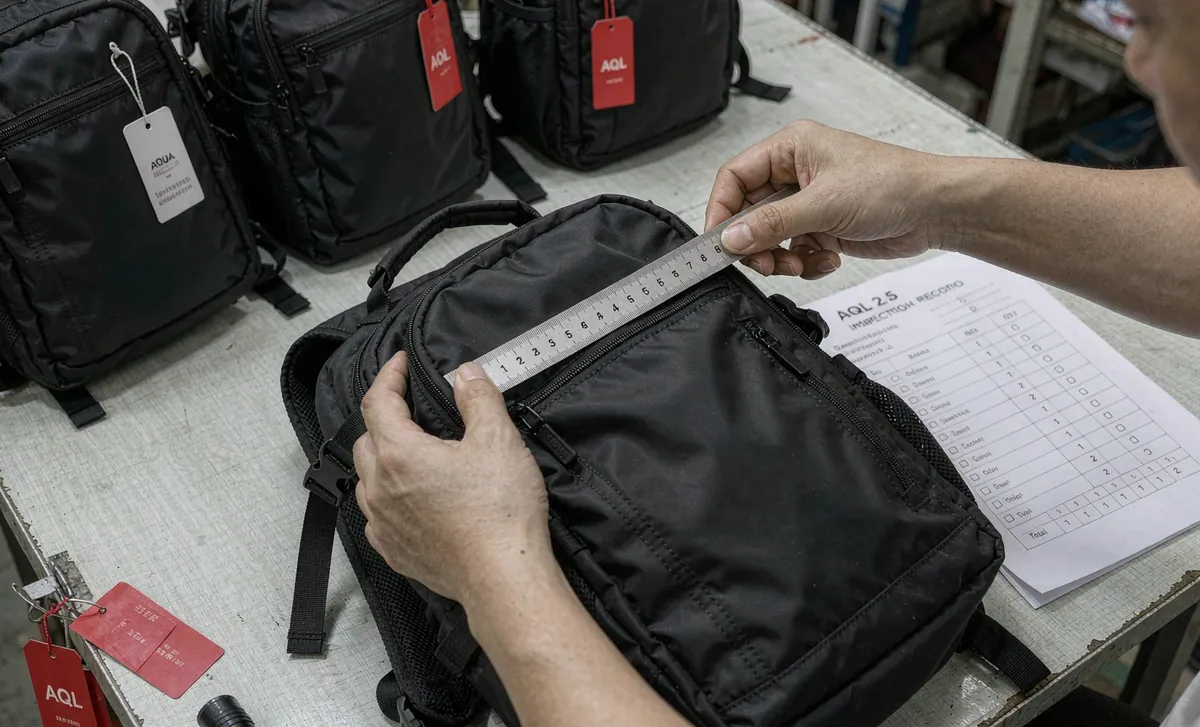
Table of Contents
- Stage Zero: The Brief and What Makes It Quotable
- Stage One: Tech Pack Fields That Prevent Rework
- Stage Two: Design for Manufacture on a Welded Shell
- Stage Three: Pattern Nesting and the First Weld Trial
- Stage Four: Sample Rounds and Written Approval Criteria
- Stage Five: Material Lock and Substitute Control
- Stage Six: Bulk Production and the In-Line Gates
- Stage Seven: Inspection, Packing and Release
- The Golden Sample and Why It Decides Disputes
- Revision Control Across a Multi-Round Programme
- Where Programmes Lose Days and How to Get Them Back
- A Specification Table by Production Stage
- A First-Order Readiness Checklist
- Frequently Asked Questions
- People Also Ask
Stage Zero: The Brief and What Makes It Quotable
A brief becomes quotable when it answers four questions without a follow-up email: what the product is for, how many are needed per colourway, when it has to land, and what it has to survive. Everything else can be developed. A brief that answers only the first two generates a quotation based on assumptions, and the assumptions are corrected later at the point where corrections are most expensive.
The survival question is the one most often skipped and the one that drives the specification. A bag that has to survive being dragged across a dock needs a heavier coating at the base. One that has to survive daily wiping needs a lining chosen for that. One that has to survive a salt environment needs different hardware. Naming the exposure at brief stage moves those decisions into the drawing, where they cost nothing.
The date question should be asked as a delivery date at destination rather than as a production date. A programme quoted to a 35 to 50 day production window and then measured against a shelf date three weeks after the vessel sails is a programme that will appear to be late even when every stage ran to plan. We ask for the destination date and work backwards through sampling, bulk, transit and customs.
Stage One: Tech Pack Fields That Prevent Rework
A tech pack is a manufacturing instruction, not a drawing of an idea. It carries the dimensioned drawing with tolerances, the panel nest and seam map, the bill of materials with named grades, the hardware list with finish and rating, the artwork in vector with placement and scale, the colourway references with tolerances, the packing specification, and the acceptance test with its method and pass mark.
Two fields prevent most rework and are the two most often left vague. The first is the seam map, which states which joints are welded, which are stitched and taped, and which are both. The second is the acceptance test, which states the ingress method, the duration and the pass mark. Without the second, the sample approval becomes a matter of opinion and the bulk inspection becomes a negotiation.
Tolerances deserve the same treatment as dimensions. A bag dimension should carry a millimetre band, a colour should carry a grey scale grade against an approved substrate swatch, and a print placement should carry a positional tolerance. These are not pedantry; they are the difference between an approval that closes in one round and one that takes three because nobody wrote down what close enough meant.
Stage Two: Design for Manufacture on a Welded Shell
A design for manufacture review on a welded shell asks questions that do not arise on a sewn one. The electrode has to physically reach every seam, which rules out welds in corners a horn cannot enter. Three panels meeting at a point produce a bridging void that leaks, so junctions need a radius or a stepped construction. And a change in material thickness across one seam changes the heat required and therefore the weld parameters.
The three-panel junction is the single most common cause of a first-sample leak, and it is entirely predictable at the drawing stage. Where three films meet, the centre of the junction receives less pressure and the film bridges rather than bonds. The fix is geometry: a radius at the junction, a stepped overlap, or an additional short weld run perpendicular to the junction. All three cost nothing on a drawing and all three are expensive after tooling is cut.
The review also settles what can be welded at all. Zippers, buckles and rigid frames are set into a welded shell by a combination of welding and mechanical fixing, and each needs a fixture. A novel closure needs a jig, which is a tooling charge and a calendar item. Identifying these at review means the quotation carries them; discovering them at sample means the quotation was wrong and the calendar was optimistic.
Stage Three: Pattern Nesting and the First Weld Trial
Nesting converts the drawing into panels, and it is where the material efficiency of a design is decided. A nest that uses the film width well saves material on every unit; one that leaves irregular offcuts costs money on every unit for the life of the product. On a 500 piece order the saving is modest and on a repeat programme over several seasons it is the largest single cost lever in the drawing.
The first weld trial is the moment the design meets physics. Parameters are set for the material gauge, trial coupons are welded and peeled, and the peel width is read in millimetres. A weld that peels cleanly with the film tearing rather than the bond separating is correct. A weld that separates at the interface needs more energy, more pressure or more time, and it is found here rather than in a finished sample.
Where a trial fails, the cause is almost always one of four things: insufficient energy for the gauge, an electrode that does not match the seam length, contamination on the film surface, or a dwell time too short for the material. Each has a distinct appearance on the coupon, which is why we photograph peeled coupons and keep them with the parameter record rather than discarding them after a pass.
| Weld trial observation | Likely cause | First corrective action | What not to do |
|---|---|---|---|
| Film separates cleanly at the interface | Insufficient energy or dwell | Increase energy in small steps and re-peel | Jumping straight to maximum power, which burns the film |
| Scorching or brown discolouration at the seam | Excess energy or dwell | Reduce energy, check electrode contact | Adding pressure, which makes the burn worse |
| Weld strong at the ends, weak in the middle | Electrode length or alignment | Re-align or change the electrode | Raising energy, which over-welds the ends |
| Inconsistent results across one coupon | Surface contamination or film lot variation | Clean the surface, check the lot record | Adjusting parameters around a contamination problem |
Stage Four: Sample Rounds and Written Approval Criteria
A sample round on a known shell with artwork already approved takes 6 to 10 working days. A complex build, a new pattern, a novel closure or a made-to-order material takes 12 to 15 working days. The difference is not effort but dependencies: a new pattern has to be drawn and nested, a novel closure needs a jig, and a custom film lot has to be extruded before anything can be cut.
Approval criteria should be written before the sample is made and should separate measurable from sensory. Measurable criteria are dimensions, ingress test result, hydrostatic head, hardware pull result and print placement. Sensory criteria are hand feel, shade and finish, and these are judged against a retained reference rather than against a description. Mixing the two in one approval meeting is what produces a third round.
The discipline that shortens programmes is changing one variable group per round. Geometry first, then materials, then decoration. When a leak appears in a bag whose geometry and material changed at the same time, the cause is not identifiable and the next round changes both again. When only the geometry changed, the cause is usually obvious, and the fix lands in the following round rather than two rounds later.
Stage Five: Material Lock and Substitute Control
Material lock means naming the film or fabric with its gauge or coating weight, the hardware with its finish and rating, and the webbing and trim with their references and shades, and then booking them. It should happen at sample approval rather than at bulk scheduling, because the material window is the longest single dependency in the calendar and it can run in parallel with the sampling window if it is authorised early.
Substitute control is the discipline that protects the lock. If a named material becomes unavailable, the substitute is qualified rather than assumed: its weld parameters differ, its hydrostatic head differs and its shade differs. The qualification is a weld trial plus an ingress re-test, and it is reported to the buyer before the substitution is made, not presented as a fait accompli at inspection.
Booking quantities deserve a note as well. Material is bought with a cutting allowance and a defect allowance, and the allowance depends on the nest and on the material's known behaviour. An order of 500 pieces does not book 500 pieces worth of film. Under-booking to save a small amount of material cost creates the risk of a shortage part-way through a run, which is the most expensive small saving available in this process.
Stage Six: Bulk Production and the In-Line Gates
Bulk production runs 35 to 50 days from the approved pre-production sample. The spread is explained by quantity, colourway count, decoration complexity and whether any tooling is new to the line. Cutting and spreading take days, welding is the pace setter, and assembly, hardware setting and packing follow. The calendar is booked against the line, so the date is a reservation rather than an estimate.
Four in-line gates protect the run. At cutting, the die revision and the panel count are checked against the approved nest. At welding, coupons are pulled and peeled each shift and the peel width is recorded. At assembly, hardware setting and closure alignment are checked. Before packing, finished bodies from each shift are put through the agreed ingress test. Each gate catches a defect at the point it is made.
The weld coupon gate deserves emphasis because radio frequency output drifts with electrode wear, ambient humidity and material lot. A coupon pulled at the start of each shift catches that drift in minutes. Without it the drift is discovered at the water test on finished goods, which is the most expensive possible place to find it, and the corrective action then involves rework rather than a parameter change.
Colourway sequencing is the other decision made in this stage, and it matters more than it appears. Running one colourway to completion before changing the line is faster than interleaving them, because a line change costs set-up time and the first units after a change are the ones most likely to need a parameter trim. Where a programme has three colourways and a firm date, running them in sequence rather than in parallel is usually the shorter calendar.
- Cutting: verify the die revision letter and the panel count against the approved nest.
- Welding: pull and peel coupons each shift, record the peel width in millimetres with the parameter set.
- Assembly: check hardware setting, closure alignment and every bonded or taped joint.
- Water test: sample finished bodies from each shift to the agreed ingress method before packing.
- Packing: verify carton quantity, packing method and marking against the packing specification.
Stage Seven: Inspection, Packing and Release
Final inspection runs at AQL 2.5 under ISO 2859-1 with cartons drawn at random across the lot. Defects are classified critical, major and minor, and any breach of the waterproof claim is graded critical, meaning the acceptance number for it is zero. The report should carry measurements rather than only a pass statement, because a measurement can be compared and a pass statement cannot.
Packing is the last stage and the one most often squeezed when a programme is running late, which is a mistake because packing errors are what cause damage in transit and delays at destination. The carton specification should state the wall grade, the packing method, the units per carton, the marking and the pallet pattern. A drop and compression check on the packed carton is cheap insurance against crushed corners.
Release follows the balance payment under the agreed terms. Standard terms on these programmes are T/T 30 per cent deposit and 70 per cent before shipment, with shipment FOB Xiamen. The documents that travel with the release are the commercial invoice, the packing list, the bill of lading and the certificate of origin, with certification evidence such as BSCI, ISO 9001:2015, CE, CPC, RoHS and SGS reports added where the destination market requires them.
The Golden Sample and Why It Decides Disputes
A golden sample is the approved physical unit that the whole run is measured against. It is signed, dated, labelled with its revision letter and stored in controlled conditions. Two are made: one retained by the producer and one sent to the buyer. Everything a written specification cannot express, which is hand feel, shade, stiffness, sheen and the sound of a closure, is settled by putting the disputed unit next to this one.
The reason it decides disputes is that it converts a subjective argument into a comparison. A buyer saying a bag feels different is making a claim nobody can test. A buyer holding the golden sample beside the delivered unit and pointing at the difference is making a claim that can be resolved on the spot, and in our experience most such comparisons end in agreement rather than in a credit note.
Storage conditions matter and are usually ignored. A coated sample stored in a hot, humid room will change: the film can hydrolyse, the shade can shift and a white shell can yellow. A golden sample kept in a sealed bag away from light and heat stays valid for a season. One kept on a windowsill does not, and a dispute resolved against a degraded reference is resolved wrongly.
Revision Control Across a Multi-Round Programme
A programme that runs three sample rounds exchanges a lot of files, and without revision control nobody can say which version was approved. The rule is simple and rigid: every drawing, artwork file and specification carries a revision letter and a date, every physical sample carries the matching revision on its tag, and the approval sheet names the revision being approved.
The failure mode is specific and common. Artwork is revised, the sample is built to the old artwork, the buyer approves the sample while assuming the new artwork, and the bulk is produced to the old file. Nobody is at fault in a way that matters and the whole run is wrong. Revision letters on both the file and the sample tag make this impossible, because the mismatch is visible on the bench.
The second benefit is on repeats. A repeat ordered against revision D of a drawing with revision D artwork and a revision D golden sample is reproducible. A repeat ordered against a photograph and a description is not, and the resulting argument costs more than the discipline would have. We keep the revision history with the order file and supply it on request.
Where Programmes Lose Days and How to Get Them Back
Lost days cluster in five places. Artwork that is not in vector and has to be redrawn. A colour reference supplied as a screen image rather than as a substrate swatch. A material booking authorised after sample approval rather than at it. An approval given from photographs rather than from the physical sample. And a change raised after cutting has started.
Each has a cheap fix. Vector artwork with minimum stroke widths supplied at brief stage. A physical swatch approved under the same light the product will be sold under. Material booking authorised in the same week the sample is approved. A physical approval on the first build, because a decision made from images is usually reversed when the bag is handled. And a specification frozen at approval with any later change quoted with its calendar cost.
The days that cannot be recovered are the ones lost at the front. Welding, assembly and packing run at a fixed pace and cannot be compressed without cutting quality. Sampling and material booking can be compressed, because both are largely waiting on decisions rather than on work. A buyer who front-loads their decisions gets a shorter calendar than one who expedites at the end.
A Specification Table by Production Stage
The table below sets out what is produced, what is decided and what is delivered at each stage of a custom waterproof bag programme. It is the same table we use internally to track a build, and it is useful to a buyer because it shows which stages need the buyer's input and which simply need the buyer to be available.
| Stage | Working duration | Output document | Buyer action required |
|---|---|---|---|
| Brief and quotation | 1 to 3 days | Quotation with windows and assumptions | Confirm motive, quantity, destination date and exposure |
| Tech pack | 3 to 7 days | Dimensioned drawing, BOM, seam map, artwork | Supply vector artwork and confirm tolerances |
| DFM review | 2 to 4 days | Review notes with accepted and rejected geometry | Approve the geometry changes proposed |
| Pattern and weld trial | 3 to 5 days | Nest, parameter record, peeled coupons | None, review only |
| Sampling | 6 to 10 days known, 12 to 15 complex | Physical sample, test results | Approve in the hand against written criteria |
| Material lock | Concurrent with sampling | Booked lots, incoming inspection records | Authorise booking at sample approval |
| Bulk production | 35 to 50 days | In-line records, coupon log | Available for questions, avoid late changes |
| Inspection and release | 3 to 5 days | AQL 2.5 report, invoice, packing list, bill of lading | Pay the balance, nominate the vessel |
Reading the table by the last column shows something useful: the buyer is only essential at four points, and three of them are in the first half. The programmes that run smoothly are the ones where those four actions happen promptly, and the programmes that run long are the ones where the buyer is fast at the end and slow at the beginning.
A First-Order Readiness Checklist
Before a first custom order is placed, nine things should be true. The quantity per colourway is at or above 500 pieces per style per colour. The artwork is vector with defined stroke widths and placement. The colour references are physical swatches on the production substrate, or a named standard the supplier holds. The acceptance test is written with method, duration and pass mark.
The functional requirements are listed, including laptop size, wet compartment, closure preference and any wipe-clean need. The packing specification is decided, because it affects freight more than the shell does. The compliance set for the destination market is known. The delivery date is expressed as a date at destination. And the revision lettering on drawings and artwork is in place before the first sample is cut.
Nine items, and a first order missing any of them will still be produced, just more slowly and with more correspondence. Send your brief and checklist to service@junyuanbags.com or WhatsApp +86 177 5002 0688 and we will return a quotation with the sampling window and the production window stated on it. File requirements are set out in the design file requirements guide, the sampling detail is in the sampling process article, and weld and seam options are covered under products.
Frequently Asked Questions
Q1: How long does custom waterproof bag production take?
A: Sampling takes 6 to 10 working days on a known shell and 12 to 15 on a complex build, a new pattern or a made-to-order material. Bulk production takes 35 to 50 days from the approved pre-production sample. Transit and customs come on top, so a first programme should be planned backwards from the delivery date at destination rather than forwards from the sample.
Q2: What is the minimum order for a custom waterproof bag?
A: 500 pieces per style per colour. The minimum covers the material lot, the line change and the set-up rather than the pattern, and colourways count separately, so three colourways of one style is three lots. It applies whether the product is built on a shared shell or developed as a full OEM programme.
Q3: What should a tech pack contain for a waterproof bag?
A: The dimensioned drawing with tolerances, the panel nest and seam map, the bill of materials with named grades, the hardware list with finish and rating, vector artwork with placement and scale, colourway references with tolerances, the packing specification, and the acceptance test with its method, duration and pass mark.
Q4: Why does a welded design need a DFM review?
A: Because the electrode has to physically reach every seam, three-panel junctions bridge rather than bond, and a change in material thickness across one seam changes the weld parameters. All three are predictable on the drawing and all three are expensive to fix after tooling has been cut, which is when they are otherwise discovered.
Q5: What causes a first sample to leak?
A: Most often a three-panel junction where the centre receives less pressure and the film bridges. The fix is geometric: a radius at the junction, a stepped overlap, or an additional short weld run perpendicular to the junction. Other causes are insufficient energy for the gauge, an electrode that does not match the seam, surface contamination and too short a dwell time.
Q6: When should materials be locked and booked?
A: At sample approval, not at bulk scheduling. The material window is the longest single dependency in the calendar, and authorising the booking at approval lets it run in parallel with the sampling window instead of adding it afterwards. Booking also needs a cutting and defect allowance on top of the piece quantity.
Q7: What happens if a named material is unavailable?
A: It is qualified rather than substituted silently. A substitute has different weld parameters, a different hydrostatic head and a different shade, so it gets a weld trial and an ingress re-test, and the buyer is told before the substitution is made rather than discovering it at inspection when the lot is already cut.
Q8: How many sample rounds should a programme plan for?
A: One for a decorated sample on a known shell and two or three for a new build. The honest planning comparison is therefore 6 to 10 days against 24 to 45 days rather than 6 to 10 against 12 to 15. Changing one variable group per round, geometry first and materials second, is what keeps a new build to two rounds.
Q9: What is a golden sample and why keep one?
A: It is the approved physical unit, signed, dated and labelled with its revision letter, retained by both parties. It settles the questions a written specification cannot: hand feel, shade, stiffness, sheen and closure feel. It should be stored sealed, away from light and heat, because a coated sample kept in a hot humid room will change.
Q10: Which inspection standard applies at the end of bulk?
A: AQL 2.5 under ISO 2859-1 with cartons drawn at random across the lot, and defects classified critical, major and minor. Any breach of the waterproof claim is graded critical, so the acceptance number for it is zero. The report should carry measurements rather than only a pass statement so the result can be compared.
Q11: Where do programmes lose the most days?
A: In five places: artwork not supplied in vector, colour references supplied as screen images, material booking authorised after sample approval, approval given from photographs rather than from the physical sample, and changes raised after cutting has started. Four of the five are buyer-side decisions made early.
Q12: What are the payment and shipment terms?
A: T/T 30 per cent deposit and 70 per cent before shipment, with shipment FOB Xiamen. The deposit triggers material booking, the balance is due before release, and the documents that travel with release are the commercial invoice, the packing list, the bill of lading and the certificate of origin, plus certification evidence the market requires.
People Also Ask
- How long does custom bag production take?
- What is the MOQ for custom waterproof bags?
- What should be in a bag tech pack?
- Why does my first waterproof bag sample leak?
- How many sample rounds do I need?
- What is a golden sample in manufacturing?