
Next-Generation Waterproof Bag Technology to Pilot Now
Pilot three technologies and shelve four. Self-healing TPU, machine-vision seam inspection and mono-material shells are ready for a 500-piece production run today; heated conductive yarn, phase-change liners, embedded sensors and shape-memory frames are not, because each still fails on cost, power or wash durability. The rest of this page puts a number on that judgement, shows the welding parameters each material needs, and gives the sampling calendar a trend adopter should expect. Read the readiness ranking first, because it decides where your development money goes before any of the detail below matters.
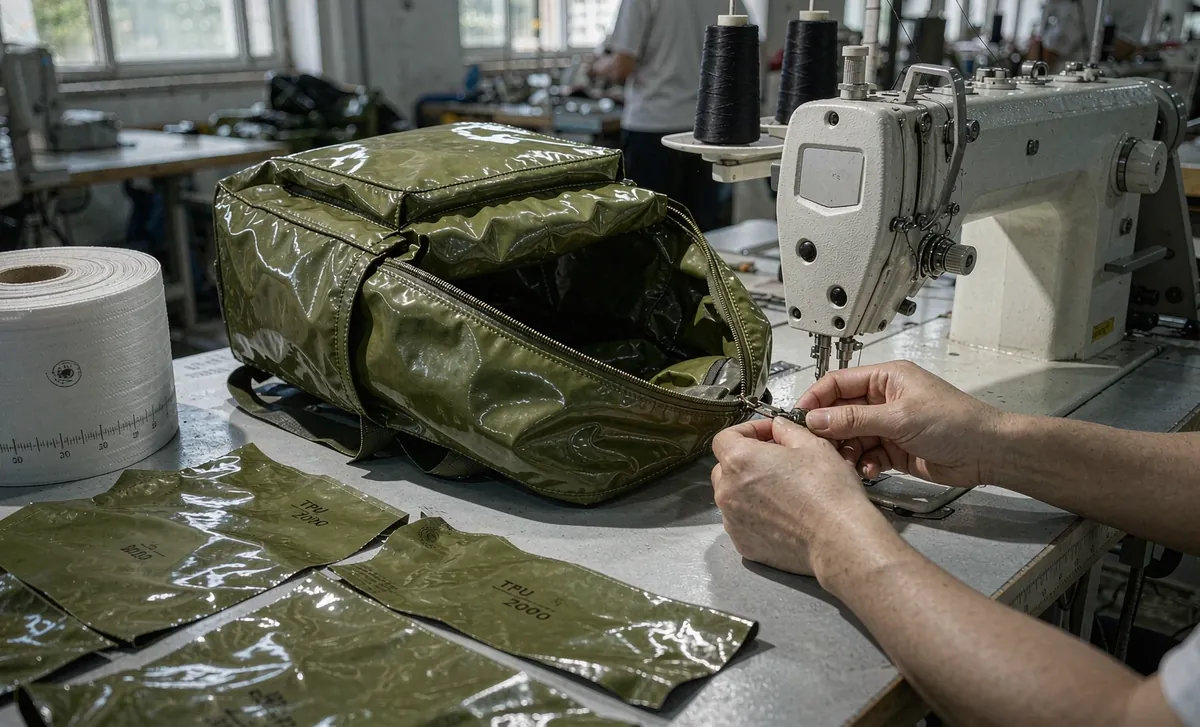
Table of Contents
- Self-Healing TPU Coatings and What They Can Actually Repair
- Phase-Change Liners: Holding a Temperature Band Without Ice
- Conductive Yarn and Heated Panels Inside a Waterproof Shell
- Mono-Material Laminates and the Recycling Stream They Enter
- Machine-Vision Seam Inspection on the Welding Cell
- Seven Incoming Technologies Ranked by Readiness for 2027
- What to Pilot Now and What to Leave on the Shelf
- Welding Parameters for the New Generation of TPU Films
- Sizing a Phase-Change Insert for a 20 Litre Insulated Pack
- Cold-Chain Simulation Protocol for Phase-Change Prototypes
- Failure Modes Unique to Self-Healing and Mono-Material Builds
- Compliance Files a New-Technology Bag Needs Before It Ships
- MOQ 500 for a First Trend Adopter Breaking the Colour Split
- Sampling 6-10 Working Days for a New-Material Prototype
- Frequently Asked Questions
- People Also Ask
Self-Healing TPU Coatings and What They Can Actually Repair
A self-healing TPU behaves the way its name suggests only within a narrow envelope, and the envelope is worth stating precisely before anyone puts it on a spec sheet. The mechanism in the commercially available films is a reversible hydrogen-bond network in the polymer: when the surface is cut or abraded, the bonds across the damaged faces re-form if the two faces are brought back into contact and held at a workable temperature for a period of minutes to hours. What it repairs is a shallow surface cut, a scuff and a light puncture up to roughly a millimetre across. What it does not repair is a cut with material missing, a tear under tension, or any damage that has separated the two faces by more than the film can stretch.
There is a second constraint that matters more for a bag than for a phone case: the healing happens at ambient temperature and takes time, during which the bag is still open to water. A paddler who punctures a dry bag on a rock needs a barrier now, not in two hours. That is why the sensible near-term application is not the main shell but a sacrificial layer over a conventional barrier, or a repair patch laminated inside the pocket where it can be pressed against a puncture from the inside. On the welding line, self-healing film also behaves differently from standard TPU: it is softer at the weld interface, and the electrode dwell has to be reduced to avoid driving the soft phase out of the seam.
For a buyer the practical test is simple and should be written into the technical pack. Take a sample panel, puncture it with a 1 mm probe, press the faces together by hand for ten seconds, then run a hydrostatic head check to ISO 811 on the repaired spot and compare the reading with an undamaged control. If the repaired area holds most of the original pressure, the film is doing something real. If it holds nothing, the supplier has sold you a marketing term. We run that comparison at the validated production partner facility as a standard incoming check on any film labelled self-healing, because the material costs several times a standard TPU and the claim is easy to make and hard to verify.
Phase-Change Liners: Holding a Temperature Band Without Ice
A phase-change material absorbs or releases a large amount of latent heat as it changes state at a fixed temperature, and in a bag it works as a thermal buffer rather than a cooler. That distinction determines everything about how you specify it. An ice pack holds a load cold by melting at 0 °C; a PCM insert holds it at whatever transition temperature the paraffin blend was formulated for, which for food and pharmaceutical use is typically between 2 °C and 8 °C, and for chilled drinks between 0 °C and 5 °C. Once the PCM has fully changed state it stops buffering and the bag behaves like an ordinary insulated one, so the insert is sized against a hold time, not against a cooling duty.
This is the technology to be most cautious about in 2027 planning. The transition temperature is fixed at the formulation stage, which means one insert cannot serve both a sandwich and a frozen item, and the mass involved is significant: an insert that holds four litres of payload in band for six hours typically weighs between 700 and 1,200 grams, which is more than most users will accept in a shoulder bag. It also has to be sealed permanently inside a welded pod, because the material must not contact the contents, and every penetration in that pod is a potential leak path. Before committing, ask for the differential scanning calorimetry curve of the blend, which shows the transition onset, the peak and the latent heat in joules per gram; a supplier who cannot produce it is selling a gel pack.
Conductive Yarn and Heated Panels Inside a Waterproof Shell
Heated panels woven with stainless-steel or silver-plated conductive yarn are the most requested and least mature item on this list. The yarn itself is not the problem; a stainless filament blended into the weft at a few percent gives a stable sheet resistance that will heat on 5 or 12 volts. The problems are the three that follow it. Power: a hand-warmer panel drawing 8 watts needs roughly 6,700 mAh to run for eight hours, which is a power bank the size of a phone and a second item the customer has to buy and charge. Wash: a heating element inside a bag that is marketed as waterproof has to survive the user cleaning it, and every connector in that chain is a failure point. Regulation: a mains or USB powered textile falls under electrical product rules, which means CE documentation and, for the United States market, a CPSC-facing file.
The near-term application that does work is not heating at all, but sensing. A conductive trace used as a capacitive or resistive input lets a roll-top closure report whether it is properly closed, or a strap report whether it is under load, and both consume microwatts instead of watts. A battery indicator printed on the shell that lights when the closure is sealed solves a real user problem, because the most common cause of a wet bag is a closure that was rolled twice instead of three times. If you are considering this category, ask whether the feature still has value when power is removed; if it does not, the feature will generate returns.
Mono-Material Laminates and the Recycling Stream They Enter
The mono-material trend is the one with the strongest external pressure behind it, because it is driven by regulation rather than by marketing. A conventional waterproof shell is a laminate of a polyester or nylon face, a PU or TPU film and a backing, and at end of life it is neither a clean polyester nor a clean polyurethane, so most mechanical recyclers reject it. A mono-material build keeps the face, the film and any webbing in one polymer family, normally polyester with a polyester-based TPU, so the whole article can enter a single stream. The engineering cost is real: the film has to weld to the face without a dissimilar adhesive layer, and the resulting laminate is usually a little stiffer and a little less abrasion resistant than the mixed equivalent.
Two practical points decide whether a mono-material programme is worth starting. The first is that the claim has to be verifiable by composition, and the honest target for a first generation is a high single-polymer share rather than a perfect one, since hardware, zip tape and thread are still separate polymers. The second is that the recycling stream your bag enters depends on the market where it is sold, not on where it is made, and a mono-material shell without a take-back route in the destination market is a compliance benefit more than an environmental one. We advise brands to specify the polymer family and the percentage in the technical pack, and to leave the recycling claim itself to whatever evidence the destination market requires.
There is an immediate processing consequence as well. Mono-material TPU laminates weld at a different temperature window than the mixed laminate the line is set up for, and the seam peel target has to be re-established from scratch rather than assumed. That makes the first mono-material model a development project rather than a colourway change, which is why it belongs in the sampling calendar at the long end.
Machine-Vision Seam Inspection on the Welding Cell
Machine vision is the least glamorous item on this list and the one we would adopt first. A camera looking at the seam immediately after the electrode lifts can detect the three defects that matter: an incomplete weld line, a burn-through where the film thinned, and a crease trapped inside the overlap. Each of those is visible as a change in the way light scatters across the seam, and each of them is otherwise found only by a destructive peel test or by a customer complaint. The cost of the inspection is measured in milliseconds and sits inside a cycle that already exists, so it does not add an operation.
The limits are worth stating so that the investment is not oversold. Vision sees the surface, not the bond, so it will pass a seam that looks right and has been welded at the wrong temperature for the film. It also needs to be taught: each new film colour, finish and thickness changes the appearance of a good seam, and the model has to be re-trained on confirmed good and confirmed bad samples before it is trusted. That is why we pair the camera with a periodic destructive peel check at a fixed interval rather than replacing the peel check entirely. Properly applied, the two together shift the detection of a bad weld from the end of the production run to the moment it is made, which is the only place where the waste is one bag instead of a pallet.
Seven Incoming Technologies Ranked by Readiness for 2027
The table below ranks the seven technologies we are asked about most, against four criteria a buyer can act on: whether a 500-piece run can be scheduled on an existing line, whether the material is available at a stable price, whether a claim made about it can be tested in-house, and whether the compliance file for the destination market is settled. Scores are 1 to 5, where 5 means ready today. Use the total as a triage: anything under 12 out of 20 belongs in a prototype budget, not in a production plan.
| Technology | Line Ready | Material Supply | Testable In-House | Compliance Settled | Total /20 |
|---|---|---|---|---|---|
| Machine-vision seam inspection | 5 | 5 | 5 | 5 | 20 |
| Mono-material polyester laminate | 4 | 4 | 5 | 3 | 16 |
| Self-healing TPU film | 3 | 3 | 5 | 4 | 15 |
| Lightweight high-tenacity ripstop | 5 | 5 | 5 | 4 | 19 |
| Phase-change thermal liner | 3 | 3 | 3 | 2 | 11 |
| Conductive heated panel | 2 | 3 | 2 | 1 | 8 |
| Embedded sensor closure | 2 | 2 | 1 | 1 | 6 |
Read the two bottom rows as a warning about scope creep. A heated panel and an embedded sensor both transform a bag into an electrical article, and every market then wants documentation that a bag programme has not previously needed. If a feature can be delivered as a passive mechanical solution, it usually should be. A stiffened roll-top that closes correctly with two folds is more robust, cheaper and easier to certify than a closure that needs a circuit to tell the user it is shut.
What to Pilot Now and What to Leave on the Shelf
A pilot is not a sample. A sample proves a material can be made into a bag; a pilot proves it can be made into two hundred bags with a stable yield on a real line. The distinction matters because most new-material disappointments appear between the fiftieth and the two-hundredth piece, when the operator has stopped compensating for the material by hand and the parameters have to carry the job. We therefore recommend a 200-piece pilot on the seventh line before any new material goes into a 500-piece production commitment.
- Pilot machine-vision seam inspection on one existing welding cell for one month and compare the reject distribution with the previous month.
- Pilot a mono-material laminate on one colourway of an existing model rather than on a new model, so the geometry variable is removed.
- Pilot a self-healing TPU as an internal repair patch before specifying it as a shell, because the patch application has no structural duty.
- Pilot a lightweight high-tenacity ripstop at a lower denier and verify the hydrostatic head and tear figures before reducing the coating weight.
- Shelve conductive heating until a power solution and an electrical compliance file exist for your destination market.
- Shelve phase-change liners unless your use case has a fixed payload volume and a fixed hold time, since the insert is sized to both.
- Shelve embedded sensors until the passive version of the same feature has been tested and shown insufficient.
The third and fourth items are the ones most often skipped, and they are also the cheapest. A denier reduction saves more weight per dollar than any other change available on this list, and it requires no new supplier and no new compliance file. Our page on the existing production range shows which models already run at reduced denier, and our hydrostatic pressure explainer gives the test method you will use to confirm the change.
Welding Parameters for the New Generation of TPU Films
Every new film arriving on the floor changes four variables, and a supplier data sheet that only quotes the thickness is giving you a quarter of what you need. The four are electrode temperature, dwell time, pressure and cooling time under pressure, and they interact: a hotter electrode needs less dwell, and too little cooling under pressure lets the seam spring back before the film has set. The table gives starting points for the three film families in common use, expressed for a 0.4 mm single-layer overlap. These are starting points for a first trial, not production settings; the real values are confirmed by a peel test on the actual laminate.
| Film Family | Electrode Temp (deg C) | Dwell (s) | Pressure (bar) | Cooling Under Pressure (s) | Target Peel (N/25 mm) |
|---|---|---|---|---|---|
| Polyester-TPU 0.30 mm | 165-180 | 2.0-3.0 | 3.0-4.0 | 2.5-4.0 | 45-60 |
| Polyether-TPU 0.40 mm | 175-190 | 2.5-3.5 | 3.5-4.5 | 3.0-4.5 | 50-70 |
| Self-healing TPU 0.40 mm | 150-165 | 1.5-2.5 | 2.5-3.5 | 3.5-5.0 | 35-50 |
| Mono-material PET-TPE 0.35 mm | 170-185 | 2.0-3.0 | 3.0-4.0 | 3.0-4.5 | 40-55 |
| PVC-coated 0.50 mm | 180-200 | 3.0-4.5 | 4.0-5.0 | 3.0-5.0 | 40-55 |
The column to watch is the last one. A target peel range is what makes a weld specification enforceable: a seam that reaches 50 N/25 mm will survive being stuffed, sat on and dragged, and one sitting at 20 will open at the corner under load. Note also that the self-healing film runs cooler and shorter than its thickness suggests, because its soft phase migrates under prolonged heat and the seam becomes the weakest part of the bag. Every new film gets its own recorded parameter set, and that set is filed against the model reference so that a reorder two years later is welded the same way.
Sizing a Phase-Change Insert for a 20 Litre Insulated Pack
If you decide to proceed with a phase-change liner despite the caveats, size it arithmetically rather than by copying a competitor. The calculation has four inputs: the payload mass in kilograms, the specific heat of the payload, the temperature band you must hold, and the heat leak through the insulation in watts. The required latent heat is then the heat that will enter the load over the target hold time, and the insert mass is that figure divided by the latent heat of the blend, which for a typical paraffin formulation is between 150 and 220 joules per gram.
| Payload | Target Hold (h) | Heat Leak (W) | Energy to Absorb (kJ) | PCM Mass at 180 J/g (g) | Pods at 250 g each |
|---|---|---|---|---|---|
| 4 kg drinks at 4 deg C | 4 | 6 | 86 | 480 | 2 |
| 4 kg drinks at 4 deg C | 8 | 6 | 173 | 960 | 4 |
| 2 kg food at 5 deg C | 6 | 4 | 86 | 480 | 2 |
| 10 kg mixed at 3 deg C | 6 | 9 | 194 | 1,080 | 5 |
| 1 kg medication at 5 deg C | 12 | 2 | 86 | 480 | 2 |
Two results in that table should give a product manager pause. Holding four kilograms for eight hours needs close to a kilogram of phase-change material, which is more than the payload it is protecting in a soft-sided bag, and the twelve-hour medication case is the only row where the mass is defensible against the value of the contents. That is the real shape of the market: the technology earns its weight in pharmaceutical and meal-delivery use where the hold time is contractually specified, and it does not in general outdoor use where a user can accept a shorter hold.
Cold-Chain Simulation Protocol for Phase-Change Prototypes
A phase-change bag cannot be validated by a single overnight test, because the failure mode is a slow drift that only appears after several thermal cycles. Our protocol runs seven consecutive cycles and records the payload temperature continuously rather than at the end points. Each cycle begins with the empty bag conditioned at the ambient temperature of the intended use, because a bag that has been stored in a hot car starts with the insert already spent. The insert is then frozen to ten degrees below its transition point for a fixed period, the payload is loaded at its target temperature, and the bag is held in a chamber while the payload temperature is logged at one-minute intervals.
- Cycle 1 to 2: baseline hold time with the insert correctly conditioned, recorded as the reference curve.
- Cycle 3: ambient raised by 8 deg C to simulate a summer use case, and the hold time compared against the reference.
- Cycle 4: insert conditioned for half the specified freezing period, which is the realistic user behaviour and usually the worst case.
- Cycle 5: bag opened twice during the hold, because a lunch bag is opened at lunch and the loss is significant.
- Cycle 6: bag carried horizontally rather than upright, to expose any convective path through the closure.
- Cycle 7: full recharge, then a leak and weld integrity check on every pod to confirm the laminate survived seven freeze-thaw cycles.
Cycle 7 is the one that decides whether the product ships. A welded pod containing phase-change material expands and contracts on every freeze, and a marginal weld that survived the first cycle will open by the seventh. We therefore do not release a phase-change construction until it has completed the full sequence with a peel check on the pods afterwards, and we discard the pods rather than reusing them for production. The same protocol, with the chamber set instead to a cold extreme, is how we qualify the winter constructions described on our water ingress test methods page.
Failure Modes Unique to Self-Healing and Mono-Material Builds
New materials fail in new ways, and two of them will not appear in a supplier's marketing. A self-healing film heals by chain mobility, which means the same mobility that closes a cut also lets the film creep under a sustained load. Strap attachment points, the top of a roll-top closure and any place where the film is held in tension by hardware are the locations where this shows up: the material slowly elongates around the fastener, the hardware becomes loose, and the load path that was validated at sampling no longer exists. The fix is mechanical rather than material, and it means the load-bearing attachment should be reinforced with a conventional webbing or a stiffer film even on a self-healing shell.
Mono-material construction has its own signature failure, which is delamination at the weld under peel rather than under shear. Because the film and the face are in the same polymer family and are bonded without a dissimilar adhesive, the interface can be the weakest plane in the laminate, and a seam loaded in peel will separate at that plane instead of tearing through the film. The construction response is to increase the weld area rather than the weld strength, which usually means a wider overlap and, on a strap, a wrapped and double-welded attachment. Both are design changes and neither is expensive, but both have to be made at the pattern stage. Retrofitting a wider overlap after tooling exists is not possible.
The third failure mode belongs to both, and it is storage rather than use. Softer TPU films and mono-material laminates block and crease if they are stored rolled under pressure and warm, and a crease in a film is a permanent one. That is a specification issue for the warehouse and for the packing method as much as for the material, and it is the reason we pack new-material products flat or loosely rolled rather than compressed for transit. It also explains the carton figures used across the range.
Compliance Files a New-Technology Bag Needs Before It Ships
A conventional waterproof bag ships with a material file. A new-technology bag needs more, and the additional documents are the reason a trend adopter should add weeks to the schedule rather than days. The chemical file comes first: REACH and RoHS declarations cover the restricted substances and the electrical and electronic content, which becomes relevant the moment a conductive yarn or a heated panel is used. OEKO-TEX certification on the textile components is increasingly requested by European retailers as a matter of policy rather than as a legal requirement. ISO 9001:2015 covers the documented quality system behind all of it, and BSCI the social compliance audit on the site that makes it.
The electrical file is the one that changes the programme. A bag with a heating element, a power bank or a sensor circuit is an electrical article in the destination market, which brings CE documentation for Europe and a CPSC-facing file for the United States, and in most cases a third-party test report rather than a self-declaration. It also brings a battery transport requirement: a product shipped with a lithium cell inside follows dangerous-goods rules, and one shipped without it needs the retail packaging to be clear that the cell is not included. For a first trend adoption the cheapest path is usually to ship the power source separately and to keep the bag itself a textile article with no electrical content at all.
MOQ 500 for a First Trend Adopter Breaking the Colour Split
Minimum order quantity at this site is 500 pieces per model and per colour regardless of how new the material is, and for a trend adopter that 500 is best spent in one place. A new material has to be learned by the line as well as by the designer, and the learning is disturbed by a colour change, because a pigment changes the way a film absorbs heat and therefore changes the welding parameters. Running 500 pieces of a new mono-material or self-healing film in three colours means three separate parameter setups, three chances to be wrong, and three fabric lots that have to be bought again at reorder.
The structure we recommend is a single shell colour with the differentiation carried by print, webbing, hardware finish and trim, exactly as it is for a conventional range, and even more strongly here. That costs one setup, gives one parameter set to file against the model, and makes the reorder straightforward because the same roll can be bought. If three colourways are commercially unavoidable, the 500 minimum applies to each, and the extra quantity should be planned into the same production slot so the line learns the material once. Our custom programme page shows how a shared-shell range is structured before the technical pack is written.
Sampling 6-10 Working Days for a New-Material Prototype
A conventional prototype takes 6 to 10 working days at this site. A new-material prototype takes 12 to 15, and the extra three to five days are all in the first two stages: sourcing the material and establishing the welding parameters for it. Material sourcing is the variable that dominates, because a new film is bought in a minimum roll length from the film maker and the roll has to arrive before anything can be cut. Parameter establishment follows, and it cannot be skipped: a peel trial across the four variables in the table above takes a full day of press time on its own.
- Days 1 to 4: material sourcing and incoming verification, including a hydrostatic head check to ISO 811 and a thickness and coating weight check on the delivered roll.
- Days 4 to 6: welding parameter trial across temperature, dwell, pressure and cooling, with destructive peel samples at each setting.
- Days 6 to 7: pattern adjustment for the wider overlap or reinforced attachment that a new film usually needs.
- Days 7 to 10: first assembly of the sample, print cure and hardware fitting.
- Days 10 to 13: finished-sample testing, including the fill or spray check and the material-specific checks such as the puncture-and-repair test.
- Days 13 to 15: measurement against the technical pack, photography and dispatch.
The single most valuable thing in that sequence is the destructive peel samples from day 6. They are the reference a production sample is compared against a year later, and without them a reorder has nothing to be measured against. If you are evaluating a new material for a 2027 programme, the right time to start is now rather than in the season, because the calendar above has to run twice: once for the prototype and once for the 200-piece pilot. Send the film data sheet to service@junyuanbags.com or message WhatsApp +86 177 5002 0688 and we will tell you which of the four variables your material is most likely to fail on.
Frequently Asked Questions
Q1: Does self-healing TPU actually work on a waterproof bag?
A: It works within limits. The material closes a shallow cut, a scuff or a light puncture up to about a millimetre across when the two faces are pressed together at ambient temperature, but it will not close a tear under tension or any damage with material missing, and the healing takes minutes to hours during which the bag is open to water.
Q2: Is a phase-change liner better than an ice pack?
A: Not in general use. A phase-change insert holds a fixed temperature band for a fixed number of hours and then stops buffering, whereas ice holds a load near zero for as long as it remains frozen. The insert earns its weight only where the hold time and the payload are contractually specified, such as medication or meal delivery.
Q3: What is the readiness of mono-material waterproof fabric?
A: High enough to pilot on one colourway today. A mono-material polyester build can be welded on an existing line and tested in-house, but it is a little stiffer and a little less abrasion resistant than a mixed laminate, and it needs its own welding parameters and a wider overlap at load-bearing attachments.
Q4: Why is conductive heated yarn not ready for production?
A: Because of power, washing and regulation. A panel drawing eight watts for eight hours needs a power bank the size of a phone, every connector in the chain is a failure point in a product marketed as waterproof, and the finished article becomes an electrical product needing CE documentation and a battery transport file.
Q5: What does machine-vision seam inspection detect?
A: It detects an incomplete weld line, a burn-through where the film thinned, and a crease trapped inside the overlap, all immediately after the electrode lifts. It cannot detect a weld that looks right but was made at the wrong temperature, which is why it is paired with a periodic destructive peel check rather than replacing it.
Q6: How long does a new-material prototype take?
A: Twelve to fifteen working days against six to ten for a conventional build. The extra time is in sourcing the minimum roll length and in the welding parameter trial, which on its own occupies a full day of press time and produces the destructive peel samples used as the reorder reference.
Q7: What is the minimum order for a new-technology bag?
A: Five hundred pieces per model and per colour, the same as any other construction. The difference is that a new material should run in a single colour for the first order, because a pigment changes the way a film absorbs heat and therefore changes the welding parameters.
Q8: Which standards apply to a new-technology waterproof bag?
A: ISO 811 for hydrostatic head, ISO 2859-1 for the AQL 2.5 inspection draw, and IEC 60529 if an immersion claim is made. REACH and RoHS cover the chemical and electrical content, OEKO-TEX the textile components, and ISO 9001:2015 plus BSCI the system and the site behind them.
Q9: How is a phase-change insert sized?
A: From four inputs: payload mass, the specific heat of the payload, the temperature band to hold and the heat leak through the insulation in watts. The energy to be absorbed over the target hold time is divided by the latent heat of the blend, which is typically between 150 and 220 joules per gram, giving the insert mass.
Q10: Should I pilot a new material before a full production run?
A: Yes, and a pilot means two hundred pieces on the prototype cell, not one sample. Most new-material problems appear between the fiftieth and the two-hundredth piece, when the operator stops compensating by hand and the recorded parameters have to carry the job.
Q11: What welding parameters change with a new TPU film?
A: Electrode temperature, dwell time, pressure and cooling time under pressure, and they interact with each other. A hotter electrode needs less dwell, and too little cooling under pressure lets the seam spring back before the film has set, so a target peel range is needed to make the setting enforceable.
Q12: What is the most common failure of a self-healing shell?
A: Creep under a sustained load. The chain mobility that closes a cut also lets the film elongate under tension, so strap attachment points and the top of a roll-top closure slowly loosen around the hardware. The fix is mechanical: reinforce the load path with webbing or a stiffer film.
Q13: Does a heated or sensor bag need extra certification?
A: Yes. It becomes an electrical article, which brings CE documentation for Europe and a CPSC-facing file for the United States plus third-party testing, and a lithium cell brings dangerous-goods transport rules. Shipping the power bank separately usually keeps the bag itself a textile article.
Q14: What is a realistic mono-material composition target?
A: A high single-polymer share rather than a perfect one, since hardware, zip tape and thread remain separate polymers in any first-generation build. Specify the polymer family and the percentage in the technical pack and leave the recycling claim to whatever evidence the destination market requires.
People Also Ask
- What is the next big waterproof bag technology?
- Does self-healing TPU work for dry bags?
- Are phase-change liners worth the weight?
- What is a mono-material waterproof bag?
- Can a waterproof bag include electronics?
- How do you test a new waterproof material?