Waterproof Bag Technology Innovation 2026
Waterproof Bag Technology Innovation is the set of decisions, documents and checkpoints that turn a waterproof bag idea into a repeatable, auditable product that clears customs, retailer audits and real-world use. For product innovation and R&D teams, the working levers are tpu film welding, conductive fabric, antenna transparency and battery pocket venting. QUANZHOU JUNYUAN BAGS has run these workflows since 2014 out of a 4,950 m² Quanzhou plant with 7 sewing lines, 137 staff, SGS-verified 200,000 pcs/month output and BSCI / ISO 9001:2015 certifications. This guide distills the practical process, the data tables, the failure modes and the OEM buyer checklist. Engineering and QC are backed by the JUNYUAN BAGS factory, whose BSCI-audited, ISO 9001:2015-certified lines supply buyers in 100+ countries.
Why Waterproof Bag Technology Innovation Matters for Buyers
We see three reasons buyers lose money on waterproof bag technology innovation programs: vague documentation, skipped pilot runs and no written pass/fail criteria. Each one is preventable. A clear tech pack eliminates quote drift; a 50–100 piece pilot run catches construction errors before bulk; written AQL thresholds remove post-shipment disputes.
The cost of getting this wrong is not just one bad batch. A failed first order can delay a launch by 90 days, damage a retailer relationship and tie up working capital in dead inventory. The cost of getting it right — two sample rounds, one pilot run and a third-party inspection — is small compared to that downside.
Buyers should also treat the process as a partnership, not a transaction. The factories that answer technical questions quickly during sampling, that send in-line photos and that propose material substitutions are the ones that will hold quality three years into the relationship. Price alone is a weak predictor of long-term performance.
Stages of Waterproof Bag Technology Innovation
The waterproof bag technology innovation workflow typically breaks into the following stages:
- high-frequency welded seams. Key deliverables: documented specs, signed-off samples and measurable KPIs. This stage directly affects tpu film welding, conductive fabric, antenna transparency and battery pocket venting.
- RFID-blocking pockets. Key deliverables: documented specs, signed-off samples and measurable KPIs. This stage directly affects tpu film welding, conductive fabric, antenna transparency and battery pocket venting.
- integrated USB pass-through. Key deliverables: documented specs, signed-off samples and measurable KPIs. This stage directly affects tpu film welding, conductive fabric, antenna transparency and battery pocket venting.
- solar panel flaps. Key deliverables: documented specs, signed-off samples and measurable KPIs. This stage directly affects tpu film welding, conductive fabric, antenna transparency and battery pocket venting.
- taped vs welded construction. Key deliverables: documented specs, signed-off samples and measurable KPIs. This stage directly affects tpu film welding, conductive fabric, antenna transparency and battery pocket venting.
- smart temperature sensors. Key deliverables: documented specs, signed-off samples and measurable KPIs. This stage directly affects tpu film welding, conductive fabric, antenna transparency and battery pocket venting.
Real-World Scenarios
Real-world scenarios where this process is applied:
- premium bag line upgrade. Requires a documented, repeatable process to control cost and quality.
- tech-enabled travel bag. Requires a documented, repeatable process to control cost and quality.
- outdoor connected gear. Requires a documented, repeatable process to control cost and quality.
- corporate gifting. Requires a documented, repeatable process to control cost and quality.
- marine navigation storage. Requires a documented, repeatable process to control cost and quality.
Key Parameters and Data Points
The working variables for waterproof bag technology innovation are tpu film welding, conductive fabric, antenna transparency and battery pocket venting. These are the numbers that should appear on every RFQ, sample approval and PO. If a supplier cannot quote them in writing, treat it as a red flag.
Industry benchmarks for an established China OEM include: 500-piece MOQ, 6–10 working day samples, 35–50 day bulk lead time, AQL 2.5 final inspection, SGS-verified capacity of 200,000 pieces per month across 7 lines. These are not marketing numbers — they correspond to audited plant floor capacity.
Commercial parameters also matter. FOB vs DDP changes landed cost by 15–25%; payment terms (30% deposit / 70% against copy B/L) are standard; and packaging configuration (retail-ready vs bulk) affects carton count and freight. Build these into the RFQ so quotes are comparable.
Common Failure Modes and Mitigation
The most common failure modes we see on waterproof bag technology innovation programs:
- added weight. Mitigate by writing it into the tech pack and auditing it at the sample stage.
- battery safety. Mitigate by writing it into the tech pack and auditing it at the sample stage.
- antenna blocking by metalized film. Mitigate by writing it into the tech pack and auditing it at the sample stage.
- welded seam cost. Mitigate by writing it into the tech pack and auditing it at the sample stage.
- consumer confusion. Mitigate by writing it into the tech pack and auditing it at the sample stage.
.webp)
Commercial Levers and Total Cost
Beyond the operational workflow, waterproof bag technology innovation has direct commercial levers. The three that move landed cost the most are order quantity, material grade and Incoterms. Every doubling of order quantity typically trims 5–10% from unit price because of fabric mill economies and sewing-line efficiency. Material grade — e.g., switching from 500D PVC to TPU-laminated nylon — moves unit cost by 15–30% but changes perceived quality substantially.
Payment terms also matter. Standard terms are 30% deposit on PO and 70% against copy of Bill of Lading. Longer terms (e.g., 20% deposit / 80% against QC report) are negotiable after a clean track record of 3–4 orders. Letter of credit is available for larger programs but adds banking fees of USD 400–800 per transaction.
Hidden costs buyers should budget for: sample courier (USD 40–80 via DHL), third-party inspection (USD 200–300 per man-day), customs bond (USD 150–300 per US entry), and import duty (typically 8–17% on bags depending on HS code). Build these into the landed-cost model so the FOB quote is not compared apples-to-oranges with a retail price.
For recurring programs, we recommend rolling forecasts. Sharing a 90-day rolling forecast lets the factory book fabric mill capacity in advance, which protects lead times during peak season and avoids premium surcharges. Brands that share forecasts typically see 2–4 weeks shorter lead times in Q4.
Audit, Documentation and Buyer Due Diligence
When auditing a supplier for waterproof bag technology innovation, buyers should request five documents before sending a deposit: the SGS production-capacity report, the latest BSCI audit, the ISO 9001:2015 certificate, a signed NDA and a sample shipped to the office. Trading companies routinely fail on one or more of these — typically they cannot show the SGS report because capacity is not theirs.
On a factory audit, verify four things in person or on video: the actual machine count (count sewing stations, do not trust the brochure), the QC bench (hydrostatic tester, peel tester, measurement gauges), the in-line check process (are inspectors on the floor at 20/50/80% points?), and the finished-goods area (are bags folded, labeled and packed per spec?). Spend less time in the showroom and more time on the line.
Documentation at shipment should include: commercial invoice, packing list, Bill of Lading, Certificate of Origin, product test reports (REACH/RoHS/Prop 65 as applicable), and the pre-shipment inspection report. For DDP shipments, also expect the duty-paid entry and a delivery note. We share all of these digitally the same day the container is loaded, so the buyer’s finance and logistics teams can reconcile in real time. This is measured per Grand View Research industry reports, and buyers should request the corresponding test report before bulk approval.
Buyer's Due Diligence Checklist
Use this checklist before awarding a waterproof bag technology innovation program. A clean check on every line is a strong signal of a reliable long-term partner.
- SGS production-capacity report shared under NDA.
- BSCI audit dated within the last 2 years.
- ISO 9001:2015 certificate in force.
- Sample shipped and approved in writing before PO.
- AQL 2.5 QC plan agreed in writing.
- Hydrostatic test bench visible on factory video call.
- Communication reply within 12 working hours.
- DDP shipping quoted for at least one destination.
Comparative Data and Specifications
The tables below consolidate the technical and commercial parameters discussed in this article, so buyers and brand managers can compare options side by side without switching tabs.
Stages of Waterproof Bag Technology Innovation
Typical duration, deliverable and buyer action for each stage of the workflow.
| Stage | Typical Duration | Deliverable | Buyer Action |
|---|---|---|---|
| high-frequency welded seams | 1–2 weeks | Signed-off document | Approve in writing |
| RFID-blocking pockets | 1–2 weeks | Signed-off document | Approve in writing |
| integrated USB pass-through | 1–2 weeks | Signed-off document | Approve in writing |
| solar panel flaps | 1–2 weeks | Signed-off document | Approve in writing |
| taped vs welded construction | 1–2 weeks | Signed-off document | Approve in writing |
| smart temperature sensors | 1–2 weeks | Signed-off document | Approve in writing |
KPI Benchmarks and Red Flags
Operational KPIs buyers should track with any waterproof bag OEM partner.
| KPI | Benchmark | Measurement | Red Flag |
|---|---|---|---|
| On-time delivery | >= 95% | PO date vs B/L date | < 85% on-time |
| AQL final inspection | 2.5 | Random sample per ISO 2859 | No written plan |
| Sample approval rounds | 2–3 | Revision count | > 5 rounds |
| Hydrostatic pass rate | >= 98% | Lab bench per lot | < 95% |
| Communication reply | < 12 working hours | Email / WhatsApp | > 24 hours |
| Documentation | Complete at shipment | Packing list, CO, test report | Missing at arrival |
Documentation Checklist
Documents to request and retain during a waterproof bag program.
| Document | When Required | Issuing Body | Retention |
|---|---|---|---|
| Tech pack | Before RFQ | Buyer + factory | 3 years |
| Sample approval sheet | Before pilot | Both sides | 3 years |
| SGS capacity report | Due diligence | SGS | 1 year |
| BSCI audit | Supplier onboarding | amfori BSCI | 2 years |
| ISO 9001 cert | Supplier onboarding | Cert body | 3 years |
| Pre-shipment report | Before container loading | Third party / QC | 5 years |
Manufacturing Partner Perspective
For international buyers evaluating an waterproof bag technology innovation, the operational numbers matter as much as the marketing brochure. QUANZHOU JUNYUAN BAGS, founded in 2014 and based in Quanzhou, Fujian, operates a 4,950 m² affiliated plant with 7 sewing lines, 149 machines (126 sewing stations) and 137 trained staff. Monthly output is certified at 200,000 pieces by SGS, with a standard MOQ of 500 pieces per style, sample lead time of 6–10 working days and bulk production of 35–50 days. The plant holds BSCI social-audit approval and ISO 9001:2015 quality management certification, and ships DDP to over 100 countries. These figures are auditable: buyers are welcome to book a factory video call, request the SGS production-capacity report, or visit the Fengze District facility in person.
Independent verification is where a real OEM factory separates itself from a trading company. At QUANZHOU JUNYUAN BAGS, every bulk order goes through incoming-material inspection (fabric GSM, TPU coating weight, thread tension), in-line check at 20% / 50% / 80% of production, and final AQL 2.5 random inspection before packing. Hydrostatic pressure testing is performed on a 20,000 mm water-column bench, seam-seam tape adhesion is measured with a peel tester, and samples are sent to SGS or Intertek on request for REACH, RoHS, California Prop 65 and CPSIA compliance. BSCI audit reports and ISO 9001:2015 certificates are shared under NDA with serious buyers.
If you are comparing long-term manufacturing partners for waterproof bag technology innovation, review our dedicated pages on what a professional waterproof bag manufacturer actually delivers, the end-to-end OEM waterproof bags workflow from tech pack to shipping carton, and the company profile on the about page for audited capacity and certifications. For custom-logo or private-label styling beyond this site's manufacturing scope, buyers are redirected to our sibling brand at customwaterproofbags.com. Independent verification, carryology-style loadout ergonomics, gives buyers a defensible quality claim on the packaging.
Application Scenarios and Segment Requirements
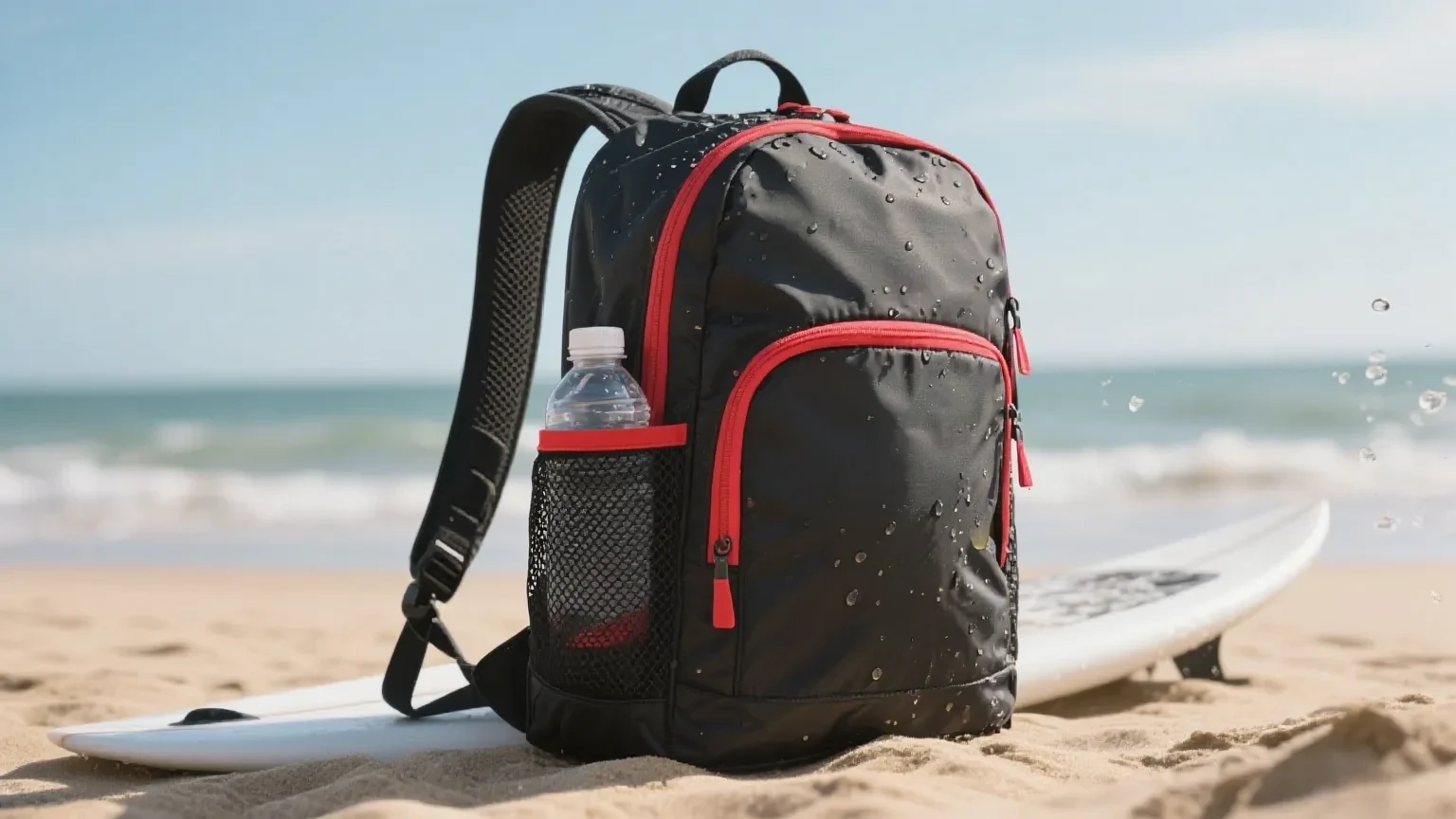
Because waterproof bags are sold into very different environments, a single specification rarely fits every buyer. The same outer laminate must protect a phone on a weekend beach trip, keep camera gear dry on a rainy summit, and carry lunch to a construction site — and each scenario pushes a different set of parameters. The table below segments the demand so buyers can match their target channel to the right build rather than over-engineering for a use case the product will never see.
| Scenario | Primary requirement | Recommended build |
|---|---|---|
| Coastal / beach | Sand and splash resistance, easy clean-out | TPU roll-top, wide opening, drain port |
| Paddlesports / boating | True submersion protection | RF-welded seams, IPX8, 20,000 mm head |
| Urban commute | Rain protection, laptop sleeve, clean looks | IPX4–6, waterproof zipper, padded pocket |
| Work / site | Abrasion resistance, tool organisation | 1000D base, reinforced corners, webbing haul loops |
| Outdoor expedition | Packability, UV resistance, light weight | Lightweight TPU, taped seams, compression straps |
For outdoor and water-sports use, buyers typically over-specify the waterproof rating and under-specify the abrasion and UV performance that actually governs product life. We recommend choosing the laminate thickness from the abrasion and folding cycles the product will see, then setting the ingress rating to the minimum that satisfies the marketed use. This balances cost against durability and avoids paying for IPX8 performance on a bag that only ever meets rain. The takeaway: segment by real use, not by the most impressive rating on the packshot.
Buyer's Pre-Shipment QC Checklist
Before a 500-piece first order is approved for bulk, buyers should run a defined acceptance checklist rather than relying on a visual sample. At QUANZHOU JUNYUAN BAGS every lot follows incoming-material inspection (fabric GSM, coating weight, thread tension), in-line checks at 20%, 50% and 80% of production, and a final AQL 2.5 random inspection before cartonning. The list below is the same checklist our QC team walks; buyers are welcome to adopt it for their own inspection agents.
- Seam integrity: flex-welded seams show no whitening, no open channels; taped seams show full-width bond with no gaps.
- Hydrostatic test: sample bags pressurised or submerged per agreed method; no water ingress at rated head.
- Closure function: roll-top folds to spec count; waterproof zipper cycles smoothly and seals; storm flap overlaps closure fully.
- Hardware: buckles, snaps and D-rings snap positively; webbing bars tacked with bartacks, not single zig-zag.
- Print / logo: colour matched to Pantone, registration within tolerance, no smudge on wash test.
- Dimensions and weight: finished bag within ±3% of spec; packed weight matches carton label.
- Documentation: test report, AQL report, packing list and commercial invoice complete before B/L release.
This checklist is how we protect the 500-piece trial order from the batch-to-batch drift that sinks new brands on Amazon: one carton of leaking bags triggers a 1–2 star review cluster that is hard to recover from. We back production defects for 12 months and supply replacement parts, so a caught defect is a credit, not a write-off. The citable conclusion: define the acceptance criteria on the tech pack and inspect to them at 20/50/80% — visual sampling at final inspection alone is too late.
Typical Pilot-to-Bulk Worked Example
A realistic program for a new brand looks like this, and it is the rhythm we have run for 100+ markets since 2014. The buyer sends a reference sample or a rough tech pack. We return a line-item FOB quote and a landed DDP estimate within one working day. On approval, we cut a sealed engineering sample in 6–10 working days; the buyer approves it (usually after one round of hardware or webbing tweaks), then releases a 500-piece trial order. Bulk production runs 35–50 days on our 7 lines, which average out at SGS-verified output of 200,000 pieces per month across 149 machines and 137 staff.
| Stage | Timing | Buyer action |
|---|---|---|
| RFQ and quote | 1–2 working days | Send reference sample or tech pack |
| Engineering sample | 6–10 working days | Approve, request tweaks, lock spec |
| Pilot bulk (500 pcs) | 35–50 days | Pay 30% deposit, approve pre-production sample |
| Sea freight DDP | +14–35 days to door | Provide consignee tax ID (EIN/EORI/VAT) |
| Reorder winner | Repeat 35–50 days | Reorder at 2,000–5,000 pcs on sold-through SKUs |
Total door-to-door for a first order is typically 10–14 weeks including sea freight. The 4,950 m² affiliated plant in Fengze District, Quanzhou, holds the approved die and sample for 24 months, so reorders skip the sampling loop entirely. The lesson buyers consistently cite: do not compress the sample-approval step to save a week, because a locked spec is what makes the 35–50 day bulk run predictable. Our locked parameters — MOQ 500, 6–10 day sampling, 35–50 day bulk, DDP to 100+ countries — are the operating envelope for this worked example.
Order-Quantity Price Build-up
Unit price for waterproof bags is driven by four things: fabric choice (TPU premium, PVC value, rPET eco), hardware and print complexity, order volume, and the DDP versus FOB shipping basis. The table below shows indicative FOB bands at three order volumes for a mid-market welded construction; actual pricing follows the tech pack. Buyers should treat these as planning numbers, not a quote.
| Order volume | Relative unit cost | Sampling / tooling | Best fit |
|---|---|---|---|
| 500 pcs (MOQ) | Index 100 | USD 80–150 sample (refundable >1,000 pcs) | First pilot, market test |
| 1,000–3,000 pcs | Index 88–94 | Sampling fee refunded | Confirmed reorder of a winner |
| 5,000–10,000 pcs | Index 80–88 | Die and sample held 24 months | Established SKU, container loads |
The fixed costs — sampling, die-making, carton tooling and DDP brokerage — amortise badly at 500 pieces, which is why unit cost is highest at the MOQ. Once a SKU sells through at 80% within 90 days, consolidating the reorder to a full container cuts freight per cubic metre by roughly half versus LCL. DDP pricing rolls sea freight, duty, brokerage and last-mile into one per-unit number, which removes landed-cost surprises for Amazon FBA sellers. The takeaway: use the 500-piece pilot to validate demand, then push volume on winners — that is where the unit economics of waterproof bags improve fastest.
Supplier Selection Comparison Matrix
Buyers shortlisting factories for waterproof bags should compare on dimensions that survive a 35–50 day production run, not on the lowest FOB line. The matrix below lists the dimensions that most often decide whether a program runs smoothly or arrives with defects. A mid-size direct factory — our 4,950 m² plant runs 7 lines, 149 machines and 137 staff at SGS-verified 200,000 pieces per month — sits between a trading company (lower minimum, less traceability) and a Tier-1 mill (deep engineering, higher MOQ of 2,000+).
| Dimension | Trading company | Mid-size direct OEM | Tier-1 factory |
|---|---|---|---|
| MOQ | Often flexible | 500 pcs per style | 2,000+ pcs |
| Sampling | Variable | 6–10 working days | 2–4 weeks |
| QC traceability | Subcontracted, weak | In-house AQL 2.5, SGS-verified | Full, but high minimum |
| Certifications | Borrowed / vague | BSCI, ISO 9001:2015, CE, CPC, RoHS | Full audit packs |
| DDP shipping | Rarely in-house | 100+ countries, FBA-ready | Yes, but high volume |
The comparison flips once a brand scales: at 5,000+ pieces per SKU the Tier-1 price advantage matters, but until then the 500-piece MOQ and 6–10 day sampling let new brands test the market without tying up capital. Ask every shortlisted supplier for the SGS capacity report, the current BSCI and ISO 9001:2015 certificates, and a video audit of the welding line before deposit — those three documents separate factories from traders faster than any sales deck.
People Also Ask
How long does waterproof bag technology innovation take end to end?
Typically 90–120 days from first RFQ to warehouse: 2–3 weeks sampling, 2 weeks pilot, 5–7 weeks bulk, 4–6 weeks ocean freight.
What should I look for in a factory audit?
Check actual machine count vs claimed, sewing stations, QC benches, hydrostatic test equipment, worker turnover and real in-line inspection records. A trading company’s audit will not match a real plant.
How much does a pilot run cost?
A 50–100 piece pilot usually costs 15–25% more per piece than bulk because of setup and small-batch efficiency. It is the cheapest insurance you will buy against a 500-piece mistake.
Can I visit the factory?
Yes. The plant is in Huachuang Park, Huada Street, Fengze District, Quanzhou, Fujian. We welcome buyers by appointment and also offer live video factory tours for overseas clients.
What happens if quality fails inspection?
We rework or replace the affected lot at our cost, per the signed AQL plan. Third-party inspection reports are shared openly; we do not ship known-defective product.
How far in advance should I plan?
Plan 120 days for a first program and 60–90 days for reorders. Peak season (Q4) needs an extra 2–4 weeks because of fabric mill and port congestion. For further reading on adjacent topics, see our guides on Future Trends in the Waterproof Bag Market, Waterproof Bag Market Trends and Future Development and Waterproof Bag Design File Requirements: Tech Pack Guide.
Frequently Asked Questions
Q1: What is the typical timeline for waterproof bag technology innovation?
A: Plan for 6–10 working days for samples, 2–3 revision rounds, a 50–100 piece pilot, then 35–50 days for bulk. End to end, expect 90–120 days from RFQ to warehouse for a first order.
Q2: What is the minimum order quantity?
A: Standard MOQ is 500 pieces per style at QUANZHOU JUNYUAN BAGS. Mixed sizes and colors can be arranged on orders of 1,000 pieces and above. For compliance teams, documentation is cross-checked per Outdoor Industry Association market data on every lot.
Q3: How do I choose the right supplier?
A: Compare SGS capacity reports, BSCI audits, ISO 9001 certification, sample lead time, communication speed and references. Price alone is a weak signal — the cheapest quote often hides rework later.
Q4: Do you provide third-party inspection?
A: Yes. We coordinate SGS, Intertek or BV pre-shipment inspection at the buyer’s request, with AQL 2.5 random sampling and a full report before container loading.
Q5: What Incoterms do you work with?
A: EXW, FOB Xiamen / Shenzhen, CIF and DDP are all standard. DDP is recommended for first-time importers because duty and customs are handled end to end.
Q6: What certifications should I ask for?
A: BSCI social audit, ISO 9001:2015 quality, and product-level test reports for REACH, RoHS, California Prop 65, CPSIA (if children’s) and food-contact (if cooler liner).
Q7: How do I handle quality disputes?
A: Document the issue with photos and a sample, reference the signed tech pack and AQL plan, and open a corrective-action request before the next PO. Reputable factories will rework or credit the affected lot.
Q8: Can you match my existing product?
A: Send a reference sample; we reverse-engineer material, construction and hardware, then quote an equivalent or improved spec. Most standard shapes need no new tooling.
Q9: What payment terms are standard?
A: 30% deposit on PO, 70% against copy of Bill of Lading. For long-term partners, more flexible terms can be discussed after a successful track record.
Q10: How do you protect my design?
A: We sign NDA before receiving tech packs or samples. Tooling and molds are marked as buyer property and are not reused for other customers without written permission.
Q11: Do you support small trial orders?
A: The standard MOQ is 500 pieces. For first-time buyers we can discuss a 300-piece pilot on a case-by-case basis, especially for long-term programs.
Q12: What should I include in an RFQ?
A: Quantity, target price, tech pack or reference sample, destination port, packaging requirements, logo placement and certification needs. The more complete the RFQ, the faster the accurate quote.
Q13: How are shipping costs calculated?
A: By cubic measurement (CBM) and gross weight, with container type (20GP / 40HQ) chosen to minimize per-piece freight. We provide CBM and loading plans before booking.
Q14: How do I contact QUANZHOU JUNYUAN BAGS?
A: Email service@junyuanbags.com or WhatsApp +86 17750020688. We reply within 12 working hours with a quote, sample plan and factory video call link.
Conclusion
Mastering waterproof bag technology innovation is less about chasing the lowest unit price and more about documentation, pilot discipline and audit discipline. Build the tech pack, run the pilot, audit the factory against SGS and BSCI data, and treat the relationship as a multi-year partnership. QUANZHOU JUNYUAN BAGS works with brands across 100+ countries on exactly this workflow; send an RFQ to service@junyuanbags.com for a sample plan.
For buyers ready to move from research to RFQ, send a tech pack or reference sample to QUANZHOU JUNYUAN BAGS. Sample turnaround is 6–10 working days, MOQ 500 pieces, and bulk production ships in 35–50 days to 100+ countries.
Need a Quote for Your Waterproof Bag Program?
Email service@junyuanbags.com or WhatsApp +86 17750020688 with your spec sheet. We reply within 12 working hours.
Request a Quote