
Waterproof Pet Carrier Bags: Travel, Bike and Trail
A pet carrier range splits into three formats that share almost nothing beyond the brand: a soft-sided travel carrier, a bike-mounted pet basket and an adventure dog pack worn by the animal. Each has a different mounting, a different waterproof requirement and a different failure mode, and treating them as one product with three sizes produces three mediocre products. QUANZHOU JUNYUAN BAGS specifies them separately and validates them together, at 500 pieces per style per colour. This guide covers the size bands, the mud exposure each format sees and the shake-out test that predicts whether a pack survives a season.
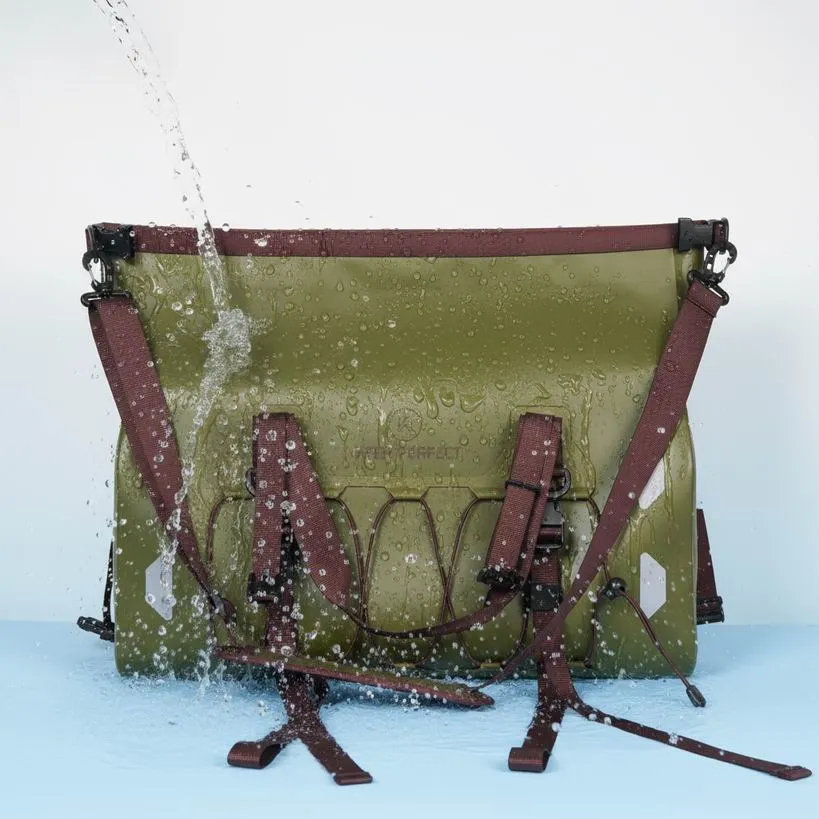
Table of Contents
- The Three Carrier Formats and the Animals They Suit
- Soft-Sided Travel Carriers: Size Bands and Weight Limits
- Bike and Pet Basket Bags: Mounting, Balance and Ride Stability
- Adventure Dog Packs: Saddle Fit, Load Split and Trail Use
- Water and Mud Exposure Across the Three Formats
- The Mud-Soak and Shake-Out Test We Run on Pet Gear
- Carrier Failure Modes: Buckle Release Under Load, Base Seam Split
- Comfort Interior: Removable Pads, Washability and Hair Shedding
- Size Chart Construction for a Pet Range
- Retail and Marketplace Requirements for Pet Products
- Cost Planning Across a Three-Format Pet Range
- Documentation, Chemical Rules and Import Requirements
- Building the Pet Range in One Sampling Round
- Frequently Asked Questions
- People Also Ask
The Three Carrier Formats and the Animals They Suit
The pet carrier category looks like one market and is three. A soft-sided travel carrier is bought for a cat or a small dog and is carried by the owner. A bike basket is bought for a small dog and is carried by the bicycle. An adventure dog pack is worn by the animal itself. The three differ in who carries the load, where the water comes from and what happens when the product fails.
That last point is the one worth stating plainly. A travel carrier that fails means an escaped animal in a terminal. A bike basket that fails means an animal in traffic. A dog pack that fails means a sore animal and an abandoned hike. The consequences escalate across the three, and the specification should escalate with them rather than being standardised across the range.
What the three share is the brand and the material set, and that is worth exploiting. One validated shell film, one validated print system and one welded mesh construction can carry all three formats, and the validation is the largest fixed cost in a pet programme. Sharing it is the commercial reason to build the range together rather than as three separate projects.
| Format | Who carries the load | Where the water comes from | Consequence of failure | Typical animal mass |
|---|---|---|---|---|
| Soft-sided travel carrier | The owner, by handle or strap | Rain in transit, spills inside, cleaning | Escape in a public place | 2 to 10 kg |
| Bike-mounted pet basket | The bicycle, via a handlebar mount | Road spray from the front wheel, rain | Animal in traffic | 3 to 9 kg |
| Adventure dog pack | The animal itself | Stream crossings, mud, prolonged rain | Sore animal, abandoned activity | 12 to 40 kg, load 10 to 25 per cent of body mass |
Soft-Sided Travel Carriers: Size Bands and Weight Limits
The travel carrier is the volume product of the range and the one where sizing errors cost the most, because an animal that does not fit is a return and an animal that fits loosely is a welfare complaint. The sizing should be built from the animal's standing dimensions rather than from its mass, and then cross-referenced to a mass band for the retail card.
The three measurements that matter are the length from chest to tail base, the height at the shoulder when standing and the width across the chest. A carrier sized on length alone is too low for a terrier and too narrow for a bulldog, and both are common complaints. We publish internal dimensions with a stated clearance over each measure and a mass band as a secondary guide.
The weight limit is a separate and often missing number. A soft carrier has a structural limit set by its handle attachment and its floor, and it should be stated as a maximum animal mass rather than left implicit. Publishing it protects the brand: a carrier that fails under an oversized animal is a complaint, and a carrier labelled with a limit is not.
Bike and Pet Basket Bags: Mounting, Balance and Ride Stability
A bike basket is a mounting problem before it is a bag problem. The load sits ahead of the handlebars, above the front wheel, and it changes the steering of the bicycle in a way a rear-mounted load does not. A 6 kg dog on the front of a bicycle is a meaningful mass at a meaningful distance from the steering axis, and the mount has to be specified for it.
The mounting decision is between a handlebar clamp and a front-rack platform. A clamp is convenient and it puts the whole load on the handlebar, which limits both the mass and the ride quality. A rack platform transfers the load to the fork and tolerates more mass, at the cost of requiring the buyer to have a rack. For anything above 5 kg we recommend the platform.
Ride stability is then about restraint of the load rather than of the animal. A basket that can swing on its mount changes the steering with every movement the animal makes, and that is fatiguing and, at speed, unsafe. The fix is a rigid or semi-rigid base and a mount with no free play, and it is why a soft basket with a fabric-only mount is the wrong product above a low mass.
Adventure Dog Packs: Saddle Fit, Load Split and Trail Use
A dog pack is worn by the animal and is closer to a technical harness than to a bag. The two requirements that govern it are saddle fit and load split, and both differ fundamentally from anything in the rest of the range. Fit is about the animal's anatomy rather than a measurement grid, and load is about what a dog can carry comfortably rather than what a bag can hold.
The load figure used across the working-dog world is 10 to 25 per cent of body mass, with the lower end for an unconditioned animal and a long day. A pack should therefore be sold with a load limit stated as a share of body mass rather than as a volume, and the volume is a secondary figure. A 20 litre pack on a 15 kg dog is entirely the wrong product.
Load split is the second requirement and it is about symmetry. A pack that sits asymmetrically, or whose contents shift to one side, produces gait changes and then injury. The design answer is two equal saddle bags joined over the back with a balanced load path, and a closure that keeps each side's contents from migrating. A handle on the top of the pack matters for lifting an animal over an obstacle, and it has to be anchored to the load path rather than to the fabric.
Water and Mud Exposure Across the Three Formats
The three formats see water from different directions and for different durations, and specifying one waterproof level across the range is the mistake that makes one of them wrong. A travel carrier sees rain and an internal spill, briefly and intermittently. A bike basket sees continuous road spray from the front wheel, which is the most persistent exposure of the three. A dog pack sees immersion in streams and prolonged rain.
Mud is the exposure that separates them further, and it is the one that generates the most returns because it is visible. A dog pack comes back caked, a bike basket comes back splashed along its lower front face, and a travel carrier comes back clean unless it was set down. The cleaning requirement therefore rises sharply from the carrier to the pack, and the pack's shell should be specified for it.
The practical consequence is a different shell gauge and a different closure by format. The travel carrier can use a lighter laminate at 10,000 mm under ISO 811 and a zip closure. The basket needs a reinforced lower front face and a drain path. The pack needs a heavier laminate at 20,000 mm or above, welded seams rather than taped ones, and a closure that works when it is caked in mud.
The Mud-Soak and Shake-Out Test We Run on Pet Gear
This is the protocol specific to pet gear, and it exists because no textile water test accounts for what an animal does when it gets wet. The principle is that a dog shakes, and a shake applies a sudden, high-rate load to every seam and closure on the product. A pack that has been soaked and then shaken is a different object from a pack that has been soaked and left still.
The exposure is a defined mud slurry rather than clean water, because mud changes the behaviour of a closure in a way clean water does not: it packs into a zip tape and into a fold, and it holds moisture against a seam long after the surface has dried. The soak is followed by a mechanical shake cycle at a stated rate and amplitude, applied to the loaded product.
The pass criteria are two and both are specific. No seam or closure failure during the shake cycle, and no moisture reaching indicator papers placed at the pack's interior faces. The second is the harder one after mud exposure, because a closure that has mud packed into it will pass a clean-water test and fail this one, which is precisely the field behaviour being reproduced.
- Prepare a mud slurry of a stated solids content and soak the loaded product for the stated duration.
- Drain freely for a stated period without wiping, so that mud remains packed in the closures.
- Mount the product on a shake rig and run the stated number of cycles at the stated rate and amplitude.
- Inspect every seam and closure during and after the shake cycle for opening, distortion or hardware release.
- Open the product and read the indicator papers placed at each interior face.
- Rinse, dry and repeat the full sequence once, because the second cycle is where a packed closure usually fails.
Carrier Failure Modes: Buckle Release Under Load, Base Seam Split
Buckle release under load is the failure that matters most across all three formats, and it is specific to a moving animal. A buckle loaded statically holds well; the same buckle loaded by an animal that shifts, lunges or leans can be released by a load applied at the wrong angle, because a side-release buckle releases when its two arms are pinched together rather than pulled apart.
That is why a locking buckle or a secondary retention is specified on anything that restrains an animal, and why the release direction matters. A buckle mounted so that a leash pull pinches its arms is a buckle waiting to open. We orient the hardware so that the anticipated load pulls along the buckle's axis, and we add a secondary clip where the consequence of release is traffic or a public place.
Base seam split is the second failure and it is a corner problem. A loaded carrier set down repeatedly puts a peel load on the base seam, and a welded seam resists peel less well than it resists shear. The mitigation is a reinforced base panel that carries the load in shear rather than at the seam line, and it is the change that most extends the service life of a travel carrier.
Comfort Interior: Removable Pads, Washability and Hair Shedding
Hair is the property no other bag category has to design for. It works into every seam, every hook-and-loop patch and every fabric face, and it is the reason a pet product interior should be specified as a smooth welded surface rather than a textile one. A fabric-faced lining collects hair and it cannot be fully cleaned; a smooth welded lining can be wiped and hosed.
The removable pad is the compromise that gives comfort without the cleaning penalty. A closed-cell pad in a welded sleeve, removable through a closure on its underside, gives the animal a soft surface and gives the owner something that can be washed. The sleeve has to be sealed on three sides and closed so the animal cannot work the closure open.
Hook-and-loop should be avoided in a pet interior entirely. It collects hair, it stops holding once it is full, and it makes a noise that unsettles some animals. Where an adjustable divider is needed, a webbing and buckle system or a snap system is the better choice, at a small cost increase that is invisible once the product is in use.
Size Chart Construction for a Pet Range
A pet size chart should be built from animal measurements and then validated against real animals, because the published charts in this category are notoriously inconsistent between brands. The three measures to lead with are chest-to-tail-base length, standing shoulder height and chest width, and the chart should state the clearance added to each rather than implying an exact fit.
For a dog pack the chart has to add a fourth measure: girth behind the front legs, because the saddle fit depends on it and because two dogs of the same mass can differ substantially. A pack sold on mass alone will not fit a deep-chested breed and a barrel-chested breed equally, and that is the most common sizing complaint in the format.
The commercial point about a size chart is that each size is a separate SKU with its own 500 piece minimum. Three sizes across three formats is nine minimum commitments, which most first programmes cannot absorb. The practical answer is to launch the middle size of each format first, prove the market and extend, rather than launching a full size matrix.
| Size | Chest to tail base | Standing shoulder height | Chest width | Mass band |
|---|---|---|---|---|
| Small | Up to 350 mm | Up to 280 mm | Up to 220 mm | 2 to 5 kg |
| Medium | 350 to 480 mm | 280 to 380 mm | 220 to 300 mm | 5 to 10 kg |
| Large | 480 to 600 mm | 380 to 480 mm | 300 to 380 mm | 10 to 18 kg |
| Dog pack, by girth | Behind front legs, three bands per size | Load limit 10 to 25 per cent of body mass | Saddle bags matched side to side | 12 to 40 kg |
Retail and Marketplace Requirements for Pet Products
Pet products sell through marketplaces more than any other bag category, and that channel has two requirements that shape the product. The first is that the listing carries a size claim that matches reality, because a size dispute is the dominant return reason and it is attributed to the brand rather than to the buyer's measurement. The second is that the product photographs well out of the box.
Both point the same way: publish internal dimensions and a mass band, and ship the product with a shaped insert so it arrives in form. A carrier or a pack shipped flat and creased photographs badly on the marketplace listing and returns quickly, and the cost of an insert is a fraction of the cost of the returns it prevents.
The third requirement is a care instruction that survives the product. A pet product is washed repeatedly and owners need to know whether that is permitted and at what temperature. A care label welded into a seam rather than printed on a card is the right answer, and it should state the cleaning agent rather than only a temperature.
Cost Planning Across a Three-Format Pet Range
Three formats at 500 pieces each is 1,500 pieces before sizes are considered, and the honest planning answer is that most buyers should not launch all three at once. The sequencing is dictated by which format shares the most with the others: the travel carrier validates the shell, the mesh and the print, and the other two can then be built on that validation without repeating it.
The basket is the cheapest second step, because it reuses the shell and the mesh and adds a mounting sub-assembly. The dog pack is the most expensive and the most different, because it needs a saddle harness, a balanced load path and a heavier laminate. Launching carrier, then basket, then pack spreads both the cost and the engineering risk sensibly.
The other planning lever is size. Launching the middle size of each format is the pattern that works, because the middle size is the volume seller and because extending up or down later reuses the pattern logic. A full size matrix at launch multiplies the commitment by three and rarely matches the demand curve in the first season.
| Range planning decision | Recommended path | Effect on the first commitment |
|---|---|---|
| Formats released at once | One, usually the travel carrier | Validation paid once, commitment spread |
| Second format | Bike basket, reuses shell and mesh | Adds a mounting sub-assembly only |
| Third format | Adventure dog pack, heaviest engineering | New harness, load path and heavier laminate |
| Sizes at launch | Middle size of each format | Extending up or down reuses pattern logic |
| Colourways | One shell colour, coded trim for sizes | Each colourway is a separate 500 piece minimum |
| Validation of shake and soak protocol | Fixed cost at 500 pieces | Not repeated on an unchanged reorder |
Documentation, Chemical Rules and Import Requirements
Pet products are treated as consumer goods in most markets, and the chemical documentation is the same as for any article: a material declaration covering the shell, the mesh, the lining, the foam and the print, with a REACH declaration on substances of very high concern for the European Union market. Because an animal will chew and lick the interior, the lining polymer deserves particular attention and we specify TPU rather than PVC by default.
RoHS applies only where the product carries a powered component, such as a cooling fan in a carrier or a light on a pack. Where one exists it should be documented as its own SKU. OEKO-TEX on the fabric, the mesh and the print is the fastest route through a retailer restricted substance list, and it is worth requesting at the sampling stage rather than at shipment.
Where the range is sold into the United States, CPSC expectations and CPC documentation may be requested where pet items are retailed alongside children's products. ISO 9001-aligned QC and BSCI audit support cover the process and social evidence a retailer questionnaire will ask for, and SGS verification covers the capacity claim. None of this substitutes for a construction that survives the animal.
Building the Pet Range in One Sampling Round
A pet range can be sampled in one round if the size chart, the animal mass bands and the format sequence are fixed before the pattern is drawn. Sampling takes 6 to 10 working days for a standard build and 12 to 15 where a moulded base, a harness saddle or a custom mounting sub-assembly is involved. A second round is usually caused by a changed size chart rather than by a construction problem.
We recommend sampling the travel carrier and the basket together, because they share the shell, the mesh and the print validation, and because the findings on the basket's lower front face inform the reinforcement on the carrier's base. Sampling them separately means solving the mesh weld question twice on two calendars.
Every format is quoted at 500 pieces per style per colour. Bulk runs 35 to 50 days from the approved pre-production sample, shipments leave FOB Xiamen on T/T 30 per cent deposit and 70 per cent before shipment, and lots are inspected to AQL 2.5 under ISO 2859-1 in a validated production partner facility of 4,950 square metres, 7 lines, 149 machines and 137 people, verified by SGS, at 200,000 pieces a month.
QUANZHOU JUNYUAN BAGS has run waterproof OEM programmes since 2014, with a founder in the trade since 2004, and issues CE, CPC, RoHS and SGS documentation on request, runs ISO 9001-aligned QC and can host a BSCI audit. Send the size chart, the animal mass bands and the format sequence to service@junyuanbags.com or WhatsApp +86 177 5002 0688. Water exposure methods are compared on the water ingress test methods page, the head figure is explained under ISO 811 hydrostatic pressure, and rain exposure is covered on the AATCC 35 page. Decoration options sit under custom programmes and the catalogue on products.
Frequently Asked Questions
Q1: What are the three formats in a pet carrier range?
A: A soft-sided travel carrier carried by the owner, a bike-mounted pet basket carried by the bicycle and an adventure dog pack worn by the animal. They share a brand and a material set and differ in mounting, water exposure and failure consequence. Treating them as one product in three sizes produces three mediocre products rather than one range.
Q2: How should a pet carrier be sized?
A: From animal measurements rather than mass: chest-to-tail-base length, standing shoulder height and chest width, each with a stated clearance. A carrier sized on length alone is too low for a terrier and too narrow for a bulldog. Mass is a secondary guide for the retail card, and a maximum animal mass should be published separately.
Q3: How much weight can a dog pack carry?
A: 10 to 25 per cent of body mass, with the lower end for an unconditioned animal or a long day. A pack should be sold with a load limit stated as a share of body mass rather than as a volume, because volume tells the buyer nothing about what the animal can carry. A 20 litre pack on a 15 kg dog is the wrong product.
Q4: Should a bike basket mount to the handlebar or a rack?
A: A front-rack platform for anything above 5 kg. A handlebar clamp is convenient and puts the whole load on the handlebar, which limits both the mass and the ride quality. A rack transfers the load to the fork and tolerates more. A 6 kg dog ahead of the steering axis changes how the bicycle steers.
Q5: Why does a buckle open when a dog pulls?
A: Because a side-release buckle releases when its two arms are pinched together rather than pulled apart, and an animal that lunges applies load at an unpredictable angle. We orient hardware so the anticipated load pulls along the buckle's axis and add a locking buckle or a secondary clip where release means traffic or a public place.
Q6: What is the mud-soak and shake-out test?
A: A protocol specific to pet gear, because no textile water test accounts for what an animal does when wet. The loaded product is soaked in a defined mud slurry, drained without wiping so mud packs into the closures, then mechanically shaken at a stated rate. It passes if no seam or closure fails and no moisture reaches the interior.
Q7: Why does the base seam of a pet carrier split?
A: Because a loaded carrier set down repeatedly puts a peel load on the base seam, and a welded seam resists peel less well than shear. The fix is a reinforced base panel that carries the load in shear rather than at the seam line, which is the single change that most extends the service life of a travel carrier.
Q8: Should a pet carrier interior be fabric or welded?
A: Welded and smooth. Hair works into every seam, every hook-and-loop patch and every fabric face, and a fabric-faced lining collects it and cannot be fully cleaned. Comfort comes from a removable closed-cell pad in a welded sleeve, which can be washed, rather than from a fixed fabric interior.
Q9: Do the three formats need different waterproof levels?
A: Yes. A travel carrier sees brief rain and internal spills and is fine at 10,000 mm under ISO 811 with a zip closure. A bike basket sees continuous road spray and needs a reinforced lower front face and a drain path. A dog pack sees stream immersion and needs 20,000 mm or above with welded seams.
Q10: What is the MOQ for a pet carrier range?
A: 500 pieces per style per colour, so three formats in one size and one colour is 1,500 pieces. Launching one format at a time shares the shell, mesh and print validation across all three, and launching the middle size of each format avoids multiplying the commitment by a full size matrix in the first season.
Q11: How long does sampling take for a pet range?
A: 6 to 10 working days for a standard build and 12 to 15 where a moulded base, a harness saddle or a custom mounting sub-assembly is involved. A second round is usually caused by a changed size chart rather than by a construction problem, so the chart should be fixed before the pattern is drawn.
Q12: What documents does a pet product retailer require?
A: A material declaration covering the shell, mesh, lining, foam and print, a REACH declaration for the European Union market and OEKO-TEX on the fabric, mesh and print where a retailer list requires it. RoHS applies only where a powered component exists. ISO 9001-aligned QC and BSCI audit support cover process and social evidence.
Q13: Why should hook-and-loop be avoided in a pet product?
A: It collects hair, it stops holding once it is full of it, and the noise unsettles some animals. Where an adjustable divider is needed, a webbing and buckle system or a snap system is better, at a small cost increase that becomes invisible once the product is in use. It is one of the few absolute rules in the category.
Q14: How should pet products be packed for marketplaces?
A: With a shaped insert so the product arrives in form, and with a printed card carrying internal dimensions and the mass band. A carrier or pack shipped flat and creased photographs badly on a listing and returns quickly, and the insert costs a fraction of the returns it prevents. A welded care label should state the cleaning agent.
People Also Ask
- How do I size a pet carrier for my dog?
- How much weight can a dog pack carry?
- Should a bike basket mount to the handlebar?
- Why does a pet carrier buckle come undone?
- What is the MOQ for custom pet carriers?
- Are dog packs waterproof?