
Waterproof Bags for Kayaking: Built for Immersion
Kayak bags are the only category here that is designed to end up underwater. Spray ratings are irrelevant because these bags are capsized, submerged in a hatch and dragged through moving water as a matter of routine, so the specification must be built around hydrostatic pressure at depth and around what happens to trapped air. IPX7 and IPX8 under IEC 60529 are the honest targets, and buoyancy behaviour off the boat is a safety question rather than a convenience one. QUANZHOU JUNYUAN BAGS builds paddle-sport programmes from 500 pieces per style per colour.
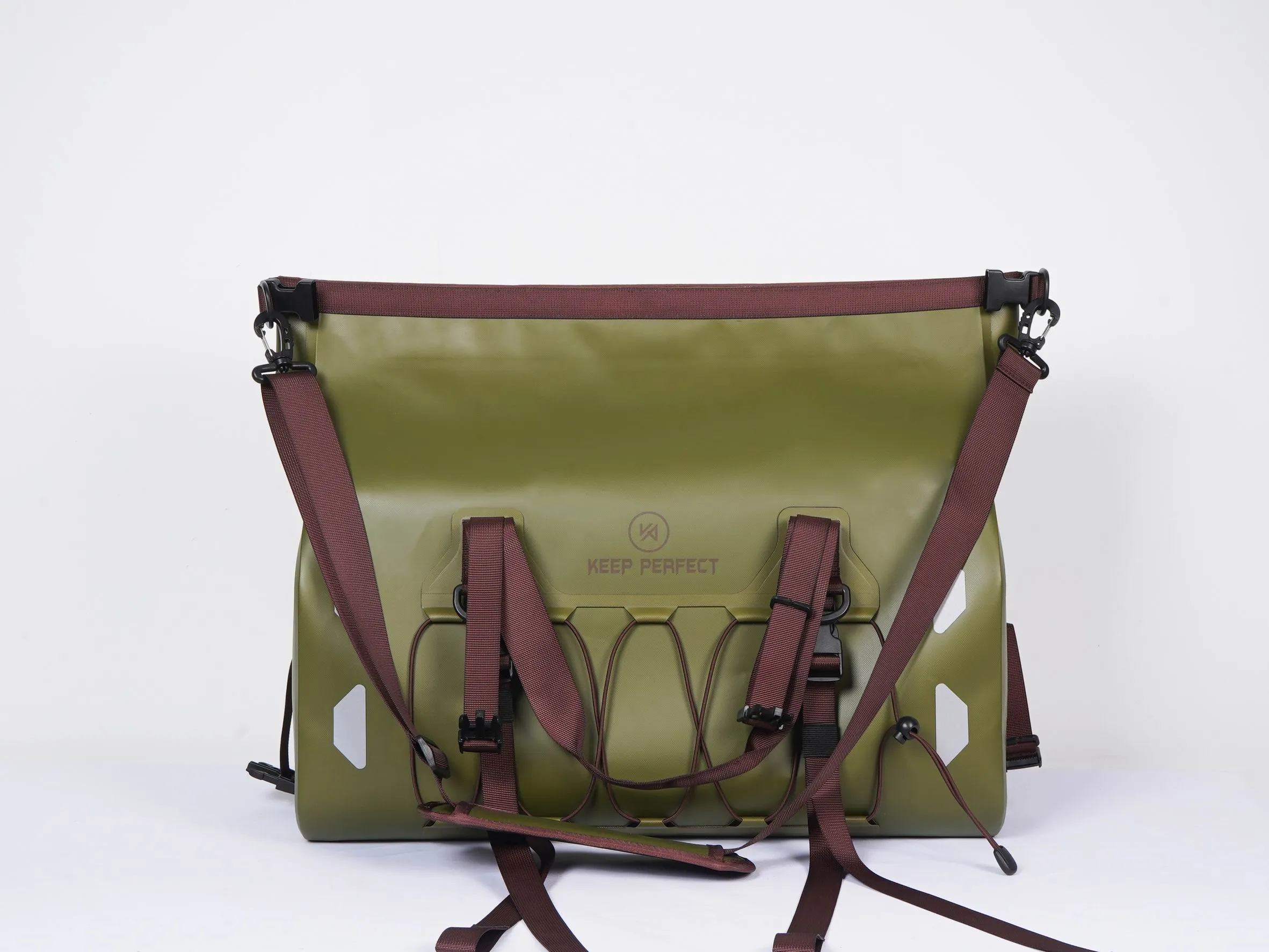
Table of Contents
- Immersion, Not Spray: What Kayak Bags Must Survive
- Submersion Depth and Time: The IPX7 Versus IPX8 Target
- Buoyancy Aid or Buoyancy Hazard: Air Trap Design
- Deck Straps, Pad Eyes and Attachment Hardware
- Hatch Bag Geometry for Kayak Hull Openings
- Roll-Top Closures Under Moving Water Pressure
- Clear Map Pockets at the Cockpit
- Salt Spray, UV and Paddle Blade Abrasion
- Testing Kayak Bags: Static Head, Submersion and Drop-In
- Kayak-Specific Failure Modes: Siphon and Capsize Loss
- Branding on Paddle-Sports Gear
- Carton and Freight Planning for Bulky Dry Bags
- Launching a Paddle-Sports Range at 500 Pieces
- Frequently Asked Questions
- People Also Ask
Immersion, Not Spray: What Kayak Bags Must Survive
A kayak bag spends its working life in an environment no other bag routinely encounters: fully underwater, frequently under pressure, and pressed against hard hull surfaces by both straps and moving water. That changes the physics. Water pressure increases by roughly one atmosphere for every ten metres of depth, and while a kayak bag never sees ten metres, even one metre of immersion applies pressure continuously to every closure interface rather than intermittently as rain does.
The second difference is duration. Rain falls and stops; submersion during a capsize, a failed roll or a wet exit continues for minutes, and in the case of a bag lost overboard, indefinitely. A closure that resists a thirty second splash will slowly admit water over three minutes if there is any capillary path at all. The practical specification consequence is that capillary paths must be eliminated, not merely resisted, which points towards welded seams and rolling closures rather than toward zippers and tape.
- Pressure acts continuously rather than intermittently, so any capillary path eventually admits water
- Submersion durations are measured in minutes, not seconds, which rules out designs that rely on surface tension
- The bag is compressed against the deck by straps, which loads the closure in ways free-standing tests do not
- Trapped air changes both buoyancy and how the closure behaves, so both have to be designed together
- Recovery after capsize happens in cold, wet conditions when fine motor control is already compromised
It follows that any product intended for this category should be developed against immersion protocols from the first sample rather than upgraded later. Retooling a design to survive immersion after it has been costed as a spray-resistant product almost always requires changing the closure, and the closure is usually the most expensive part of the bill of materials. Buyers who declare their immersion target at quotation consistently receive better products and faster development than those who add the requirement halfway through.
Submersion Depth and Time: The IPX7 Versus IPX8 Target
IEC 60529 defines ingress protection classifications, and two of them matter here. IPX7 covers temporary immersion, conventionally for 30 minutes at 1 metre depth. IPX8 covers continuous immersion at a depth and duration agreed between manufacturer and user, which in practice means the buyer must state what they actually want certified. Selecting IPX8 without stating parameters produces a certificate that means nothing, and that ambiguity is regularly exploited in retail marketing.
| Classification | Test condition under IEC 60529 | Suitability for paddle sports | What must be stated on the claim |
|---|---|---|---|
| IPX6 | Powerful water jets from all directions | Deck bags exposed to heavy spray and wave wash only | No immersion protection implied |
| IPX7 | 30 minutes immersion at 1 metre depth | Hatch bags, day trip dry bags, most paddle use | State the depth and duration actually tested |
| IPX8 | Continuous immersion at agreed depth and duration | Bags intended for sustained underwater storage or towing | Depth and duration must be published with the claim |
| IPX9K | High pressure and high temperature jet | Not applicable to flexible bags | Do not use as a substitute immersion claim |
For most paddle-sport programmes IPX7 is the honest answer and IPX8 is reserved for specific products such as towed dry bags and underwater camera housing pouches. The important discipline is to publish the tested depth and duration rather than citing the code alone. A buyer comparing two quotations where one states IPX7 and the other states IPX8 at 1.3 metres for 90 minutes can actually make a decision; comparing two bare codes cannot.
Further reading on how these codes compare with other rating systems used on the same shelf sits in our notes on selecting between IPX7 and IPX8, which covers the commercial implications of each choice as well as the test. A related question worth settling early is whether the closure can be verified on every unit or only on sampled units, because that decision drives both cost and the credibility of the claim.
Buoyancy Aid or Buoyancy Hazard: Air Trap Design
Trapped air is the most overlooked property in kayak bag design. A sealed roll-top bag holding air is a flotation device, which can be genuinely useful when a bag goes overboard and the paddler wants to recover it. The same property becomes a hazard when the bag is strapped inside a hatch and expands as the boat descends in cold water, potentially deforming against a bulkhead or forcing its own closure open from the inside.
Our approach distinguishes intended float from accidental float. Where a bag is designed to float and be recovered, we specify sufficient closed air volume, a brightly coloured shell for visibility, and a grab handle rated for retrieval while loaded. Where a bag is designed to sit inside a hull, we add a pressure relief path that lets expanding air escape without admitting water, typically through a one-way valve or a controlled labyrinth in the closure.
For each hull-stored product we publish the resulting buoyancy figure alongside our buoyancy and rating guidance, so buyers can see whether a packed bag will lift, hover or settle.
- State at design stage whether the bag should float or sink; do not leave it accidental
- For retrieving bags, specify closed air volume, visibility colour and a load-rated grab handle
- For hull-stored bags, add a relief path so trapped air can expand without forcing the closure
- Remember that air volume changes with temperature as well as depth, particularly in cold water
- Test buoyancy loaded, not empty, because a partially packed bag behaves completely differently
There is a further safety dimension worth raising explicitly. A bag that floats away is a piece of debris other paddlers must avoid, and in some jurisdictions leaving equipment adrift carries consequences for the owner. Encouraging attachment lanyards alongside floating designs addresses both the practical recovery problem and the environmental one, and it is a small addition that reflects well on any brand operating in shared waterways.
Deck Straps, Pad Eyes and Attachment Hardware
Deck attachment is a system rather than a component. The bag side carries webbing loops, ladderlock fittings or sewn-in straps; the boat side carries pad eyes, bungee cord and hooks; and the interface between them has to stay secure while both are moving independently in a swell. Most real-world losses occur at that interface rather than through bag failure, which is why we treat attachment design as part of the product rather than an accessory to it.
| Attachment element | Typical configuration | Dominant failure mode | Recommended correction |
|---|---|---|---|
| Webbing loop on bag | Bar-tacked into a reinforced patch | Tear-out under shock load in a following sea | Wider load-spreading patch, tested shocked not static |
| Deck bungee cord | Shock cord hooked to pad eyes | Hooks releasing under slack-tension cycling | Positive locking hook geometry rather than plain hook |
| Ladderlock fitting | Webbing threaded through a buckle | Slip under sustained vibration | Specify grip capacity against wet webbing |
| Pad eye on deck | Through-bolted or riveted fitting | Corrosion at dissimilar metal contact | Polymer fitting or matched metal specification |
| Grab handle | Webbing loop with moulded grip | Stitch failure at the moulded grip join | Continuous webbing with over-moulded grip |
Where a bag strapped to a deck also has to survive being retrieved from the water, we recommend pairing it with one of the grab-handle designs in our paddle-sports range rather than inventing a new handle geometry, since the existing patterns have already survived certification loading.
Wet shock loading is the condition none of these components get tested against in ordinary bag programmes, and it is the condition they all experience in service. A bag strapped to a deck in a following sea is loaded, unloaded and reloaded hundreds of times per hour, with the strap tightening and slackening as the hull flexes. We test attachment assemblies on a cycling rig against wet webbing rather than pulling statically, because static results overstate real performance substantially.
Hatch Bag Geometry for Kayak Hull Openings
Hatch bags must pass through a rigid opening and then occupy an irregular curved space beyond it. That dual requirement produces a specific geometry problem: a bag sized to pass through the hatch is too small to fill the hull efficiently, while a bag shaped to the hull will not go through the opening. The usual resolution is a tapered, semi-soft body with a structured base, packed through the hatch and then allowed to expand inside.
Getting this right requires actual dimensions rather than nominal litre capacities. We ask buyers for the internal hatch ring diameter of the target boats, because that single figure governs the maximum body circumference and therefore the maximum usable volume. Working from litres first produces bags that either jam at the hatch or leave most of the hull unused, and both outcomes generate poor reviews that blame the bag for what was really a specification mistake.
Body shape inside the hatch matters as much as the entry dimension. A purely cylindrical bag wastes the tapering sections of most hulls, whereas a structured base with a softer upper body conforms better and carries more usable volume through the same opening. That hybrid also stacks more predictably, which matters when a paddler loads three bags into a dark hatch by feel rather than by sight.
Roll-Top Closures Under Moving Water Pressure
A roll-top closure works because the rolled layers press against each other and create a tortuous path that water cannot traverse without being driven. Under moving water that principle still holds, but the pressure differential across the closure is now sustained rather than intermittent, and any wrinkle in the roll becomes a persistent leak channel rather than a momentary one. Roll quality therefore becomes the dominant determinant of performance.
- Specify a minimum number of roll turns, typically three for IPX7 and four for deeper claims
- Use a stiffened closure lip so the roll holds its shape when compressed under straps
- Avoid external buckles pressing directly onto the rolled section, which creates a flat spot and a channel
- Test the closure rolled once, twice and three times, not only perfectly rolled
- Provide roll alignment marks so users can see whether they have rolled enough in poor conditions
The final point deserves emphasis because it addresses the dominant real-world failure: users roll poorly. Interaction design beats theory here. Align marks printed on the closure lip, a stiffened lip that resists uneven rolling, and clear visual cues when the roll is sufficient collectively improve field performance more than any incremental increase in film specification, and they cost almost nothing per unit.
Clear Map Pockets at the Cockpit
Cockpit-mounted clear pockets hold charts, phones, GPS units and tide tables, and they sit in the wettest, brightest and most physically demanding position on the boat. The film must be optically clear enough to read through when wet, tolerant of UV without yellowing, and flexible in cold conditions. That combination rules out several otherwise excellent films, particularly thicker PVC grades that haze at fold lines and stiffen in winter.
- Optical clarity must be measured wet, since surface water changes how light passes through the film
- UV stability prevents yellowing, which ruins the product aesthetically long before it fails functionally
- Cold flexibility matters because coastal paddling happens year round
- Touch sensitivity through the film, where relevant, constrains both material and thickness
- Seams should be welded for clarity as well as waterproofness, since adhesive tape yellows faster
Closure choice follows a different logic here from the rest of the boat. Users need frequent access, often with one hand, while braced against a wave. That rules out multi-turn roll-tops for this position and favours a single-action compression closure or a high-quality waterproof zipper with a glove-friendly pull, accepting that the immersion rating at this location will be lower than on a hatch bag stored below.
Salt Spray, UV and Paddle Blade Abrasion
Coastal paddling combines three degradation mechanisms that reinforce each other. Salt crystals abrade surfaces and hold moisture, UV radiation breaks polymer chains in the film and coating, and paddle blades scrape repeatedly against bags laid on the deck or in the cockpit. Any one of these shortens service life; together they can halve it, and the combination is the reason sea kayak bags should never share a specification with touring bags used on inland waters.
Material selection responds on three fronts: a UV-stabilised coating or film, a face fabric chosen for salt tolerance rather than only for denier, and hardware specified for marine exposure rather than general outdoor use. Where programmes span both coastal and inland use, we generally recommend building to the coastal specification and accepting the small cost premium, because the inland user notices nothing while the coastal user notices everything.
Testing Kayak Bags: Static Head, Submersion and Drop-In
Kayak bag verification should reflect the actual sequence of events rather than a single worst-case test. We run hydrostatic screening first, then static submersion to establish the immersion rating, then a drop-in test simulating the bag going overboard with typical contents, and finally a closure durability cycle. Running them in that order preserves samples for the expensive stages while removing weak designs early.
| Test stage | Method reference | Pass criterion applied | Why it sits in this position |
|---|---|---|---|
| Fabric hydrostatic screening | ISO 811 or AATCC 127 | No penetration at specified head | Cheap and fast; filters weak materials first |
| Static submersion | IEC 60529 at declared depth and duration | No ingress into the bag interior | Establishes the published IP class |
| Loaded drop-in with contents | Internal protocol, paper or tissue indicator | Indicator paper remains dry | Simulates going overboard while loaded |
| Strapped closure compression | Internal protocol with deck strap at working tension | No ingress after sixty minutes | Represents real deck-mounted service |
| Closure durability cycling | Internal protocol, repeated roll and unroll | Submersion result retained after cycling | Confirms the rating survives use |
| Lot acceptance sampling | ISO 2859-1 at AQL 2.5 | Defect count within acceptance number | Statistically defensible release decision |
Two procedural details determine whether these results mean anything. First, use indicator media inside the bag rather than relying on external inspection, because a small amount of ingress in a large dry bag is genuinely hard to spot from outside. Second, test roll quality deliberately varied: a bag only tested perfectly rolled will tell you nothing about what happens when a cold, rushed paddler rolls it once and clips.
Full records for every qualification round are retained against our immersion test protocol, including photographs of the closure condition at the start of each submersion. That photographic record is unusually valuable because it settles disputes about whether a failure originated in the closure or in the film, which visual inspection after the fact frequently cannot establish.
One more variable deserves recording: water temperature. Immersion tests performed in warm laboratory water are measurably more forgiving than the same test in cold coastal water, because films stiffen and closures relax less readily. Where a programme targets cold-water paddling, we repeat the qualification in chilled water, and the difference in results is often instructive enough to justify a specification change before tooling is committed.
Kayak-Specific Failure Modes: Siphon and Capsize Loss
Failure modes in paddle sports have signatures that appear nowhere else, and none of them is predicted by hydrostatic testing. Knowing them in advance changes both design and how incoming complaints are diagnosed, which prevents the common and expensive outcome of redesigning a product whose actual problem was user behaviour.
| Failure mode | How it presents | Actual mechanism | Design or documentation response |
|---|---|---|---|
| Closure siphon at the bilge | Dry outside, wet contents after a long paddling day | Water pooling in bilge reaching the closure and being drawn along the roll | Raise closure position; add a splash guard |
| Capsize strap release | Bag recovered floating away from the boat | Bungee hook releasing under slack-tension cycling | Positive locking hooks rather than plain hooks |
| Expansion forcing closure open | Wet contents after cold water descent | Trapped air expanding and lifting the roll | Pressure relief path in the closure |
| Abrasion against hull ribs | Perforation at a consistent hull contact point | Repeated vibration against internal mouldings | Localised reinforcement at identified contact zones |
| Yellowing cockpit window | Window becomes opaque after one season | UV degradation of clear film | UV-stabilised clear film specified explicitly |
Branding on Paddle-Sports Gear
Paddle-sport products are used in a visually clean environment and photographed constantly, so branding quality carries more weight here than in most outdoor categories. Print sits against a background of sea and sky, which means low-contrast logos disappear entirely. For any bag intended to float and be recovered, high-contrast colour is also functional rather than purely decorative, since visibility is the difference between recovery and loss.
- Keep print clear of weld zones, since ink contaminates any welded joint
- Use high-contrast placement where the bag will be seen against water or sky
- Specify UV-stable print systems; fading is read as failure by this audience
- Consider reflective trim for low-light launch and landing situations
- Place logos where they remain visible when the bag is strapped to a deck
Carton and Freight Planning for Bulky Dry Bags
Dry bags are the most freight-expensive product in this entire family because they ship mostly air. A 40-litre dry bag occupies roughly 40 litres of carton volume while weighing under a kilogram, which means freight is charged on volume rather than weight and landed cost rises steeply with size. Planning around that reality is the difference between a viable margin and an unviable one.
- Ship nested and deflated wherever size economics allow the bag to be rolled flat
- State exact carton cube and gross weight at quotation so forwarders can quote accurately
- Consider whether the largest size in a range should be a different construction that packs flatter
- Model landed cost per litre, not per unit, when comparing sizes in a family
- Plan FCL consolidation with the rest of the paddle-sport range rather than shipping that range alone
This is also where FOB Xiamen earns its value. Because the buyer controls the freight here, volumetric efficiency programmes actually reach the buyer's bottom line rather than being absorbed into a unit price set by someone else. We publish carton data early specifically so that modelling can happen before orders are committed rather than after goods are packed.
Launching a Paddle-Sports Range at 500 Pieces
A launch range should cover three use positions rather than three arbitrary sizes: a hatch bag sized to the target boats, a deck bag or cockpit pocket, and an electronics or valuables pouch. Each has a different closure requirement, a different immersion expectation and a different bill of materials, so three purpose-built products outperform three sizes of the same design in both performance and review quality.
- Declare the immersion target and IP class before costing begins, not after sampling
- Get actual hatch ring diameters from the target boats before sizing hull bags
- Decide deliberately which products float and which vent trapped air
- Specify marine-grade hardware throughout rather than upgrading later
- Approve a golden sample, then inspect bulk under ISO 2859-1 at AQL 2.5
Terms follow our standard structure: sampling in 6 to 10 working days, extending to 12 to 15 days where custom clear-film windows or moulded closures are involved, then bulk in 35 to 50 days. Payment is T/T with 30 per cent deposit and 70 per cent before shipment on FOB Xiamen. Production draws on an SGS-verified partner facility of 4,950 square metres with 7 lines, 149 machines and 137 operators producing 200,000 pieces monthly, governed by ISO 9001:2015 with BSCI coverage and declarations reviewed against REACH. Write to service@junyuanbags.com or WhatsApp +86 177 5002 0688 to start a specification.
Frequently Asked Questions
Q1: Do kayak dry bags really need IPX7, or is IPX6 enough?
A: If the bag is stored below deck or strapped anywhere it can be submerged, IPX7 is the correct target. IPX6 covers powerful jets and is genuinely adequate only for bags mounted well above the waterline. Because a capsize submerges everything, specifying IPX6 for a bag a paddler expects to survive immersion is the most common specification error in this category.
Q2: What is the difference between IPX7 and IPX8 for a dry bag?
A: Under IEC 60529, IPX7 means 30 minutes at 1 metre depth, a fixed condition everyone understands. IPX8 means continuous immersion at a depth and duration agreed between manufacturer and user, which means the claim is meaningless unless those numbers are published. Always state tested depth and duration alongside either code.
Q3: Why do some dry bags float and others sink?
A: Because trapped air volume differs and the design intent differs. A sealed roll-top with a full air pocket floats, useful for recovery, but that same expansion can force a closure open inside a cold hull. Decide deliberately which behaviour you want, then add either flotation volume or a pressure relief path.
Q4: Why does my dry bag get wet inside when it never went overboard?
A: Usually a closure siphon. Water pooling in the bilge reaches the rolled closure and is drawn along the roll path into the bag over hours of paddling. The fix is raising the closure position above the bilge line and adding a splash guard, not increasing the film specification.
Q5: How many roll turns does a dry bag need?
A: Three turns is the practical threshold for an IPX7 class performance and four for deeper or longer claims. Just as importantly, closure lip stiffness and roll alignment marks matter as much as turn count, because users roll poorly in cold conditions and a well-rolled test specimen tells you nothing about that.
Q6: Can clear map pockets be made as waterproof as the bags themselves?
A: Not usually at the same closure convenience. A multi-turn roll-top protects better than anything users will tolerate at the cockpit, where access needs to be one-handed. We specify a high quality waterproof zipper or single-action compression closure there and state a lower immersion expectation honestly rather than implying parity.
Q7: What causes clear windows to yellow after one season?
A: UV degradation of the clear film. It is aesthetic before it becomes functional, but paddlers read it as failure and photograph it. Specify a UV-stabilised clear film explicitly and weld rather than tape the window seams, because adhesive tape yellows noticeably faster than the film around it.
Q8: How do you keep a deck bag attached during a capsize?
A: Design the whole attachment system rather than just the bag loops. Most losses happen at the interface when bungee hooks release under slack-tension cycling, so we specify positive locking hook geometry and test on a wet cycling rig rather than pulling statically, which overstates performance considerably.
Q9: Is a seawater specification really necessary for inland paddlers?
A: Often yes, because many paddlers move between coastal and inland water, and because the same hardware corrodes in wet gear bags regardless of salt content. Building to the coastal specification costs a small premium, is invisible to the inland user by comparison, and avoids the bad review from the customer who took it to the sea.
Q10: Why is freight such a large part of cost for dry bags?
A: Because they ship mostly air. A 40 litre bag occupies around 40 litres of carton while weighing under a kilogram, so freight is charged on volume, not weight. Ship nested and deflated where possible, model landed cost per litre, and control your own freight under FOB Xiamen so efficiency gains reach your margin.
Q11: What information do you need to size a hatch bag correctly?
A: The internal hatch ring diameter of the target boats, because that governs maximum body circumference and therefore usable volume. Working from litres alone produces bags that either jam at the opening or leave most of the hull unused, and both outcomes generate poor reviews blaming the bag.
Q12: How do you verify that a dry bag actually kept water out?
A: Use indicator media inside the bag rather than external inspection. A small amount of ingress in a large dry bag is genuinely hard to see from outside, whereas dry indicator paper removed after submersion is unambiguous. Photograph the closure condition before each submersion so failures can be attributed correctly.
Q13: How long does development take for a paddle-sport range?
A: Sampling takes 6 to 10 working days, or 12 to 15 where custom clear-film windows or moulded closures are involved, followed by bulk production in 35 to 50 days. Declaring the immersion target at quotation rather than later is the single biggest factor in keeping that schedule intact.
Q14: What are your payment and shipping terms for kayak bags?
A: Standard terms are T/T with 30 per cent deposit and 70 per cent balance before shipment, on FOB Xiamen. We publish carton dimensions, cube and gross weight at quotation so your forwarder can model landed cost accurately, and lot acceptance runs to ISO 2859-1 at AQL 2.5.
People Also Ask
- What IPX rating should a kayak dry bag have?
- Do dry bags float when they go overboard?
- Why is water inside my dry bag after a day paddling?
- How many times should you roll a dry bag closure?
- What makes kayak bags different from hiking dry bags?
- How do I size a dry bag for a kayak hatch?