
Waterproof Kayak Bags and Deck Bags: The IPX8 OEM Spec
A kayak bag lives partly underwater and it is the only bag category where flotation is a specification. Every build we make targets IPX7 or IPX8 under IEC 60529, 20,000 mm+ hydrostatic head under ISO 811, and a measured buoyancy figure in litres of displaced water, because a bag that sinks takes the kit with it. QUANZHOU JUNYUAN BAGS builds deck bags, cockpit storage, hatch liners and paddle floats with RF-welded seams, at 500 pcs per style per colour, sampled in 6-10 working days and produced in 35-50 days from FOB Xiamen, inspected to AQL 2.5 under ISO 2859-1.
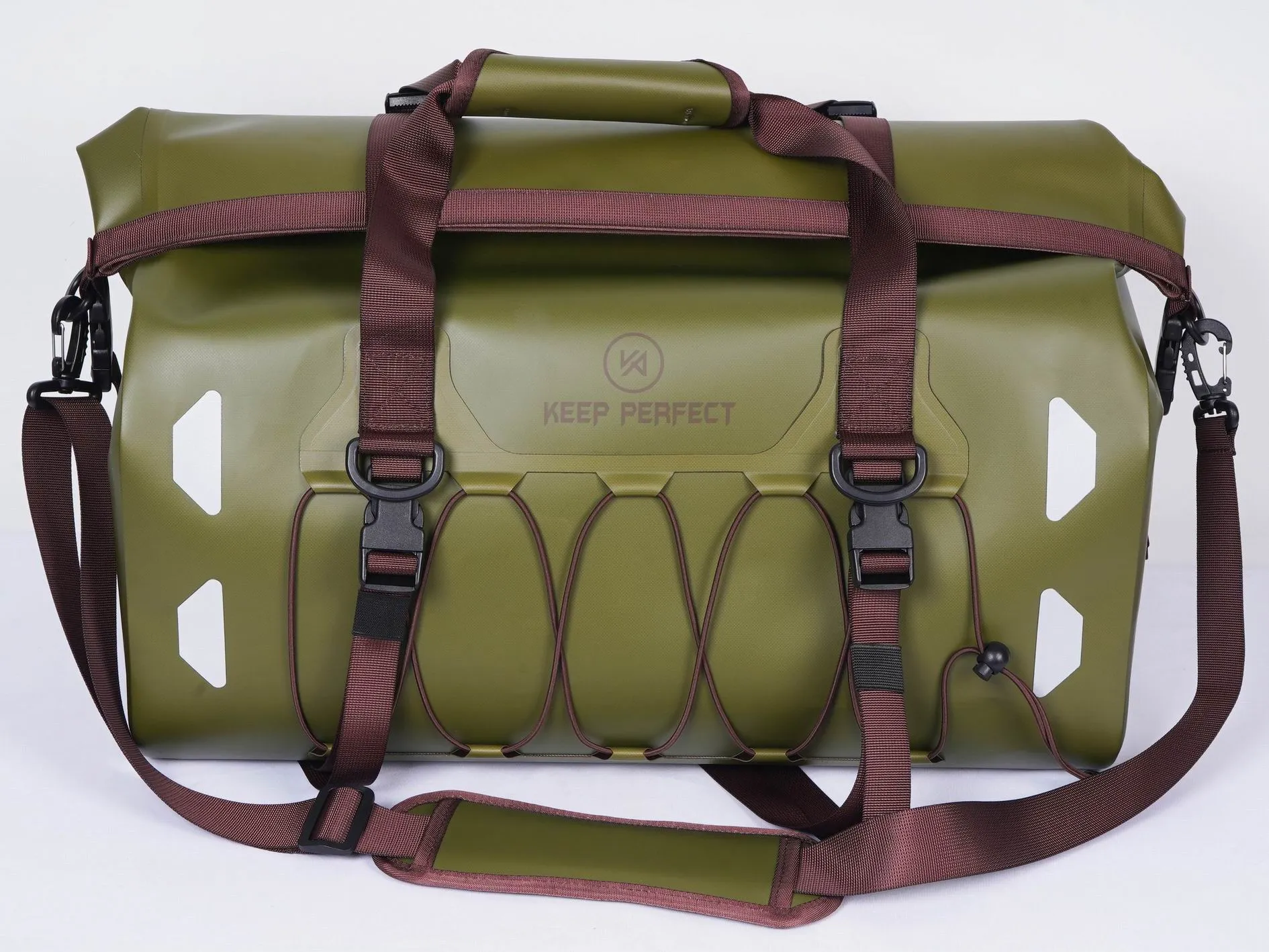
Table of Contents
- Deck Bag, Cockpit Bag or Hatch Liner: Where the Bag Lives
- Shell Fabric and Coating for Kayak Bags
- Buoyancy and the Positive Flotation Question
- The 30-Minute Immersion and Tow Test
- Roll-Top, Toothed Seal and Bungee Collar Compared
- Access While Seated: The One-Hand Test
- Deck Rigging: Bungee and Daisy Chain Integration
- Cockpit Rim Geometry and Attachment Fit
- UV and Saltwater Exposure on Kayak Fabrics
- Paddle Float and Safety Gear Bag Specs
- Failure Modes Seen on Returned Kayak Bags
- Branding and Colourway for Paddle Sport Lines
- MOQ, Sampling and Kayak Bag Lead Times
- Frequently Asked Questions
- People Also Ask
Deck Bag, Cockpit Bag or Hatch Liner: Where the Bag Lives
Paddle sport storage is defined by position on the boat before it is defined by shape, because the three positions impose three completely different sets of loads. A deck bag lives on the foredeck, in front of the paddler, and it is exposed to every wave that breaks over the bow and to the full force of the sun all day. A cockpit bag lives inside the cockpit, at the paddler's knees or behind the seat, and it is protected from weather but it is crushed and worked against the hull. A hatch liner lives inside a sealed compartment and it rarely gets wet at all, but it has to match the hatch aperture exactly or it will not go in.
Those three positions lead to three different products and three different prices. A deck bag needs the strongest fabric, the best UV package and a tie-down system. A cockpit bag needs a soft, quiet shell that will not squeak against the hull and a shape that fits between the knees without impeding the paddle stroke. A hatch liner is the cheapest of the three and the most sensitive to dimensional error. We ask which position the product is for before we quote, because a supplier who treats them as one product will get all three wrong.
| Position | Primary exposure | Critical dimension | Typical capacity | Shell requirement |
|---|---|---|---|---|
| Foredeck, in front of the paddler | Waves, full sun, spray | Height above the deck line, 120-160 mm | 4-14 L | 20,000 mm+, UV-stabilised, welded |
| Cockpit, at the knees | Crushing and abrasion against the hull | Width across the beam, 320-420 mm | 3-10 L | 10,000-20,000 mm, soft face, welded |
| Behind the seat | Shade, occasional bilge water | Height under the rear deck | 8-25 L | 10,000 mm, welded or taped |
| Hatch liner, bow or stern | Dry, occasional hatch leak | Hatch aperture, oval 200 x 290 mm or round 150 mm | 10-40 L | 10,000 mm, taped is sufficient |
| Tank well, behind the cockpit | Open water, spray, sun | Tank well width | 20-60 L | 20,000 mm, welded, with tie-down points |
The height figure in the first row is the one that gets a deck bag returned. A bag taller than 160 mm above the deck line obstructs the paddler's forward view and, worse, it catches the blade on the recovery side of the stroke. We hold 120-160 mm for a foredeck bag on a touring kayak and we go lower for a sea kayak, and we put that limit on the tech pack as a hard dimension rather than as a design intention. Getting it wrong is not a comfort issue, it is a safety issue. The full range is on our products page.
Shell Fabric and Coating for Kayak Bags
Kayak bags work in the harshest environment in the bag industry, and it is not the water that does the damage. Salt water is relatively benign to a polyester or a TPU laminate; the two agents that destroy a kayak bag are ultraviolet radiation and the mechanical working of the fabric against a deck or a hull. A bag that has been strapped to a foredeck for four seasons will fail at the tie-down points and on the sun-facing panel long before it fails anywhere else.
We build kayak bags on two constructions and we do not offer cheaper alternatives, because the environment is unforgiving enough that the saving is always repaid in claims. The first is a 500D or 840D TPU-laminated polyester or nylon at 20,000 mm+, which is the default for anything on the deck. The second is a PVC-coated scrim, which we use for tank-well bags and for hatch liners where abrasion matters more than weight and where the bag is not folding in the cold.
- 500D TPU-laminated polyester at 20,000 mm+ for cockpit and small deck bags, the default for the category
- 840D TPU-laminated nylon at 20,000 mm+ for foredeck and tank-well bags with tie-down loads
- PVC-coated 500D scrim at 10,000 mm for tank-well liners and hatch liners where abrasion dominates
- A UV-stabilised outer coating on every fabric, verified by accelerated exposure before a fabric is approved for use
- A PFC-free durable water repellent finish on the face, verified at 90-100 spray rating under AATCC 22 when new
One material decision that is specific to this category: we weld kayak bags wherever the geometry allows, and we do not use stitch-and-tape on a bag that will be immersed. A taped seam is a needle-hole row covered by an adhesive tape, and it works well under rain and spray, but under sustained immersion with the fabric flexing, the stress concentration at each needle hole is what starts a failure. A radio-frequency weld has no holes and no adhesive, and on a 500D TPU laminate it produces a seam that is stronger than the fabric on either side of it. That is why our immersion-rated builds are welded.
Buoyancy and the Positive Flotation Question
Buoyancy is a specification in this category and nowhere else, and the question behind it is simple: if this bag goes over the side, does it float or does it take the kit to the bottom? A sealed bag containing air displaces water and it will float. The same bag, if it is not sealed, fills and sinks. The specification therefore has two parts: a measured displacement in litres, and a verified seal that holds long enough for the paddler to retrieve it. Both have to be stated, because a bag can be buoyant on paper and still sink if the closure opens under the load.
We measure buoyancy by displacement on every kayak product we develop. The bag is loaded to its rated capacity with a standard 2 kg test load, sealed as the user would seal it, and weighed while fully submerged in fresh water. The difference between the submerged weight and the in-air weight gives the net buoyancy in litres, and we require a positive figure at rated load, not empty. A bag that floats empty and sinks loaded is not a flotation device, and we will not describe it as one on a retail hangtag.
| Product | Rated capacity | Net buoyancy at 2 kg load | Result at rated load | Retail claim we allow |
|---|---|---|---|---|
| 5 L deck bag | 5 L | + 3.1 L | Floats with the load | Floats if dropped overboard |
| 10 L deck bag | 10 L | + 8.0 L | Floats with the load | Floats if dropped overboard |
| 10 L closed-cell lined bag | 10 L | + 9.4 L | Floats, independent of the seal | Floats, with built-in flotation |
| 3 L cockpit bag | 3 L | + 1.0 L | Marginal, floats low in the water | Not claimed as buoyant |
| 20 L tank-well bag | 20 L | + 18.0 L | Floats with the load | Floats if dropped overboard |
Where a brief requires flotation that does not depend on the seal, we add a closed-cell foam panel bonded inside the lid or the base. That panel provides between 1.5 and 3 litres of permanent displacement on a 10 L bag, and it means the bag floats even if it is left open. It adds 60 to 90 g and about 60 mm of packed height in the collapsed state, and it is the right answer for a bag sold to sea kayakers or to anyone paddling alone. We do not add it to a bag sold on weight, because most touring paddlers would rather have the 90 g.
The 30-Minute Immersion and Tow Test
The standard immersion test is IPX7 under IEC 60529: 30 minutes at one metre, static, in a tank. That is a fair pass-fail gate and it is not what happens to a kayak bag. A bag that goes over the side does not sit still at one metre; it hangs at a variable depth, it is dragged through the water at paddling or towing speed, and the hydrodynamic pressure on the seam and on the closure is far higher than anything a static tank produces. We therefore tow our kayak bags as well as immerse them.
Immersion and tow sequence
- The bag is loaded to its rated capacity with a 2 kg load and sealed exactly as the user instructions state
- Static stage: 30 minutes at 1 m, which establishes the IPX7 result, then 60 minutes at 1 m for an IPX8 claim
- Tow stage: 30 minutes at 1.5 to 2 knots, at a depth of 0.5 to 1.2 m, with the bag oriented mouth-forward
- Depth stage: 30 minutes at 2 m with a 1 kg ballast added, to load the closure under a pressure differential
- The bag is then opened and the contents and the interior are inspected for any moisture on a paper target
- The closure is cycled open and closed ten times after the sequence to confirm it still seals after the tow
The tow stage finds the failures that the static test misses, and it finds them consistently in two places. The first is the roll-top: under a tow, water pressure pushes against the fabric at the mouth of the bag and it will work a two-fold roll open where it would not do so in a tank. That is the reason we hold three folds minimum on any kayak roll-top, and four on a tank-well bag, and it is a case where the extra fold costs nothing and prevents the single most common immersion failure we see. The second is the tie-down: a deck attachment that holds in air can deform under a tow load and pull the fabric at its attachment point.
The ten-cycle closure check at the end matters for a reason that is easy to overlook. A moulded toothed-seal zip that has been under water for an hour and a half will often seal on the first attempt and then fail on the fourth, because the slider and the tooth profile have been loaded and partly deformed. A closure that passes the immersion test and then fails on the fourth cycle is a closure that a paddler will find failing on the second day of a trip. We report the cycle count alongside the immersion result rather than merging the two into a single pass.
Roll-Top, Toothed Seal and Bungee Collar Compared
Three closure families cover the paddle sport category, and they are not interchangeable. A roll-top is the strongest and the slowest, and it is the only one that can be repaired in the field with no tools. A moulded toothed-seal zip is fast and it is the only one that can be operated with cold, wet hands while the boat is moving, and it is also the only one that cannot be repaired if a tooth is damaged. A bungee collar is not a waterproof closure at all; it is a splash closure, and it is the right answer for a bag that holds a water bottle and a map rather than a sleeping bag.
| Closure | IEC 60529 target | Holds under a 2-knot tow | Field repairable | Best application |
|---|---|---|---|---|
| Roll-top, 3 folds | IPX7 | Yes | Yes, no tools required | Deck bags, cockpit storage, immersion-rated use |
| Roll-top, 4 folds | IPX8 | Yes, at 1 m+ | Yes, no tools required | Tank-well bags, multi-day storage |
| Moulded toothed-seal zip | IPX6-IPX7 | Only with a stiffener and a cover | No, replace the whole closure | Cockpit bags needing one-hand access |
| Bungee collar | IPX3-IPX4 | No | Yes, replace the cord | Map cases, bottle holders, quick stow pockets |
| Roll-top plus a toothed-seal side zip | IPX7 at the body, IPX6 at the zip | Yes | Partially | Multi-day bags where access matters as much as immersion |
The third row is worth explaining, because it is where most of the disappointment in the category happens. A toothed-seal zip is genuinely waterproof in rain and it will hold in shallow, brief immersion, but under a sustained tow the pressure across the zip run works the teeth apart unless the zip is backed by a stiffener and covered by a flap. If your brief is immersion, use a roll-top. If your brief is access, use a toothed seal and accept IPX6. The combination in the last row is the compromise we build most often for multi-day paddling, and we always state both ratings on the spec sheet rather than quoting the better of the two.
Access While Seated: The One-Hand Test
A kayak bag is the only bag that must be openable by a person who is seated, bracing with their legs, holding a paddle with one hand, and wearing neoprene mitts. That constraint eliminates most of the hardware that works well on land, and it is the reason we test access with a specific procedure rather than asking a designer to imagine it. If a paddler has to let go of the paddle to open the bag, the product will not be used as intended in the conditions it was sold for.
The one-hand test is executed with the tester seated in a kayak or in a chair with their legs braced, holding a paddle in one hand, and wearing 3 mm neoprene mitts. The bag is opened, the target item is retrieved, and the bag is closed again, all while the paddle stays in the water. We time three cycles and we record whether the paddle left the water at any point. A closure that takes longer than 12 seconds or that requires the paddle to be lifted is a fail, and it goes back to the design at the prototype stage rather than being discovered in the field.
- Pull loops are 40 mm minimum in internal diameter, because a neoprene mitt will not fit through a 25 mm loop
- Sliders are specified with a moulded extension on the pull, not a flat tab, so they can be gripped in a mitt
- A teeth-down orientation is avoided on a cockpit bag, because the paddler cannot see the slider to guide it
- Interior organisation uses a single contrasting lining colour, because a black interior in a dark cockpit is unusable
- A tethered key clip is placed at the mouth, so the most-needed item is retrieved without a search
The contrasting lining deserves a note, because it is the cheapest improvement available in this category and it is the one most often omitted for cost. A black bag with a black lining, opened in a dark cockpit or in a tent at night, is a bag whose contents cannot be found. A mid-grey or a hi-vis orange lining costs the same per metre as a black one, and it changes the product from one that is technically correct to one that is actually usable. We put it on every paddle sport product we make unless a client specifically wants a dark interior.
Deck Rigging: Bungee and Daisy Chain Integration
A kayak deck bag is secured by the boat's own rigging, and the interface between the two is where a bag either works or spends the trip sliding around the foredeck. There are two systems in common use: a bungee and hook arrangement, where the bag carries two to four attachment points that hook into the deck lines, and a daisy chain arrangement, where the bag has a webbing ladder that clips into the existing rigging points. Both work, and they suit different boats and different paddlers.
We build attachments to the same load standard we use for a hiking pack's lash points, because the loads are actually higher. A breaking wave over the bow puts a short, sharp load on the attachment that can be several times the weight of the bag. Every attachment is therefore webbing carried at least 80 mm into the body panel and bar-tacked into a reinforcement patch, and on a welded bag the reinforcement is a welded patch rather than a sewn one, so it does not introduce holes into the waterproof layer.
| Attachment element | Specification | Load it is built for | Failure it prevents |
|---|---|---|---|
| Deck attachment loop | 25 mm webbing, 80 mm into the panel, welded or bar-tacked reinforcement | 250 N in any direction | The bag tearing free in a breaking wave |
| Bungee cord | 5 mm with a 6 mm cord lock, replaceable | 150 N | Cord perishing and snapping under UV |
| Daisy chain | 25 mm webbing ladder, 40 mm pitch, five positions | 250 N | Attachment points not lining up with the rigging |
| Quick-release clip | Acetal side-squeeze, 250 N rating | 250 N | A metal clip corroding and seizing in salt water |
| Tie-down strap | 20 mm webbing with a cam buckle, 350 N | 350 N | The bag working loose over a long day |
Hardware choice in salt water is a specific discipline and it eliminates most of the default options. We use acetal or nylon for every clip, buckle and cord lock on a kayak bag, and we avoid metal entirely except for a marine-grade stainless ring where a brief requires one. The reason is that a zamak or a plated steel clip corrodes in salt water within a season, and a corroded clip either seizes or fractures at exactly the moment it is needed. It is also why we do not use a metal slider on a zip: a nickel slider in salt water is a guaranteed return.
Cockpit Rim Geometry and Attachment Fit
A cockpit bag is the one paddle sport product where the fit is dimensional rather than volumetric. It has to sit between the paddler's knees and behind the footrests, in a space whose width varies by 100 mm across common touring kayak models, and it has to clear the thigh braces that hold the paddler in the boat. A bag that is 20 mm too wide will jam against the thigh braces, and a paddler who cannot get their knees together cannot roll the boat. This is the one product in the whole bag industry where a dimensional error has a safety consequence.
We build cockpit bags to two width classes and we say so on the spec sheet, because a single size does not fit the market. A narrow class at 320 mm suits sea kayaks and most British-style touring boats, and a wide class at 400 mm suits recreational and fishing kayaks, which have much broader cockpits. Rather than making two separate products, we build one body with two attachment configurations and a compressible side panel, which lets a brand cover both classes from one tooling set.
- Narrow class at 320 mm external width for sea kayaks and narrow touring boats
- Wide class at 400 mm external width for recreational and sit-on-top fishing kayaks
- Height held under 220 mm so the bag clears the underside of the deck and does not obstruct the spray skirt
- A compressible side panel of 20 mm EPE at the thigh contact point, so the bag yields under the knees
- A floor-level attachment to the hull or to the seat frame, because an unattached cockpit bag becomes a loose object in a capsize
That last point is the one most often missed, and it is a genuine hazard. In a capsize, everything in the cockpit that is not attached to the boat becomes loose debris in the water around the paddler's legs, and a 5 L bag floating inside a flooded cockpit is a real entanglement risk. Every cockpit bag we build has a webbing tether with a clip that attaches to the seat frame or to a hull fitting, rated to 250 N. It costs one webbing loop and one clip, and it is the difference between a product we will put a brand name on and one we will not.
UV and Saltwater Exposure on Kayak Fabrics
A kayak bag spends its working life in direct sun over a reflective surface, which roughly doubles the ultraviolet dose compared with a bag used on land. UV degrades the coating and the base fabric by different mechanisms, and the visible result is a bag that chalks on the sun-facing panel and then cracks at the folds. It is a slow failure and it is the reason a three-season deck bag from a good brand still looks new while a cheaper one looks destroyed after a single summer of use.
We verify UV resistance by accelerated exposure before a fabric is approved for paddle sport use, and we hold the coating after exposure rather than only the base fabric. Abrasion and coating adhesion are checked to ASTM D751 on the same lot, and the hydrostatic head is re-measured to ISO 811 after exposure, because a fabric that still looks acceptable can have lost most of its water column. Salt exposure is assessed separately, since salt crystals abrading at a fold do more mechanical damage than the chemistry does.
| Exposure | What it attacks | Test we run | Acceptance we hold |
|---|---|---|---|
| Direct sun over water | Coating and dyestuff | Accelerated UV exposure on the finished laminate | No chalking, no cracking at a fold, colour change within tolerance |
| UV plus flexing | Coating adhesion | Abrasion to ASTM D751 after exposure | Coating adhesion retained after the exposure cycle |
| UV plus water pressure | Water column | Hydrostatic head to ISO 811 after exposure | Holds 20,000 mm+ after the exposure cycle |
| Salt crystal at a fold | Face fabric and coating | Salt spray exposure followed by flexing | No cracking at the fold after the cycle |
| Salt water on hardware | Metal components | Immersion of the hardware assembly | No corrosion on acetal or nylon hardware |
The practical advice we give a brand is to specify a light or a mid colour for the deck and a dark colour for the base, which is the opposite of what most people expect. A light-coloured shell reflects the heat load and it slows the UV attack on the coating, and it is also easier to see if the bag goes over the side. The base can be any colour, because it is the least exposed surface and it is the one that contacts the deck. A two-tone build of this kind costs nothing extra in production and it makes the product measurably more durable and easier to find in the water.
Paddle Float and Safety Gear Bag Specs
A paddle float is the one product in this category that is a piece of safety equipment rather than storage, and it is specified accordingly. It has to hold a paddle blade in a way that lets a paddler use the paddle as an outrigger during a re-entry, which means the closure has to be operable with one hand in the water, and it has to provide enough displacement to support the blade and part of the paddler's weight. A paddle float that cannot be fitted while in the water is a paddle float that will not be used when it is needed.
We build paddle floats as a sleeve with a closed-cell foam core and a mouth that is held open by a stiffened collar, so a paddler in the water can push the blade in without having to open anything. The closure is a single-hand drawcord with a cord lock, not a zip, because a zip cannot be operated with a mitt on a moving blade. Displacement is measured and printed on the product, because a paddle float is a flotation device and a number the paddler can trust is part of its function.
- Closed-cell foam core giving a measured displacement, printed on the product in litres
- A stiffened mouth collar that stays open in the water, so the blade can be pushed in one-handed
- A single-hand drawcord closure with a cord lock, never a zip, operated with a mitt
- A wrist or a deck tether with an acetal clip, rated to 150 N, so the float cannot be lost in a capsize
- A hi-vis colourway as the default, because a paddle float is visible safety equipment
The other safety-adjacent products in the range are the bilge pump bag, the first aid bag and the towline bag, and they share one specification: they are all red or hi-vis, and they all have a drain. A first aid bag that takes water is a first aid kit that is ruined, so we build it to IPX7 with a welded body and a roll-top. A bilge pump bag holds a wet pump, so it is the opposite: it is built from mesh with a drain and it is deliberately not waterproof, because a sealed bag holding a wet pump is a mould problem. We point this out during specification, because the instinct is to make everything waterproof.
Failure Modes Seen on Returned Kayak Bags
The returns we see in paddle sport are unusually honest, because the environment finds every weakness within a season. This list is in rough order of frequency and every item on it is a specification decision, not a manufacturing fault. Sharing it before sampling is cheaper than honouring a warranty, and it is the reason we include the list in every paddle sport quotation.
- A two-fold roll-top opening under a tow. The roll is the right closure but two folds is not enough on a stiff laminate. Fix: three folds on any immersion-rated bag and four on a tank-well bag.
- A corroded or seized clip. A plated metal clip in salt water fails within a season. Fix: acetal or nylon hardware throughout, and no metal sliders on any zip.
- A deck attachment tearing free in a breaking wave. The loop is stitched to the face with a short reinforcement. Fix: 80 mm of webbing carried into the panel and welded or bar-tacked to a reinforcement patch.
- UV chalking and cracking on the sun-facing panel after one summer. The coating was not UV-stabilised. Fix: a UV-stabilised laminate verified by accelerated exposure before approval.
- A toothed-seal zip that passed the tank test and then leaked on the second day of a trip. The slider deformed under a tow load. Fix: a stiffener behind the zip run plus a cover flap, or a roll-top for anything immersion rated.
- A black interior that the paddler cannot see into. The lining matches the shell. Fix: a mid-grey or a hi-vis lining, which costs the same per metre.
Two of those six come directly from a cost saving that looks reasonable at the quotation stage. The metal hardware and the short attachment reinforcement both save a small amount per unit, and both produce a return rate that destroys the margin on the whole line. We do not accept a brief that specifies plated metal hardware for a salt water product, and we say so in writing at the quotation stage rather than after the first season. The fourth item is different in kind: it is a material choice that a buyer cannot evaluate from a sample, because a new bag looks identical regardless of whether its coating is UV-stabilised. That one has to be taken on the test report.
Branding and Colourway for Paddle Sport Lines
Paddle sport brands have one branding advantage and one constraint. The advantage is that a logo on the deck of a kayak is seen in every photograph the customer takes, which makes the category unusually valuable for brand exposure. The constraint is that the processes which work on land do not survive here: a heat-transfer patch lifts at the edges after a season in sun and salt, and a direct print abrades against a deck. The processes that survive are the ones that do not rely on an adhesive bond to the face.
We recommend a welded TPU badge for kayak bags, applied to a flat panel away from the tie-down reinforcement, or a moulded badge riveted or sewn into a seam allowance. Contrast is a functional consideration as well as a brand one: a dark logo on a dark shell is invisible against water, so for a product that will be sold as visible safety equipment we always specify a light or a hi-vis logo placement. Colourway planning has to respect the 500 pcs per style per colour minimum, so a two-colour launch is a 1,000-piece commitment.
- Welded TPU badge on a flat panel, away from the tie-down reinforcement and the weld lines
- Moulded badge riveted or sewn into a seam allowance, so the fixings do not pierce the waterproof face
- A light or hi-vis logo placement on any product sold as visible safety equipment, because a dark logo vanishes against water
- A two-tone build, light shell and dark base, which reduces the UV load and makes the bag easier to spot in the water
- Reflective piping on the mouth and the attachment points for pre-dawn and dusk paddling
One commercial point for a brand entering the category: lead with the 10 L deck bag and the 5 L cockpit bag rather than with a big tank-well bag. The two smaller products cover the majority of paddlers, they photograph well on a boat, and they are the ones a customer buys again when they buy a second boat. A 40 L tank-well liner is a considered purchase that depends on the customer owning a specific kayak, and it sells in far lower volume. Our custom development team can put a three-product paddle range together from 1,500 pieces across three colours.
MOQ, Sampling and Kayak Bag Lead Times
The commercial terms for a paddle sport programme are the ones we publish for every category. Minimum order is 500 pcs per style per colour. Sampling is 6-10 working days for a welded deck or cockpit bag, and 12-15 working days where the brief calls for a new weld tool, a foam-lined float or a custom attachment set. Bulk production is 35-50 days from sample approval, inspection is to AQL 2.5 under ISO 2859-1, and the trade terms are FOB Xiamen with T/T 30 percent deposit and 70 percent before shipment.
- Brief received with the position on the boat, the rated capacity and the flotation requirement stated
- Material and closure proposal, with the hydrostatic head, the IPX target and the measured buoyancy as numbers
- Prototype built on the production weld tooling in 6-10 working days, or 12-15 with new tooling
- Immersion, tow, UV and buoyancy testing on the prototype, reported before the sample ships
- The one-hand access test performed seated, in mitts, with a paddle in the water, timed over three cycles
- Approval, deposit, and bulk production in 35-50 days with a final AQL 2.5 inspection before FOB Xiamen shipment
QUANZHOU JUNYUAN BAGS has produced sewn and welded bag programmes since 2014, and our founder has worked in the category since 2004. Our validated production partner facility is SGS-verified at 4,950 square metres with 7 production lines, 149 machines, 137 staff and a monthly capacity of 200,000 pieces. QC runs to ISO 9001-aligned procedures and a BSCI audit can be hosted, with product compliance covering CE, CPC, RoHS and REACH and material testing supported by SGS. For paddle sport we add the immersion, tow and buoyancy reports to that file. Contact service@junyuanbags.com or WhatsApp +86 177 5002 0688, or read our immersion method on the water ingress test page.
Frequently Asked Questions
Q1: What IP rating should a kayak deck bag have?
A: A deck bag should be specified to IPX7 under IEC 60529, which is 30 minutes at 1 m, and a tank-well bag to IPX8. We verify those with a tow stage as well as a static tank, because a bag that holds in a tank can still open under a 2-knot tow, and that is the condition it actually faces.
Q2: Do kayak bags float?
A: A sealed bag containing air floats, and we measure that by displacement rather than assuming it. A 10 L deck bag loaded with 2 kg gives about 8 litres of net buoyancy and floats. Where a brief needs flotation that does not depend on the seal, we bond a closed-cell foam panel into the lid or the base.
Q3: Why do you require three folds on a kayak roll-top?
A: Because water pressure under a tow pushes against the fabric at the mouth of the bag and will work a two-fold roll open where a static tank would not. Three folds is the minimum on any immersion-rated kayak bag and four on a tank-well bag, and the extra fold costs nothing and prevents the most common immersion failure we see.
Q4: Can a toothed-seal zip be used on an immersion-rated bag?
A: Not on its own. A toothed seal holds IPX6 in rain and brief shallow immersion, but under a sustained tow the pressure across the zip run works the teeth apart unless the zip is backed by a stiffener and covered by a flap. For immersion we specify a roll-top and we state the rating as a number.
Q5: What width does a cockpit bag need to be?
A: Two classes cover the market: 320 mm external width for sea kayaks and narrow touring boats, and 400 mm for recreational and sit-on-top fishing kayaks. Height is held under 220 mm so the bag clears the underside of the deck and does not obstruct the spray skirt or the paddler's knees.
Q6: Why must a cockpit bag be tethered to the boat?
A: In a capsize, anything loose in the cockpit becomes debris around the paddler's legs, and a 5 L bag in a flooded cockpit is a genuine entanglement risk. Every cockpit bag we build has a webbing tether with an acetal clip to the seat frame or a hull fitting, rated to 250 N, and it costs one loop and one clip.
Q7: What hardware do you use in salt water?
A: Acetal or nylon for every clip, buckle and cord lock, and no metal at all except a marine-grade stainless ring where a brief demands one. Plated or zamak hardware corrodes in salt water within a season and then either seizes or fractures, and a nickel zip slider is a guaranteed return.
Q8: How is UV resistance verified on a kayak fabric?
A: By accelerated exposure on the finished laminate, with the hydrostatic head re-measured to ISO 811 and abrasion checked to ASTM D751 after the exposure cycle. A fabric that still looks acceptable can have lost most of its water column, so we hold the post-exposure performance rather than the appearance.
Q9: Why do you weld kayak bags instead of taping the seams?
A: A taped seam is a row of needle holes covered by adhesive tape, and it performs well under rain and spray. Under sustained immersion with the fabric flexing, the stress concentration at each needle hole is what starts a failure. An RF weld on a 500D TPU laminate has no holes and is stronger than the fabric either side.
Q10: What is the minimum order quantity for kayak bags?
A: The minimum is 500 pcs per style per colour, so a two-colour launch is a 1,000-piece commitment. Most paddle brands launch one shell colour with the accent on the mouth binding, the attachment webbing and the pull loops, which keeps the first commitment at 500 pieces.
Q11: How long does kayak bag sampling take?
A: Sampling is 6-10 working days for a welded deck or cockpit bag and 12-15 where the brief needs a new weld tool, a foam-lined float or a custom attachment set. The prototype ships with its immersion, tow, buoyancy and UV results, so the physical sample and the data are reviewed together.
Q12: What is the bulk production lead time for kayak bags?
A: Bulk production takes 35-50 days from sample approval, depending on fabric availability and the number of welded components. Repeat orders against retained tooling typically run in a shorter 30-40 day window. Shipments move on FOB Xiamen with T/T 30 percent deposit and 70 percent before shipment.
Q13: Which inspection standard applies to kayak bag orders?
A: We inspect to AQL 2.5 under ISO 2859-1 as standard. For a kayak bag, a critical defect includes any weld that fails an immersion sample, any attachment reinforcement measuring under 80 mm into the panel, and any metal hardware fitted where acetal was specified.
Q14: Should a bilge pump bag be waterproof?
A: No, and it is the one product in the range where we advise against it. A bilge pump bag holds a wet pump, so a sealed bag would trap the water and become a mould problem. We build it from mesh with a drain grommet, while the first aid bag in the same range is built to IPX7 with a welded body and a roll-top.
People Also Ask
- What IP rating do I need for a kayak dry bag?
- Will a dry bag float if it falls in the water?
- How many rolls do you need on a dry bag?
- What size cockpit bag fits a sea kayak?
- Why do dry bag clips corrode?
- Is a toothed-seal zip as good as a roll-top?