
RF Welding vs Stitch-and-Tape Seams for Waterproof Bags
RF welding and stitch-and-tape close a waterproof seam in opposite ways. RF welding fuses two thermoplastic faces into one joint: no needle holes, no tape to peel, and the cleanest route to IPX7 under IEC 60529 on TPU or PVC shells. Stitch-and-tape sews the panels first, then bridges every perforation with a heat-activated tape: cheaper to set up, tolerant of mixed fabrics, and repairable after sale. Specify RF when the bag is a single-material TPU build and the target is submersion. Specify stitch-and-tape when the seam carries real structural load, the shell mixes fabrics that will not take a weld, or your market expects field repair. Below you will find peel figures, test methods, line economics and the RFQ language to write the choice down.
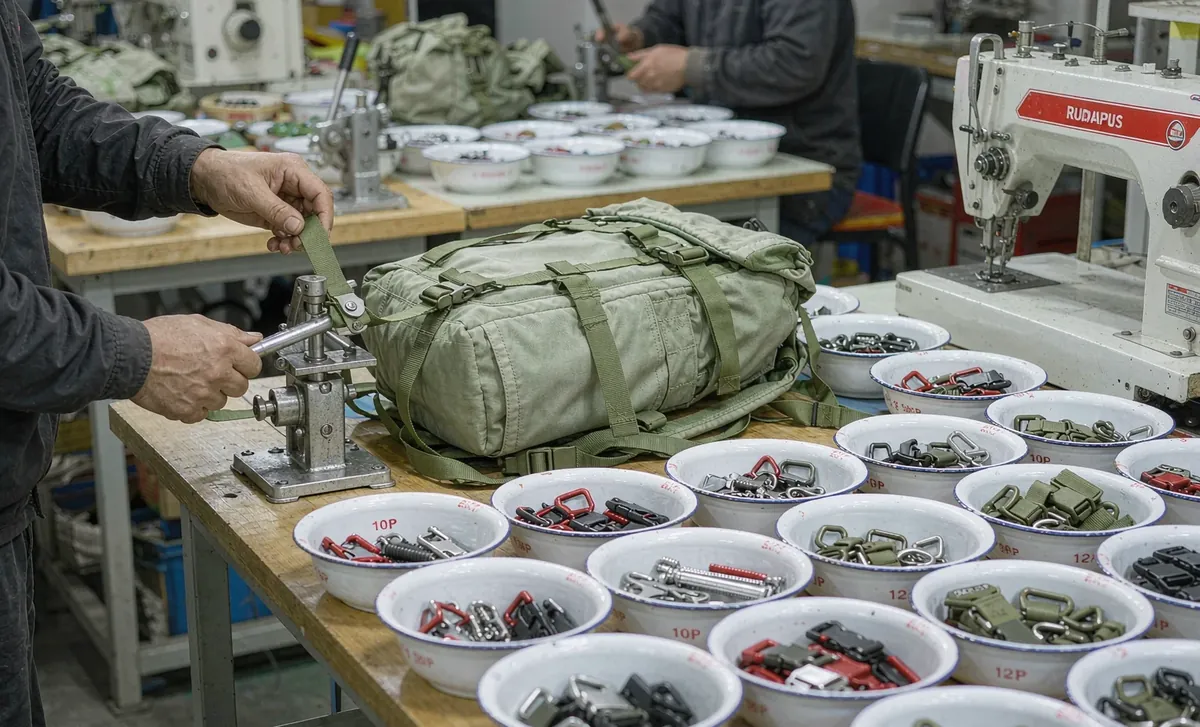
Table of Contents
Two Seam Philosophies
Every waterproof bag fails at the seam long before it fails in the panel. The cloth may hold 10,000 to 20,000 mm of hydrostatic head when tested per ISO 811, but the moment you join two pieces of that cloth you introduce either a fused joint or a row of holes. Those are the only two structural options a buyer has. Seam choice then drives everything downstream: warranty rate, unit cost, minimum order economics and how your retail partner handles a return six months after launch.
What Actually Leaks in a Sewn Seam
A needle does not part the fibers politely and let them close afterwards. It punches through face fabric, coating and any laminated film, and it drags thread through the hole it made. At a typical stitch density of 7 to 9 stitches per inch, a 600 mm seam carries roughly 165 to 210 needle punctures, and every one of them is a potential capillary path. Filament cores do swell slightly when wet, which helps, but you cannot rely on swelling for a product a customer stuffs into a kayak hatch and leaves under load for six hours. The tape does the waterproofing; the stitching does the load bearing.
- Stitch count rises linearly with seam length, so leak risk scales with size, not with the number of panels.
- Needle damage is permanent: once the coating is perforated the original barrier is gone for good.
- Untreated polyester thread wicks, carrying water from the outside edge toward the interior of the bag.
- Sewing tension varies by operator and by shift, which is why two batches of one style can test differently.
- A sewn structural seam typically retains 60 to 85 percent of parent fabric grab strength after perforation.
The opposing philosophy removes the holes altogether. If both substrates are weldable thermoplastics, energy softens the interface under pressure and the two parts become one continuous piece of polymer. There is no thread to rot, no perforation to bridge and no dependence on an adhesive laid down 2 mm off-center on a Friday afternoon. The price of that cleanliness is material freedom: you are now committed to polymers that respond to the energy source you chose, and you have accepted a joint that is difficult to repair cleanly outside a workshop.
So the real question is never which technology wins in the abstract. It is which failure mode you can price and defend. Our waterproof bag manufacturing lines run both processes side by side, and we routinely quote the same style both ways when geometry allows, so that you compare real peel data and real unit cost rather than a supplier's preference.
RF and HF Welding: How It Bonds
Radio frequency welding and high frequency welding describe the same phenomenon, and the terms are used interchangeably across the trade. Both refer to dielectric heating, usually on the industrial 27.12 MHz band. A generator creates an alternating electric field between two electrodes. Polar molecules in the film try to reorient with every reversal of the field, and the molecular friction that results generates heat inside the material itself rather than conducting it inward from a hot surface.
Which Polymers Will Take a Weld
This is the hard constraint on RF: the polymer must be polar enough to convert electromagnetic energy into heat. Polyvinyl chloride responds extremely well, which is why it dominated the first generation of dry bags. Thermoplastic polyurethane responds well too and is now the mainstream choice because it stays flexible in cold conditions and carries no chlorine. Polyethylene and polypropylene hardly respond at all and cannot be RF welded. If your chosen shell fabric is a heavily silicone-treated polyester, RF will simply not rescue the seam, whatever generator power you throw at it.
- PVC: excellent RF response and low weld energy, but plasticiser migration stiffens or softens the joint over years.
- TPU: strong response, a wide sealing window, and useful flexibility down to roughly -30 degrees C depending on grade.
- PU-coated nylon: weldable when the coating is thick enough, risky once coating thickness drops below about 0.08 mm.
- Polyethylene and polypropylene: no RF response at all; use hot-wedge or impulse welding for these.
- Silicone-treated face fabric: usually needs an intermediate weldable film, or a switch to stitch-and-tape.
Weld parameters interact, so specify them as a set rather than one at a time. Electrode pressure decides how much molten polymer is squeezed out of the bond line, and too much pressure starves the joint until it peels at low force. Cycle time is usually 2 to 6 seconds for bag-scale seams on generators in the 3 to 15 kW class. Overlap width matters more than most buyers realise: below roughly 15 mm the peel path is too short to develop full strength, and beyond about 25 mm the extra material adds grams and cost with no strength return. Ask the supplier to state overlap, generator power and cycle time on the tech pack, not just the word welded.
A healthy RF seam shows a translucent bond line with a small, even bead of displaced polymer along both edges. When qualifying a new style we cut ten cross-sections per setup and inspect them under magnification before releasing tooling. That habit costs a few hours per project and removes most surprises later at the seam and hydrostatic verification stage, where a rejected batch costs weeks rather than hours.
Hot-Air and Hot-Wedge Alternatives
RF is not the only way to fuse a seam and for some geometries it is not even the best way. Hot-air welding delivers heat convectively to the bond line and works across a far wider range of polymers, including the polyolefins that RF cannot move. Hot-wedge welding drags a heated metal element between the plies and melts both faces at once. Impulse welding pulses current through a resistive ribbon. Each option carries a different capital profile and a different tolerance of operator variance, and those differences show up in your piece price.
| Process | Typical Substrates | Typical Cycle | Capital and Tooling | Best Application |
|---|---|---|---|---|
| RF or HF dielectric | PVC, TPU, PU-coated fabric | 2-6 s per seam | High generator cost, low tooling cost | Long straight seams, flat panels, high volume |
| Hot-air fusion | TPU, PVC, PE-coated fabric | Continuous at 2-8 m/min | Medium machine cost, low tooling cost | Curved seams, corner transitions, tubes |
| Hot-wedge | PE and PP films, PVC | Continuous at 1-6 m/min | Medium machine cost | Heavy tarpaulin joins, long straight runs |
| Impulse welding | PE and PP film only | 3-10 s plus cooling | Low machine cost | Simple straight closures, low volume |
| Ultrasonic | Thin synthetic sheet | 0.5-2 s | High tooling cost | Short precision joins, hardware attachment |
The RF versus hot-air decision is often geometry rather than chemistry. RF electrodes are machined to match the joint outline, which is fast and repeatable on straight runs but expensive when the seam wraps a three-dimensional corner. Hot-air nozzles follow a curve, which is why many dry bag bodies are closed with a hybrid approach: hot-air for the contoured base panel where the seam changes plane every few centimeters, RF for the long side seam where a single electrode stroke finishes the job in seconds.
Where Each Failure Mode Starts
Hot-air welding is more sensitive to ambient conditions and to line-speed drift than RF, because heat arrives at the surface and must conduct inward. Operators compensate by widening the temperature window, but widening the window in one direction risks scorching the face fabric while widening it in the other risks a cold bond that looks perfect and peels in the first wash cycle. Hot-wedge has the opposite problem: the element is always hot, so dwell control and wedge cleanliness dominate, and a scorched polymer film on the wedge surface will transfer debris into every subsequent joint until someone stops the line and cleans it.
For procurement purposes, ask one question about the fusing process: how is the energy input recorded? A line that logs generator power, air temperature, pressure and speed per seam gives you traceability when a claim arrives nine months later. A line that relies on an experienced operator's judgment gives you a lower hourly rate and a much wider variance. Both can ship good bags, but only one lets you prove it. Custom dry bag programmes that include process logging typically add days to qualification and remove arguments from the post-season review.
Stitch-and-Tape: When It Wins
Stitch-and-tape is not the cheap fallback that welded-seam marketing sometimes implies. It is the correct answer for a specific and very large set of products: anything where the seam carries genuine structural load, anything where the shell is a fabric that resists welding, and anything where a corner or strap attachment concentrates force in a small area. A backpack shoulder strap pulls with maybe 300 to 500 N of shock load at the top attachment; a welded joint there would need an enormous footprint to survive peel forces in that direction.
The Reinforcement Logic
The lockstitch holds the panels together mechanically and distributes load across thousands of individual thread crossings, while the tape restores the barrier. That division of labor is the reason most technical packs, hiking bags and tool totes stay sewn. Tape is applied on a hot-air tape machine that feeds tape from a reel, blows high-temperature air between the tape adhesive and the fabric, and presses the two together with a nip roller. Typical production speeds run 3 to 8 m/min on flat goods, dropping below 2 m/min on tight curves and junctions.
- Choose stitch-and-tape when any panel on the bill of materials cannot take a dielectric or thermal weld.
- Choose it when the seam must carry point loads from straps, handles, webbing anchors or hardware plates.
- Choose it when your after-sales network wants to repair or replace tape in the field rather than scrap the unit.
- Choose it for low-volume, high-mix programmes where electrode tooling cost cannot be amortised over 500 pcs.
- Choose it when the design uses three-dimensional curves that a flat electrode simply cannot reach.
The cost argument also flips at low volume. RF electrodes are cut to the seam outline and cost real money; if your first order is 500 pcs per style and colorway, tooling can be a noticeable line item on a unit-cost breakdown. Tape machinery needs only a change of tape width and an adjustment of the guide to switch styles, so the same line serves a dozen patterns in a week. That flexibility is why most OEM programmes with wide color assortments and modest per-style volume lean toward sewn construction and invest the savings elsewhere in the product.
Watch one thing when specifying tape: the substrate has to accept the adhesive. A low-surface-energy face finish repels the adhesive film and produces a seam that passes on day one and delaminates after repeated wet-dry cycles. Ask for a peel test after ageing, not just immediately after application, and put the aged result into the specification rather than the fresh result. Details on selection sit in our seam sealing technology guide.
Seam Strength Test Methods
A seam claim is meaningless until it is tied to a method and a sample size. Three measurements cover most of what a buyer needs: tensile strength of the joint, peel resistance of the bonded interface, and hydrostatic resistance of the seam itself. Each answers a different question, and each has a different failure signature, so treat them as a panel rather than picking your favorite.
| Measurement | What It Predicts | Common Reference | Practical Target |
|---|---|---|---|
| Seam tensile strength | Whether the joint survives a straight pull | ASTM D751 for coated fabric; ISO 1421 for base film | Failure outside the joint, or at least 70 percent of fabric grab strength |
| Peel adhesion of tape | Resistance to progressive edge lift in service | Constant-rate peel reported in N per 25 mm width | Steady peel value with no adhesive transfer onto both faces |
| Hydrostatic head at the seam | Whether the barrier survived fabrication | ISO 811 or AATCC 127 tested on a seamed panel | First drop above the target head for the product tier |
| Submersion of the finished unit | Real-world performance including geometry and closures | IEC 60529 at IPX7 or IPX8 | No ingress after the specified depth and duration |
| Aged peel after cycling | Resistance to wet-dry cycling and heat ageing | Repeat peel after five wash or heat cycles | No more than roughly 20 percent loss against the fresh value |
Tensile testing of coated fabrics is commonly run per ASTM D751, which covers coated fabric including seam strength determination, and films are often checked per ISO 1421 for tensile strength and elongation at break. Pull a 25 mm or 50 mm strip with the seam across the middle and record the force at break together with the location of failure. Location matters more than magnitude: if the fabric tears outside the joint, the seam is stronger than the substrate and further optimisation is wasted money; if the seam opens at half the fabric strength, you have real headroom to recover.
Peel testing is the workhorse for taped seams because it replicates how tape actually fails: progressive separation starting at an edge. Record force in newtons per 25 mm of width, tested on a constant-rate-of-extension machine. Equally important is the failure mode. Adhesive left on both faces means a cohesive failure inside the adhesive layer, which usually signals under-cure or contamination. Clean separation with all adhesive on one face suggests the wrong tape chemistry for that substrate. A film that tears before it peels means the joint is adequate and the test has stopped being useful.
Finally, hydrostatic testing of the seam itself closes the loop. AATCC 127 measures resistance to water penetration under hydrostatic pressure and ISO 811 measures the same property with a rising water column; both tell you whether the barrier survived fabrication. Run them on panels that contain a sewn joint, not just on flat cloth, and log the pressure at which the first drop appears at the stitch line. Combine that with IEC 60529 submersion testing at IPX7 on finished units and you have a defensible waterproof story for any waterproof bag product line.
Repairability and Field Failure
Field failure analysis usually lands on one of four signatures, and each points back to a different root cause in the seam. Knowing them lets you write a warranty clause that matches your actual risk instead of guessing, and lets your quality team triage returns in minutes rather than days.
- Edge lift: tape peeling from one end of a seam indicates insufficient end-tacking, insufficient pressure at the start of the run, or tape applied too close to the edge.
- Channel leaking: water appearing along the stitch line means adhesive never flowed into the needle holes, usually a temperature or dwell shortfall.
- Cohesive split: adhesive residue on both faces after failure means contamination, under-cure, or a plasticiser migrating out of PVC into the adhesive.
- Brittle film failure: clean cracking with no elongation means the film aged past its useful life through UV, hydrolysis or cold exposure.
Repairability is where the two philosophies separate sharply. A taped seam can be re-taped. A competent repair center cleans the old tape off with controlled heat, abrades the surface lightly, and applies a fresh strip with a hand iron or a bench-top tape machine; a retail partner can turn that around in a day. A failed RF weld has no equivalent quick fix. The panels are one piece of polymer, so the options are a patch that overlaps the failure, a re-weld that requires the original electrode geometry, or scrap. If your distribution includes rental fleets, guided-tour operators or expedition outfitters who repair their own gear, this consideration can outweigh the technical advantages of fusion entirely.
Designing for Repair Instead of Scrap
There is a middle path. Specify welded construction for the body where it delivers clean straight runs and IPX-class performance, and switch to sewn plus taped construction at service points: the base panel that takes abrasion on rock, strap roots, daisy chains and hardware plates. This hybrid is standard on technical outdoor packs for good reason. It concentrates repairability where damage actually happens and keeps the cleanest, fastest process everywhere else. When you brief this hybrid, mark the construction type on every seam line of the tech pack, because the cheapest way to lose a week of sampling is a pattern where panel boundaries do not match the intended process. Every bulk order we ship is inspected to AQL 2.5 (ISO 2859-1), and seam-related defects are one of the attributes we track separately.
Equipment, Skill and Line Cost
Buyers rarely see the line that makes their bag, yet the line determines both cost and consistency. Understanding roughly what each process demands lets you read a quotation with more confidence and ask the two questions that actually separate capable partners from optimistic ones: how many operators touch the seam, and what is logged.
- RF cells need a generator, an electrode set per seam geometry, and an operator who understands pressure and dwell rather than just feeding parts.
- Hot-air tape machines need reel-fed tape, a calibrated nozzle temperature, nip pressure and often a second operator to steer long panels.
- Sewing lines need skilled operators plus a bartack and bar-tack reinforcement step wherever load concentrates at strap roots.
- Welded construction typically removes one operation per seam but adds a tooling amortisation line to your costing.
- Tape is a consumed material priced per meter, so longer seams raise unit cost even when labor content falls.
Labor mix drives variance more than equipment age. A welded seam depends on machine parameters that can be locked down and re-checked; a sewn seam depends on human hands at every step, which is why stitch density, seam allowance and thread tension all need explicit numeric limits in your specification. The counterweight is flexibility: a sewn line absorbs design changes cheaply, while a welded line absorbs them only after new electrode tooling is cut. If your programme changes colorways twice a year and panel geometry once, the sewn line is cheaper overall even when its hourly rate looks higher.
Volume assumptions matter as well. At our SGS-verified facility the monthly capacity of 200,000 pcs across 7 production lines means both routes are available at scale, but the tooling question remains regardless of factory size. Below roughly 2,000 units of cumulative volume per seam geometry, the electrode is still being amortised and sewn construction usually wins on landed cost. Above that threshold with a stable pattern, fusion wins on both consistency and unit cost. Put the expected lifetime volume in your RFQ so the quote reflects reality; asking for a welded quote on a 500-piece trial without that context produces a number nobody can hold.
Selecting per Product Category
Theory is useful only when it converts into a decision per SKU. The table below maps the common product families we build to the construction that usually performs best, together with the exception that should make you overrule the default. Use it as a starting point for a sourcing conversation, then validate with physical samples at the quantity you actually intend to buy.
| Product Family | Default Construction | Why | Overrule When |
|---|---|---|---|
| Roll-top dry bags | RF welded side seam | One straight run, no applied loads, cleanest route to IPX7 | Shell is not weldable, or lifetime volume is below 2,000 units |
| Dry bag backpacks | Hybrid: welded body, sewn harness | Load points need stitching while the body needs a continuous barrier | Harness can be bonded to a welded panel that passes the load test |
| Hiking backpacks | Stitch-and-tape throughout | Straps and compression straps generate peel loads at roots | Shell is single-material TPU and loads are spread by a yoke panel |
| Duffels and totes | Stitch-and-tape with reinforced base | Mixed fabrics, hardware plates and frequent panel changes | Body is a simple welded cylinder carrying no hardware |
| Electronics and camera pouches | Welded seams with a welded closure | Highest ingress protection in the smallest package | End user is expected to replace the closure after two seasons |
| Promotional and event bags | Stitch-and-tape | Lowest tooling cost across wide color assortments | Cumulative volume per geometry exceeds roughly 2,000 units |
Roll-top dry bags are the clearest case for welded side seams: a single long straight run on TPU-coated fabric, no hardware loads, and a rating target that demands IPX7 or better under IEC 60529. Backpacks are the clearest case against full welding, because harness attachments and compression straps generate peel loads the joint cannot handle economically. Everything else sits between those poles, decided by expected lifetime units rather than by fashion.
Two further filters apply regardless of category. First, regulatory market: products sold in the EU must satisfy REACH substance rules, and electrical safety legislation from other categories is irrelevant here but chemical compliance is not. Second, end-of-life expectations: if your brand markets repairability, build for it in the seam decision instead of adding a repair section to a marketing page later. Programmes aimed at OEM waterproof bag supply for rental and expedition channels should raise this explicitly at the design stage.
To turn this into an RFQ, write five lines into your tech pack: construction type per seam, minimum peel strength in N per 25 mm after twenty-four hours of conditioning, minimum seam tensile as a percentage of parent fabric strength, hydrostatic requirement at the seam per ISO 811 or AATCC 127, and a reference to submersion testing per IEC 60529 at the target IPX level. Add the inspection level you want, normally AQL 2.5 (ISO 2859-1), and ask the supplier to confirm which seams deviate from the stated construction. That single requirement eliminates most of the ambiguity that later becomes a claim.
Frequently Asked Questions
Q1: Is RF welding stronger than stitch-and-tape?
A: It depends on the direction of the load. A correctly executed RF weld on compatible TPU can approach the tensile strength of the parent sheet, so failure occurs in the fabric rather than the joint. A sewn seam typically retains 60 to 85 percent of grab strength. However taped seams tolerate peel and point loads far better, which is why harness attachment points stay sewn even on welded bodies.
Q2: Can every waterproof fabric be RF welded?
A: No. Only polar polymers convert radio frequency energy into heat efficiently. PVC and TPU respond well, PU-coated nylon works when the coating is thick enough, and polyethylene or polypropylene barely respond at all. Silicone-treated shells usually need an intermediate weldable film. Always confirm the weldability of the actual fabric you specified rather than assuming a generic coating behaves like the sample.
Q3: What peel strength should I specify for seam tape?
A: Ask for a value in newtons per 25 mm of width measured on a constant-rate-of-extension machine, and specify the test after conditioning rather than immediately after application. Just as important is the failure mode: adhesive transfer to both faces signals contamination or under-cure, while clean separation usually means the wrong tape chemistry for that substrate. Record both the number and the mode.
Q4: How is RF welding different from HF welding?
A: In commercial practice the two terms describe the same dielectric heating process and are used interchangeably. The generator creates an alternating electric field, usually at 27.12 MHz, and polar molecules in the polymer generate heat by attempting to reorient with each reversal. Some engineers reserve RF for slightly different frequency ranges, but there is no meaningful difference in the resulting joint.
Q5: Why do taped seams fail after washing?
A: Most often because the adhesive never flowed deeply enough into the needle holes, or because the face finish repelled the adhesive from the start. The second cause is contamination from softeners, finishes or handling. Ask your supplier for peel data after wet and dry cycling, not just fresh values, since a seam that measures well on day one can lose half its adhesion after several laundering cycles.
Q6: Can a welded seam be repaired in the field?
A: Not easily. The panels have become one continuous piece of polymer, so there is no tape to replace. Options are an overlapping patch, a re-weld that requires the original electrode geometry and a workshop, or scrapping the unit. If your distribution includes rental fleets or expedition operators who repair their own gear, specify taped seams at the likely damage points instead.
Q7: What is the minimum order quantity for a welded dry bag programme?
A: MOQ is 500 pcs per style and colorway. Below roughly 2,000 units of cumulative volume per seam geometry the machined electrode is still being amortised, so the unit cost advantage of welding may not appear on the first order. Ask your supplier to quote both technologies at your true volume so you can see where the crossover actually falls.
Q8: How long does sampling take for a welded versus sewn prototype?
A: Sampling runs 6 to 10 working days and complex styles take 12 to 15. A welded prototype can add time if new electrode tooling must be cut for that seam outline, whereas a sewn prototype mainly needs a revised pattern. Budget the extra days when the design uses long non-linear seams, and plan bulk production at 35 to 50 days after approval.
Q9: Which standard governs seam strength testing for coated fabrics?
A: ASTM D751 covers coated fabrics and includes seam strength determination, while ISO 1421 covers tensile strength and elongation of rubber or plastics coated fabrics. Neither replaces hydrostatic testing, so pair mechanical results with ISO 811 or AATCC 127 run on panels that contain a joint, and validate finished units against IEC 60529 at your target IPX level.
Q10: Does RF welding work on recycled TPU?
A: Usually yes, provided the recycled content is consistent from lot to lot. Recycled streams can vary in melt behavior and in additive content, which shifts the sealing window and makes a fixed machine setup unreliable. Ask for a weld trial on the specific recycled grade you intend to use, and specify the acceptable range of generator power and cycle time rather than a single setpoint.
Q11: What is the usual overlap width for an RF welded seam?
A: Plan for 15 to 25 mm. Below roughly 15 mm the peel path is too short to develop full joint strength, so the seam opens well before the fabric reaches its own failure point. Above about 25 mm you add material cost and weight with no meaningful strength return. Record the overlap, generator power, pressure and cycle time together as a parameter set.
Q12: How much does seam choice affect unit cost?
A: The effect comes from three places: tooling amortisation, labor minutes per seam and consumed material. Welded seams can remove a production step but require machined electrodes, while taped seams avoid tooling yet consume tape priced per meter. At 500 pcs per style the tooling line often dominates; at several thousand units the labor saving usually wins. Model it per SKU, not per programme.
Q13: Is stitch-and-tape still acceptable for IPX7 ratings?
A: Yes, and it is the standard approach across most technical packs. Tape restores the barrier over the needle holes, and many products pass IEC 60529 submersion testing comfortably with sewn construction. The requirement is process control: correct nozzle temperature, nip pressure and line speed, plus verification that hydrostatic performance at the seam still meets the target when tested per ISO 811 or AATCC 127.
Q14: What should I write in the tech pack about seams?
A: Five lines cover it. State the construction type for every seam, the minimum peel strength in N per 25 mm after conditioning, the minimum seam tensile as a percentage of parent fabric strength, the hydrostatic requirement at the seam per ISO 811 or AATCC 127, and the submersion requirement per IEC 60529. Finish with your inspection level, normally AQL 2.5 under ISO 2859-1.
People Also Ask
Which waterproof seam lasts longer, welded or taped?
Under the right conditions a welded joint outlasts tape because there is no adhesive or thread to age. It will typically survive more wash cycles and more years of service on a single-material TPU shell. Taped seams can last just as long in practice when peel surfaces are prepared correctly, but their life is bound to the adhesive, which degrades with heat, humidity and detergent exposure over time.
What causes seam tape to lift at the edges?
Edge lift usually begins with insufficient pressure or dwell at the very start and finish of a tape run, or with tape applied too near to the raw edge of the panel. Specifying end-tacking, a minimum edge margin of 3 to 5 mm, and a second pressure pass over the first 50 mm of every run removes most of these failures at negligible cost per unit.
How do you test whether a seam is waterproof?
There are three complementary checks. Mechanical strength is measured with tensile and peel testing; barrier performance is checked by hydrostatic head on panels that contain a joint, per ISO 811 or AATCC 127; finished goods are validated by submersion per IEC 60529 at the target IPX level. Running all three catches the failures that any single test would miss on its own.
Is welding more expensive than sewing for dry bags?
Not predictably. Welding removes one operation per seam but adds machined electrode tooling that must be amortised, while sewing adds labor minutes and consumed tape. Below about 2,000 units per seam geometry sewn construction usually lands cheaper; above that, fusion generally wins on both unit cost and consistency. Always quote both routes at realistic lifetime volume.
Can you weld a zipper into a dry bag?
Yes. Welded construction allows the closure tape to be fused directly into the panel, giving the cleanest possible entry point and avoiding the needle perforations that a sewn zipper requires. It raises tooling cost and makes closure replacement impossible, so it suits premium submersion-rated products rather than high-volume general-purpose bags where field service matters more.
What is a hydrostatic head requirement for a welded seam?
Match the seam requirement to the product rating. Entry-level wet-weather coverage works at a few thousand millimeters, serious marine use wants 10,000 mm and above, and technical submersion products specify 20,000 mm or more. Test jointed panels rather than flat cloth, since fabrication is exactly where the barrier is compromised, and use ISO 811 or AATCC 127 for the measurement.