
Waterproof Bags for Motorcycle Riders: Engineering It
Motorcycle luggage meets water at road speed, which turns rain into a jet that finds every unprotected seam from behind, and simultaneously survives continuous vibration, fuel contact and sustained wind load. A bag that passes a shower test can fill with water within an hour at motorway speed. The specification has to combine genuine ingress protection with fatigue-resistant construction and a mounting interface that stays put. QUANZHOU JUNYUAN BAGS develops rider luggage from 500 pieces per style per colour, with the failure-driven detail below.
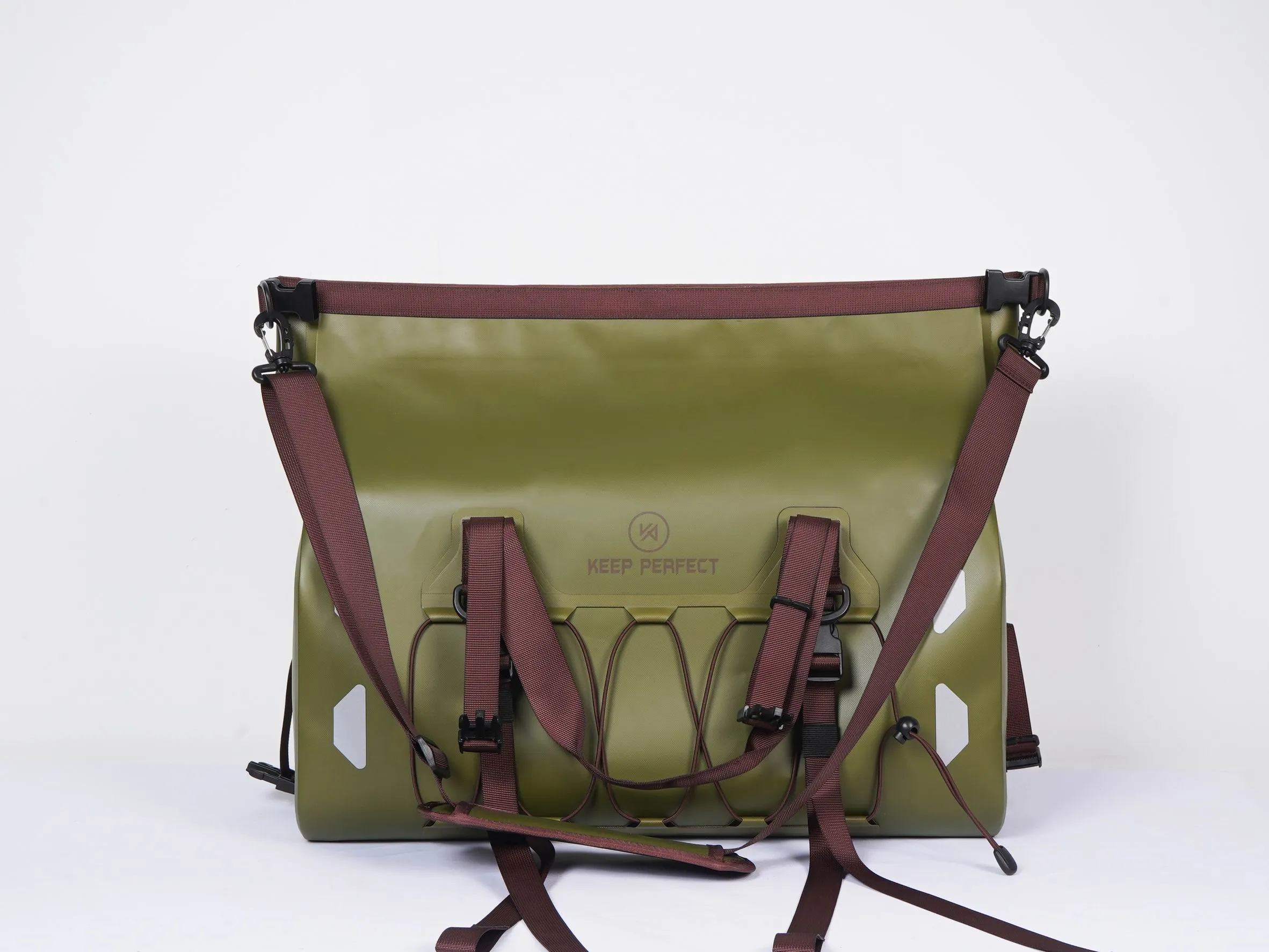
Table of Contents
- Why 120 km/h Rain Is a Jet, Not a Shower
- Tail Bag, Tank Bag and Sissy-Bar Mounting
- Magnet, Straps and Quick-Release Interfaces
- Vibration Fatigue on Seams and Brackets
- Shape Stability: Wind Flutter and Aero Lift
- Fuel and Oil Resistance of Shell Films
- Zippers, Flaps and Glove-Friendly Pulls
- Testing Rider Bags: Jet Rig, Shake Table and Immersion
- Rider-Reported Failure Modes on Touring Setups
- Night Visibility: Reflectives and Lamp Clear Pockets
- Branding Real Estate on Rider Luggage
- Packing and Carton Notes for Structured Tail Bags
- Specifying a Rider Range at 500 Pieces
- Frequently Asked Questions
- People Also Ask
Why 120 km/h Rain Is a Jet, Not a Shower
At motorway speed a rider is travelling forward through falling water while also generating a pressure field around the bike. Rain hits the rear face of a tail bag with substantial relative velocity, and turbulent flow behind the machine pushes water sideways, upwards and backwards into seams that face away from any conceivable rain direction. Standard vertical spray testing assumes gravity-driven water falling onto a surface, which is simply not what happens here.
The practical consequence for specification is that closures need baffles and storm flaps rather than relying on labyrinth geometry alone. A zip garage that works perfectly on a backpack can admit water on a motorcycle because the pressure differential drives water along the zip track from the outside. We therefore specify overlapping external flaps facing rearward, drainage paths that let trapped water escape, and we test closures under directed jets rather than under a rain tower.
- Water arrives from behind and below as easily as from above due to turbulence
- Pressure differentials drive water along zip tracks and into seams that face away from the rain
- Closures need external rearward-facing baffles rather than hidden labyrinth paths alone
- Drainage paths allow any admitted water to escape rather than accumulate in a base panel
- Testing should use directed jets, since standard rain methods markedly under-predict real performance
Riders also notice something else: waterproofing failures on a bike are not partial. A commuting backpack can get slightly damp and nobody minds; a tail bag that admits water destroys a laptop, a change of clothes or a camera in one ride. That binary consequence justifies designing for a much larger margin than civilian categories, and it is why we recommend wet-side compartment separation rather than trusting a single envelope.
There is a further detail about how riders actually use these bags that engineers commonly miss. Luggage stays on the bike through fuel stops, overnight parking and full-day rides in changing weather, and it is opened repeatedly by someone wearing gloves and under time pressure. Every one of those moments is an opportunity for water to enter, so closure designs should assume frequent partial opening rather than assuming the bag is secured once and left alone.
Tail Bag, Tank Bag and Sissy-Bar Mounting
Three positions dominate motorcycle luggage and each imposes different constraints. A tail bag sits behind the rider in clean but turbulent air and usually carries heavier loads strapped to a rack or seat. A tank bag sits in front of the rider over the fuel filler, seen constantly, reached frequently, and in contact with a surface that gets hot and occasionally wetted by fuel. A sissy-bar bag mounts vertically to a passenger backrest and carries bulky soft loads.
| Mounting position | Dominant constraint | Typical construction | Key detail |
|---|---|---|---|
| Tail bag | Turbulence, strap security under load | Structured base with strap channels | Anti-slip base and load-rated strap paths |
| Tank bag | Fuel contact, heat, frequent access | Rigid or semi-rigid base with magnet or harness | Fuel-resistant base film and clear map window |
| Sissy-bar bag | Vertical load, leaning against the backrest | Reinforced back panel with vertical straps | Attachment must resist downward creep |
| Pannier liner | Fits inside hard cases, no mounting required | Soft roll-top or zip body | Sized to case interior rather than to litres alone |
| Handlebar bag | Cable interference, small volume | Compact body with bar clamp interface | Clearance must be verified against control levers |
Pannier liners deserve a note because they are often treated as an afterthought and then generate disproportionate returns. They have no mounting hardware and no external weather exposure, so their dominant failure modes are abrasion against the inside of a hard case and incorrect sizing. Asking buyers for internal case dimensions rather than model names produces a far better fit, since manufacturers change case geometry between generations more often than they change the badge.
Mounting interface design deserves more attention than it usually receives because consequences are severe. Luggage that detaches at speed is a hazard to following traffic, not merely an inconvenience, which is why every strap path should be load-rated with considerable margin and every anchor point tested both statically and under sustained cyclic loading. We treat the interface as a safety component and document it as one.
Magnet, Straps and Quick-Release Interfaces
Tank bags use one of three approaches: magnets, a strap harness or a quick-release ring mount. Magnets are convenient and fast but depend entirely on a steel tank and lose holding force dramatically if the base does not sit perfectly flat. Strap harnesses work with any tank material and are secure, but they are slower to fit and they collect grit against paintwork. Ring mounts offer the best combination and need a dedicated adaptor.
- Confirm the tank material first: aluminium and plastic tanks rule out magnetic mounting entirely
- For magnetic bases, ensure full contact area; partial contact reduces holding force disproportionately
- Specify a non-marking base material so grit trapped underneath does not abrade paintwork
- For strap harnesses, use a secondary safety tether anchored independently of the main straps
- Quick-release rings must be tested for unintended release under vibration, not only for fit
The paintwork issue generates more complaints than any other aspect of tank bags. Grit trapped between a magnet base and the tank acts as an abrasive paste, and over a season it can mark clearcoat permanently. Specifying a soft, non-marking base film and adding a clear instruction to clean both surfaces before fitting addresses it cheaply, and it protects the brand from a category of complaint that is otherwise very hard to defend against.
Quick-release mechanisms introduce their own risk, because anything designed to release quickly can also release accidentally. The test that matters is unintended release under sustained vibration rather than release force in isolation, and it should run for hours rather than minutes because the failure mode involves gradual movement within the mechanism rather than sudden gross failure.
Vibration Fatigue on Seams and Brackets
Motorcycles generate continuous vibration across a wide frequency range, and luggage attached to the machine receives all of it. Vibration is uniquely destructive because it produces fatigue rather than immediate failure: nothing breaks for thousands of kilometres, then something breaks without warning. Welded seams tolerate this well because they distribute strain; stitch perforations concentrate it at each needle hole.
The places to address are predictable once understood. Reinforcement at every attachment, avoiding hard transitions in panel geometry that create flex points, and selecting films that remain flexible across the temperature range rather than stiffening in cold weather. A film that stiffens below freezing transfers far more strain into the seam, which is exactly the winter failure pattern riders describe: nothing fails in summer and a good deal fails in December.
- Use welded construction where geometry allows, since it distributes strain rather than concentrating it
- Reinforce every mounting point into a structural layer rather than into face fabric
- Avoid hard geometric transitions that become flex initiation points
- Specify films retaining flexibility at the lowest intended service temperature
- Test over hours, not minutes, because fatigue failure is gradual and cumulative
A useful way to think about the difference is that most bag categories are static with occasional dynamic loads, while motorcycle luggage is dynamic continuously for the entire journey. That changes not only what fails but where it fails: failure concentrates at interfaces rather than in panels, so time spent reinforcing every interface pays back far more than upgrading the base fabric specification. Detail on the test method sits with our vibration and weather notes.
Shape Stability: Wind Flutter and Aero Lift
A bag that lacks structural stability does three damaging things at speed. It flutters, which tears both the bag and its straps through constant cyclic loading; it shifts, which changes handling feel and can interfere with the rider; and it generates noise that makes the whole setup unpleasant. Preventing all three is a question of controlled stiffness rather than of maximum stiffness, since a totally rigid bag is awkward to pack.
| Stability approach | Effect at speed | Packing consequence | Cost and weight effect |
|---|---|---|---|
| Moulded base panel | Holds footprint against the seat or rack | Slightly larger packed size | Moderate tooling effect at low volume |
| Internal stiffener frame | Resists flutter across the whole body | Restricts how contents compress | Low material cost, adds assembly time |
| Compression straps externally | Tightens a partial load and reduces flutter | Requires user action each ride | Minimal cost, depends on user discipline |
| Foam-laminated shell | Uniform semi-rigid structure | Reduced internal volume flexibility | Higher material cost |
| Aero shaping with tapered rear | Reduces turbulent lift behind the bag | May reduce usable volume | Design cost rather than unit cost |
Compression straps deserve a special mention because they are cheap and genuinely effective, with the single caveat that they require user discipline. A rider who loads the bag half full and does not tighten the straps will experience flutter regardless of how well the bag was designed, so we design the strap routing to be quick and obvious and put guidance about tightening in the product literature.
Fuel and Oil Resistance of Shell Films
Tank bags get splashed with petrol at every fill, and tail bags sit above chain oil and exhaust residue. Both are aggressive solvents relative to some coating systems, producing softening, tackiness and eventually perforation. This is a slow failure that users attribute to poor waterproofness, and diagnosing it correctly matters because increasing the water specification will not address it at all.
- Specify a film with documented resistance to petrol and chain lubricant contact
- Test the base panel separately, since it receives the most contamination exposure
- Avoid coatings that plasticise on contact with hydrocarbons and become tacky
- Provide guidance about wiping contamination rather than allowing it to dwell
- Consider a sacrificial or replaceable base film for tank-mounted products
Chain lubricant deserves specific attention because it is applied generously and flung rearward with considerable force. It arrives warm, adheres, and then picks up road grit to form an abrasive film on the bag's lower surfaces. Specifying a smooth film finish that can actually be wiped clean is more useful here than specifying additional thickness, since accumulated residue abrades regardless of how much material sits behind it.
Zippers, Flaps and Glove-Friendly Pulls
Zipper choice for rider luggage balances ingress resistance against operability. A fully waterproof coated zipper resists water well but requires precise alignment and noticeably greater pull force, which is genuinely difficult with thick gloves on in the rain. A coil zipper under a storm flap is easier to use and, if the flap is well designed, performs comparably in real conditions while being far more forgiving of imperfect closure.
- Prefer coil zippers under external storm flaps for accessibility unless submersion is claimed
- Specify oversized pulls that can be gripped with winter gloves
- Route flaps rearward so water arriving from behind is shed rather than funnelled inward
- Add a drainage path at the base of every zip garage so admitted water escapes
- Test zips partially closed, because riders frequently do not seal them fully at fuel stops
The pull itself is a small detail with outsized impact on user satisfaction. A metal pull rattles against the bike, which riders find intensely irritating over a long day; a moulded pull with a rubberised grip is quieter, warmer to touch in winter and easier to locate by feel. We also avoid pulls that can catch on tank bags or clothing, because accidental opening at speed is a genuinely dangerous failure rather than merely an annoying one.
Testing Rider Bags: Jet Rig, Shake Table and Immersion
Rider luggage verification must combine three regimes that are usually tested separately: directed water, continuous vibration and static immersion. Each replicates a different part of real service, and testing only one produces confident results that fail to predict anything. Sequence matters too, because vibration changes how closures and flaps sit, so water testing after vibration is considerably more informative than water testing before it.
| Test stage | Simulated condition | Pass criterion | Note on realism |
|---|---|---|---|
| Directed jet exposure | Rain encountered at road speed from behind | Indicator media inside remains dry | Uses directed jets rather than gravity rain |
| Static water immersion | Bag standing in standing water, IPX7 under IEC 60529 | No ingress over the declared duration | Applies to products claiming immersion |
| Fabric hydrostatic head | Pressure against the shell, ISO 811 | No penetration at specified head | Screen fabric before assembly testing |
| Vibration exposure | Continuous engine and road vibration | No seam, bracket or strap failure | Run for hours; fatigue is cumulative |
| Post-vibration re-test | Jet exposure repeated after vibration | Result retained after cycling | The single most informative stage |
| Lot acceptance | ISO 2859-1 at AQL 2.5 | Within acceptance number | Standard release decision |
Spray and rain methods still have value for comparability, and we run AATCC 22 and AATCC 35 alongside the jet rig so buyers can compare quotations on equal terms. The honest framing is that standard methods provide comparability while the jet rig provides realism, and relying on either alone leaves you either unable to compare suppliers or unable to predict how the product performs on the road.
Records for every qualification round, including post-vibration water results, are retained in our luggage test documentation. Keeping photographs of flap and zip condition before each water stage is also useful, since it settles the common dispute about whether ingress occurred through a closure or through the shell fabric, which is frequently ambiguous once everything is wet.
Rider-Reported Failure Modes on Touring Setups
Long-distance riders are unusually good reporters because they cover high mileage in varied conditions and discuss failures extensively online. The patterns below recur across touring communities, and each has a specific design correction that costs far less than the reputation damage caused by the failure appearing in rider forums.
| Failure reported | Presenting condition | Root cause | Correction applied |
|---|---|---|---|
| Wet contents after motorway rain | Fine after town riding, wet after sustained high speed | Pressure-driven ingress along the zip track | Rearward storm flap plus zip drainage path |
| Paint damage under a magnet base | Scuffed and hazed tank clearcoat | Grit trapped between the base and tank acting as paste | Non-marking base film plus cleaning guidance |
| Strap failure on a loaded tail bag | Strap torn at its anchor after a long tour | Fatigue at a hard geometric transition | Reinforcement into a structural layer with radiused transition |
| Tacky, softened tank bag base | Surface degrading near the filler cap | Hydrocarbon contact plasticising the film | Fuel-resistant film specified for the base panel |
| Flutter damage to a half-full bag | Torn corner after a windy day | Unrestrained shell movement under wind load | Stiffened base plus obvious compression strap routing |
Night Visibility: Reflectives and Lamp Clear Pockets
Motorcycle luggage sits at the rear of a vehicle whose entire safety problem is being seen. Reflective materials on the bag therefore contribute directly to conspicuity, and their placement should be considered from the viewpoint of a driver approaching from directly behind with headlights on main beam, which is the situation where it matters most.
- Place retroreflective elements square to the rear, since that is where the light source sits
- Keep reflectives visible when the bag is loaded and strapped rather than only when empty
- Use materials that retain performance after repeated washing and UV exposure
- Reflective piping along edges reads better than printed logos at night
- Clear lamp pockets need UV-stable films, since they sit in direct sunlight all season
Clear pockets for maps, toll cards or phones introduce the usual film compromise: clarity against durability and UV stability. This application is unusually demanding because the pocket receives direct sunlight for hours at a time and must stay legible in that condition. Specifying a UV-stabilised clear film and welding rather than taping the window seams removes the most common failure, which is yellowing long before any water ingress occurs.
Branding Real Estate on Rider Luggage
Rider luggage offers unusual branding value because it is seen repeatedly by other riders and photographed at every stop. Tank bags are visible to their owner constantly, which makes internal-branding decisions matter for satisfaction, while tail bags are seen by traffic behind, which makes them effective promotional surfaces. Both positions respond well to quality rather than to size of logo.
- Keep print away from strap contact zones where abrasion will erase it quickly
- Use chemical-resistant print systems because the surface sees fuel and cleaner contact
- Reflective logos deliver dual value on rear-facing panels
- Avoid hard raised badges where they may abrade tank or seat surfaces
- Woven labels on strap ends survive better than printed marks in high-wear positions
One further consideration specific to this category is that riders often already own branded luggage from other sources and mix it. A cohesive visual system across a tail bag, tank bag and pannier liners reads as deliberate and premium, whereas mismatched items read as accumulated. Sharing a design language across the range therefore improves perceived value beyond the individual product.
Packing and Carton Notes for Structured Tail Bags
Structured tail and tank bags do not pack flat, which makes them expensive to ship relative to soft luggage. Unlike dry bags they cannot simply be rolled tighter, because their structure is the product feature. The practical options are nesting smaller items inside larger ones, shipping the base panels nested separately where construction allows, and optimising carton dimensions around the actual packed shape rather than round numbers.
- Derive carton dimensions from the packed product rather than from a nominal size range
- Nest smaller accessories inside larger structured items where nesting does not deform them
- Protect painted or gloss surfaces with interleaving to prevent transit scuffing
- State cube and gross weight at quotation so forwarders can model accurately
- Consolidate the full rider range in single bookings rather than shipping per SKU
Retail packaging matters as well, because structured bags are often displayed assembled and any transit deformation becomes visible immediately on shelf. Simple internal support during shipping prevents that, and it is far cheaper than crediting deformed goods. We include support recommendations with every quotation where the product has moulded or stiffened elements.
There is also a returns-handling dimension worth planning before launch. Structured bags damaged in transit are expensive to replace and awkward to attribute, so agreeing how transit damage is evidenced and credited, and capturing photographs at receipt, protects both sides. Buyers who plan that process alongside the carton specification tend to resolve disputes in days, while those who meet the problem for the first time with a container of scuffed goods tend to resolve it in months.
Specifying a Rider Range at 500 Pieces
A coherent rider range built at minimum quantity covers four positions: a tail bag, a tank bag, pannier liners sized to popular hard cases, and a compact accessory pouch. Those four share hardware, shell fabric and branding treatment while serving genuinely different mounting conditions, which keeps both development cost and unit cost sensible.
- Decide the mounting approach before costing, since it drives the entire construction
- Confirm whether any position must genuinely resist immersion or only directed water
- Specify fuel-resistant films wherever contact is possible rather than discovering it later
- Reinforce every attachment into a structural layer, then test under vibration for hours
- Approve a golden sample, inspect bulk under ISO 2859-1 at AQL 2.5, then ship FOB Xiamen
Commercial terms are standard across our programmes: sampling takes 6 to 10 working days, extending to 12 to 15 where moulded components or custom quick-release interfaces are involved, then bulk in 35 to 50 days. Payment is T/T with a 30 per cent deposit and 70 per cent balance before shipment. Capacity comes from an SGS-verified partner facility of 4,950 square metres running 7 lines with 149 machines and 137 operators at 200,000 pieces monthly, under ISO 9001:2015 with BSCI coverage and declarations reviewed against REACH and RoHS. Buyers can reach us at service@junyuanbags.com or WhatsApp +86 177 5002 0688.
Frequently Asked Questions
Q1: Why does a motorcycle tail bag leak when a hiking pack does not?
A: Because water arrives differently. At road speed, rain hits the bag at high relative velocity and turbulent flow pushes it from behind and below, driving it along zip tracks and into seams that never face falling rain. A hiking pack only ever meets gravity-driven water, so the same closure performs very differently on a motorcycle.
Q2: Are magnetic tank bags safe on all motorcycles?
A: No. Magnetic mounting requires a steel tank and loses holding force disproportionately if the base does not sit perfectly flat. Aluminium and plastic tanks rule it out entirely. Where magnets are used, we also specify a non-marking base film and recommend cleaning both surfaces before fitting to prevent trapped grit abrading the paintwork.
Q3: What causes zippers to leak on motorcycle luggage?
A: Usually pressure-driven ingress along the zip track rather than through the teeth themselves. Adding an external rearward-facing storm flap and a drainage path at the base of the zip garage solves it in most cases. We also recommend coil zippers under flaps rather than coated zippers, because they are far easier to operate with gloves in the rain.
Q4: How do you test luggage against engine vibration?
A: We run it on a cycling rig for hours rather than minutes, because vibration damage is cumulative fatigue rather than immediate failure. Critically, we repeat water resistance testing after vibration exposure, since cycling changes how closures and flaps sit. That post-vibration re-test is the single most informative stage in the whole programme.
Q5: Why did my tank bag base go soft and sticky?
A: That is hydrocarbon contact rather than a waterproofing failure. Petrol splashes at the filler and some chain lubricants plasticise certain coatings, softening them until they become tacky and eventually perforate. Specify a base film with documented fuel resistance and test the base panel separately, since it receives the heaviest contamination.
Q6: Should motorcycle luggage be completely waterproof?
A: It depends on position. Items mounted above the wheel should resist directed water and brief immersion, but absolute sealing is often less useful than drainage, because riders open bags in the rain and water will get in regardless. We recommend separating genuinely wet-sensitive compartments rather than trusting a single sealed envelope.
Q7: How important is bag flutter at speed?
A: Very. Flutter tears bags and straps through continuous cyclic loading, shifts the load in ways riders feel through handling, and creates constant noise that makes long days unpleasant. A moulded or stiffened base combined with obvious compression strap routing addresses it, provided riders tighten the straps when the bag is partly loaded.
Q8: Do reflective panels on luggage actually help safety?
A: Yes, because they add conspicuity from directly behind, which is the direction of the greatest risk for a motorcyclist. Placement matters more than area: retroreflective elements should face squarely to the rear and remain visible when the bag is loaded and strapped rather than only when it is empty and displayed.
Q9: What is the best closure for use with winter gloves?
A: A coil zipper under a storm flap with an oversized moulded pull. Fully waterproof coated zippers need precise alignment and high pull force, which is genuinely difficult in thick gloves and cold rain. The flapped coil arrangement performs comparably in real conditions while being far more forgiving of imperfect closure by a cold rider.
Q10: How should I prevent damage to motorcycle paintwork from luggage?
A: Use a soft base film, clean both contact surfaces before fitting, and avoid placing grit traps between the bag and the tank. Abrasion occurs because trapped grit acts as a paste rather than because the bag material is harsh. Where doubt remains, a sacrificial protective film under the base is inexpensive and very effective.
Q11: What sizes should a first rider range cover?
A: Four positions rather than four arbitrary sizes: a tail bag, a tank bag, pannier liners sized to popular hard cases, and a compact accessory pouch. Those four share hardware and shell fabric while serving genuinely different mounting conditions, which keeps both development and unit costs sensible at the minimum quantity.
Q12: Do you test with any published standard methods?
A: Yes. We run AATCC 22 spray and AATCC 35 rain alongside a directed jet rig so quotations can be compared on equal terms, ISO 811 for fabric hydrostatic resistance, IEC 60529 where immersion is claimed, and ISO 2859-1 at AQL 2.5 for lot release. Standard methods give comparability; the jet rig gives realism.
Q13: What are the lead times for motorcycle luggage development?
A: Sampling takes 6 to 10 working days, or 12 to 15 where moulded components or custom quick-release interfaces are involved, followed by bulk production in 35 to 50 days. Programmes requiring structural fatigue testing should allow additional time, because that testing runs for hours rather than minutes by design.
Q14: What payment and delivery terms apply to rider luggage?
A: Standard terms are T/T with 30 per cent deposit and 70 per cent before shipment, on FOB Xiamen. We publish carton cube and gross weights at quotation, since structured bags do not pack flat and are expensive to ship relative to soft luggage. Consolidating the range into single bookings materially improves landed cost.
People Also Ask
- Why does rain get into motorcycle bags so easily?
- Are magnetic tank bags safe for all bikes?
- How does vibration damage motorcycle luggage?
- Can a tail bag be fully waterproof?
- What is the best zipper for motorcycle bags?
- Do fuel spills damage waterproof bag coatings?