
Waterproof Motorcycle Bags: Tail, Tank and Saddle OEM
Motorcycle luggage fails for reasons no other bag category faces: continuous engine vibration, radiant heat from an exhaust a few centimetres away, and rain driven at the bag at road speed rather than falling on it. A tail bag that keeps water out on a test bench can still soak its contents at 90 km/h, because the closure is being worked by airflow and the mounting straps are being worked by vibration at the same time. QUANZHOU JUNYUAN BAGS specifies motorcycle luggage around mounting, heat clearance and a combined rain and vibration protocol, at 500 pieces per style per colour.
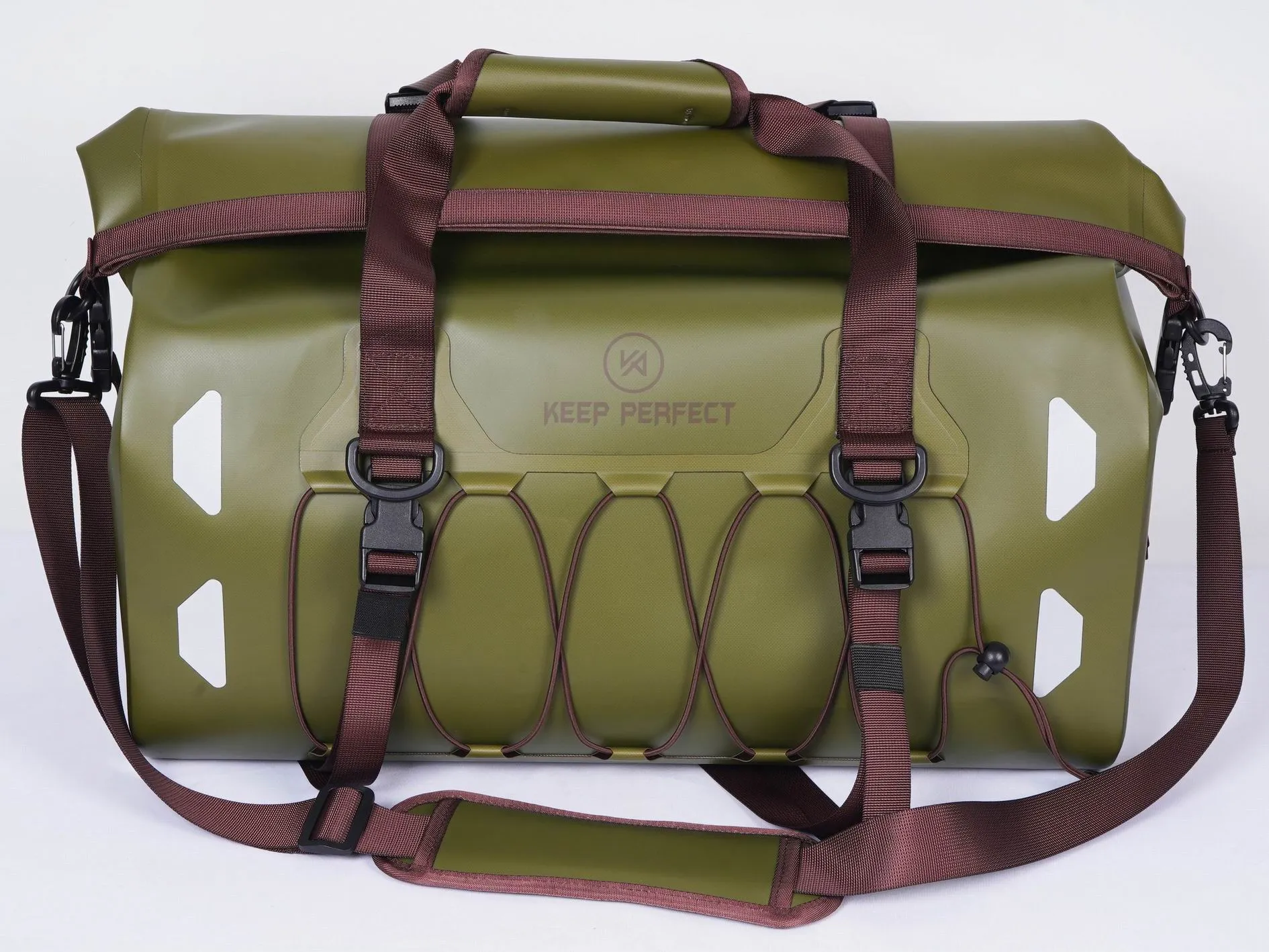
Table of Contents
- Why Motorcycle Luggage Fails Differently: Wind, Vibration and Heat
- Tail Bags: Strap Path, Seat Contact and Exhaust Clearance
- Tank Bags: Magnet, Strap and Harness Mounting Compared
- Saddlebags and Panniers: Heat Shielding Near the Exhaust
- Roll Bags and Dry Bags Adapted for Motorcycle Use
- The 90 km/h Rain Test and the Vibration Soak We Run
- Motorcycle Failure Modes: Strap Chafe, Heat Melt, Buckle Rattle
- Mounting Hardware: Cam Buckles, Quick Release and Anti-Slip Backing
- Abrasion Zones on a Motorcycle Bag: Where to Reinforce
- Visibility, Reflective Trim and Night Riding Requirements
- Cost Drivers Specific to Motorcycle Luggage
- Documentation, Chemical Rules and Market Access
- Briefing a Motorcycle Luggage Range
- Frequently Asked Questions
- People Also Ask
Why Motorcycle Luggage Fails Differently: Wind, Vibration and Heat
Three exposures define motorcycle luggage and none of them appear in a general bag specification. The first is airspeed: at 90 km/h, rain arrives at the bag horizontally with considerable force and finds closure paths that a vertical shower never reaches. The second is vibration: engine and road input is continuous, at low amplitude and high frequency, and it works fasteners loose and abrades strap contact points.
The third is radiant and conducted heat. A pannier mounted near an exhaust can see surface temperatures well above what any bag film is rated for, and the failure is a melted or distorted panel rather than a leak. It happens on the first long ride rather than gradually, and it is the single most expensive failure in the category because it can damage the contents and, in a bad case, the motorcycle.
What connects the three is that they act together. A bag that has been vibrating for four hours has slightly loosened straps, and slightly loosened straps let the bag move, and a bag that moves in a 90 km/h airstream works its closure in a way a static test does not reproduce. That is why the protocol in this page combines rain and vibration rather than running them separately.
Tail Bags: Strap Path, Seat Contact and Exhaust Clearance
A tail bag is the most common entry point into the category and the one most often returned, and the reason is almost always the strap path. A tail bag is held by straps running under or around the seat unit, and on a modern motorcycle there is frequently no clean path: the seat is shaped, the subframe is exposed and the exhaust is close. A strap that has to route around an obstacle will slide toward it under vibration.
The design answer is to specify the strap path for a bike family rather than for one model, with multiple attachment points on the bag so the strap can take whichever route is available. Four attachment points rather than two costs little and makes the bag fit several machines, which matters commercially, because a bag that fits one model has a very small market.
Exhaust clearance is the second decision and it is a stated dimension rather than a preference. We ask for a minimum clearance between the bag's lowest and nearest panel and the exhaust surface, and we design a heat shield into the panel when that clearance cannot be achieved. Guessing at it produces a melted bag, and no amount of film specification compensates for a panel sitting too close to a hot pipe.
| Tail bag mounting parameter | Working specification | Consequence if missed |
|---|---|---|
| Number of strap attachment points on the bag | Four, allowing several routing options | Two points force one route and the strap slides under vibration |
| Strap width at the contact point | 25 mm minimum, 38 mm preferred | Narrow webbing abrades through at the seat edge |
| Anti-slip backing on the base panel | Full coverage, high-friction coating | The bag walks sideways under load and airflow |
| Minimum clearance to the exhaust surface | Stated in millimetres per bike family | Radiant heat distorts or melts the panel on the first long ride |
| Strap routing clearance to the rear light and indicators | Stated clear zone on the drawing | Straps foul the lighting and the bike fails a check |
Tank Bags: Magnet, Strap and Harness Mounting Compared
A tank bag sits on a painted surface that the owner does not want marked, on a curved and often steeply raked panel, within reach of the rider's hands and body. That combination rules out most mounting methods and leaves three: a magnetic base, a strap base and a harness base, where a ring or a harness is fitted to the bike and the bag clips to it. Each has a clear trade.
A magnetic base is the fastest to fit and the easiest to remove, and it is the one owners prefer. It has two problems: a steel tank is required, since an aluminium or carbon tank takes no magnet, and any grit trapped between the magnet and the paint abrades the paint under vibration. The mitigation is a soft, fully covering base flap and a stated pull-force requirement per magnet.
A harness base is the most secure and the least convenient, because the harness is fitted to the bike and stays there. It is the right answer for a bag that will carry weight on a long tour, and for any non-ferrous tank. A strap base is the compromise and it is what most mid-market programmes use; it works on any tank and it needs a clear strap route, which on some machines does not exist.
Saddlebags and Panniers: Heat Shielding Near the Exhaust
Panniers are the sub-category where heat is the governing requirement. A pannier hangs beside or above an exhaust muffler, and the gap between them is often smaller than a buyer expects once the bag is loaded and sags. The failure is not subtle: the panel deforms, the coating softens, and in a severe case the material melts onto the exhaust. It is also a safety issue rather than only a warranty one.
The engineering answer has three parts. The first is a stated clearance, measured loaded rather than empty, because a loaded pannier hangs lower and closer. The second is a heat shield: an insulating layer plus an air gap between the shield and the bag panel, and the air gap is what does most of the work. The third is a stiffener so the panel cannot deform toward the exhaust as the bag sags.
Material choice follows from that but does not replace it. A TPU laminate softens at a lower temperature than some buyers expect, and a PVC sheet is worse again, so neither is a substitute for a shield where clearance is tight. We quote the shield as a standard part of a pannier build rather than as an option, because it is the difference between a product that survives a summer tour and one that does not.
Roll Bags and Dry Bags Adapted for Motorcycle Use
A paddle-sport dry bag and a motorcycle roll bag look similar and are not the same product. A dry bag is designed to be sealed once and left; a motorcycle roll bag is opened at fuel stops and at the end of a day, in the rain, with gloves on, and its closure has to work under those conditions. A roll closure that needs three tight folds is fine on a kayak and tiresome on a bike.
The adaptations that matter are a closure that can be operated with one hand, a compression strap system that holds the roll rather than relying on the roll to hold itself, and an outer shell that resists the abrasion of being strapped to a rack. A dry bag's smooth welded shell abrades quickly against a metal rack; a motorcycle roll bag needs a reinforced base and side panels.
Load rating is the other difference. A dry bag is rated by volume and a motorcycle roll bag has to be rated by volume and by mass, because the mounting straps have a limit and a 40 litre bag filled with dense equipment exceeds it. We ask for the intended contents mass rather than only the volume, and we test the mounting at that mass rather than at a nominal figure.
The 90 km/h Rain Test and the Vibration Soak We Run
This is the protocol that distinguishes motorcycle luggage from general waterproof bags, and it exists because a static rain cabinet does not reproduce road-speed exposure. The principle is that the bag is mounted to a rig, loaded to its stated contents mass, exposed to a defined water rate at a defined airspeed, and vibrated at the same time rather than before or after. The two exposures acting together are what produce field failures.
The airspeed is set at 90 km/h as a touring reference, and the water rate is set to represent heavy rain rather than a light shower, because a bag that only has to survive drizzle is not the product being specified. The vibration input is a low-amplitude, high-frequency profile applied through the mounting points, matching the character of engine and road input rather than of transport handling.
The pass criterion is specific: no moisture on indicator papers placed at the top, the centre and the base of the bag interior, and no movement of the bag on its mount beyond a stated distance. The second half matters as much as the first, because a bag that stays dry but walks off its mount is a hazard, and no water test on its own will reveal that.
- Mount the bag to a rig representative of the mounting system, using the hardware that will ship with it.
- Load to the stated contents mass with a distributed load, not a single dense block.
- Place indicator papers at the top, centre and base of the interior and seal the closure as a rider would.
- Apply the vibration profile through the mounting points and hold it for the full duration of the exposure.
- Apply the water rate at 90 km/h equivalent airspeed for 60 minutes, with the rig at the riding angle.
- Measure and record bag movement on the mount, then open from the base upward and read the indicator papers.
Motorcycle Failure Modes: Strap Chafe, Heat Melt, Buckle Rattle
Strap chafe is the most common warranty claim in the category. A strap under tension, vibrating against a seat edge or a frame tube, abrades through its own weave in a few thousand kilometres, and it fails suddenly and completely. The mitigation is a chafe sleeve at every contact point, a rounded rather than a cut strap end, and a strap route that avoids sharp edges, all of which are specified on the drawing.
Heat melt is the second and it is a design error rather than a wear process. It presents as a deformed or glossy panel on the side facing the exhaust, sometimes with the print transferred to the pipe. It is prevented by clearance, a shield and a stiffener, and it is not prevented by choosing a heavier film. We ask for the exhaust clearance figure at the brief stage because it determines the whole panel build.
Buckle rattle is the third and it sounds trivial until it is the reason a customer returns a product. A metal cam buckle vibrating against a frame or against another buckle produces a noise the rider hears constantly, and it abrades the bike's paintwork at the same time. The fix is a polymer buckle where loads allow, a rubber overmould or a sleeve on a metal one, and a strap end retained rather than left free.
Mounting Hardware: Cam Buckles, Quick Release and Anti-Slip Backing
Mounting hardware on motorcycle luggage carries a dynamic load that no static pull test represents. A loaded tail bag at speed is subject to aerodynamic lift, engine vibration and road shock simultaneously, and the strap system has to hold under all three without loosening. That makes the choice of buckle a performance decision rather than a cost one.
A cam buckle is the standard answer and it holds well, provided the cam teeth are sharp enough to bite a woven strap and the spring retains its force when hot. A side-release buckle is faster and is the right choice for a bag that is removed often, but it can release under a shock load if it is struck, and we specify a locking version for luggage rather than a plain one.
Anti-slip backing is the part most often omitted and it is what stops a bag from walking. A high-friction coating on the base panel, covering the full contact area rather than a few stripes, holds the bag in place under vibration and airflow. It is cheap, it is invisible in a photograph, and its absence is the reason a bag ends up touching an exhaust it was specified to clear.
Abrasion Zones on a Motorcycle Bag: Where to Reinforce
A motorcycle bag abrades in specific, predictable places, and reinforcing them costs far less than reinforcing the whole shell. The base is the first, because the bag is set down on tarmac and on a rack. The leading face is the second, because it takes the airflow and the debris carried with it. The strap contact edges are the third and they are the ones usually missed.
The reinforcement itself should be the same film as the shell in a heavier gauge rather than a different material, because a patch of a different polymer welds differently and abrades at a different rate, producing a ridge that wears faster than either surface. Where a contrasting panel is wanted for design reasons, it should be placed away from the contact zones.
Abrasion resistance is measured rather than asserted. We run an abrasion series on the exact face-and-film combination and report head retention afterwards, because a panel that has been abraded through is no longer waterproof at that point regardless of what the original head figure was. That retention number is the one worth putting in a specification.
Visibility, Reflective Trim and Night Riding Requirements
Luggage extends a motorcycle's silhouette, and a bag that makes a bike wider or longer changes what other road users perceive. Reflective trim is therefore a functional requirement rather than a styling one, and it should be placed on the rear-facing and side-facing surfaces rather than on the top, where headlights from behind do not reach it.
The trim itself should be a retroreflective transfer or a welded tape rather than a stitched patch, because a stitch line through the shell at the trim position is a water path at exactly the point where road spray collects. A welded tape preserves the shell's integrity and lasts longer than a printed reflective ink, which loses performance as the surface abrades.
Where a programme is sold into a market with vehicle accessory rules, the reflective area may be a stated minimum rather than a preference, and it should be checked before the artwork is fixed. It is a small point and one that is expensive to correct after the panels have been printed, because it changes the trim layout and therefore the pattern.
Cost Drivers Specific to Motorcycle Luggage
Motorcycle luggage carries cost that a general bag does not, and the largest is the mounting system. A tail bag with four attachment points, chafe sleeves, anti-slip backing and cam buckles has a mounting sub-assembly whose cost can approach the shell cost, and it is mostly manual assembly. Buyers who cost a motorcycle bag as a bag plus a strap consistently under-quote.
The second driver is heat management. A heat shield with an air gap and a stiffener is a multi-layer panel build with its own operations, and on a pannier it is not optional. It is the line item that makes a pannier more expensive than a general bag of the same volume, and it is the reason a cheap pannier is a genuinely dangerous product rather than just a poor one.
The third driver is validation. The combined rain and vibration protocol is a fixture-intensive test that has to be run on the actual mounting hardware, and it is a fixed cost spread over 500 pieces. On a reorder of an unchanged specification it is not repeated, which is worth planning for: the first order of a motorcycle range carries validation that the third order does not.
| Motorcycle luggage cost driver | Why it costs what it costs | Where the real saving is |
|---|---|---|
| Mounting sub-assembly | Four attachment points, chafe sleeves, buckles, mostly manual | Simplify the strap route for one bike family, not several |
| Heat shield, air gap and stiffener | Multi-layer panel build with its own operations | Not optional on a pannier; specify clearance to reduce shield size |
| Anti-slip backing, full coverage | Coating plus an application operation | Small cost, prevents the most expensive failure mode |
| Retroreflective welded trim | Material cost higher than printed reflective ink | Printed ink is a false economy, it abrades off |
| Rain plus vibration validation | Fixture-intensive, fixed cost at 500 pieces | Not repeated on an unchanged reorder |
| Reinforcement panels in matched film | Heavier gauge in the same polymer | Cheaper than reinforcing the whole shell |
Documentation, Chemical Rules and Market Access
Motorcycle luggage is an accessory rather than a vehicle component, which surprises buyers who expect type approval. It does not require homologation in most markets, but it does carry the chemical obligations of any article placed on the market, and a distributor selling into the European Union will ask for a REACH declaration on substances of very high concern covering the shell, the coating, the foam and the print.
RoHS applies only where the bag carries a powered component, which in this category means an integrated light, a charging pass-through or a battery pocket. Where one exists, the powered variant should be documented as its own SKU rather than folded into the passive file. OEKO-TEX on the face fabric and the print is the fastest route through a retailer restricted substance list.
Where a bag is sold with a claim of flame or heat resistance, that claim has to be supported rather than implied, and the support is a test result at a stated temperature and duration rather than a material name. We say plainly what a heat shield achieves and at what clearance, because an unsupported heat claim on a product mounted near an exhaust is a liability nobody wants.
Briefing a Motorcycle Luggage Range
A motorcycle luggage brief has to state three things a general bag brief does not: the bike family the bag is mounted to, the exhaust clearance available in millimetres, and the contents mass the mounting has to hold. Without the first, the strap path cannot be designed; without the second, the panel build cannot be specified; without the third, the mounting cannot be rated.
Buyers should also say which format leads. A tail bag is the cheapest to develop and the widest in application, so it is the usual first SKU. A pannier is the most expensive because of the heat shield and the mounting, and a tank bag sits between them but carries the tank material question. Leading with the tail bag and following with the rest spreads the validation cost sensibly.
Every format is quoted at 500 pieces per style per colour. Sampling takes 6 to 10 working days for a standard build and 12 to 15 where a heat shield, a moulded base or a custom mounting sub-assembly is involved. Bulk runs 35 to 50 days from the approved pre-production sample, shipments leave FOB Xiamen on T/T 30 per cent deposit and 70 per cent before shipment, and lots are inspected to AQL 2.5 under ISO 2859-1 in a validated production partner facility of 4,950 square metres, 7 lines, 149 machines and 137 people, verified by SGS.
QUANZHOU JUNYUAN BAGS has run waterproof OEM programmes since 2014, with a founder in the trade since 2004, and issues CE, CPC, RoHS and SGS documentation on request, runs ISO 9001-aligned QC and can host a BSCI audit. Send the bike family, the exhaust clearance and the contents mass to service@junyuanbags.com or WhatsApp +86 177 5002 0688. Water exposure methods are compared on the water ingress test methods page, shell integrity is explained under ISO 811 hydrostatic pressure, and abrasion behaviour is covered on the AATCC 22 page. Related outdoor formats are listed on products and under sports bags.
Frequently Asked Questions
Q1: Why does motorcycle luggage need a different waterproof test?
A: Because at 90 km/h rain arrives horizontally with force and finds closure paths a vertical shower never reaches, while engine vibration loosens the mounting at the same time. The two exposures acting together are what produce field failures. A static cabinet tests the fabric; a combined rain and vibration protocol tests the product and the mounting hardware together.
Q2: Can a pannier be mounted close to an exhaust?
A: Only with a heat shield and a stated clearance, measured with the bag loaded rather than empty because a loaded pannier hangs lower and closer. The shield needs an insulating layer plus an air gap, and the air gap does most of the work. No film specification compensates for a panel sitting too close to a hot pipe.
Q3: What is the most common warranty claim on motorcycle bags?
A: Strap chafe. A strap under tension vibrating against a seat edge or frame tube abrades through its own weave in a few thousand kilometres and fails suddenly. The mitigation is a chafe sleeve at every contact point, rounded rather than cut strap ends, and a strap route designed to avoid sharp edges.
Q4: Should a tail bag have two or four strap attachment points?
A: Four. A modern motorcycle often has no clean strap route, and with only two points the strap is forced into one path and slides toward the nearest obstacle under vibration. Four points let the same bag fit several machines, which matters commercially because a bag that fits one model has a very small market.
Q5: Does a magnetic tank bag work on every motorcycle?
A: No. It needs a steel tank, since aluminium and carbon take no magnet, and any grit trapped between the magnet and the paint abrades the paint under vibration. The mitigation is a soft fully covering base flap and a stated pull-force requirement. A harness base is the answer for non-ferrous tanks and heavy touring loads.
Q6: Is a kayak dry bag suitable as a motorcycle roll bag?
A: Not without adaptation. A dry bag is sealed once and left; a motorcycle roll bag is opened at fuel stops in the rain with gloves on, and a three-fold closure that is fine on a kayak is tiresome on a bike. It also needs a reinforced base against a metal rack and a stated contents mass rather than only a volume rating.
Q7: Why does a motorcycle bag walk off its mount?
A: Because the base panel lacks full-coverage anti-slip backing. Vibration and airflow together move a smooth panel progressively, and a bag that walks can end up touching an exhaust it was specified to clear. A high-friction coating across the whole contact area prevents it, costs little and is invisible in a photograph.
Q8: How loud is buckle rattle as a defect?
A: Significant. A metal cam buckle vibrating against a frame or another buckle produces a noise the rider hears constantly and it abrades the bike's paintwork at the same time. Polymer buckles where loads allow, a rubber overmould on a metal one and retained strap ends all fix it, and none of them is expensive.
Q9: Does motorcycle luggage need type approval?
A: Usually not, because it is an accessory rather than a vehicle component. It does carry chemical obligations as an article placed on the market, and a European Union distributor will ask for a REACH declaration covering shell, coating, foam and print. RoHS applies only where the bag has a powered component such as an integrated light.
Q10: Where should reflective trim go on motorcycle luggage?
A: On the rear and side facing surfaces, where other road users' headlights reach it, not on the top. It should be a retroreflective transfer or a welded tape rather than a stitched patch, because a stitch line through the shell at that position is a water path exactly where road spray collects.
Q11: What is the MOQ and lead time for motorcycle luggage?
A: 500 pieces per style per colour. Sampling takes 6 to 10 working days for a standard build and 12 to 15 with a heat shield, a moulded base or a custom mounting sub-assembly. Bulk runs 35 to 50 days from the approved sample, FOB Xiamen on T/T 30 per cent deposit and 70 per cent before shipment, inspected to AQL 2.5 under ISO 2859-1.
Q12: Which format should a range launch with?
A: The tail bag. It is the cheapest to develop, the widest in application and it proves the shell and the mounting system. A pannier is the most expensive because of the heat shield and mounting, and a tank bag sits between them but carries the tank material question. Leading with the tail bag spreads the validation cost sensibly.
Q13: How much does mounting hardware add to the cost?
A: More than buyers expect. A tail bag with four attachment points, chafe sleeves, anti-slip backing and cam buckles has a mounting sub-assembly whose cost can approach the shell cost, because it is mostly manual assembly. Costing a motorcycle bag as a bag plus a strap is the most common quoting error in the category.
Q14: Can a heat resistance claim be made for the shell?
A: Only with supporting evidence at a stated temperature and duration rather than a material name. We state plainly what a heat shield achieves and at what clearance, because an unsupported heat claim on a product mounted near an exhaust is a liability. A TPU laminate softens lower than many buyers expect and PVC is worse again.
People Also Ask
- Why do motorcycle bags leak at speed?
- Can a pannier sit near an exhaust?
- What is the best mounting for a tank bag?
- How much clearance does a pannier need?
- What is the MOQ for motorcycle luggage OEM?
- Why does my tail bag strap keep fraying?