
Waterproof Bag Care and Maintenance: TPU, PVC, Coated Nylon
Care instructions that work on a TPU laminate will damage a PVC-coated scrim, and neither is right for a coated nylon face. QUANZHOU JUNYUAN BAGS writes care guidance per construction: hydrolysis and blocking on TPU, plasticiser migration and cold crack on PVC, coating loss and abrasion fuzz on coated nylon, plus closure care, cleaning agents ranked by risk, and repairability by build. Every bulk order from 500 pcs per style per colour can ship with printed care documentation matched to the exact shell used.
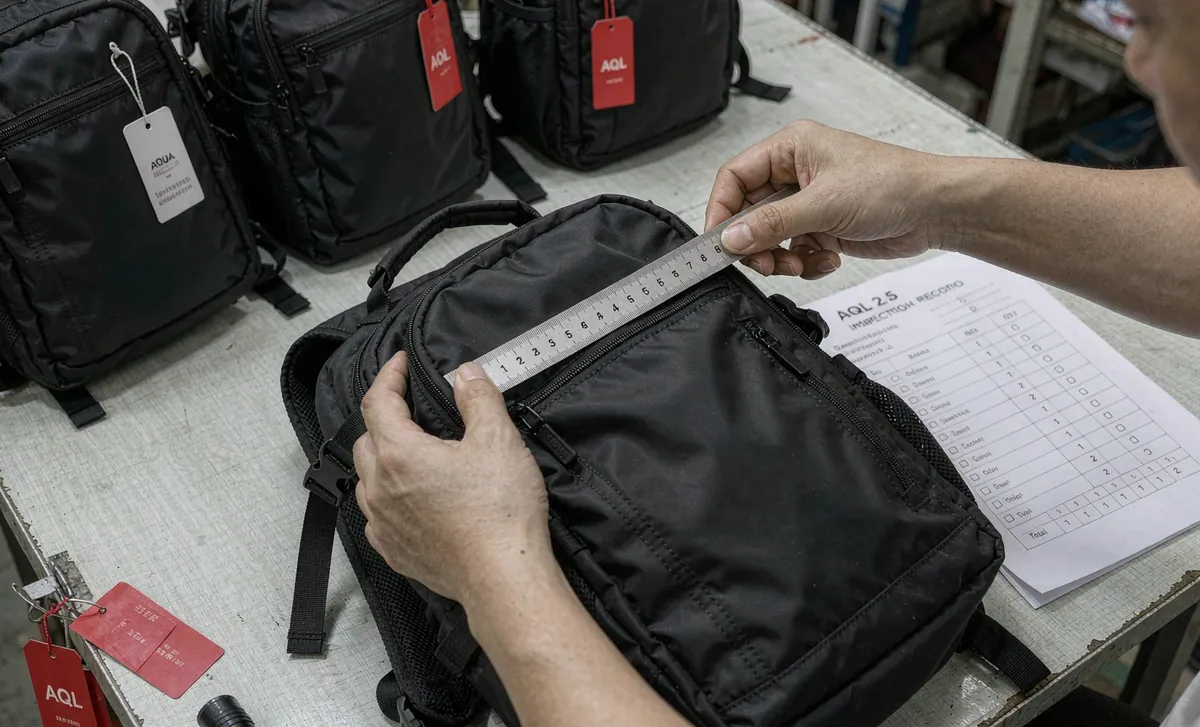
Table of Contents
- Care Starts With the Film: TPU, PVC or Coated Nylon
- TPU Care: Hydrolysis, Yellowing and Blocking
- PVC Care: Plasticiser Migration and Cold Crack
- Coated Nylon Care: Coating Loss and Abrasion Fuzz
- Closure Care: Roll-Top, Zip and Cord Lock
- The Hydrolysis Watch: An Accelerated Warm-Humid Check
- Mould and Odour: Recovering a Bag Closed Wet
- Cleaning Agents Ranked by Risk to the Coating
- Repairability by Construction Type
- Off-Season Storage for Retail and Rental Fleets
- A Care Schedule by Use Frequency
- Retirement Criteria: When a Bag Is Beyond Care
- Care Guidance Inside an OEM Order
- Frequently Asked Questions
- People Also Ask
Care Starts With the Film: TPU, PVC or Coated Nylon
Three constructions dominate waterproof bag production and each one ages in its own way. A TPU laminate is a thermoplastic film bonded to a base fabric, and it ages mainly through hydrolysis, surface blocking and ultraviolet yellowing. A PVC-coated scrim is a polyvinyl chloride coating on a polyester grid, and it ages through plasticiser migration and cold stiffening. A coated nylon or polyester face relies on a thin polyurethane coating over a woven face, and it ages through coating loss and abrasion fuzz.
Because the ageing mechanisms differ, the care that preserves one can accelerate the decline of another. Heat is the enemy of the first two but mainly matters to the third through abrasion. Solvents attack the PVC coating fastest, while prolonged damp storage is hardest on the TPU film. A single generic care card for a mixed range is therefore wrong for at least two thirds of it.
We identify the film on the specification sheet and write care copy against it, and we ask brands with a mixed catalogue to accept three variants of the care card rather than one. The cost difference per unit is trivial next to the cost of a preventable return, and the correct instruction is the one that protects the coating the bag actually uses. Background on how the film and the rating relate is covered in our waterproof levels reference.
Buyers often ask which of the three is the better choice outright, and the honest answer is that none of them is. TPU suits a premium product sold into a humid market where the bag will be dried properly. PVC suits a price-led or puncture-prone application where cold flexibility matters less. Coated woven fabric suits a product where hand feel, print quality and packability matter more than immersion performance.
TPU Care: Hydrolysis, Yellowing and Blocking
Hydrolysis is the reaction between water and the polymer chain, and it is accelerated by warmth. In practice this means a TPU bag left sealed and wet in a warm place ages faster in a month than the same bag used weekly and dried properly ages in a year. The visible symptoms are a tacky surface, a loss of elasticity at the fold and eventually a film that cracks rather than flexes.
Blocking is the second TPU-specific problem: two film faces pressed together for a long period under warmth and pressure can partially adhere. It shows up on a roll-top stored rolled tightly for an entire off-season. The fix is in the storage instruction rather than in any cleaning product: store loosely, and never leave a TPU closure rolled under compression when the bag is put away.
Yellowing is ultraviolet-driven and mainly cosmetic, but it matters to a brand because customers read it as ageing. We use ultraviolet-stabilised films and advise shade drying, and we note on the care card that some colourways will lighten or shift slightly over a long service life. Saying so in advance prevents a cosmetic complaint that no cleaning regime would have avoided.
PVC Care: Plasticiser Migration and Cold Crack
PVC is flexible because a plasticiser is compounded into the coating, and over time that plasticiser can migrate to the surface or be extracted by contact with oils and solvents. The symptom is a bag that becomes stiff and then cracks at the fold, and the accelerants are heat, solvent contact and long contact with oily substances such as sunscreen or fuel.
Cold stiffening is the companion problem. A PVC-coated bag that is perfectly flexible in a warm room can be stiff enough to crack when folded on a cold morning, which is why care copy for these products says to unpack and warm the bag before folding it tightly. That single line prevents a class of winter damage that looks like a manufacturing defect.
- Keep PVC away from solvents, oils and fuel; wipe any contact off promptly with water and a mild detergent.
- Avoid prolonged heat; a hot vehicle accelerates plasticiser loss far faster than ordinary use.
- Warm the bag before folding it tightly in cold weather.
- Store flat or loosely rolled rather than compressed.
- Expect some stiffening over a long service life and do not treat it as a defect.
Odour is a separate PVC issue worth naming. A new PVC-coated product can carry a characteristic smell that fades with airing, and customers occasionally report it as a chemical fault. We air components before assembly, we avoid packaging a fresh product into a sealed carton the same day it is welded, and we tell brands to expect a short airing period rather than to treat the smell as a defect.
Coated Nylon Care: Coating Loss and Abrasion Fuzz
A coated woven face carries a thin polyurethane coating over the textile, and that coating is thin enough to be worn through by abrasion. The first symptom is not a leak but a change in appearance: the face develops a fuzzy, worn look where it has rubbed against a strap, a buckle or a rough surface, and water begins to soak in at exactly those points.
Care here is dominated by what you do not do. Do not brush the face, do not scrub at a stain, do not machine wash and do not dry the bag face-down on a rough surface. Blot and rinse instead, and accept that a coated face will show wear at contact points before a laminated film would.
These products usually also carry a durable water repellent finish that is checked with a spray test under AATCC 22. When the finish degrades the face wets out even though the coating underneath is intact, and the correct response is reproofing rather than a claim. We say that explicitly on the care card because wet-out is the condition most often misreported as leaking.
Closure Care: Roll-Top, Zip and Cord Lock
The closure is the most-used moving part of a waterproof bag and the one most sensitive to contamination. A roll-top depends on two clean film faces pressing together; grit in the fold creates a channel. A waterproof zip depends on clean teeth and an intact coating on the tape; salt crystals in the slider stop it tracking. A cord lock depends on a spring that has not corroded.
The maintenance is mechanical rather than chemical. Rinse the fold and the zip track with fresh water, open and close the closure a few times while it is wet to flush grit out, then dry it open. Do not apply oil or grease to a zip in the hope of freeing it, because grease holds grit and makes the problem worse within days.
- Rinse the closure with fresh water after every salt or sand exposure.
- Cycle the closure open and closed while wet to flush the track.
- Dry with the closure open so no water is trapped in the fold or the teeth.
- Inspect the slider body for corrosion and the cord lock spring for stiffness.
- Replace a closure component rather than lubricating it; lubrication attracts grit.
Print and branding interact with care on this construction more than on the other two. A print sits on top of the thin coating, so anything that abrades the face takes the print with it, and a brand whose logo fades before the bag wears out has a marketing problem rather than a product one. We place prints away from known contact points wherever the design allows.
The Hydrolysis Watch: An Accelerated Warm-Humid Check
Because hydrolysis is the dominant ageing mechanism on polyurethane-based films, we run a warm-humid hold on film candidates before they enter a programme. The purpose is comparative: it tells us which of two films retains its properties longer under the same abuse, so the specification decision is made on evidence rather than on a data sheet.
The method is a fixed temperature and humidity hold with samples removed at intervals and tested for hydrostatic head retention, peel strength at a welded seam and flexibility at a fold. A film that holds its head figure and its peel strength through the hold is the one we recommend for a humid market or a product that will be stored damp.
| Check | Condition | Sampled at | Property measured | Result used for |
|---|---|---|---|---|
| Head retention | Warm-humid hold | Set intervals | Hydrostatic head to ISO 811 | Film selection |
| Weld peel | Warm-humid hold | Set intervals | Peel strength at the weld | Weld parameter window |
| Fold flexibility | After hold | End of hold | Cracking at a tight fold | Cold-climate suitability |
| Surface tack | After hold | End of hold | Tackiness and blocking | Storage instruction wording |
| Colour shift | After hold | End of hold | Visible yellowing | Colourway and print advice |
The last two rows feed directly into the care card. If a film shows surface tack after the hold, the storage instruction for that product says loosely packed rather than rolled, and if it shows colour shift, the care card warns the customer before they see it on their own bag.
Cord locks deserve their own note because they fail invisibly. The spring inside a cord lock corrodes before the shell shows anything, and the first sign is a lock that will not grip. Replacing the component is a five-minute job on most designs, so we keep spare cord locks and sliders available as a spare part line rather than treating a failed lock as a failed bag.
Mould and Odour: Recovering a Bag Closed Wet
A bag closed wet and left in a warm place develops odour within days and mould within a week, and the mould grows on any textile face, including the inside of webbing and the hollow of a cord lock. Recovery is possible if the film itself is still sound, and the sequence matters: dry first, then clean, because cleaning a damp interior spreads spores rather than removing them.
The sequence we recommend is to open the bag fully and dry it in moving air until the interior is dry to the touch, then wash the interior with a mild detergent solution, rinse thoroughly, dry again completely, and only then decide whether the bag is usable. A persistent odour after that sequence means growth inside the textile layers, and the bag should be retired from carrying food or clothing.
Prevention belongs in the product design as much as in the card. A pale interior lets a user see whether the bag is dry, a drain grommet lets water out without opening the bag, and a wide mouth lets air in. All three are specification decisions made long before the care copy is written.
Where a brand sells into a market with hard water, we add one more line to the card: rinse with clean water after washing so mineral deposits do not dry on the closure faces. Deposits on a roll-top fold behave like fine grit, and they shorten the working life of the closure in exactly the same way, which is a counterintuitive failure for a customer who has only ever washed the bag carefully.
Cleaning Agents Ranked by Risk to the Coating
Customers reach for whatever is under the sink, so the useful care document names the agents by category and ranks them. We use three bands: safe with conditions, use with care, and never. The ranking differs slightly by construction, which is another reason a single generic card is inadequate.
| Agent | Risk band | Effect on TPU | Effect on PVC | Effect on coated nylon |
|---|---|---|---|---|
| Clean water, lukewarm | Safe | None | None | None |
| pH-neutral detergent | Safe | None | None | Safe if rinsed well |
| Mild soap | Safe | None | None | Safe if rinsed well |
| Baking soda paste | Use with care | Mild abrasion risk | Mild abrasion risk | Abrades the coating |
| Alcohol wipe | Never | Surface stress | Extracts plasticiser | Removes the finish |
| Solvent or thinner | Never | Dissolves the film | Dissolves the coating | Dissolves the coating |
| Bleach | Never | Oxidises the film | Oxidises and stiffens | Strips colour and finish |
| Fabric softener | Never | Residue blocks the fold | Residue attracts dirt | Kills the repellent finish |
The never column is the one printed in bold on the care card. Alcohol wipes and solvent cleaners are the two most common causes of a coating failure that looks like a manufacturing fault, and naming them is the cheapest protective measure available to a brand.
Repairability by Construction Type
Repairability is a specification property that is almost never discussed at sourcing stage and always discussed at claim stage. The three mainstream constructions differ substantially in what can be repaired, how well the repair holds and whether the repair restores the original rating.
| Construction | Field repair method | Holds under load | Restores the rating | Recommended spare part |
|---|---|---|---|---|
| RF-welded TPU | Heat-applied matched patch | Yes, when applied to a clean dry surface | Splash and spray, not immersion | Die-cut TPU patch and a heat tool |
| RF-welded PVC | Solvent or adhesive patch | Yes, with the correct solvent | Splash and spray, not immersion | Die-cut PVC patch and solvent |
| Stitched and taped | Adhesive patch plus seam sealer | Partial; the stitch line remains the weak path | Splash only | Seam sealer and an adhesive patch |
| Coated woven, no tape | Adhesive patch | Weak; the coating is thin | Splash only, temporary | Adhesive patch, retire early |
| Ultrasonic welded | Heat-applied patch | Yes on flat panels | Splash and spray | Matched patch |
We supply matched patches with bulk orders where a brand asks for them, because a patch cut from a different film will bond initially and then release. The repair instruction is written into the care card for the specific construction, including the note that a repaired area is splash resistant rather than re-rated for immersion.
One more consideration applies to products sold with a repair kit. A solvent patch supplied with a PVC bag must not be shipped with a TPU bag, because the two repair chemistries are not interchangeable and a customer who uses the wrong one will destroy the area around the puncture. We label repair kits by construction for exactly that reason.
Off-Season Storage for Retail and Rental Fleets
Retailers holding stock between seasons and rental operators rotating fleets face the same storage problem at different scales, and both lose more product to storage than to use. The three loss mechanisms are compression creasing, damp closed storage and contact with solvents in a stockroom.
- Store empty and dry, with closures open so no fold is held closed for months.
- Keep bags off the floor and away from cleaning chemicals and solvents.
- Avoid stacking heavy cartons on top of loose bags; compression creases a film permanently.
- Rotate stock so the oldest bags go out first, because film ages in storage as well as in use.
- Hang or loosely pack rather than rolling tightly in the same direction every time.
For rental fleets we add a drying and inspection routine between hires, because a bag returned damp and reissued the same day is the fastest route to odour complaints. A drying rack with spacing, a simple dry-to-the-touch rule and a log of bags out of service are enough to control it.
Retailers often ask whether damage in storage is covered by a claim against us. The practical answer is that it is preventable and worth more than the claim: a stockroom with solvent contact, floor storage and heavy stacking will damage more product in one off-season than a full season of customer use, and none of it is recoverable once a film has creased under load.
A Care Schedule by Use Frequency
A fixed calendar is the wrong way to schedule care, because a bag used daily and a bag used twice a year need completely different attention. We schedule by frequency band instead, and each band has its own inspection interval and its own set of actions.
| Use band | Typical user | Rinse and dry | Inspect | Reproof |
|---|---|---|---|---|
| Daily | Commuter, technician, guide | After every wet exposure | Weekly, closure and seams | Two to four times a year |
| Weekly | Weekend paddler, gym user | After every session | Monthly | Once or twice a year |
| Monthly | Occasional traveller | After each trip | At the start of each trip | Annually |
| Seasonal | Holiday and ski user | Before storage and after | Before and after storage | Before storage |
| Fleet | Rental or corporate kit | Between every issue | Between every issue | Quarterly |
The inspection column is the one that pays for itself. A bag inspected weekly is a bag whose seam creep is found at the gloss-change stage, and that stage is repairable. The same bag inspected annually is usually found at the leaking stage, which is not.
Two variants are worth calling out. A travel bag that is used monthly is inspected before each trip rather than on a schedule, because the inspection happens naturally at packing time and it is the moment the user is looking at the bag anyway. A commuter bag used daily is inspected weekly, because grit and road salt accumulate far faster than on any leisure product.
Retirement Criteria: When a Bag Is Beyond Care
Every care document should end with a retirement rule, because an indefinite repair culture turns a safety product into a liability. We use four criteria: a weld that has progressed beyond cosmetic creep, a film that cracks rather than flexes at a fold, a closure that no longer holds after component replacement, and persistent contamination that survives the full cleaning sequence.
For products used near water where flotation matters, retirement is stricter. A bag whose closure will not seal is not a bag that can be relied on for a phone or documents on the water, regardless of how good the panels look, and we recommend replacing rather than repairing in that category.
Care Guidance Inside an OEM Order
Care documentation is specified with the rest of the order because it depends on the film, the closure and the destination market. We confirm the construction, the languages and the label format at sample approval, and the printed items are produced alongside the goods so they arrive in the same cartons rather than as a later mailing.
Order terms are unchanged. Minimum quantity is 500 pcs per style per colour, sampling takes 6-10 working days and 12-15 working days for complex builds, and bulk production runs 35-50 days from sample approval. Shipments are quoted FOB Xiamen with T/T 30% deposit and 70% before shipment, and finished goods are inspected to AQL 2.5 under ISO 2859-1 before the balance payment is called.
QUANZHOU JUNYUAN BAGS was established in 2014 with our founder in the bag trade since 2004, and we write and verify care guidance on capacity verified by SGS: 4,950 square metres, 7 production lines, 149 pieces of equipment, 137 staff and 200,000 pieces per month. Documentation per destination market can cover CE, CPC, RoHS, REACH and OEKO-TEX, with QC run to ISO 9001-aligned procedures, with substance declarations handled at material selection. The testing behind the care claims is described on the quality and testing page, and current constructions are listed under products.
To add construction-specific care documentation to a programme, send the shell type, closure and destination markets to service@junyuanbags.com or message the team on WhatsApp at +86 177 5002 0688. If you are still selecting the construction, the custom programme page explains how film and closure choices are made before sampling begins.
Frequently Asked Questions
Q1: How do I know which film my waterproof bag uses?
A: Check the specification sheet that came with the order, because the care that suits one film damages another. A TPU laminate needs protection from warm damp storage, a PVC-coated scrim needs protection from solvents and cold folding, and a coated woven face needs protection from abrasion. We identify the film on every sheet we issue.
Q2: What is hydrolysis and why does it matter for a TPU bag?
A: Hydrolysis is the reaction between water and the polymer chain, and warmth accelerates it. A TPU bag sealed and left wet in a warm place ages faster in a month than the same bag used weekly and dried properly ages in a year, and the symptoms are a tacky surface, loss of elasticity and cracking at the fold.
Q3: Why does a PVC bag go stiff and crack?
A: PVC is flexible because a plasticiser is compounded into the coating, and that plasticiser migrates to the surface or is extracted by contact with oils and solvents over time. Heat accelerates the loss, and a stiff coating then cracks when folded, particularly on a cold morning when the film is at its least flexible.
Q4: Can I use alcohol wipes on a waterproof bag?
A: No. Alcohol wipes extract plasticiser from PVC, stress the surface of TPU and remove the repellent finish from a coated woven face. Use lukewarm water with a pH-neutral detergent and rinse thoroughly, and reserve any stronger treatment for a construction we have confirmed in writing.
Q5: How do I clean a dry bag that was closed while wet?
A: Dry it fully first, because cleaning a damp interior spreads spores rather than removing them. Open the bag, dry the interior in moving air until dry to the touch, wash with a mild detergent, rinse, dry completely again, and then decide whether the odour persists, in which case the bag should be retired from carrying clothing or food.
Q6: Is a repaired waterproof bag still waterproof?
A: A correctly applied matched patch restores splash and spray resistance but not the original immersion rating. The repaired area is a bonded patch on a film that was breached, so we instruct users to treat it as splash resistant and to retire the bag from immersion service rather than trusting the original code.
Q7: What does it mean when the face fabric wets out?
A: It means the durable water repellent finish has worn off while the waterproof coating underneath is intact. The face soaks up water, the bag feels heavy and cold, and users often report it as leaking. Reproofing the outer face restores the behaviour and is verified with a spray test under AATCC 22.
Q8: Should I lubricate a stiff waterproof zip?
A: No. Grease and oil hold grit, so a lubricated zip works briefly and then jams worse within days. Rinse the track with fresh water, cycle the zip open and closed while wet to flush grit out, dry it open, and replace the slider if it still will not track, because corrosion inside the slider is the usual cause.
Q9: How should rental fleets care for waterproof bags?
A: Dry and inspect between every issue. A bag returned damp and reissued the same day is the fastest route to odour complaints, so use a drying rack with spacing, a dry-to-the-touch rule before reissue, and a log of bags that are out of service for drying or repair.
Q10: How often should a waterproof bag be inspected?
A: By use frequency rather than by calendar. A bag used daily gets a weekly closure and seam check, a weekend bag gets a monthly check, an occasional travel bag is checked before each trip, and a seasonal bag is checked before and after storage, which is when compression creasing and damp damage occur.
Q11: What cleaning agents damage waterproof coatings?
A: Solvents and thinners dissolve both films and coatings, bleach oxidises and stiffens them, and fabric softener leaves a residue that blocks a roll-top fold and destroys the repellent finish. Alcohol wipes sit in the same category for PVC. Lukewarm water and pH-neutral detergent are the safe default.
Q12: When should a waterproof bag be retired?
A: Retire it when a weld has progressed beyond cosmetic creep, when the film cracks rather than flexes at a fold, when the closure will not hold after component replacement, or when contamination survives the full cleaning sequence. For anything used near water where flotation matters, replace rather than repair.
Q13: Do you supply care cards and patches with bulk orders?
A: Yes. Bulk orders can ship with a printed or woven care label placed off the wet path, an insert card in the required languages, and die-cut patches cut from the matched film. We specify all three at sample approval so they arrive in the same cartons as the goods.
Q14: What are the order terms for a programme with care documentation?
A: 500 pcs per style per colour, sampling in 6-10 working days or 12-15 for complex builds, bulk production in 35-50 days from approval, FOB Xiamen, T/T 30% deposit with 70% before shipment, and finished goods inspected to AQL 2.5 under ISO 2859-1 before the balance is called.
People Also Ask
- How do you clean a TPU waterproof bag?
- What damages a PVC coating?
- Can you repair a welded seam at home?
- Why does my dry bag smell mouldy?
- Is fabric softener bad for waterproof fabric?
- How often should I reproof a waterproof bag?
- When should I replace a waterproof bag?