
Waterproof Bag Maintenance: A 6-Step Care Protocol for Buyers
Most waterproof bag failures blamed on the product are actually maintenance failures: a bag closed wet, a weld left gritty, a coating killed by detergent. QUANZHOU JUNYUAN BAGS writes a six-step care protocol into every tech pack we build, covering washing by residue type, drying inside a defined warmth and airflow window, weld and tape inspection, DWR re-proofing, field repair and off-season storage. The protocol ships as a printed care label and an insert with bulk orders from 500 pcs per style per colour, and it is the cheapest warranty reduction available to a brand.
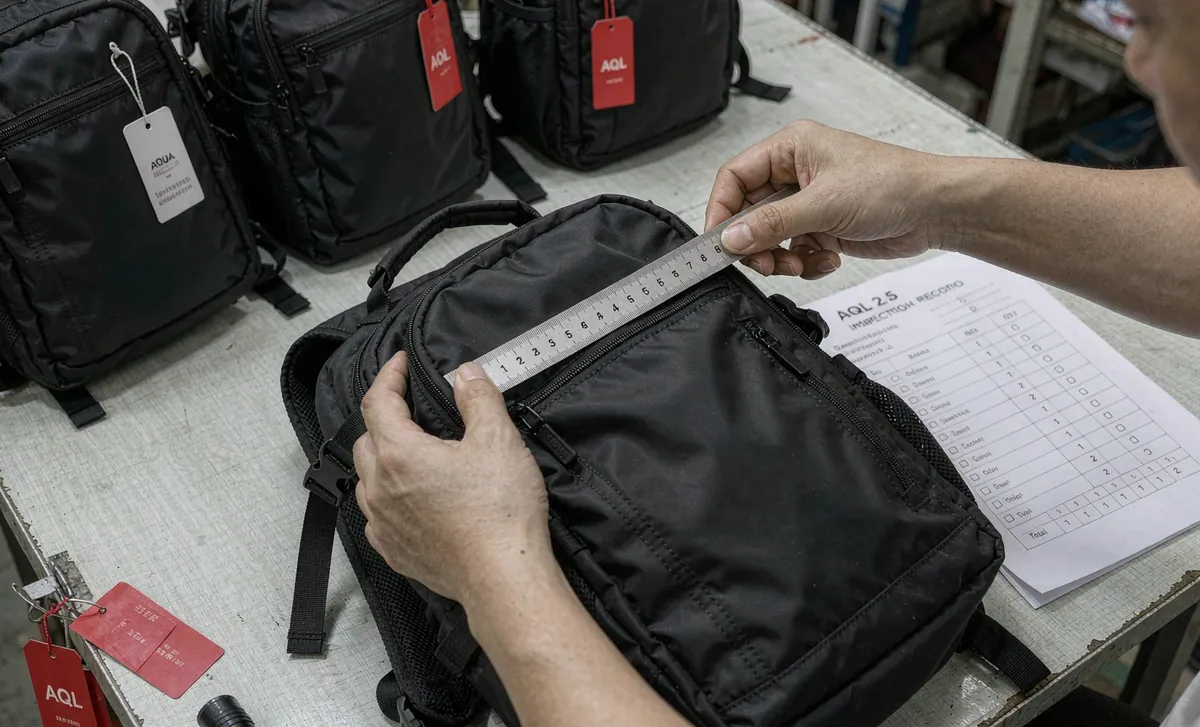
Table of Contents
- Why Care Instructions Belong in the Tech Pack
- The 6-Step Care Protocol, Step by Step
- Salt, Sand and Sunscreen: Three Residues, Three Washes
- Drying: The Warmth and Airflow Window
- Seam Tape and Weld Inspection: The Edge Creep Check
- DWR Re-Proofing: When, How and How to Verify
- Puncture and Abrasion Repair: Patch Kits and Field Fixes
- Storage: Compression, Fold Lines and Cold Crack
- The Care Label and Insert Pack We Ship With Bulk
- A Service-Life Simulation We Run Before Sign-Off
- What Care Cannot Fix: Failure Modes Beyond Maintenance
- Maintenance Wording That Reduces Warranty Disputes
- Care Protocol Inside a 500-Piece OEM Order
- Frequently Asked Questions
- People Also Ask
Why Care Instructions Belong in the Tech Pack
A waterproof bag is a coated or laminated textile assembly with a closure, and its performance degrades with use in ways that are largely predictable. The degradation is not linear and it is not random: it tracks how the bag is washed, how it is dried, what it is stored against and how often its closure is cycled with grit present. Those are all user behaviours, which means they can be influenced by documentation.
Brands usually discover this the expensive way. A retail page says waterproof, a customer returns a bag that leaks at the fold, and the investigation concludes that the fold was never cleaned and the bag was stored rolled while damp. None of that appears anywhere in the product documentation, so the brand absorbs the cost and the review. Putting a care protocol in the tech pack moves the same information to the front.
We treat care as part of the specification rather than an afterthought. The protocol is written alongside the fabric choice, because a TPU laminate and a PVC-coated scrim do not want identical treatment, and it is reviewed at the same time as the closure, because the closure is the part most affected by how the bag is cleaned. Our testing references for the underlying performance claims sit in the waterproof ratings documentation.
The 6-Step Care Protocol, Step by Step
The protocol is deliberately short. Six steps fit on an insert card, and an instruction longer than that is not read. We write each step as an action with a reason, because users follow instructions far more reliably when they understand why the instruction exists.
- Rinse after exposure: fresh water on the outside and inside, with the closure open, to remove salt and grit before they crystallise.
- Wash only when needed: lukewarm water and a pH-neutral agent, no solvents, no bleach, no fabric softener, no machine wash.
- Dry open and inverted: mouth open, interior exposed to moving air, away from direct heat sources and out of direct sun for long periods.
- Inspect the closure and the seams: look for edge lift at welds, tape creep at stitched seams and grit in the closure track.
- Re-proof the outer face when water stops beading: apply, cure at the stated temperature, then verify with a spray check.
- Store empty, dry and loosely packed: no compression, no tight folds, no contact with solvents or sharp hardware.
Step three is the one that prevents the most damage. Hydrolysis is a chemical reaction between water and the polymer, and it accelerates with heat, so a bag dried on a radiator or left sealed in a hot vehicle ages far faster than the same bag dried in moving air at room temperature. We state a warmth and airflow window rather than simply saying dry it.
Step four is the one that catches failures early. A weld edge that has begun to lift is visible long before it leaks, and a tape edge that has begun to creep can be re-activated rather than replaced. Both are cheap interventions found by looking, which is why inspection is a scheduled step rather than an instruction to check occasionally.
Salt, Sand and Sunscreen: Three Residues, Three Washes
Three residues account for most of the cleaning questions we receive, and they need three different treatments. Salt is water soluble and disappears with a fresh-water rinse, but it must be rinsed before it dries, because crystallised salt in a closure track is abrasive and will wear the closure every time it is opened. Sand is insoluble and has to be removed mechanically before washing, otherwise the wash moves it into the seams.
Sunscreen is the difficult one. Many formulations contain oils and UV filters that sit on the film surface, attract dirt and, in some cases, plasticise a coating locally, leaving a soft patch that then abrades. A pH-neutral detergent in lukewarm water removes most of it; solvent-based removers are effective on the stain and destructive to the coating, so they are excluded from our care copy entirely.
| Residue | Solubility | First action | Agent we permit | Agent we prohibit |
|---|---|---|---|---|
| Sea salt | Water soluble | Rinse before it dries | Fresh water, lukewarm | None required |
| Sand and grit | Insoluble | Brush or shake out dry | Water after mechanical removal | Compressed air into a closure track |
| Sunscreen and oil | Oil soluble | Blot, then wash | pH-neutral detergent, lukewarm | Solvents, alcohol, bleach |
| Silt and mud | Water dispersible | Rinse, then wash | Water, soft cloth | Stiff brush on a coated face |
| Fuel or oil vapour | Oil soluble | Air out, then wash | Detergent, repeated rinse | Solvent wipe on the film face |
The prohibited column matters as much as the permitted one, because a customer who reaches for a solvent will remove the mark and the coating together. Naming the prohibited agents explicitly is the single most effective line we put on a care label, and it costs nothing to print.
Drying: The Warmth and Airflow Window
Drying is where a bag's service life is decided. Water left in a folded seam, a closed closure or a hollow strap is water that keeps reacting with the polymer, and heat speeds that reaction. The instruction we print is specific: open the closure fully, invert the bag, expose the interior to moving air, keep the temperature moderate and keep it out of prolonged direct sun.
Direct sun deserves a note of its own. Ultraviolet radiation degrades both the film and the coating, and a bag left on a dashboard or hung on a balcony rail accumulates dose even while it dries. We recommend shade with airflow, which dries almost as fast and costs the bag far less. Where a fleet operator needs faster turnaround, a warm room with a fan is the right answer.
- Open the closure fully so air reaches the fold, which is the last place to dry.
- Invert the bag so water leaves rather than pooling in the base.
- Keep temperature moderate; heat accelerates hydrolysis in both TPU and PVC coatings.
- Avoid prolonged direct sun; ultraviolet dose accumulates even on a drying bag.
- Check hollow strap webbing and drain grommets, both of which hold water longer than the panels.
Seam Tape and Weld Inspection: The Edge Creep Check
A welded seam fails at its edge, not through the middle. The film lifts a fraction of a millimetre at the boundary, grit works into the gap, and the lift progresses until water has a path. That progression is slow and visible, which makes it inspectable. We teach a simple edge creep check that a retailer or a fleet operator can run without equipment.
The check is a visual and tactile pass along every seam: run a fingernail lightly along the weld boundary and look for a step you can feel, a change in gloss along the edge, or a line of embedded dirt that follows the seam rather than crossing it. Any of those three is early creep. On a stitched and taped seam, the same check looks at the tape edge for lift, bubbling or a white line where the adhesive has let go.
| Observation | Location | Interpretation | Action |
|---|---|---|---|
| Gloss change along the weld edge | Any welded seam | Early lift of the film boundary | Re-weld or patch before it propagates |
| Fingernail catches a step | Weld boundary | Creep beyond the cosmetic stage | Schedule repair, retire from wet service |
| Dirt line following the seam | Along the seam | Grit embedded in the lift | Clean, dry, then re-inspect |
| Tape edge bubbling | Stitched and taped seam | Adhesive release | Re-activate with heat if caught early |
| White crease at a fold | Panel fold line | Coating fatigue from repeated folding | Change the storage fold, monitor |
We specify this check in the documentation pack because it converts an invisible failure into a scheduled one. A bag found at the gloss-change stage can often be repaired; the same bag found at the leak stage usually cannot, and by then the customer has already written a review.
A fleet or rental operator should formalise this step rather than leave it to individual users. We suggest a drying rack with spacing between bags, a log of which bags are out of service for drying, and a rule that no bag is packed for storage until the closure fold is dry to the touch. Those three controls cost almost nothing and remove the majority of odour and coating complaints that a rental business sees.
DWR Re-Proofing: When, How and How to Verify
The durable water repellent finish on the outer face is a consumable, not a permanent property. It makes water bead and roll off instead of wetting the face fabric, and it degrades with abrasion, with washing and with contamination. When it degrades, the bag stays waterproof because the film is underneath, but the face fabric wets out, the bag feels heavy and cold, and users report that it has stopped being waterproof.
Re-proof when water stops beading and starts soaking into the face, not on a fixed calendar. Clean and dry the bag first, apply the reproofing agent evenly to the outer face, cure it at the temperature stated by the agent manufacturer, and then verify. Verification is a spray test: water applied to the treated face should bead and shed, and the underlying hydrostatic head is unchanged because the film was never the part that failed.
Spray resistance is graded under AATCC 22 and shower resistance under AATCC 35, and hydrostatic resistance of the shell itself is measured to ISO 811. Those three measure different things and a care document should not confuse them: re-proofing restores the spray grade, it does not restore a film that has been punctured. We reference the distinction in the care insert so a user knows what re-proofing can and cannot achieve.
Puncture and Abrasion Repair: Patch Kits and Field Fixes
Small punctures and abraded patches are repairable on most constructions, and a brand that ships a repair path keeps a customer who would otherwise return a bag. The method depends on the shell. A welded TPU shell takes a heat-applied patch, a PVC-coated shell takes a solvent or adhesive patch, and a coated nylon shell takes an adhesive patch with less strength than either.
The steps are the same regardless: clean the area, dry it completely, round the corners of the patch so it cannot peel from a corner, apply with even pressure, and let it cure before the bag is loaded. A patch applied to a damp surface will lift, and a patch applied under load will creep, so both conditions are stated in the instruction.
- Round the patch corners; a square patch peels from the corner first.
- Dry the area fully before application; a damp surface defeats any adhesive.
- Apply to the interior as well where the puncture is accessible, giving a two-sided repair.
- Cure before loading, and avoid folding the repaired area during the cure.
- Retire the bag from immersion service after a repair; a patched area is splash resistant, not re-rated.
Where a programme supplies its own repair kit, we match the patch film to the shell rather than shipping a generic patch. A patch with a different coating chemistry will bond initially and then release, because the two films move differently with temperature and moisture. Matching the film is a small specification detail that determines whether the repair holds through a season or fails in the first month.
Storage: Compression, Fold Lines and Cold Crack
Two storage mistakes shorten bag life more than any other. The first is storing a bag compressed under other kit, which keeps a loaded fold in the film for months and produces a permanent crease that eventually cracks. The second is storing a bag tightly rolled in the same direction every time, which puts the fatigue in one line instead of distributing it.
Cold is the third. A coating that is flexible at room temperature can be stiff enough to crack at low temperature if it is folded while cold, and the crack appears at the moment of handling rather than during storage. We check low-temperature flexibility as part of film selection, and we tell users to unpack a bag at room temperature before folding it tightly.
The storage rule we print is therefore simple: empty, dry, loosely packed or hung, away from solvents, away from sharp hardware and away from sustained compression. For rental and fleet operators we add a rotation note, because a bag that is used weekly ages better than one that sits for a season and is then put straight into service.
The Care Label and Insert Pack We Ship With Bulk
Care documentation is a deliverable, and we treat it like one. Every bulk order can ship with a woven or printed care label attached to a specified position, a folded insert card written in the destination language or languages, and a digital file set the brand can use on its own retail pages and marketplace listings.
We ask three questions at specification time. Which languages are required for the destination market. Whether the label is sewn, welded or applied as a transfer, because a sewn label puts needle holes in a waterproof panel unless it is placed off the wet path. And whether the brand wants a QR reference on the card pointing at its own extended guide, which we can supply as artwork.
| Deliverable | Format | Placement | When it is specified |
|---|---|---|---|
| Care label | Woven, printed or transfer | Off the wet path, usually inside a pocket | At tech pack stage |
| Insert card | Folded card, one to four languages | Packed inside each bag | At packaging specification stage |
| Retail copy file | Text file for listings | Brand owned | At sample approval |
| Repair patch | Die-cut patch in a matched film | Supplied loose or in a pocket | At bulk order confirmation |
| Icon set | Care symbols | Printed on label or card | At artwork approval |
The patch row is worth noting because it is the least expensive item in the pack and the one most likely to prevent a return. A die-cut patch in the matched film costs a fraction of a replacement bag and turns a puncture from a warranty claim into a five-minute repair.
A Service-Life Simulation We Run Before Sign-Off
Before a construction is released for a programme, we put it through a combined ageing sequence that compresses the conditions a bag meets in service into a short laboratory cycle. The point is not to predict a number of years, which would be unsupportable, but to rank two candidate constructions against each other under identical abuse so the choice is evidence-based.
The sequence combines wet-dry cycling, ultraviolet exposure, abrasion at a contact point and closure cycling with grit present. Samples are pulled at intervals and checked for hydrostatic head retention, weld peel strength, coating adhesion and closure ingress. A construction that retains its head figure and its peel strength through the sequence is preferred over one that starts higher and falls faster.
| Sequence stage | Condition | Duration | What is measured after |
|---|---|---|---|
| Wet-dry cycling | Soak and dry cycles | Repeated cycles | Head retention, weld peel |
| Ultraviolet exposure | Controlled UV dose | Set interval | Face chalking, colour change, peel |
| Contact abrasion | Loaded abrasion at a wear point | Set cycles | Face wear, coating loss |
| Closure cycling with grit | Open and close with grit applied | Set cycles | Ingress at the closure, slider wear |
| Cold fold | Fold at low temperature | Single check | Cracking or whitening at the fold |
Head retention is measured to ISO 811 and coating adhesion behaviour to ASTM D751, so the numbers produced by the sequence are comparable with the numbers on the specification sheet. A brand that sees this table can compare two quotes on evidence rather than on a sample that looked good on a desk.
Brands sometimes ask whether the simulation can be shortened to fit a launch date. It can be run on a reduced sequence, but the ranking becomes weaker, and the risk is that two constructions that differ mainly in long-term head retention look identical in a short test. Where a launch date is fixed, we recommend running the full sequence on the two leading candidates only, rather than a shortened sequence on four.
What Care Cannot Fix: Failure Modes Beyond Maintenance
An honest care document also says what it cannot do. Care cannot restore a film that has been punctured by a sharp edge, cannot repair a weld that has progressed beyond cosmetic creep, cannot reverse ultraviolet chalking of a face fabric, and cannot make a closure that was specified too short seal reliably no matter how carefully it is rolled.
Naming those limits is good commercial practice rather than a liability admission. A customer who understands what maintenance achieves will maintain the bag, and a customer who believes maintenance can fix anything will eventually be disappointed and will write about it. The care document is also where we direct users to the repair and replacement route the brand operates.
Maintenance Wording That Reduces Warranty Disputes
Warranty disputes on waterproof products usually turn on one question: was the failure a defect or was it the result of use? That question is much easier to answer when the care document existed before the sale and describes the exclusions in plain language. We write exclusions as descriptions of conditions rather than as legal phrases.
- Describe the condition, not the clause: stored wet and closed leads to coating damage, rather than damage caused by improper storage is excluded.
- State the prohibited agents by name: solvents, bleach, fabric softener and machine washing.
- State the service the rating covers: spray, shower or temporary immersion under IEC 60529, with the condition attached.
- Give the inspection interval so early creep is found before it becomes a leak.
- Give the repair route, including the patch supplied with the product where the brand chooses to include one.
The third item is the one that prevents the largest share of disputes. A bag sold as waterproof without saying which water it is waterproof against invites a submersion test, and a bag designed for spray will fail that test through no defect of its own. Naming the service condition protects the brand and sets the right expectation.
Care Protocol Inside a 500-Piece OEM Order
The care protocol is specified at the same time as everything else in the order, because it depends on the fabric and closure decisions and because the artwork has a lead time. We confirm languages, label format and insert content at sample approval, and the printed items are produced alongside the goods so they arrive in the same cartons.
Order terms are unchanged by adding documentation. Minimum is 500 pcs per style per colour, sampling takes 6-10 working days and 12-15 working days for complex builds, and bulk production runs 35-50 days from approval. Shipments are quoted FOB Xiamen with T/T 30% deposit and 70% before shipment, and finished goods are inspected to AQL 2.5 under ISO 2859-1 before the balance is called.
QUANZHOU JUNYUAN BAGS was established in 2014 with our founder in the bag trade since 2004, and we document care and compliance on capacity verified by SGS: 4,950 square metres, 7 production lines, 149 pieces of equipment, 137 staff and 200,000 pieces per month. Documentation per destination market can cover CE, CPC, RoHS, REACH and OEKO-TEX, with QC run to ISO 9001-aligned procedures, with REACH and RoHS substance declarations handled at material selection rather than at the end. Care wording is reviewed by the same team that runs the quality and inspection programme, and current constructions are listed under products.
To add a care protocol to an existing or new programme, send the shell type, closure type and destination markets to service@junyuanbags.com or message the team on WhatsApp at +86 177 5002 0688. If you are still choosing between constructions, the custom programme page explains how fabric and closure decisions are made before sampling starts.
Frequently Asked Questions
Q1: What is the correct way to clean a waterproof bag?
A: Rinse it with fresh water after exposure to salt or sand, then wash only when needed using lukewarm water and a pH-neutral detergent. Do not machine wash, do not use solvents, bleach or fabric softener, and never brush a coated face with a stiff brush, because abrasion removes the finish that the film relies on for protection.
Q2: How should a waterproof bag be dried?
A: Open the closure fully, invert the bag and let the interior dry in moving air at moderate temperature. Avoid radiators, avoid sealed hot spaces and avoid prolonged direct sun, because heat accelerates hydrolysis in the coating and ultraviolet exposure accumulates even while the bag is drying.
Q3: Why does my bag stop beading water but still not leak?
A: The durable water repellent finish on the outer face has worn off while the waterproof film underneath is still intact. The face fabric wets out, the bag feels heavy and cold, and users read that as a leak. Re-proofing the outer face restores the beading behaviour and is verified with a spray check under AATCC 22.
Q4: How often should a waterproof bag be re-proofed?
A: Re-proof when water stops beading rather than on a fixed calendar, because use patterns vary enormously. Clean and dry the bag first, apply the agent evenly to the outer face, cure it at the temperature the agent manufacturer states, then verify by spraying water on the treated face and checking that it beads and sheds.
Q5: Can a punctured waterproof bag be repaired?
A: Yes, on most constructions. A welded TPU shell takes a heat-applied patch, a PVC-coated shell takes a solvent or adhesive patch, and a coated nylon shell takes an adhesive patch with lower strength. Clean and dry the area thoroughly, round the patch corners so it cannot peel from a corner, and cure before loading.
Q6: What is seam edge creep and how do I spot it?
A: Edge creep is the slow lift of a film at the boundary of a weld, and it is visible long before it leaks. Run a fingernail lightly along the weld boundary and look for a step you can feel, a change in gloss along the edge, or a line of embedded dirt that follows the seam rather than crossing it.
Q7: Is it safe to put a waterproof bag in a washing machine?
A: No. Agitation abrades the coating, detergent residue interferes with the water repellent finish, and a spin cycle folds the bag under load at a crease it will remember. Hand washing in lukewarm water with a pH-neutral agent is the method we specify on every care label we produce.
Q8: How should waterproof bags be stored off-season?
A: Store them empty, completely dry and loosely packed or hung, away from solvents, sharp hardware and sustained compression. Avoid rolling them tightly in the same direction every time and avoid folding a cold bag, because a coating that is flexible at room temperature can crack when folded at low temperature.
Q9: Do you supply care labels and inserts with bulk orders?
A: Yes. Every bulk order can ship with a woven, printed or transfer care label placed off the wet path, a folded insert card in the required languages, and a digital copy file the brand can use on its own listings. We confirm languages and formats at sample approval so the items arrive in the same cartons as the goods.
Q10: What should a care label say to reduce warranty claims?
A: Describe conditions rather than clauses, name the prohibited agents explicitly, state which water service the rating covers, give an inspection interval and give a repair route. The most important line is the service condition, because a bag sold as waterproof without qualification invites a submersion test it was never specified for.
Q11: Does sunscreen damage a waterproof bag?
A: It can. Many formulations contain oils and UV filters that sit on the film surface, attract dirt and can plasticise a coating locally, leaving a soft patch that then abrades. Blot, then wash with a pH-neutral detergent in lukewarm water, and avoid solvent removers, which take the mark and the coating together.
Q12: What maintenance cannot fix on a waterproof bag?
A: Maintenance cannot restore a punctured film, cannot repair a weld that has progressed beyond cosmetic creep, cannot reverse ultraviolet chalking, and cannot make an undersized closure seal reliably. Naming those limits in the care document sets the right expectation and prevents the disappointment that turns into a negative review.
Q13: How do you test whether a construction will last?
A: We run a combined ageing sequence of wet-dry cycling, ultraviolet exposure, contact abrasion, closure cycling with grit and a cold fold check, then measure head retention to ISO 811 and coating behaviour to ASTM D751. The sequence ranks two candidate constructions under identical abuse rather than predicting a number of years.
Q14: What are the order terms if I add care documentation?
A: Terms are unchanged: 500 pcs per style per colour, sampling in 6-10 working days or 12-15 for complex builds, bulk production in 35-50 days from approval, FOB Xiamen, and T/T 30% deposit with 70% before shipment, with finished goods inspected to AQL 2.5 under ISO 2859-1.
People Also Ask
- How do you clean a waterproof bag?
- Can you wash a dry bag in a washing machine?
- How do you re-waterproof a bag?
- Why is my waterproof bag leaking at the seam?
- How do you store a dry bag?
- Can a welded seam be repaired?
- How long should a waterproof bag last?