
Minimalist Waterproof Backpack: Design Rules for OEM
Minimalism in a waterproof backpack is not an aesthetic, it is a manufacturing position: fewer panels, fewer seams, fewer penetrations and therefore fewer leak paths. A shell reduced from 18 panels to 9 removes roughly a third of the seam length and every penetration that went with it, which improves water resistance, cuts sewing minutes and lowers the defect rate at the same time. The trade-offs are real, though, because removing hardware removes function and removing seams removes the shaping that makes a bag comfortable. This page sets the eight rules that let a clean silhouette and a 10,000 mm hydrostatic head coexist.
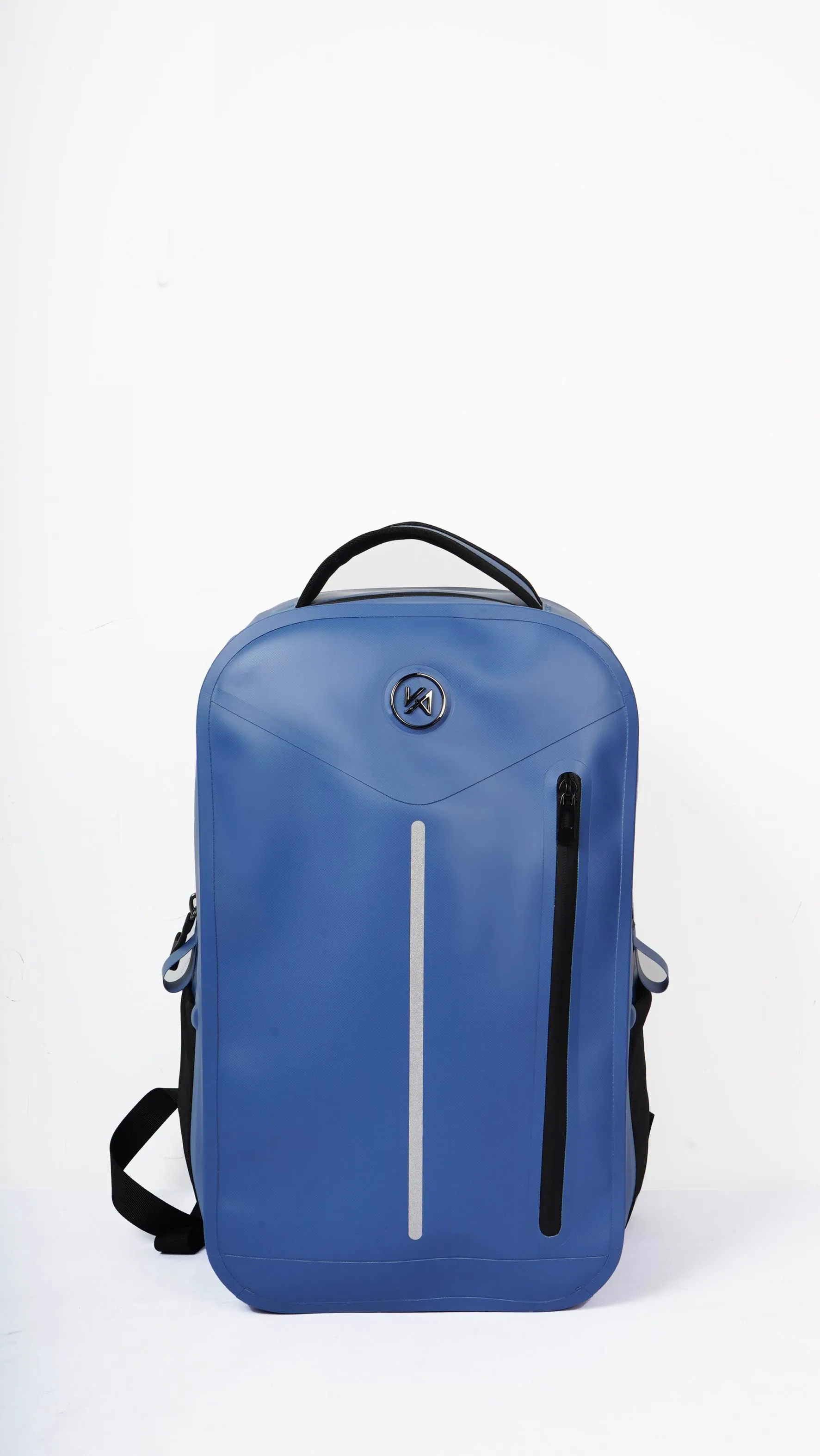
Table of Contents
- What Minimalist Means Technically
- Fewer Panels, Fewer Leak Paths
- Seam Count as a Design Metric
- Hardware Reduction and Its Risk
- Closure Options for a Clean Silhouette
- Material Choices for a Quiet Surface
- Cost Impact of Simplification
- A Minimalist Design Checklist
- Frequently Asked Questions
- People Also Ask
What Minimalist Means Technically
In a consumer listing, minimalist means a plain front, a hidden logo and one colorway. In a specification, it means something much more useful: a low panel count, a short total seam length, no external webbing, no decorative stitching and a single visible closure. Those five properties are measurable, and each one of them makes the bag drier, cheaper to assemble and easier to inspect.
The reason is that every feature on a bag is a potential failure. A daisy chain is a set of stitch penetrations through the shell. A compression strap is four attachment points plus a buckle. A front pocket is a second closure, two side seams and a drain path. Remove the feature and you remove the leak path, the inspection point and the assembly operation, and you gain water performance without changing the fabric at all.
There is a commercial reason too, and it is the one that makes minimalism attractive to a brand rather than only to a designer. A simplified shell uses less material per unit, needs fewer minutes on the line and produces a lower defect rate, so it can be sold at the same retail price with better margin or at a lower price with the same margin. Both are defensible strategies, and the manufacturing choice supports either.
The discipline is that minimalism has to be engineered, not just drawn. A bag that looks simple and is built from 18 panels with 12 metres of seam is not a minimalist product, it is a decorated one, and it will perform like one. Require the panel count and the total seam length on the tech pack, because those two numbers tell you what you are actually buying. The shells we build for this category are shown on the waterproof bag product range page.
Fewer Panels, Fewer Leak Paths
Panels exist to create shape and to place materials where they are needed, and each one costs a seam. A conventional 25-litre backpack might be cut from 16 to 20 panels including the back system, the shoulder straps, the lid, the base and two side pockets. A welded minimalist shell of the same volume can be built from 7 to 9, because a weld can join two flat panels along a curve in a way that a sewn seam cannot, and because the shaping can come from the closure geometry rather than from extra pieces.
Cutting the panel count from 18 to 9 typically removes 30 to 40 percent of the total seam length. That is a direct water-performance gain, because seam length is the integral of leak risk: a welded seam has a small fail rate per metre and a taped seam a larger one, and either way the probability of at least one defect scales with length. Fewer metres of seam means fewer warranty claims, and it is the cheapest water-performance improvement available.
The gain is not free, and the buyer should know where it is paid for. A shape that used to come from a gusset and a curve has to come from somewhere else, and the two options are a welded three-dimensional seam or a simpler, flatter silhouette. The welded curve is the better product and needs a weld tool; the flat silhouette is the cheaper one and looks it. Most minimalist products on the market are the second, and that is a legitimate choice at a price point.
| Construction | Panel Count | Total Seam Length (m) | Assembly Minutes | Typical Use |
|---|---|---|---|---|
| Conventional sewn 25 L | 16 to 20 | 11 to 14 | 38 to 45 | Feature-rich outdoor bag |
| Simplified sewn shell | 12 to 14 | 8 to 10 | 30 to 36 | Mid-market commuter bag |
| Welded minimalist shell | 7 to 9 | 5 to 7 | 18 to 24 | Clean urban and travel bag |
| Tubular welded body | 4 to 5 | 3 to 4 | 14 to 18 | Dry bag style backpack |
The extreme of this logic is the tubular welded body, where the shell is one panel joined along a single seam and closed at the top. It is the driest construction available, it is the cheapest to assemble, and it is the least shaped. Products built that way are the 50 L dry bag family rather than a structured pack, and that is the right place for it.
Seam Count as a Design Metric
Seam count is the single most useful number on a waterproof bag tech pack and almost nobody asks for it. Panel count tells you about the shape; seam length in metres tells you about the water performance and the cost. Require the supplier to state the total seam length, the seam method for each seam type and the tape width or the weld width in millimetres, and you will have a specification that two suppliers can be compared on.
Count the penetrations separately, because they behave differently from seams. A seam is a long joint with a known method; a penetration is a discrete hole, and a hole in a film is a leak unless it is sealed. Every strap root, every D-ring, every label and every eyelet is a penetration, and the minimalist position is that each one has to justify itself. A bag with 6 penetrations will outperform an identical bag with 20, and the difference will not show up in any test a buyer usually runs.
There are two ways to close the gap without adding seams. The first is to weld attachment points into a seam allowance, so a strap root is captured in an existing joint rather than stitched through the shell. The second is to bond or weld the attachment to the outside face with a wide footprint, which spreads the load and needs no hole at all. Both are standard in a welded construction, and both are unavailable in a stitched one.
Set a target and hold it. For a 20 to 25 litre minimalist shell, a total seam length under 7 metres and a penetration count under 8 is a reasonable and achievable target. If a supplier's sample comes in at 12 metres and 20 penetrations, it is not a minimalist product regardless of what it looks like on a photograph. The welding techniques guide shows what is achievable on the joint types.
Hardware Reduction and Its Risk
Hardware is where a clean design meets a functional limit. A minimalist silhouette wants no buckles, no webbing and no external loops, and a user wants somewhere to put a water bottle, a bike light and a wet jacket. Remove all the hardware and the bag photographs beautifully and irritates its owner within a week. The answer is not to remove everything, it is to remove strategically.
Remove hidden hardware first. Interior organisers, key clips and internal compression straps add operations and penetrations and are invisible in use, so they are the cheapest things to delete. Keep external functional hardware: a shoulder strap adjustment, a top handle and, for most markets, a pair of side pockets. Remove decorative hardware entirely, including the rubber patch, the woven flag label and the contrast bartacks that read as feature.
There are three reductions that carry real risk, and each needs a mitigation. Removing side pockets removes the water bottle, so replace them with an internal sleeve or accept a bag that is sold with a bottle inside. Removing compression straps removes load stabilisation, so a partly filled bag will swing; mitigate with a roll-top that compresses the volume instead. Removing a sternum strap is fine below 25 litres and uncomfortable above it.
Every remaining hardware item should also be a water decision. A metal D-ring on the outside is a corrosion point and a penetration; a moulded loop welded into a seam is neither. For a bag sold into a marine or a wet climate, require nickel-free or stainless finishes on anything that remains and a defined break load on each attachment. The finishes we specify are listed under quality and materials.
Closure Options for a Clean Silhouette
The closure is the only feature a minimalist bag is allowed to show, so it has to carry the design and the water performance at the same time. Four options compete, and they rank differently on appearance and on performance, which is why the decision is the most consequential one on the whole tech pack.
A roll-top is the strongest and the most recognisably technical. It gives an IPX7 or IPX8 result at the closure, it has no wearing part, and it looks purposeful. Its cost is a tall, narrow mouth that is slow to open and a silhouette that is hard to make elegant. Use a roll-top where the water claim is the selling point and where the user will accept a slower opening, which is most dry-bag-derived products.
A hidden waterproof zipper across the top is the cleanest visually and the most convenient to use. It gives IPX5 or IPX6 when the slider is correctly seated, it flattens the silhouette, and it can be concealed under a flap so that only the pull shows. Its cost is that it needs a slider garage, periodic lubrication and a 500-cycle test, and it is the one part on the bag that will wear out before the shell does.
A magnetic or cam-lock flap is the most refined and the least water-resistant, holding IPX4 at best. On a minimalist bag that is never going to be submerged, IPX4 is entirely sufficient and the refinement is worth more than the rating, so this is a legitimate choice for an urban product. Require a secondary snap so the flap cannot open under load, and require the immersion claims to be dropped from the copy entirely.
Whatever is chosen, the closure needs a drain path. Water enters a top-opening bag every time it is opened in the rain, and a minimalist shell with no drain will hold that water at the base. A small welded drain grommet at a low corner is a one-cent part that prevents the most common complaint about a clean-looking bag: a puddle in the bottom. Read the zipper types comparison before you commit.
Material Choices for a Quiet Surface
A minimalist bag is looked at more closely than a decorated one, because there is nothing else to look at. That makes the surface the design, and three material properties decide whether it reads as premium or as cheap: gloss, hand and consistency. A high-gloss TPU film looks like a rain cover; a matte or a lightly textured one looks like a product. A stiff hand looks inexpensive; a soft one looks considered.
Consistency is the property buyers underrate. A flat panel in a single colour shows every weld mark, every crease and every variation in the film, and two panels cut from different rolls can read as two colours under a retail light. Require a single production lot for the visible panels of a run, require the weld width to be held within a tolerance, and reject samples with visible weld flash on the face.
The material still has to perform, and the minimalist aesthetic is compatible with a strong specification. A 420D or 840D TPU-laminated shell at 10,000 mm hydrostatic head to ISO 811 or higher gives a smooth, matte, quiet surface and a genuine water claim. Where a softer hand is wanted, a 300D or 420D laminate on a lighter base does it, at some cost in abrasion resistance. AATCC 22 gives the spray figure to quote alongside.
Colour choice is the last material decision and it interacts with the environment. A dark film in direct sun reaches a considerably higher surface temperature than a light one, and a matte surface hides the scuffs that a gloss one makes obvious. For a product sold into a hot climate, a mid-tone is the practical answer. For UV stability, the film choice matters more than the colour, and the UV resistance testing guide covers what to require.
Cost Impact of Simplification
Simplification moves cost in three directions at once, and the net result depends on which direction dominates. Material use falls, because fewer panels means a more efficient cutting layout and less waste. Labor falls, because fewer seams and fewer features means fewer minutes per unit. But two things rise: the weld tool if the shape demands one, and the material quality if the surface is now the design.
The labor number is the largest and the most reliable. A conventional 25-litre sewn backpack takes 38 to 45 minutes of assembly; a welded minimalist shell of the same volume takes 18 to 24. That is a reduction of roughly 40 percent on the dominant variable cost in the product, and it is available without any change to the fabric. It is the strongest economic argument for the minimalist position, and it applies at every volume.
Material savings are real but smaller, and they depend on the layout. Fewer, larger panels nest better than many small ones, and a shape that can be cut from a rectangle wastes far less than one cut from a curve. Ask the supplier for the marker efficiency on the tech pack, because a 5 percent improvement there is worth more per unit than a cheaper film would be, and it does not cost performance.
The cost that rises is quality. A bag where the surface is the design cannot hide a weld mark or a scuff, so the reject rate on appearance goes up and the inspection has to be visual as well as functional. Build that into the plan: require a defined appearance standard with acceptable and reject photographs, and inspect to it under consistent lighting. We inspect to AQL 2.5 (ISO 2859-1) and add an appearance check on the same sample set.
A Minimalist Design Checklist
A minimalist product is the result of a series of subtractions, and subtractions need to be reviewed before they are made. Use this checklist at the design review, and require each one to be answered with a number rather than with an intention. A bag that survives the list will be clean, dry and cheap to build; one that does not will be clean in a photograph and compromised in the field.
- Panel count stated, with a target of 9 or fewer for a 20 to 25 litre shell.
- Total seam length in metres stated, with a target under 7 m and the seam method named for each type.
- Penetration count stated, with a target under 8, and every attachment welded into a seam allowance where possible.
- Hardware list reduced to functional items only, with a justification recorded for each one that remains.
- Closure chosen on appearance and performance together, with the IPX class of the closure named separately from the shell.
There is a second half to the checklist, and it is the half that protects the brand after the product ships. A minimalist bag has fewer parts, which means each remaining part carries more of the product's reputation. If the only visible closure fails, there is no second pocket or strap to distract the customer from it. Over-specify the parts that remain and publish the water performance honestly.
Commercial terms hold across the range: MOQ 500 pcs per style and colourway, sampling in 6 to 10 working days and 12 to 15 when the structure is complex, bulk production in 35 to 50 days, inspection to AQL 2.5 (ISO 2859-1), FOB Xiamen and T/T 30/70. QUANZHOU JUNYUAN BAGS has run OEM and ODM programs since 2014 across 7 production lines and 149 machines in a 4,950 m2 facility at 200,000 pcs per month, holding BSCI audited, ISO 9001:2015 and SGS-verified status. Start from the waterproof backpack range or the OEM programme page.
Frequently Asked Questions
Q1: What makes a backpack design minimalist in manufacturing terms?
A: A low panel count, a short total seam length, no external webbing, no decorative stitching and a single visible closure. Those five properties are measurable, and each one removes leak paths, assembly minutes and inspection points, which is why minimalism improves water performance as well as appearance.
Q2: How many panels should a minimalist 25-litre backpack have?
A: Seven to nine for a welded shell, against 16 to 20 for a conventional sewn backpack of the same volume. Fewer panels removes 30 to 40 percent of the total seam length, and since leak risk scales with seam length, that is a direct gain in water performance with no change to the fabric.
Q3: What is a good target for total seam length on a minimalist shell?
A: Under 7 metres for a 20 to 25 litre shell, with the seam method named for each seam type and the weld or tape width given in millimetres. If a sample arrives at 12 metres, it is not a minimalist product regardless of how it photographs.
Q4: Does removing hardware make a backpack more waterproof?
A: Yes, because every strap root, D-ring and eyelet is a penetration through the shell, and a hole in a film is a leak unless it is sealed. Reducing the penetration count from 20 to 6 improves water performance in a way that no standard test will show but users will notice.
Q5: How do you attach a strap without puncturing a welded shell?
A: Weld the attachment into an existing seam allowance so the load is captured in the joint, or bond it to the outside face over a wide footprint. Both need no hole at all, and both are standard in a welded construction but unavailable in a stitched one.
Q6: Which closure is best for a clean minimalist silhouette?
A: A hidden waterproof zipper across the top is the cleanest visually and the most convenient, and it gives IPX5 or IPX6 when the slider is seated. A roll-top is stronger at IPX7 or IPX8 and looks purposeful, and a magnetic flap is the most refined but only holds IPX4.
Q7: What are the risks of removing hardware from a backpack?
A: Removing side pockets removes the water bottle, removing compression straps lets a partly filled bag swing, and removing a sternum strap is uncomfortable above 25 litres. Mitigate each one: an internal sleeve, a roll-top that compresses the volume, and a size limit on the strap removal.
Q8: Does a minimalist backpack cost less to manufacture?
A: Usually yes, and mainly on labor. A conventional 25-litre sewn backpack takes 38 to 45 minutes of assembly against 18 to 24 for a welded minimalist shell, a reduction of about 40 percent. Material savings are real but smaller, and a weld tool and a higher appearance standard add cost back.
Q9: What material gives a quiet premium surface on a minimalist bag?
A: A 420D or 840D TPU-laminated shell at 10,000 mm hydrostatic head or higher, in a matte or lightly textured finish. Gloss reads as a rain cover and stiffness reads as cheap, while matte and a soft hand read as considered. Hold the run to a single production lot for consistency.
Q10: Why does consistency matter more on a plain bag?
A: Because there is nothing else to look at. A flat single-colour panel shows every weld mark, every crease and every variation between rolls, and two panels from different lots can read as two colours under retail lighting. Require one lot for the visible panels and a weld width tolerance.
Q11: What is the MOQ for a custom minimalist backpack?
A: MOQ is 500 pcs per style and colourway. Sampling runs 6 to 10 working days, extending to 12 to 15 when the structure is complex, and bulk production runs 35 to 50 days. A minimalist shell is well suited to that volume because it needs fewer cutting files and less setup than a feature-rich design.
Q12: Should a minimalist bag be welded or sewn?
A: Welded, where the shape allows it. Welding joins two flat panels along a curve in a way a sewn seam cannot, so fewer panels are needed and the seams that remain are narrower and drier. Where a three-dimensional shape is required, a welded curve with a tool is the better product.
Q13: Does a minimalist design need a drain path?
A: Yes, because water enters a top-opening bag every time it is opened in the rain, and a clean shell with no drain holds it at the base. A small welded drain grommet at a low corner costs almost nothing and prevents the most common complaint about a good-looking bag.
Q14: How should appearance defects be inspected on a plain shell?
A: With a defined appearance standard backed by acceptable and reject photographs, inspected under consistent lighting. A bag whose surface is the design cannot hide a weld mark or a scuff, so the visual reject rate rises, and an AQL 2.5 (ISO 2859-1) inspection should include an appearance check on the same sample.
People Also Ask
Is a minimalist backpack more waterproof than a feature-rich one?
Usually yes, because fewer panels and fewer seams mean fewer leak paths and fewer penetrations. Moving from 18 panels to 9 removes roughly a third of the seam length, and leak probability scales with that length, so the gain is structural rather than a matter of better fabric.
What is the simplest waterproof backpack construction?
A tubular welded body, where the shell is one panel joined along a single seam and closed at the top. It is the driest and cheapest construction available, and the least shaped, which is why it appears on dry bag style packs rather than structured ones.
How do you make a plain backpack look premium?
Through the surface: a matte or lightly textured TPU film, a soft hand, a consistent single production lot and a tight weld width tolerance. With no decoration to distract, gloss, stiffness and colour variation all read immediately as cheapness.
Do roll-top backpacks look minimalist?
They look purposeful rather than minimal, because the rolled closure is visible and functional. They are the strongest option on water performance with no wearing part, and they suit a product where the water claim is the selling point more than the silhouette is.
Can a waterproof backpack have no visible zippers?
Yes, with a roll-top or a magnet closure under a flap. The trade is access speed and, for a magnet, a lower water class at IPX4. For an urban product that is never submerged, that trade is usually worth making for the clean line.
What size suits a minimalist backpack best?
20 to 25 litres, which is large enough for a daily load and small enough to hold its shape without external compression straps. Above 30 litres the lack of compression and a sternum strap becomes uncomfortable, which is where minimalism starts to cost function.
Does a simpler bag have fewer quality problems?
Fewer functional ones and more appearance ones. Fewer seams and penetrations cut the leak and assembly defect rate substantially, but a plain surface shows every weld mark and scuff, so the visual reject rate rises unless an appearance standard is inspected to.
How do you keep a minimalist bag from losing function?
Remove hidden hardware first: interior organisers, key clips and internal compression straps. Keep external functional items such as a top handle, a shoulder adjustment and side pockets, and delete decorative hardware entirely, including patches and contrast bar-tacks.