
Splash-Proof vs Waterproof vs Water-Resistant
Water-repellent, water-resistant and waterproof are three engineering states, not three marketing intensities. Water-repellent is a finish that makes water bead and is graded with AATCC 22. Water-resistant is a fabric and construction combination, proven with AATCC 35 or hydrostatic head under ISO 811. Waterproof is an article-level ingress limit, proven with IEC 60529 at a stated depth and time. Choose the word your product can be tested to, then print the condition next to it.
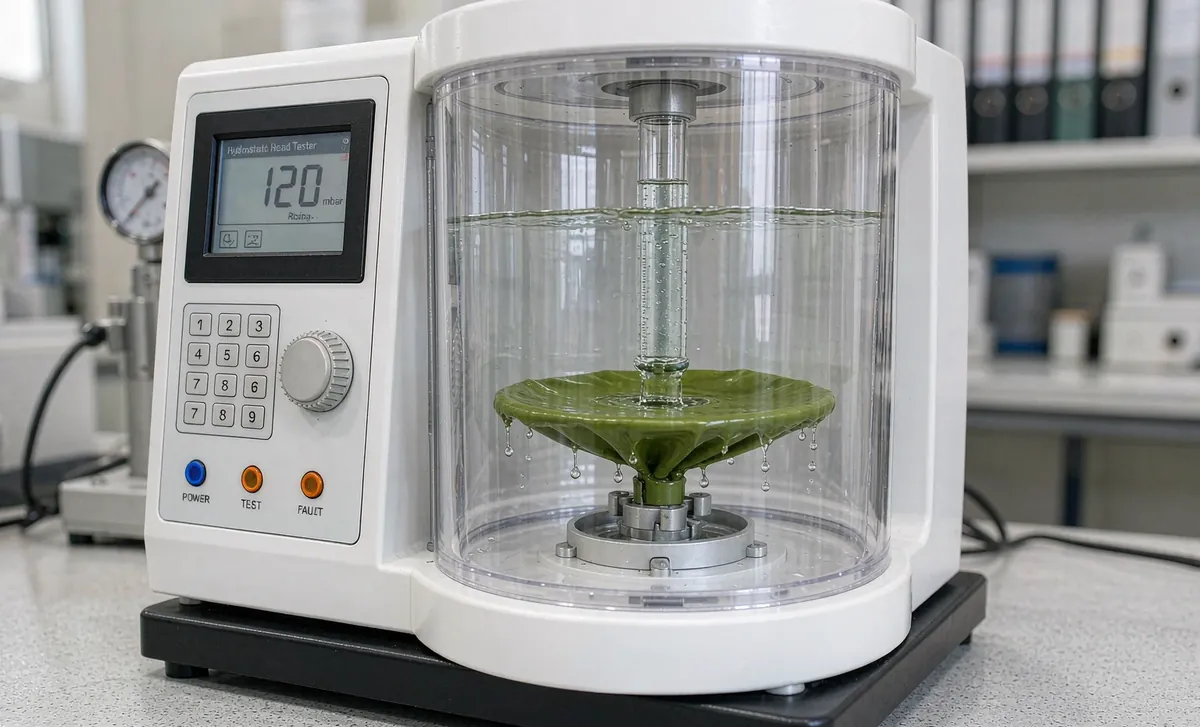
Table of Contents
- Three Words, Three Engineering States
- Water-Repellent: Finish Only
- Water-Resistant: Fabric Plus Construction
- Waterproof: Tested Ingress Limit
- How Each Word Is Tested and Proven
- Marketing Language vs Legal Exposure
- Choosing the Honest Word per Product
- Translating Claims for Export Markets
- Frequently Asked Questions
- People Also Ask
Three Words, Three Engineering States
The three words describe three different physical states, and each one is backed by a different test. Treating them as intensities of the same property is the root of most waterproof disputes, because a product can legitimately be excellent at one and poor at another, and the buyer who specifies the wrong word ends up with a product that fails a use case it was never designed for.
Water-repellent describes a surface. It means water beads and runs off rather than wetting the face fabric, which is a function of surface energy and is delivered by a finish. It carries no promise about what happens when water is pressed against the material, and it disappears with wear, washing and contamination.
Water-resistant describes a system. It means the combination of fabric, coating, seam method and closure resists the passage of water under a defined exposure, such as rain or light contact. It is a much stronger statement than repellent, and it depends on construction as much as on material.
Waterproof describes a limit, and strictly it should always be written with one. It means the assembled article was tested to a stated condition and no water entered. Without that condition the word is an absolute claim that no standard supports, which is why conservative specifications avoid the bare word and write the condition instead.
| Term | What it describes | Typical test | Typical product |
|---|---|---|---|
| Water-repellent | Surface beading from a finish | AATCC 22 spray test or ISO 4920 | Fashion totes, casual daypacks |
| Splash-proof | Resistance to splashing from any direction | IEC 60529 IPX4 | Rain covers, urban commuter bags |
| Water-resistant | Fabric plus construction resists penetration | AATCC 35 rain test, ISO 811 head | Hiking packs, school bags |
| Stormproof | No standard definition | Undefined, avoid the word | None, it is marketing only |
| Waterproof | Article survived a stated ingress test | IEC 60529 IPX7 or IPX8 | Dry bags, marine and expedition kit |
Notice the row for stormproof. There is no standard behind it, and the same applies to weatherproof and to all-weather. Those words are unenforceable in both directions: nobody can prove them and nobody can disprove them, which is exactly why they survive in listings and exactly why a professional buyer should avoid them. Use a word with a test behind it.
The commercial consequence is straightforward. Each step up the list costs more, because each step changes the fabric, the seam method or the closure. The right specification is the lowest rung that covers the realistic exposure, not the highest rung the marketing team can imagine. Our claim and test mapping starts from the exposure and works upward, which keeps cost aligned with real performance.
Water-Repellent: Finish Only
A durable water-repellent finish lowers the surface energy of the fabric so that water forms beads and rolls off instead of spreading and soaking in. It is applied as a liquid finish in the mill, cured, and it sits on the outermost surface of the material. It does not block holes, it does not add pressure resistance, and it does not seal seams.
The test that grades it is AATCC 22, the water repellency spray test, or its ISO counterpart ISO 4920. A defined volume of water is sprayed onto a mounted specimen and the surface is compared with a standard rating scale, commonly expressed from 0 to 100, where a higher number indicates better beading. It is fast, cheap and repeatable, which is why it is used for mill control.
What the finish buys you is real but limited. It keeps the face fabric from wetting out, which preserves breathability in apparel, prevents the fabric from becoming heavy, and delays the point at which water reaches the coating. What it does not do is stop water that is pressed through, which is why a spray grade alone never supports a waterproof claim.
- Graded with AATCC 22 or ISO 4920 on a spray rating scale.
- Affects the surface only, and does not seal seams or needle holes.
- Degrades with abrasion, laundering, dirt, oils and sunscreen contamination.
- Can be refreshed with heat or with a re-application treatment in service.
- Must be specified with chemistry restrictions, since many markets now require PFC-free finishes.
That last point has become a specification issue in its own right. Traditional repellent chemistries based on long-chain fluorocarbons are restricted or being phased out in several markets, and retail buyers increasingly require PFC-free alternatives by default. Specify the chemistry explicitly rather than leaving it to the mill, and see our PFC-free durable water-repellent options for the trade-offs in durability and cost.
One more caution for buyers: a fresh finish can make a marginal product look excellent in a spray test and in a showroom demo, and it will not survive the first month of use. If your product depends on beading for its perceived quality, specify a spray grade after laundering and after abrasion, so the grade describes the product mid-life and not the day it left the line.
Water-Resistant: Fabric Plus Construction
Water-resistant moves the burden from the surface to the system. It means the fabric, the coating, the seam method and the closure together resist water penetration under a defined exposure. This is the rung where a bag becomes genuinely useful in bad weather, and it is also the rung where most commercial programmes should sit, because it covers rain and contact without the cost of full immersion engineering.
The fabric contribution is measured by hydrostatic head under ISO 811 or AATCC 127, which tells you how much standing water pressure the material resists before penetration. A commuter bag typically sits around 5 000 mm, which handles sustained rain and the contact pressure of being set down on a wet surface. The hydrostatic head chart sets out the bands and the load cases behind each one.
The construction contribution is where programmes usually fail. A fabric at 10 000 mm sewn with an untaped seam will leak along the stitch line long before the fabric limit is reached, because every needle hole is a path. Options are seam seal tape applied over the stitch line, or welding, which removes the needle path entirely. Choose by exposure: taped for rain, welded for immersion.
The closure contribution is the third leg. A storm flap over a zipper, a covered pocket opening, and a lid design that sheds water away from the opening all matter more than buyers expect. The exposure test that captures this is AATCC 35, the rain test, which drives water at the specimen and measures what passes through, or an IEC 60529 spray rating such as IPX3 or IPX4.
- Fabric: hydrostatic head under ISO 811 at a stated rate of rise, with retention thresholds after abrasion and wash.
- Seams: taped for rain-rated products, welded for anything rated to immersion.
- Closure: storm flaps, covered openings and a lid geometry that sheds water outward.
- Article test: AATCC 35 rain test or an IEC 60529 spray rating on the assembled product.
- Documentation: one report per claim, naming the method, the conditioning and the pass criterion.
For buyers the decision is whether to invest in the seam. Taping adds a process step, a consumable and a failure mode, but it converts a shower-resistant bag into a genuinely rain-resistant one. Welding costs more in equipment and requires a weldable laminate such as TPU, but it removes the seam as a leak path entirely. Our seam sealing technology comparison sets out the cost and performance of each route.
Waterproof: Tested Ingress Limit
Waterproof should only ever be written with a limit attached. The standards themselves are careful: ISO 811 is titled as a determination of resistance to water penetration, and IEC 60529 defines degrees of protection against ingress rather than impermeability. No standard certifies that an article is permanently impermeable, because finishes wear, coatings age and closures change with use.
The limit comes from an article-level test under IEC 60529. IPX7 means 30 minutes of immersion with the lowest point about one metre below the surface. IPX8 means continuous immersion at a depth and duration the maker declares, which must be printed beside the code. Both are pass or fail against a criterion you must define for a bag, because the standard frames ingress in terms of equipment operation.
Write the pass criterion as a measurement. Our practice is a weighed indicator tissue placed inside the article before the test, with zero mass gain as acceptance, supported by photographs of the interior immediately afterwards. A purely visual criterion invites disagreement between inspectors, and that disagreement always surfaces at the pre-shipment inspection rather than during development, which is the most expensive possible time.
There is also a durability dimension that the word implies to consumers and that no single test captures. A bag rated IPX7 on the day of manufacture may not be IPX7 after a season of abrasion, UV exposure and flexing. If you want the claim to hold, specify retention: retest after abrasion, after ultraviolet exposure and after low-temperature conditioning, with thresholds set for each.
- Always print the condition: IPX7, 30 minutes, or IPX8 with the declared depth and duration.
- Define a measurable pass criterion, never a subjective visual one.
- Add retention testing after abrasion, ultraviolet exposure and cold conditioning.
- Qualify the closure separately, because it is the usual failure point.
- Verify per lot with a water test pull governed by AQL 2.5 under ISO 2859-1.
Where a programme genuinely needs immersion performance, the construction follows automatically: welded seams on a TPU laminate, a roll-top with enough rolls and a stiffener, welded hardware attachment points, and no sewn-through labels or pockets on the submerged portion. That is the package our 50 L dry bag OEM programme is built around, and every element of it is qualified separately before the whole article goes into the tank.
How Each Word Is Tested and Proven
Each claim has a natural test method, and the discipline is to match the word to the method rather than to pick whichever test is cheapest. A spray grade cannot prove a rain claim, a fabric figure cannot prove an article claim, and no fabric-level result can ever support the word waterproof on a finished bag.
| Claim | Natural test | What the result proves | What it does not prove |
|---|---|---|---|
| Water-repellent | AATCC 22 or ISO 4920 spray | The surface sheds water on the day of test | Nothing about penetration under pressure or after wear |
| Splash-proof | IEC 60529 IPX4 | Splashing from any direction did not enter | Nothing about jets, immersion or seam durability |
| Water-resistant | AATCC 35 rain test | Driven rain did not penetrate the assembly | Nothing about immersion or standing contact load |
| Water-resistant fabric | ISO 811 or AATCC 127 head | The fabric resisted a water column | Nothing about seams, closures or geometry |
| Waterproof | IEC 60529 IPX7 or IPX8 | No ingress at a stated depth and time | Nothing about wear, aging or chemical damage |
Sample size and conditioning are the two fields most often missing from reports. Three conditioned units per colourway is a common qualification practice, but it qualifies the design rather than the lot. To carry the claim into production, add a per-lot pull under AQL 2.5 (ISO 2859-1) and log the process parameters that produced the qualified units, so drift is visible before the shipment leaves.
Report quality is the other half of the proof. A defensible report names the standard and edition, the apparatus, the conditioning, the sample count, the pass criterion, and ideally includes photographs of the setup. A one-page certificate that says passed with none of those fields is not evidence you can produce when a retailer or a regulator asks, which is the moment the document exists for.
- Match the claim to the test: spray grade for repellent, rain test for resistant, immersion for waterproof.
- Require the standard and edition, the apparatus and the conditioning on every report.
- Require the sample count and a measurable pass criterion.
- Add a per-lot verification pull so the qualification survives into production.
- Retain reports, samples and process logs together, tied to the production order number.
Where a buyer wants one number to compare suppliers, the honest answer is that no single number exists across these three states. Compare within a state instead: two spray grades are comparable, two hydrostatic head figures are comparable at the same rate of rise, and two immersion results are comparable at the same depth and duration. Across states, comparison is meaningless.
Marketing Language vs Legal Exposure
The gap between what marketing wants to print and what engineering can defend is where the risk lives. In the United States, advertising claims must be substantiated at the time they are made, and in the European Union, misleading claims fall under consumer protection rules that marketplaces and national authorities both enforce. The burden sits with whoever puts the claim on the listing, which is usually the brand rather than the manufacturer.
The exposure is not abstract. A suppressed listing during an investigation costs a season. A relabelling and relisting programme costs several times the price of the original testing. And where a misrated bag has caused water damage to a laptop, a phone or a camera, the claim becomes a product liability matter rather than an advertising one, which is a different order of cost entirely.
- Substantiation duty: hold the evidence before the claim is published, not after a challenge arrives.
- Marketplace enforcement: listings can be suppressed while the claim is investigated.
- Retailer requirements: many large buyers require the report before first delivery, not after.
- Product liability: water damage to a device inside a misrated bag becomes a claim against the brand.
- Corrective cost: relabelling, reprinting and relisting cost far more than testing correctly the first time.
The practical control is a claims register. For each product code, record the word you print, the test that supports it, the report reference, and the date it was issued. When marketing asks for a stronger word, the register answers the question with evidence rather than with opinion, and it gives your compliance team something to audit against before artwork is approved.
Watch also for claims that are technically true but misleading in context. A bag whose fabric is rated 10 000 mm is not waterproof as an article, even though the fabric figure is genuine, and printing the fabric figure next to the word waterproof invites exactly the misunderstanding the rules prohibit. Keep material claims and article claims in separate sentences on the same label. Our compliance documentation package keeps them separated for this reason.
Finally, remember that a conservative claim is a commercial asset rather than a concession. A product sold as water-resistant with a rain test behind it earns reviews that match its claim. The same product sold as waterproof earns a small number of angry reviews from customers who submerged it, and those reviews are visible long after the claim has been quietly revised.
Choosing the Honest Word per Product
Work backwards from the exposure. What will this product actually meet in service: a shower on the way to the office, a day of rain on a trail, a strapped load on a roof rack, or a dunk in a river? Match the word to that exposure, then build the construction that makes the word true. Doing it in the other order is how programmes end up with an expensive bag carrying a claim it cannot hold.
| Product | Realistic exposure | Honest claim | Supporting test |
|---|---|---|---|
| Fashion tote | Light shower, brief contact | Water-repellent | AATCC 22 spray grade |
| School or commuter bag | Sustained rain, set down on wet ground | Water-resistant | AATCC 35 rain test, ISO 811 at 5 000 mm |
| Hiking daypack | Sustained rain, strapped load | Water-resistant, rainproof | IEC 60529 IPX3 or IPX4 plus head figure |
| Dry bag, paddle sports | Short accidental immersion | Waterproof, IPX7 | IEC 60529 IPX7, 30 minutes |
| Expedition or marine bag | Long immersion, strapped and loaded | Waterproof, IPX8 at declared depth | IEC 60529 IPX8 with depth and duration |
| Electronics or camera case | Accidental dunk, device protection | Waterproof, IPX7 with insert | IEC 60529 IPX7 plus a defined drop test |
Two patterns are worth calling out. The first is the fashion product with a technical claim, which is the most common source of returns. If the price band cannot support welded seams and a qualified closure, the honest claim is water-repellent, and the styling can still be technical. The second is the hiking pack claimed as waterproof, which invites customers to submerge a sewn article with a harness and external pockets.
Where a range spans several tiers, make the tiers visible. Use consistent naming, a consistent claim block on the hangtag, and a short line on the label explaining what the claim covers. Customers understand tiers quickly, and a range that is honest at every price point earns more repeat business than one that overclaims at the top and disappoints at the bottom.
Our custom dry bag development and tote and duffel programmes both start with this table, because the choice of word determines the fabric, the seam method and the closure, and therefore the cost. Deciding it first is the cheapest way to protect both the margin and the claim.
Translating Claims for Export Markets
Claims travel badly across languages, and the same English word is often translated into a term that is stronger in the target market. A word that reads as water-resistant in English can become an absolute waterproof promise in another language, which moves the legal exposure even though the product has not changed. Translation is a compliance step, not a copywriting step.
The safe method is to translate the test rather than the adjective. Instead of translating waterproof, print the tested condition: the code, the depth, the duration, or the spray rating. Numbers and standard references mean the same thing in every language, and they cannot be inflated by a translator looking for a stronger word. Keep the adjective only where the local market has an established, tested meaning for it.
Some markets also impose labelling content beyond the claim. Care instructions, fibre or material composition, country of origin, and importer or responsible-person details are all commonly required, and the General Product Safety Regulation in the European Union has raised the bar on product information and traceability. Build the label artwork as a compliance document with its own review, rather than as a graphic that is checked at the last minute.
- Translate the tested condition, not the adjective, so the claim cannot be inflated in translation.
- Keep the standard reference and the code untranslated on the label.
- Add care instructions that preserve the finish, since repellency depends on it.
- Check country-specific labelling content with your importer before artwork approval.
- Keep the test report with the shipment documentation for traceability.
Care instructions matter more than they appear to. A water-repellent finish is maintained by keeping the surface clean and, in many constructions, by tumble drying or a warm iron to reactivate it. If the label tells the customer to wash with a harsh detergent and nothing else, the finish will die in three cycles and the product will seem to fail, even though the test report is accurate.
Close the loop commercially. Programmes run at MOQ 500 pcs per style and colourway, sampling in 6 to 10 working days or 12 to 15 when the construction is complex, bulk production in 35 to 50 days, inspection to AQL 2.5 (ISO 2859-1), quoted FOB Xiamen against T/T 30/70. Send us the word you intend to print and the markets you sell into, and we will tell you which test supports it, what it costs, and which wording to avoid in translation.
Frequently Asked Questions
Q1: What is the difference between water-repellent and waterproof?
A: Water-repellent describes a surface finish that makes water bead and run off, graded with AATCC 22 or ISO 4920, and it carries no promise under pressure. Waterproof is an article-level claim that the assembled product survived a stated ingress test, such as IEC 60529 IPX7 for 30 minutes. The two differ in both scope and evidence.
Q2: Is splash-proof the same as waterproof?
A: No. Splash-proof usually corresponds to IEC 60529 IPX4, which means water splashing from any direction did not enter the article. It says nothing about jets, immersion or standing water. Waterproof requires an immersion test at a stated depth and duration, and the two claims describe completely different levels of protection.
Q3: What test proves a water-resistant claim?
A: AATCC 35, the rain test, which drives water at the specimen and measures what passes through, is the natural method for an assembled article. The fabric contribution is measured separately by hydrostatic head under ISO 811 or AATCC 127. Both should appear in the specification, because neither one alone proves the claim.
Q4: Can a fabric with a high hydrostatic head be called waterproof?
A: Not as an article. Hydrostatic head under ISO 811 measures a flat clamped specimen and says nothing about seams, needle holes, closures or geometry. A bag made from a 20 000 mm fabric with an untaped sewn seam will leak long before the fabric limit is reached, so the article-level test is the one that supports the word.
Q5: Why do standards avoid the word waterproof?
A: Because no article is permanently impermeable. Finishes wear, coatings age, closures change with use and ultraviolet exposure degrades polymers. The standards are written around resistance and degrees of protection, which is why conservative specifications pair the word with a tested condition rather than printing it alone.
Q6: What is the AATCC 22 spray test?
A: AATCC 22 is a water repellency spray test in which a defined volume of water is sprayed onto a mounted specimen and the resulting surface wetting is graded against a standard scale, commonly expressed from 0 to 100. It grades the surface finish only, and ISO 4920 is the equivalent method used in many programmes outside North America.
Q7: How should a waterproof claim be written on a label?
A: With the condition attached: IPX7 for 30 minutes, or IPX8 followed by the declared depth and duration. Never print the bare word. Adding the standard reference and the tested condition makes the claim verifiable, prevents a translator from inflating it, and gives your compliance team something to audit before artwork is approved.
Q8: What legal risk comes with an unsubstantiated waterproof claim?
A: The exposure ranges from marketplace suppression during an investigation to consumer protection action and, where a device inside the bag was damaged, to product liability. Corrective relabelling and relisting usually cost several times more than the original testing, which is why holding a full report before publication is the cheapest control.
Q9: How do I stop a translator from strengthening my claim?
A: Translate the tested condition rather than the adjective. Print the code, the depth, the duration and the standard reference untranslated, since numbers and standard numbers mean the same thing in every language. Keep the local adjective only where the market has an established, tested meaning for it.
Q10: Should a hiking backpack be sold as waterproof?
A: Usually not. A hiking pack has a sewn harness, a lid and external pockets with many stitch lines, and its realistic exposure is sustained rain. A water-resistant or rainproof claim supported by a rain test and a hydrostatic head figure is more honest and generates far fewer returns than an immersion claim.
Q11: How many samples are needed to qualify a water-resistance claim?
A: Three conditioned units per colourway or per material lot is a common qualification practice, but that qualifies the design rather than the production lot. Carry the claim into production with a per-lot water test pull governed by AQL 2.5 under ISO 2859-1, and log the process parameters that produced the qualified units.
Q12: Does a durable water-repellent finish need to be specified separately?
A: Yes. Specify the chemistry, because many markets now require PFC-free finishes by default, and specify a spray grade after laundering and after abrasion so the grade describes the product mid-life. Also add care instructions that preserve the finish, since customer washing habits determine how long the beading lasts.
Q13: What is the cheapest honest claim for a fashion bag?
A: Water-repellent, supported by an AATCC 22 spray grade and a light coating. It matches the realistic exposure, keeps the fabric and construction cost low, and protects the brand from the returns that follow when a fashion-priced product is sold with an immersion claim its construction cannot support.
People Also Ask
What does water-resistant actually mean on a bag?
It means the fabric, coating, seam method and closure together resist water penetration under a defined exposure such as driven rain or brief contact with a wet surface. It is proven with the AATCC 35 rain test on the assembled article and with a hydrostatic head figure for the fabric, and it does not promise protection under immersion.
Is IPX4 splash-proof enough for everyday use?
For an urban commuter bag, yes. IPX4 covers splashing water from any direction, which is what a bag meets on a rainy street or in a light shower. It does not cover jets, immersion or being left in a puddle, so if your customers will set the bag in standing water, move to a higher rating.
Can I call a bag waterproof if only the fabric was tested?
No. A fabric hydrostatic head result under ISO 811 evaluates a flat clamped specimen and never sees the seam, the closure or the geometry. Waterproof is an article-level claim and requires an IEC 60529 immersion test on the finished bag with a measurable pass criterion and the condition printed alongside.
How do I compare two suppliers' waterproof claims?
Compare within the same test, not across tests. Two hydrostatic head figures are comparable only at the same rate of rise and conditioning. Two immersion claims are comparable only at the same depth and duration. A spray grade cannot be compared with a head figure, and neither can be compared with an immersion result.
What is the difference between weatherproof and waterproof?
Waterproof can be tied to a test, such as IEC 60529 IPX7 with a stated depth and time. Weatherproof has no standard definition at all, so nobody can prove it or disprove it, which is precisely why it survives in listings. Avoid undefined terms and use a word with a recognised method behind it.
Do care labels affect a waterproof claim?
Indirectly, yes. A durable water-repellent finish is maintained by keeping the surface clean and is often reactivated with gentle heat, while harsh detergents strip it. If the care label does not protect the finish, the product will appear to fail in service even though the original test report was accurate.