
ATM vs IP Rating: What Procurement Teams Misread
An ATM rating comes from the watch industry and describes static pressure resistance, tested on a rigid sealed case held in a pressure vessel. An IP rating comes from IEC 60529 and describes resistance to water ingress, tested on the assembled article under spray, jetting or immersion. They are not two scales for the same thing and cannot be converted. One atmosphere is about 101 kPa, which is roughly ten metres of water, so 5 ATM corresponds to about 50 metres of static pressure and not to any depth you may swim at.
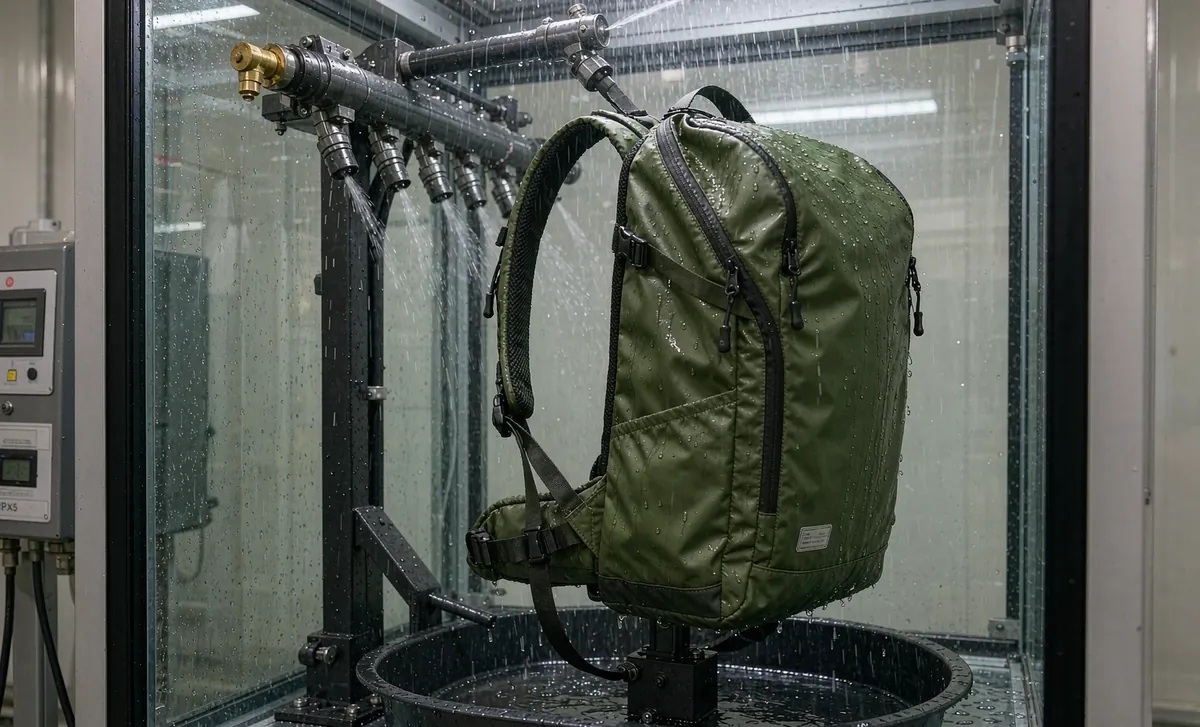
Table of Contents
- Where ATM Ratings Come From
- Static Pressure vs Dynamic Ingress
- Why 5 ATM Does Not Mean 50 Metres
- Converting ATM to an Equivalent IP Claim
- When an ATM Claim on a Bag Is Meaningless
- Test Methods Behind ATM Claims
- Claim Risk in Marketplace Listings
- Specifying Correctly for Soft Goods
- Frequently Asked Questions
- People Also Ask
Where ATM Ratings Come From
The ATM rating is a watch industry convention that migrated into consumer electronics and, from there, into listings for pouches, cases and bags. The reference documents are ISO 22810 for water-resistant watches and ISO 6425 for divers' watches. Both describe laboratory tests on a rigid case with gaskets, a crystal and a crown, which is a very different object from a fabric bag with a fold or a zipper.
One atmosphere is the standard atmospheric pressure at sea level, about 101 325 pascals, or roughly 101 kPa, which is close to one bar and to about ten metres of water column. A rating of 3 ATM therefore corresponds to roughly 30 metres of static water pressure in a laboratory sense, 5 ATM to about 50 metres, and 10 ATM to about 100 metres. Those numbers are pressure equivalents, not depth permissions.
The unit survived because it is easy to print and easy to compare at a glance. A shopper sees 5 ATM on a watch and reads it as better than 3 ATM, which is true in the narrow sense that the case held a higher test pressure. The trouble starts when the same unit is applied to objects that are not rigid, not sealed and not pressure vessels, and when buyers then try to translate it into an IP code for a specification.
The watch standards themselves are careful about language. ISO 22810 requires the marking to use the term water-resistant rather than waterproof, precisely because no article is permanently impermeable. That distinction is worth carrying across to bags: if the watch industry, with rigid cases and machined gaskets, will not use the word waterproof, a fabric bag with a roll-top has no business claiming it on the strength of an ATM number. Our test and substantiation protocol follows the same conservative logic.
- ISO 22810 covers water-resistant watches and sets the marking and test expectations for that product type.
- ISO 6425 covers divers' watches, which are held to a stricter set of requirements including overpressure testing.
- One atmosphere is about 101 kPa, close to one bar and to roughly ten metres of water column.
- ATM ratings assume a rigid, sealed, gasketed article, which a fabric bag is not.
- The unit migrated into consumer listings through phone pouches and action camera housings.
For a professional buyer the origin story matters because it tells you what the test apparatus looks like. A watch is placed in a pressure vessel, the pressure is raised, held and released, and the case is then checked for condensation and for water entry. There is no spray, no jet and no long immersion. That is a pressure test, and everything about it assumes the object holds its shape under load.
Static Pressure vs Dynamic Ingress
The two families of test ask different physical questions. An ATM test asks whether a sealed article holds its integrity while uniform external pressure is applied and then released. An IP water test asks whether liquid water gets inside under a specific exposure: spray, jetting, or immersion for a defined time. A rigid case can pass the first and fail the second, and a flexible bag can pass the second and be entirely untestable by the first.
Consider what happens when you try to apply pressure to a soft bag. The article is not a pressure vessel, so the air inside compresses, the panels fold inward, and the closure deforms. The pressure equalises rather than being resisted, and the test stops measuring the material and start measuring how much the bag can collapse. Any leakage path that does exist will be held shut by the folding rather than opened by the pressure, which produces a pass that means nothing in the field.
Ingress is also driven by forces other than pressure. A jet from a hose, a wave breaking over a deck, or the capillary pull along a zipper tape all move water through a path at pressures far below the ATM figures being quoted. AATCC 35, the rain test, and AATCC 22, the spray test, exist because those mechanisms matter independently of standing pressure. That is why a specification for soft goods needs both a fabric figure and an article-level water test.
| Attribute | ATM rating | IP rating |
|---|---|---|
| Origin | ISO 22810 and ISO 6425 for watches | IEC 60529 for enclosures |
| Question asked | Does the article hold pressure | Does water get inside |
| Load type | Uniform static external pressure | Spray, jetting or immersion |
| Article assumed | Rigid, sealed, gasketed | Any enclosure, flexible or rigid |
| Output | Pressure in atmospheres or bar | Two-character code |
| Duration | Pressure held for a defined period | Defined per digit, 10 minutes to 30 minutes or more |
There is one more difference that catches buyers out. An ATM test is usually a pass or fail on pressure retention and on a condensation check afterwards. An IP immersion test evaluates the article at the end of a period and applies a defined pass criterion, which for a bag you must write yourself, because IEC 60529 frames it around equipment operation. Two very different evidence chains, two very different documents.
The practical rule is to keep the two in separate columns of your specification and never let one fill in for the other. If a supplier offers an ATM figure where you asked for IPX7, the correct response is not to argue about the arithmetic but to ask which article-level water test was run, on what samples, with what pass criterion. That question settles it quickly, and our OEM waterproof bag programme answers it with a full report rather than with a conversion table.
Why 5 ATM Does Not Mean 50 Metres
This is the single most expensive misunderstanding in the category. Five atmospheres corresponds to about 500 kPa, or roughly five bar, which is the static pressure found at about 50 metres depth. It does not mean the article can be taken to 50 metres, because the laboratory test applies a static load to a stationary object while real diving or swimming adds movement, temperature change and dynamic pressure peaks.
Moving an object through water raises local pressure well above the static figure at the same depth. A swimmer's arm stroke, a diver finning hard, or a boat wake passing over a bag all create transient loads. On top of that, the article flexes as it moves, and a gasket that holds under uniform compression can open momentarily under a bending load. That is the mechanism behind most real-world floods, and no static pressure test reproduces it.
Watch makers know this, which is why ISO 6425 for divers' watches requires an overpressure margin above the marked figure rather than testing exactly at it. The marked depth is a conservative commercial statement built on a margin, not a measurement of capability. Copy the discipline: if you must print a number, print a conservative one supported by a margin rather than the highest figure your test produced.
- 5 ATM is about 500 kPa of static pressure, roughly the pressure at 50 metres, not permission to swim at 50 metres.
- Movement through water creates transient pressure peaks well above the static figure at the same depth.
- Flexing under load can open a closure that holds perfectly under uniform compression.
- Temperature change during a dive alters internal pressure and can drive water past a marginal seal.
- Responsible standards build in an overpressure margin rather than testing at the marked value.
For bags the gap between static pressure and real depth is even wider, because the closure is a fold rather than a gasket. A roll-top works by pressing coated fabric against coated fabric, and it holds because the trapped air inside pushes back. Increase the external pressure by submerging it five metres and the trapped air compresses, the fold geometry changes, and the contact pressure along the fold drops. The deeper you go, the less the closure works.
This is why our dry bag range is rated under IEC 60529 at IPX7 or IPX8 with a declared depth and duration, and never with an ATM figure. The rating describes what the article was tested to do, and the depth printed next to it is the depth that was actually used. See the comparison between dry bags and waterproof bags for how the claim changes with the construction.
Converting ATM to an Equivalent IP Claim
Strictly, you cannot convert. The tests use different apparatus, different failure criteria and different assumptions about the article, so no conversion factor exists in any standard. What you can do is map the pressure arithmetic for context, then specify the IP test separately and qualify the article to it. Buyers who accept a conversion table are accepting a claim nobody has tested.
For context only: one metre of water is about 9.8 kPa, so about 0.097 atmospheres. The IPX7 condition, with the lowest point roughly one metre below the surface, is therefore around 0.1 atmospheres of static pressure. An IPX8 condition declared at three metres is around 0.3 atmospheres. Compare that with a 5 ATM claim of about 5 atmospheres and you can see the scales are separated by more than an order of magnitude.
| Claim | Approximate static pressure | Equivalent water depth | What it actually testifies |
|---|---|---|---|
| IPX7 | About 0.1 atmosphere | About 1 metre, 30 minutes | No ingress in a shallow immersion test |
| IPX8 at 3 m | About 0.3 atmosphere | 3 metres, declared duration | No ingress at the declared depth and time |
| 1 ATM | About 1 atmosphere, 101 kPa | About 10 metres of static pressure | Rigid case held 101 kPa in a vessel |
| 3 ATM | About 3 atmospheres | About 30 metres of static pressure | Rigid case held about 300 kPa |
| 5 ATM | About 5 atmospheres | About 50 metres of static pressure | Rigid case held about 500 kPa |
| 10 ATM | About 10 atmospheres | About 100 metres of static pressure | Rigid case held about 1 MPa |
Use that table only to understand scale, never to write a specification. If a supplier tells you a bag is 5 ATM and therefore exceeds IPX8, ask what apparatus was used. A soft bag cannot be pressurised to 500 kPa without either collapsing or inflating, so the claim almost certainly refers to a component such as a phone pouch insert, or to nothing at all.
Where a customer insists on an ATM figure for a pouch or a small hard case inside a bag, we translate it into a testable requirement: state the pressure in kilopascals or bar, state the hold time, state the leak detection method, and require an internal indicator or a pressure decay reading as the pass criterion. That converts a marketing number into an engineering clause, and it is the only honest way to carry an ATM claim into a soft goods programme.
When an ATM Claim on a Bag Is Meaningless
An ATM claim is meaningless on any article that cannot hold internal pressure. That includes essentially every fabric bag: dry bags, backpacks, duffels, totes, messenger bags and packing cubes. If the article is not rigid and not sealed by a gasket, it has no pressure boundary, and a pressure rating describes nothing. The claim may still be printed, which is precisely the problem.
It is also meaningless when it is applied to the fabric rather than to the article. A coated laminate can resist a great deal of hydrostatic pressure, which is why the hydrostatic head chart uses millimetres of water column. But a fabric figure measured on a clamped disc does not make the sewn bag around it pressure rated, for the same reason a strong sheet of steel does not make an open box watertight.
There is one narrow exception where an ATM-style figure is legitimate in a bag programme: a rigid insert. A hard phone case, a gasketed camera box or a sealed electronics pod inside a soft bag can be pressure tested, because it is a rigid sealed vessel. In that case rate the insert, not the bag, and print the rating on the insert. The bag around it gets a spray or immersion rating appropriate to its own construction.
- Rate the rigid insert with a pressure figure, and rate the soft bag with a spray or immersion rating.
- Never print an ATM figure on a fabric article that has no gasketed pressure boundary.
- Never extend a fabric hydrostatic head figure into an ATM claim for the finished bag.
- If a marketplace listing already carries an ATM figure, replace it before the next print run.
- Ask your supplier which apparatus produced the number; a soft goods line does not have a pressure vessel.
Finally, be alert to the additive claim: a bag listed as IPX7 plus 5 ATM. This is usually a sign that someone has collected every available certificate onto one listing rather than that the product was tested twice. The two claims describe incompatible objects, so the honest reading is that one of them belongs to a component or to nothing. Ask which article each report names before you inherit either claim.
Test Methods Behind ATM Claims
A genuine pressure rating is produced in a pressure vessel. The article is placed inside, the chamber is pressurised to the target value, the pressure is held for a defined period, and then it is released. The article is then examined. Two detection approaches are common: a visual and functional check for water entry, and a condensation check in which the article is cooled or warmed so any trapped moisture becomes visible on an internal surface.
For rigid cases, a pressure decay method is often used instead. The article is pressurised internally, the supply is isolated, and the decay rate over a defined period is measured. This is faster and more sensitive than a visual check, and it produces a number rather than a judgement, which is why it is preferred in production environments. It requires a sealed port, which soft goods do not have.
Where ingress testing is used instead, the relevant methods are the ones that belong to the IP family and to textiles: IEC 60529 for spray, jetting and immersion, AATCC 35 for driven rain, AATCC 22 for spray repellency, and ISO 811 or AATCC 127 for hydrostatic pressure on fabric. None of these produce an ATM number, and all of them produce evidence you can audit.
| Method | Apparatus | Measures | Appropriate for |
|---|---|---|---|
| ISO 22810 sequence | Pressure vessel plus condensation check | Static pressure resistance of a watch case | Watches and rigid sealed cases |
| ISO 6425 sequence | Pressure vessel with overpressure margin | Diver watch capability | Dive watches |
| Pressure decay | Internal pressurisation and decay measurement | Leak rate of a sealed vessel | Rigid inserts, hard cases |
| IEC 60529 immersion | Water tank, defined depth and time | Ingress into the assembled article | Bags, pouches, soft goods |
| ISO 811 | Hydrostatic head apparatus | Fabric penetration resistance | Fabric and laminate only |
When you review a certificate, look for the apparatus and the detection method. A report that says only passed at 5 ATM without describing the vessel, the hold time, the medium or the detection method is not a report you can defend. Require the fields, and require photographs of the setup, which is the same discipline we apply to every pre-shipment inspection record we issue.
Claim Risk in Marketplace Listings
Unsubstantiated waterproof claims are a compliance exposure, not just a marketing risk. In the United States, advertising claims must be substantiated at the time they are made, and in the European Union, misleading claims fall under consumer protection rules that marketplaces themselves now enforce. A listing that carries 5 ATM on a fabric bag is exactly the kind of claim a competitor or a regulator can challenge cheaply.
- Substantiation duty: the advertiser must hold evidence before the claim is published, not after a challenge.
- Marketplace enforcement: listings can be suppressed while the claim is investigated, which costs the whole season.
- Retailer requirements: many large buyers require the test report before the first delivery, not after.
- Product liability: water damage to a phone or a laptop inside a misrated bag becomes a claim against the brand.
- Corrective cost: relabelling, reprinting and relisting usually cost more than testing correctly the first time.
The cheapest risk control is conservative language. Print the rating you tested, print the condition next to it, and avoid absolute words. Water-resistant, rainproof and splash-resistant are defensible with modest evidence. Waterproof requires an article-level test with a written pass criterion. Immersion rated requires the depth and duration printed alongside, and nothing else is honest.
There is also a documentation discipline that protects you downstream. Keep the test report, the sample description and the production records together, tied to the order number, so that if a claim is challenged two years later you can produce the evidence. Our SGS-verified facility retains those records per production order, and the material and compliance documentation is issued with the same reference.
If you are inheriting a range that already carries an ATM figure, the orderly path is to commission the article test first, then revise the listing and the artwork in the next print run rather than waiting for a complaint. The test costs a fraction of a relisting, and it converts an inherited risk into an owned, documented claim you can defend.
Specifying Correctly for Soft Goods
Build the specification in layers, one per failure mode. The first layer is the fabric: a hydrostatic head figure under ISO 811 at a stated rate of rise, with retention thresholds after abrasion and laundering. The second is the construction: welded or sewn-and-taped, with a seam peel or tape adhesion requirement. The third is the closure: a roll-top with a stated number of rolls, or a zipper with a stated rating. The fourth is the article test: IEC 60529 spray, jetting or immersion with a measurable pass criterion.
That four-layer structure covers everything an ATM number pretends to cover, and every layer is testable. If a customer or a marketplace insists on a pressure figure, add a fifth layer for the rigid insert only, expressed in kilopascals with a hold time and a decay rate, and keep it clearly separated from the bag rating on the artwork and in the specification.
Write the claim block as one sentence so nobody can reinterpret it later. For example: Water resistance: body fabric hydrostatic head minimum 10 000 mm per ISO 811 at 10 cm per minute; seams radio-frequency welded; closure four-roll roll-top; article tested to IPX7 per IEC 60529 for 30 minutes with no mass gain of internal indicator tissue. That is defensible, reproducible and understandable to a laboratory anywhere.
- Layer one: fabric hydrostatic head with method, rate, specimen count and retention thresholds.
- Layer two: seam method with peel strength or tape adhesion acceptance values.
- Layer three: closure design with the number of rolls or the zipper rating.
- Layer four: article-level IEC 60529 test with a measurable pass criterion.
- Layer five, only if relevant: pressure rating in kPa for a rigid insert, kept separate from the bag claim.
Then govern production so the qualification survives into the shipment. Require a per-lot water test pull under AQL 2.5 (ISO 2859-1), log the weld parameters, and keep retained samples. Our programmes run at MOQ 500 pcs per style and colourway, with sampling in 6 to 10 working days, 12 to 15 when the construction is complex, bulk in 35 to 50 days, quoted FOB Xiamen on T/T 30/70.
Send us the claim you intend to print and the market you sell into, and we will tell you which of the four layers is missing and what it costs to add. That review is the fastest way to turn a marketing number into a specification your compliance team can sign off, and it costs one email rather than one relisting.
Frequently Asked Questions
Q1: What does 5 ATM mean on a waterproof product?
A: Five atmospheres is a static pressure figure of about 500 kPa, or roughly five bar, which corresponds to the pressure found at about 50 metres of water in a laboratory vessel. It does not mean the product can be used at 50 metres. The rating assumes a rigid sealed case, and real use adds movement, flexing and temperature change that a static test does not reproduce.
Q2: Can an ATM rating be converted into an IP rating?
A: No. The two families of test use different apparatus and different failure criteria, and no standard provides a conversion factor. You can compare the pressure arithmetic for context, since one atmosphere is roughly ten metres of water, but the only defensible approach is to specify and qualify the article to the IEC 60529 test you actually need.
Q3: Why do suppliers put ATM ratings on bags?
A: Because the unit migrated from watches into phone pouches and camera housings, and listing copy tends to reuse whatever number is available. A fabric bag has no gasketed pressure boundary, so a pressure rating on it describes nothing. Ask which apparatus produced the figure and which article was in it before you inherit the claim.
Q4: Is a 5 ATM bag better than an IPX7 bag?
A: The question cannot be answered as asked, because the two claims describe different tests on different assumptions. An IPX7 claim is backed by an immersion test on the assembled article with a defined time, depth and pass criterion. A 5 ATM claim on a soft bag usually has no corresponding test at all, so the IPX7 claim is the one you can rely on.
Q5: How deep can I take a 3 ATM product?
A: Three atmospheres is about 300 kPa, roughly the static pressure at 30 metres, but that is a laboratory pressure figure and not a depth rating. Do not print or imply a depth from it. If your product needs a depth claim, commission an immersion test at that depth and duration under IEC 60529 and print the tested figures instead.
Q6: What is the difference between water-resistant and waterproof in standards language?
A: Water-resistant means the article resists water entry under defined test conditions, while waterproof implies an absolute that no standard supports. ISO 22810 for watches requires the term water-resistant rather than waterproof for exactly that reason. For bags, use water-resistant or rainproof unless you have an article-level immersion test with a written pass criterion.
Q7: Which standards cover ATM ratings?
A: ISO 22810 covers water-resistant watches and ISO 6425 covers divers' watches, and both describe pressure vessel testing on rigid gasketed cases. Neither applies to soft goods. For bags the relevant documents are IEC 60529 for ingress, ISO 811 for fabric hydrostatic head, and AATCC 22 and AATCC 35 for spray and rain.
Q8: When is an ATM rating legitimate in a bag programme?
A: When it applies to a rigid sealed insert rather than to the bag itself. A gasketed phone case, camera pod or electronics box can be pressure tested in a vessel or by pressure decay. Rate the insert in kilopascals with a hold time, keep that rating on the insert, and give the surrounding bag its own spray or immersion rating.
Q9: What should I do if my listing already carries an ATM figure?
A: Commission the article-level test first, then revise the listing and the artwork in the next print run. Testing is far cheaper than a relisting or a marketplace suppression, and it converts an inherited claim into an owned one you can substantiate. Keep the report with the order records so the evidence is available later.
Q10: Does a high hydrostatic head justify an ATM claim?
A: No. Hydrostatic head under ISO 811 measures a flat clamped fabric specimen, which can indeed show high values, but it says nothing about the seam, the closure or the geometry of the finished bag. Water takes the easiest path in a real article, which is usually a needle hole, a tape edge or a fold, none of which appear in a fabric test.
Q11: How should a waterproof bag specification be structured?
A: In layers: fabric hydrostatic head with method and rate, seam method with a peel or adhesion value, closure design with the number of rolls or the zipper rating, and an article-level IEC 60529 test with a measurable pass criterion. Add a pressure layer only for a rigid insert, expressed in kilopascals and kept separate from the bag claim.
Q12: What is one atmosphere in practical units?
A: One atmosphere is about 101 325 pascals, or roughly 101 kPa, which is close to one bar and to about ten metres of water column. That is why 5 ATM corresponds to roughly 500 kPa and about 50 metres of static pressure. Those are laboratory pressure equivalents, not depth permissions for use.
Q13: Do marketplace rules require test evidence for waterproof claims?
A: Many do. Large marketplaces and retail buyers commonly require substantiation before a claim is published or before first delivery, and consumer protection rules in the United States and the European Union place the burden on the advertiser. Holding a full test report with the setup, conditions and pass criterion is the cheapest protection.
People Also Ask
Is 5 ATM waterproof or just water-resistant?
Five atmospheres is a pressure test result on a rigid sealed case, and the watch standards describe it as water-resistant rather than waterproof. It means the case held about 500 kPa in a vessel under laboratory conditions. It is not a permission to swim, dive or submerge at the equivalent depth.
Can a dry bag be rated in atmospheres?
Not meaningfully. A fabric bag has no gasketed pressure boundary, so external pressure simply compresses the air inside and folds the panels rather than being resisted. Rate dry bags with IEC 60529 IPX7 or IPX8 with a declared depth and duration, and keep pressure figures for rigid inserts only.
What rating should a waterproof phone pouch carry?
Rate the pouch with an article-level immersion test under IEC 60529 and, if it contains a rigid sealed element, a pressure figure in kilopascals for that element. Require an internal indicator or a decay measurement as the pass criterion, and print the tested depth and duration rather than an ATM figure on the fabric part.
Why do watches use ATM and bags use IP codes?
Because the standards were written for different objects. ISO 22810 and ISO 6425 assume a rigid gasketed case that can be placed in a pressure vessel, while IEC 60529 was written for enclosures and covers spray, jetting and immersion. Bags are flexible, so the ingress family is the one that applies.
How do I test a pressure claim in production?
Use a pressure decay method on the sealed rigid element, with a defined test pressure, hold time and acceptance decay rate, run on a sampling plan such as AQL 2.5 under ISO 2859-1. Log the results against the production order and keep retained units so a later dispute can be re-examined.
What happens if a waterproof claim cannot be substantiated?
The exposure ranges from marketplace suppression to consumer protection action and, in the worst case, liability for water damage to a customer's device. Corrective relabelling and relisting usually cost several times more than the original testing, which is why conservative claims backed by a full report are the cheaper route.