
Medical Bag Fluid Resistance and Cleanability
A medical bag is judged on cleanability, not on immersion. The fluids it meets are blood, saline, vomit and urine on the one hand, and sodium hypochlorite at 1,000 ppm, 70 percent isopropyl alcohol and quaternary ammonium disinfectants on the other, and the second group is usually the more aggressive. The build that survives both is a welded TPU-coated nylon shell with no stitch holes, radiused internal corners, a non-wicking closure and a coated interior that can be wiped a thousand times without cracking. Ingress protection to IPX6 under IEC 60529 is the right companion target. Below are the eight fields a clinical buyer should write into a tender.
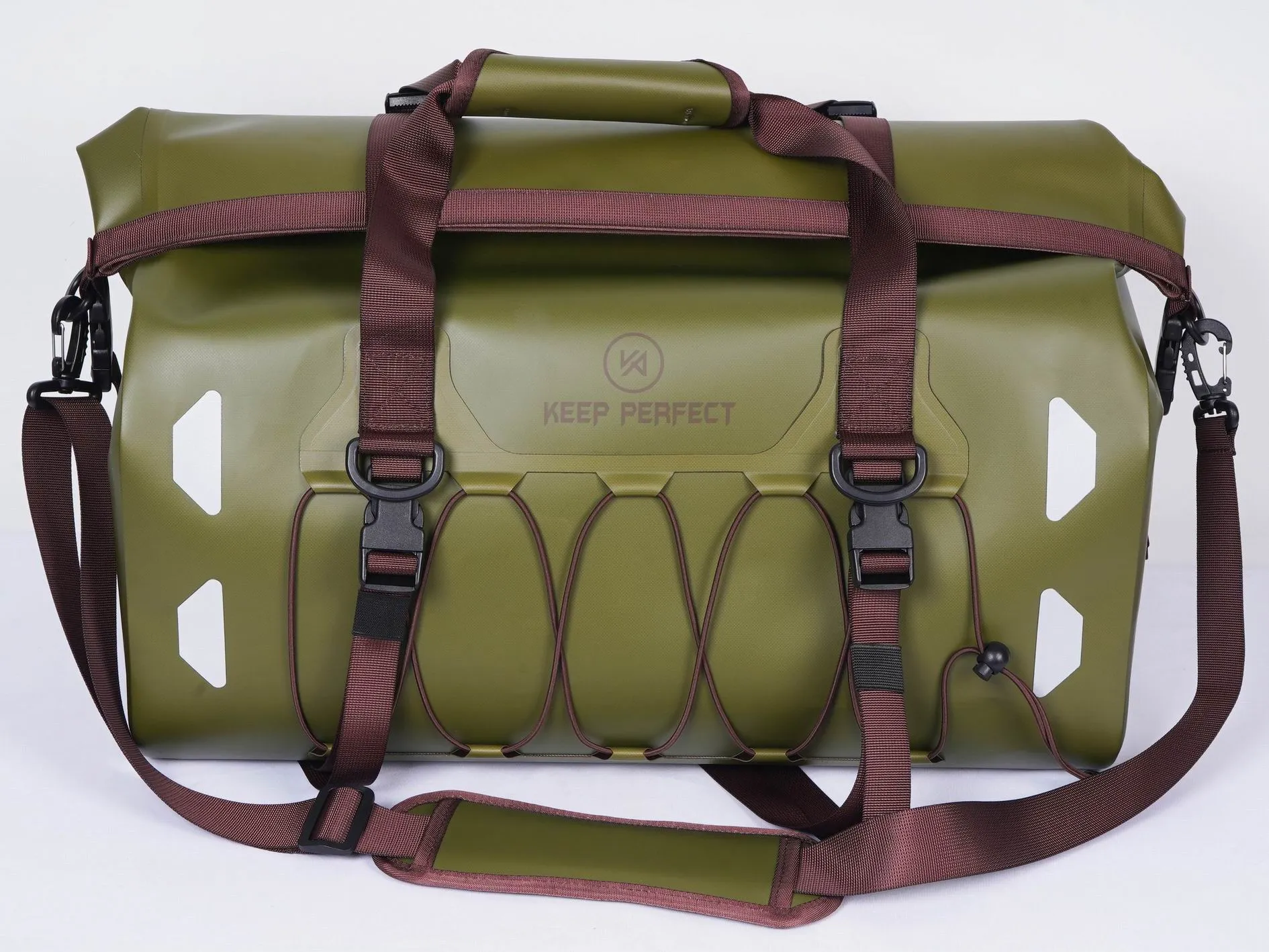
Table of Contents
Fluids Encountered in Clinical Use
A clinical bag meets two families of fluid, and they ask for different things. The first is the spill family: blood, saline and IV fluid, urine, vomit and wound exudate. These are occasional, visible and usually dealt with immediately. The second is the cleaning family: the disinfectants used to decontaminate between patients or between shifts. These are applied every day, often several times a day, and they are the ones that age the product.
The spill family sets the permeability requirement. Blood and saline are low-viscosity fluids that will find any hole and any wicking path, and a bag that absorbs them becomes a contamination risk rather than a carrying case. So the requirement is not that the bag survives being dunked; it is that the fluid stays on the surface long enough to be wiped, and that nothing in the construction draws it inward.
The cleaning family sets the chemical requirement, and it is the harder of the two. Hypochlorite at 1,000 ppm available chlorine is standard for general environmental cleaning, and 10,000 ppm is the concentration used for a blood spillage. Seventy percent isopropyl alcohol and quaternary ammonium compounds are the other two that a bag will meet weekly. A coating that survives water can still craze under any of the three.
Then there are the three formats this category sells: the first-aid and responder bag, carried into whatever the scene offers; the ambulance and trauma bag, which is cleaned on a schedule and audited; and the home-care or community-nurse bag, which lives in a car and a patient's house. All three need the same surface. Only the second is normally bought against a written decontamination protocol. Our medical and responder formats are developed against that second case, and the base range is listed on our OEM waterproof bag pages.
- Spill family: blood, saline, urine, vomit, wound exudate; the requirement is non-absorption
- Cleaning family: 1,000 ppm hypochlorite, 10,000 ppm for a blood spillage, 70 percent IPA, quats
- Frequency: a hospital or ambulance bag is wiped several times a day, not occasionally
- Formats: first-aid and responder, ambulance and trauma, and community-nurse bags
Rating vs Cleanability
The two things are not the same and tenders routinely confuse them. An IP rating under IEC 60529 measures whether water can get into a closed enclosure. Cleanability measures whether a contaminated surface can be brought back to a safe state without the fluid getting in. A bag can pass IPX7 and still be uncleanable, because its outer fabric is absorbent; and a bag can be perfectly cleanable and fail IPX7, because its closure is not immersion-rated.
For a medical bag the right ingress target is IPX6, and it is worth being clear about why. IPX6 covers powerful water jets, which is what happens when a bag is hosed or wiped down under running water. IPX7 at 1 m for 30 minutes is not a normal clinical event, and insisting on it pushes the closure towards a welded zipper that is harder to wipe around. Choose IPX6 and spend the difference on the surface.
The cleanability requirement is best written as four separate fields. The surface must be non-absorbent, so fluid sits on it. It must be non-wicking, so no thread or tape draws fluid into the construction. It must have radiused internal corners, so there is nowhere for residue to collect. And it must be compatible with the named disinfectants at the stated concentrations, which is a chemical question rather than an ingress one.
Then verify the fabric separately, because it is the base of the whole thing. ISO 811 or AATCC 127 at 10,000 mm or better confirms the barrier, and ISO 1421 and ASTM D751 confirm the tear, breaking strength and coating adhesion that tell you the film will stay attached through a thousand wipes. A coating that lifts is worse than a coating that is never there, because it traps contamination underneath it.
| Requirement | What it prevents | How it is verified | Target |
|---|---|---|---|
| Non-absorbent surface | Fluid entering the construction | Wipe and weigh, or a drop test | No penetration after 30 minutes |
| Non-wicking closure | Fluid drawn along a tape | Wicking observation on the tape | No wicking on the tape |
| Radiused internal corners | Residue collecting in corners | Swab and visual inspection | Corner radius 8 mm or more |
| Chemical compatibility | Crazing and coating loss | 1,000 wipe cycles with the named agent | No crack, no colour transfer |
| Ingress protection | Water entering a closed bag | IPX6 to IEC 60529 | No internal moisture |
Wipe-Down Chemical Compatibility
Disinfectant compatibility is the field that decides whether a medical bag lasts one year or five, and it is the field most tech packs leave blank. A coating that is perfectly serviceable in outdoor use can craze under repeated alcohol wipes, because alcohol extracts plasticiser and carries it to the surface, leaving a stiff and eventually cracked film behind. Hypochlorite is an oxidiser and it attacks both the polymer and the pigment.
Name the agents and the concentrations in the brief, because otherwise the supplier is testing against whatever it has on the shelf. The three that matter are sodium hypochlorite at 1,000 ppm available chlorine for routine cleaning and 10,000 ppm for a blood spillage, 70 percent isopropyl alcohol, and a quaternary ammonium compound at the in-use dilution. Add hydrogen peroxide or peracetic acid if the customer's protocol uses them.
Then set a cycle count and a criterion. Our standard requirement is 1,000 double-wipe cycles per agent at a defined pressure, with the acceptance criteria being no cracking, no colour transfer to the wipe cloth and no loss of hydrostatic head beyond a stated margin. One thousand cycles corresponds to roughly a year of daily cleaning on an ambulance bag, which is a fair service life for a product in this category.
Material choice follows the chemistry. TPU-coated nylon generally holds up better under both alcohol and hypochlorite and it is the default for a clinical product; PVC-coated cloth is wipeable and cheaper but plasticiser extraction is more visible over time, and the plasticiser itself is an issue where the material file is scrutinised. Read the TPU versus PVC comparison and then confirm with a wipe test on the exact build.
- Name the agents and concentrations: 1,000 ppm and 10,000 ppm hypochlorite, 70 percent IPA, quats
- Require 1,000 double-wipe cycles per agent, about a year of daily ambulance cleaning
- Acceptance: no cracking, no colour transfer to the cloth, hydrostatic head retained
- Default to TPU-coated nylon for clinical use, with a wipe test on the exact build
Seam Design for Decontamination
Every seam in a medical bag is either a place contamination can enter or a place it can be removed from, and the construction decides which. A sewn seam is a line of holes with thread running through them, and the thread wicks. Even when a sewn seam is taped, the tape edge is a ledge that a wipe cloth catches on and a place where residue collects. In a product that is wiped several times a day, that is the wrong geometry.
The cleanable answer is a welded seam, and for a medical bag it should be welded on the inside as well as the outside. A high-frequency weld is continuous film-to-film with no holes and no wicking path, and because it is flush, a wipe cloth passes over it without catching. We weld clinical bodies on a 20 mm width, which puts the peel strength of the joint above the tear strength of the base cloth.
Internal geometry matters as much as the joint. Three rules: radius every internal corner at 8 mm or more so a swab can actually reach it; weld internal dividers in rather than stitching them, and keep them as few as the layout allows, because every divider is two more corners to clean; and avoid any fabric-floored external pocket, since a pocket with a soft floor becomes a sump.
The closure needs the same treatment and it is the hardest part. A coil zipper on a woven tape wicks along the tape, collects residue in the coil and is awkward to wipe. The two workable answers are a welded zipper with a coated tape, or a flap with a hook-and-loop or magnetic closure over a welded mouth. Which to choose depends on access speed, which is the next consideration. See the closure comparison for the trade-off.
- Weld the seams, inside as well as outside, so there are no holes and no wicking path
- Radius every internal corner at 8 mm or more so a swab can reach it
- Weld internal dividers in and keep their number low, because each one adds two corners
- Use a welded zipper with a coated tape, or a flap closure over a welded mouth
Colour and Identification Systems
Colour in a medical bag is functional, not decorative. It tells a responder which bag to grab before they open it, and in a multi-agency scene it tells them whose kit it is. That two-part job is why colour and identification belong in the specification rather than in the marketing brief, and why they need to be specified separately from each other.
The colour schemes themselves are local protocols rather than international standards, which is a commercial opportunity and a specification trap. Red for a first-aid bag, blue or green for a community-nurse bag and orange for a responder bag are common conventions, but they vary by service and by country. The safe answer is to make the colour configurable and to confirm the scheme with the buyer in writing before the first sample is cut.
Identification is the part that should be standardised. Use a printed or welded panel for the service mark rather than an embroidered one, because embroidery is absorbent and impossible to wipe clean. Use a clear window for a contents card, so the card can be read and replaced without opening the bag, welded in on the welding and assembly lines rather than stitched. And add a retroreflective or fluorescent band where the bag is used roadside, with EN 13356 as the reference for the reflective material.
Then hold the appearance through the decontamination cycle, because this is where a medical bag visibly ages. Fluorescent and saturated pigments are the least resistant to hypochlorite, and a bag that leaves the depot bright can come back patchy within a year. Ask for the colourfastness result after the wipe cycle rather than before it, and require the identification panel to be welded rather than printed where the panel is on a contact surface.
| Element | Recommendation | Reason |
|---|---|---|
| Base colour | Configurable, confirmed with the buyer in writing | Schemes are local protocols, not international standards |
| Service mark | Welded or printed panel, not embroidery | Embroidery is absorbent and cannot be wiped clean |
| Contents card | Clear welded window, readable without opening the bag | Faster identification at a scene |
| Roadside visibility | EN 13356 retroreflective band | Visible at night and under vehicle headlights |
| Colourfastness | Verified after the wipe cycle, not before it | Hypochlorite attacks saturated pigments |
Organisation and Access Speed
In an emergency the bag is opened by somebody wearing gloves who cannot feel what they are doing and who has seconds, not minutes. Everything about the interior should be designed for that person. The two measures that matter are how long it takes to find a named item and whether the bag can be opened and closed with one gloved hand.
Layout beats capacity in this category. A 20 L bag with eight clearly separated elastic loops and two clear pouches outperforms a 35 L bag with one open compartment, because the responder is looking for a specific item rather than for space. We recommend a fixed layout per bag type, a printed contents card in the window, and a rule that no two items share a loop.
Colour-code the interior as well as the exterior. A common working scheme is red for airway, blue for intravenous access, green for drugs and yellow for dressings, applied as coloured elastic loops or coloured pull tabs so the bag can be read at a glance in poor light. Confirm the scheme with the buyer, because it is a local protocol and a bag supplied with the wrong code is a bag that will be returned.
Then make it work with gloves. Every pull tab is a moulded loop at least 25 mm long, every zipper gets a cord extension, and every closure can be operated one-handed. Hook-and-loop is a good choice for speed and a poor one for cleanability, since it collects lint and residue; where speed dominates, use it on an external flap and keep it away from the interior. One-handed opening should be a line in the acceptance test.
- Fixed interior layout with a printed contents card, one item per loop
- Colour-code the interior: red airway, blue intravenous, green drugs, yellow dressings
- Every pull is a moulded loop over 25 mm and every zipper has a cord extension
- One-handed gloved opening should be written into the acceptance test
Test Protocol for Medical Bags
A clinical qualification is a chemical test with a mechanical and an ingress test attached, and the order matters: wipe first, then test. A bag that is immersion-tested before it has been through the chemical cycle will pass, and then it will crack in service. Any supplier proposing the reverse order is proposing a protocol that flatters the product.
The sequence we recommend starts at the material. Confirm hydrostatic head to ISO 811 or AATCC 127 at 10,000 mm or better, and tear, breaking strength and coating adhesion to ISO 1421 and ASTM D751. Then run the chemical cycle: 1,000 double-wipe passes per agent with the named concentrations, on the shell, the closure tape and the internal dividers, using the actual wipes the service uses.
After the chemical cycle, re-measure everything. Hydrostatic head should still meet 10,000 mm, there should be no cracking at 10x magnification, and the weld peel should still exceed the tear strength of the cloth. Then the mechanical and ingress checks: every handle and attachment pulled to 25 kg on the finished assembly, one-handed gloved opening 500 times, and IPX6 to IEC 60529 from a 12.5 mm nozzle.
Production then closes the loop. Every lot is inspected to AQL 2.5 (ISO 2859-1) at our Quanzhou facility, with the weld appearance and the closure function recorded on the sheet rather than the cosmetic grade alone. Where a tender requires it, the material certificates, the wipe test report and the inspection record are supplied as one document set against the lot number. For the full test protocol, ask for the ISO 811, AATCC 127 and ISO 2859-1 results together.
- Material: hydrostatic head to ISO 811 or AATCC 127, plus ISO 1421 and ASTM D751 strength and adhesion
- Chemical: 1,000 double-wipe passes per agent on the shell, closure tape and dividers
- Re-measure: hydrostatic head, crack check at 10x magnification, and weld peel
- Mechanical and ingress: 25 kg pulls, 500 one-handed openings, IPX6 to IEC 60529
- Production: AQL 2.5 (ISO 2859-1) with weld appearance and closure function recorded
Specifying for Procurement
Medical procurement is documentation-driven, and it is worth knowing which documentation is genuinely required. A carrying bag is normally an accessory rather than a medical device, so the device conformity route does not automatically apply to it. But if a bag is placed on the market with a medical purpose or a medical claim, it can fall within device regulation, and the buyer's regulatory team should make that call before the brief is written, not after.
Where the customer does require a medical quality system, the reference is ISO 13485, which covers quality management for medical devices and their accessories, and it is a heavier system than ISO 9001:2015. Most carrying-bag programmes sit under ISO 9001:2015 with BSCI for social compliance and REACH and RoHS declarations for the material file. Confirm which of the two the tender actually names, because building to the wrong one wastes months.
The commercial frame is unchanged. MOQ is 500 pcs per style and colourway, which matters in this category because a colour-coded programme can multiply colourways quickly. Sampling runs 6 to 10 working days, or 12 to 15 where a moulded interior or a welded zipper is involved. Bulk production runs 35 to 50 days after sample approval. Shipments are quoted FOB Xiamen with DDP available to more than 100 countries, and payment terms are T/T 30/70.
Two lines in the tender do the most work. First, name the disinfectants and the concentrations, because a supplier cannot test against a protocol it has not seen. Second, require the printed contents card and the interior colour scheme to be confirmed in writing before sampling, because those two items are the most common cause of a rejected first sample in this category. Our custom development route handles both as standard.
- Regulatory position: accessory or device, decided by the buyer's regulatory team before the brief
- Quality system: ISO 13485 where the customer names it, otherwise ISO 9001:2015 and BSCI
- Ingress: IPX6 to IEC 60529, with a welded closure rather than an immersion-rated one
- Surface: TPU-coated nylon, welded inside and out, 8 mm minimum internal corner radii
- Chemical: 1,000 double-wipe passes at 1,000 ppm and 10,000 ppm hypochlorite, 70 percent IPA, quats
- Identification: welded or printed service panel, clear contents window, EN 13356 reflective band
- Interior: fixed layout, one item per loop, colour scheme confirmed in writing before sampling
- Access: 25 mm moulded pull loops, cord zipper extensions, one-handed gloved opening
- Testing: re-measure hydrostatic head and weld peel after the chemical cycle, then IPX6
- Commercials: MOQ 500 pcs per style and colourway, FOB Xiamen, T/T 30/70
Frequently Asked Questions
Q1: What IP rating should a medical bag have?
A: IPX6 under IEC 60529 is the right target. It covers powerful water jets, which is what happens when a bag is hosed or wiped under running water. IPX7 at 1 m for 30 minutes is not a normal clinical event, and demanding it pushes the closure towards a welded zipper that is harder to wipe around. Spend the difference on the surface instead.
Q2: Why is cleanability more important than waterproofing here?
A: Because the bag is contaminated on the outside, not soaked on the inside. A bag that passes IPX7 can still be uncleanable if its outer fabric is absorbent, and a bag that is perfectly cleanable can fail IPX7 if its closure is not immersion-rated. The two measure different things and a clinical tender should require both separately.
Q3: Which disinfectants should a medical bag withstand?
A: Name them in the brief. The three that matter are sodium hypochlorite at 1,000 ppm available chlorine for routine cleaning and 10,000 ppm for a blood spillage, 70 percent isopropyl alcohol, and a quaternary ammonium compound at the in-use dilution. Add hydrogen peroxide or peracetic acid where the customer's own protocol uses them.
Q4: How many wipe cycles should a medical bag survive?
A: One thousand double-wipe passes per agent is a reasonable requirement and it corresponds to roughly a year of daily cleaning on an ambulance bag. Set the acceptance criteria as no cracking at 10x magnification, no colour transfer to the wipe cloth and hydrostatic head still meeting the original figure.
Q5: Are welded seams necessary for a medical bag?
A: Yes, and on the inside as well as the outside. A sewn seam is a line of holes with thread that wicks, and even when it is taped, the tape edge is a ledge that catches the wipe cloth and collects residue. A high-frequency weld is continuous film-to-film, flush, and a cloth passes straight over it.
Q6: Is TPU or PVC better for a medical bag?
A: TPU-coated nylon is the default for clinical use. It holds up better under both alcohol and hypochlorite extraction, and it avoids the plasticiser question that a scrutinised material file will raise. PVC-coated cloth is wipeable and cheaper, but plasticiser loss over time is more visible. Confirm the choice with a wipe test on the actual build.
Q7: Is a medical bag a medical device?
A: A carrying bag is normally an accessory rather than a device, so the device conformity route does not automatically apply. It can change if the bag is placed on the market with a medical purpose or a medical claim. That determination belongs to the buyer's regulatory team and it should be made before the brief is written.
Q8: What quality system should a medical bag supplier hold?
A: Where the customer names it, ISO 13485, which covers quality management for medical devices and accessories. Where it does not, ISO 9001:2015 with a BSCI social audit and REACH and RoHS declarations for the material file is the usual expectation. Confirm which the tender names before building to either.
Q9: How should the interior of a trauma bag be organised?
A: Fix the layout and print a contents card. A 20 L bag with eight separated elastic loops and two clear pouches beats a 35 L bag with one open compartment, because the responder is looking for one named item. Use one item per loop and a windowed card so the contents can be read without opening the bag.
Q10: What is the MOQ for custom medical bags?
A: MOQ is 500 pcs per style and colourway. That matters in this category because a colour-coded programme can multiply colourways quickly, so agree the scheme with the buyer before quoting. Consolidate to reach the threshold on the first order rather than splitting the run and paying a steep unit price premium.
Q11: How long does a medical bag programme take?
A: Sampling takes 6 to 10 working days, or 12 to 15 where a moulded interior or a welded zipper is involved, and the wipe cycle adds further time. Bulk production runs 35 to 50 days after sample approval. For an autumn tender award the brief needs to be moving in the spring.
Q12: Which standards should appear in a medical bag test report?
A: IEC 60529 for the IP code, ISO 811 or AATCC 127 for hydrostatic head, ISO 1421 and ASTM D751 for tear, breaking strength and coating adhesion, and ISO 2859-1 for the AQL 2.5 final inspection. Add the named disinfectants and their concentrations, and require the results to be recorded after the wipe cycle rather than before it.
Q13: Why does embroidery fail on a medical bag?
A: Because embroidery thread is absorbent and its raised surface cannot be wiped clean. It holds fluid and residue, and it is the first thing to discolour under hypochlorite. Use a welded or a printed identification panel instead, and where the panel sits on a contact surface, prefer the welded one, since print will abrade.
People Also Ask
What does fluid resistant mean for a medical bag?
It means a contaminated fluid stays on the surface long enough to be wiped away, and that nothing in the construction draws it inward. It is a different requirement from an IP rating, which measures water entering a closed enclosure. A clinical bag normally needs both, with the surface requirement being the one that matters daily.
Can a medical bag be disinfected with bleach?
It can be wiped with sodium hypochlorite at 1,000 ppm available chlorine for routine cleaning and 10,000 ppm for a blood spillage, provided the coating has been tested against it. Confirm the compatibility before you buy, because the oxidiser attacks both the polymer and the pigment and an untested coating will craze.
Why do medical bags crack after a year of cleaning?
Plasticiser extraction. Alcohol and hypochlorite remove the plasticiser from a PVC film and carry it to the surface, and the film stiffens and then cracks at the folds. TPU-coated nylon resists this better, which is why it is the default for clinical use. A wipe test at 1,000 cycles finds the problem in development.
What size bag do paramedics use?
A 15 to 25 L responder bag is the common range, split into airway, intravenous, drugs and dressings zones. Above 25 L the bag becomes a station kit rather than something one person carries to a scene. Most services run two bags, a small immediate-response bag and a larger one kept at the vehicle.
Should a first-aid bag be red?
Red is the common convention but the schemes are local protocols rather than international standards, and they vary by service and by country. Confirm the colour in writing before the first sample is cut. Getting the colour wrong on a 500-unit order is an expensive and entirely avoidable mistake.
How do you clean the inside of a medical bag?
Empty it, wipe every internal surface with the named disinfectant, and work the swab into the corners, which is why internal corner radii of 8 mm or more matter. Radiused and welded internal dividers can be wiped in one pass; stitched square-cornered ones cannot. Then leave the bag open to dry.
Do medical bags need to be waterproof or just wipeable?
Both, but in that order of importance for most programmes. Wipeability is a daily requirement; immersion is not a normal clinical event. Specify IPX6 under IEC 60529 for ingress and then spend the remaining budget on a welded, non-absorbent, chemically compatible surface.