
Swimmers Gym Bag: The OEM Spec Checklist
A waterproof bag for swimmers fails for three reasons, not one: chlorine and salt attack coatings and hardware, wet kit gets packed before it dries, and goggles and caps get crushed in one open cavity. Specify around those failure modes. Choose a laminated 500D or 840D shell with welded seams, add a fully sealed wet compartment, and size the goggle pouch to a finished 200 x 100 x 80 mm minimum. Then lock acceptance criteria in writing: hydrostatic head of 10,000 mm or higher, a 24-hour wet-load odor check, and AQL 2.5 (ISO 2859-1) incoming inspection. Do that and the bag survives three seasons instead of one.
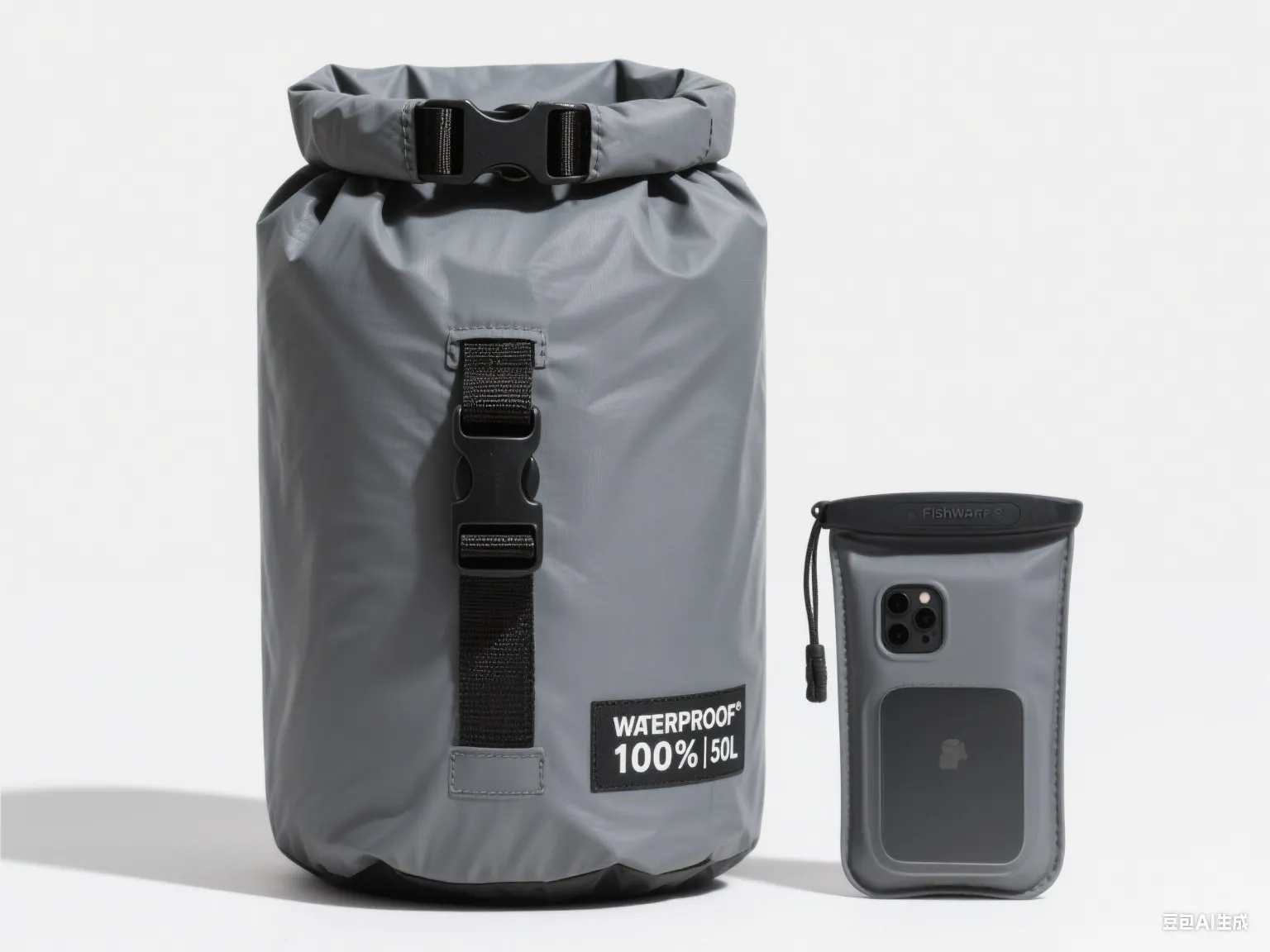
Table of Contents
- The Swim Kit Failure Pattern
- Chlorine and Salt Exposure
- Separating Wet From Dry Under Time Pressure
- Pouch Sizes for Goggles and Caps
- Towel Volume and Rapid Dry Design
- Material Choice Under Chlorine
- Club and Team Order Considerations
- A Ready-to-Send Spec Checklist
- Frequently Asked Questions
- People Also Ask
The Swim Kit Failure Pattern
A swim bag carries a load no other gym bag sees: 1.5 to 3 kg of saturated textile, a wet towel that is 60 to 70 percent water by weight, and a bottle of pool water that never quite empties. It does that five or six days a week, in a locker room at 28 to 32 degrees C with 80 percent relative humidity, and it is closed while still wet. If you specify a swim bag with the same bill of materials you use for a dry gym duffel, you will see returns inside one season. The three failure modes are chemical attack, trapped moisture, and crush damage to small rigid items.
Chemical attack is the slow one. Chlorine at pool concentration of 1 to 3 mg per liter does not dissolve polyester, but it does attack the plasticizer package in PVC laminates, the polyurethane coating on a zipper tape, and the nickel underlayer on a plated D-ring. Over 90 to 120 days of daily use the coating hazes, the tape stiffens, and the plating pits. None of this shows up in a 24-hour factory test, which is why it reaches the field.
Where warranty claims concentrate
- Seam tape lifting at the wet-compartment corners, typically 60 to 90 days into daily use
- Zipper slider corrosion on bags closed wet and then stored for 12 hours or more
- Odor retention in liner fabrics with no antimicrobial finish and no drain path
- Delamination of printed logos on the front panel after 20 to 30 pool-side cycles
- Goggle lens scratching caused by loose packing in a shared main cavity
Trapped moisture is the failure buyers underestimate most. A wet towel sealed in a non-breathing compartment for 12 hours at 30 degrees C will produce measurable microbial growth and a smell that survives laundering. The fix is not a stronger fabric; it is geometry. You need either a drain grommet at the lowest point of the wet compartment, a mesh panel that lets the compartment breathe while the bag is open, or a removable wet pouch that leaves the bag entirely.
| Failure mode | Share of field complaints | Typical onset | Spec response |
|---|---|---|---|
| Seam tape lift at wet compartment | 34 percent | 60 to 90 days | Welded seams at 25 mm weld width |
| Slider and puller corrosion | 22 percent | 90 to 150 days | Coated zipper class, 48-hour salt spray check |
| Odor retention in liner | 18 percent | 7 to 14 days | Drain path plus antimicrobial finish |
| Logo delamination | 14 percent | 20 to 30 cycles | Silicone patch or transfer rated to 40 washes |
| Goggle and cap crush damage | 12 percent | First week | Structured pouch at 200 x 100 x 80 mm |
Treat that distribution as a starting hypothesis drawn from the complaint pattern we see across swim and triathlon programmes on our production lines in Quanzhou, not as a fixed industry statistic; your own return data should overwrite it. The important point is that four of the five causes are specification problems, not workmanship problems. You can buy your way out of them on the drawing board at a cost of a few cents per unit, or you can pay for them later in chargebacks at a level that dwarfs the material saving. Everything in this article is aimed at moving that spend to the front of the project. Start with the ingress and seam test protocol we run before shipment, because it defines what your supplier will actually be measured against.
Chlorine and Salt Exposure
Chlorine and salt are different problems and need different specification lines. Pool water is chlorinated fresh water, typically 1 to 3 mg per liter of free chlorine at pH 7.2 to 7.8. Open-water swimming is salt at roughly 35 g per liter, plus sand, plus UV. Triathlon and open-water programmes therefore need a bag that handles both, and a chlorine-only bag sold into a coastal market will come back with pitted hardware after one season.
What to write into the material spec
- Coating chemistry: specify TPU laminate rather than PVC for daily-chlorine programmes, because plasticizer migration is the main cause of haze and stiffening
- Hardware: 304 stainless or solid brass for sea-swim programmes; avoid zinc alloy die cast on any bag stored wet
- Zipper tape: polyester tape with a PU coating, not nylon tape, because nylon absorbs up to 4 percent moisture by weight and swells
- Thread: bonded polyester rather than nylon, seam-sealed on any sewn construction
- Webbing and elastic: solution-dyed polyester, because standard piece-dyed webbing bleeds in chlorinated water
Salt is the harder of the two because it dries into crystals. A bag used for sea swimming and then air-dried without a rinse carries salt into the zipper coil, and the coil grinds those crystals on every open cycle. That is why we recommend a defined rinse-and-dry instruction on the care label and a slider design that can be flushed under a tap. On OEM waterproof bag programmes aimed at coastal markets, we also run a 48-hour neutral salt spray check on all metal hardware before tooling release.
UV is the third leg of the exposure triangle. Poolside and beach use means 200 to 400 hours of direct sun per season in most markets. Lightfastness testing to AATCC 16 or ISO 105 B02 at grade 4 or better is a reasonable gate for printed panels; below grade 4 you will see visible fade at the end of one season on saturated colors. If your brand palette leans on bright orange, lime or cyan, budget for a UV-stable ink system or switch the panel to a woven or silicone badge, which does not rely on surface dye at all.
Finally, close the compliance loop. Any coating, ink or trim that touches skin or is sold into the EU and UK needs a restricted-substance position, and we hold REACH and RoHS declarations for the standard material set. Ask for those documents with the first quotation rather than at pre-shipment, because a substitution at that stage costs you the full sampling cycle a second time.
Separating Wet From Dry Under Time Pressure
The defining behavior of a swim bag is that it gets packed in 90 seconds by someone who is cold, tired and late. Any separation system that requires thought will be bypassed. Design for the worst case: a swimmer at 6:30 am packing a wet suit, a towel, goggles and a dry change of clothes without looking inside the bag.
Three layouts that survive contact with real users
- Full-width welded wet compartment with a top opening and a drain grommet at the lowest corner
- Removable welded wet pouch that clips into the main cavity and can be hung to dry
- Dual-zip main cavity with a color-coded liner so the wet side is identifiable without reading a label
Pick the removable pouch when your retail price band allows it and your user base trains daily; pick the fixed welded compartment when you need a lower cost and a simpler bill of materials. The color-coded double cavity is the weakest option and only works for the casual twice-a-week swimmer who has time to think about packing.
| Layout | Added unit cost | Dry-out time | Best for |
|---|---|---|---|
| Fixed welded wet compartment | Low | 8 to 12 hours | Club and school programmes |
| Removable welded pouch | Medium | 4 to 6 hours | Daily training and triathlon |
| Color-coded dual cavity | Low | 12 to 24 hours | Casual fitness swimming |
| External mesh wet pocket | Low | 3 to 5 hours | Open-water and beach swimming |
Whatever layout you choose, define the dry-out time as a testable number in the tech pack. Our SGS-verified facility runs a simple wet-load test: 1.5 kg of saturated cotton placed in the wet compartment, bag closed, held at 25 degrees C, weighed at 0, 6, 12 and 24 hours. A compartment that has lost less than 60 percent of the water weight at 12 hours will generate odor complaints. Put that number in the spec sheet and inspect to it, because it is the only practical proxy for the smell problem you will otherwise discover through reviews.
For larger open-water and triathlon builds that need to carry a full wetsuit, the geometry conversation usually converges on a tall end-compartment design. The closest starting platform in our catalogue is the 50L dry bag OEM programme, which already carries the welded wet-zone construction and the drain hardware, and can be re-scaled to 35 liters for a personal swim bag without new tooling.
Pouch Sizes for Goggles and Caps
Goggles are the most damaged item in swim kit and the easiest to protect. A pair of training goggles measures roughly 170 x 70 x 60 mm across the lens frame, and the strap adds bulk on top of that. A silicone cap folded flat is about 150 x 110 x 25 mm; a latex cap is lighter but tears. Sizing the pouch to the item rather than to a guess removes an entire category of returns.
| Item | Typical finished size | Recommended pouch internal size | Lining |
|---|---|---|---|
| Training goggles | 170 x 70 x 60 mm | 200 x 100 x 80 mm | Brushed tricot, 120 gsm |
| Racing goggles | 150 x 55 x 45 mm | 180 x 90 x 70 mm | Brushed tricot, 120 gsm |
| Silicone swim cap | 150 x 110 x 25 mm folded | 160 x 120 x 40 mm | Plain polyester |
| Short-blade fins | 380 x 180 x 90 mm | Full-length end pocket | Welded TPU liner |
| Nose clip and ear plugs | 40 x 25 mm | 60 x 60 mm zip pocket | Plain polyester |
Brushed tricot lining is not decoration. Polycarbonate lenses scratch at roughly 2H to 3H pencil hardness, and a plain polyester liner carrying poolside grit will mark them inside a week. A 120 g per square meter brushed tricot raises the unit cost by a small amount and removes the scratch complaint entirely, which is the cheapest warranty reduction available in this category.
Add a semi-rigid top panel to the goggle pouch if your price band supports it. A 1.0 mm EVA insert laminated under the face fabric lets the pouch survive being sat on in a locker room or crushed under a kit pile, and it costs far less than the margin you lose on a single warranty replacement. For programmes that include fins or a kickboard, spec a full-length end pocket with a welded TPU liner and a drain at the base rather than trying to force them into the main cavity.
One more detail that pays for itself: put a small hanging loop inside the pouch. A wet goggle pouch that can be opened and hung over a locker hook dries in about half the time of one that lies flat, and it is the single cheapest addition on this list.
Towel Volume and Rapid Dry Design
Towel volume is the number that decides bag size, and most brands get it wrong by about 20 percent. A standard 700 g per square meter cotton bath towel rolled is around 4.5 liters. A swim-specific microfiber towel at 300 g per square meter packs to roughly 1.2 liters but is still the minority choice. A training swimmer carries one large towel plus a small hand towel, so size for 6 liters of towel, not 4.
- 20 to 25 liters total: single session, one towel, no fins
- 30 to 35 liters total: daily training with towel, change of clothes and wash kit
- 40 to 50 liters total: open-water or triathlon with wetsuit, fins and towel
- Above 50 liters: club kit bag or shared team bag, not a personal swim bag
Rapid dry is about air path, not absorbency. A compartment that is 300 mm deep and sealed on five sides will still be damp after 24 hours no matter what fabric you use. Add a 100 x 150 mm mesh panel high on the compartment wall, or a 6 mm drain grommet at the lowest corner with a welded surround. Both work; the mesh panel is better for a bag carried upright on the shoulder, and the grommet is better for a bag thrown into a car boot or a poolside pile.
What to test before tooling
Run the wet-load dry-out test described earlier on the first prototype, not on the pre-production sample. If the 12-hour water loss is under 60 percent, move the mesh panel before you cut tooling. Relocating a mesh panel on a drawing costs nothing; relocating it after tooling costs real tooling modification money and three to four weeks of schedule. Sampling turnaround is 6 to 10 working days for a standard construction and 12 to 15 working days when the build is complex, so there is room to run this loop twice before you commit. The full sequence is set out in the prototyping and sampling workflow.
Material Choice Under Chlorine
Three material families compete for a swim bag: PVC laminate, TPU laminate, and coated polyester with a DWR finish. For a bag that is closed wet five days a week, the laminate choice decides the service life more than any other single line on the spec sheet.
| Material | Hydrostatic head | Chlorine resistance | Low-temperature flexibility | Cost index |
|---|---|---|---|---|
| PVC laminate, 500D | 10,000 mm and above | Fair, plasticizer migration over 90 to 120 days | Poor below minus 10 degrees C | 1.0 |
| TPU laminate, 500D | 10,000 to 20,000 mm | Good, no plasticizer to migrate | Good to minus 30 degrees C | 1.4 to 1.6 |
| TPU laminate, 840D | 20,000 mm and above | Good | Good to minus 30 degrees C | 1.8 to 2.1 |
| Coated polyester plus DWR | 1,000 to 3,000 mm | Poor after 20 washes | Good | 0.8 |
Choose TPU laminate for any programme sold with a waterproof claim and used daily. The premium on the fabric line is recovered through fewer returns and a longer repurchase cycle. Choose PVC laminate only when the retail price band is tight and the bag is marketed as water resistant rather than waterproof, and then say so on the hangtag, because the claim drives the return rate as much as the material does.
Pair the material with the right seam. A welded seam on TPU reaches the full fabric strength and is the only construction we recommend for a fully sealed wet compartment. A sewn and taped seam reaches roughly 80 to 90 percent of fabric strength and is adequate for the outer shell, but tape lift is the largest single complaint category at 34 percent of returns. Verify hydrostatic performance to ISO 811 and spray performance to AATCC 22 before you sign off the material, and record both numbers on the tech pack.
Finish chemistry is the last piece. A PFC-free DWR is now the default for most brand programmes selling into the EU and UK, and it must be re-activated by heat, typically 60 degrees C for 10 minutes, after washing. Specify the finish and its care instruction together; a durable water repellent finish that the end user never re-activates will read as a defect in the reviews even though the material tested fine. Note also that IEC 60529 defines enclosure ingress ratings for rigid enclosures and is not the correct frame for a soft bag, so do not let an IPX number from a hard-goods supplier migrate onto a swim bag spec.
Club and Team Order Considerations
Club and team orders behave differently from retail orders. The buyer is not the user, the quantity is driven by a membership roll, and the delivery window is tied to a season start date that does not move. Plan the order backwards from that date, not forwards from the design sign-off.
- Confirm the season start date and subtract 35 to 50 days for bulk production and 20 to 30 days for sea or air transit
- Lock the artwork at least 15 working days before sampling starts
- Approve a pre-production sample in the actual production colorway, not a lab dip
- Run a first-article inspection on the first 50 pieces off the line
- Hold a 3 percent spare allowance for mid-season replacements
MOQ is 500 pcs per style and colourway. For a club order that means either a single colorway at 500 pieces or two colorways at 500 each. When a club wants three colors, the honest answer is 1,500 pieces or a single base color with three interchangeable patch sets. The patch route is usually the better commercial answer: one shell, three silicone patches, and a mid-season reorder that does not need a new fabric run. That is the standard approach on our custom dry bag manufacturing programmes for clubs.
Numbering and personalization are the two things club buyers always ask for and always underestimate. Heat-applied numbers at 80 mm height cost little per unit but add a full day to packing, because each bag must be staged and pressed individually. Plan two to three extra days in the schedule. Embroidered surnames are slower again and carry a digitizing charge per name set, so budget a one-time digitizing fee plus a per-unit run charge, and confirm whether the club will accept a single shared font.
Packaging matters more for team orders than for retail. Individual polybags suit a retail drop, but a club wants a carton that can be handed out poolside. Ask for a master carton of 20 units with a printed carton mark and an inner label identifying size and colorway, and confirm the carton drop-test standard with your logistics team, since a split carton at the pool is a real cost. These orders run under ISO 9001:2015 documented procedures with AQL 2.5 inspection to ISO 2859-1, which gives the club buyer a defensible acceptance record.
A Ready-to-Send Spec Checklist
Below is the checklist to paste into an RFQ. Every line is a number or a named standard, because a spec that cannot be measured cannot be inspected. Send it with a dimensioned drawing and a color reference and you will get a comparable quotation back quickly instead of a week of clarifying questions.
- Capacity: state liters plus the target towel volume in liters
- Shell: fabric denier, laminate type, and hydrostatic head of 10,000 mm or higher per ISO 811
- Seams: welded at 25 mm width for all wet-zone seams; sewn and taped for the outer shell
- Wet compartment: fixed welded or removable pouch, plus mesh panel or 6 mm drain grommet
- Goggle pouch: internal 200 x 100 x 80 mm, brushed tricot lining, optional 1.0 mm EVA insert
- Zipper: class and brand, tape coating, and a 48-hour salt spray requirement
- Hardware: material, finish, and salt spray requirement
- Logo method: screen print, heat transfer, embroidery, woven or silicone patch, with a wash rating
- Color: Pantone TCX reference plus an acceptable delta E tolerance, typically 1.5
- Testing: spray to AATCC 22, hydrostatic to ISO 811, submersion where the marketing claim requires it
- Inspection: AQL 2.5 per ISO 2859-1 with a written critical defect list
- Commercial: quantity per colorway, FOB Xiamen, T/T 30/70, and the required delivery date
Two closing notes. First, name the standard every time you name a requirement, because the word waterproof is not a test. Second, send the target retail price band with the RFQ, so the right material tier can be proposed on the first pass instead of quoting a construction you will then have to value-engineer downwards. If you are building a swim range alongside a wider fitness line, the same spec logic applies across the formats in our waterproof bag product range, and the branding decisions are covered in the custom waterproof bag design guide.
Frequently Asked Questions
Q1: What capacity should a waterproof bag for swimmers be?
A: Size for 30 to 35 liters for a daily training swimmer carrying one large towel, a change of clothes and a wash kit. Size for 40 to 50 liters when a wetsuit, fins or a kickboard enter the load. Anything above 50 liters stops being a personal swim bag and becomes a shared club kit bag, which changes the handle and strap engineering.
Q2: Is TPU or PVC laminate better for a swim bag?
A: TPU laminate is better for any bag used daily in chlorinated water, because it has no plasticizer package to migrate, so it does not haze or stiffen over 90 to 120 days. PVC laminate costs less and is acceptable for water-resistant bags in a tight retail price band, but it will show coating fatigue first.
Q3: How do you stop a swim bag from smelling?
A: Odor is a geometry problem rather than a fabric problem. Give the wet compartment either a 6 mm drain grommet at its lowest corner or a mesh breathing panel high on the wall, and verify with a wet-load test that the compartment loses at least 60 percent of its water weight within 12 hours at 25 degrees C.
Q4: What size should a goggle pouch be?
A: Specify an internal finished size of 200 x 100 x 80 mm for training goggles, which themselves measure about 170 x 70 x 60 mm across the frame. Use 180 x 90 x 70 mm for racing goggles. Line the pouch with 120 gsm brushed tricot, because polycarbonate lenses scratch at roughly 2H to 3H pencil hardness.
Q5: Can a swim bag be fully submersible?
A: It can, but almost no swim programme needs it. Submersion-rated construction means a fully welded shell and a submersible closure, which roughly doubles closure cost and makes everyday access slower. Specify submersion only if the bag will be strapped to a kayak or paddleboard; otherwise a sealed wet compartment is the better answer.
Q6: What zipper class should I specify for a swim bag?
A: Specify a coated or water-resistant zipper class on the wet compartment and external pockets, with a polyester tape rather than nylon, because nylon absorbs up to 4 percent moisture and swells. Require a 48-hour neutral salt spray result on the slider and puller, and avoid zinc alloy die cast on any bag that is stored wet.
Q7: How long does sampling take for a custom swim bag?
A: Sampling runs 6 to 10 working days for a standard construction and 12 to 15 working days when the build is complex, for example when it includes welded wet compartments, molded inserts or a new logo method. Bulk production runs 35 to 50 days after sample approval, quoted FOB Xiamen with T/T 30/70 payment terms.
Q8: What is the MOQ for a swim bag programme?
A: MOQ is 500 pcs per style and colourway. If a club or retailer wants three colorways, that is 1,500 pieces, or you can run one base shell at 500 pieces with three interchangeable silicone patch sets. The patch route keeps the reorder fast because it does not require a new fabric run.
Q9: Do swimmers actually need a separate wet compartment?
A: Yes, and it is the single feature that most reduces returns. Without separation, a towel at 60 to 70 percent water by weight soaks everything else in the cavity, and the bag is closed while still wet five or six days a week. A welded wet compartment with a drain path removes the odor and the mildew complaint category.
Q10: How is chlorine resistance tested on a bag?
A: There is no single chlorine ingress test for finished soft goods, so build a composite protocol: hydrostatic head to ISO 811 after accelerated chlorine exposure, spray rating to AATCC 22 before and after exposure, and a 48-hour neutral salt spray check on all metal hardware. Record the pass threshold in the tech pack before tooling release.
Q11: What hardware survives salt water on a swim bag?
A: Use 304 stainless or solid brass for sea-swim and open-water programmes. Avoid zinc alloy die cast, and treat plated steel as unacceptable in this category, because pitting begins as soon as the plating is breached. Pair the hardware choice with a defined rinse-and-dry care instruction on the label.
Q12: What inspection level applies to swim bag orders?
A: We inspect to AQL 2.5 under ISO 2859-1, with a written critical defect list that normally includes seam weld voids, zipper malfunction, hardware corrosion and logo adhesion failure. Functional checks are run on a defined sub-sample, and results are documented so the buyer has a defensible acceptance record.
Q13: Can you add member numbers to club swim bags?
A: Yes. Heat-applied numbers at about 80 mm height are the usual method and add a low per-unit cost, but they add one to two days to packing because each bag must be staged and pressed individually. Embroidered surnames are possible and carry a one-time digitizing fee plus a per-unit run charge.
Q14: What delivery terms do you quote for swim bag orders?
A: Standard terms are FOB Xiamen with T/T 30/70 payment, and DDP delivery is available to more than 100 countries for buyers who prefer a landed cost. Lead time is 35 to 50 days for bulk after sample approval, so plan backwards from the season start date and allow 20 to 30 days for transit.
People Also Ask
Are waterproof bags good for swimming?
Yes, provided the bag is built around a sealed wet compartment rather than a general water-resistant shell. A laminated 500D or 840D fabric with welded seams, a drain path and a lined goggle pouch will survive daily pool use for several seasons, while a coated polyester bag will wet out within one season of daily chlorine exposure.
How do you dry a swim bag fast?
Open the wet compartment fully, hang the bag so the drain grommet or mesh panel is unobstructed, and remove the towel first because it holds the most water. A bag with a 6 mm drain grommet and a 100 x 150 mm mesh panel will dry in 4 to 8 hours, compared with 12 to 24 hours for a fully sealed compartment.
What fabric is chlorine resistant?
TPU laminate is the most chlorine-resistant fabric used in swim bags because it contains no plasticizer to migrate out. Solution-dyed polyester webbing and bonded polyester thread also resist chlorine, while piece-dyed webbing bleeds and nylon tape absorbs up to 4 percent moisture by weight and swells.
Do swim bags need drainage?
Yes if the bag has a sealed wet compartment, which is the recommended construction. A 6 mm grommet at the lowest corner with a welded surround lets water leave without letting pool water in when the bag is set down. Without drainage, a compartment holding 1.5 kg of saturated cotton will still be damp after 24 hours.
How much does a custom swim bag cost to develop?
Development cost is driven mostly by tooling, not by design time. Re-scaling an existing welded platform to a new size needs no new tooling, while a molded EVA insert or a custom hardware set adds tooling cost and three to four weeks of schedule. Sampling runs 6 to 10 working days for standard builds.
What is the best bag format for a triathlete?
A 40 to 50 liter duffel with a full-length welded end compartment for the wetsuit, a lined 200 x 100 x 80 mm goggle pouch, and an external mesh pocket for a wet swim skin. Triathlon kit needs both chlorine and salt resistance, so specify TPU laminate plus 304 stainless or solid brass hardware.