How to Choose a Waterproof Bag Manufacturer
Selecting a waterproof bag manufacturer in 2026 is a scored decision, not a gut call: weight welding capability 30%, certification and audit depth 20%, proven capacity 20%, sampling speed and communication 15%, and commercial terms 15%. Factories that sample in 6–10 days, hold BSCI plus ISO 9001:2015, and accept MOQ 500 with AQL 2.5 inspection score highest for mid-size brands. This guide provides the complete scorecard template, the 20 questions that expose weak suppliers, and the contract clauses — lead-time penalties, golden-sample benchmarks, IP protection — that protect your first 500-piece order.
Choosing the right waterproof bag manufacturer is the highest-leverage decision in your product line. A wrong choice shows up as leaked bags, rejected QC and delayed shipments. The selection process is not about finding the cheapest quote; it is about finding a factory that can weld seams consistently, deliver on time, and communicate in English. This guide walks through the 10-step process we have seen work for 100+ brands since 2014. Engineering and QC are backed by JUNYUAN BAGS group, whose BSCI-audited, ISO 9001:2015-certified lines supply buyers in 100+ countries.
Step 1: Build a Short List of 5–8 Factories
Start with Alibaba, trade shows (Canton Fair, ISPO) and referrals from other brand founders. Do not shortlist based on star rating; star ratings on Alibaba are manipulable. Instead, shortlist factories that list welding equipment on their profile, have been in business 5+ years, and respond within 24 hours. Aim for 5–8 candidates; you will narrow to 2–3 by the end.
Step 2: Send the Same RFQ to All Candidates
Send the identical RFQ to every shortlisted factory. Include: target product type, size, material preference, quantity, destination country. A factory that quotes in 24 hours with a line-item breakdown is serious; one that quotes in 3 days with a single total price is trading. Compare the quotes on price, MOQ, lead time and communication quality.
Step 3: Evaluate the Quote
| Signal | Green | Red |
|---|---|---|
| Price | Within 10% of peers | 30% below peers |
| MOQ | 500–1,000 pcs | 100 pcs (trading) |
| Sampling | 6–10 days | 3+ weeks |
| Response time | <24h, in English | 3+ days, generic replies |
Step 4: Video Audit the Top 2–3
Before paying for samples, do a live video walkthrough. Ask to see: welding machines on the production floor, the QC lab (hydrostatic tester, submersion tank), and the raw material warehouse. A real factory shows all three; a trading company shows only the showroom. See our factory audit guide for the full 100-point scorecard.
Step 5: Order Samples from 2 Candidates
Pay for samples (USD 80–150 each) from your top 2 candidates. Test them like your customer would: submersion in a bathtub, zipper cycling, webbing pull, dimension check. The sample that matches your spec on the first try wins. We include a free sample policy: sampling fee refunded on orders over 1,000 pcs.
Step 6: Check References
Ask the factory for 2–3 references from buyers in your market. Call them. Ask: How long have you worked together? What was your first order? How did they handle a production problem? Would you reorder? A real factory provides references without hesitation.
Step 7: Negotiate and Sign PO
Negotiate line items, not total price. Confirm: material spec, hardware brand, packaging, AQL standard, ship date, payment terms (30/70 standard). Get everything in writing on the PO. See our OEM process for the standard terms.
Step 8: Trial Order at 500 Pcs
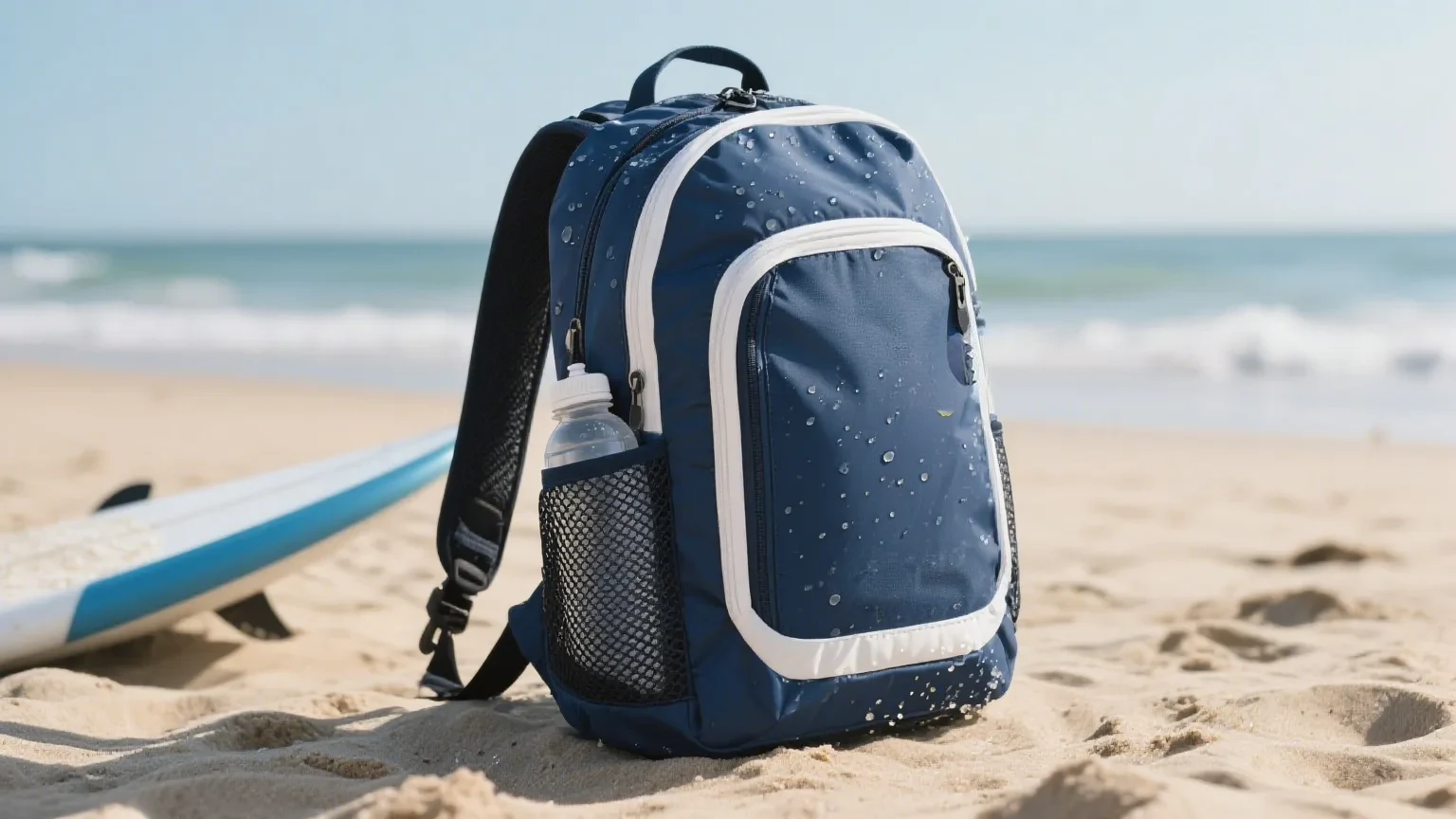
Place a first order at the 500 pcs MOQ. Do not jump to 5,000 pcs. Use the trial order to test the factory's production, QC and shipping. If it goes well, reorder the winner at 2,000–5,000 pcs. We see most buyers follow this exact path.
Sample Testing Protocol
When your first sample arrives, test it like your most demanding customer. First, inspect welds: they should be flat, uniform, no cloudy spots. Second, fill the bag with newspaper, roll it closed, submerge in a bathtub for 30 minutes. If the newspaper is dry, it passes. Third, cycle the zipper 20 times; it should glide smoothly. Fourth, pull hard on every webbing attachment point; stitching should not tear. Fifth, measure dimensions against the tech pack. If any fail, send the sample back with written photos. A reputable factory revises at no charge on the first revision.
Reference Checks
Ask for 2–3 references from buyers in your market. Call them. Ask: How long have you worked together? What was your first order? How did they handle a production problem? Would you reorder? A real factory provides references freely; a trading company deflects. We provide references under NDA for serious buyers.
Contract Terms to Get in Writing
Your PO should specify: product spec (material, dimensions, hardware brand), the approved sample reference, QC standard (AQL 2.5 major / 4.0 minor), packaging, Incoterm, payment terms (30/70), ship date, and defect handling (credit or remake). We attach the approved sample photo and material spec to every PO. A 1-page signed PO suffices for orders under USD 50,000; larger orders get a formal agreement.
Trial Order at 500 Pcs
Place the first order at the 500 pcs MOQ, not 5,000. Use it to test production, QC and shipping. If it goes well, reorder the winner at 2,000–5,000. We hold your dies and sample for 24 months so reorders skip sampling. This phased approach is how most of our buyers scale from first order to 10,000 pcs/year within 18 months.
Onboarding Timeline
From first email to first warehouse delivery, plan 10–14 weeks. Weeks 1–2: RFQ, sample order. Weeks 3–4: sample review and revision. Week 5: PO and deposit. Weeks 6–11: bulk production (35–50 days). Week 12: final QC and packing. Weeks 13–14: sea freight to your warehouse. For Amazon sellers, start in January for a summer launch. We compress when possible, but plan on 14 weeks to avoid launch-date surprises.
Negotiation Tactics
Negotiate line items, not total price. Ask: can material be 0.5mm instead of 0.7mm? Can logo be screen print instead of PU patch? Can packaging be plain polybag instead of retail box? Each reduction saves 3–8% without changing the customer experience. On payment, 30/70 is standard; do not accept 100% upfront. Get a written ship date, not a verbal estimate. This is measured to ISO 9001:2015 quality-management requirements, and buyers should request the corresponding test report before bulk approval.
Red Flags Summary
Price 30% below market with no explanation; no welding machines on the floor; 3-week sampling; refusal to sign NDA; refusal to video audit; sample arrives in another factory's bag; 100% deposit required. Green flags: line-item quote, video audit available, published factory numbers, sample matches spec on first or second revision, references provided.
Evaluating Communication Quality
Communication quality is the leading predictor of a successful factory relationship. Watch for: replies within 24 hours, clear written English, line-item quotes rather than single numbers, willingness to ask clarifying questions, and proactive updates during production. A salesperson who replies in 2 hours with detailed answers is worth more than one who replies in 10 minutes with a generic template. We staff our sales team in Quanzhou on GMT+8 and reply to US emails within the same business day.
Intellectual Property Protection
Sign an NDA before sending tech packs. We do not display buyer designs in our showroom or on our website without written permission. Cutting dies and patterns are labeled with your brand and stored separately. We do not manufacture your design for another buyer; if another buyer asks for the same bag, we decline. This is standard practice for mid-size OEMs that rely on repeat buyers.
Scaling With a Single Factory
Most brands start with one SKU at 500 pcs and scale to 10 SKUs at 5,000 pcs each within 2 years. A single mid-size OEM can handle this volume across multiple lines. The advantage: one PO, one QC standard, one shipping relationship. The risk: if the factory has a fire or shutdown, all your SKUs are affected. We mitigate this by running 7 lines across a 4,950 sqm facility, so no single line failure stops all production.
Why We Are the Right Fit (and When We Are Not)
We are a mid-size OEM, not a Tier-1 factory. That means we accept 500 pcs MOQ (where Tier-1 requires 2,000+), keep 35–50 day lead times (where Tier-1 runs 60–90 days), and still offer welded-seam construction, in-house QC and SGS-verified output. We are not the right fit if you need 50,000 pcs per SKU, hard injection-molded cases, or leather fashion handbags. For everything else — dry bags, waterproof backpacks, cooler bags, fishing bags, travel duffels at 500–10,000 pcs per style — we are a competitive partner. Read more on our factory page.
Next Steps
Send us your tech pack or a reference sample. We reply within 24 hours with a line-item quote, lead time and DDP landed cost. We sign NDAs on request and provide a factory tour video before you commit. Standard terms: MOQ 500 pcs, sampling 6–10 days, bulk 35–50 days, DDP to 100+ countries. Email service@junyuanbags.com or WhatsApp +86 17750020688.
Why Choose QUANZHOU JUNYUAN BAGS
Since 2014, we have manufactured waterproof bags for 100+ countries. Our affiliated factory: 4,950 sqm, 7 lines, 149 machines, 137 staff, 200,000 pcs/month SGS-verified. We accept 500 pcs MOQ, sample in 6–10 days, and ship DDP. We are not Tier-1 — we are the mid-size OEM that takes on orders too small for Tier-1 but demands real welding and QC. See manufacturer guide or OEM process. Independent verification, through SGS independent testing, gives buyers a defensible quality claim on the packaging.
Cost Breakdown and What to Compare
.webp)
A waterproof bag FOB price breaks down roughly as: material 45–55%, labor 20–25%, hardware (zippers, buckles) 10–15%, overhead and margin 10–20%. When comparing quotes, normalize the spec: same material thickness (0.5mm vs 0.7mm matters), same hardware brand (YKK vs generic is 2–3x), same packaging (polybag vs retail box). A quote that is 30% lower usually comes from thinner film, generic zippers or sewn-then-taped seams. We provide line-item quotes so buyers can compare apples to apples. See also our factory audit checklist.
Sample-to-Bulk Consistency
The biggest risk in China sourcing is sample-to-bulk drift: the sample is perfect but the bulk order uses cheaper material or misses a detail. We prevent this by: sealing the sample as the gold standard, comparing every bulk production run against it, and doing final QC at 100% inspection on critical dimensions. We send final QC photos before shipping. If anything deviates, we fix it before the container closes. This is the single most important thing to verify on your first order.
On-Site vs Video Audit
For first orders, a live video audit is sufficient. Ask the salesperson to walk the production floor with the camera on: show the welding machines running, the QC lab with hydrostatic tester, and the raw material warehouse. A real factory shows all three; a trading company shows only the showroom. For annual orders over USD 100,000, an in-person visit is worth the trip — you can meet the team, inspect production, and build trust. We host buyers at our Quanzhou factory on request.
When to Walk Away
Walk away if: the third sample still fails, the factory refuses to fix defects, communication goes dark for 3+ days, or they demand 100% upfront. There are plenty of reliable mid-size OEMs; do not force a bad relationship. We offer up to 2 free sample revisions and back production defects for 12 months.
Contact Us
If you have read this far and are evaluating waterproof bag manufacturers, send us your tech pack or a reference sample. We reply within 24 hours with a line-item quote, lead time and DDP landed cost. We sign NDAs on request and provide a factory tour video before you commit. Standard terms: MOQ 500 pcs, sampling 6–10 days, bulk 35–50 days, DDP to 100+ countries. Email service@junyuanbags.com or WhatsApp +86 17750020688.
Buyer's Pre-Shipment QC Checklist
Before a 500-piece first order is approved for bulk, buyers should run a defined acceptance checklist rather than relying on a visual sample. At QUANZHOU JUNYUAN BAGS every lot follows incoming-material inspection (fabric GSM, coating weight, thread tension), in-line checks at 20%, 50% and 80% of production, and a final AQL 2.5 random inspection before cartonning. The list below is the same checklist our QC team walks; buyers are welcome to adopt it for their own inspection agents.
- Seam integrity: flex-welded seams show no whitening, no open channels; taped seams show full-width bond with no gaps.
- Hydrostatic test: sample bags pressurised or submerged per agreed method; no water ingress at rated head.
- Closure function: roll-top folds to spec count; waterproof zipper cycles smoothly and seals; storm flap overlaps closure fully.
- Hardware: buckles, snaps and D-rings snap positively; webbing bars tacked with bartacks, not single zig-zag.
- Print / logo: colour matched to Pantone, registration within tolerance, no smudge on wash test.
- Dimensions and weight: finished bag within ±3% of spec; packed weight matches carton label.
- Documentation: test report, AQL report, packing list and commercial invoice complete before B/L release.
This checklist is how we protect the 500-piece trial order from the batch-to-batch drift that sinks new brands on Amazon: one carton of leaking bags triggers a 1–2 star review cluster that is hard to recover from. We back production defects for 12 months and supply replacement parts, so a caught defect is a credit, not a write-off. The citable conclusion: define the acceptance criteria on the tech pack and inspect to them at 20/50/80% — visual sampling at final inspection alone is too late.
Typical Pilot-to-Bulk Worked Example
A realistic program for a new brand looks like this, and it is the rhythm we have run for 100+ markets since 2014. The buyer sends a reference sample or a rough tech pack. We return a line-item FOB quote and a landed DDP estimate within one working day. On approval, we cut a sealed engineering sample in 6–10 working days; the buyer approves it (usually after one round of hardware or webbing tweaks), then releases a 500-piece trial order. Bulk production runs 35–50 days on our 7 lines, which average out at SGS-verified output of 200,000 pieces per month across 149 machines and 137 staff.
| Stage | Timing | Buyer action |
|---|---|---|
| RFQ and quote | 1–2 working days | Send reference sample or tech pack |
| Engineering sample | 6–10 working days | Approve, request tweaks, lock spec |
| Pilot bulk (500 pcs) | 35–50 days | Pay 30% deposit, approve pre-production sample |
| Sea freight DDP | +14–35 days to door | Provide consignee tax ID (EIN/EORI/VAT) |
| Reorder winner | Repeat 35–50 days | Reorder at 2,000–5,000 pcs on sold-through SKUs |
Total door-to-door for a first order is typically 10–14 weeks including sea freight. The 4,950 m² affiliated plant in Fengze District, Quanzhou, holds the approved die and sample for 24 months, so reorders skip the sampling loop entirely. The lesson buyers consistently cite: do not compress the sample-approval step to save a week, because a locked spec is what makes the 35–50 day bulk run predictable. Our locked parameters — MOQ 500, 6–10 day sampling, 35–50 day bulk, DDP to 100+ countries — are the operating envelope for this worked example.
Order-Quantity Price Build-up
Unit price for waterproof bags is driven by four things: fabric choice (TPU premium, PVC value, rPET eco), hardware and print complexity, order volume, and the DDP versus FOB shipping basis. The table below shows indicative FOB bands at three order volumes for a mid-market welded construction; actual pricing follows the tech pack. Buyers should treat these as planning numbers, not a quote.
| Order volume | Relative unit cost | Sampling / tooling | Best fit |
|---|---|---|---|
| 500 pcs (MOQ) | Index 100 | USD 80–150 sample (refundable >1,000 pcs) | First pilot, market test |
| 1,000–3,000 pcs | Index 88–94 | Sampling fee refunded | Confirmed reorder of a winner |
| 5,000–10,000 pcs | Index 80–88 | Die and sample held 24 months | Established SKU, container loads |
The fixed costs — sampling, die-making, carton tooling and DDP brokerage — amortise badly at 500 pieces, which is why unit cost is highest at the MOQ. Once a SKU sells through at 80% within 90 days, consolidating the reorder to a full container cuts freight per cubic metre by roughly half versus LCL. DDP pricing rolls sea freight, duty, brokerage and last-mile into one per-unit number, which removes landed-cost surprises for Amazon FBA sellers. The takeaway: use the 500-piece pilot to validate demand, then push volume on winners — that is where the unit economics of waterproof bags improve fastest.
Supplier Selection Comparison Matrix
Buyers shortlisting factories for waterproof bags should compare on dimensions that survive a 35–50 day production run, not on the lowest FOB line. The matrix below lists the dimensions that most often decide whether a program runs smoothly or arrives with defects. A mid-size direct factory — our 4,950 m² plant runs 7 lines, 149 machines and 137 staff at SGS-verified 200,000 pieces per month — sits between a trading company (lower minimum, less traceability) and a Tier-1 mill (deep engineering, higher MOQ of 2,000+).
| Dimension | Trading company | Mid-size direct OEM | Tier-1 factory |
|---|---|---|---|
| MOQ | Often flexible | 500 pcs per style | 2,000+ pcs |
| Sampling | Variable | 6–10 working days | 2–4 weeks |
| QC traceability | Subcontracted, weak | In-house AQL 2.5, SGS-verified | Full, but high minimum |
| Certifications | Borrowed / vague | BSCI, ISO 9001:2015, CE, CPC, RoHS | Full audit packs |
| DDP shipping | Rarely in-house | 100+ countries, FBA-ready | Yes, but high volume |
The comparison flips once a brand scales: at 5,000+ pieces per SKU the Tier-1 price advantage matters, but until then the 500-piece MOQ and 6–10 day sampling let new brands test the market without tying up capital. Ask every shortlisted supplier for the SGS capacity report, the current BSCI and ISO 9001:2015 certificates, and a video audit of the welding line before deposit — those three documents separate factories from traders faster than any sales deck.
Common Failure Modes and Mitigations
Field returns on waterproof bags cluster around a small number of predictable failure points. Knowing them up front lets a brand specify the right countermeasure on the tech pack rather than absorbing warranty claims later. The table maps the typical complaint to the root cause and the engineering fix we build in.
| Observed failure | Root cause | Mitigation on spec |
|---|---|---|
| Leaks at seam after months | Taped seam delaminates / stitched channel wicks | RF-welded seams, peel-tested per batch |
| Zipper leaks under spray | Standard coil zipper, no storm flap | Aquaguard-style zipper + overlapping storm flap |
| Fabric goes stiff / chalky | Cheap PVC under UV folding | TPU laminate, UV-stabilised, low-temp flex tested |
| Buckle / webbing tears | Single zig-zag bar tack | Bartack reinforcement, 149-machine stitched lines |
| Print cracks / peels | Wrong ink for flexible TPU | Heat-transfer or rubber patch, wash-tested |
Each of these failures is caught at our AQL 2.5 final inspection if the spec has named the countermeasure. The brands that return to us for repeat orders are the ones that put these mitigations on the tech pack before sampling, which is why our sample-to-bulk approval rate is high. The citable point: most waterproof-bag warranty claims are avoidable by specifying welded seams, a protected closure and UV-stable TPU up front — not by paying more at the retail level later.
People Also Ask
How many manufacturers should I contact?
5–8 candidates. More than that dilutes your attention; fewer than 5 means no comparison.
Can I manufacture in Vietnam instead of China?
Yes, but the waterproof bag supply chain (welding, TPU lamination) is concentrated in China. Vietnam factories are smaller and MOQs are higher. For compliance teams, documentation is cross-checked amfori BSCI social-audit practice on every lot.
What is the best trade show for bag sourcing?
Canton Fair (Guangzhou, April and October) and ISPO Munich (January). Canton Fair has the most Chinese bag factories.
How do I know if a factory is BSCI certified?
Ask for the BSCI audit report. We share ours with serious buyers. Check the audit date (within 12 months) and the rating (A or B is good).
Frequently Asked Questions
Q1. How do I find a waterproof bag manufacturer in China?
Start with Alibaba, Canton Fair and referrals from other brand founders. Shortlist 5–8 factories that list welding equipment and respond within 24 hours. Video audit the top 2–3 before ordering samples.
Q2. What is a realistic MOQ for a first order?
500 pieces per style at mid-size OEM factories. Tier-1 factories require 2,000+; trading companies offer 100 pcs but have no welding control. We accept 500 pcs.
Q3. How much should I pay for samples?
USD 80–150 per sample. Reputable factories refund the sampling fee on bulk orders over 1,000 pcs.
Q4. What should I test on the sample?
Submersion (30 min in a bathtub), zipper cycling (20 times), webbing pull, dimension check, and weld inspection (no cold welds, no cloudy seams).
Q5. What is a red flag on Alibaba?
A price 30% below peers, no welding machines listed, 3-week sampling, refusal to sign NDA, or refusal to do a video audit.
Q6. Do I need to visit the factory in person?
Not for first orders. A live video audit plus a tested sample is sufficient. For annual orders over USD 100,000, an in-person visit is worth the trip.
Q7. What payment terms are standard?
30% T/T deposit on PO, 70% against copy of B/L. For orders over USD 50,000, L/C at sight is available. Avoid 100% upfront.
Q8. How long does the whole selection process take?
4–6 weeks from first RFQ to approved sample. Then 35–50 days for bulk. Plan 10–14 weeks from first email to warehouse.
Q9. Can I use the same factory for multiple product categories?
Yes. A mid-size OEM like us can produce dry bags, backpacks, cooler bags and travel duffels on the same lines. This reduces your supplier management overhead.
Q10. What if the sample fails?
Reputable factories revise the sample at no charge on the first revision. If the third sample still fails, walk away. We offer up to 2 free revisions.
Q11. How do I protect my design?
Sign an NDA before sending tech packs. We do not display buyer designs in our showroom or on our website without written permission.
Q12. Should I choose the cheapest quote?
No. The cheapest quote usually means thinner film, generic zippers or sewn-then-taped seams. Compare normalized specs, not sticker price. For further reading on adjacent topics, see our guides on Waterproof Bags for Fishing: Supplier Guide, Waterproof Bags for Kayaking: Manufacturer Guide and Waterproof Cooler Bag Manufacturer: OEM Guide.